Quick definition: The asl meaning in text is “age, sex, location.” It is one of the oldest chat abbreviations in internet history — a quick question people used to ask when meeting someone new in a chatroom or DM: “ASL?” meant “How old are you, are you male or female, and where are you from?” On modern social media, ASL also commonly means “as hell,” as in “I’m tired ASL.” Which meaning applies depends entirely on context, and this guide shows you how to tell the difference every time.
ASL Meaning in Text: Meaning & Definition
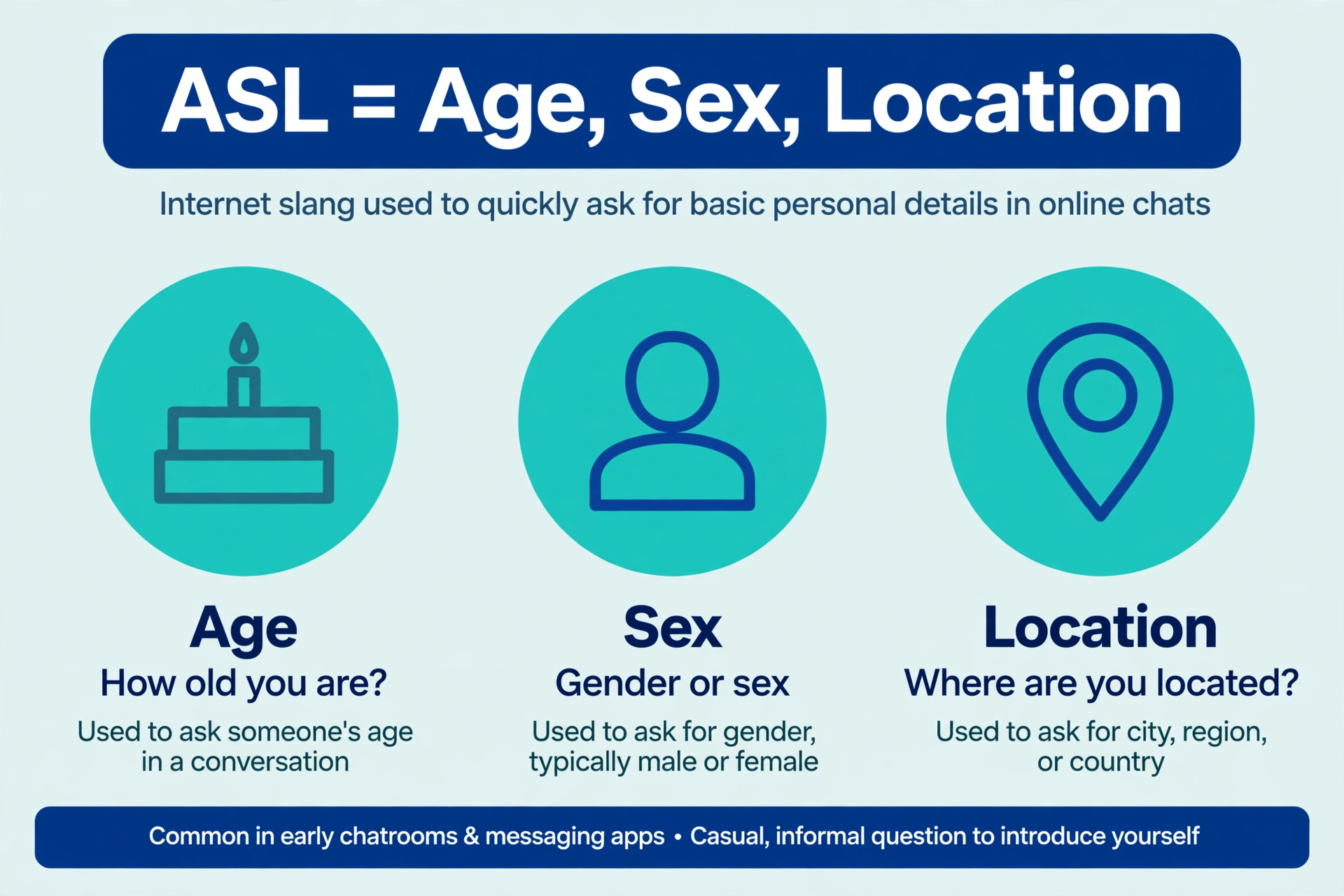
ASL stands for “age, sex, location.” It is shorthand for three questions packed into three letters: How old are you? Are you a male or female? Where are you located? When someone opens a conversation with “ASL?” or “what’s your ASL?”, they are asking you to introduce yourself with those three basic facts.
Here is the meaning broken down in its simplest form:
| Element | What It Means |
|---|---|
| ASL | Age, Sex, Location |
| Core message | “Tell me the basics about yourself so I know who I’m talking to” |
| Tone | Casual, curious, sometimes flirty — or just conversational |
| Where it appears | Chatrooms, DMs, dating apps, gaming chats, Omegle-style sites, TikTok |
| Modern alternate | “As hell” — e.g. “that movie was boring ASL” |
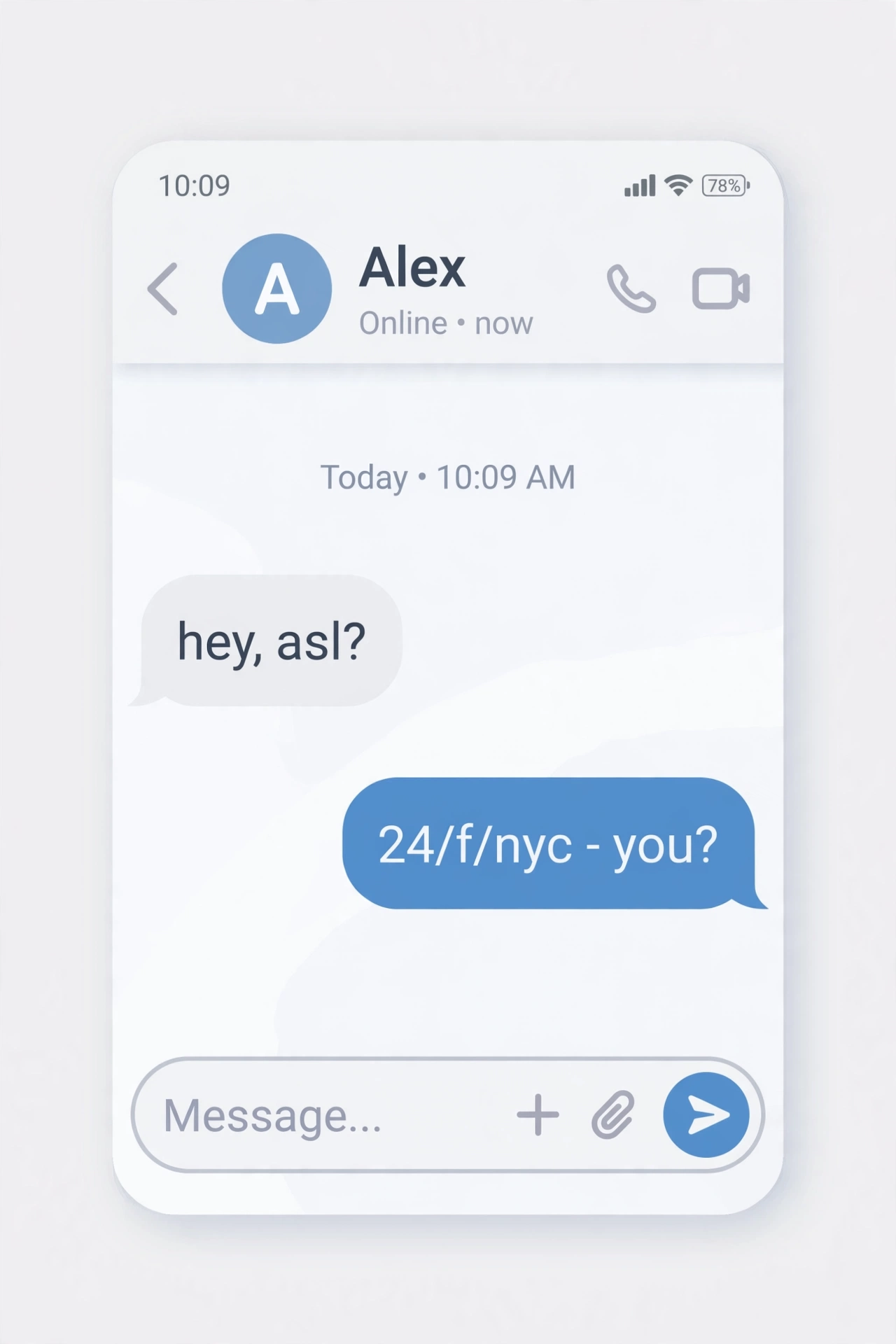
A typical ASL exchange looks like this:
Person 1: hey, asl?
Person 2: 24/f/nyc — you?
Person 1: 26/m/la
That compact “24/f/nyc” format — age, sex, location separated by slashes — is the classic reply. It became so standard that even people who never used chatrooms learned the pattern. The beauty of ASL was efficiency: instead of a long introduction, three letters and three slashes told you everything you needed to decide whether to keep talking.
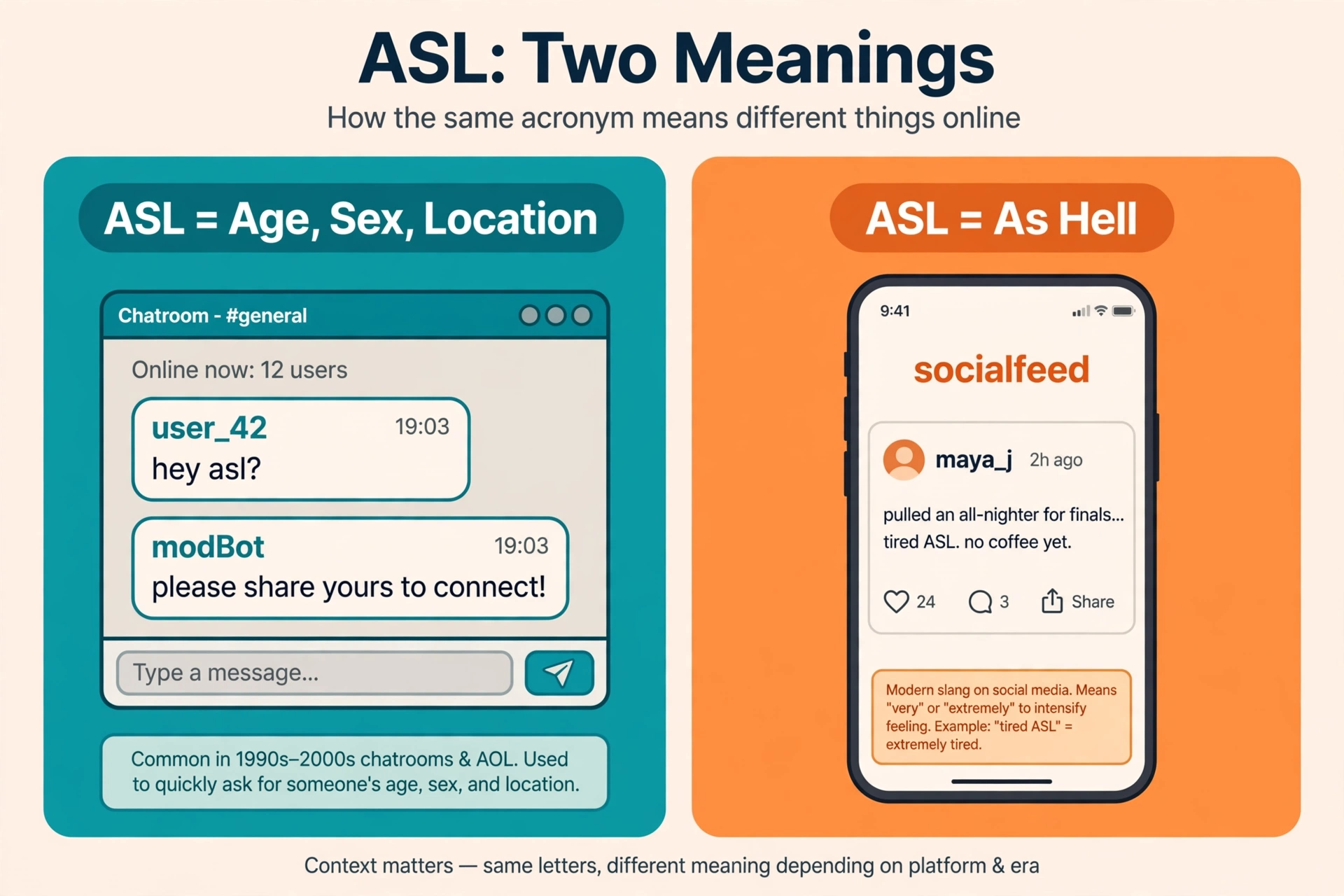
But here is what makes the asl meaning in text tricky today: the same three letters now carry a completely different popular meaning. On TikTok, Twitter, and in casual texting, “ASL” frequently means “as hell.” The sentence “I’m hungry ASL” has nothing to do with age, sex, or location — it means “I’m hungry as hell,” i.e. extremely hungry. Context is everything, and later in this guide you will learn the exact signals that tell the two meanings apart.
Introduction
Imagine this: you join a random chatroom or get a DM from a stranger, and the very first message is just three letters — “asl?” No hello, no introduction, just “asl?” If you have never seen it before, the message looks like a typo. If you have been online long enough, you know instantly what they want: your age, your sex, and your location, served up in one line.
The asl meaning in text is one of those pieces of internet language that refuses to die. It was born in the 1990s chatroom era, survived instant messaging, and then — instead of fading away like so many acronyms — it reinvented itself. Today’s teenagers use ASL in a way the AOL generation never did, and the old meaning still lives on in dating apps and gaming lobbies. Few slang terms have two lives like this one.
In this guide, you will learn the full ASL meaning in text, where it came from, why it exploded in the chatroom era, how the “as hell” meaning took over on social media, and exactly how to reply when someone asks for your ASL. You will also see real examples for every situation, a comparison with similar abbreviations, alternate meanings you should know (including a very important one), the mistakes people make, polite alternatives, and answers to the most common questions. By the end, no “asl?” message will ever confuse you again.
ASL Meaning in Text: Origin
ASL was born in the golden age of internet chatrooms — the mid-to-late 1990s. When services like AOL Instant Messenger (AIM), Yahoo! Messenger, MSN Messenger, and IRC chatrooms exploded, millions of strangers were suddenly talking to each other in real time with nothing but a screen name. Nobody had profile photos. Bios barely existed. You were talking to “xX_darkangel_Xx” or “sk8er_gurl99,” and you had no idea who was on the other side.
That is where “ASL?” came in. In a crowded public chatroom, when someone caught your eye, you would open a private message with the fastest possible introduction request. Typing “What is your age, sex, and location?” was too slow and too formal for chat culture. “ASL?” did the job in three keystrokes plus a question mark. It became the universal icebreaker — the “hello” of anonymous chat.
The format of the reply became standardized just as quickly: age/sex/location, separated by slashes. “19/f/tx” told you the person was a 19-year-old female from Texas. Sometimes people used single letters — “m” or “f” — and sometimes they spelled it out. The location could be a city, a state, a country, or something vague like “earth” if they wanted to be mysterious. This format was so efficient that it spread beyond chatrooms into early texting, forums, and multiplayer games.
ASL was not just practical — it was part of a whole generation’s social ritual. Kids and teens in the 2000s met friends, crushes, and sometimes trouble through “asl?” conversations. Parents’ groups warned about it. Pop culture referenced it. It became one of the defining acronyms of the early internet, right alongside LOL, BRB, TTYL, and OMG. Long before “wyd” or “hru,” there was “asl?” — the original getting-to-know-you shortcut.
Popularity
ASL’s first wave of popularity ran roughly from 1996 to 2010, tracking the rise and fall of public chatrooms and instant messengers. During that period, it was arguably one of the most-typed acronyms online. But unlike most chatroom slang, ASL never truly died — it evolved.
The second wave began in the mid-2010s on platforms like Tumblr, Twitter, and TikTok, where “ASL” took on its new life as “as hell.” Instead of asking a question, ASL became an intensifier — a way to add emphasis to the end of a sentence. “I’m bored ASL.” “This is funny ASL.” “He’s fine ASL.” This usage spread fast because it was short, punchy, and fit perfectly into meme captions, tweets, and TikTok comments where character count and rhythm matter.
Today, ASL is popular in both forms, just in different corners of the internet:
- “Age, sex, location” still thrives on dating apps, in gaming voice chats and lobbies, on Omegle-style random chat sites, and in any anonymous or semi-anonymous conversation where people meet strangers.
- “As hell” dominates on TikTok, Twitter/X, Instagram captions, and in casual texting between friends — anywhere the tone is playful and informal.
This double life is exactly why the asl meaning in text confuses people. Someone from the chatroom generation hears ASL and thinks of introductions; someone from the TikTok generation hears ASL and thinks of emphasis. Both are right. You just have to read the room.
How It Is Used
The classic “age, sex, location” ASL is used as a direct question, almost always at the start of a conversation with a stranger. It is an icebreaker and a filter: the answer tells you whether this is someone worth talking to. You will see it written as “asl?”, “ASL?”, “what’s your asl,” or “asl pls.” It is almost never used with people you already know — asking your friend “asl?” would be bizarre, since you already know their age and location.
The reply follows the famous slash format: age/sex/location. A few real-world patterns:
- Standard: “22/f/chicago”
- Vague on purpose: “25/m/somewhere in europe”
- Playful: “old enough/f/far from you lol”
- Cautious: “21/f” (location withheld — smart for strangers)
The modern “as hell” ASL works completely differently. It goes at the END of a sentence as an intensifier, and it can attach to almost any adjective: “tired ASL,” “cute ASL,” “loud ASL,” “expensive ASL,” “funny ASL.” It is never a question in this form. It is emphasis — the digital equivalent of leaning into a word.
One more usage worth knowing: ASL is also the universally recognized abbreviation for American Sign Language. In conversations about deaf culture, accessibility, or language learning, “ASL” almost always means American Sign Language. This matters because misreading it can cause real confusion — “I’m learning ASL” means sign language, not “I’m learning age sex location.” Context decides, as always.
Examples
Here are real-world examples of ASL in both of its main texting meanings, across different tones.
Friendly Examples
Gaming lobby (classic meaning):
Player1: “yo anyone wanna squad up? asl?”
Player2: “20/m/uk, you?”
Player1: “22/f/us — let’s go”
Random chat (classic meaning):
Stranger: “hey! asl?”
You: “24/f/toronto. you?”
Stranger: “26/m/vancouver — nice, fellow canadian”
Between friends (as hell meaning):
“This pizza is good ASL 🍕”
“I’m so happy ASL, we finally did it!”
Professional Examples
Here is the honest truth: ASL has no real professional use in the “age, sex, location” sense — asking a stranger their age and sex is not workplace behavior. In professional settings, the only ASL that appears is American Sign Language, and that is not slang at all.
Workplace example:
“We’re adding ASL interpretation to the webinar for accessibility.”
(ASL = American Sign Language — the correct, professional meaning here.)
If you see “ASL” in a work email or HR document, it means American Sign Language. Full stop. The “as hell” version is far too informal for professional communication — write “extremely” or “very” instead.
Funny Examples
Meme caption energy (as hell meaning):
“Me: I’ll just have one chip. Also me, 20 chips later: addicted ASL 😭”
“POV: it’s Monday and you’re already tired ASL”
The generational mix-up (genuinely happens):
Teen: “this test was hard ASL”
Millennial parent: “why are you asking me my age sex and location??”
Teen: “nooo it means AS HELL 😭”
Comparison with Similar Terms
ASL sits in a family of internet abbreviations, and mixing them up is easy. Here is how it compares to the terms people confuse it with:
| Term | Meaning | How It Differs from ASL |
|---|---|---|
| ASL (classic) | Age, sex, location | A question to a stranger; an icebreaker |
| ASL (modern) | As hell | An intensifier at the end of a sentence; not a question |
| WYD | What you doing | Asks about activity, not identity |
| HRU | How are you | Asks about wellbeing; used with people you know |
| A/S/L | Age/sex/location | Same meaning as ASL, just with slashes — the old-school spelling |
| IRL | In real life | Contrasts online vs offline; not an introduction |
| AF | As f*** | A stronger intensifier, like the “as hell” ASL but more vulgar |
The closest cousin of the modern “as hell” ASL is AF (“as f***”) — both are sentence-ending intensifiers, but AF is cruder and ASL (“as hell”) is the milder, more social-media-friendly version. That is a big reason “as hell” ASL caught on: it delivers the same punch as AF without the profanity, so it works in captions and comments where people want to keep things clean-ish.
And do not confuse the slash-spelled A/S/L with anything new — it is the exact same “age, sex, location” question, just written the way 2000s chatrooms wrote it. If you see slashes between the letters, it is always the classic meaning.
Alternate Meanings
ASL has more alternate meanings than most three-letter abbreviations. Here are the ones you are most likely to run into:
- American Sign Language — the most important alternate meaning. In education, accessibility, healthcare, and deaf culture contexts, ASL always means American Sign Language. Never assume the slang meaning here.
- As hell — the dominant slang meaning on TikTok, Twitter, and in casual texting. “I’m broke ASL” = “I’m broke as hell.”
- Age, sex, location — the original chatroom meaning, still alive on dating apps, gaming chats, and anonymous chat sites.
- Above sea level — in geography, aviation, and hiking contexts (e.g. “the peak is 8,000 ft ASL”).
- Advanced Squad Leader — a classic board wargame; in gaming forums, ASL can mean this.
- Automated storage and retrieval — logistics/warehouse industry term, rare in everyday conversation.
How do you pick the right one? Position and context do the work. “ASL?” alone at the start of a chat = age, sex, location. “___ ASL” at the end of a sentence = as hell. “Learning ASL,” “ASL interpreter,” “ASL classes” = American Sign Language. “Feet ASL” or meters = above sea level. When in doubt, the sentence around it tells you everything.
Professional or Polite Alternatives
Because the classic “age, sex, location” ASL is essentially a stranger’s icebreaker, it has no place in professional or formal communication — and the “as hell” version is too casual for work too. Here is what to say instead, depending on your situation:
- Instead of “asl?” to a new contact: “Tell me a little about yourself” or “Where are you based, and what do you do?” — warmer, and it does not ask for someone’s sex.
- Instead of “as hell” at work: “extremely,” “very,” or “incredibly.” (“I’m extremely tired” beats “I’m tired ASL” in any professional message.)
- For American Sign Language: just say the full “American Sign Language” the first time in a formal document, then ASL after that.
- On dating apps (where classic ASL still appears): instead of the blunt “asl?”, try “Hey! I’m 26, based in Austin — what about you?” You will get better responses because you offered something first.
Common Mistakes
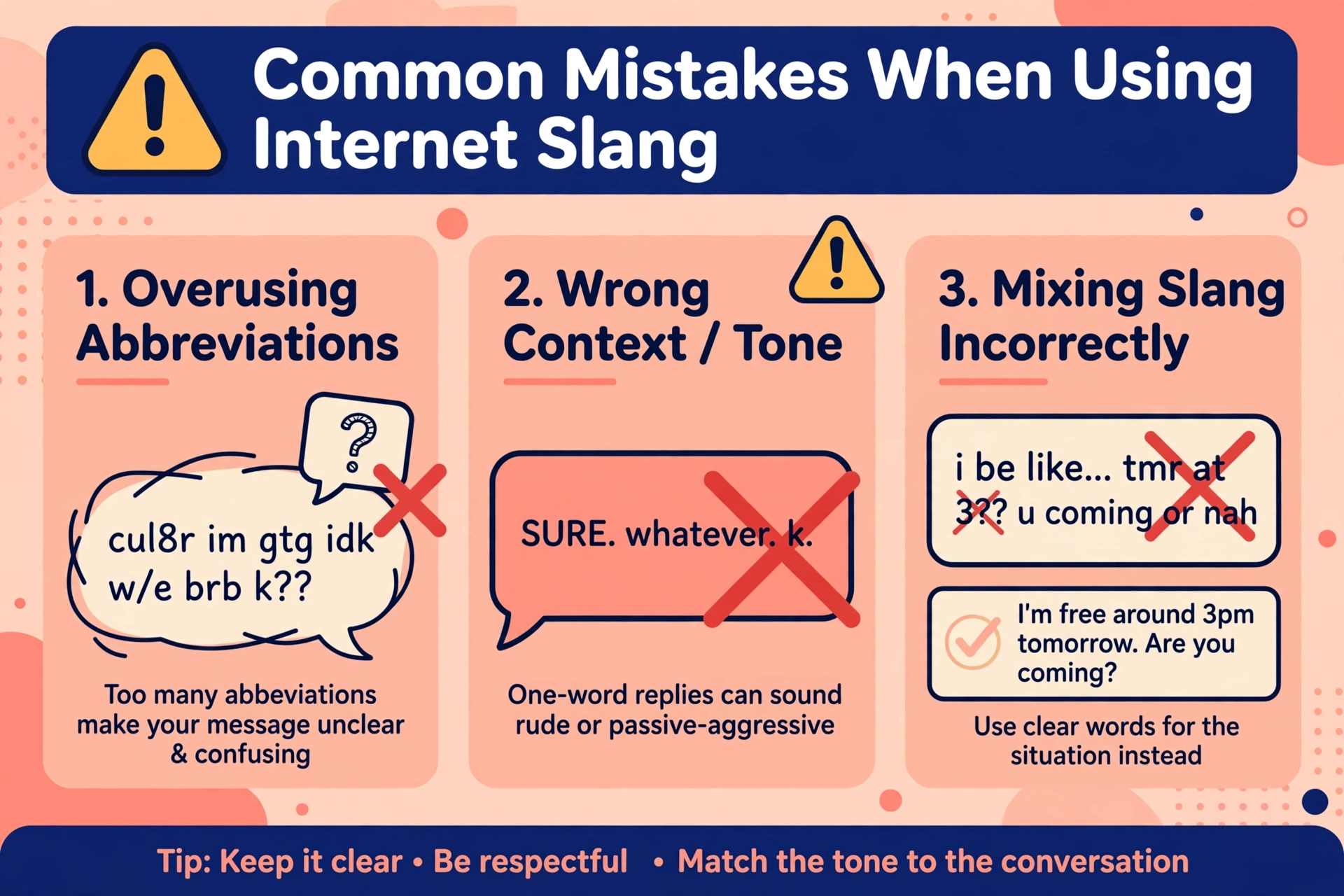
People get ASL wrong in a few predictable ways. Avoid these:
- Using the wrong meaning for the audience. Texting your 40-year-old cousin “that’s cool ASL” (as hell) may get you a confused “why are you asking my age??” Know who you are talking to.
- Answering “asl?” with your full details to a stranger. Never share your exact age, full name, or precise location with someone you just met online. A vague answer (“20s/f/US”) or no answer is perfectly fine.
- Reading American Sign Language as slang. “I’m learning ASL” in a class or job context is about sign language. Assuming otherwise can be embarrassing — or offensive.
- Using “as hell” ASL professionally. It reads as very casual and a little crude-adjacent. Keep it for friends and social media.
- Asking “asl?” of someone you already know. It is an icebreaker for strangers. Using it with friends looks like you forgot who they are.
- Confusing it with A/S/L being something different. A/S/L with slashes is the same question — just the retro spelling. Do not treat it as a new term.
Quick Tips
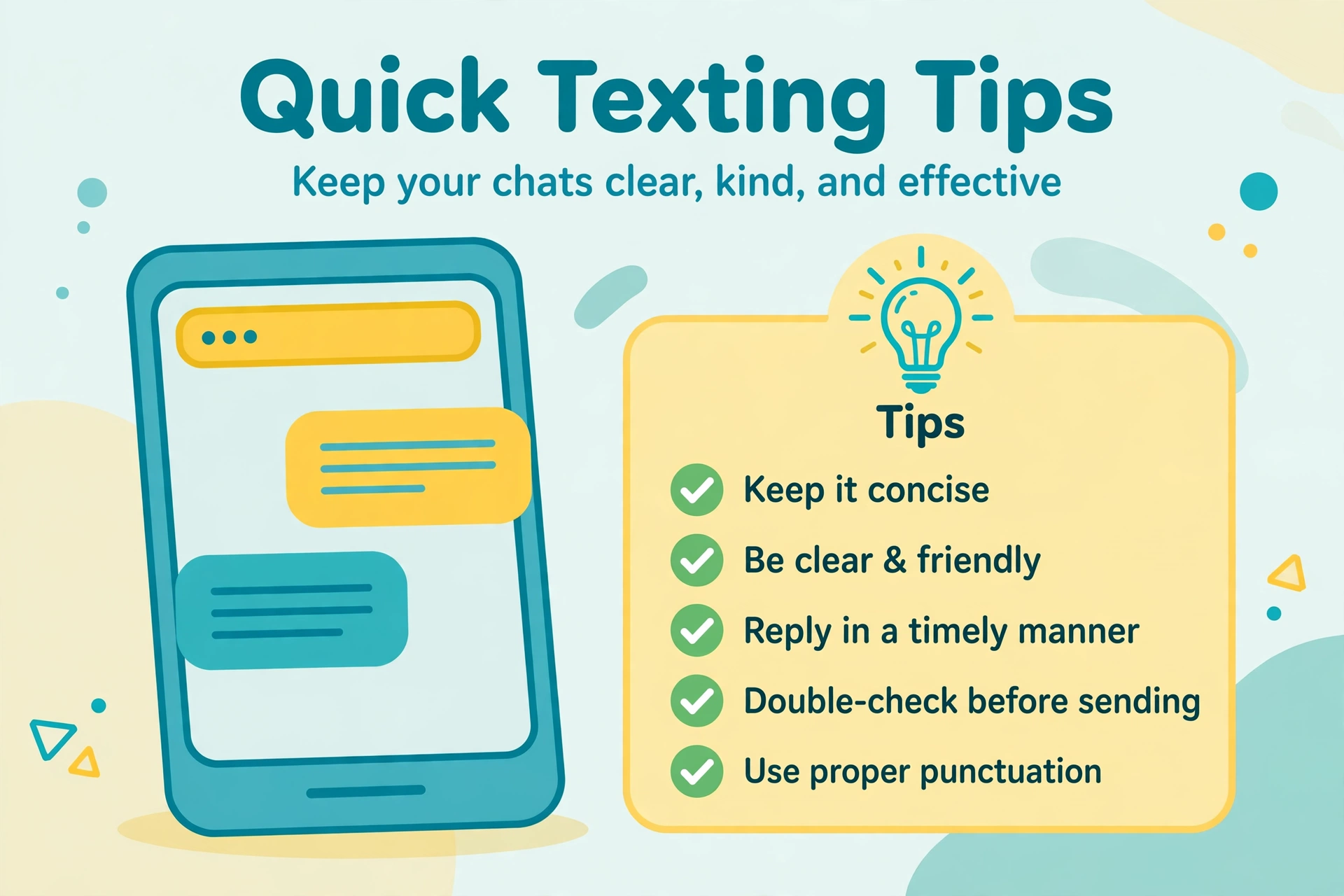
- Decode by position: “ASL?” at the start = age, sex, location. “___ ASL” at the end = as hell. This one rule resolves 95% of confusion.
- Reply to “asl?” with the slash format — age/sex/location — if you choose to answer. It is the expected pattern and keeps things short.
- Stay vague with strangers. City is enough; nobody needs your street. And “20s” works fine instead of an exact age.
- Mirror the meaning back. If a friend says “I’m stressed ASL,” reply in the same register: “same, this week is brutal ASL.” Matching energy keeps the vibe right.
- When meeting someone new online, offer first. “I’m 24/m/Seattle, you?” gets warmer replies than a bare “asl?”
- In mixed-age group chats, default to “as hell” sparingly — or skip it. Older readers may only know the chatroom meaning.
- If someone asks your ASL and you are under 18, do not answer a stranger. Tell a trusted adult instead. Real talk: “asl?” from strangers is exactly how online grooming conversations start.
FAQ
What does ASL mean in texting?
In texting, ASL most commonly means “age, sex, location” — a question asking for your age, gender, and where you live. On social media and in casual texts, it increasingly means “as hell,” used as an intensifier (e.g. “I’m tired ASL”). Context tells you which one applies.
What does “ASL?” mean from a stranger?
When a stranger opens with “asl?”, they are asking for your age, sex, and location. It is the classic chatroom icebreaker, still common on dating apps, gaming chats, and anonymous chat sites. You are never obligated to answer — especially with precise personal details.
What does ASL mean on TikTok?
On TikTok, ASL almost always means “as hell.” Comments and captions like “this is funny ASL” or “I’m obsessed ASL” use it as an intensifier meaning “very” or “extremely.” The chatroom meaning rarely appears on TikTok.
Does ASL mean American Sign Language?
Yes — and in education, accessibility, and deaf culture contexts, that is the only correct meaning. “I’m learning ASL” or “ASL interpreter” refers to American Sign Language, not slang. Never assume the texting meaning in these contexts.
How do you reply when someone asks for your ASL?
Use the classic slash format: age/sex/location, e.g. “24/f/chicago.” Keep it vague if the person is a stranger (“20s/f/US”). You can also deflect with humor (“old enough to know better 😄”) or simply not answer — no one is entitled to your personal info.
Is ASL rude or inappropriate?
Not inherently. “Age, sex, location” is just an introduction shortcut, though it can feel blunt or intrusive from a stranger. The “as hell” version is casual but mild. The main risk is context: using the wrong meaning with the wrong audience causes confusion, not offense.
What is the difference between ASL and A/S/L?
Nothing — they are the same term. A/S/L is just the older spelling with slashes between the letters, the way 2000s chatrooms wrote it. Both mean “age, sex, location.”
Why do people say “as hell” as ASL?
It started as a milder, social-media-friendly alternative to “AF” (as f***). “ASL” delivers the same sentence-ending emphasis — “I’m broke ASL” — without the profanity, so it spread quickly through TikTok captions, tweets, and memes where a cleaner punch lands better.
Conclusion
ASL is one of the rare slang terms with two full lives. The asl meaning in text started as “age, sex, location” — the three-letter icebreaker that defined the chatroom era and taught a generation to introduce themselves in slashes. Then, instead of retiring, it reinvented itself as “as hell,” the punchy little intensifier all over TikTok and modern texting. One abbreviation, two eras, both still alive.
The key takeaway is simple: read the position. “ASL?” up front is a question about you; “___ ASL” at the end of a sentence is emphasis. And when the topic is classes, interpreters, or accessibility, it is American Sign Language — no slang involved. Get that right and you will never be confused by those three letters again.
Use the classic meaning with care — share little with strangers, offer first when you are the one asking — and use the modern meaning with friends who share your internet generation. Language online moves fast, but the rule underneath never changes: context is everything.
Curious about more texting slang? Keep exploring the ever-growing dictionary of internet shorthand — from IDT to FRFR, IKTR to WYA, every acronym has a story. And if you want the full picture on how three letters can carry a whole introduction, the Merriam-Webster definition of ASL is a solid authoritative reference.
