
Quick Definition: In slang and texting, TW stands for “trigger warning.” It is a short heads-up placed before content that might upset someone — such as talk of violence, abuse, self-harm, or grief — so readers can decide whether they want to keep reading. You will see it most often on TikTok, Instagram, X (Twitter), Reddit, and Discord, usually written as “TW: violence” or “TW // eating disorders” right before the sensitive part begins.
TW Meaning Slang Meaning & Definition
TW meaning slang is simple once you know the full form: TW is short for trigger warning. It is an initialism, which means it takes the first letters of two words — Trigger and Warning — and turns them into a compact label that fits easily in a caption, a tweet, or a chat message.
Unlike most slang, TW is not there to sound cool or funny. It has a real job: to warn people that the content that follows could bring up painful memories or strong emotions. When someone writes “TW: death” before a post about losing a loved one, they are giving their audience a choice — read on, or scroll past. That small act of care is the whole point of the term.
| Abbreviation | Meaning |
|---|---|
| TW | Trigger Warning |
| Full form | A warning placed before content that may be emotionally distressing |
| Used on | TikTok, Instagram, X (Twitter), Reddit, Tumblr, Discord, group chats |
| Tone | Considerate, serious, protective — rarely casual |
| Typical format | TW: [topic] or TW // [topic] |
| Closest cousin | CW (content warning) |
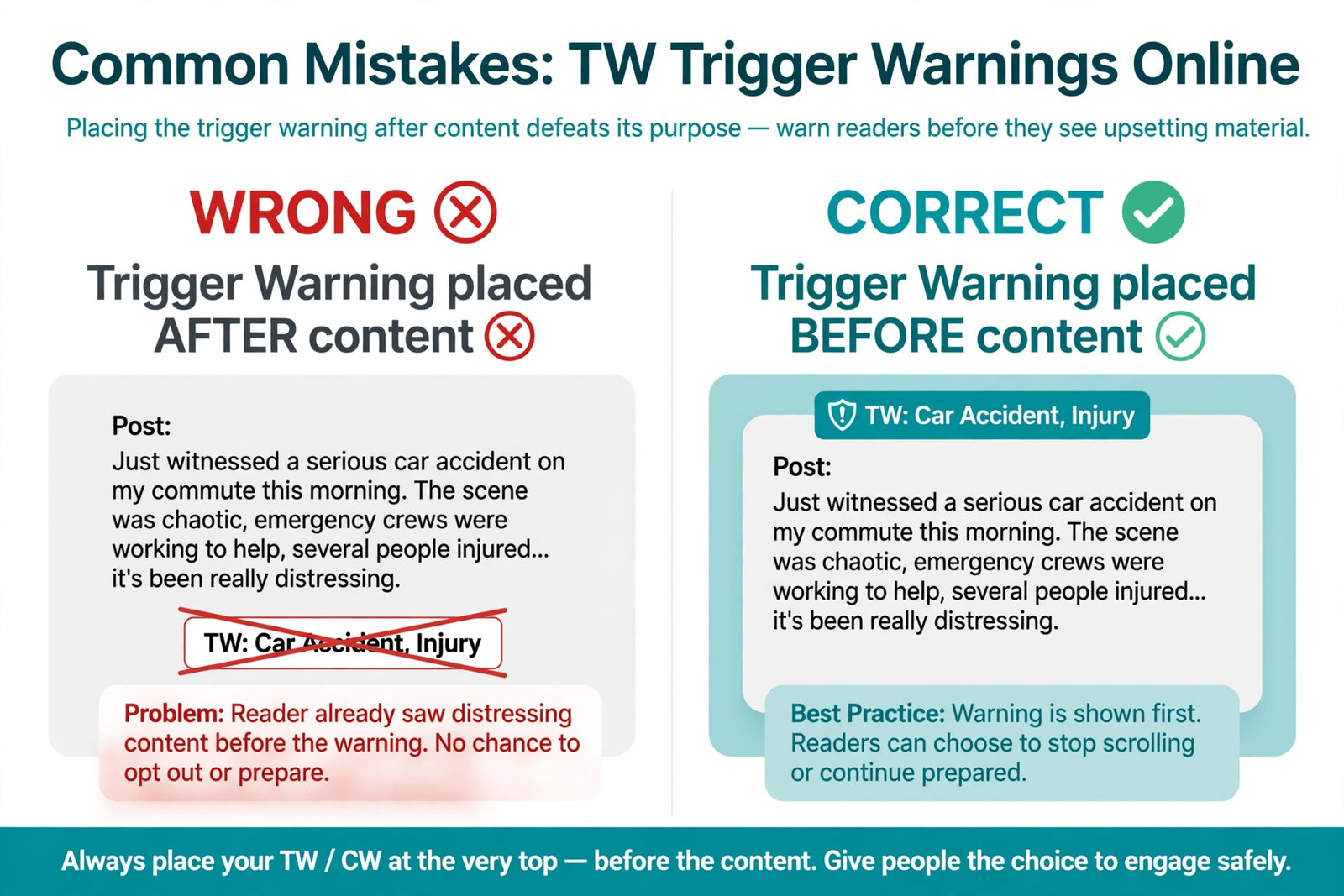
The key thing to remember is placement. A trigger warning only works if it comes before the sensitive content, never after it. That is why you almost always see TW at the very start of a post, caption, or message — sometimes even before the first sentence. If the warning comes after the upsetting part, it has already failed.
TW is also context-dependent. While “trigger warning” is by far the most common meaning online, the same two letters can mean something completely different in another setting — “this week” in a work chat, “Taiwan” in a geography discussion, or “teamwork” in a gaming lobby. The words around TW tell you which meaning applies, and this guide will show you exactly how to read those clues.
Introduction
Imagine scrolling TikTok late at night. A video caption starts with two small letters — “TW: car accident” — and suddenly you know what is coming before you press play. Or a friend sends a long message in your group chat that begins “TW: family stuff” and you instantly understand: this is not a casual update, this is something heavy, and you get to choose how and when to read it.
That is the world of TW. In a feed full of jokes, dances, and hot takes, these two letters are a rare moment of pause — a signal that the person posting actually thought about how their words might land. It is one of the few pieces of internet slang that exists mainly to protect other people, and that is exactly why it has spread so far and stuck around for so long.
If you have ever seen TW and wondered whether it meant something rude, secret, or complicated, relax. It is one of the easiest slang terms to learn — and one of the most useful. This guide covers the full tw meaning slang breakdown: the definition, the origin, real examples from texting and social media, how it differs from CW and other warnings, the alternate meanings, and the mistakes people make when they use it. By the end, you will not only know what TW means, you will know exactly when to use it yourself.
And if you are still building your texting vocabulary, TW sits right alongside other everyday abbreviations you will see in the same chats — like FN meaning in text, which shows up in the same fast, casual style of messaging.

Origin
The idea of a trigger warning did not start on TikTok. It began in online mental-health communities and feminist forums in the early 2000s, where people sharing personal stories about trauma, abuse, or eating disorders started adding short warnings at the top of their posts. The goal was practical: survivors of trauma can experience sudden, intense reactions when they unexpectedly encounter reminders of what happened to them, and a two-letter label gave them a chance to prepare — or to skip the post entirely.
From those forums, the practice spread to university campuses and blogging platforms like Tumblr and LiveJournal in the late 2000s and early 2010s. As social media grew, the phrase “trigger warning” got shortened to TW, because character limits and fast scrolling rewarded brevity. By the mid-2010s, TW had become a standard feature of posts on Twitter and Tumblr, especially in communities discussing mental health, social justice, and personal storytelling.
TikTok and Instagram pushed it even further. Creators started putting “TW” in captions and on-screen text before videos that dealt with grief, accidents, medical procedures, or disturbing news — and audiences came to expect it. Today, leaving out a trigger warning on a heavy post is often seen as careless, while including one is seen as basic online etiquette. For a deeper background on how the concept developed, see the history of trigger warnings on Wikipedia.
Popularity
TW is popular for a simple reason: it solves a real problem in two keystrokes. Social media throws thousands of posts at us every day, with no way to know what is coming next. A trigger warning acts like a label on a food packet — it tells you what is inside before you consume it. That matters most for people who have lived through trauma, but it is also useful for anyone who simply does not want to see graphic or upsetting content while eating lunch or winding down before bed.
Several trends made TW explode in popularity:
- Mental-health openness: Younger generations talk about anxiety, depression, and trauma far more openly than previous ones, and TW is part of that honest, caring language.
- Short-form video: TikTok and Reels auto-play without warning, so creators use TW in captions and on-screen text to give viewers a split-second choice before the video starts.
- Community norms: On Reddit, Discord, and Tumblr, many communities now require or strongly encourage trigger warnings in their rules — so new users learn the habit fast.
- Creator responsibility: Influencers and brands use TW to show they respect their audience, and followers notice when a creator bothers to add one.
Unlike slang that fades in a season, TW has staying power because it is tied to a social value — looking out for each other — rather than a joke or a trend. It is not the kind of word people use to sound young. It is the kind of word people use to be kind.
How It Is Used
Using TW correctly is mostly about format and placement. There are two widely accepted formats, and both mean the same thing:
- TW: [topic] — the most common form. Example: “TW: blood” or “TW: sexual assault.”
- TW // [topic] — the same warning with double slashes instead of a colon. Example: “TW // suicide” or “TW // car crash.”
Here are the unwritten rules that make a trigger warning actually work:
- Put it first. TW goes at the very beginning of the post, caption, or message — before the sensitive content, not buried in the middle or added as an afterthought.
- Name the topic. A bare “TW” with no topic is almost useless. “TW: needles” tells people exactly what to expect; “TW” alone leaves them guessing.
- Be specific, not graphic. The topic label should be clear enough to warn, but not so detailed that the warning itself becomes upsetting. “TW: eating disorders” is right; a graphic description of the behaviour is not.
- Use it in captions and on-screen text. On video platforms, the warning belongs in the caption and, ideally, as text on the first frame — because many people watch with sound off and captions hidden.
- Use it in private chats too. A quick “TW: bad news about grandma” before a heavy family message gives the other person a moment to brace themselves, even in a one-to-one conversation.
One thing TW is not: a spoiler tag, a joke format, or a way to make ordinary content seem dramatic. People sometimes write “TW: cuteness overload” under a puppy photo — that is playful irony, not a real warning — but using TW as a punchline about genuinely sensitive topics is widely considered disrespectful.
Examples
Real examples make the meaning of TW click instantly. Here is how it shows up in different kinds of conversations.
Friendly Examples
In friendly chats, TW usually appears when someone is about to share something personal or heavy with people they trust:
- “TW: grief — just wanted to share something about my dad today, skip if you are not in the headspace.”
- “Hey, TW: hospital stuff. I am okay, but I wanted to tell you what happened yesterday.”
- “TW // needles — this video shows a vaccination, so look away if that bothers you.”
- “TW: job loss. I got laid off this morning and I am still processing it.”
Notice the pattern: the warning comes first, the topic is named clearly, and the tone is gentle. The sender is not being dramatic — they are giving their friends a choice, which is exactly what a good friend does. If you want more casual chat abbreviations like this one, check out IMK meaning in text, another short form that pops up in the same friendly conversations.
Professional Examples
TW also appears in professional and educational settings, especially in content, media, and community work:
- “TW: descriptions of violence — this article covers the court case in detail, so reader discretion is advised.”
- “Before we begin today’s lecture: TW — we will be discussing domestic abuse statistics in the second half.”
- “TW // flashing images — this presentation includes strobe effects, please let me know if you need an alternative version.”
- “Content note for this week’s reading: TW — the chapter includes a scene of self-harm.”
In professional contexts, you will also see the fuller phrase “content note” or “content warning” used instead of TW, especially in emails, syllabi, and published articles. The meaning is identical — only the formality changes.
Funny Examples (if applicable)
Because TW is a serious label, genuinely funny examples are rare — and that is the point. The humour around TW is almost always ironic, using the format for something harmless:
- “TW: my cooking. This lasagne might emotionally damage you.”
- “TW // extreme cuteness. This puppy video may cause uncontrollable smiling.”
- “TW: secondhand embarrassment. Watch my karaoke video at your own risk.”
These jokes work precisely because everyone knows what a real TW is for. But there is a line: turning a real trigger — like abuse or self-harm — into a punchline is not funny to the people it affects, and it is one of the fastest ways to lose credibility online. Keep the ironic TWs for puppies and bad cooking, and keep the real ones serious.

Comparison with Similar Terms
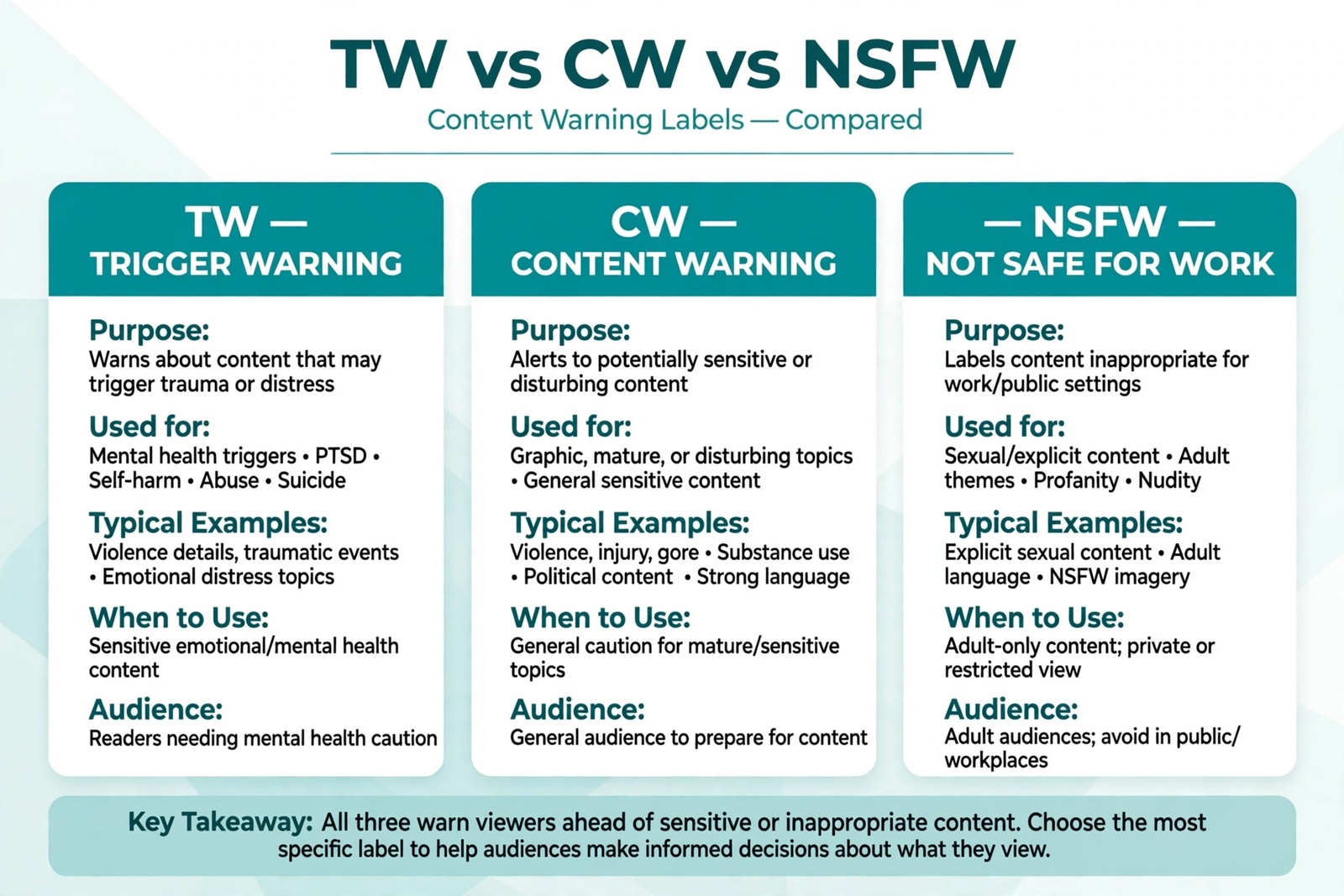
TW is often confused with a few lookalike labels. They overlap, but they are not the same — and using the wrong one can send the wrong message.
| Term | Full Form | What It Warns About | When to Use It |
|---|---|---|---|
| TW | Trigger Warning | Content that may trigger trauma or strong emotional reactions | Before posts about violence, abuse, self-harm, grief, eating disorders |
| CW | Content Warning | Any content some readers may find upsetting or want to skip | A broader, gentler label — works for almost anything sensitive |
| NSFW | Not Safe For Work | Sexual, graphic, or explicit content | Before anything you would not want open on a work screen |
| Spoiler / Spoiler Alert | — | Plot details that ruin a surprise | Before revealing endings, twists, or results |
| PSA | Public Service Announcement | Important information everyone should know | For announcements and advice, not warnings |
| Graphic Content Warning | — | Blood, injuries, or disturbing images | Before photos or videos showing real injuries |
The most important distinction is TW vs CW. Many people now prefer CW (content warning) because it covers a wider range of sensitivities — flashing lights, spiders, food, or loud noises — without implying a trauma response. TW is the stronger, more specific label, and it is usually reserved for the heavy topics: violence, abuse, self-harm, and death. If you are unsure which one fits, CW is the safer, broader choice; if the topic is genuinely traumatic, TW is the honest one.
NSFW is a different job entirely. It is about appropriateness for a setting (work, school, family), not about emotional safety. A post can be NSFW without needing a TW, and it can need a TW without being NSFW — a written account of an accident, for example, is perfectly safe for work but may still deserve a trigger warning.
Alternate Meanings
Like many two-letter abbreviations, TW wears several hats. Outside of social media, it can mean something completely different — and the context is your only guide.
| Meaning | Where You Will See It |
|---|---|
| Trigger Warning | Social media, texting, forums, Discord, Reddit — the dominant online meaning |
| This Week | Work chats and emails — “Let’s finish this TW” means this week |
| Taiwan | Geography, news, sports, country codes — TW is Taiwan’s ISO country code |
| Teamwork | Gaming and sports chats — “Good TW everyone” means good teamwork |
| Older posts and bios — a legacy shorthand for the platform now called X | |
| Trans Woman | LGBTQ+ community spaces — an identity abbreviation used by some people |
| Time Warp | Gaming and sci-fi discussions — a game mechanic or story device |
| Total War | Gaming — the strategy game series by Creative Assembly |
How do you tell them apart? Look at what comes next. If TW is followed by a colon and a sensitive topic — “TW: violence” — it is a trigger warning, every time. If it sits in a sentence about schedules — “Can we meet TW?” — it almost certainly means “this week.” And if it appears next to a country name or a flag emoji, it means Taiwan. When in doubt, read the whole sentence before deciding.
Professional or Polite Alternatives
TW is informal internet language, so it does not fit every situation. In a work email, a school essay, or a published article, these alternatives carry the same meaning with a more professional tone:
- “Content warning:” — the most direct professional swap. “Content warning: this report discusses child abuse.”
- “Please note:” — soft and formal. “Please note: the following section contains graphic descriptions.”
- “A heads-up:” — friendly but professional. “A quick heads-up: this video includes scenes of a car accident.”
- “Reader discretion is advised:” — the classic formal version, common in news and publishing.
- “Sensitive content ahead:” — clear and neutral, works well in newsletters and course materials.
- “This material may be distressing:” — direct and respectful, ideal for official documents.
The rule is simple: match the label to the room. TW is perfect for TikTok captions, Discord servers, and group chats. In a boardroom or a classroom handout, one of the alternatives above will land better — and it shows the same care, just in a different register. For another example of how internet abbreviations shift between casual and formal settings, see CFS meaning in text.
Common Mistakes
TW is easy to use, but people still get it wrong — and when they do, the warning stops working. Here are the mistakes to avoid:
- Putting the warning after the content. A TW at the end of a post is useless. The reader has already seen the upsetting part. Always lead with it.
- Writing a bare “TW” with no topic. “TW” alone tells people to be careful but not about what. Always name the topic: “TW: death,” “TW: needles,” “TW: abuse.”
- Over-warning everything. If every post carries a TW, people stop noticing them — the same way we ignore car alarms. Reserve TW for content that is genuinely heavy.
- Using TW as a joke about real trauma. Ironic TWs are fine for puppies and bad cooking, but joking about self-harm, abuse, or violence with a fake warning is hurtful and damages trust.
- Being vague to the point of uselessness. “TW: stuff” or “TW: bad things” helps no one. Be specific enough that readers can make a real choice.
- Using TW in formal documents. In a work report or an academic paper, “TW:” looks out of place. Use “content warning” or “please note” instead.
- Assuming everyone knows what TW means. Older readers, or people new to social media, may not recognise it. In mixed audiences, write it out once: “Trigger warning (TW): violence.”
- Warning about the wrong thing. Labelling a post “TW: spiders” when it actually contains graphic injury footage misleads the exact people the warning was meant to protect.
Quick Tips
Want to use TW like someone who actually knows what they are doing? Keep these tips in mind:
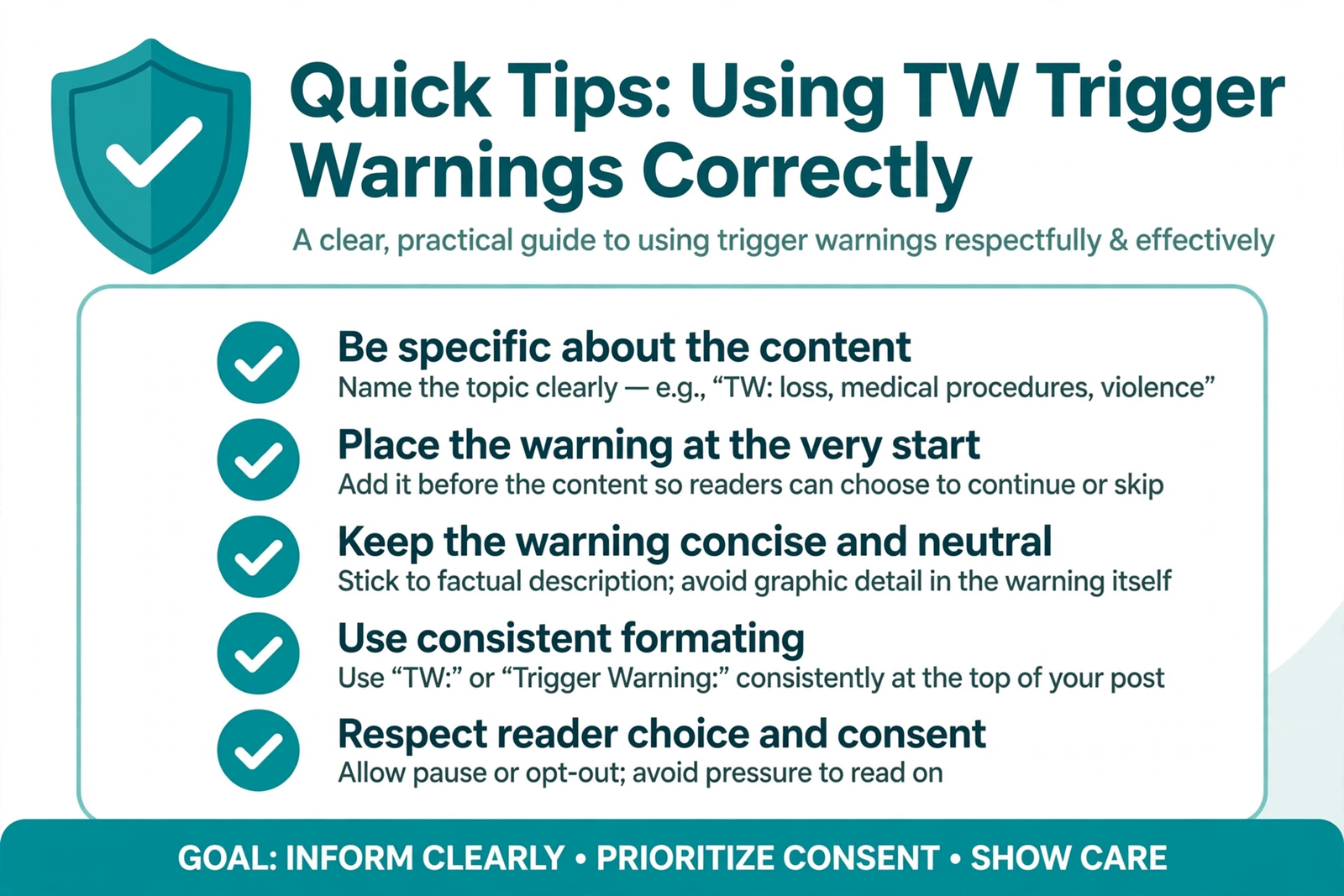
- Lead with it. TW goes first — in the caption, at the top of the post, before the first sentence of the message.
- Name the topic, keep it short. Two to four words is enough: “TW: eating disorders,” “TW: flashing lights.”
- Match the platform. On video apps, put the warning on screen as well as in the caption, because captions are easy to miss.
- When in doubt, add one. If you are unsure whether a post needs a warning, adding one costs you nothing — and it may genuinely help someone.
- Respect other people’s warnings. If someone asks you to add a TW to a post, do it. It takes five seconds and it matters to them.
- Do not use TW to make content seem edgier. A warning is not a marketing trick. If the content is not sensitive, do not dress it up as if it were.
- Learn CW too. Content warnings cover the broader, milder sensitivities — flashing images, food, spiders — that do not quite need a full trigger warning.
- Keep it kind. TW exists to protect people. Use it in that spirit, and you will never go wrong.

FAQ
What does TW mean in texting?
In texting, TW most commonly means “trigger warning.” It is placed before a message that discusses something sensitive — like violence, grief, or abuse — so the reader can decide whether to keep reading. For example: “TW: car accident. I need to tell you what happened today.”
What does TW mean on TikTok?
On TikTok, TW means “trigger warning” and usually appears in the video caption or as on-screen text before a video that deals with a heavy topic — such as mental health, accidents, medical procedures, or disturbing news. Creators use it so viewers can scroll past if they are not in the right headspace.
What does TW mean on Instagram?
On Instagram, TW also means “trigger warning.” You will see it at the start of captions, in stories, and in reels that discuss sensitive subjects. Some creators also put it as a text sticker on the first frame of a story so followers see the warning before the content loads.
Is TW the same as CW?
Not exactly. TW (trigger warning) is the stronger, more specific label, used for content that may trigger a trauma response — violence, abuse, self-harm, or death. CW (content warning) is broader and gentler, covering anything some readers might want to skip, from flashing lights to spiders. Many people use CW for milder topics and save TW for the heavy ones.
What does TW mean in a work chat?
In a work chat, TW often means “this week” rather than “trigger warning.” For example, “Can we ship this TW?” means “Can we ship this this week?” The context makes the meaning clear — scheduling language means “this week,” while a colon followed by a sensitive topic means “trigger warning.”
What does TW // mean?
“TW //” is simply another way of writing a trigger warning, using double slashes instead of a colon. “TW // violence” and “TW: violence” mean exactly the same thing. The slash style is especially common on Tumblr, Twitter, and Discord.
Is it rude to not use TW?
It is not usually meant rudely, but in many online communities it is considered careless — especially if you regularly post about heavy topics. Adding a TW takes two seconds and shows respect for your audience. In communities where warnings are part of the rules, skipping one can even get your post removed.
What are other meanings of TW?
Besides “trigger warning,” TW can mean “this week” in work chats, “Taiwan” in geography and news, “teamwork” in gaming, “Twitter” in older posts, and “trans woman” in LGBTQ+ community spaces. The surrounding words always tell you which meaning applies.
Conclusion
TW is one of the smallest abbreviations on the internet — and one of the most meaningful. In slang, tw meaning slang comes down to two words: trigger warning. It is a promise from the person posting that they have thought about how their content might affect the people reading it, and a gift of choice to everyone who sees it.
Now you know the full picture: what TW stands for, where it came from, how to write it correctly (“TW: topic” before the content, never after), how it differs from CW and NSFW, and the alternate meanings — from “this week” to Taiwan — that can trip you up in other contexts. Use it when the content is genuinely heavy, name the topic clearly, and keep the ironic versions for harmless jokes only.
The next time you see “TW: grief” at the top of a post, you will know exactly what it means — and the next time you share something heavy yourself, you will know exactly what to write. Small letters, big kindness. And if you are still decoding the slang in your chats, start with the friendliest one of all — TYSM meaning in text — and build your vocabulary from there.
