Quick Definition: In slang, “cooking” means doing something brilliantly, being completely in your element, or creating something impressive — as in “let him cook” or “she’s cooking right now.” The cooking slang meaning comes from hip-hop, sports, and gaming culture, where “cooking” describes someone who is on fire, locked in, and producing results. It can also mean planning or preparing something big behind the scenes, as in “we’re cooking something up.”
cooking slang Meaning & Definition
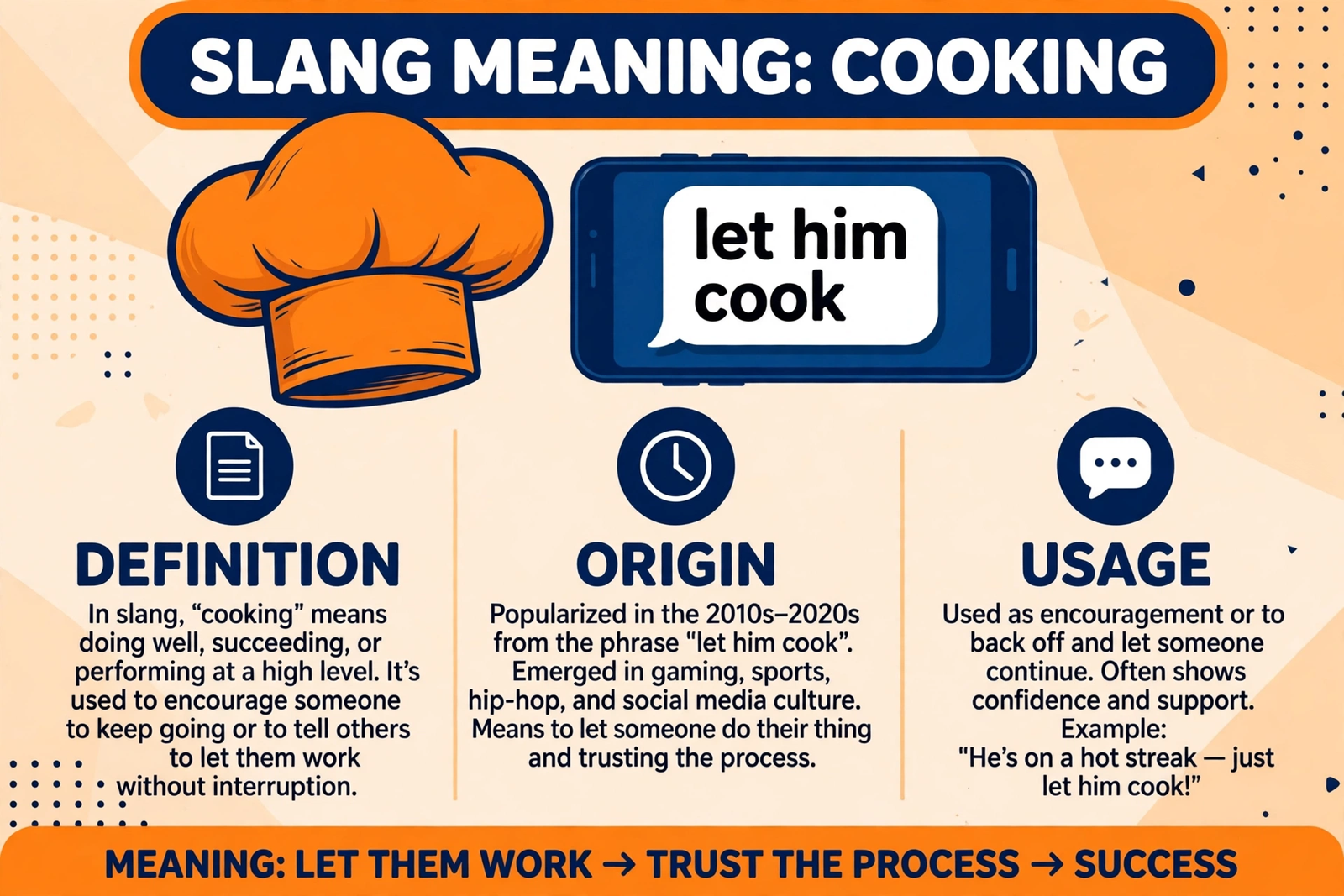
Cooking slang means to perform at a high level, to be in a flow state, or to create something great. When someone says “he’s cooking,” they are not talking about a kitchen at all. They mean he is dominating a game, delivering a great performance, making smart moves, or producing impressive work. The phrase works as praise, encouragement, and a warning to everyone else: step back, because this person is on a roll.
The cooking slang meaning is almost always positive. Unlike slang words that flip meaning with tone, “cooking” in this sense is a compliment in nearly every context. A gamer can be cooking in a ranked match, a rapper can be cooking in the studio, a chef can be cooking in the literal sense and the slang sense at the same time, and a friend can be cooking up a brilliant plan in a group chat. The word describes excellence that is visible to everyone watching.
What makes cooking slang interesting is how flexible it is. It works as a verb (“let him cook”), as a present-continuous state (“she’s cooking”), as a noun for the process itself (“the cooking has begun”), and as part of longer phrases (“cook up,” “let them cook,” “now we’re cooking”). It can describe sports, music, gaming, work, creativity, or even a clever comeback. If someone is producing something impressive, someone nearby has probably said they are cooking.
It is also worth knowing that “cooking” has a second, related slang life. To “cook something up” means to plan, invent, or prepare something — often something exciting or secret. “We’re cooking up a surprise party” or “she’s cooking up a new album” both use this sense. The idea is the same in both meanings: heat, transformation, and something good coming out of the process. The modern compliment sense grew out of that same energy — taking raw ingredients, applying skill, and serving up something nobody expected.
Introduction
You are watching a basketball game when a player suddenly cannot miss. Every shot drops, every pass lands, every defender looks a step too slow. The commentator leans into the mic and says it: “He’s cooking right now.” Nobody in the arena is thinking about dinner. They are watching someone operate at a level that looks almost unfair — and the word “cooking” is the perfect description for it.
That is the world of cooking slang. In just a few years, an ordinary kitchen verb has become one of the most popular compliments in internet English. It shows up in sports commentary, gaming streams, music studios, group chats, and TikTok comments. “Let him cook” is now a full sentence, a meme, and a philosophy all at once — and if you did not grow up with this slang, it can look completely confusing the first time you see it.
This guide explains cooking slang properly: what it means, where it came from, how people actually use it, and the mistakes that make you sound like you are trying too hard. You will find real examples for friendly, professional, and funny situations, a comparison with similar slang like “eating” and “on fire,” and answers to the questions people search for most. Whether you are a parent decoding your teenager’s comments, a creator trying to understand your audience, or just curious about internet language, this is the complete guide to cooking slang. For more food-flavoured internet words, check out our guide to eat slang — another kitchen word that became a compliment.
Origin
The compliment sense of “cooking” comes from hip-hop and Black American culture, where the kitchen has always been a metaphor for creation. A music producer “cooks up” a beat the way a chef cooks a meal: raw ingredients go in, skill and heat are applied, and something new comes out. Rappers have used “cooking” this way for decades — to cook in the studio meant to be making great music, often late at night, often under pressure, and often brilliantly.
From music, the word travelled into sports. Basketball players and commentators started saying a player was “cooking” when he was scoring at will — heating up, unstoppable, serving defenders one possession after another. The kitchen metaphor fit perfectly: a hot player, like a hot stove, produces results fast. By the 2010s, “he’s cooking” was a regular line in sports commentary, and fans picked it up for their own conversations.
Gaming finished the job. Around 2020–2022, “let him cook” became a viral phrase on TikTok, Twitter, and Twitch. Gamers used it when a teammate was on a hot streak, streamers used it when a player was making an impossible comeback, and meme pages used it for anyone doing something impressive — a chef plating a dish, a student acing an exam, a friend pulling off a perfect prank. The phrase “let him cook” spread because it is both praise and a command: stop interrupting, give this person room, and watch what happens.
That journey matters, because it explains why the word feels so natural online. Cooking slang was not invented by a marketing team or a single viral video. It grew out of real communities — music studios, basketball courts, gaming lobbies — was carried by the people who created it, and only later became a general internet compliment. Knowing that history is part of using the word respectfully. For a similar journey from one community to the whole internet, see our guide to glizzy meaning, another word that travelled from a specific scene into everyday speech.
Popularity
Cooking slang exploded in popularity between 2021 and 2024, and it has stayed popular since. The main reason is TikTok: the platform’s comment culture rewards short, emotional reactions, and “LET HIM COOK” is one of the most emphatic compliments available. A three-word comment can carry the same energy as a whole paragraph of praise, and it fits perfectly in a fast-scrolling feed.
The phrase also benefited from sports and gaming culture. When a player goes on a scoring run, fans flood the comments with “he’s cooking,” and when a streamer pulls off a clutch play, the chat spams “LET HIM COOK.” These moments are shared thousands of times, and each share teaches new people the phrase. Music fan communities were important too — producers post studio clips captioned “cooking up something special,” and fans reply with the same language.
Another reason for its staying power is versatility. Most slang compliments are narrow: “fire” describes something exciting, “iconic” describes something memorable. “Cooking” covers all of it — a performance, a plan, a meal, a comeback, a creative project — and it works as a verb, a reaction, and a meme format. That flexibility is why it has outlasted dozens of trendier words that faded in a month.
Today, cooking slang is understood far beyond Gen Z. Millennials use it, brands use it in social media captions, sports broadcasters use it on live television, and even news outlets use it in headlines about athletes and artists. It has become one of the standard compliments of internet English, alongside “eating” and “slaying.”
How It Is Used
Cooking slang is used in three main ways. The first is as a verb describing a specific performance: “He’s cooking on the court,” “She’s cooking in the studio,” “They’re cooking up a plan.” The structure is simple — subject + cooking + the thing being done well — and it works for almost any achievement.
The second way is the command “let him cook” (or “let her cook,” “let them cook”). This is the most famous form. It means: stop interfering, give this person space, and let them do what they do best. People say it when someone is mid-performance and others are doubting them, when a creative person is working and others are rushing them, or when a friend is about to prove everyone wrong. It is both encouragement for the person cooking and a warning to everyone else to back off.
The third way is “cook up,” meaning to plan, create, or prepare something — often something exciting or secret. “We’re cooking up a surprise,” “She’s cooking up a new project,” “They cooked up a scheme.” This form focuses on the creative process rather than the performance itself. It suggests something is being made right now, and it is going to be worth the wait.
The word also appears in the past tense: “he cooked” means he delivered, he dominated, he did it perfectly. And in gaming and sports, “he’s cooking” can mean someone is on a hot streak that shows no sign of stopping. Tone matters, though — “cooking” is casual and enthusiastic, so it fits comments, chats, and social media far better than a formal email or a work presentation.
Examples
Context changes how cooking slang sounds, so here are real examples grouped by tone. Notice that the meaning stays the same — impressive performance or creation — but the surrounding words shift with the situation.
Friendly Examples
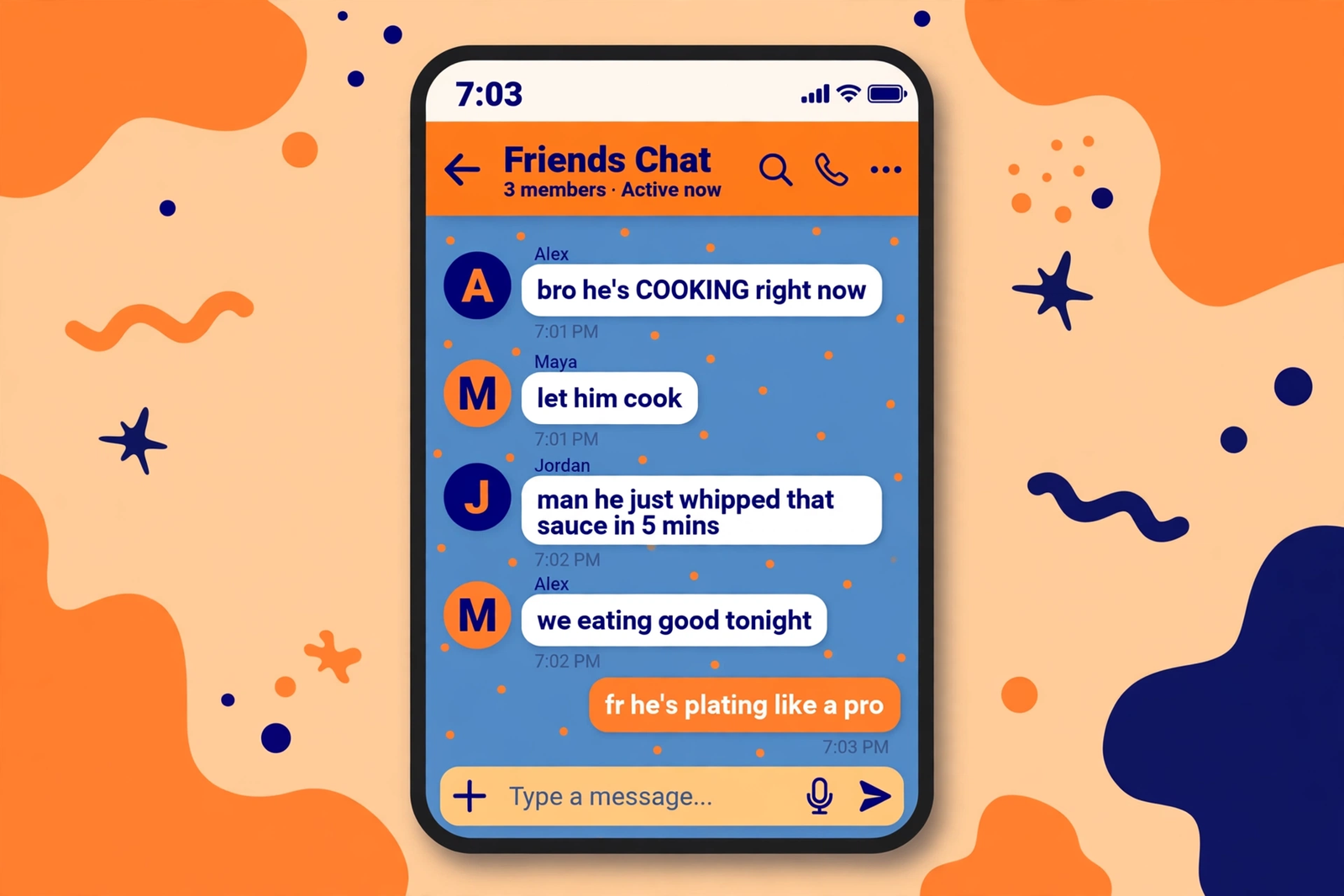
- “Bro hit three threes in a row — he’s COOKING right now.”
- “Let her cook, she knows exactly what she’s doing.”
- “You’re cooking with this playlist, every song is perfect.”
- “He cooked that whole argument, nobody had a comeback.”
- “We’re cooking up something fun for your birthday, just wait.”
- “She’s been cooking in the kitchen all morning and it smells amazing.”
Professional Examples
- “Give the design team a week — they’re cooking up something strong for the launch.”
- “Our lead developer is cooking right now, the new feature is nearly done.”
- “Let her cook on the pitch deck, she has the best instincts on the team.”
- “The marketing team cooked with that campaign, the numbers speak for themselves.”
Funny Examples
- “My grandma said ‘let me cook’ and then made the best biryani of my life.”
- “He said he was cooking and then burnt toast. Literally and figuratively.”
- “The cat knocked over the plant and just sat there like ‘I cooked.’”
- “Me: I’m going to cook. Also me: orders takeout. Still cooking, technically.”
Notice how “cooking” works in all three registers. With friends it is hype and celebration. At work it is a relaxed way to praise someone’s creative process. And in jokes it plays on the double meaning — the literal kitchen and the slang performance — which is exactly why the word is so fun to use.
Comparison with Similar Terms
Cooking slang belongs to a family of food and heat metaphors that internet English uses for excellence. Here is how it compares to its closest relatives, so you can pick the right word every time.
| Term | What It Means | When to Use It | Example |
|---|---|---|---|
| Cooking | Performing brilliantly or creating something great | Someone is mid-performance or mid-creation | “Let him cook, he’s on fire.” |
| Eating / Ate | Performing flawlessly, owning a moment | A finished performance, a look, a comeback | “She ate that performance.” |
| On fire | On a hot streak, unstoppable right now | Sports, gaming, any streak | “He’s on fire from three-point range.” |
| Slaying | Looking amazing or dominating with style | Fashion, confidence, attitude | “She slayed that outfit.” |
| Locked in | Completely focused, in the zone | Work, study, training, gaming | “He’s locked in for the final.” |
| Chef’s kiss | Something is perfect, flawless | Reacting to a finished result | “That goal? Chef’s kiss.” |
The key difference is timing. “Eating” and “chef’s kiss” usually describe something already finished — a performance that already happened, a result you can already see. “Cooking” describes something in progress: the person is still doing it, still creating, still heating up. That is why “let him cook” is a command about the future — it asks everyone to wait, because the best part is still coming.
“Cooking” is also broader than its cousins. “Slaying” is mostly about style and confidence, “on fire” is mostly about streaks, and “locked in” is mostly about focus. “Cooking” covers all of it — performance, creativity, planning, and results — which is why it has become the default word when people are not sure which compliment to pick. If you want a deeper look at the closest cousin, read our eat slang guide, where we break down “ate” and “left no crumbs” in full.

Alternate Meanings
Like most slang, “cooking” has more than one meaning, and context is everything. The most important alternate meaning is “cooked” — the past-tense adjective that means finished, done for, or in serious trouble. “We’re cooked” means the situation is hopeless; “he got cooked” in sports means he was badly beaten by an opponent. This is almost the opposite of “he’s cooking,” so pay attention to the grammar: “cooking” is active and positive, “cooked” is often passive and negative.
Another meaning lives in drug culture, where “cooking” can refer to preparing drugs. This sense is much older and much rarer in everyday conversation, and it is almost never what people mean when they say “let him cook” online. If the context is a kitchen, a studio, a game, or a plan, the meaning is the compliment sense.
In everyday English, “cooking” can also simply mean something is happening or developing. “Something’s cooking” means a plan or event is in progress, often secretly. “What’s cooking?” is a casual greeting that means “what’s going on?” or “what’s new?” Both of these are standard idioms, not slang, but they share the same kitchen metaphor — heat, preparation, and something coming soon.
Finally, “cook” as a noun in slang can mean a person who is excellent at something — a “cook” in a creative field is someone who consistently produces great work. This usage is less common, but you will see it in music and gaming communities: “he’s a real cook” means he is genuinely talented, not just lucky.
Professional or Polite Alternatives
Cooking slang is casual, so it does not belong in every setting. In a formal email, a job interview, or a meeting with a client, you need a more professional way to say the same thing. Here are polite alternatives that carry the same energy without the slang.
- Instead of “let him cook”: “Let’s give him the space to work through this.”
- Instead of “she’s cooking”: “She’s doing outstanding work right now.”
- Instead of “he cooked”: “He delivered an excellent result.”
- Instead of “we’re cooking something up”: “We’re developing something exciting.”
- Instead of “he’s on fire”: “He’s performing at a very high level.”
- Instead of “chef’s kiss”: “That was flawless.”
The trick is to keep the enthusiasm and drop the slang. “Let him cook” is really saying “trust this person’s process,” and that idea sounds just as good in professional language. Save the slang version for chats, comments, and casual conversations, where it lands naturally and makes people smile.
Common Mistakes
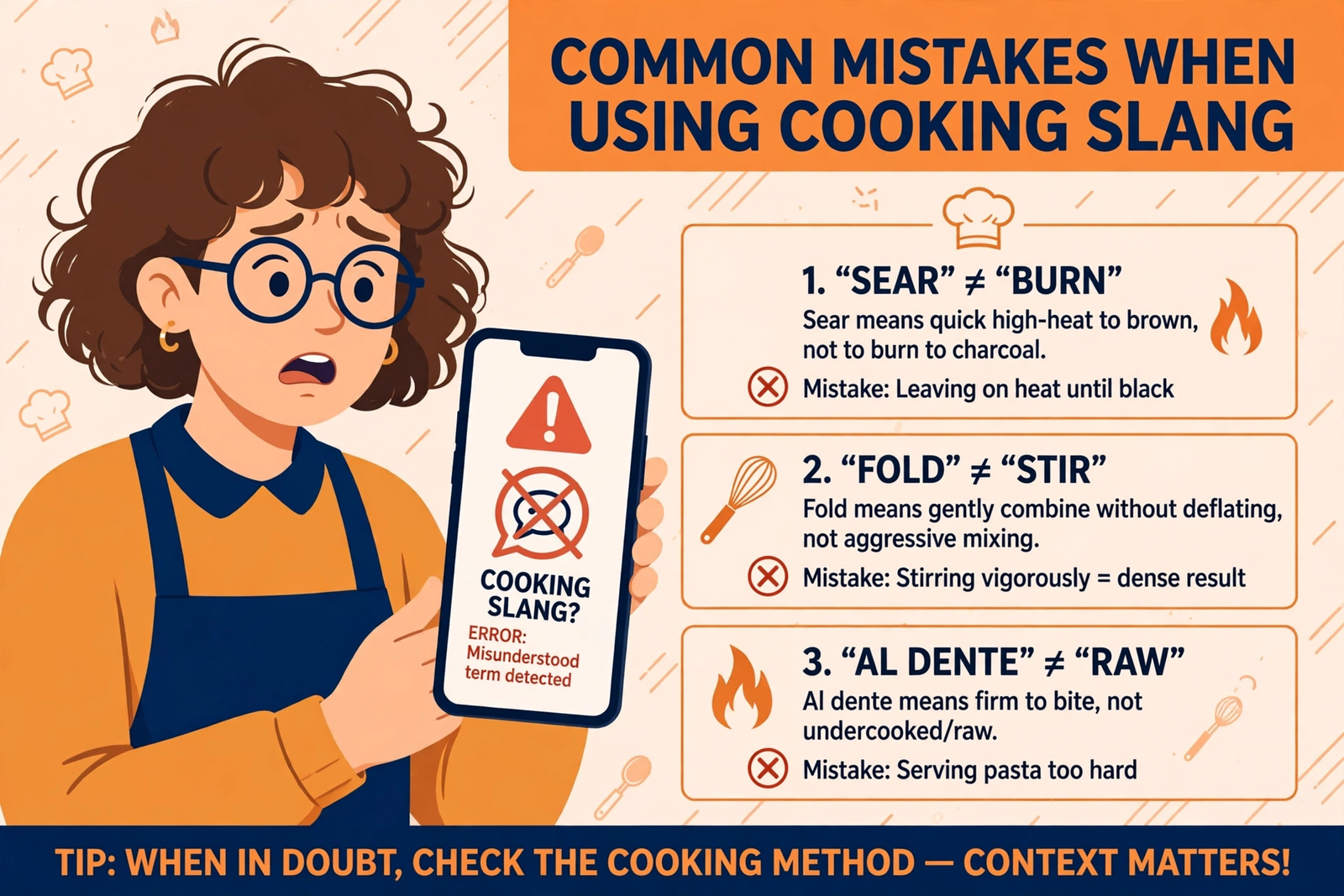
Cooking slang is easy to use, but a few mistakes make people sound like they are trying too hard — or like they do not understand the word at all. Here are the ones to avoid.
1. Using it for something finished. “Cooking” describes a process in progress. Saying “he cooked that test last week” works, because “cooked” is the finished form — but “he’s cooking that test last week” is wrong, because the test is already over. Match the tense to the timing.
2. Confusing “cooking” with “cooked.” This is the biggest trap. “He’s cooking” means he is doing great. “He’s cooked” means he is done for. One letter changes the meaning completely, so double-check which one you mean — especially in text, where there is no tone of voice to save you.
3. Saying it in formal settings. “Let him cook” in a board meeting will get laughs, but not the kind you want. Keep the phrase in casual spaces: group chats, comment sections, gaming lobbies, and friendly conversations.
4. Overusing it. If everything is cooking, nothing is. Save the phrase for moments that genuinely impress you — a hot streak, a brilliant idea, a creative breakthrough. When you use it sparingly, it hits harder.
5. Using it for yourself too often. Saying “I’m cooking” about your own work can sound confident and fun among friends, but saying it constantly sounds boastful. Let other people say you are cooking — that is when the compliment means the most.
6. Forgetting the kitchen joke. Part of the fun of cooking slang is the double meaning. If someone says “let him cook” and you reply with a literal cooking joke, you are in on it. If you take the phrase literally and ask what is for dinner, the joke passes you by.
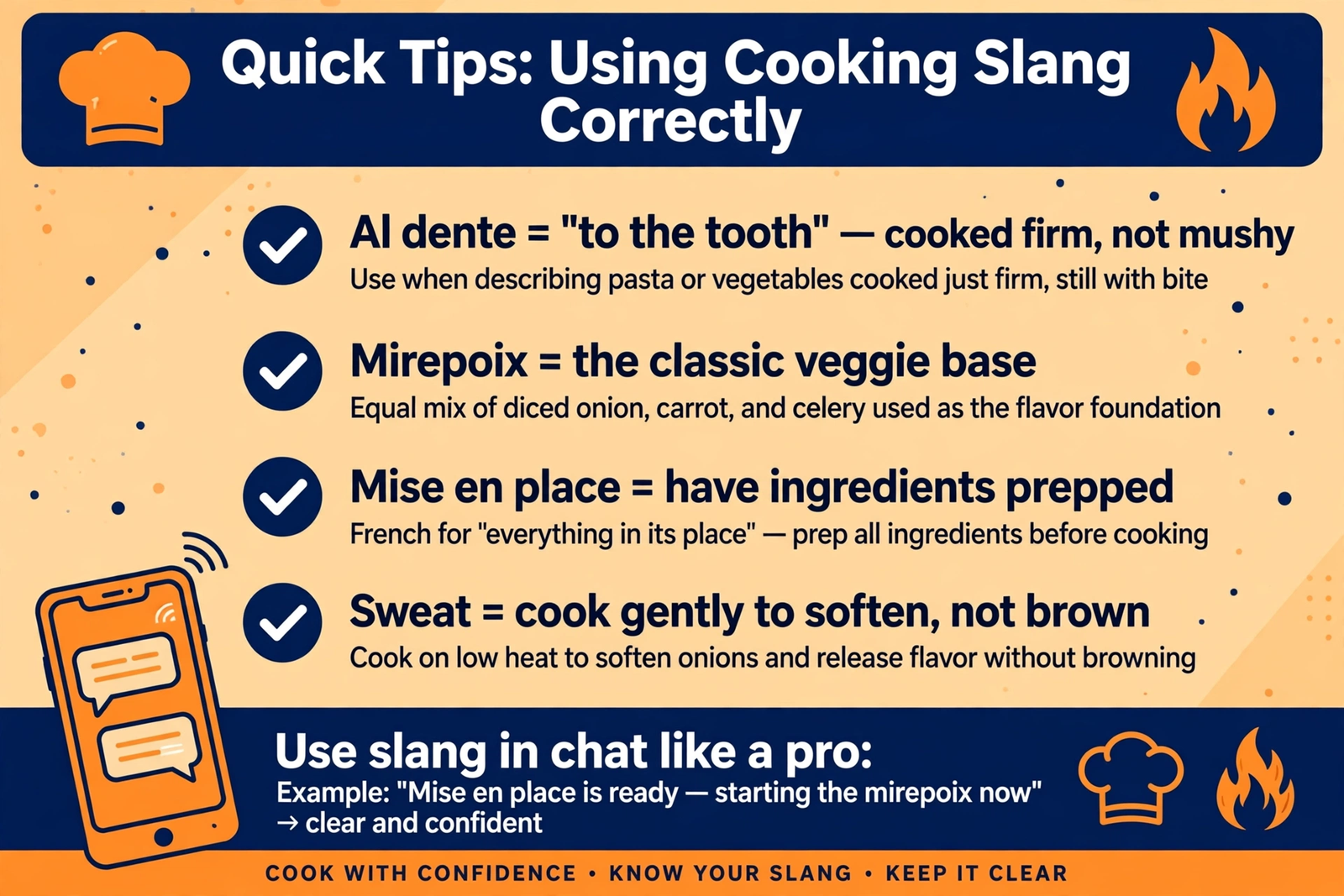
Quick Tips
Want to use cooking slang naturally? These quick tips will help you sound like you have been saying it for years.
- Use “let him cook” when someone is being doubted. It is the perfect reply when a friend is mid-performance and others are rushing or criticising them. It shows confidence in the person and tells everyone else to relax.
- Pair it with specifics. “He’s cooking” is good; “He’s cooking — three goals in twenty minutes” is better. A detail makes the praise believable.
- Use “cook up” for plans and projects. It is the most natural form for anything creative or secret: a surprise, a business idea, a new song, a prank.
- Match the energy. “Cooking” is enthusiastic slang, so use it when you are genuinely excited. A flat “he’s cooking” about something boring sounds sarcastic.
- Keep it in casual spaces. Comments, chats, gaming, sports talk, and friendly conversations are the natural home of this phrase.
- Learn the opposite too. Knowing that “cooked” means finished or in trouble stops you from mixing the two up — and it helps you understand jokes that play on the contrast.
- Watch sports and gaming clips. The fastest way to learn the rhythm of the phrase is to hear it in context. Commentators and streamers use it constantly, and you will pick up the timing naturally.
FAQ
What does “let him cook” mean in slang?
“Let him cook” means give someone space and time to do what they do best without interrupting or doubting them. It is encouragement for the person and a warning to everyone else to step back and watch. The cooking slang meaning comes from the idea of a chef working in the kitchen — the best results need time, heat, and focus.
What does “he’s cooking” mean?
“He’s cooking” means he is performing brilliantly right now — on a hot streak, in a flow state, or producing impressive work. It is used in sports, gaming, music, and everyday life. It is a compliment that says someone is dominating the moment.
What does “cooking up” mean in slang?
“Cooking up” means planning, creating, or preparing something — often something exciting or secret. “We’re cooking up a surprise party” means a surprise is being planned. In music, “cooking up a beat” means producing a new track. The phrase focuses on the creative process.
Is “cooking” slang positive or negative?
“Cooking” is almost always positive — it means doing great work. But be careful with “cooked,” which usually means finished, beaten, or in trouble. “He’s cooking” is praise; “he’s cooked” is the opposite. Context and tense decide the meaning.
Where did “let him cook” come from?
The phrase comes from hip-hop and Black American culture, where “cooking” described making music in the studio, and from sports, where a hot player was said to be “cooking” on the court. It went viral on TikTok and Twitch around 2021–2022 and is now common in everyday internet English.
What is the difference between “cooking” and “eating” in slang?
Both are compliments, but “cooking” describes a process in progress, while “eating” usually describes a finished result. “She’s cooking” means she is doing great right now; “she ate” means she already delivered a flawless performance. Cooking is about the heat of the moment; eating is about the finished plate.
Can I use “cooking” slang at work?
In casual work chats with friendly colleagues, yes — “the design team is cooking up something good” sounds natural and fun. In formal emails, meetings, or client presentations, use a professional alternative like “doing outstanding work” or “developing something exciting.”
What does “we’re cooked” mean?
“We’re cooked” means we are done for, finished, or in serious trouble — the situation is hopeless. It is the negative opposite of “we’re cooking.” The phrase is common in gaming and sports when a team has lost all hope of winning, and in everyday speech when a plan has completely fallen apart.
Conclusion
Cooking slang is one of the most useful compliments in modern internet English — and one of the most fun. A single word, “cooking,” can say what a paragraph of praise cannot: that someone is on fire, locked in, and producing something worth watching. From its roots in hip-hop studios and basketball courts to its home in TikTok comments and gaming chats, the word has travelled a long way, and it has earned its place as a standard part of Gen Z and internet speech.
The key takeaways are easy to remember. Use “cooking” for performances and creations in progress, “let him cook” when someone needs space to work their magic, and “cook up” for plans and projects being prepared. Remember the difference between “cooking” and “cooked” — one is praise, the other is trouble — and save the phrase for moments that genuinely deserve it. Keep it in casual spaces, add a specific detail to make the compliment land, and respect the culture the word came from.
Language keeps moving, and today’s slang will be tomorrow’s nostalgia. But the idea behind cooking slang — trusting someone’s process and letting great work happen — is timeless. The next time a friend, a player, or a creator starts heating up, you will know exactly what to say. And if you want to keep decoding internet language, start with the classics — from the food-flavoured praise in our eat slang guide to the snack words in our buns meaning slang guide — and you will never be lost in the comments again.
