Quick Definition: The iwl meaning in texting is “I won’t lie.” People use IWL at the start of a message to signal that what follows is their honest opinion — even if it is blunt, unpopular, or a little awkward to admit. It works like a softer, more casual version of “to be honest.”
IWL Meaning & Definition
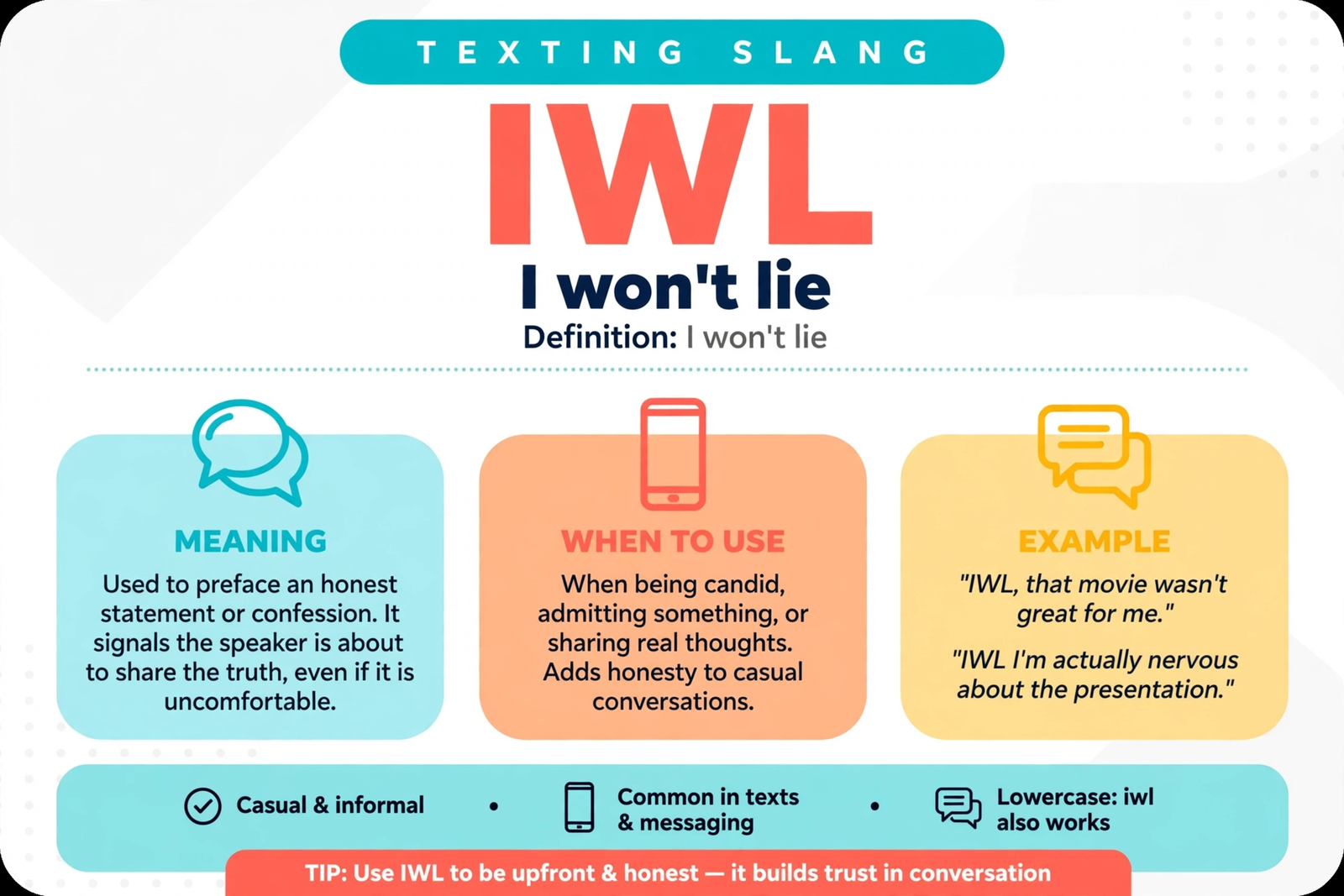
IWL stands for “I won’t lie,” and the iwl meaning is simple: the sender is about to say something truthful. It is an abbreviation used in texting, social media comments, and online chats, almost always at the beginning of a sentence. When someone writes “IWL, that movie was kind of boring,” they are telling you two things at once — their opinion about the movie, and the fact that they are being straight with you instead of sugar-coating it.
Unlike formal abbreviations, IWL lives entirely in casual conversation. You will see it on TikTok, Snapchat, Instagram, X (Twitter), Discord, and in everyday group chats. It is most popular with teens and young adults, but like most internet slang, it has spread well beyond that age group. The phrase sets a tone: what comes next is real, unfiltered, and probably something the person has been holding back.
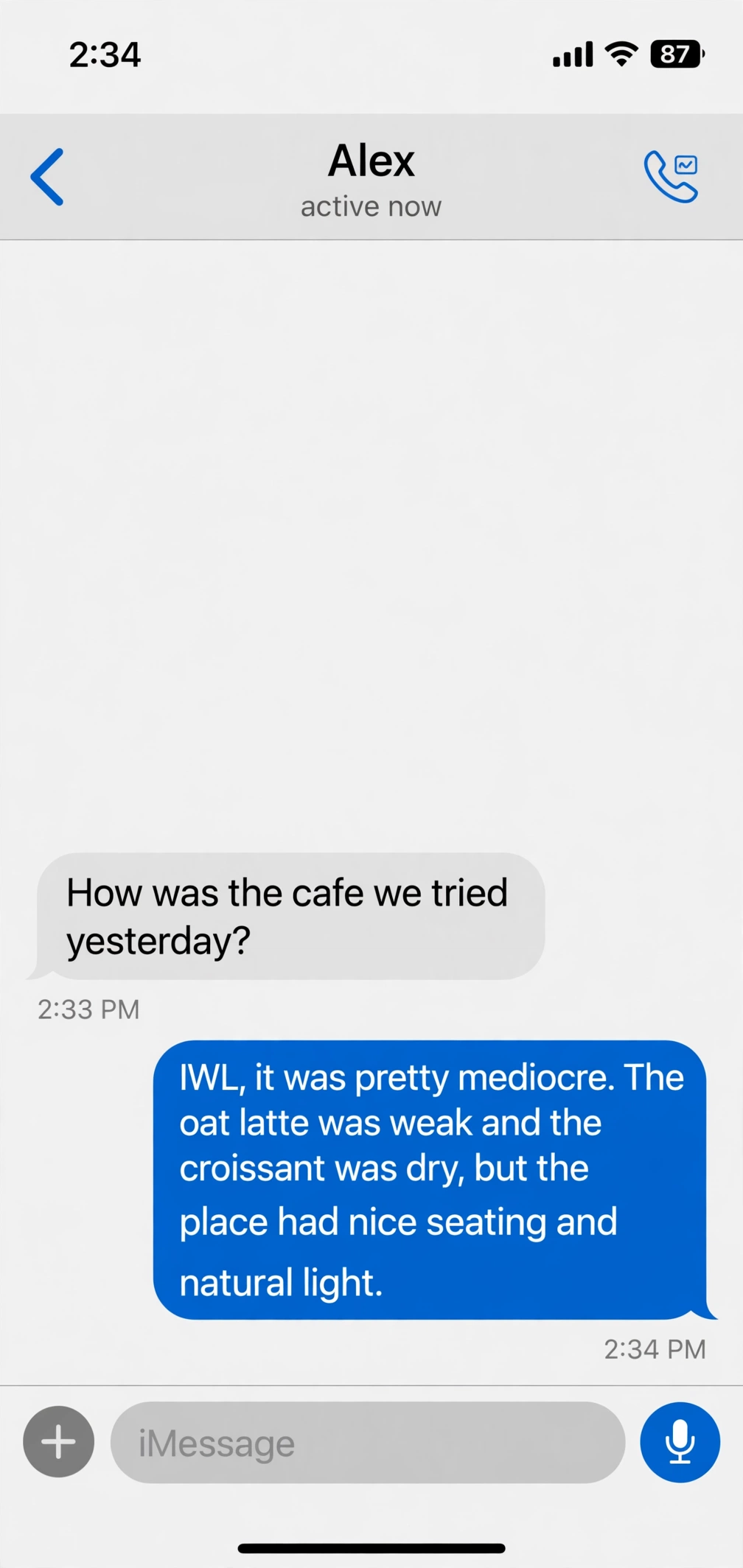
One reason the iwl meaning has caught on is that it does useful social work in just three letters. Saying “I won’t lie” softens a harsh opinion before it lands. It tells the reader, “I am not trying to be rude — I am just being honest.” That tiny bit of framing can turn a criticism into a conversation instead of an argument, which is exactly why people reach for it so often in texts and comments.
Introduction
Imagine a friend texts you: “IWL, your playlist is actually fire.” Or a classmate messages: “IWL, I did not study at all for this test.” In both cases, the three letters do the same job — they flag honesty. The first message makes a compliment feel more genuine, because the sender is framing it as a real opinion rather than polite flattery. The second makes a confession feel lighter, because admitting something embarrassing is easier when you announce that you are just being honest.
That is the power of IWL. It is short, casual, and instantly understood by anyone who spends time online. In a world where texts move fast and tone is hard to read, a tiny abbreviation that says “I am being real with you” is genuinely useful. It adds sincerity to compliments, softens criticism, and makes confessions feel less heavy.
In this guide, we will break down the full iwl meaning, where it came from, how it became popular, and how to use it correctly — with real examples for friendly, professional, and funny situations. You will also learn how IWL compares to similar slang like NGL and TBH, what mistakes to avoid, and polite alternatives you can use when “I won’t lie” feels too casual for the setting.
Origin
IWL comes from the full phrase “I won’t lie,” which has been part of spoken English for a very long time. People have always said “I won’t lie” before an honest statement — in conversations, interviews, and even song lyrics. The abbreviation itself, though, is a product of internet culture, where long phrases get squeezed into a few letters so they can be typed faster.
The exact moment IWL first appeared is hard to pin down, because abbreviations like this usually spread gradually rather than launching on a single day. It began showing up in text messages and chatrooms in the late 2010s, alongside the broader wave of honesty-related slang. Words and phrases that frame opinions as truth — TBH (to be honest), NGL (not gonna lie), IMO (in my opinion) — were already everywhere, and IWL fit naturally into that family.
Social media gave it a boost. Short-form video platforms like TikTok and image-based apps like Snapchat reward quick, punchy language, and a three-letter abbreviation is perfect for captions and comments. Creators started using IWL in video captions (“IWL, this is the best song of the year”), and commenters copied it. From there it spread into group chats, gaming lobbies, and everyday texting.
Interestingly, IWL also gained ground because it sounds slightly more polite than its closest cousin, NGL. “Not gonna lie” carries a hint of casual defiance, while “I won’t lie” sounds like a promise — a small pledge of honesty. That subtle difference made IWL a favourite for compliments and confessions, where the speaker wants to sound sincere rather than edgy. For a broader look at how internet slang evolves and spreads, Dictionary.com’s slang section tracks many of these terms as they move from niche chats into everyday language.
Popularity
IWL is most popular on platforms where young people talk in short bursts: TikTok, Snapchat, Instagram, and Discord. On TikTok, it appears in captions, on-screen text, and comments — often attached to hot takes about music, movies, celebrities, and food. On Snapchat and in private group chats, it is a go-to opener for honest opinions between friends.
Part of its popularity comes from versatility. IWL works before a compliment (“IWL, you look great in that photo”), before a criticism (“IWL, that show went downhill after season two”), before a confession (“IWL, I forgot your birthday”), and before a hot take (“IWL, pineapple on pizza is actually good”). Very few slang terms are that flexible, and that flexibility keeps it in constant use.
It is also popular because it is safe. Unlike some slang that can sound rude or confrontational, IWL is almost always read as friendly honesty. Parents, teachers, and older users who see it in a message usually understand the intent even if they do not know the abbreviation — because the full phrase, “I won’t lie,” is plain English. That low barrier to understanding has helped IWL spread across age groups faster than more cryptic slang.
Search interest in the iwl meaning has grown steadily as more people encounter the term in comments and chats and look it up. It now sits alongside established abbreviations like NGL and TBH as one of the standard honesty markers of internet slang — a small piece of vocabulary that millions of people use every day without thinking about it.
How It Is Used
IWL is almost always placed at the very beginning of a sentence or message, followed by a comma. That position matters: it frames everything that follows as an honest statement. The basic pattern is simple — “IWL, [honest opinion or confession].” You will rarely see it buried in the middle of a sentence, and you will almost never see it at the end.
Here are the main ways people use it:
- Before a compliment: “IWL, that outfit is perfect on you.” The abbreviation makes praise feel more genuine, as if the sender is admitting something they really mean.
- Before a criticism: “IWL, the new season was not as good as the last one.” It softens the blow by signalling honesty rather than hostility.
- Before a confession: “IWL, I ate the last slice of pizza.” Admitting something is easier when you frame it as simply telling the truth.
- Before a hot take: “IWL, I think winter is better than summer.” It warns the reader that an unpopular opinion is coming.
- Before a request or favour: “IWL, I really need your help with this.” It adds sincerity to the ask.
- As a reaction: Sometimes people use it as a standalone reply — “IWL 😭” — to agree with something honest someone else just said.
IWL can also appear in lowercase (“iwl”) or uppercase (“IWL”) — both are correct, and the choice is purely stylistic. Uppercase is more common at the start of a sentence, while lowercase fits the relaxed style of fast texting. It is frequently paired with emojis, especially 😭, 💀, and 😅, which add emotional colour to the honesty that follows.
One thing to note: IWL is informal. It belongs in texts, chats, and social media, not in formal emails, job applications, or academic writing. Using it in a professional setting can come across as too casual, so save it for conversations where slang is welcome.
Examples
The best way to understand the iwl meaning is to see it in real conversations. The examples below show how IWL works in friendly, professional, and funny contexts — and how the tone changes depending on what follows it.
Friendly Examples
- “IWL, you’re the funniest person in this group chat.”
- “IWL, I missed hanging out with you this weekend.”
- “IWL, your cooking has gotten so much better lately.”
- “IWL, I was nervous before the party, but I’m really glad I came.”
- “IWL, that song you sent me is on repeat now.”
- “IWL, you always know exactly what to say.”
In friendly messages, IWL makes compliments land harder. Saying “you’re funny” is nice; saying “IWL, you’re funny” feels like a real admission — and that makes it warmer.
Professional Examples
IWL is rare in formal work settings, but it does appear in casual workplace chats, especially among younger colleagues or in creative teams. If you use it at work, keep it light and positive:
- “IWL, your presentation was the best one today.”
- “IWL, I think this design is a big improvement.”
- “IWL, I was worried about the deadline, but the team nailed it.”
- “IWL, this is my favourite project we’ve worked on.”
As a rule, avoid IWL before criticism at work. “IWL, this report is a mess” will not land the way you want it to. In professional settings, honest feedback is better delivered with a full sentence like “To be honest, I think we can improve this section.”
Funny Examples
- “IWL, I came here for the free food, not the meeting. 😅”
- “IWL, my sleep schedule is completely destroyed. 💀”
- “IWL, I only watched the show for one character.”
- “IWL, I have no idea what I’m doing, but I’m doing it confidently.”
- “IWL, my phone battery is at 2% and I’m still scrolling. 😭”
Humour is where IWL shines, because honesty and comedy go together naturally. A funny confession lands better when it is framed as the truth — and that is exactly what IWL does.
Comparison with Similar Terms
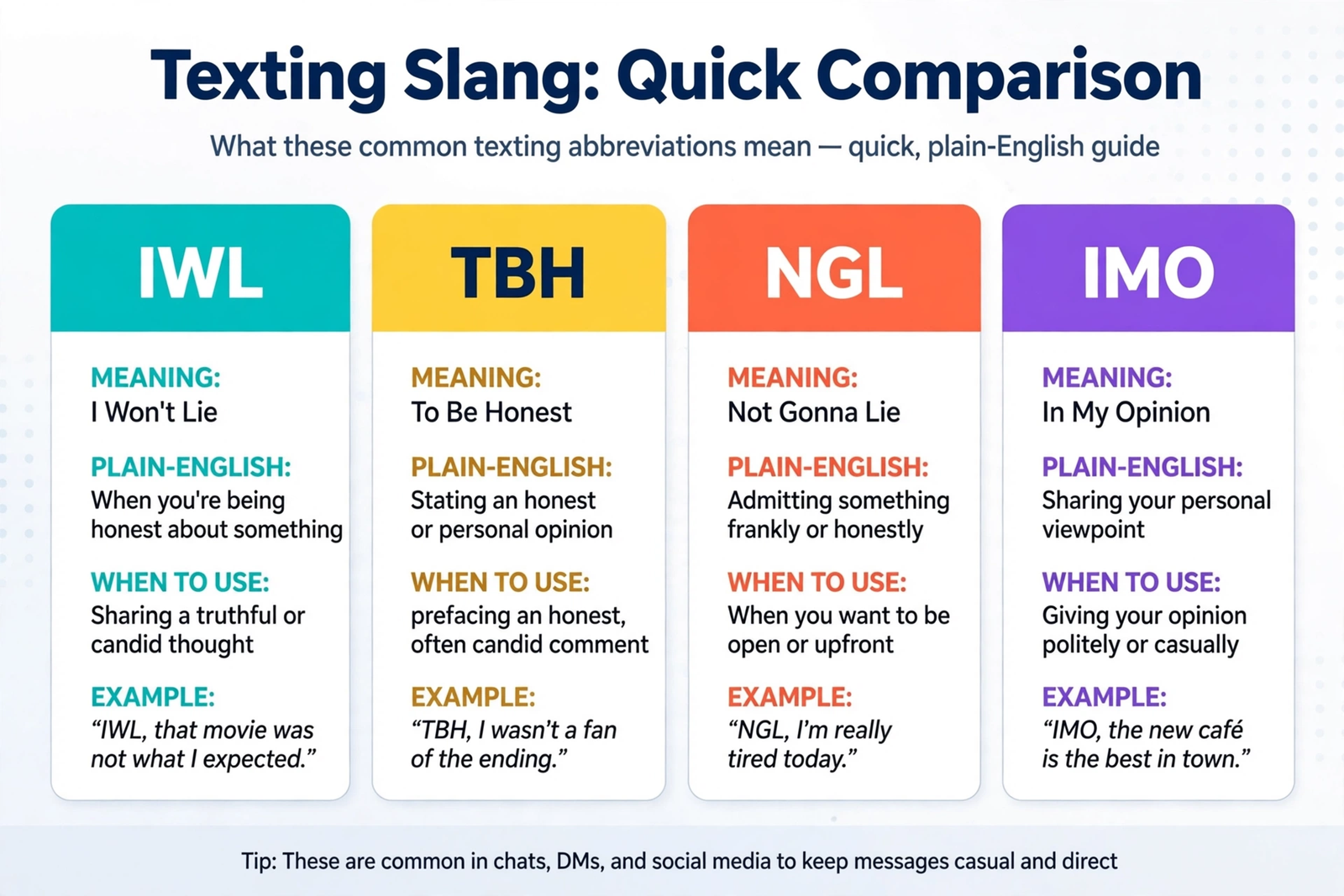
IWL is part of a family of honesty-related slang terms, and they often get mixed up. The table below shows how IWL compares with its closest relatives, so you can pick the right one for every situation.
| Term | Full Form | Meaning | Tone | Best For |
|---|---|---|---|---|
| IWL | I won’t lie | About to say something honest | Sincere, warm | Compliments, confessions, hot takes |
| NGL | Not gonna lie | About to say something honest | Casual, slightly edgy | Hot takes, blunt opinions |
| TBH | To be honest | Sharing an honest opinion | Neutral, thoughtful | Opinions, gentle criticism |
| IMO / IMHO | In my opinion / In my humble opinion | Marking something as a personal view | Neutral, polite | Debates, discussions |
| FR | For real | Emphasising that something is true | Enthusiastic, emphatic | Agreeing strongly, reactions |
| ONG | On God | Swearing something is true | Strong, emphatic | Serious promises, strong agreement |
The closest match is NGL — “not gonna lie” means almost the same thing as “I won’t lie.” The difference is mostly tone. NGL sounds a little more casual and blunt, which makes it better for hot takes and bold opinions. IWL sounds slightly softer and more sincere, which makes it better for compliments and confessions. In practice, many people use them interchangeably, and nobody will misunderstand you if you pick one over the other.
TBH is broader: it introduces any honest opinion, not just a surprising or awkward one. If you are curious about that term in detail, our guide to NGL meaning in text breaks down the differences even further. And if you enjoy decoding short slang, the IYKYK meaning guide covers another three-letter favourite that works very differently — it signals shared knowledge instead of honesty.
Alternate Meanings
Like many abbreviations, IWL can mean different things in different contexts. The “I won’t lie” meaning is by far the most common in texting and social media, but here are a few other uses you might come across:
- “I will” (rare): In very casual typing, some people use IWL as a shortened form of “I will,” but this is uncommon and usually clear from context (“IWL do it tomorrow”).
- Initials and names: IWL can be someone’s initials, a username, or a short name for a group, team, or organisation.
- Gaming and fandom contexts: In some gaming communities and fan groups, IWL has been used as a clan tag or team abbreviation with no connection to the slang meaning.
- “In real life” confusion: IWL is sometimes confused with IRL (“in real life”), but the two mean completely different things — IRL describes the offline world, while IWL is a promise of honesty.
Context almost always clears up the confusion. If a message reads “IWL, that was amazing,” the “I won’t lie” meaning is obvious. If it reads like a name or a team tag, it probably is not slang at all. When in doubt, look at the sentence around it — the words that follow IWL will tell you which meaning fits.
Professional or Polite Alternatives
IWL is perfect for casual chats, but it does not belong everywhere. In formal emails, work messages, school assignments, or conversations with people you do not know well, these alternatives carry the same honesty in a more polished form:
- “To be honest…” — The safest all-purpose alternative. Works in almost any setting.
- “Honestly…” — Short, natural, and acceptable in both casual and professional writing.
- “In my opinion…” — Best when you want to mark something as your personal view rather than a fact.
- “If I’m being honest…” — A gentle, conversational way to introduce a difficult truth.
- “I’ll be straight with you…” — Warm and direct; good for feedback or advice.
- “Candidly…” — Formal and polished; ideal for professional or written communication.
- “Truthfully…” — Simple and sincere; works in speeches, essays, and serious conversations.
The key is matching your language to your audience. With friends, IWL is natural and friendly. With a manager, a teacher, or a client, a full phrase like “to be honest” shows the same sincerity without the slang. Knowing both versions — and when to use each — is a small skill that makes a real difference in how your message is received.
Common Mistakes
IWL is easy to use, but a few common mistakes can make your message confusing or awkward. Here is what to watch out for:
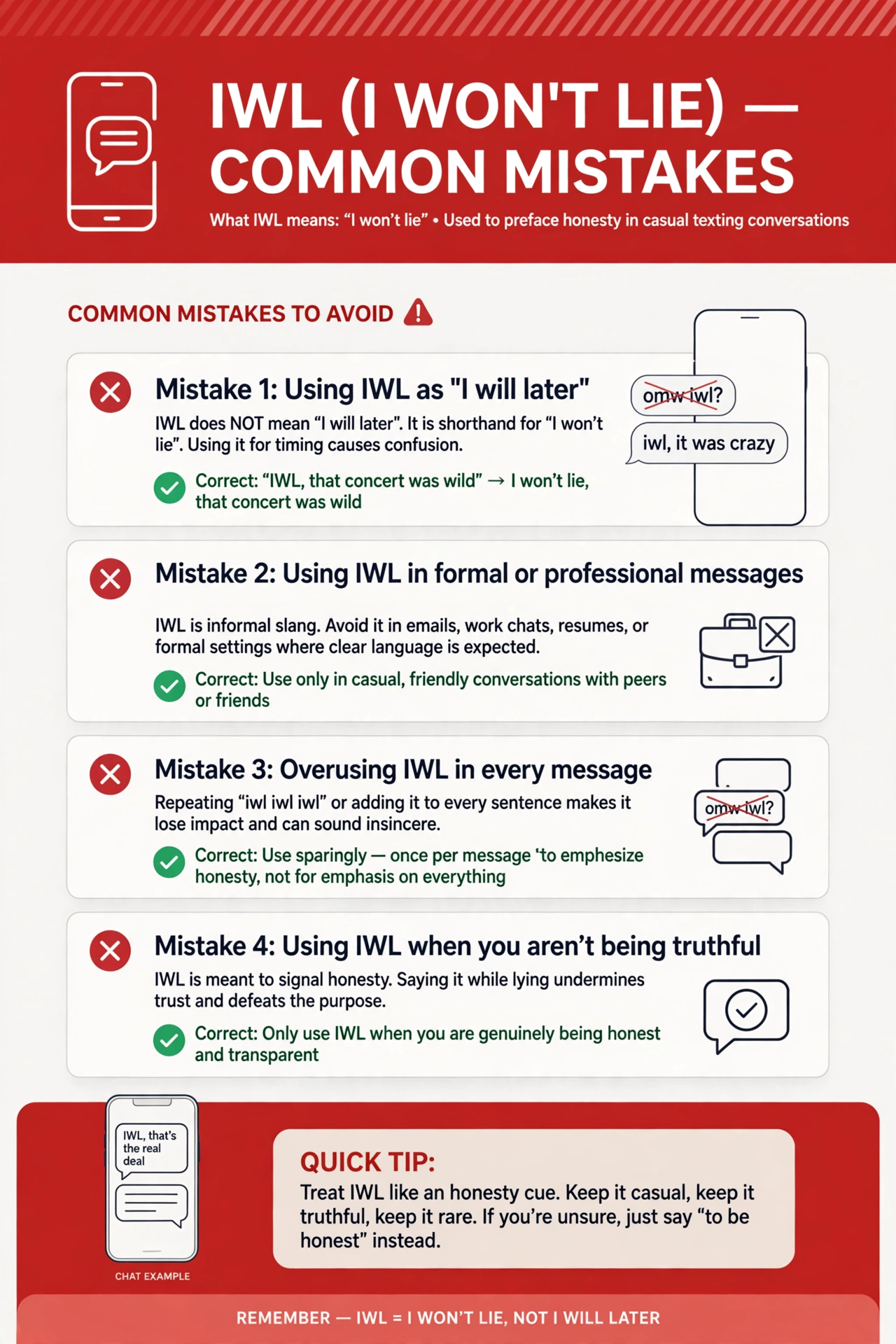
- Using it in formal writing: Dropping IWL into a job application, a school essay, or a formal email looks careless. Save it for casual conversations.
- Using it before a lie or a joke: IWL promises honesty. If what follows is obviously a joke or a lie, the abbreviation loses its meaning — and your message can come across as confusing rather than funny.
- Putting it in the wrong place: IWL belongs at the start of the sentence. Writing “That movie was great, IWL” sounds unnatural; “IWL, that movie was great” is how people actually use it.
- Using it before every sentence: Repeating IWL in every message makes it lose its effect. It works because it signals something worth flagging — if everything is flagged, nothing stands out.
- Confusing it with IRL: IWL and IRL look similar but mean different things. IRL means “in real life”; IWL means “I won’t lie.” Mixing them up changes your message completely.
- Using it to soften something genuinely hurtful: Starting a cruel comment with “IWL” does not make it kind. Honesty is not a shield for rudeness — if the message would hurt without the abbreviation, it will hurt with it too.
- Using it with people who do not know slang: Older relatives, new colleagues, or anyone unfamiliar with texting abbreviations may not understand IWL. With them, just write out “I won’t lie” in full.
Quick Tips
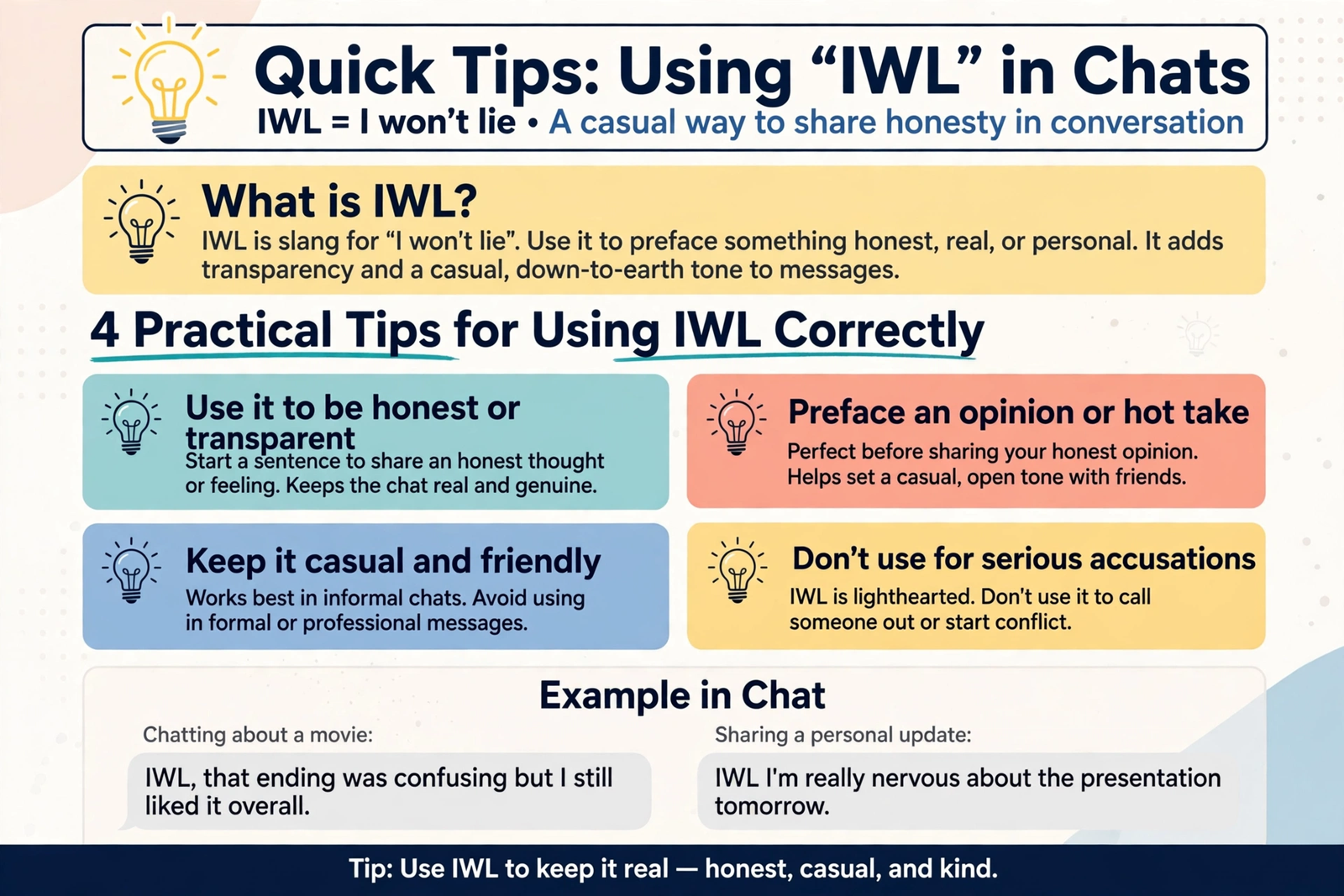
Want to use IWL like a native? These quick tips will help you get it right every time:
- Lead with it: Put IWL at the very start of your message, followed by a comma, then your honest thought.
- Use it for real opinions: IWL works best before something you genuinely believe — a compliment, a confession, or a hot take.
- Pair it with an emoji: A 😅, 😭, or 💀 after your message adds emotional context and makes the honesty feel friendly.
- Keep it casual: IWL belongs in texts, chats, and social media. In formal settings, switch to “to be honest” instead.
- Do not overuse it: Save IWL for moments when honesty needs flagging. Used sparingly, it carries weight; used constantly, it becomes noise.
- Match the tone: Before a compliment, keep it warm. Before a hot take, expect a reaction. Before a confession, keep it light.
- Try its cousins: If IWL does not fit, NGL, TBH, and IMO cover similar ground — each with a slightly different flavour. The FRFR meaning in text guide is a good next read if you like emphatic slang, and NFS meaning in slang covers another abbreviation that confuses a lot of people.
FAQ
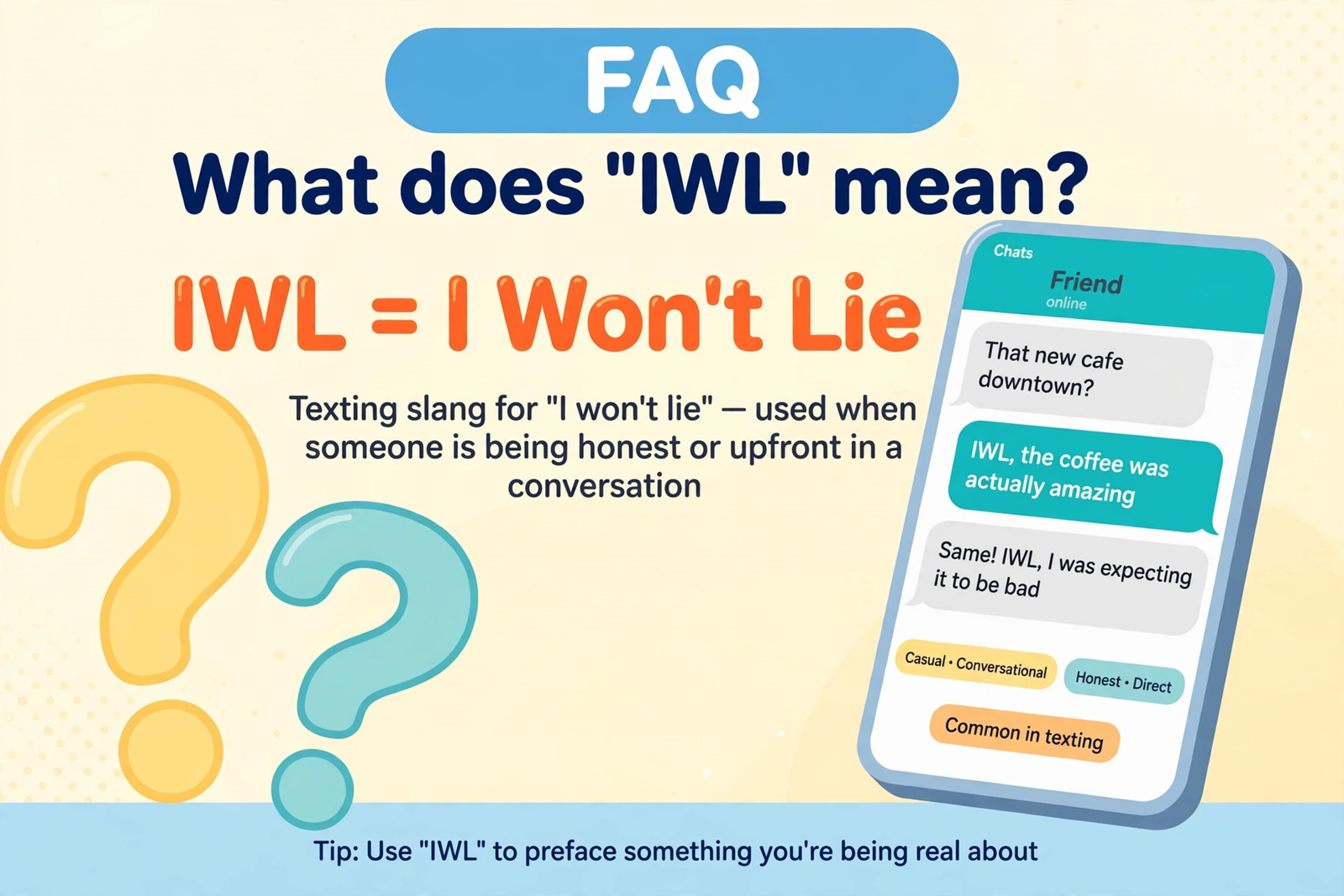
What does IWL mean in texting?
IWL means “I won’t lie.” It is used at the start of a message to signal that the sender is about to share an honest opinion, confession, or hot take. For example: “IWL, that was the best concert I’ve ever been to.”
Is IWL the same as NGL?
Almost. NGL means “not gonna lie,” which carries the same basic idea as IWL. The difference is tone: NGL sounds a bit more casual and blunt, while IWL sounds slightly softer and more sincere. Most people use them interchangeably.
Where is IWL used most?
IWL is most common on TikTok, Snapchat, Instagram, Discord, and in private text messages. It appears in captions, comments, and group chats, usually before an opinion, compliment, or confession.
Is IWL rude?
No — IWL is generally friendly. It frames honesty as a positive thing and often softens criticism. However, using it before a genuinely hurtful comment does not make that comment kind, so the words that follow still matter.
Can I use IWL at work?
It depends on the workplace. In casual team chats with colleagues you know well, a light “IWL, great job on this” is fine. In formal emails, reports, or messages to clients, use “to be honest” instead.
What does IWL mean on TikTok?
On TikTok, IWL means the same thing as everywhere else: “I won’t lie.” Creators use it in captions and on-screen text before hot takes, and commenters use it before honest reactions to videos.
Is IWL formal or informal?
IWL is informal slang. It belongs in texts, chats, and social media. For formal writing, write the full phrase “I won’t lie” or use an alternative like “to be honest” or “honestly.”
How do you reply when someone says IWL?
Just respond to the honest statement itself. If someone says “IWL, you look amazing today,” a simple “Thank you! 😊” works perfectly. If it is a hot take, you can agree, disagree, or laugh — the IWL is just the framing, not the message.
Conclusion
The iwl meaning is simple, but the abbreviation does a surprising amount of work: three letters that promise honesty, soften criticism, warm up compliments, and make confessions easier. Whether it appears in a TikTok comment, a Snapchat message, or a late-night group chat, IWL tells the reader that what follows is real — and in a world of filtered photos and careful wording, that small promise of truth is worth a lot.
Now that you know what IWL means, where it came from, and how to use it, try it in your next honest message. Start with a compliment — “IWL, you’re great at this” — and notice how much warmer it feels than the same words without it. Just remember the golden rules: lead with it, use it sparingly, keep it casual, and never hide a hurtful comment behind it. Honesty works best when it is kind, and IWL is at its best when it helps you say something true in the friendliest way possible.
Language keeps changing, and new abbreviations appear every month — but the ones that last are the ones that solve a real communication problem. IWL solves one of the oldest problems there is: how to tell someone the truth without sounding harsh. That is why it is here to stay, and why understanding it puts you one step ahead in every conversation online.
