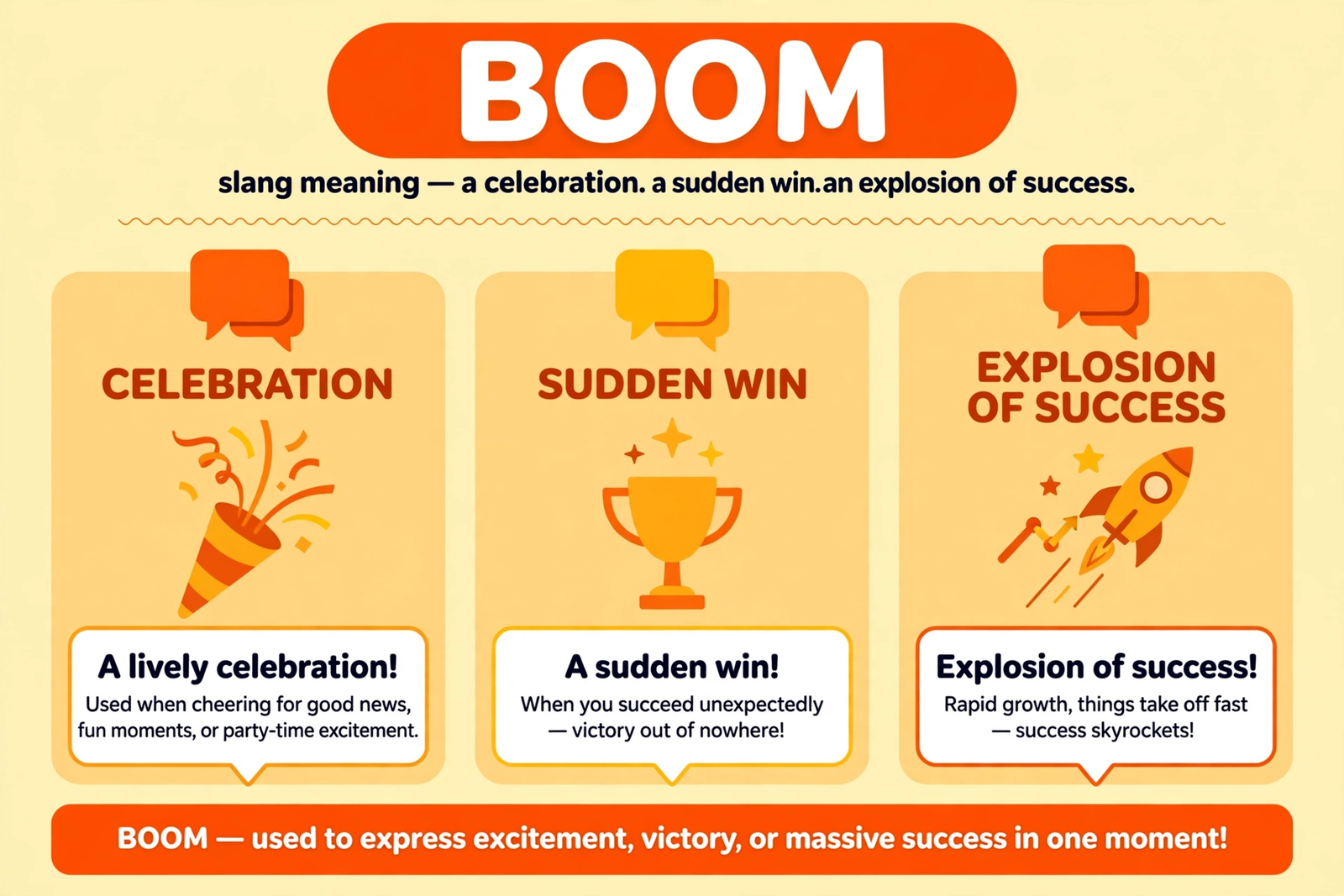
Quick definition: In slang, boom is an exclamation used to celebrate a win, emphasize a point, or describe something amazing, explosive, or suddenly successful. When someone says “boom,” they are basically dropping a verbal mic — the moment landed, the joke hit, the plan worked, or the beat just went off.
Boom Slang Meaning & Definition
Boom slang meaning is simple at its core: it is a one-word celebration. In everyday slang, boom works as an exclamation that means “done,” “nailed it,” “that was amazing,” or “mic drop.” It can also describe something that exploded in popularity, like a song, a meme, or a trend that went boom overnight.
The word borrows its power from the literal sound of an explosion. A real boom is loud, sudden, and impossible to ignore — and that is exactly the energy slang users want when they say it. A great comeback gets a “boom.” A perfect outfit gets a “boom.” A plot twist in a TV show gets a “boom.” It is short, punchy, and instantly understood, which is why it has survived for decades while other slang words fade away.
Boom is also flexible in a way few slang words are. It can stand alone as a full sentence (“Boom. Done.”), open a sentence (“Boom, just like that, we won”), or sit inside a phrase (“boom shakalaka,” “boom goes the dynamite”). It works in texts, in comments, in captions, and out loud. Teenagers use it, gamers use it, sports fans use it, and even grandparents who grew up with the word in cartoons and comic books use it.
At its heart, boom slang is about impact. Whether the moment is funny, impressive, surprising, or satisfying, boom is the sound effect people reach for when words alone feel too slow. If you have ever watched a friend sink a basketball shot from across the court and heard someone yell “boom,” you already understand the word perfectly.
Introduction
Some slang words need a whole paragraph to explain. Boom is not one of them. Say it out loud — boom — and you can feel the energy in it. It is the sound of a door slamming shut on an argument, a beat dropping in a song, a firework going off, or a plan coming together perfectly. That instant, explosive feeling is exactly why the word jumped from comic books and cartoons into everyday speech, and why it refuses to leave.
Today, boom shows up everywhere. It is in TikTok captions celebrating a glow-up, in gaming chats after a perfect headshot, in sports commentary after a huge dunk, and in text messages after a friend finally gets the joke. It is also used as a verb and an adjective: a song can “boom” on the charts, a business can be “booming,” and a party can be an absolute “boom.” The word has grown far beyond its original sound-effect roots.
But boom is not always a celebration. Context changes everything. “Boom, there it is” is pure triumph, while “boom, and just like that the money was gone” is a warning about how fast things can disappear. The same word can cheer a win or describe a crash, and knowing the difference comes down to tone, timing, and the sentence around it.
This guide breaks down everything you need to know about boom slang: where it came from, how it became popular, how people use it today, and the mistakes to avoid. By the end, you will know exactly when to drop a “boom” — and when to leave it out. If you enjoy decoding words like this, you will also like our guide to what does gas mean in slang, another hype word that took over the internet the same way.
Origin
Boom started as pure sound. The word is an example of onomatopoeia — a word that imitates the sound it describes. People have used “boom” to mimic deep, loud noises for centuries: thunder, cannons, explosions, and drums. Long before it was slang, it was simply the noise something big makes.
The jump from sound effect to slang happened through entertainment. In the 1960s and 1970s, comic books printed “BOOM!” in huge letters across panels whenever something exploded. Cartoons followed, with characters yelling “boom” after a pratfall or a magic trick. Kids who grew up reading and watching those shows carried the word into playgrounds, and playgrounds are where slang is born.
African American English and hip-hop culture gave boom its modern swagger. In the 1980s and 1990s, rappers used “boom” to describe beats that hit hard and rhymes that landed with force — a “boom bap” beat is literally named after the sound of a kick drum and a snare. Phrases like “boom shakalaka” became a playful way to celebrate something impressive, and sports broadcasters picked it up for highlight reels. By the late 1990s, “boom” was a mainstream celebration word.
The internet finished the job. Early viral videos like “boom goes the dynamite” turned the word into a meme in the mid-2000s, and social media gave it new life. On TikTok and Instagram, “boom” became the caption of choice for transformation videos, outfit reveals, and satisfying before-and-after clips. A word that started as an explosion sound had become a universal signal for “look at this.”
Popularity
Boom has stayed popular for an unusual reason: it never belonged to just one generation. Older people know it from comic books and cartoons, millennials know it from 90s hip-hop and viral videos, and Gen Z knows it from TikTok and gaming. Each generation has reinvented it slightly, but the core meaning — sudden impact — has never changed.
Music keeps boom alive. Producers talk about a beat that “booms” when the bass hits, rappers drop “boom” as an ad-lib, and fans use it in comments the moment a song goes viral. When a track suddenly explodes on the charts, people say it “went boom” — the same way they say a meme or a trend went viral.
Gaming is another home for the word. A headshot, a perfect combo, or a clutch play all earn a “boom” in the chat. Sports fans use it the same way: a three-pointer, a home run, or a knockout punch all get a boom. The word fits any moment where something lands with force, and games and sports are full of those moments.
On social media, boom works as a caption, a comment, and a reaction. A glow-up photo with the caption “boom” says more than a paragraph could. A cooking video where the dish comes out perfectly ends with a satisfied “boom.” Its popularity is not a trend that will fade — it is built into how English speakers express excitement, and that is not changing any time soon.
How It Is Used
Boom is used in three main ways in slang: as an exclamation, as a verb, and as a descriptor. Each one is slightly different, and each one shows up in a different kind of sentence.
As an exclamation, boom stands alone or opens a sentence. “Boom! Got the job!” is a celebration. “Boom, there it is” is a confident reveal. “Boom, done” means the task is finished and there is nothing more to say. In this form, it is usually followed by an exclamation mark and said with energy. It is the verbal version of dropping the mic.
As a verb, boom means to explode in popularity or to hit hard. A song “boomed” on TikTok when it suddenly went viral. A small business “is booming” when customers are lining up. A bass line “booms” when it shakes the room. This use is common in business and music, and it is the most formal of the three — you can say a company is booming in a work meeting without anyone blinking.
As a descriptor, boom adds emphasis to a moment or a thing. A “boom moment” is the instant everything clicks. A “boom play” in sports is the highlight of the game. This use is less common in everyday conversation but shows up often in commentary, captions, and headlines.
Boom also appears in fixed phrases. “Boom shakalaka” is a playful, old-school celebration. “Boom goes the dynamite” describes a dramatic, often funny failure or explosion. “Boom or bust” describes a high-risk situation. These phrases are less common with younger speakers, but they still appear in memes and throwback content.
- Boom! — a celebration, a mic drop, a perfect landing.
- Boom, done. — the task is finished, case closed.
- It went boom. — it suddenly exploded in popularity.
- Business is booming. — things are going extremely well.
- Boom shakalaka! — an old-school, playful cheer.
- Boom goes the dynamite. — a dramatic or funny disaster.
Examples
The best way to understand boom slang is to see it in real conversations. The examples below show how the word changes with tone — friendly, professional, and funny — because the same four letters can mean very different things depending on who is talking.
Friendly Examples
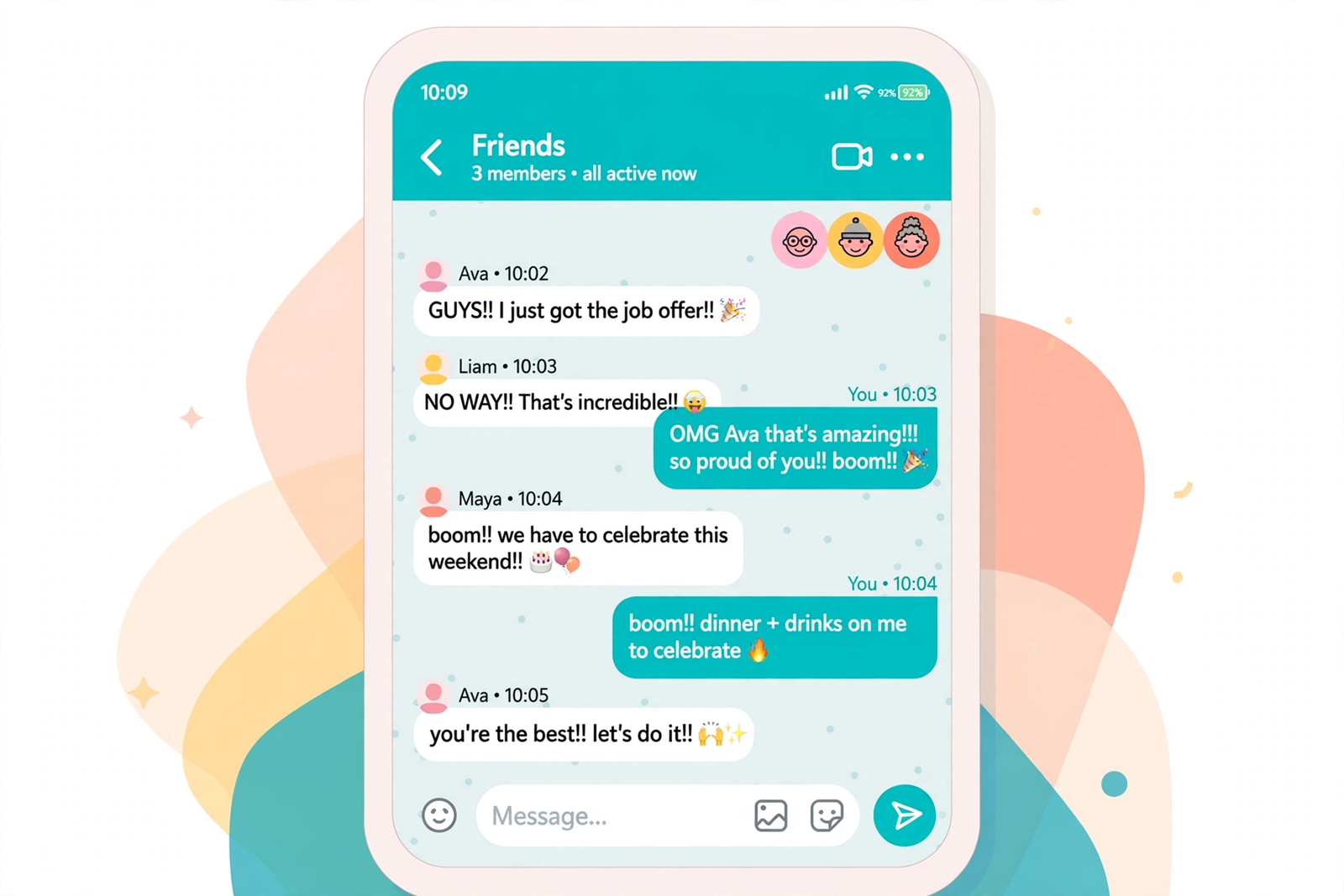
- “I finally passed my driving test!” — “Boom! I knew you could do it!”
- “Check out my new haircut.” — “Boom. You look amazing.”
- “We got tickets to the concert!” — “Boom! Best day ever.”
- “I finished all my homework before dinner.” — “Boom, done. Now let’s play.”
- “She said yes!” — “Boom! Congratulations, man!”
- “Look at this sunset photo I took.” — “Boom. That is actually stunning.”
In friendly conversations, boom is warm and supportive. Friends use it to hype each other up, celebrate good news, and add energy to a compliment. It is almost always positive in this setting, and it is one of the safest slang words you can use with people you know well.
Professional Examples
- “Our sales doubled this quarter — business is booming.”
- “The new product launch went boom on social media within a day.”
- “Boom — the report is finished and sent to the client.”
- “When the announcement dropped, our website traffic boomed overnight.”
- “The marketing campaign boomed after the influencer shared it.”
At work, boom usually appears in its verb form — “booming” or “boomed” — to describe growth, success, or sudden popularity. The exclamation form shows up too, but mostly in casual team chats rather than formal emails. Saying “business is booming” in a meeting is completely normal; shouting “boom!” after closing a deal is fine with a relaxed team, but you should read the room first.
Funny Examples
- “I tried to bake a cake and boom goes the dynamite — the kitchen is covered in flour.”
- “He tried to dunk, missed the rim, and boom — straight onto the floor.”
- “I said ‘just one episode’ and boom, it is 3 a.m. and I finished the whole season.”
- “My phone was at 2%, I plugged it in, and boom — it died anyway.”
- “I opened the chips ‘just to taste one’ and boom, the bag is empty.”
Funny uses of boom usually describe something going wrong in a spectacular way, or something happening much faster than expected. The humor comes from the contrast: boom sounds triumphant, but the situation is a mess. That twist is what makes the joke land.
Comparison with Similar Terms
Boom shares territory with several other slang words, but each one has its own flavor. The table below shows how boom compares to the words people confuse it with most often.
| Term | Meaning | When to Use It | Example |
|---|---|---|---|
| Boom | A sudden win, impact, or explosion of success | Celebrating a moment or describing fast growth | “Boom! Got the job!” |
| Bang | A sharp, sudden hit or a great time | Describing impact or fun, often with “with a bang” | “We ended the year with a bang.” |
| Pow | A comic-book punch or sudden surprise | Playful emphasis, often joking or retro | “Pow! Right in the kisser.” |
| Bam | Instant success or a sudden arrival | Quick emphasis, similar to boom but shorter | “Bam, just like that, it’s done.” |
| Mic drop | A final statement that ends the debate | After a perfect comeback or argument win | “And that’s why I’m right. Mic drop.” |
| Let’s go | Excitement and celebration | Cheering a team, a friend, or a win | “We won the game! Let’s go!” |
| Fire | Something excellent or impressive | Praising music, style, or food | “That new song is straight fire.” |
| Gas | Something amazing or high-quality | Hyping up a song, meal, or moment | “That album is gas, no skip.” |
The closest cousins to boom are “bam” and “bang,” which also imitate loud sounds and mark a sudden moment. The difference is mostly style: boom feels bigger and more dramatic, bam feels quicker and snappier, and bang feels a little more old-fashioned. “Mic drop” overlaps with boom when the moment is a comeback or an argument win, but mic drop is specifically about ending a debate, while boom can celebrate anything.
“Fire” and “gas” are worth comparing too, since they are the other big hype words of the moment. Fire and gas describe quality — a song is fire because it sounds great. Boom describes impact — the moment something lands. That is why you will often see them together: a song can be fire, and the moment it drops, boom, everyone is talking about it. If you want the full breakdown of gas, our guide to what does gas mean in slang covers it in detail, and what does drip mean in slang explains another hype word from the same world.

Alternate Meanings
Like most short words, boom has more than one life. Outside slang, it still carries its older meanings, and some of them can cause confusion if you are not expecting them.
- An explosion or loud noise: the literal meaning. “We heard a boom in the distance” means an actual bang, not a celebration.
- A sudden increase: a “baby boom” is a sharp rise in births; a “boom” in the economy is rapid growth. This is the formal, dictionary version of the slang verb.
- A long pole: in film and sailing, a boom is a piece of equipment — a microphone boom holds a mic over actors, and a sailboat boom holds the sail. “Boom mic” is the most common everyday use of this meaning.
- A deep, resonant sound: a drum or a bass speaker “booms” when it produces low, powerful sound. This is where the music use of the word comes from.
- A barrier: a floating boom in a harbor blocks boats or oil spills. Rare in conversation, but it exists.
- Boom as a name: “Boom” is also used as a nickname and a surname, and as the name of characters in games and shows.
In slang itself, there are also a few niche uses. In some gaming communities, “boom” can mean an in-game explosion or a player being eliminated. In older hip-hop, “boom bap” refers to a specific style of beat. None of these change the main meaning — they are all built on the same idea of sudden, loud impact.
Professional or Polite Alternatives
Boom is casual by nature, so there are times when a different word fits better. In a formal email, a job interview, or a presentation to senior management, try one of these instead.
| Instead of Boom | Try Saying | Best For |
|---|---|---|
| “Boom! Done.” | “Completed successfully.” | Work updates and emails |
| “Business is booming.” | “Business is growing rapidly.” | Reports and meetings |
| “Boom, there it is.” | “Here it is, exactly as promised.” | Presentations |
| “That was boom.” | “That was excellent.” | Formal praise |
| “It went boom overnight.” | “It gained popularity very quickly.” | Professional writing |
| “Boom shakalaka!” | “Wonderful news!” | Polite celebration |
The verb form — “booming” — is the most workplace-friendly version of the word. Saying “sales are booming” in a meeting is standard business English and nobody will think twice. The exclamation form is the one to save for casual settings. A good rule is simple: if you would not shout “yes!” in the room, do not shout “boom!” either.
Common Mistakes
Boom is easy to use, but people still get it wrong. These are the mistakes that make the word fall flat — or worse, make you sound like you are trying too hard.
- Overusing it: boom works because it is sudden. If every sentence ends with “boom,” it stops sounding exciting and starts sounding like a habit. Save it for moments that actually deserve it.
- Using it for bad news: “Boom, I failed the test” only works as a joke among close friends. In most cases, boom signals something good or impressive, so using it for a loss confuses people.
- Forcing it in formal settings: shouting “boom!” in a job interview or a serious meeting can come across as unprofessional. The word carries a playful, casual tone that does not fit every room.
- Confusing it with an explosion: if you say “there was a boom downtown,” people will think you mean an actual explosion, not a celebration. Context matters — keep the slang use clearly in casual conversation.
- Using outdated phrases with young people: “boom shakalaka” is fun, but it is a 90s throwback. Using it with teenagers may get a laugh, but not always the laugh you wanted.
- Saying it without the moment: boom needs a moment to land on. Saying it after something boring — “I bought milk. Boom.” — is not funny, it is just confusing. The moment has to earn the word.
- Typing it in the wrong tone: in text, “boom.” with a period can read as sarcastic or flat, while “boom!” reads as excited. Punctuation changes the whole feeling, so match it to your mood.

Quick Tips
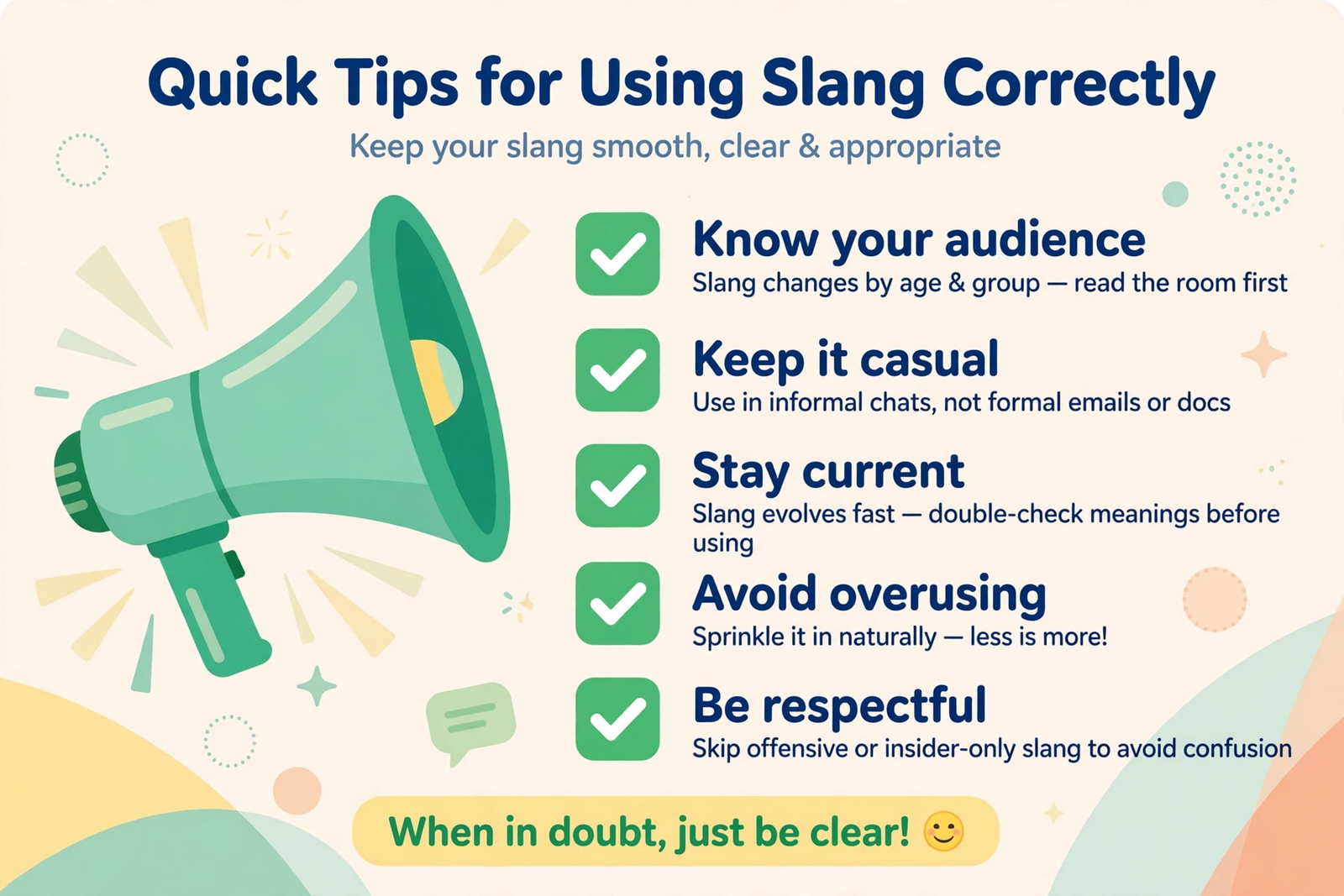
Want to use boom slang like a native speaker? These tips will help you drop it naturally and at the right moment.
- Let the moment earn it: boom works best after a real win, a great joke, or a satisfying finish. The bigger the moment, the better the boom lands.
- Pair it with a gesture: in person, boom works even better with a small gesture — a fist pump, a clap, or a confident nod. The word is a sound effect, so act like one.
- Use it in captions: boom is a perfect one-word caption for a glow-up photo, a finished project, or a big reveal. Short captions get more engagement, and boom says it all.
- Keep it short in texts: “Boom!” on its own is a complete message. You do not need to add a paragraph after it — the word is the message.
- Match your audience: with friends, go loud. With coworkers, stick to “booming” as a verb. With strangers, a simple smile and a “boom” after a shared joke is enough.
- Learn the phrases, use them rarely: knowing “boom shakalaka” and “boom goes the dynamite” makes you fluent in the culture of the word — but using them every day makes you sound like a time traveler.
- Watch the punctuation: “Boom!” is excitement, “Boom.” is confidence, “Boom…” is suspense. Pick the one that matches what you mean.

FAQ
What does boom mean in slang?
In slang, boom is an exclamation that celebrates a win, emphasizes a point, or describes something amazing or suddenly successful. It can also be a verb meaning to explode in popularity, as in “the song boomed on TikTok.” The word comes from the sound of an explosion, which is why it carries that feeling of sudden impact.
Is boom slang rude or offensive?
No, boom is not rude or offensive. It is a playful, energetic word that is safe to use with friends, family, and most casual audiences. The only risk is using it in a formal setting where its casual tone does not fit — but the word itself is completely clean.
What does “boom shakalaka” mean?
“Boom shakalaka” is a playful, old-school way to celebrate something impressive, popular in the 1990s through hip-hop and sports commentary. It means roughly the same as “boom” — a big, happy celebration — but with extra retro style. It is mostly used jokingly today.
What does “boom goes the dynamite” mean?
“Boom goes the dynamite” describes a dramatic or funny failure, or a moment that blows up in someone’s face. It comes from a famous viral sports blooper video from the mid-2000s, where a student broadcaster used the phrase after a series of on-air mistakes. Today it is used as a meme caption for spectacular fails.
Can boom be used as a verb?
Yes. As a verb, boom means to grow or explode suddenly — a business can be booming, a song can boom on the charts, and a bass line can boom through speakers. This verb form is standard English and is acceptable even in professional settings, unlike the exclamation form.
What is the difference between boom and bam?
Both are sound-effect words used to mark a sudden moment, but boom feels bigger and more dramatic, while bam feels quicker and snappier. “Boom, done” sounds like a triumph; “bam, done” sounds like a magic trick. They are often interchangeable, and the choice is mostly about style.
Is boom still popular in 2026?
Yes, boom is still widely used in 2026. It shows up in TikTok captions, gaming chats, sports commentary, and everyday conversation. Because it is not tied to one generation or one platform, it has stayed relevant far longer than most slang words, and it shows no signs of disappearing.
When should you not say boom?
Avoid boom in formal settings like job interviews, serious meetings, or condolence messages, where its playful energy does not fit. Also avoid it for genuinely bad news, since people expect boom to signal something good. And do not overuse it — a word that marks a special moment loses its power if you say it ten times a day.
Conclusion
So, what does boom mean in slang? It means the moment landed — the win, the joke, the reveal, the beat, the comeback. From its roots as the sound of an explosion, through comic books, hip-hop, viral videos, and TikTok, boom became one of the most durable celebration words in English. It is short, it is loud, and it is instantly understood by almost everyone who hears it.
The key takeaways are simple: boom is an exclamation for celebrating, a verb for sudden growth, and a sound effect for anything that hits with impact. Use it when the moment deserves it, save the verb form for work, and keep the retro phrases for jokes with friends who will appreciate them. Like all great slang, boom works best when it feels natural — forced hype falls flat, but a well-timed “boom!” after a real win never does.
Want to keep building your slang vocabulary? Check out our guides to tysm meaning and cfs meaning in text — both break down popular texting terms the same clear way. And if you are curious how dictionaries define the word, Merriam-Webster’s definition of boom covers both the literal and slang senses. Now go out there, find your moment, and say it with confidence: boom.

1 thought on “Boom Slang Meaning: What Does Boom Mean in Slang? (2026 Guide)”