tik tok slang Meaning & Definition
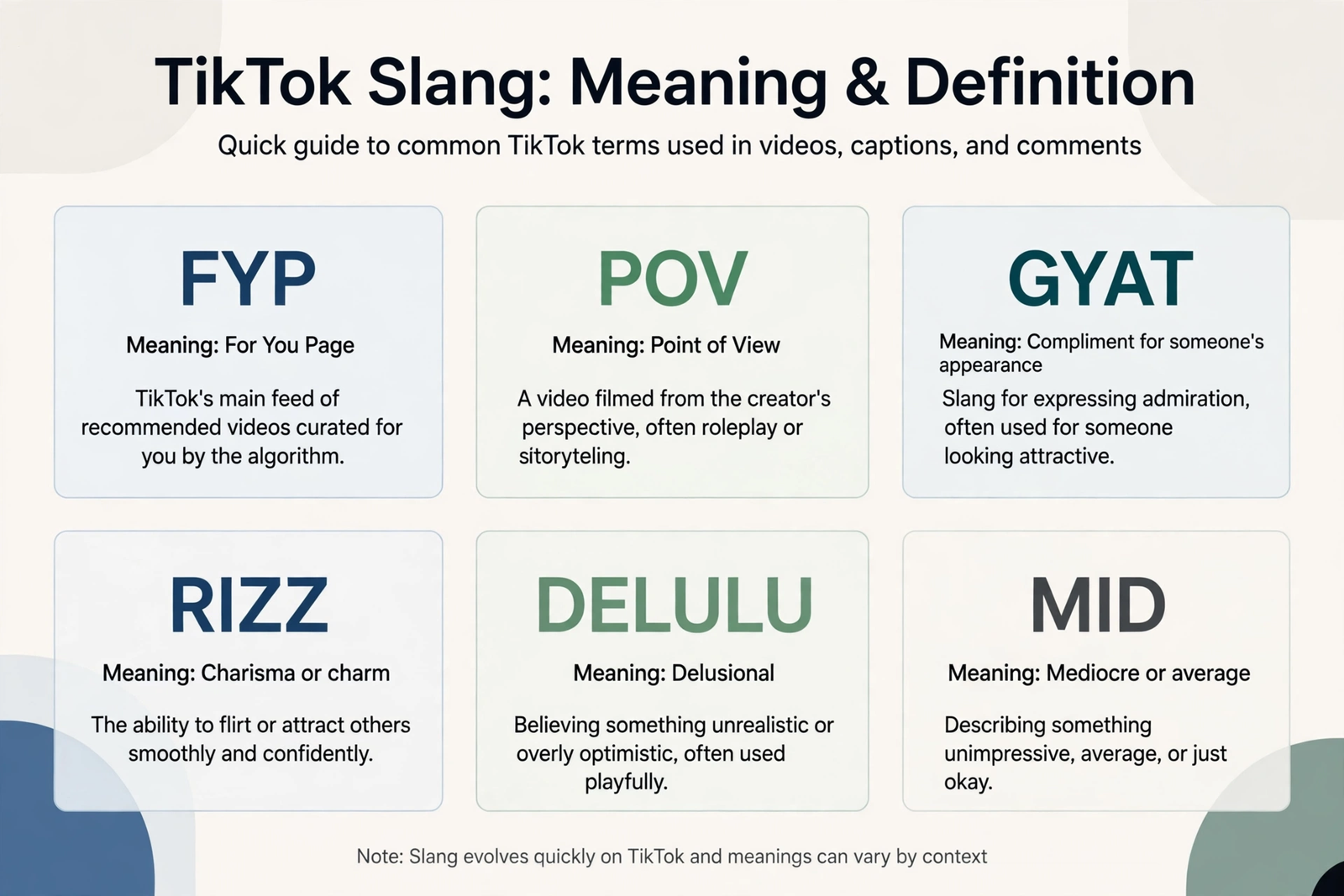
tik tok slang refers to the fast-moving set of words, abbreviations, phrases, and inside jokes that were born — or made famous — on TikTok, the short-video app where trends can explode overnight. If you have ever read a comment like “no thoughts, head empty” or “it’s giving main character energy” and wondered what on earth it meant, you were looking at tik tok slang in action. In simple words, tik tok slang is the informal language of TikTok culture: playful, creative, constantly changing, and deeply tied to viral videos, memes, sounds, and challenges. It includes brand-new words (like “cheugy” and “rizz”), old words given new meanings (like “slay” and “tea”), and short forms such as “FYP”, “POV”, and “GRWM” that regular users type without thinking twice.
Unlike traditional slang, which might take years to spread through a city or a country, tik tok slang can travel around the world in a single weekend. One viral video is often all it takes for a strange new phrase to appear in millions of comments, captions, group chats, and even real-life conversations. That speed is exactly why so many people — parents, teachers, marketers, and curious scrollers alike — keep searching for what these words mean. This guide breaks it all down in plain English, with real examples, so you never feel lost in a TikTok comment section again.
| Term | Quick Meaning |
|---|---|
| tik tok slang | Informal words and phrases popularized by TikTok videos, comments, and trends |
| FYP | “For You Page” — TikTok’s main discovery feed |
| POV | “Point of view” — a video style that puts you inside a scene |
| Slay | To do something exceptionally well or look amazing |
| Rizz | Charisma, especially romantic charm or flirting skill |
| No cap | “I’m not lying” / “for real” |
Introduction
Open TikTok for five minutes and you will meet a whole new language. Comments fly by in shorthand, captions are packed with abbreviations, and creators drop phrases that sound like a secret code. For regular users, it feels natural. For everyone else, it can feel like landing in a foreign country without a phrasebook. That is the power — and the confusion — of tik tok slang. It is not just random internet talk; it is a living, breathing dialect shaped by teenagers, creators, comedians, musicians, and millions of everyday people who post, comment, and remix each other’s ideas every single day.
What makes tik tok slang so interesting is how quickly it jumps off the app. A phrase that starts as a joke in one video can end up in a text message from your best friend, a tweet, a song lyric, or even a news headline within days. Words like “rizz” went from TikTok comments to being named Oxford’s Word of the Year, and “slay” went from drag culture to everyday compliments. Understanding this slang is not just about keeping up with trends — it is about understanding how a whole generation communicates, jokes, flirts, and expresses identity online.
In this guide, we will walk through where tik tok slang comes from, why it spreads so fast, how people actually use it in comments, captions, and chats, and what the most popular terms really mean. You will also find plenty of real-life examples, a comparison with other kinds of internet slang, polite alternatives for work or formal settings, and the common mistakes to avoid. Whether you are a parent trying to decode your teenager’s texts, a creator who wants to sound natural, or simply curious, this is your complete, beginner-friendly guide. If you enjoy decoding internet language, you may also like our breakdown of fn meaning in text, another phrase that confuses people in chats every day.
Origin
TikTok itself launched internationally in 2017, after its parent company ByteDance merged it with the lip-syncing app Musical.ly in 2018. Musical.ly already had a young, creative audience that loved making short videos to popular songs, and TikTok kept that energy while adding a powerful recommendation algorithm — the famous For You Page. Instead of only seeing posts from people you followed, you suddenly saw videos from strangers all over the world, chosen for you because the app thought you would like them. That single design choice changed internet language forever.
Before TikTok, slang usually spread slowly: from a neighborhood, to a city, to a country, and eventually into the mainstream. TikTok collapsed that timeline. A creator in Los Angeles could invent a phrase on Monday, a creator in London could remix it on Tuesday, and by Friday millions of people in dozens of countries were using it. The app’s short-video format helped too. With only 15 to 60 seconds to make a point, creators favored short, punchy, memorable language — exactly the kind of language that becomes slang.
Many tik tok slang terms also have deeper roots. Some come from African American Vernacular English (AAVE) and ballroom and drag culture, where words like “slay,” “tea,” “shade,” and “serving” had been used for decades before TikTok discovered them. Others come from gaming communities, K-pop fandoms, and stan culture. TikTok did not always invent these words, but it amplified them to a global audience at a speed no earlier platform could match. Understanding that history matters, because it reminds us that behind every funny phrase there is usually a real community that created it.
The pandemic years of 2020 and 2021 poured fuel on the fire. With billions of people stuck at home, TikTok downloads exploded, and the app became the center of online culture. Dance challenges, cooking hacks, storytimes, and comedy sketches all carried new slang with them. Words like “bussin,” “cheugy,” “simp,” and “sus” went from niche jokes to everyday vocabulary in a matter of months. Even mainstream dictionaries started adding TikTok-born words, and brands began hiring young creators just to help them sound fluent in the language of the app.
Popularity
Today, TikTok has more than a billion monthly active users around the world, and its influence on language is hard to overstate. Scroll through any social platform — Instagram, X (formerly Twitter), YouTube, or even Facebook — and you will find TikTok phrases everywhere. Creators cross-post their videos, screenshots of TikTok comments go viral elsewhere, and news outlets regularly publish explainers with titles like “What does this TikTok word mean?” The language of the app has become the language of the internet.
Several things keep tik tok slang so popular. First, it is fun. These words are playful, dramatic, and expressive — saying “she ate that” feels more exciting than saying “she did well.” Second, it creates belonging. Using the right slang at the right time signals that you are part of the community, that you get the joke. Third, it is constantly fresh. Because trends move so quickly, there is always a new word to learn, a new joke to share, and a new way to describe something ordinary in an extraordinary way.
The popularity of tik tok slang also shows up in places you might not expect. Teachers report hearing it in classrooms, parents hear it at the dinner table, and advertisers build entire campaigns around it. In 2023, Oxford University Press chose “rizz” — a TikTok-popularized word for charisma — as its Word of the Year, after its usage exploded online. Major dictionaries now track TikTok trends when deciding which new words to add. And when a word like “delulu” (short for delusional, used jokingly for hopeless romantic fantasies) or “demure” (used ironically to describe modest, mindful behavior) takes off, it can dominate conversation for weeks.
But popularity comes with a catch: tik tok slang ages fast. A word that feels fresh in January can feel cringe by June, and using last year’s slang can mark you as out of touch. That is why guides like this one matter — they help you understand not just what words mean, but which ones are still current, which ones have faded, and how to use them without sounding like you are trying too hard. The golden rule is simple: slang works best when it sounds natural, not forced.
How It Is Used
Tik tok slang shows up in almost every corner of the app, and each place has its own style. In comments, people use short, punchy slang to react quickly: “SLAY,” “no because why is this so accurate,” “the accuracy is sending me,” or a simple “ate.” In captions, creators use slang to set the mood of a video: “POV: you finally understand the assignment” or “GRWM for a very demure evening.” In video audio and on-screen text, slang often carries the whole joke — a creator might mouth “it’s giving…” and let the audience fill in the rest.
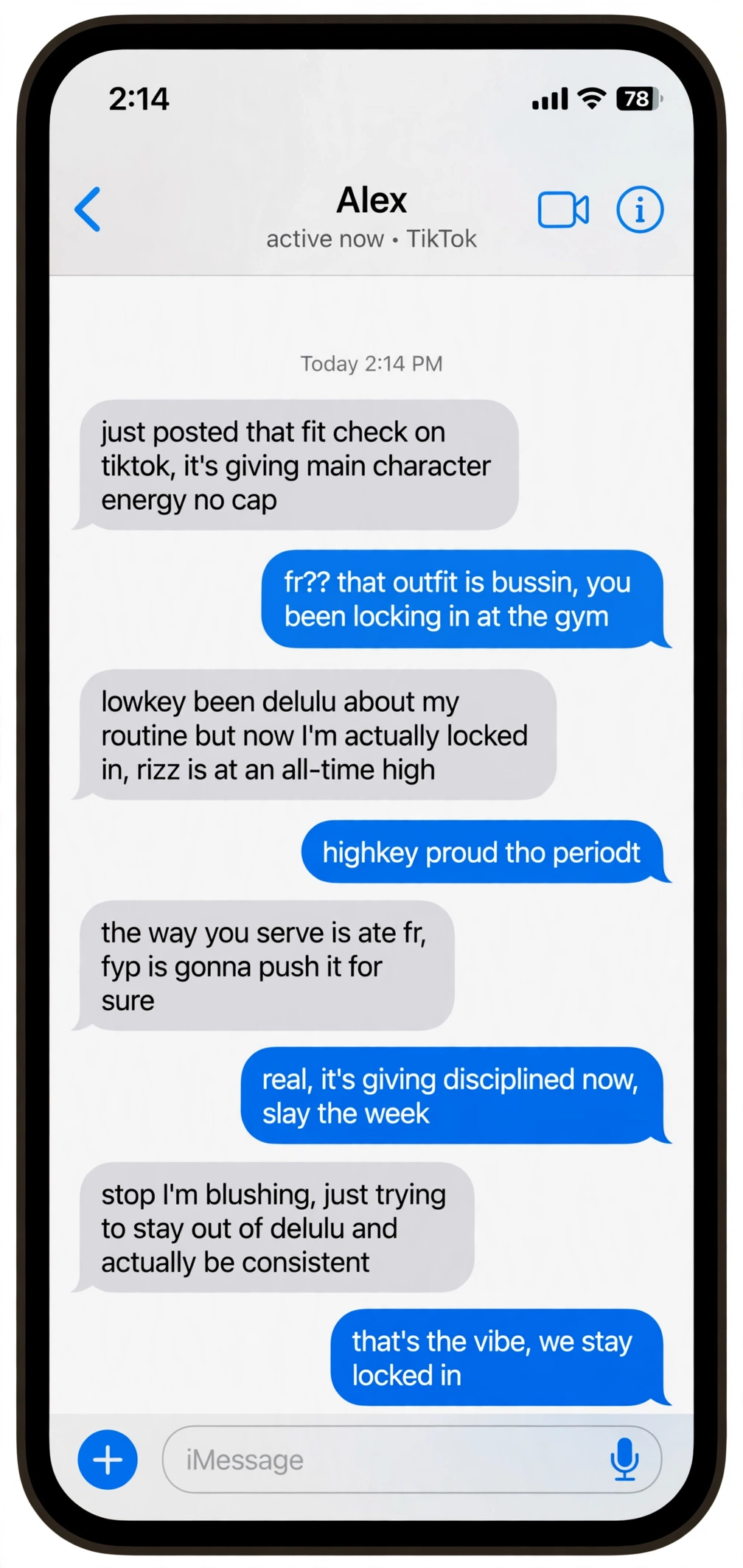
Beyond TikTok, the same slang spills into text messages, group chats, and DMs, where friends use it to joke, react, and exaggerate. A friend might text “bro has zero rizz” after a failed flirting attempt, or “this fit is bussin” about a great outfit. On other platforms like Instagram and X, TikTok phrases appear in memes, replies, and bios. Even in real life, young people drop TikTok words into spoken conversation — sometimes without realizing it — because the language feels natural to them now.
Here is how tik tok slang is typically used across different situations:
- To react: “She ate and left no crumbs” means someone did something perfectly.
- To agree: “No cap, that’s so true” adds honest emphasis to an opinion.
- To joke: “Me, delulu as always” pokes fun at your own unrealistic hopes.
- To describe a vibe: “It’s giving cozy autumn energy” captures a feeling in a few words.
- To label a trend: “That outfit is so cheugy” calls something outdated or trying too hard.
- To tell a story: “Storytime: my situationship had the audacity” sets up a dramatic tale.
One important thing to remember is that context changes everything. The same word can be a compliment, a joke, or an insult depending on tone and situation. “Sus” can be a playful accusation among friends or a serious warning. “Slay” can praise a performance or celebrate an outfit. If you are unsure how a TikTok slang term is being used, look at the video, the surrounding comments, and the tone — the context almost always gives the meaning away.
Examples
Seeing tik tok slang in real sentences is the fastest way to learn it. Below are examples in friendly, professional, and funny tones, so you can see how the same kind of language shifts depending on who is talking and where. Notice how the words stay the same, but the feeling changes completely with context.
Friendly Examples
- “Girl, your makeup today? You absolutely slayed it, no cap. 🔥” — a friend hyping up another friend’s look.
- “POV: we finally find a brunch place with no wait — best day ever!” — a playful caption for a video with friends.
- “Okay but this song is so bussin, I’ve had it on repeat all week.” — a casual compliment about a new track.
- “You’re literally the main character today, it’s giving confidence. ✨” — a warm, encouraging message.
- “Lowkey obsessed with this thrift haul, everything ate and left no crumbs.” — a friend sharing excitement about shopping.
- “No thoughts, head empty, just vibes — that’s my whole mood this weekend.” — a relaxed, relatable joke between friends.
- “He has so much rizz, I don’t know how he does it.” — admiring a friend’s easy charm.
Professional Examples
TikTok slang rarely belongs in formal emails or meetings, but it does appear in creative industries, social media marketing, and casual workplace chats — usually in a softened, careful form. Here is how it can look when used lightly and appropriately:
- “This campaign is giving exactly the energy our audience loves — let’s lean into it.” — a marketer describing a brand vibe in a team brainstorm.
- “The new product demo? It honestly slayed — engagement was our best yet.” — a social media manager celebrating results in a casual team chat.
- “POV: you finally find a project tool that actually works.” — a relatable, light-hearted caption on a brand’s TikTok account.
- “No cap, our customers keep asking for this feature, so let’s prioritize it.” — a teammate emphasizing honest feedback in a stand-up meeting.
- “That presentation was very demure, very mindful — clean slides, clear message.” — a playful compliment borrowing a viral TikTok joke, used only when the team shares the reference.
The rule for professional settings is simple: only use tik tok slang at work if you are sure everyone in the room understands it and the tone fits. When in doubt, use plain, professional language instead — you can always save the slang for your friends.
Funny Examples
- “Me explaining to my mom why I need a third Stanley cup: it’s giving hydration, it’s giving aesthetic, it’s giving… I have no self-control. 😭”
- “My bank account after I said ‘treat yourself’ for the fifth time this week: girl, you ate… my entire salary.”
- “POV: you say ‘just one episode’ at 9 p.m. and suddenly it’s 3 a.m. and you’re emotionally invested in a show about competitive baking.”
- “Bro really said ‘trust me, I have rizz’ and then got left on read in 0.2 seconds. The audacity. 💀”
- “My toxic trait is thinking I can learn a full TikTok dance in five minutes. The video evidence says otherwise.”
- “Nobody: … Absolutely nobody: … Me at 2 a.m.: ‘What if I just… became a morning person?’ Delulu is the solulu, apparently.”
- “It’s giving broke, it’s giving tired, it’s giving I need a nap and a snack in that exact order.”
Funny tik tok slang works because it exaggerates everyday moments into dramatic little performances. The humor comes from the contrast — using grand, confident language (“slay,” “main character,” “ate”) to describe completely ordinary things like doing laundry or watching TV. That playful exaggeration is a huge part of why the slang feels so fun to use.
Comparison with Similar Terms
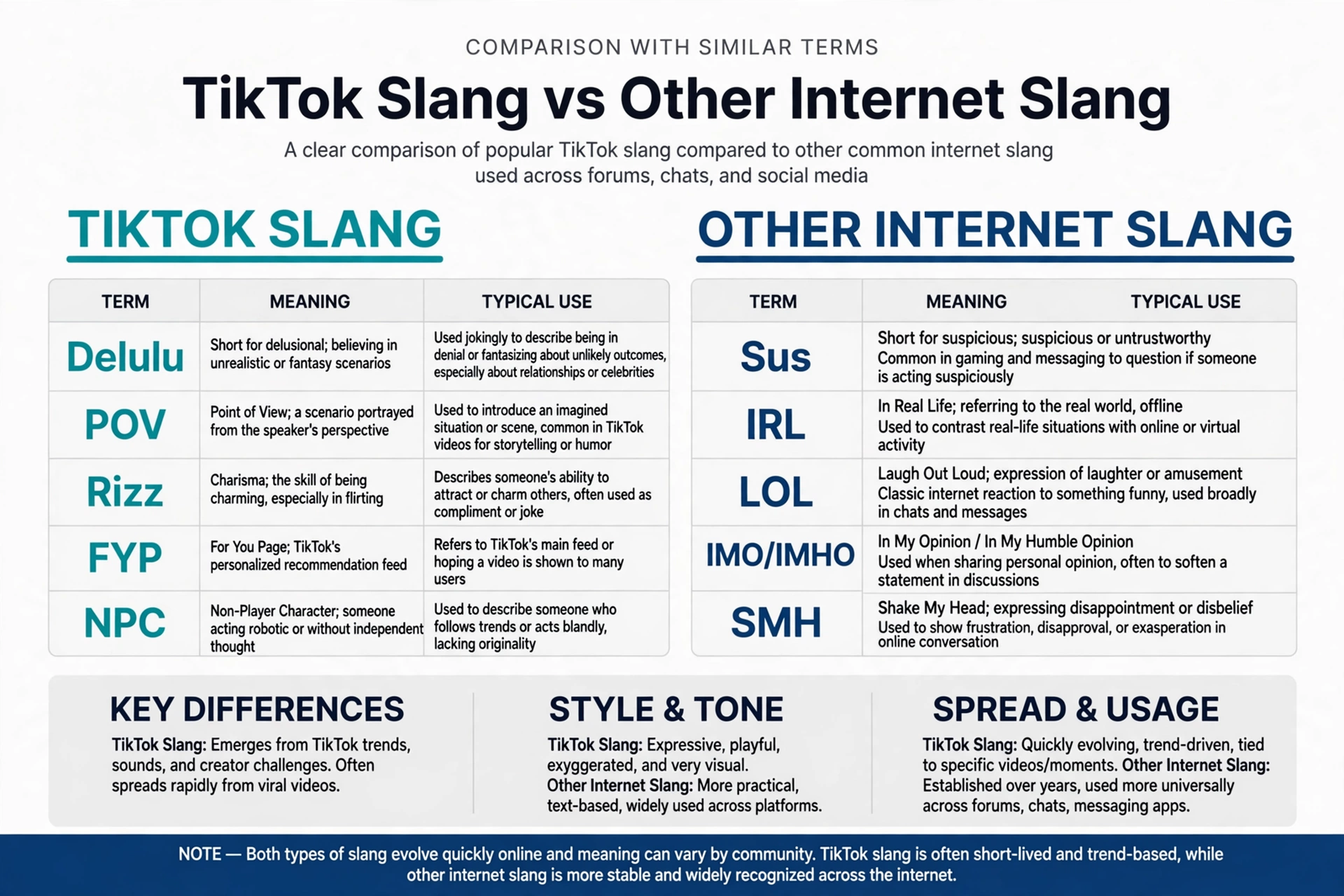
TikTok slang is often confused with other kinds of internet slang, but each type has its own home, style, and lifespan. Texting slang is built for speed in private chats, Instagram slang leans visual and aesthetic, Twitter or X slang is built for hot takes and arguments, and gaming slang comes from competitive play. TikTok slang borrows from all of them — and then adds its own video-first, trend-driven flavor. The table below shows how they compare.
| Feature | tik tok slang | Texting Slang | Instagram Slang | Twitter / X Slang |
|---|---|---|---|---|
| Where it lives | TikTok videos, comments, captions | SMS, WhatsApp, DMs | Captions, Stories, Reels | Posts, replies, quote tweets |
| Typical words | Slay, rizz, bussin, delulu, ate | LOL, BRB, OMW, NGL, TBH | Aesthetic, vibe, link in bio, dump | Ratio, moot, stan, timeline, cooked |
| Main purpose | React, joke, and ride trends | Save time while chatting | Show lifestyle and mood | Argue, joke, and go viral |
| Speed of change | Very fast — weekly trends | Slow — classics last years | Medium — seasonal aesthetics | Fast — driven by news cycles |
| Tone | Playful, dramatic, expressive | Quick, casual, practical | Polished, curated, visual | Witty, sarcastic, punchy |
| Example sentence | “It’s giving main character energy.” | “OMW, be there in 5, NGL I’m tired.” | “Golden hour dump, no filter needed.” | “This take is cooked, ratio incoming.” |
The biggest difference is the engine behind the slang. Texting abbreviations like “LOL” and “BRB” were invented to save keystrokes, and they have stayed useful for decades. TikTok slang, on the other hand, is invented to entertain — to make a video funnier, a comment more dramatic, or a reaction more shareable. That is why it changes so quickly and why it feels so creative. A TikTok term can also outgrow its home: words that start on TikTok, like “rizz” or “cheugy,” often spread to texting, Instagram, and everyday speech within months. If you want to compare how other short forms work in chats, check out our guide to pmo meaning in text — it follows the same pattern of a tiny abbreviation carrying a big attitude.
Alternate Meanings
Like most internet slang, “tik tok slang” does not always mean exactly the same thing to everyone. The phrase itself can point to a few different ideas depending on who says it and where, and many individual TikTok terms carry more than one meaning as well. Here are the main alternate readings to know:
- The language of TikTok in general: Most of the time, people use “tik tok slang” to mean the whole vocabulary of the app — the words, phrases, and abbreviations popular there. This is the most common meaning, and the one this guide focuses on.
- A specific viral word or trend: Sometimes someone says “that’s such tik tok slang” about a single word, like “delulu” or “demure,” meaning it became famous because of TikTok, even if it existed before.
- Gen Z internet speak: Older users sometimes use “tik tok slang” loosely to mean any modern youth slang online, whether or not it actually started on TikTok. In this loose sense, it is almost a synonym for “Gen Z slang.”
- Video captions and sounds: In creator communities, “tik tok slang” can also refer to the repeated phrases attached to trending sounds — lines like “very demure, very mindful” or “no thoughts, head empty” that become templates thousands of people copy.
Individual terms shift meaning too. “Tea” can mean gossip (“spill the tea”) or simply the truth. “Slay” can praise a performance, an outfit, or even a witty comeback. “Sus” can mean suspicious, strange, or just a little bit off. “Ate” almost always means “did it perfectly,” but “ate that up” can also mean someone believed a lie completely. And “bussin” started as a compliment for delicious food before expanding to anything amazing — a song, an outfit, or a whole vibe can now be “bussin.” The lesson is always the same: check the context before you decide what a word means, because TikTok slang loves a double meaning.
Professional or Polite Alternatives
TikTok slang is perfect for friends, comments, and captions — but it can sound out of place in a job interview, a formal email, a classroom presentation, or a conversation with someone who does not use social media. The good news is that almost every slang term has a natural, professional equivalent. Use the table below as a quick translation guide.
| tik tok slang | What It Means | Professional / Polite Alternative |
|---|---|---|
| Slay | Did something excellently | “Excellent work” / “You did a wonderful job” |
| No cap | Honestly, I’m not lying | “Honestly” / “To be completely frank” |
| Rizz | Charisma, charm | “Charisma” / “Great people skills” |
| Bussin | Amazing, excellent | “Outstanding” / “Really impressive” |
| It’s giving… | It has the vibe of… | “It gives the impression of…” |
| Main character energy | Confident, standing out | “Confident presence” / “Commanding attention” |
| Delulu | Unrealistically hopeful | “Overly optimistic” / “Wishful thinking” |
| Ate / ate that up | Performed perfectly | “Nailed it” / “Performed brilliantly” |
| Lowkey | Secretly, quietly | “Honestly” / “If I’m being candid” |
| Vibe / vibes | Feeling or atmosphere | “Atmosphere” / “Overall feeling” |
Switching between slang and professional language is a skill, not a chore. Think of it like changing outfits: you would not wear a party outfit to a job interview, and you would not wear a suit to a friend’s birthday. Language works the same way. Knowing both versions — the fun TikTok version and the polished professional version — means you can fit in anywhere without losing your personality.
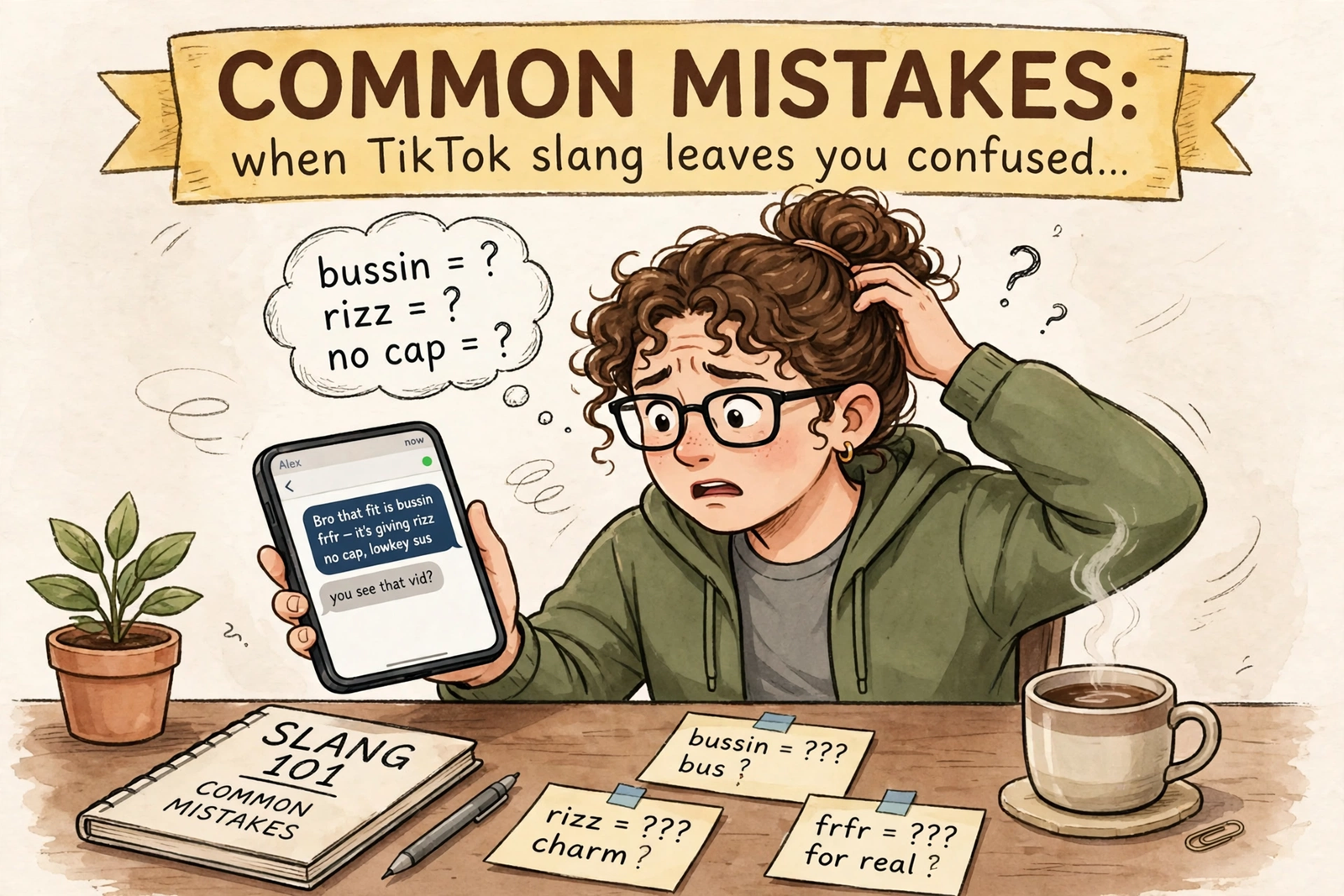
Common Mistakes
Using tik tok slang wrong is easy, and the results can range from mildly embarrassing to genuinely awkward. These are the mistakes people make most often — and how to avoid them:
- Using slang you do not understand: Never drop a word into a sentence just because it sounds cool. If you do not know what “cheugy” or “situationship” means, look it up first — using it wrong is worse than not using it at all.
- Forcing it in formal settings: Telling your boss a report “slayed” or that a client meeting was “bussin” will probably not land the way you hope. Match your language to the room.
- Mixing up similar terms: “Sus” (suspicious) is not the same as “sussy” (a joking variant), and “rizz” (charm) is not the same as “aura” (overall presence or coolness). Small differences matter.
- Using outdated slang: TikTok moves fast. Words that were everywhere last year — like “cheugy” or “no thoughts, head empty” at their peak — can sound stale now. If everyone has stopped saying it, you should too.
- Overusing slang in every sentence: A comment packed with “slay, no cap, bussin, periodt, ate” sounds like a parody, not a person. One or two slang words per sentence is plenty.
- Ignoring where words come from: Many TikTok terms come from AAVE and Black, queer, and drag communities. Using them respectfully — and giving credit where it is due — matters more than sounding trendy.
- Assuming one meaning fits everywhere: “Tea” means gossip in one sentence and truth in another. Always read the context before replying.
- Correcting others aggressively: If someone uses a term slightly differently, that is often just how language works online. Gentle curiosity beats public correction every time.
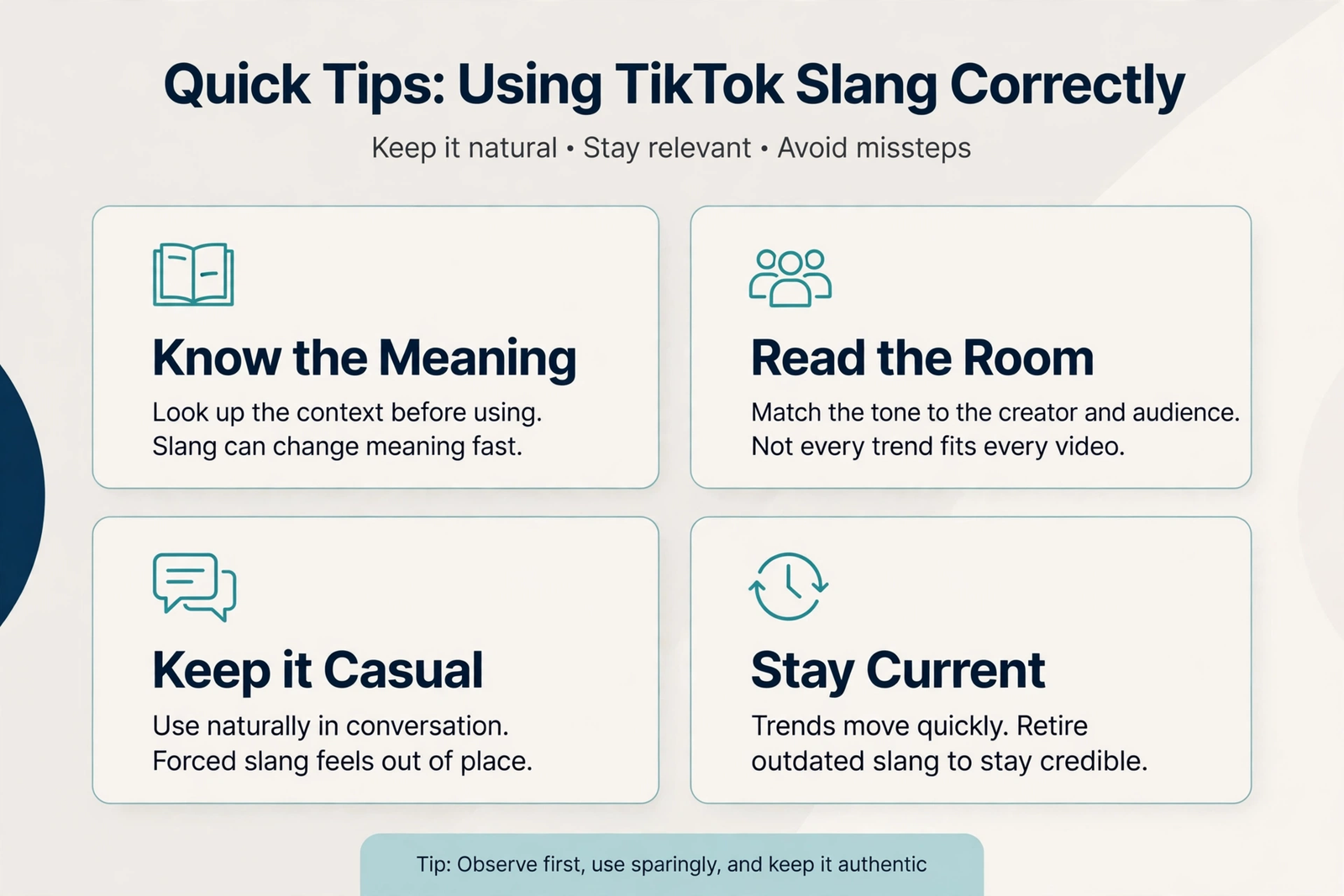
Quick Tips
Want to sound natural with tik tok slang instead of trying too hard? These quick tips will help you learn fast and use the language with confidence:
- Watch before you speak: Spend time reading TikTok comments before using new slang yourself. You will absorb the tone, timing, and context naturally.
- Learn one or two terms at a time: Mastering “slay” and “no cap” properly is better than half-knowing twenty words. Add new terms slowly.
- Copy the context, not just the word: Notice whether people use a term as a compliment, a joke, or an insult — then use it the same way.
- Keep it light: TikTok slang is playful by nature. If a sentence starts to sound forced, swap the slang word for a plain one.
- Check the date: Search a term before using it in something public, like a caption or a work post, to make sure it is still current and means what you think it means.
- Use it where it belongs: Comments, captions, group chats, and friendly DMs are the natural home of tik tok slang. Formal emails and interviews are not.
- When unsure, ask or look it up: There is no shame in searching “what does this TikTok word mean” — millions of people do it every month, and it beats guessing wrong in front of an audience.
- Have fun with it: Slang is supposed to be enjoyable. Play with it, laugh with it, and do not stress about being perfect — even native users mix terms up sometimes.

FAQ
What does tik tok slang mean?
tik tok slang means the informal words, abbreviations, and phrases that became popular on TikTok, the short-video app. It includes terms like “slay,” “rizz,” “no cap,” “bussin,” “POV,” and “FYP,” used in videos, comments, captions, and chats to react, joke, and describe trends in a fun, expressive way.
What are some common examples of tik tok slang?
Some of the most common examples include “slay” (do something excellently), “rizz” (charisma or flirting skill), “no cap” (I’m not lying), “bussin” (amazing, especially food), “delulu” (delusionally hopeful), “ate” (performed perfectly), “POV” (point of view), “FYP” (For You Page), and “it’s giving…” (it has the vibe of…). New terms appear constantly as trends change.
What does “slay” mean on TikTok?
On TikTok, “slay” means to do something exceptionally well or to look amazing. If someone comments “you slayed this” on a dance video, they mean the performance was perfect. If a friend says “she slayed that outfit,” they mean the outfit looked incredible. It is one of the most positive words in tik tok slang.
What does “rizz” mean in tik tok slang?
“Rizz” is short for charisma, and it means the ability to attract or charm someone, usually in a romantic or flirting context. Someone with “rizz” is smooth, confident, and good at talking to people they like. The word became so popular that Oxford University Press named it Word of the Year in 2023.
Is tik tok slang the same as Gen Z slang?
Not exactly, though they overlap a lot. Gen Z slang is the broader language of people born roughly between 1997 and 2012, used across many platforms and in real life. tik tok slang is the part of that language that lives on, or was popularized by, TikTok specifically. Many TikTok terms become Gen Z slang, but not all Gen Z slang comes from TikTok.
What does “no cap” mean on TikTok?
“No cap” means “I’m not lying” or “for real.” People say it to emphasize that they are being completely honest, as in “No cap, that was the best concert I’ve ever been to.” Its opposite is “cap,” which means a lie — so “that’s cap” means “that’s not true.” The phrase comes from hip-hop culture and became hugely popular on TikTok.
What does POV mean in tik tok slang?
POV stands for “point of view.” On TikTok, a POV video puts the viewer inside a scene, usually with a caption like “POV: you’re the new kid on the first day of school.” The creator acts out the scenario as if you are living it. The format is one of TikTok’s most popular video styles and is now used across almost every social platform.
How can I learn tik tok slang quickly?
The fastest way is to spend time on TikTok itself: watch videos, read the comments, and notice which words keep appearing. Look up any term you do not understand, learn one or two at a time, and try using them in casual chats with friends before using them publicly. Guides like this one, plus dictionary explainers such as Dictionary.com’s TikTok slang guide, are great for checking meanings quickly.
Conclusion
tik tok slang is much more than a collection of funny words — it is a window into how millions of people communicate, joke, and connect in the age of short video. From “slay” and “rizz” to “no cap” and “POV,” these terms pack humor, emotion, and identity into just a few syllables, and they travel from a single viral video to the whole world in a matter of days. Understanding them means understanding the culture that created them: fast, creative, playful, and always changing.
The practical advice is simple. Learn the most common terms first, watch how real people use them in context, and use them where they belong — in comments, captions, and friendly chats, not in formal emails or job interviews. Do not force slang you do not understand, do not overuse it, and remember that the words themselves often come from real communities with real histories. A little respect goes a long way. If you keep learning one or two terms at a time, you will go from confused to fluent faster than you think — and you might even enjoy the process. For more internet language decoded the same way, explore our guide to asl meaning in text or wyg meaning in text, two more abbreviations that pop up in chats every day.
