Quick Definition: The amos meaning slang is simple — AMOS stands for “Add Me On Snapchat.” It is a short invitation people drop into bios, captions, comments, and chats when they want someone to add them as a friend on Snapchat. Instead of typing out the whole sentence, they write four letters, and everyone who knows the code understands instantly: find me on Snap and add me.
Amos Meaning Slang & Definition
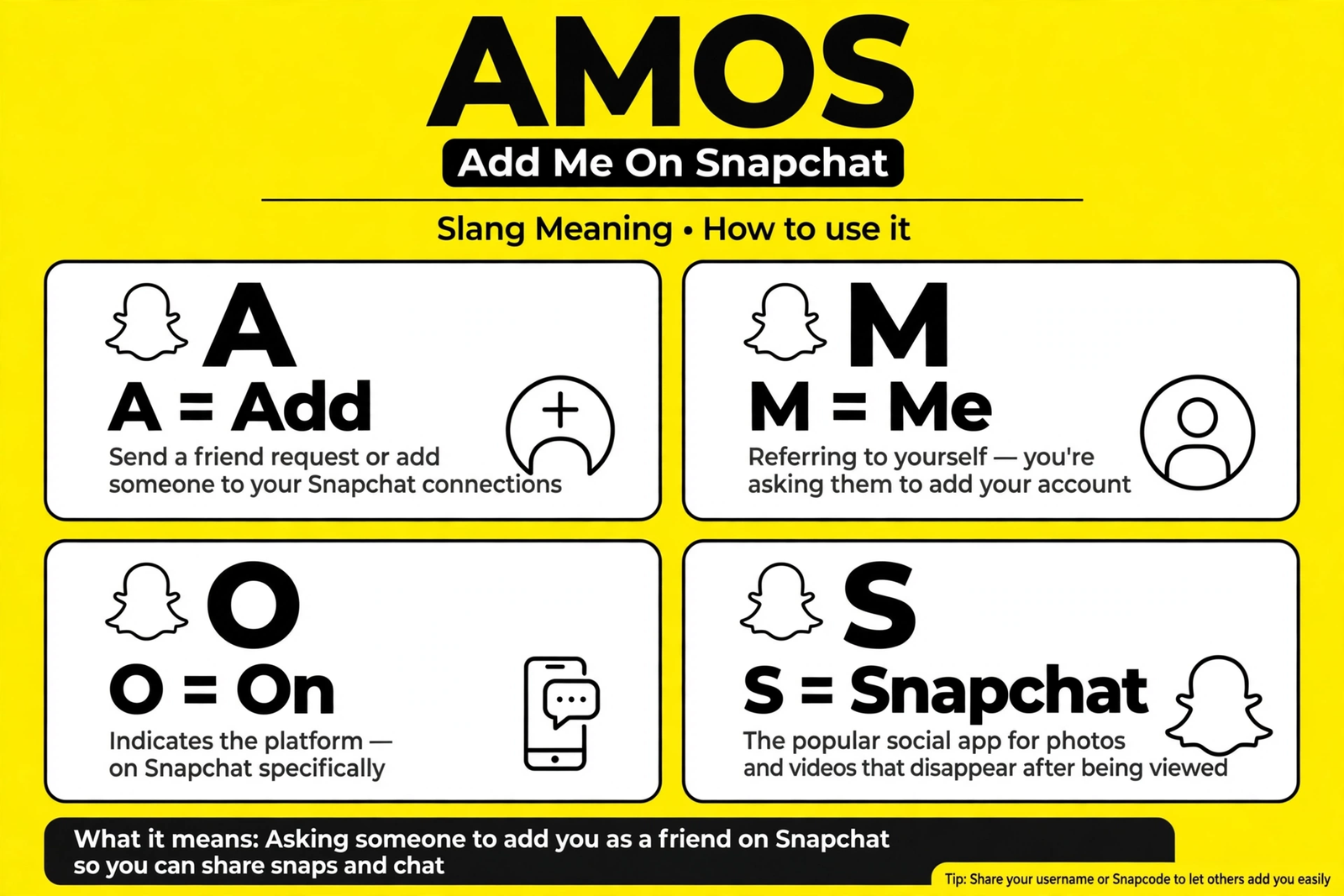
AMOS is an acronym built from the first letters of four words: Add Me On Snapchat. In slang, the amos meaning slang is always a request, never a statement. When someone writes AMOS, they are saying, “I want you to add me on Snapchat,” in the shortest way possible.
Unlike many slang words that shift meaning from platform to platform, AMOS is unusually stable. On Snapchat itself, on TikTok, on Instagram, in a dating-app bio, or in a gaming lobby, it means the same thing: let us connect on Snapchat. The word does not describe a feeling, a joke, or an object. It is a call to action — a tiny digital handshake.
That stability is part of why AMOS has survived for years while other acronyms faded. Internet slang usually burns bright and dies fast, but AMOS solves a real, repeated problem: people meet on one app and want to move the conversation somewhere more private, more visual, and more immediate. Snapchat is that somewhere for millions of users, and AMOS is the bridge between the two apps.
It is also worth saying what AMOS is not. It is not a name in this context, even though Amos is a real given name and a biblical prophet. It is not a typo. And it is not a general invitation to follow someone everywhere — it points at one specific app, Snapchat, and one specific action, adding a friend. If you see AMOS in a bio, the person is not asking you to follow them on Instagram or subscribe on YouTube. They are asking for a Snap add.
Introduction
Picture this: you are scrolling TikTok late at night and a creator you like ends their video with a caption that reads “AMOS 👻” next to their Snapchat username. Or you match with someone on a dating app, and their profile says, in three words, “AMOS if interested.” Or a friend texts you after a party: “good meeting you! AMOS?” You have just met one of the internet’s most practical pieces of slang — and if you did not know it, the message probably felt like a riddle.
That is the everyday reality of the amos meaning slang. It lives in the small spaces of the internet — bios, captions, comments, and direct messages — where character counts are short and attention spans are shorter. In those spaces, “Add Me On Snapchat” is too long. AMOS does the same job in four letters, and it doubles as a small signal: the person using it knows the culture, and they assume you do too.
This guide unpacks AMOS completely. You will learn the exact definition, where it came from, why it became so popular, how people use it on Snapchat, TikTok, Instagram, and dating apps, and how it compares with similar acronyms like ttm meaning in text and SFS. You will see real examples in friendly, professional, and funny tones, the common mistakes people make with it, quick tips for using it safely, and answers to the eight questions people search for most. By the end, AMOS will never confuse you again — and you will know exactly when to use it and when to leave it alone.
Origin
AMOS was born inside Snapchat culture. Snapchat launched in 2011 and grew fast among teenagers and young adults who wanted a place to share photos and videos that disappeared instead of living forever on a public feed. As the app grew, so did a problem: how do you tell someone to add you on Snapchat when you are talking to them somewhere else?
In the early 2010s, people typed the full phrase — “add me on Snapchat” — in their Instagram bios, tweets, and forum signatures. It worked, but it was clumsy, and the internet hates clumsy. Shortening was inevitable. Users began trimming the phrase to its initials, and AMOS appeared in bios and captions around the mid-2010s, at the same time as a whole family of platform-invitation acronyms. The timing matters: this was the era when every social app was fighting for attention, and users were constantly funnelling friends from a public platform to a private one.
The acronym also got a boost from TikTok. As TikTok exploded in the late 2010s and early 2020s, creators needed a fast way to move followers to Snapchat, where they could share more personal, unfiltered, or exclusive content. A TikTok slang guide from Dexerto confirms that AMOS is one of the platform-invitation acronyms TikTok users recognise most, usually appearing in bios next to a Snapchat username. A TikTok bio has limited space, and a video caption disappears in seconds — “AMOS” fits both. Creators started putting AMOS next to their Snap usernames, viewers copied the habit, and the term crossed from Snapchat natives into the wider internet.
Urban Dictionary entries for AMOS, dating back several years, consistently define it the same way: “Add Me On Snapchat.” That consistency is rare for slang. Most slang terms splinter into half a dozen meanings within a year; AMOS has stayed put because its job never changed. As long as people meet on one app and want to chat on Snapchat, four letters will do the work of a sentence.
Popularity
AMOS is popular for a simple reason: it solves a problem millions of people have every day. Snapchat remains one of the most-used apps among people aged 13 to 34, and it is the default private-chat app for a huge share of Gen Z. Every new friendship, crush, or creator-follower relationship that starts on a public platform eventually faces the same question — where do we actually talk? For a lot of people, the answer is Snapchat, and AMOS is how they ask.
You will see AMOS most often in five places. First, TikTok bios and captions, where creators funnel viewers to Snapchat for exclusive content. Second, Instagram bios and story stickers, where people list their other handles. Third, dating apps, where a match wants to move the conversation off the app and onto Snapchat quickly. Fourth, gaming chats and Discord servers, where players swap socials after a good match. And fifth, inside Snapchat itself, where users put AMOS on a story or a Snap to invite new adds.
The term also rides on a bigger behaviour that marketers call “platform funnelling” — using a public platform to drive people toward a more private one. A TikTok video can reach a million strangers, but a Snapchat friend list is personal. AMOS is the shortest possible version of that funnel: four letters that say “come find me where it is just us.”
It is not, however, universal. Older users, people who do not use Snapchat, and professional contexts rarely use it. That is part of its character: AMOS is in-group language. Knowing it marks you as someone who lives on social media; not knowing it just means Snapchat is not your world — and that is completely fine.
How It Is Used
AMOS is almost always used as a standalone request, often with a username attached. The most common pattern is “AMOS: [username]” or “AMOS 👻 [username]” — the ghost emoji is Snapchat’s logo, so it acts as a visual pointer to the app. Sometimes it appears alone in a bio with no username at all, which only works if the Snapchat username is listed elsewhere in the same bio.
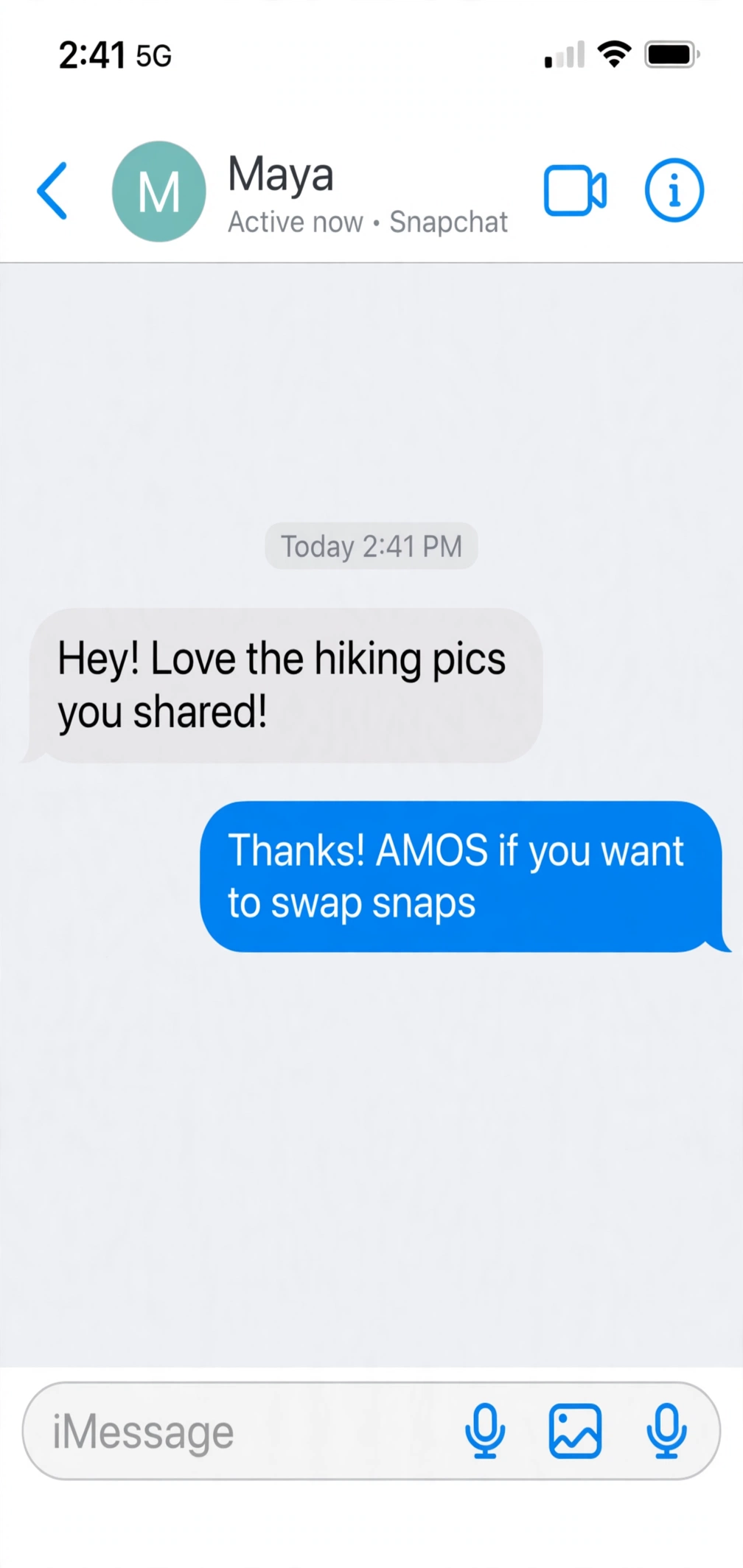
On TikTok, AMOS usually appears in captions and comments. A creator might write “new video on Snap, AMOS” to tell followers where the extra content lives. A viewer might comment “AMOS?” on a creator’s video to ask for their Snapchat. In direct messages, it works as a quick question: “AMOS?” means “Can I add you on Snapchat?” and the answer is usually a yes, a username, or a polite no.
On Instagram, AMOS shows up in bios, story text, and DMs — often alongside other acronyms. On dating apps, it is a filter of sorts: someone who writes AMOS in their profile is signalling they prefer Snapchat for chatting, and they want matches who are comfortable moving there. In group chats and gaming lobbies, it is the fastest way to swap socials without breaking the flow of conversation.
Tone matters. AMOS is casual and friendly by default. It is not formal, not flirty by itself, and not rude — but context can change that. From a stranger in a comment section, it can feel forward. From a friend after a party, it feels natural. From a creator to their audience, it feels like an invitation. The four letters stay the same; the relationship around them decides how they land.
Grammatically, AMOS behaves like a verb phrase squeezed into a noun. People do not conjugate it — nobody writes “AMOSing” — they just drop it into a sentence where “add me on Snapchat” would go. You can also answer it with a Snapcode or a username instead of words, which is part of its charm: the reply can be a single image.
Examples
The fastest way to understand the amos meaning slang is to see it in real sentences. The examples below show the same idea — “add me on Snapchat” — expressed in friendly, professional, and funny tones, so you can feel how the meaning shifts with the words around it.
Friendly Examples
- “It was so nice meeting you tonight! AMOS, my username is alex.jones22 👻”
- “That party was unreal. AMOS and I will send you all the photos.”
- “Hey! Just saw your story. AMOS?”
- “We should stay in touch — AMOS, I am always on Snap.”
- “New to the city and looking for friends. AMOS if you are down to hang out!”
- “Your outfit in that post is everything. AMOS so I can send you the link to the shop?”
Professional Examples
- “For behind-the-scenes content from today’s shoot, AMOS — I post daily updates there.”
- “Thanks for coming to the event! AMOS for photos, highlights, and the aftermovie.”
- “I share quick tips on Snap that never make it to the feed. AMOS if you want them.”
- “Awesome work on the project — AMOS and I will send you the reference images.”
- “Our community hangs out on Snapchat too. AMOS to join the conversation.”
Funny Examples
- “My camera roll is 90% my dog. AMOS if you want the full uncut series.”
- “I only use Snap for the filters that make me look like a potato. AMOS for premium potato content.”
- “Me: I am deleting social media. Also me, five minutes later: AMOS 👻”
- “My Snap streaks are the only commitment I have kept since 2019. AMOS and test my loyalty.”
- “Warning: my Snaps are mostly food and bad decisions. AMOS at your own risk.”
Comparison with Similar Terms
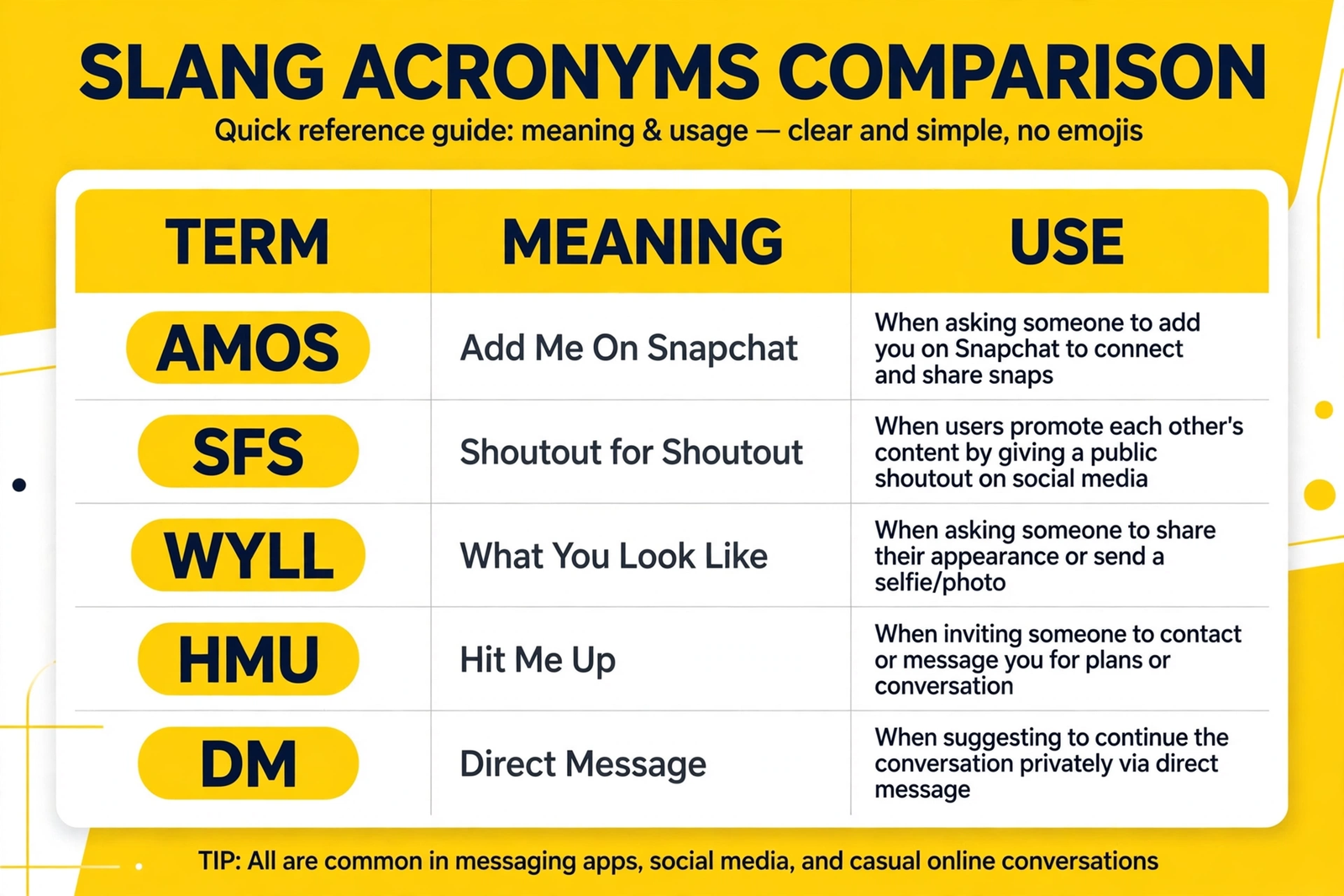
AMOS is not the only acronym that moves people between apps. The internet has a whole vocabulary for invitations, follows, and friend requests, and mixing them up is the most common source of confusion. The table below puts AMOS next to its closest cousins so you can tell them apart at a glance.
| Term | What It Means | Where You See It | How It Differs from AMOS |
|---|---|---|---|
| AMOS | Add Me On Snapchat | Bios, captions, DMs, dating apps | The baseline — a Snapchat-specific invitation |
| AMOF | Add Me On Facebook | Older bios, Facebook groups | Points to Facebook, not Snapchat; much rarer now |
| SFS | Shoutout For Shoutout | Instagram, TikTok captions | A mutual promotion deal, not a friend request |
| WYLL | What You Look Like | Snapchat, dating chats | A question asking for a photo, not an add request |
| DM | Direct Message | Every platform | A private message on the same app, not a move to Snap |
| HMU | Hit Me Up | Texts, bios, captions | A general “contact me” — no specific app named |
| ADD | Add (me) | Gaming, Snapchat | Vague — could mean any platform or game |
| SB | Snap Back | Snapchat | Asks for a reply Snap, not a new friend add |
The closest confusion is with SFS and HMU. SFS is a trade — “I will shout you out if you shout me out” — while AMOS asks for nothing in return except a friend add. HMU is broader: “hit me up” could mean text me, DM me, or call me, on any app. AMOS is precise. It names the app and the action, which is why it works so well in a bio where there is no room for a paragraph of explanation.
WYLL is the other term people mix up with AMOS, because both appear in Snapchat-adjacent conversations. But WYLL is a question — “what do you look like?” — usually sent after two people have already connected. AMOS comes first: it is the invitation that starts the connection, and WYLL is something that might happen later. If you are still deciding whether to add someone, AMOS is the word you want; WYLL is a step further down the road.
One more useful comparison is with the general family of texting acronyms like fn meaning in text and cfs meaning in text. Those terms describe feelings or situations, while AMOS describes an action you want someone to take. That is why AMOS almost always appears with a username, a Snapcode, or a ghost emoji nearby — the invitation is useless without a way to accept it.
Alternate Meanings
In slang, AMOS almost always means “Add Me On Snapchat.” But the same four letters have other lives, and knowing them helps you avoid an embarrassing mix-up.
Amos the name. Amos is a real given name with Hebrew origins, and a prophet named Amos appears in the Old Testament. If someone named Amos introduces themselves, they are not an acronym — they are a person. Context makes this obvious: a bio that says “Hi, I am Amos” is a name, while a bio that says “AMOS 👻” is an invitation.
Amos in Spanish. In Spanish, “amos” is a real word — the first-person plural of “amar” (to love) in some tenses, and the plural of “amo” (master or owner). A Spanish speaker writing “te amos” is not asking you to add them on Snapchat. Language overlap like this is common online, and it is the best reason to check the language and context before assuming a slang meaning.
AMOS as “A Man Of Steel.” Very rarely, usually as a joke, AMOS is read as “A Man Of Steel” — a Superman reference. This is almost never the intended meaning in a bio or a chat, and treating it as the real definition will confuse everyone. If you see it, it is almost certainly a joke or a wrong guess.
Technical AMOS. In engineering and science, AMOS can stand for things like “Automated Mission Operations System.” You will not meet this meaning on TikTok or Snapchat, but it exists in textbooks and technical documents. Again, context is everything: a NASA document and a TikTok bio are not the same world.
The rule is simple. If AMOS appears in a social media bio, caption, comment, or chat, it means “Add Me On Snapchat” unless something in the message strongly points elsewhere. If it appears in a Spanish sentence, a Bible study, or a technical manual, it is something else entirely.
Professional or Polite Alternatives
AMOS is casual by design, which means it does not fit everywhere. In a work email, a formal profile, or a message to someone you do not know well, the acronym can look lazy or overly familiar. These alternatives say the same thing in a tone that fits the room:
- “Feel free to add me on Snapchat — my username is [username].”
- “You can find me on Snapchat at [username] if you would like to connect there.”
- “I share updates on Snapchat too — happy to connect if you use the app.”
- “Let us connect on Snapchat. My handle is [username].”
- “My Snapchat is [username] — feel free to add me.”
- “I am most active on Snapchat these days; my username is [username].”
For creators and businesses, a slightly warmer version works well: “I post daily behind-the-scenes content on Snapchat — come say hi at [username].” It gives people a reason to add you instead of just an instruction, and it sounds like an invitation rather than a demand.
The polite alternatives also solve a problem AMOS cannot: they include the username in the same sentence. AMOS without a username is a dead end — the reader knows what you want but has no way to do it. Whenever you use AMOS or any alternative, put the username or Snapcode right next to it. That one habit doubles the number of adds you actually receive.
Common Mistakes
AMOS is short, but people still get it wrong. These are the mistakes that show up most often — and how to avoid them.
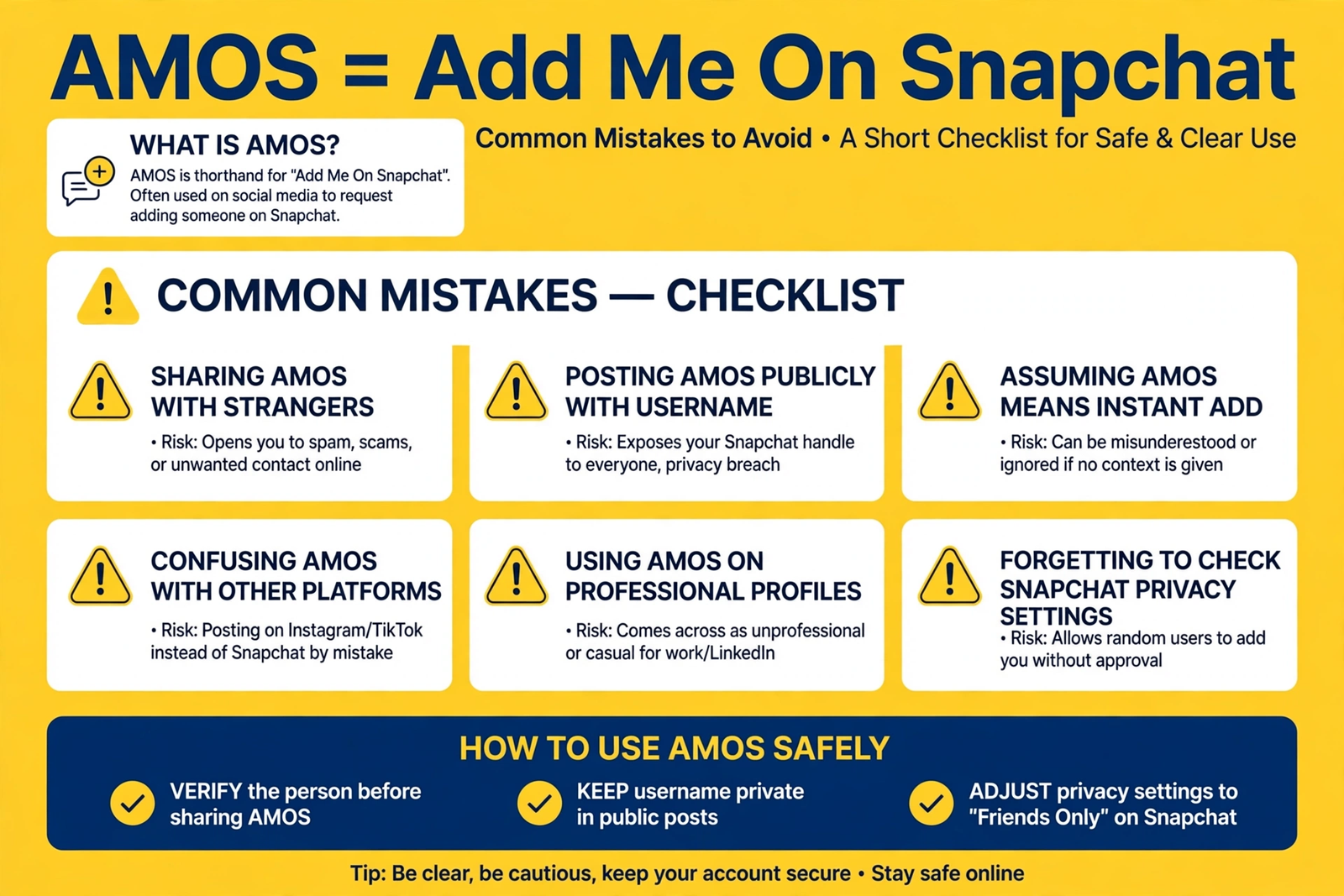
Using AMOS without a username. This is the number one mistake. “AMOS” on its own tells people what to do but not how to do it. If your Snapchat username is not visible in the same bio, caption, or message, the invitation goes nowhere. Always pair AMOS with your handle or a Snapcode.
Using it in the wrong context. Dropping AMOS into a work email, a formal application, or a message to a client looks unprofessional. Save it for social platforms and casual chats, and use the full sentence in formal settings.
Assuming everyone knows it. Not everyone lives on Snapchat. If you write AMOS to someone who does not use the app — a parent, a grandparent, a colleague from another generation — they may read it as a name, a typo, or a mystery. When in doubt, spell it out once: “AMOS (add me on Snapchat).”
Replying to AMOS with just “okay.” If someone writes “AMOS?” to you, they are waiting for a username or a Snapcode, not a one-word answer. Reply with your handle, or with a clear no if you would rather not connect there. A bare “okay” leaves the other person guessing.
Treating AMOS as flirting. AMOS by itself is neutral — it is a friend request, not a romantic signal. Reading romance into it, or using it as a pickup line, overstates what the letters mean. The flirting, if any, lives in the rest of the conversation, not in the acronym.
Posting AMOS publicly without thinking about privacy. A public AMOS in a viral TikTok caption can bring hundreds of friend requests from strangers, including people you would rather not hear from. Snapchat has privacy settings for a reason: you can limit who can add you and who can send you Snaps. Before you broadcast AMOS to the world, check those settings — and think about whether a public invitation is really what you want. Parents should know that teens posting AMOS publicly can attract attention from strangers, so a quick conversation about who can add them is worth having.
Quick Tips
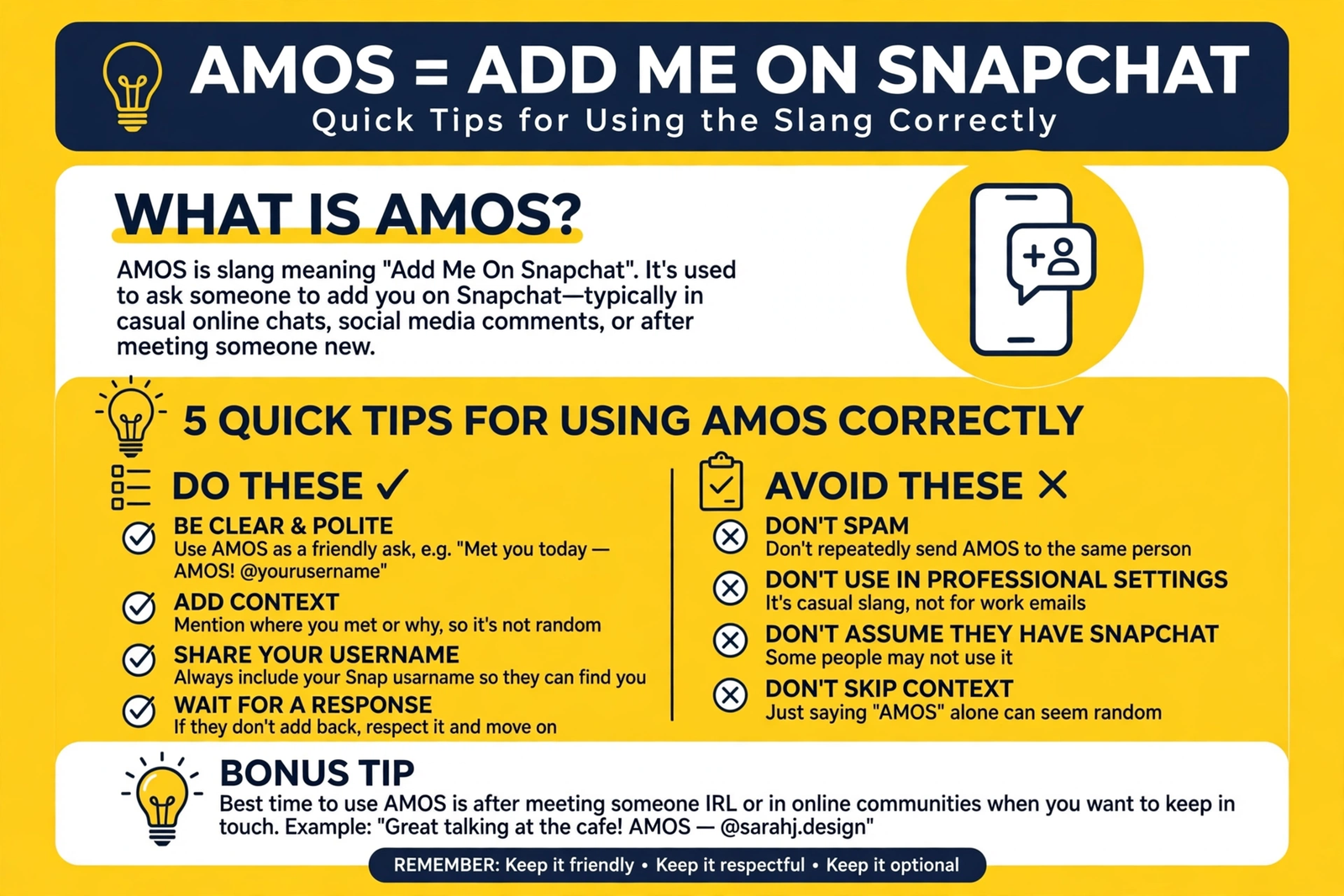
- Always attach your username or Snapcode. AMOS without a handle is an invitation with no address. Put the username in the same line, every time.
- Put it where people look. Bios and captions get seen; the middle of a long comment thread does not. The best spots are your TikTok bio, Instagram bio, and the end of a video caption.
- Use the ghost emoji 👻 as a pointer. It is Snapchat’s logo, so it tells people which app you mean before they even read the letters.
- Match the tone to the platform. Playful on TikTok, simple on Instagram, careful on dating apps — AMOS is flexible, but the room still matters.
- Check your privacy settings first. Decide who can add you and who can message you before you invite the internet in.
- Answer fast when someone takes you up on it. A friend request that sits unanswered for a week feels like a rejection. Accept it, or politely decline.
- Do not spam it. One AMOS in a bio is an invitation; AMOS in every comment looks desperate and can get you flagged as spam.
- Spell it out for non-Snapchat people. If the person you are talking to does not use Snapchat, write “add me on Snapchat” in full — the acronym will only confuse them.
- Keep streaks in perspective. AMOS often leads to Snap streaks, which are fun but can become a chore. It is fine to let a streak end.
- Remember the context rule. AMOS means “Add Me On Snapchat” in social media contexts, a name in a church, and a Spanish verb in a Spanish sentence. Read the room before you decode.
FAQ
What does AMOS mean in slang?
In slang, AMOS means “Add Me On Snapchat.” It is a short invitation used in bios, captions, comments, and chats when someone wants you to add them as a friend on Snapchat.
What does AMOS mean on Snapchat?
On Snapchat, AMOS means the same thing it means everywhere: “Add Me On Snapchat.” People put it on their stories or Snaps to invite new friends to add them, usually next to their username or Snapcode.
What does AMOS mean on TikTok?
On TikTok, AMOS usually stands for “Add Me On Snapchat.” Creators put it in their bios and captions to move followers to Snapchat for exclusive or behind-the-scenes content, and viewers comment “AMOS?” to ask a creator for their Snapchat.
What does AMOS mean in texting?
In texting, AMOS is a casual request: “add me on Snapchat.” Someone might text “AMOS?” after meeting you, which means they want to continue the conversation on Snapchat instead of regular text messages.
Is AMOS only about Snapchat?
Yes, in slang AMOS points specifically at Snapchat. It does not mean “add me” on any platform — the S stands for Snapchat. If someone wants you to follow them on Instagram or TikTok, they will say so differently.
What is the full form of AMOS?
The full form of AMOS is “Add Me On Snapchat”: A for Add, M for Me, O for On, and S for Snapchat. It is an acronym, not a regular word, in its slang use.
Is AMOS rude or flirty?
No, AMOS is neutral by itself. It is simply a friend request in short form. Whether it feels friendly, flirty, or forward depends on who sends it and the conversation around it — the letters alone carry no romantic meaning.
How do you reply when someone says AMOS?
Reply with your Snapchat username or a Snapcode if you want to connect, or politely decline if you do not. A good reply is “Sure! My username is [username] 👻” or “I am not really on Snap, but you can DM me here.” Avoid replying with just “okay” — the other person needs your handle to actually add you.
Conclusion
The amos meaning slang is one of the most practical pieces of internet shorthand you will ever meet: four letters that say “Add Me On Snapchat.” It was born in Snapchat culture, grew up on TikTok and Instagram, and survived because it solves a real problem — moving a conversation from a public platform to a private one — in the shortest way possible.
The key takeaways are simple. AMOS always points at Snapchat, it is a request rather than a statement, and it only works when your username or Snapcode is right next to it. Use it in bios, captions, and casual chats; spell it out in formal settings and for people who do not use Snapchat; and check your privacy settings before you broadcast it to the world. Like other texting shortcuts — from imk meaning in text to ttm meaning in text — AMOS is a small piece of a bigger language, and once you know the code, the internet gets a little less confusing.
So the next time a bio, a caption, or a message says “AMOS 👻,” you will know exactly what to do: check the username, decide whether you want to connect, and add away — or simply smile, because you finally speak the language.
