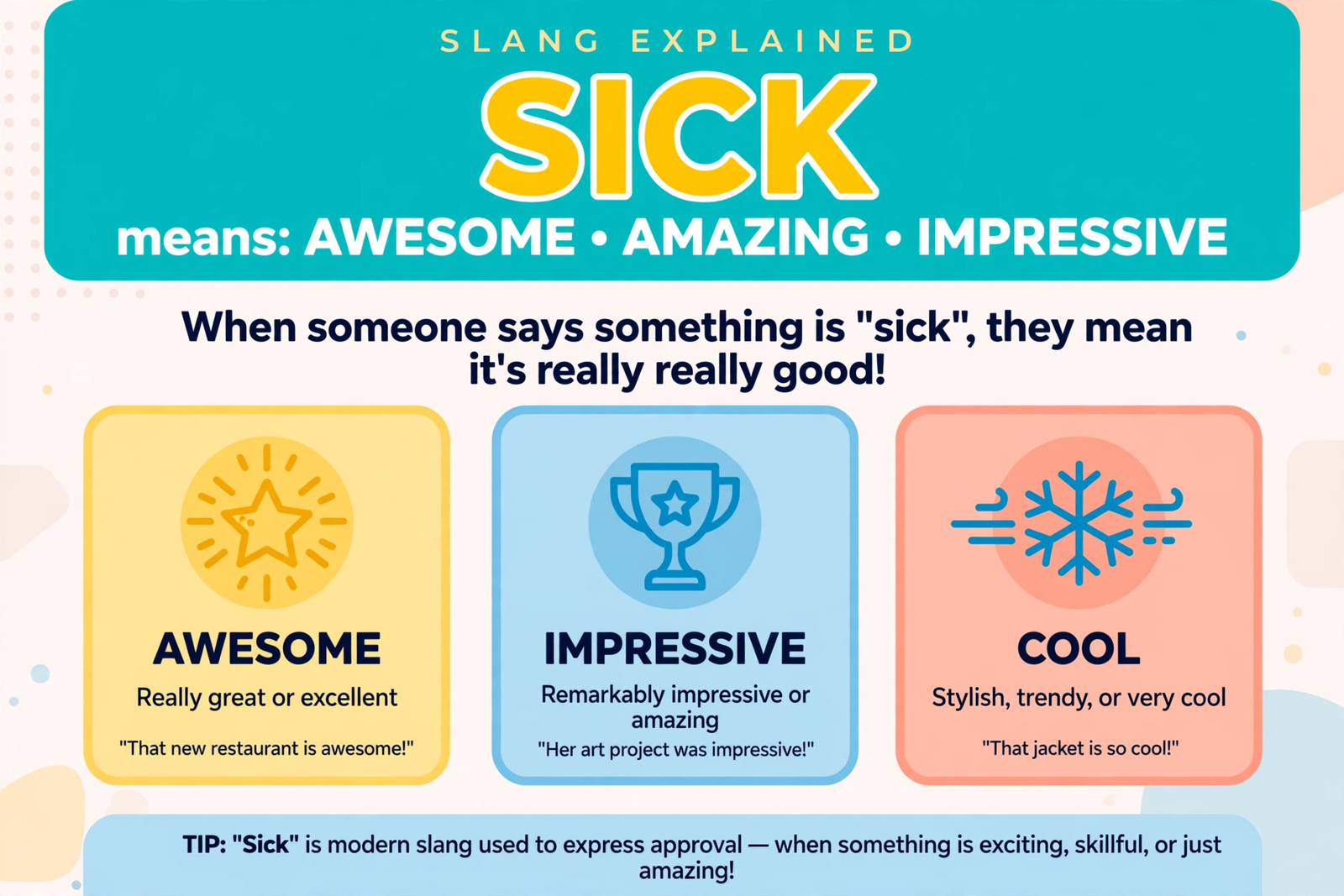
Quick definition: In slang, sick means exceptionally good, impressive, or cool. When someone texts “that trick was sick,” they are not talking about illness at all — they are saying the trick was amazing. The sick slang meaning flips the word’s normal sense upside down, which is exactly why it confuses so many people the first time they see it.
sick slang Meaning & Definition
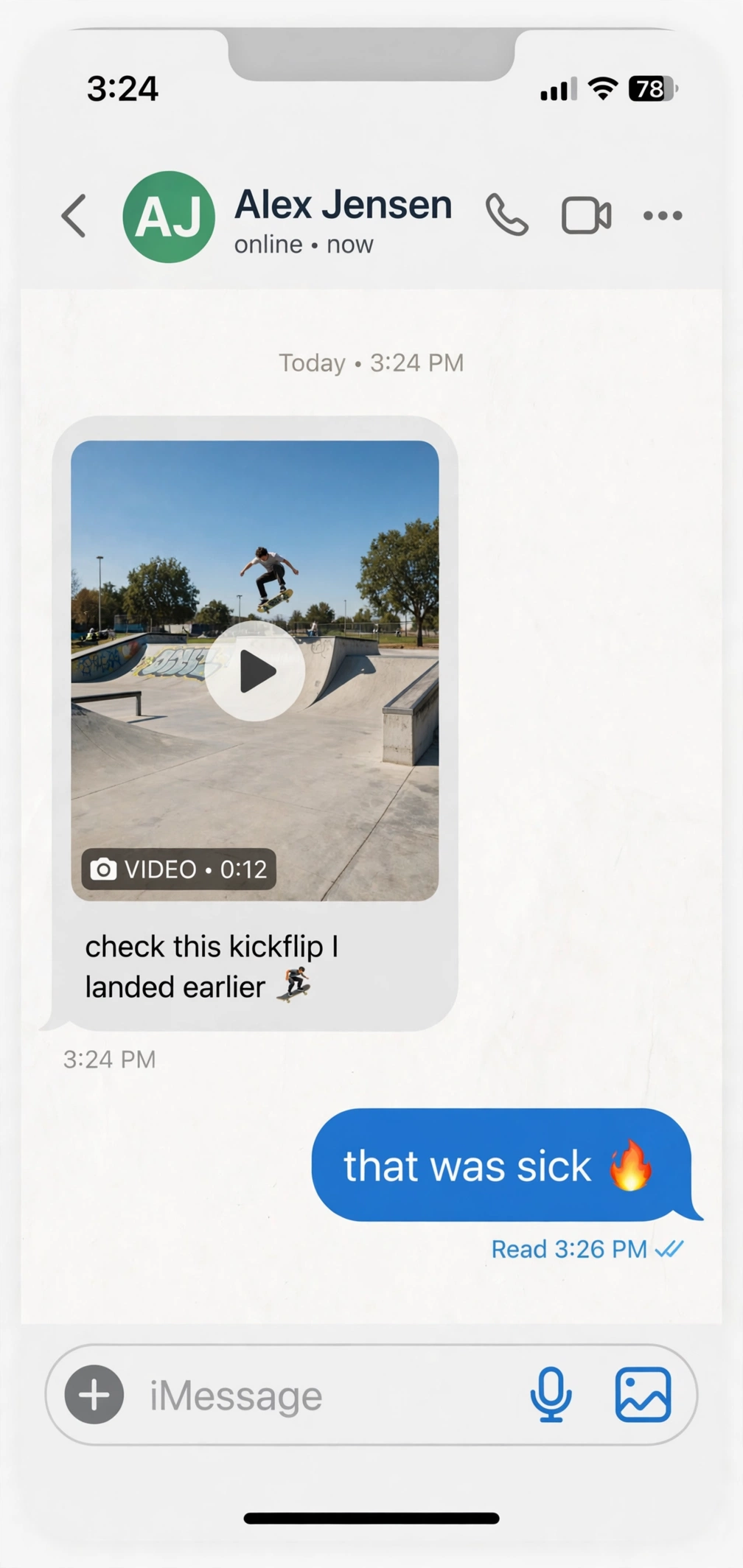
The sick slang meaning is simple once you know it: sick = awesome. It is praise, not a diagnosis. If a friend sends you a video of a skateboarder landing a near-impossible jump and captions it “that was sick,” they mean the jump was unbelievable in the best possible way. The same goes for a song, a goal in a football match, a new pair of sneakers, or a joke that lands perfectly — “sick” is the word people reach for when “cool” feels too weak and “amazing” feels too formal.
Here is the full picture in one line: in everyday English, sick means ill, but in slang, sick means so good it almost hurts. That contrast is the whole point. Slang often takes a negative word and flips it into praise — the same trick gave us “bad” meaning good in the 1980s, “wicked” meaning excellent, and “killer” meaning outstanding. Sick belongs to that same family, and it has stayed popular for decades because the exaggeration feels fun to say.
It helps to think of sick as a scale, not a switch. “Cool” is a mild compliment. “Awesome” is stronger. “Sick” sits at the top end — it carries excitement, surprise, and a hint of disbelief, as if the thing being described was almost too good to be real. That is why you hear it most in reaction to performances: a trick, a goal, a beat drop, a comeback, a fit check. Nobody says “this sandwich is sick” about a normal lunch, but they absolutely will say it about a sandwich so good it deserves a photo.
One more thing worth knowing up front: sick is an adjective in slang, and it almost always comes before a noun (“a sick goal,” “sick shoes”) or after a linking verb (“that was sick,” “this is so sick”). You will also see it stretched for emphasis — “siiick” — and intensified with words like “so,” “mad,” “hella,” or “absolutely.” All of those are just volume knobs on the same meaning.
Introduction
You are scrolling through comments under a highlight reel when you see it: “Bro that dunk was SICK.” Nobody is injured. Nobody is calling an ambulance. Everybody in the replies agrees, and a few of them are typing the same word back. Welcome to one of English slang’s most successful inside jokes — a word that means the exact opposite of what the dictionary says, and everyone under thirty knows it.
The sick slang meaning trips people up precisely because the literal meaning is so familiar. Parents reading their teenager’s messages see “I’m sick” and worry, then see “that party was sick” and get confused all over again. Is the party ill? Was anyone actually unwell? No — the party was legendary, and the teenager is simply out of superlatives. Context does all the work, and once you learn to spot it, you will never misread the word again.
This guide covers everything about the sick slang meaning: where it came from, how it spread from skate parks to group chats, how to use it without sounding forced, the examples that make it click, the mistakes that flip it back into an insult, and the polite alternatives for work or formal settings. By the end, you will know exactly when “sick” is the highest compliment in the sentence — and when it is a doctor’s appointment.
Origin
The approving sense of sick is older than most people assume. The Oxford English Dictionary’s earliest citation for “sick” meaning excellent comes from a 1983 typescript of campus slang at the University of North Carolina at Chapel Hill, and Green’s Dictionary of Slang records the sense spreading through American campus culture in the 1980s. It was not invented by Gen Z or even by millennials — it was already circulating on skateboards and surfboards before many of today’s TikTok creators were born.
So why did a word for illness become a word for excellence? Linguists call this pattern “bad means good” reversal, and it shows up again and again in youth slang. A word with a strong charge — even a negative one — gets flipped for emphasis, because saying something is “good” is boring and saying it is “sick” makes people pay attention. The skateboarding and surfing scenes of the 1980s were the perfect incubator: sports built on risk, pain, and near-misses needed a word that carried danger and admiration at the same time, and “sick” did both jobs at once. A trick that looked borderline insane was, naturally, sick.
From there the word rode the same wave as the sports themselves. Skate videos, surf magazines, and MTV carried it into mainstream youth culture through the 1990s, and hip-hop picked it up as well — “sick flow,” “sick beat,” “sick rhymes” became standard praise in lyrics. By the 2000s, sick was no longer scene-specific at all. It was simply how young Americans said “amazing,” and the internet finished the job: gaming chats, YouTube comments, and later TikTok and Instagram captions spread it to every English-speaking country. The BBC even recorded British teenagers using it in a 2009 report on teen slang, proof that the word had fully crossed the Atlantic.
What is remarkable is how little the meaning has drifted in forty years. Many slang words burn out in a season; sick has survived the 80s, 90s, 2000s, and the entire social media era without losing its core sense. It is no longer “new” slang — it is established slang, the kind parents now use themselves, sometimes to their children’s horror.
Popularity
Sick is one of the most durable slang words in modern English. Unlike trend-driven terms that spike on TikTok and vanish in a month, sick has been in continuous use for over four decades, and it still appears constantly in comments, captions, chats, and everyday speech. Its staying power comes from its versatility: it works for sports, music, fashion, gaming, food, comedy, and anything else that can impress you.
Where will you actually see it? Everywhere people react to something impressive in real time. Gaming chats light up with “sick play” after a clutch moment. Sports highlight comments are full of “that goal was sick” and “sick save.” Music fans call a beat drop sick, sneaker fans call a new release sick, and friends in a group chat call a comeback sick. It is especially common in short-form video culture, where a one-word comment needs to carry maximum enthusiasm in minimum characters — “sick” does that better than almost any other word.
The word also crosses age groups more easily than most slang. Teenagers use it, twenty-somethings use it, and plenty of people in their thirties and forties use it without thinking twice, because they grew up with it. That broad adoption is a sign of a word that has moved from slang into the everyday vocabulary — dictionaries now list the approving sense openly. Merriam-Webster defines sick in slang as “outstandingly or amazingly good or impressive,” which is about as official as slang gets.
It is worth noting that sick is not tied to one region or one platform. It shows up in American, British, Australian, and Canadian English, in texts and in speech, in captions and in conversation. It is not a TikTok word or a gamer word — it is simply a word English speakers use when something impresses them, and its popularity shows no sign of fading.
How It Is Used
Using sick correctly is mostly about placement and tone. The word is casual and enthusiastic, so it fits relaxed settings — friends, group chats, comments, captions, gaming lobbies — and feels out of place in formal writing, work emails, or serious conversations. Nobody writes “the quarterly results were sick” in a board report, and if they did, the board would assume a typo.
The most common patterns are easy to copy. As a compliment after the fact: “That was sick!” As a description before a noun: “a sick goal,” “sick shoes,” “a sick beat.” As a reaction in a chat: “Sick 🔥” or just “sickkk.” And as a question or check-in: “Did you see that? Sick, right?” In each case the word is doing the same job — stamping something with approval and excitement.
Tone matters as much as grammar. Sick is enthusiastic by default, so it lands best when you genuinely mean it. Dropping it flatly — “yeah, sick” with no energy — can sound sarcastic, as if you mean the opposite. That is a feature, not a bug: the word is flexible enough to be sincere or ironic depending on delivery, which is part of why people love it. In text, where tone is invisible, an emoji or an exclamation mark usually clears up which one you mean.
Finally, sick pairs naturally with other casual words. You will often see it with intensifiers (“so sick,” “mad sick,” “absolutely sick”), with fire emojis, or alongside other slang for cool like “lit” and “fire.” It also works as a standalone reply: send a friend a clip of something incredible, and “sick” alone is a complete, satisfying response. Short, punchy, and unmistakable — that is the whole appeal.
Examples
Examples make the sick slang meaning click instantly. Notice how in every case, replacing “sick” with “amazing” keeps the sentence perfectly sensible — that is the test that you have the meaning right. The examples below are grouped by tone, because the same word sounds slightly different in a friendly chat, a workplace message, and a joke between friends.
Friendly Examples
- “That goal was sick! You have to send me the clip.” — the classic sports reaction, pure excitement.
- “Your new haircut is sick, honestly it suits you so well.” — a compliment between friends.
- “We just got tickets and the seats are sick, right near the stage!” — describing something impressive you are looking forward to.
- “Did you hear the new album? The last track is absolutely sick.” — music praise, the most common use of all.
- “Bro, that comeback was sick. I was screaming at my screen.” — gaming or esports, where the word lives most.
- “Check out these shoes — sick, right?” — showing off something you are proud of.
Professional Examples
Sick is a casual word, so “professional” here means the more polished end of casual — a message to a colleague you are friendly with, a relaxed creative workplace, or a client in a creative industry. In a formal office, use the alternatives in the section below instead.
- “The demo video turned out sick — the client is going to love this cut.” — creative team chat, enthusiastic and informal.
- “That presentation was sick, by the way. The opening slide really landed.” — praising a coworker after a meeting, friendly tone.
- “Your portfolio is sick. The branding project especially stood out.” — a compliment in a design or media context.
- “The event setup looks sick in the photos. Great work, team.” — team chat after a successful launch.
Funny Examples
- “That movie was sick — in the good way, not the I-need-soup way.” — the joke writes itself, and everyone has made it.
- “My cooking was so sick last night that the smoke alarm gave it a standing ovation.” — self-deprecating humor, obviously ironic.
- “He tried to look cool walking in and tripped over nothing. Sick entrance, bro.” — sarcastic sick, meaning the exact opposite.
- “I told my grandma my playlist was sick and she asked if I needed medicine.” — the generation-gap joke that never gets old.
- “That parking job was sick… if the goal was to block three cars at once.” — sarcasm again; context is everything.
One pattern to steal from these examples: sick works best as a reaction, not a description in cold blood. It lands hardest right after the impressive thing happens, when the excitement is real. Save it for moments that deserve it, and it keeps its punch.
Comparison with Similar Terms
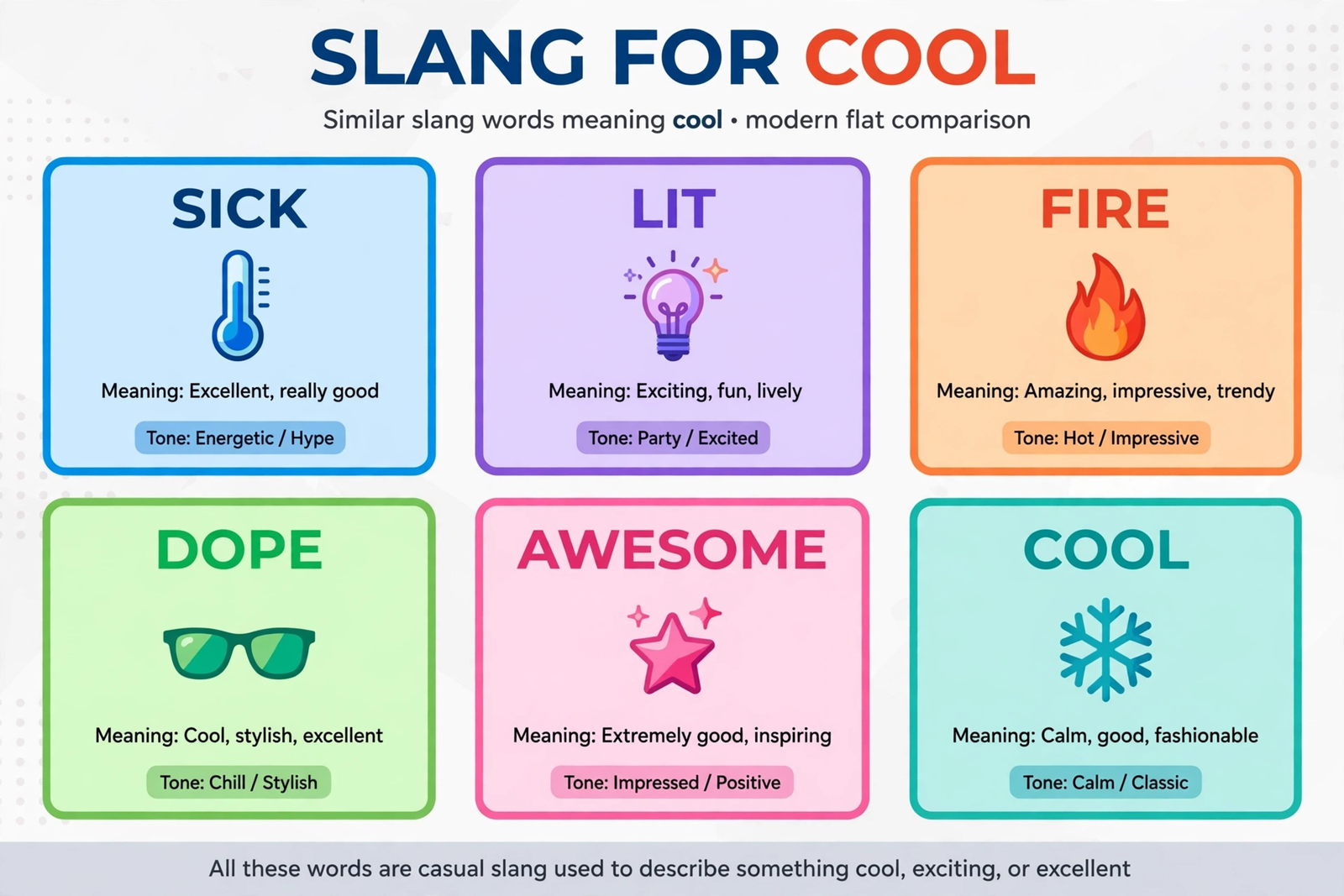
Sick is not the only word that means “amazing,” and picking the wrong one can change the vibe of your sentence. The table below compares sick with its closest relatives so you can choose the right word for the moment. All of them are positive, but they are not interchangeable — each one carries a slightly different energy.
| Word | What It Means | Energy Level | Best Used For |
|---|---|---|---|
| Sick | Amazing, impressive, almost unbelievable | Very high | Skills, tricks, performances, highlights |
| Cool | Nice, good, approved of | Medium | Almost anything; the safe default |
| Awesome | Excellent, worthy of awe | High | Experiences, news, achievements |
| Lit | Exciting, fun, full of energy | Very high | Parties, events, nights out, vibes |
| Fire | Excellent, especially music or style | Very high | Songs, outfits, photos, takes |
| Dope | Cool, impressive, high quality | High | Music, style, skills, gear |
| Epic | Grand, legendary, huge in scale | Very high | Stories, comebacks, big moments |
| Rad | Cool, excellent (retro surfer/skater vibe) | Medium-high | Casual praise, nostalgic tone |
The key difference is focus. Sick points at skill and spectacle — a trick, a goal, a performance. Lit points at atmosphere — a party or a night that was wild. Fire points at taste — a song, an outfit, a photo. Cool points at everything and nothing in particular, which is why it is the safest choice when you are unsure. If you want to dig deeper into the whole family of praise words, our guide to synonyms for cool slang breaks down more than sixty of them by era and vibe.
There is also a subtle age signal in the choice. Sick and rad carry an 80s and 90s skate-culture flavor that older millennials recognize instantly. Lit and fire feel more current, tied to hip-hop and social media. None of them is wrong — but matching the word to your audience makes you sound natural instead of trying too hard. A teenager calling a skate trick “rad” sounds charmingly retro; a forty-year-old calling a party “lit” can sound fine too, as long as the enthusiasm is genuine.
Alternate Meanings
Sick is a busy word, and the slang meaning is only one of several. Knowing the others is what keeps you from misreading a message — and from sending one that gets misread.
- Ill / unwell: The original and still most common meaning. “I feel sick,” “I called in sick today,” “she’s sick with the flu.” If the sentence is about health, symptoms, or missing work or school, this is the meaning.
- Disgusted or fed up: “I’m sick of this,” “sick and tired,” “that gossip makes me sick.” Here sick describes a strong negative feeling, not illness and not praise.
- Disturbing or morbid: “A sick joke,” “a sick sense of humor,” “that was sick” said about something cruel. This is the dark side of the word — something twisted or offensive rather than impressive. Tone and topic tell you which side you are on.
- Mentally unwell: “Sick thoughts,” “a sick mind.” A serious, clinical use, far from slang praise.
- Sick as a verb (sic): Spelled “sic,” it means to set a dog on someone — “sic ’em!” — a different word that just sounds the same.
The golden rule: praise = skill or spectacle, illness = health or absence, disgust = “sick of” something. If someone says “I’m sick,” they are unwell. If they say “that was sick,” they are impressed. If they say “I’m sick of this,” they are annoyed. And if the sentence is “I’m sick of being sick,” they are both annoyed and unwell — English is fun like that.
The most famous confusion is the sentence “I’m at the ATM ATM” for a different word, but sick has its own classic: “That party was sick and now I feel sick.” Both uses in one sentence, both correct, and everyone who hears it understands exactly what happened — the party was amazing, and the morning after was not.
Professional or Polite Alternatives
Sick is casual, and casual is not always appropriate. In a work email, a job interview, a formal message, or a conversation with someone you do not know well, reach for one of these instead. They carry the same praise without the slang.
| Instead of | Say | When |
|---|---|---|
| “That was sick!” | “That was outstanding!” | Work praise, formal feedback |
| “Sick presentation” | “Excellent presentation” | Emails, meetings, reviews |
| “Sick shoes” | “Great shoes” / “I love those shoes” | Polite compliments to strangers |
| “That’s so sick” | “That’s really impressive” | Any formal setting |
| “Sick beat” | “Great track” / “Brilliant production” | Talking to musicians professionally |
| “Sick goal” | “Incredible goal” / “What a goal” | Commentary, mixed company |
None of these loses the compliment — “outstanding,” “excellent,” and “impressive” are all strong words. What they lose is the casual energy, which is exactly what you want to lose in a formal setting. Save sick for friends, fans, and group chats, and use its polished cousins everywhere else.
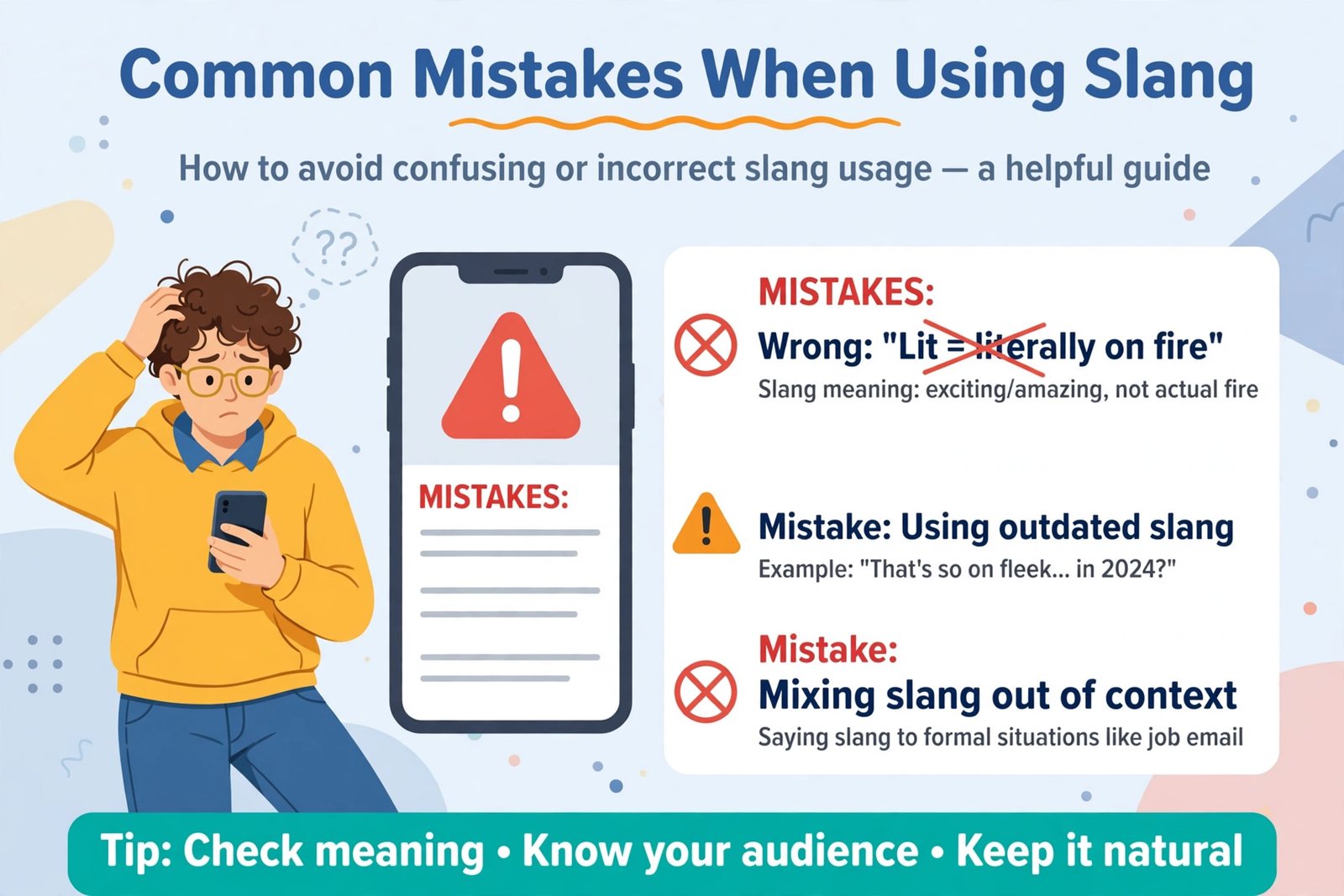
Common Mistakes
Most mistakes with sick come from forgetting that the word has more than one meaning, or from using it in the wrong room. Here are the ones people actually make.
1. Using it to describe illness-adjacent things. “The hospital food was sick” is a sentence nobody can decode. Did you love it or did it make you ill? Avoid sick anywhere near health, hospitals, medicine, or food poisoning unless you are deliberately joking.
2. Saying it in formal settings. Telling a hiring manager your previous project was “sick” will not ruin your chances, but it will make you sound less polished than “outstanding” would. Match the word to the room.
3. Confusing sick with sickening. They are not the same. “Sick” in slang is praise; “sickening” almost always means disgusting or offensive (“a sickening display”). Saying “that goal was sickening” to praise it is a real mistake people make — and it means the opposite of what they intended.
4. Forcing it. Slang that is used self-consciously sounds awkward. If you would not naturally say “sick” out loud, do not force it into a text to sound young. A sincere “that was amazing” always beats a performed “that was sick.”
5. Missing sarcasm. “Oh, sick” after bad news is not praise — it is the sarcastic “great, just great.” In text, the lack of tone makes this easy to miss. If the context is negative, read the word as ironic, not enthusiastic.
6. Using it about people you do not know well. Calling a stranger’s outfit “sick” is usually fine, but calling a stranger themselves “sick” can confuse them — are you complimenting them or saying something about their health? Aim the word at things and performances, not at people directly, until you know them.
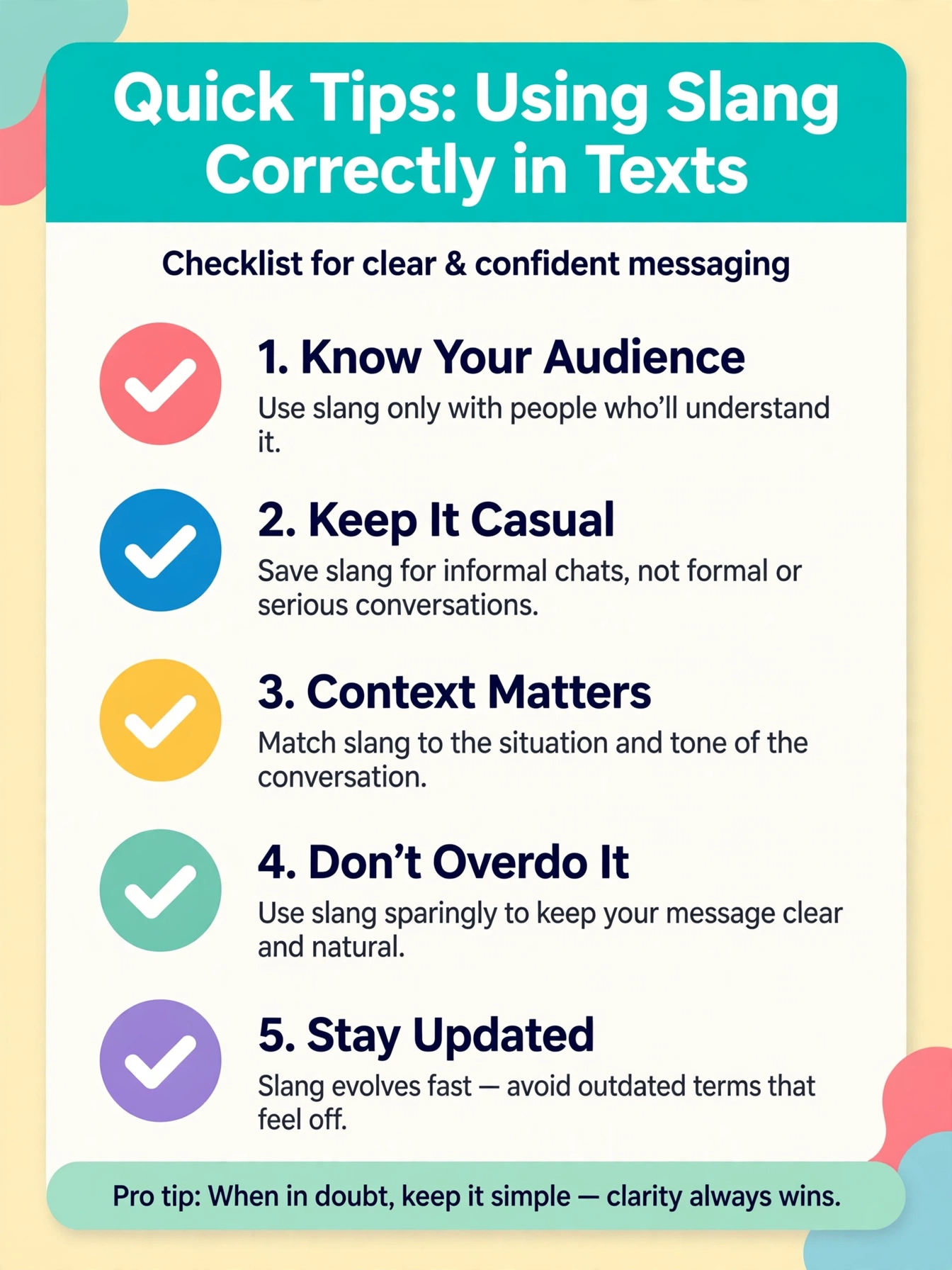
Quick Tips
- Use it as a reaction. Sick lands hardest right after something impressive happens. A fast “that was sick!” beats a delayed paragraph.
- Aim it at skills and spectacles. Tricks, goals, songs, outfits, comebacks — if it took talent or looked incredible, sick fits.
- Let context do the work. If your sentence is about health, skip the word entirely. One ambiguous “sick” can derail a message.
- Add energy, not essays. An exclamation mark or a fire emoji makes the praise unmistakable in text. “Sick 🔥” needs no explanation.
- Do not overuse it. If everything is sick, nothing is. Save it for the moments that genuinely impress you and it keeps its power.
- Know your audience. Friends and fans love it; bosses, clients, and grandparents usually prefer “amazing” or “outstanding.”
- Watch for sarcasm. “Sick” after bad news means the opposite. Read the room — or the rest of the message — before replying.
- Pair it naturally. It sits comfortably with words like “so,” “absolutely,” and “mad” — but one intensifier is enough. “Absolutely so mad sick” is trying too hard.

FAQ
What does sick mean in slang?
In slang, sick means exceptionally good, impressive, or cool. “That trick was sick” means the trick was amazing. It is praise, and it is one of the most common slang compliments in English, used for performances, music, sports highlights, and anything else that impresses you.
Is sick a compliment or an insult?
It is almost always a compliment in casual conversation — but it depends on context. “That was sick” about a goal or a song is high praise. “I’m sick” is about health, “I’m sick of this” is annoyance, and “a sick joke” can mean something cruel. The sentence around the word tells you which meaning applies.
What does “that’s sick” mean?
“That’s sick” means “that’s amazing” or “that’s awesome.” It is a short, enthusiastic reaction, usually to something you just saw or heard — a trick, a goal, a beat drop, a joke. Said flatly or after bad news, it can be sarcastic, so tone and timing matter.
Is sick Gen Z slang?
No — sick is much older than Gen Z. The approving sense is documented in American campus slang as early as 1983, and it spread through skateboarding and surfing culture in the 1980s and 90s. Gen Z uses it, but so do millennials and plenty of older adults. It is established slang, not a new trend.
Can I say sick at work?
In a relaxed, creative workplace with colleagues you know well, yes — “that demo was sick” is fine in a team chat. In a formal email, a client meeting, or a job interview, use “outstanding,” “excellent,” or “impressive” instead. When in doubt, pick the polished word.
What is the difference between sick and sickening?
They are opposites in practice. In slang, “sick” means amazing; “sickening” almost always means disgusting or offensive. Never say “that goal was sickening” when you mean to praise it — you will be understood as saying the exact opposite.
Does sick mean the same thing when a girl says it?
Yes. Sick means the same thing no matter who says it — amazing, cool, impressive. There is no separate “girl meaning” or “guy meaning” for this word, unlike some slang that shifts with the speaker. “That outfit is sick” is a compliment from anyone.
What can I say instead of sick?
Try “amazing,” “awesome,” “incredible,” “outstanding,” “brilliant,” “fire,” “lit,” or “dope,” depending on the situation. For formal settings, “outstanding” and “impressive” are the safest swaps. And if you want more options, our guide to ngl meaning in text and other slang explainers covers the words people pair with sick most often.
Conclusion
The sick slang meaning is beautifully simple: sick means amazing. Three letters, one flipped meaning, and forty years of staying power. It started on college campuses and skate parks in the 1980s, rode surf videos, hip-hop, and gaming chats into the mainstream, and now lives in comment sections and group chats all over the English-speaking world. Merriam-Webster lists the slang sense right alongside the medical one, which tells you everything about how established this word has become.
The trick to using it well is context. Aim it at skills, spectacles, and performances — the trick, the goal, the song, the outfit — and it lands as the highest casual compliment in the sentence. Keep it away from hospitals, formal emails, and anything actually about health, and you will never be misunderstood. And remember the golden rule: if the sentence is about something impressive, sick is praise; if it is about someone’s health, it is a doctor’s visit; if it is “sick of,” someone is annoyed.
So the next time a friend sends you a clip that makes your jaw drop, you know exactly what to type: “that was sick.” One word, full marks. And if you want to keep building your slang vocabulary, start with smh meaning in text — it is the word you will need for everything that is not sick at all.

1 thought on “sick slang: What Does Sick Mean in Text? 7 Fun Examples”