
Quick definition: The phrase “new zealand slang” refers to the informal words and expressions Kiwis use every day — from chur and sweet as to yeah, nah and she’ll be right. It blends Māori words, British English, and uniquely Kiwi inventions into a laid-back, friendly way of speaking that can confuse visitors at first but is easy to learn once you know the basics.
New Zealand Slang Meaning & Definition
New Zealand slang is the casual, everyday language of New Zealanders, known as Kiwis. It is the set of informal words, phrases, and expressions that people in New Zealand use in conversation, text messages, and social media — words you will rarely find in a textbook but will hear constantly on the streets of Auckland, Wellington, Christchurch, and every small town in between.
At its heart, New Zealand slang reflects the country’s culture: relaxed, friendly, direct, and full of humour. Kiwis shorten words, add as to the end of adjectives (sweet as, choice as), and borrow freely from te reo Māori, the Māori language. The result is a dialect that sounds familiar to English speakers yet contains dozens of words with meanings you would never guess — a dairy is a corner shop, jandals are flip-flops, and togs are swimwear.
For travellers, students, new migrants, and anyone chatting with a Kiwi online, learning new zealand slang is the fastest way to understand what people actually mean — and to avoid the awkward moment of nodding along while having no idea what was just said.
Introduction
Imagine landing in Auckland, ordering a coffee, and hearing the barista say, “Sweet as, bro — that’ll be six bucks, chur.” You smile, pay, and walk away wondering what exactly just happened. Welcome to New Zealand, where the slang is as distinctive as the landscape.
New Zealand slang is not just a handful of funny words. It is a living part of Kiwi identity, shaped by Māori culture, British settlers, Pacific Island communities, and the country’s famously laid-back attitude. Some terms, like kia ora, are known around the world. Others, like munted or wop wops, will leave even native English speakers completely lost.
In this guide, you will learn the 25+ most important New Zealand slang words and phrases, what they mean, where they came from, and how to use them without sounding like a tourist trying too hard. Whether you are planning a trip, moving to New Zealand, or just curious about Kiwi culture, this is everything you need to know.

Origin
New Zealand slang did not appear overnight. It grew over nearly 200 years from three main sources, and understanding them explains why Kiwi speech sounds the way it does.
Māori Roots
The oldest layer of New Zealand slang comes from te reo Māori, the language of New Zealand’s Indigenous people. Words like kia ora (hello / thank you), kai (food), whānau (family), and mana (prestige, authority) have moved from Māori into everyday Kiwi English. Today, even Kiwis with no Māori heritage use these words naturally — kia ora is as common a greeting as “hello” in New Zealand.
This Māori influence is one of the biggest things that separates New Zealand slang from Australian slang. Australia has its own Aboriginal loanwords, but New Zealand’s Māori vocabulary is far more woven into daily speech, including in schools, news broadcasts, and government.
British Settlers and Shortening
The second layer comes from 19th-century British settlers, who brought words like bloke (man), bugger (a mild swear word), and reckon (think, believe). Kiwis then did what they do best: they shortened everything. Afternoon became arvo, barbecue became barbie, and chocolate became chocky. This habit of clipping words is still one of the clearest markers of New Zealand slang today.
Isolation, Humour, and the “She’ll Be Right” Attitude
The third layer is cultural. New Zealand is geographically isolated, and for much of its history Kiwis had to fix things themselves, make do, and not complain. That produced the famous she’ll be right attitude — a relaxed optimism that things will work out — and a love of understatement. A Kiwi who says something was “not bad” might mean it was excellent. A Kiwi who says “yeah, nah” is politely saying no. The slang carries this dry, self-deprecating humour in almost every phrase.
Popularity
New Zealand slang has exploded in popularity beyond New Zealand’s shores in the last decade, and there are clear reasons for it.
Travel and migration: New Zealand welcomes millions of visitors every year, and hundreds of thousands of people move there to study or work. Every one of them needs a crash course in Kiwi English, and searches for New Zealand slang have climbed steadily as a result.
Social media and streaming: Kiwi creators on TikTok, YouTube, and Instagram regularly go viral explaining words like chur or reacting to tourists misusing sweet as. New Zealand shows and films, from Flight of the Conchords to Hunt for the Wilderpeople, have also carried Kiwi slang to global audiences.
The Lord of the Rings effect: New Zealand’s role as Middle-earth put the country on the map for a generation of travellers, and many visitors arrive already curious about how Kiwis actually talk.
Online gaming and group chats: In gaming lobbies and Discord servers, Kiwi players drop words like bro, choice, and keen constantly, spreading new zealand slang to people who may never set foot in the country. The same thing happens in texting: a Kiwi friend replying “sweet as bro” is often someone’s first encounter with the dialect.
How It Is Used
New Zealand slang is used in almost every casual context in New Zealand: at the beach, in the pub, at work drinks, on the sports field, and in family group chats. It is far less common in formal writing, job interviews, or official emails — though even there, a friendly kia ora at the start is completely normal.
The tone is almost always warm and informal. Calling someone bro is friendly, not aggressive. Saying chur is a cheerful thanks. And yeah, nah is the softest possible way to disagree. Kiwis also use slang to signal belonging — using the right words at the right time tells people you understand the culture, not just the language.
One thing to remember: context matters. Munted can describe a broken car, a tired person, or a wild party, depending on the sentence. Choice can mean excellent, or it can be a simple “yes, that works.” Listen to how Kiwis use a word before you try it yourself, and you will pick it up quickly.
| Context | Typical slang you will hear | Tone |
|---|---|---|
| Greeting a friend | Kia ora, bro! How’s it going? | Warm, friendly |
| Agreeing to plans | Sweet as, keen as. Choice! | Enthusiastic |
| Thanking someone | Chur, bro. Thanks a million. | Grateful, casual |
| At the beach | Grab your togs and jandals. | Relaxed |
| Something goes wrong | She’ll be right. No worries. | Calm, optimistic |
| Softly disagreeing | Yeah, nah, I reckon not. | Polite, indirect |
Examples
Here are the most useful New Zealand slang words and phrases, grouped by how you will actually use them. Learn these and you will understand about 90% of everyday Kiwi conversation.
Friendly Examples
- “Kia ora, bro — chur for the lift!” (Hello, mate — thanks for the ride!)
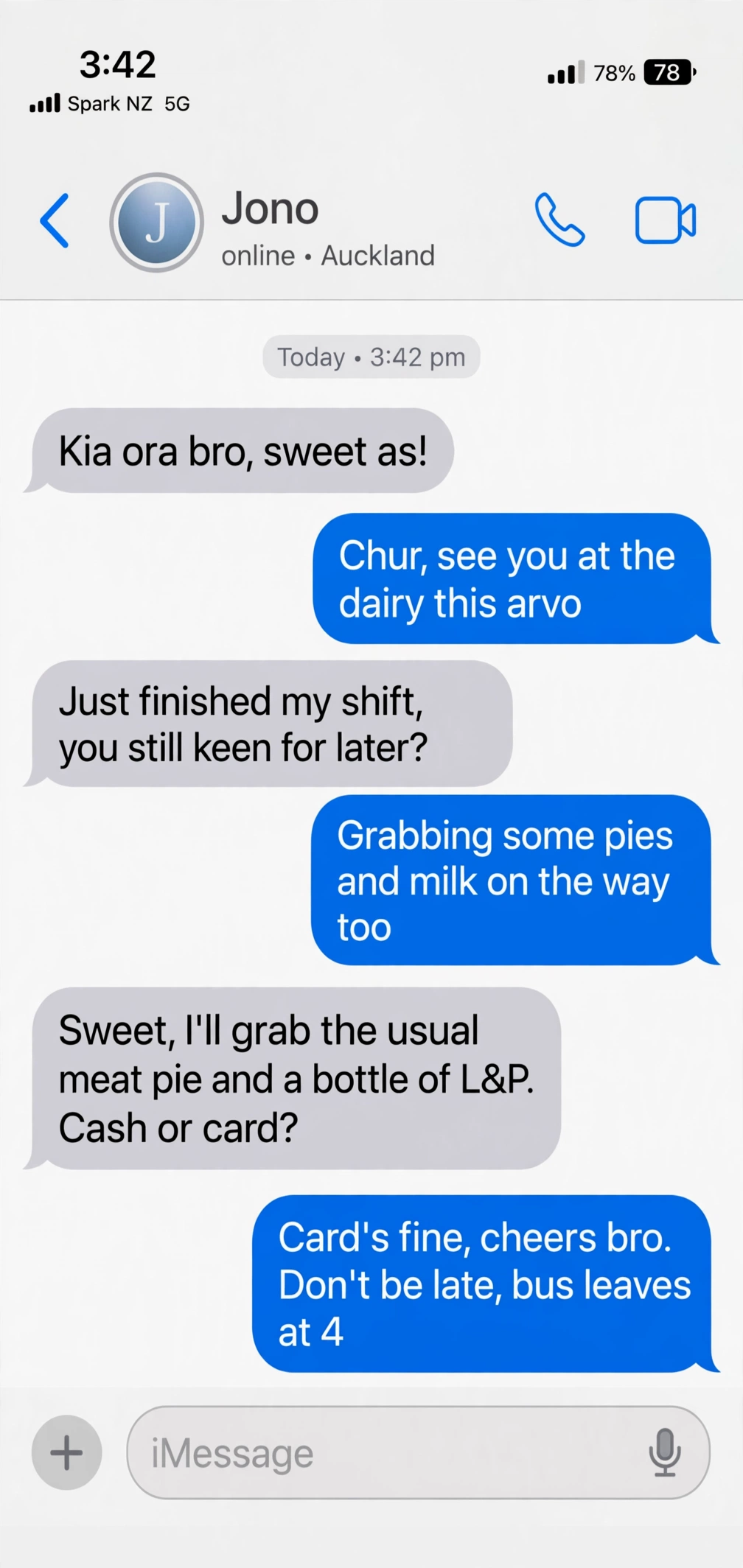
- “Sweet as, I’ll see you at the dairy.” (Sounds great, I’ll meet you at the corner shop.)
- “That was a choice feed, thanks heaps.” (That was an excellent meal, thank you very much.)
- “Good as gold, mate. All sorted.” (Everything is perfect, all done.)
- “He’s a hard case, always cracking jokes.” (He’s a funny character.)
- “Wanna come over for a barbie this arvo?” (Want to come for a barbecue this afternoon?)
Professional Examples
- “Kia ora team, let’s touch base after the hui.” (Hello team, let’s meet after the meeting — hui is a Māori word for a gathering.)
- “I’m keen to take that on — I’ll yarn with the client tomorrow.” (Yarn means a chat or discussion.)
- “No worries, she’ll be right by Friday.” (Don’t worry, it will be finished by Friday.)
- “Can you suss out the numbers before lunch?” (Suss means figure out or investigate.)
Funny Examples
- “Yeah, nah, I’m not going tramping in that weather.” (No way am I hiking in that rain — tramping is Kiwi for hiking.)
- “He got absolutely munted at the party.” (He got very drunk — or very tired, depending on context.)
- “I left my jandals at the bach and had to walk on hot sand.” (A bach is a holiday home.)
- “That movie was a bit daggy, eh?” (That movie was uncool or daggy — dag means unfashionable.)
- “Don’t be a dag, just give it a go.” (Don’t be silly, just try it.)
The 25 Most Common New Zealand Slang Words
| Slang word | Meaning | Example |
|---|---|---|
| Chur | Thanks / awesome / yes | “Chur, bro!” |
| Sweet as | Great / no problem / cool | “Sweet as, see you there.” |
| Bro | Friend, mate (any gender) | “Hey bro, what’s up?” |
| Kia ora | Hello / thank you / cheers | “Kia ora, welcome in.” |
| Choice | Excellent / great / OK | “Choice feed, mate.” |
| Yeah, nah | A polite “no” | “Yeah, nah, not today.” |
| She’ll be right | It’ll be fine / don’t worry | “She’ll be right, mate.” |
| Keen | Eager / interested | “I’m keen as for a swim.” |
| Munted | Broken / drunk / ruined | “My phone’s munted.” |
| Dairy | Corner shop / convenience store | “Grab milk from the dairy.” |
| Jandals | Flip-flops / thongs | “Wear your jandals.” |
| Togs | Swimwear | “Don’t forget your togs.” |
| Chilly bin | Cooler box / esky | “Put the drinks in the chilly bin.” |
| Bach | Holiday home / cabin | “We’re off to the bach.” |
| Tramping | Hiking / bushwalking | “Going tramping this weekend.” |
| Heaps | A lot / very much | “Thanks heaps!” |
| Reckon | Think / believe / guess | “I reckon it’ll rain.” |
| Good as gold | Perfect / all good | “All good as gold.” |
| Hard case | Funny person / character | “He’s a real hard case.” |
| Dag | Uncool / silly / daggy | “That’s so dag.” |
| Suss | Figure out / check out | “Go suss it out.” |
| Yarn | Chat / story / talk | “Let’s have a yarn.” |
| Arvo | Afternoon | “See you this arvo.” |
| Bloke | Man / guy | “He’s a top bloke.” |
| Wop wops | The middle of nowhere | “He lives in the wop wops.” |
Comparison with Similar Terms
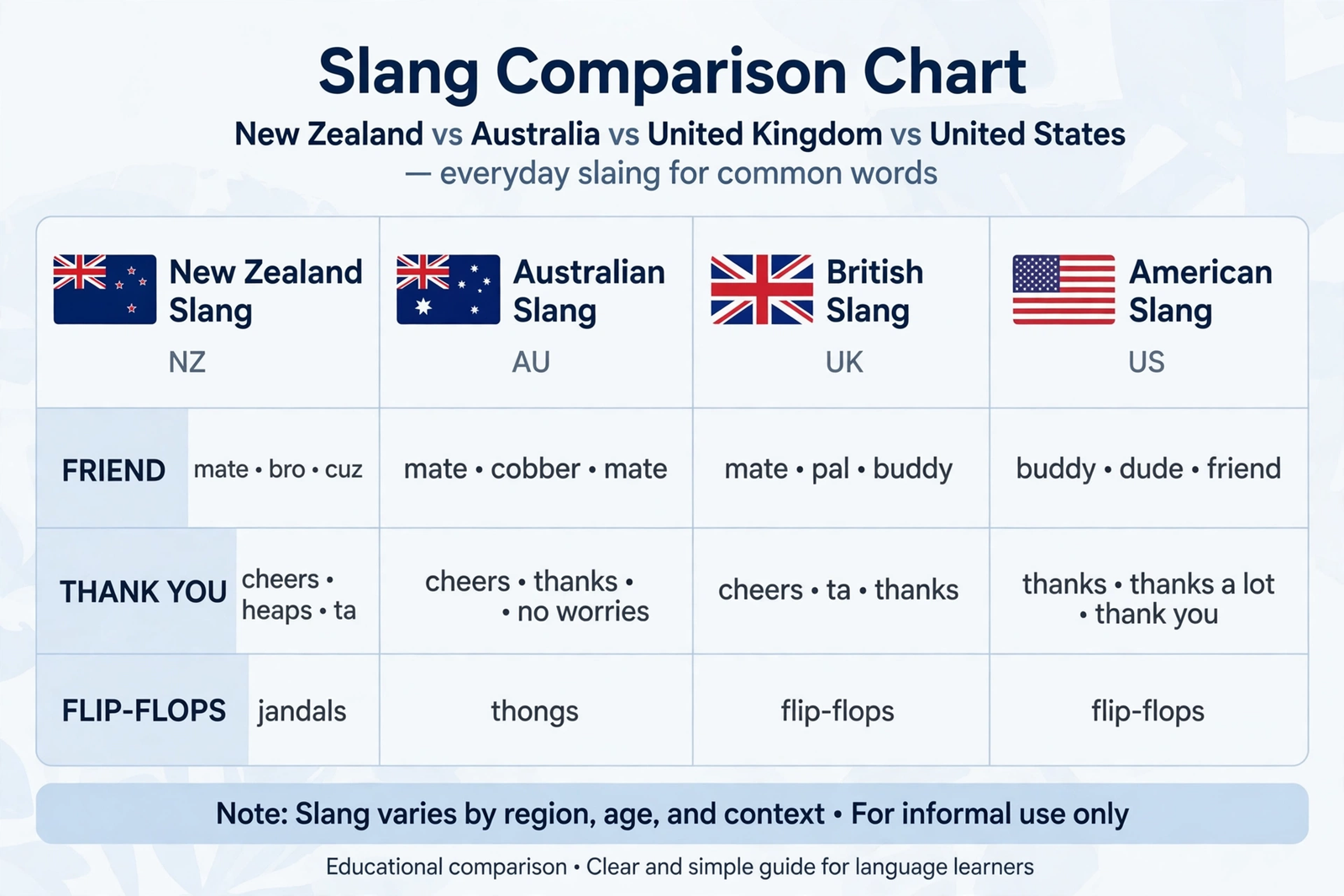
New Zealand slang is often confused with Australian slang, and the two do share some words — mate, arvo, and barbie appear on both sides of the Tasman Sea. But they are not the same, and Kiwis will happily (and proudly) correct you. Here is how New Zealand slang compares with similar English dialects.
| Meaning | New Zealand | Australia | Britain | USA |
|---|---|---|---|---|
| Friend | Bro | Mate | Mate | Dude / buddy |
| Thank you / awesome | Chur | Ta / beaut | Cheers | Thanks / awesome |
| Great / cool | Sweet as | Beaut / ripper | Brilliant | Awesome |
| Flip-flops | Jandals | Thongs | Flip-flops | Flip-flops |
| Convenience store | Dairy | Milk bar | Corner shop | Bodega / corner store |
| Swimwear | Togs | Cossie / swimmers | Swimming costume | Swimsuit |
| Hiking | Tramping | Bushwalking | Hiking / rambling | Hiking |
| Holiday home | Bach | Shack / weekender | Cottage | Cabin / lake house |
| Polite “no” | Yeah, nah | Nah, yeah | Not really | Probably not |
| Very drunk / broken | Munted | Plastered | Plastered | Wasted / hammered |
The biggest difference is the Māori layer. Australia has no everyday equivalent of kia ora as a universal greeting, and the soft, understated Kiwi tone — yeah, nah instead of a blunt no — is distinctively New Zealand. If you are learning global slang, it also helps to know the internet’s shared vocabulary: for example, imo meaning in text and ngl meaning in text are used by Kiwis online just as much as anywhere else, sitting comfortably alongside chur and sweet as in the same group chat.
Alternate Meanings
Like all slang, New Zealand slang words can shift meaning with context. Here are the ones that trip people up most:
- Bro: Usually means friend, but it can also be used to address a stranger (“Cheers, bro”) or even as a mild warning (“Bro, don’t do that”). It is used by all genders in New Zealand.
- Choice: Most often means excellent (“choice feed!”), but it can also be a simple agreement (“Choice, see you then”). Context tells you which one it is.
- Sweet as: Can mean “great,” “no problem,” or “you’re welcome” — three different jobs for one little phrase.
- Munted: Can describe a broken object (“my car’s munted”), a drunk person (“he was munted”), or something ugly (“that haircut is munted”). The common thread is “ruined.”
- Dairy: Has nothing to do with milk products. It is a small corner shop that sells milk, bread, snacks, and newspapers.
- Flat: In New Zealand, a flat is an apartment or a shared house — not something level. “I’m flatting in Wellington” means “I share a rented place in Wellington.”
- Chilly bin: Not a bin at all — it is a cooler box for keeping drinks cold at the beach or a barbecue.
- Kia ora: Works as hello, thank you, goodbye, and cheers. Its Māori root means “be well” or “have life,” which is why it fits so many moments.
Professional or Polite Alternatives
New Zealand slang is perfect for casual settings, but in formal situations you will want the standard version. Here is a quick translation guide:
| Slang | Formal / polite alternative | When to switch |
|---|---|---|
| Chur, bro | Thank you very much | Job interviews, formal emails |
| Sweet as | That sounds great / no problem | Client meetings |
| Yeah, nah | I’m afraid not / I don’t think so | Professional disagreement |
| She’ll be right | It will be resolved | Reporting to a manager |
| Keen as | I would be very interested | Job applications |
| Suss it out | Please look into it | Workplace requests |
| Have a yarn | Let’s have a discussion | Formal meetings |
| Munted | Damaged / not working | Any formal context |
That said, New Zealand workplaces are famously relaxed, and a friendly kia ora or no worries is welcome almost everywhere. When in doubt, mirror the people around you: if your Kiwi colleagues say chur, you can too.
Common Mistakes
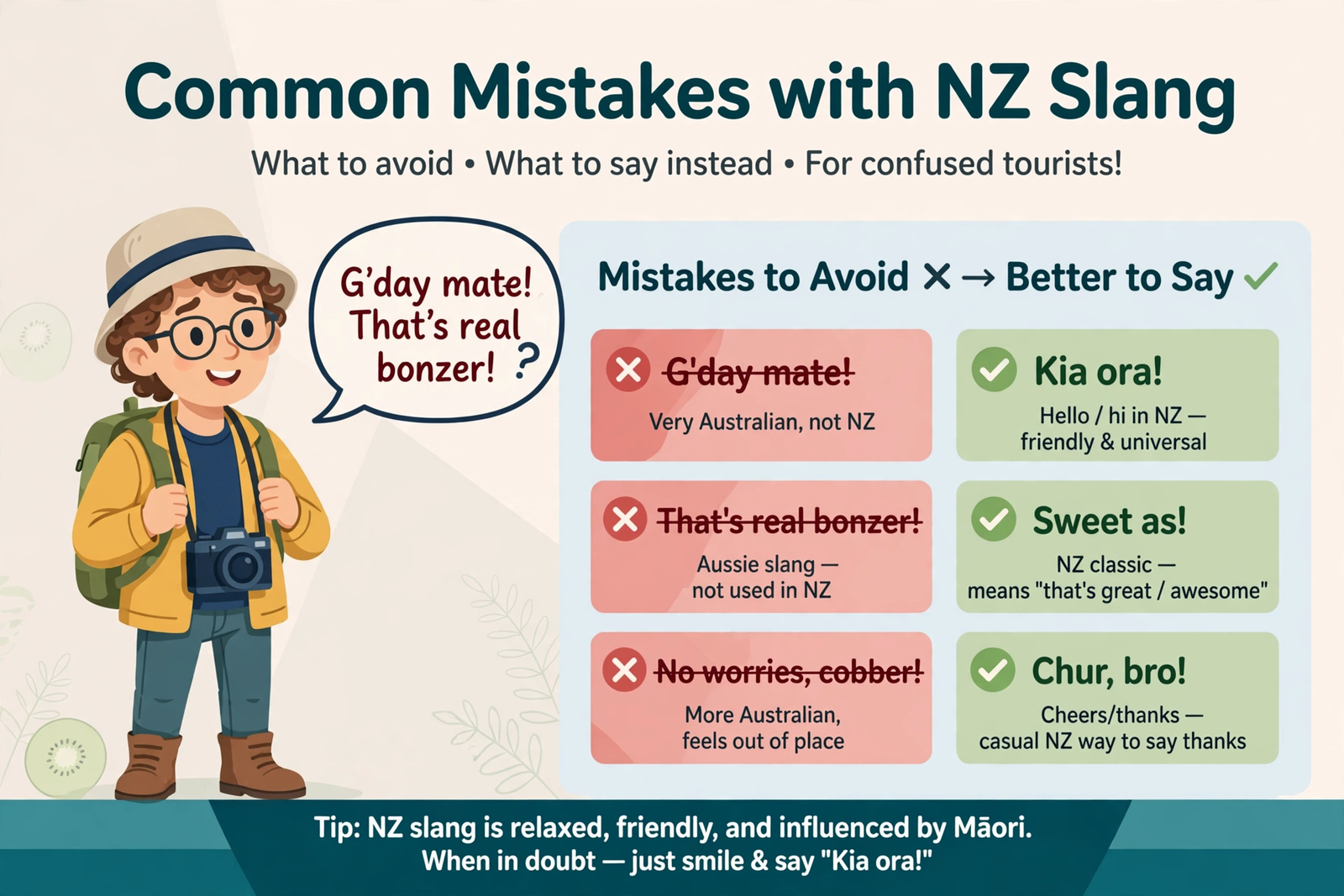
Visitors and new migrants make the same handful of mistakes with New Zealand slang. Avoid these and you will sound far more natural:
- Overusing “sweet as” and “chur”: These are the two words tourists learn first, and using them in every sentence sounds forced. Kiwis use them sparingly — once or twice in a conversation, not ten times.
- Calling everything “bro”: Bro is friendly, but calling your boss or a stranger bro in a formal setting can come across as too familiar. Use names until you know someone well.
- Confusing “yeah, nah” with “nah, yeah”: Yeah, nah means no. Nah, yeah means yes. Mixing them up reverses your answer completely.
- Assuming NZ slang is Australian slang: Telling a Kiwi their slang is “just Australian” is the fastest way to annoy one. The Māori words, the pronunciation, and many terms are uniquely New Zealand.
- Using “munted” at work: It is crude and casual. Keep it for friends, not colleagues or clients.
- Mispronouncing Māori words: Kia ora is pronounced “kee-ah OR-ah,” not “kai ora.” A little effort with pronunciation goes a long way — Kiwis notice and appreciate it. The Māori Dictionary (Te Aka) is the authoritative place to check pronunciation and meaning.
- Translating “dairy” literally: If a Kiwi says “I’m going to the dairy,” they are going to the shop, not a farm. Do not ask where the cows are.
- Taking understatement literally: “Not bad” from a Kiwi often means “really good.” “Yeah, it was alright” can mean “I loved it.” Listen for the tone, not just the words.
Quick Tips
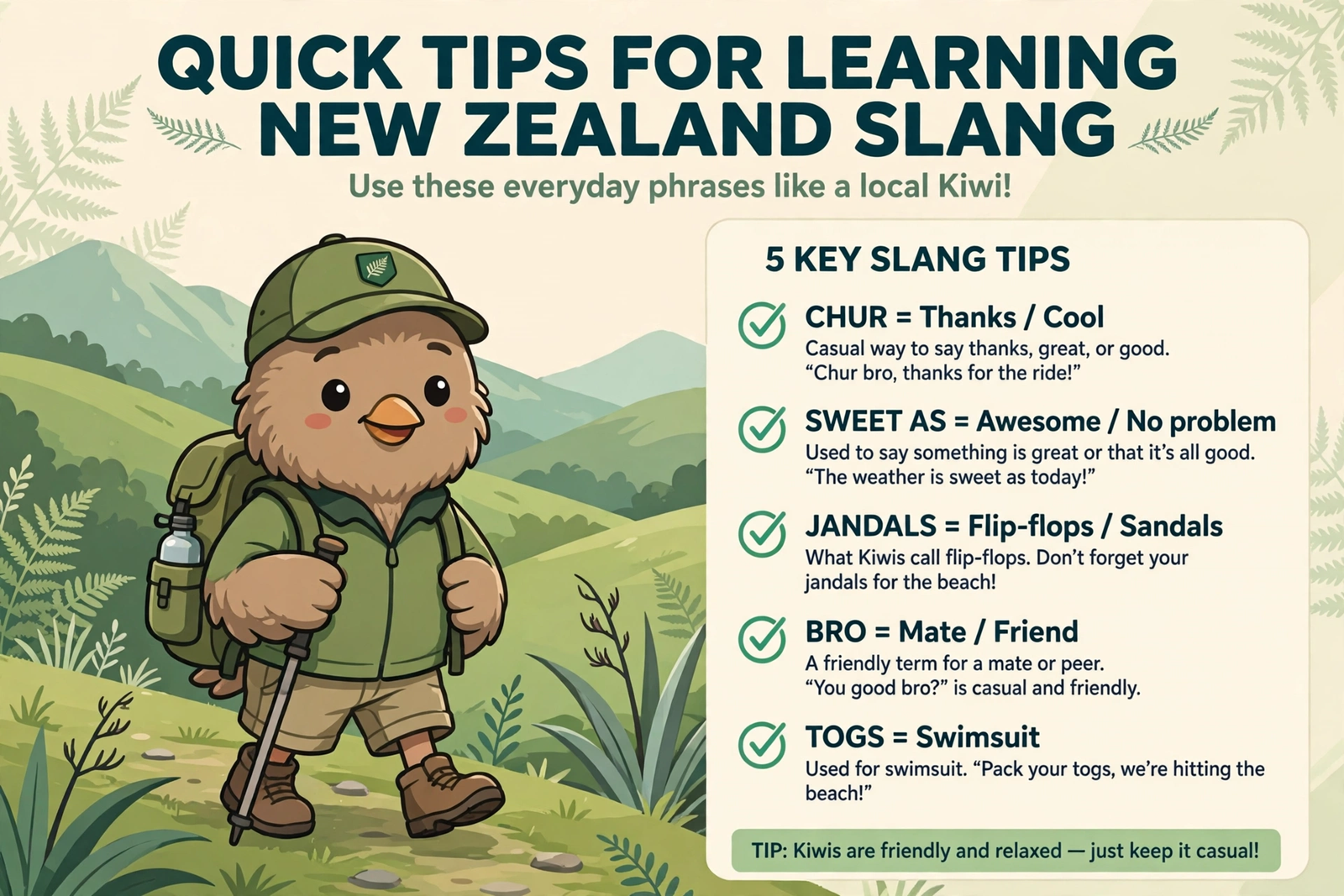
- Start with five words: Learn kia ora, chur, sweet as, bro, and yeah, nah first. They cover most everyday interactions.
- Listen before you speak: Spend a day listening to how Kiwis use a word before you try it. Context is everything in New Zealand slang.
- Use “eh” sparingly: Kiwis end sentences with eh (“Good day, eh?”) to invite agreement. It is natural for them; for learners it is easy to overdo.
- Learn the Māori greetings: Kia ora (hello), ka kite anō (see you again), and ngā mihi (thanks / regards) will earn you instant goodwill.
- Watch Kiwi shows and creators: A few hours of New Zealand YouTube, TikTok, or TV will teach you more about tone and timing than any list.
- Do not fake the accent: Slang is about words, not accent. Use the vocabulary in your own voice — Kiwis would much rather hear you say chur naturally than attempt a Kiwi accent.
- Ask when unsure: Kiwis love explaining their slang. “What does that mean?” is always a welcome question — it usually starts a great conversation.
- Pair it with global slang: Online, Kiwi slang mixes freely with internet slang. Knowing terms like pmo meaning in text helps you follow Kiwi group chats, where chur and pmo can appear in the same sentence.

FAQ
What does “chur” mean in New Zealand slang?
Chur is one of the most versatile words in new zealand slang. It can mean thank you (“Chur, bro!”), awesome (“Chur, that’s choice!”), or yes/agreed (“Chur, let’s do it”). It comes from Māori-influenced Kiwi speech and is used in casual conversation all over New Zealand.
What does “sweet as” mean?
Sweet as means great, cool, no problem, or you’re welcome, depending on context. It is the Kiwi way of saying everything is good. The as is a shortened form of “as [something]” — Kiwis add as to many adjectives, like keen as or choice as.
What does “yeah, nah” mean in New Zealand?
Yeah, nah is a polite way of saying no. The yeah softens the refusal, and the nah delivers it. Its opposite is nah, yeah, which means yes. This gentle, indirect style is a classic feature of Kiwi communication.
What is a dairy in New Zealand slang?
A dairy is a small corner shop or convenience store that sells milk, bread, snacks, drinks, and newspapers. It has nothing to do with a milk farm — the name comes from the fact that dairies traditionally sold milk and dairy products.
What does “she’ll be right” mean?
She’ll be right means “it will be fine” or “don’t worry, it will work out.” It reflects the relaxed, optimistic Kiwi attitude toward problems. It can also mean “no worries” when someone apologises.
What does “kia ora” mean?
Kia ora is a Māori greeting that literally means “be well” or “have life.” In everyday New Zealand slang it is used as hello, thank you, goodbye, and cheers. It is the most widely used Māori word in Kiwi English and is appropriate in almost any setting, formal or casual.
Is New Zealand slang the same as Australian slang?
No. While the two share some words like mate and arvo, New Zealand slang has its own Māori vocabulary (kia ora, whānau), unique words like jandals, chur, and munted, and a different accent and tone. Kiwis are proud of the difference.
How can I learn New Zealand slang quickly?
Start with the five most common words — kia ora, chur, sweet as, bro, and yeah, nah — then listen to how Kiwis use them in real conversation. Watching Kiwi creators on TikTok and YouTube, listening to New Zealand podcasts, and chatting with locals will teach you the tone and timing faster than any list. And remember, asking “what does that mean?” is always welcome.
Conclusion
New Zealand slang is more than a list of funny words — it is a window into Kiwi culture: relaxed, friendly, humorous, and deeply shaped by Māori language and New Zealand’s unique history. From kia ora and chur to sweet as and she’ll be right, these expressions carry the warmth and understatement that define how New Zealanders talk to each other.
The good news is that new zealand slang is easy to learn. Start with the five core words, listen to how locals use them, and do not be afraid to ask questions — Kiwis love sharing their language. Before long, you will be dropping a casual chur at the dairy, agreeing with a sweet as, and answering tricky questions with a perfectly timed yeah, nah.
If you enjoyed this guide, you may also like our explainers on other popular terms — from vanilla meaning slang to trade slang — and the next time a Kiwi says “she’ll be right,” you will know exactly what they mean. Because in New Zealand, she always is.

2 thoughts on “New Zealand Slang: 25+ Kiwi Words, Phrases & Meanings Explained (2026)”