
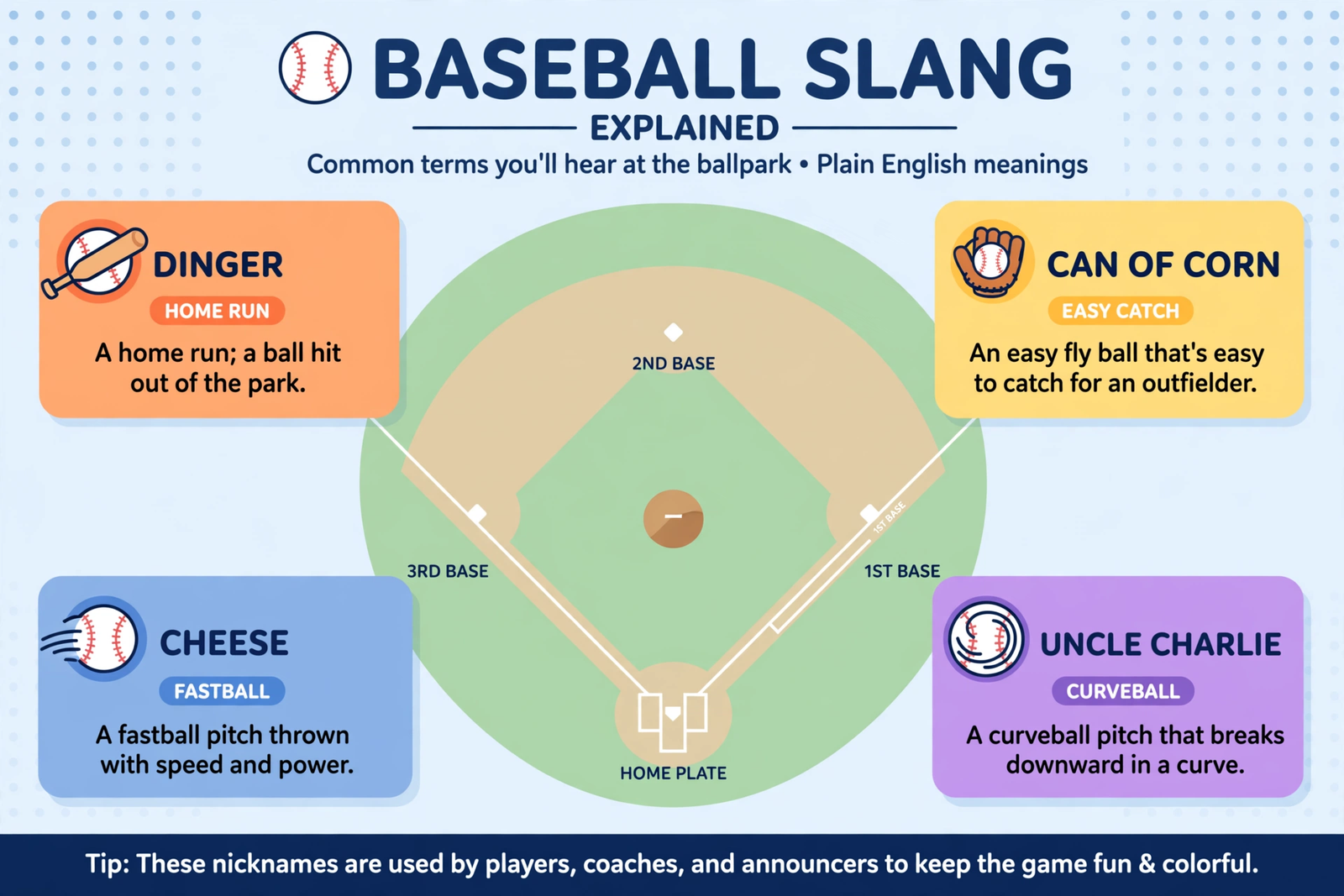
Quick definition: Baseball terms slang is the colourful, unofficial vocabulary of baseball — words like dinger (home run), can of corn (an easy fly ball), chin music (a high, inside pitch), and Uncle Charlie (a curveball) that players, broadcasters, and fans use instead of the formal rulebook language. Learning baseball terms slang is the fastest way to understand what announcers are actually saying and to sound like a real fan at the ballpark.
Baseball Terms Slang Meaning & Definition
Baseball terms slang means the informal words and phrases that describe the plays, pitches, players, and moments of a baseball game. Some of it is official terminology — strikeout, grand slam, RBI — and some of it is pure dugout invention, like calling a home run a dinger, a tater, or a bomb. Together, these words form a second language that has been growing for more than 150 years.
Why does baseball need so much slang in the first place? Because the game is slow enough to talk through and old enough to have collected nicknames for almost everything on the field. A fastball is not just a fastball — it can be cheese, heat, or a heater. A curveball can be Uncle Charlie, a bender, or a yellow hammer. And when a batter hits a home run, the announcer has a dozen ways to say it, from going yard to hitting a moonshot.
For a new fan, baseball terms slang can feel like a wall. The good news is that most of it follows a simple logic: the words describe what the ball does, what the player does, or how the moment feels. Once you learn the 30 or 40 most common terms, the other hundred fall into place quickly — and the game on TV suddenly makes a lot more sense.
Introduction
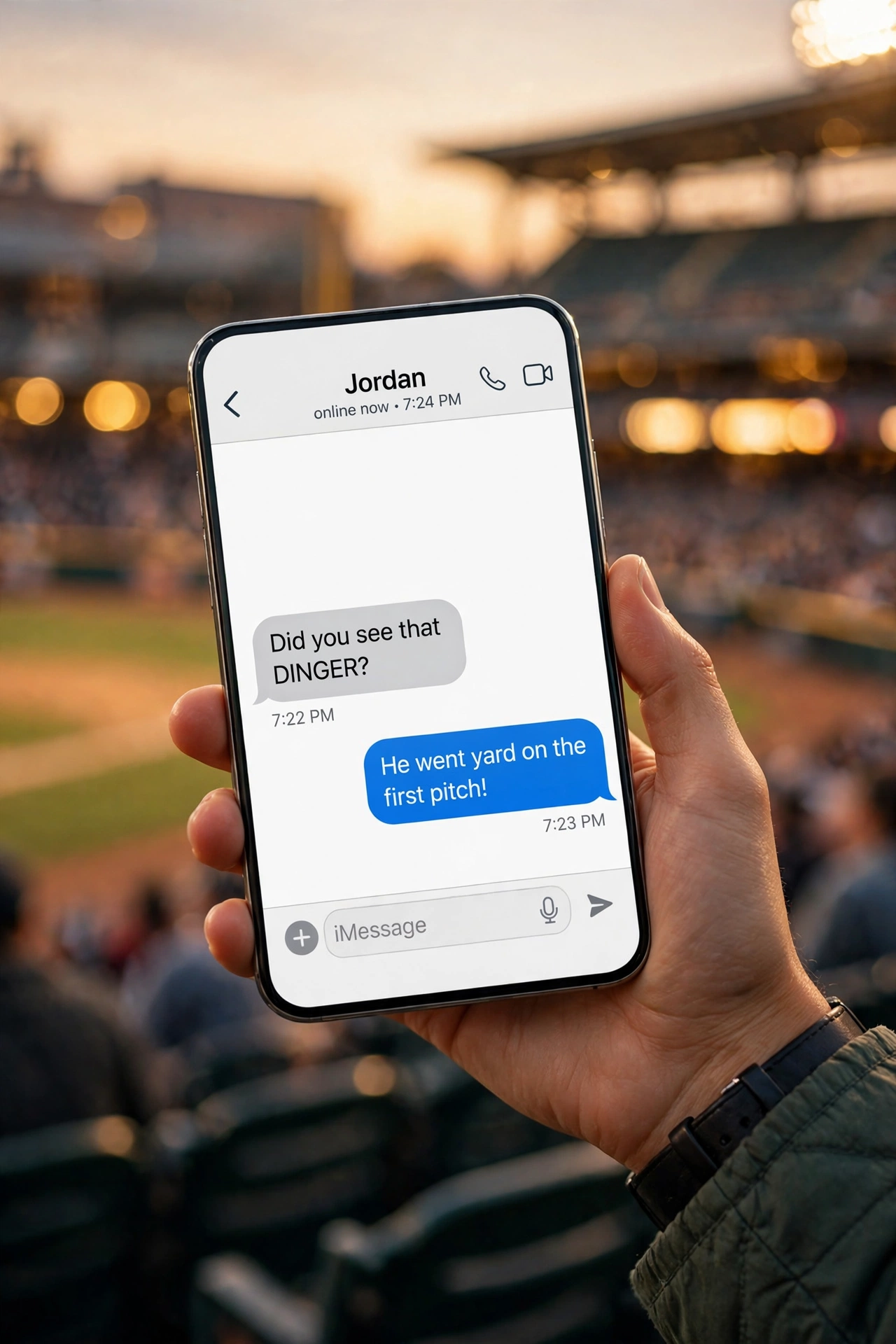
Picture this: you are watching a game with friends, the batter crushes a pitch over the left-field wall, and the whole room erupts. The announcer shouts, “That is an absolute dinger — he went yard on the first pitch!” Everyone cheers. And you nod along, quietly wondering what a dinger is and where exactly the yard is.
If that sounds familiar, you are not alone. Baseball has more slang than almost any other sport in America, and it shows up everywhere — in the broadcast booth, in the dugout, on social media, and in everyday conversation. People say “out of left field,” “touch base,” “step up to the plate,” and “a whole new ballgame” without ever thinking about baseball at all.
This guide explains baseball terms slang in plain English. You will learn the pitching slang, the hitting slang, the fielding slang, and the scoring words that announcers use every night, with real examples so you can use them yourself. By the end, you will know what a can of corn is, why a pitcher throws chin music, what a golden sombrero means, and when to call a home run a tater instead of a dinger. No rulebook required — just a love of the game and a little curiosity. And baseball is not the only place slang moves fast — our sigma meaning slang guide shows how a single word can take over the whole internet overnight.
Origin
Baseball slang was born in the 1800s, when the game itself was still being invented. Early newspaper writers needed colourful words to fill their game reports, and players needed short, punchy words they could shout across a noisy field. The result was a vocabulary built from everyday life: groceries, music, food, and work.
Take can of corn, one of the oldest terms in the game. In the 1800s, grocery clerks kept cans of corn on high shelves. When a customer asked for one, the clerk would tip it off the shelf and catch it in his apron — an easy, lazy catch. An outfielder catching a high, lazy fly ball does exactly the same thing, so the phrase stuck.
Uncle Charlie, the old nickname for the curveball, comes from the same era of playful naming. Nobody knows exactly who Charlie was, but the name sounds like a friendly old relative — fitting for a pitch that looks harmless until it bends away at the last second. Chin music arrived a little later, describing a pitch thrown high and inside, close enough to the batter’s chin to feel like a song he did not ask to hear.
Broadcasters carried the slang into American living rooms. Radio voices in the 1920s and 1930s, and then television announcers, repeated dugout words until the whole country knew them. ESPN’s nightly highlight shows in the 1990s added a new layer — web gem for a spectacular defensive play, for example — and social media keeps adding more every season. The slang never stops growing because the game never stops being talked about.
Popularity
Baseball terms slang is popular far beyond the ballpark. Major League Baseball draws tens of millions of fans every season, and its broadcasts reach every corner of the United States. When an announcer calls a home run a moonshot, millions of people hear it at the same time — and many of them repeat it the next day.
The slang also lives on social media. Clips of walk-off home runs and diving catches go viral on TikTok and X with captions full of baseball terms slang: “absolute dinger,” “he painted the corners,” “that was a web gem.” Fantasy baseball players use the same words in their group chats, and sports betting apps list terms like grand slam and strikeout on every screen. The same viral energy drives internet slang too — our csl meaning in text guide breaks down a term that spread through group chats the same way baseball slang spread through ballparks.
Perhaps the biggest reason for its popularity is that baseball slang escaped the sport entirely. English borrowed dozens of baseball phrases for everyday life: out of left field (a surprising idea), touch base (check in with someone), step up to the plate (take responsibility), hit it out of the park (succeed brilliantly), three strikes and you’re out (no more chances), and ballpark figure (a rough estimate). Even people who have never watched a full game use baseball terms slang every week without realising it.
How It Is Used
Baseball terms slang is used in four main settings: on the field, in the broadcast booth, in the stands, and online. Each setting uses the words a little differently, and knowing the difference helps you sound natural instead of forced.
On the field, players and coaches use short, practical slang. A pitcher “takes the bump” (the mound), a coach tells a batter to “protect the plate,” and a fielder shouts that a fly ball is a “can of corn” so everyone relaxes. Dugout slang is fast, loud, and full of encouragement — “good eye” for a batter who takes a close pitch, “wheels” for a fast runner.
In the broadcast booth, announcers use the most colourful slang. They call a home run a dinger, a tater, or a moonshot, describe a hard fastball as high cheese, and say a pitcher is “painting the corners” when his pitches keep catching the edges of the strike zone. Broadcasters also mix in statistics — ERA, RBI, OPS — so the slang sits next to the numbers.
In the stands and at home, fans use the friendliest version of the slang. “He’s got wheels!” when a player steals a base. “That was a bomb!” when a home run clears the fence by a mile. Fans also use it jokingly — calling a bad swing a “whiff” or a weak hit a “bleeder” that somehow found a hole.
Online, baseball terms slang shows up in memes, highlight captions, and fantasy league chats. The tone is playful and exaggerated: a grand slam becomes a “salami,” a four-strikeout game becomes a “golden sombrero,” and a dominant performance becomes a player who is “dealing” or “absolutely shoving.” If you can read a baseball meme, you already know more slang than you think.
Examples
The best way to learn baseball terms slang is to see it in real sentences. Here are examples from friendly chats, professional broadcasts, and funny moments — the same words, used in very different tones.
Friendly Examples
- “Did you see that dinger? He launched it into the second deck!” — a fan texting a friend after a home run.
- “That was a can of corn. The centre fielder barely had to move.” — friends watching an easy fly ball get caught.
- “He’s got wheels — he stole second before the catcher even threw.” — praising a fast baserunner.
- “The closer came in and shut the door. Game over.” — describing the final pitcher finishing the game.
- “That pitch was pure cheese. Ninety-nine miles an hour, right down the middle.” — talking about a great fastball.
Professional Examples
- “The ace takes the bump tonight, looking for his tenth win of the season.” — a broadcaster introducing the team’s best starting pitcher.
- “He’s painting the corners with that backdoor slider — the batter never had a chance.” — a commentator describing precise pitching.
- “Two outs, bases loaded — a grand slam here would tie the game.” — a play-by-play announcer setting up a dramatic moment.
- “The cleanup hitter drives in two with a frozen rope to left field.” — a broadcaster describing a hard line drive.
- “That ball is gone — a walk-off moonshot, and the home crowd is going wild.” — the call of a game-winning home run.
Funny Examples
- “He swung at that pitch like he was swatting a fly — total whiff.” — joking about a wild, missed swing.
- “Golden sombrero tonight — four strikeouts and a very quiet walk back to the dugout.” — teasing a batter after a rough game.
- “That bleeder somehow found a hole between two fielders. Baseball is a funny game.” — laughing at a lucky, weak hit.
- “The pitcher threw him chin music and he danced away from the plate like it was hot.” — describing a batter dodging a high, inside pitch.
- “He hit a Baltimore chop so high the infielders had time to order lunch.” — joking about a ground ball that bounced sky-high off the dirt.
Comparison with Similar Terms
Baseball slang is full of words that sound alike but mean different things — and words that mean the same thing but feel different. The comparison table below clears up the most common mix-ups, so you never call a single a double or a curveball a slider again.
| Term | What It Means | Similar Term | Key Difference |
|---|---|---|---|
| Dinger | A home run | Tater / Bomb | All mean a home run; “dinger” is the most common, “bomb” implies a very long one |
| Can of corn | An easy, high fly ball | Pop-up | A pop-up is any high, short fly ball; a can of corn is one so easy the fielder barely moves |
| Cheese / Heat | A hard fastball | Heater | All mean a fastball; “high cheese” is a fastball thrown up in the strike zone |
| Uncle Charlie | A curveball | Bender / Yellow hammer | Same pitch; “Uncle Charlie” is the old nickname, “bender” is the modern dugout word |
| Walk-off | A game-winning hit in the final inning | Walk-off homer | A walk-off can be any hit or play; a walk-off homer is specifically a home run that ends the game |
| Golden sombrero | Striking out four times in one game | Hat trick | In baseball, a “hat trick” is three strikeouts; the golden sombrero is the worse, four-strikeout version |
| Ace | The team’s best starting pitcher | Closer | The ace starts games; the closer finishes them, usually in the ninth inning |
| Small ball | Scoring with bunts, steals, and singles | Long ball | Small ball is patient, tactical scoring; long ball is scoring with home runs |
| Web gem | A spectacular defensive play | Routine play | A web gem is a highlight-reel catch or throw; a routine play is one any fielder should make |
| Texas leaguer | A short bloop hit that falls in | Bleeder | A Texas leaguer is a soft fly ball; a bleeder is a weak ground ball — both are lucky hits |
The biggest takeaway from this comparison is that baseball slang loves variety. A home run alone has more than ten nicknames — dinger, tater, bomb, blast, moonshot, jack, big fly, long ball, going yard, salami (for a grand slam). Broadcasters switch between them to keep the call exciting, and fans pick their favourites. You do not need to memorise all of them; learning one word for each play is enough, and the rest will come naturally as you watch more games.

Alternate Meanings
Some baseball terms slang words have meanings outside the ballpark — and a few mean something completely different depending on the sport or the situation.
Home run is the most famous example. In baseball, it is a hit that scores the batter. In everyday English, “hitting a home run” means succeeding brilliantly at anything — a sales pitch, a first date, a job interview. The phrase travelled so far from the ballpark that most people who use it have never watched a full baseball game.
Out of left field comes from the left fielder’s position, far from the action — so an idea that comes “out of left field” is surprising and unexpected. Touch base comes from a runner touching a base safely; in business, it means checking in with someone. Step up to the plate means taking responsibility, just as a batter steps up to face the pitcher. Ballpark figure means a rough estimate, as if you are only guessing which ballpark you are in.
Strikeout also has a second life. In baseball, it is three strikes and the batter is out. In everyday speech, “striking out” means failing completely — striking out on a date, striking out on a job application. The same goes for three strikes and you’re out, which people use to mean “no more chances.”
Curveball is another word that escaped the sport. A real curveball is a pitch that bends in the air. In life, “life threw me a curveball” means something unexpected and hard to handle happened. And ace means the best pitcher on a team — but also the best card in a deck, or the best person at something: “she’s an ace at negotiation.”
Within baseball itself, some words shift meaning by context too. Changeup is a slow pitch designed to fool a batter — but it can also describe any change of pace in strategy. Cleanup hitter is the fourth batter in the lineup, expected to “clean up” the runners on base; in the office, “cleaning up” means finishing a messy job. Context decides the meaning, and in a baseball conversation, the baseball meaning almost always wins.
Professional or Polite Alternatives
Baseball slang is casual by nature, and that is fine for fans and friends. But in formal writing, coaching, or a work presentation, the plain official words work better. Here is how to translate the slang into professional language:
- Dinger / tater / bomb → home run (formal reports, scorecards, news articles)
- Cheese / heat / heater → fastball or high-velocity fastball
- Uncle Charlie / bender → curveball
- Can of corn → routine fly ball
- Chin music → high, inside pitch
- Painting the corners → locating pitches at the edges of the strike zone
- Golden sombrero → four strikeouts in a game
- Walk-off → game-winning hit in the final inning
- Web gem → outstanding defensive play
- Small ball → situational hitting and baserunning strategy
When do you need the formal version? In a school essay about baseball, a coaching manual, a business presentation that borrows baseball words, or any written piece where the reader may not know the slang. The slang itself is not rude — none of these words are offensive — but the official terms are clearer for readers who are new to the game. A good rule: use the slang when you are talking with fans, and use the official words when you are explaining the game to someone for the first time.
Common Mistakes
New fans make the same handful of mistakes with baseball terms slang. Avoid these, and you will sound like you have been watching the game for years.
1. Calling every home run a grand slam. A grand slam is a very specific home run: one hit with the bases loaded, worth four runs. A solo home run is just a home run — or a dinger, if you like. Calling a solo shot a grand slam is the fastest way to give yourself away as a new fan.
2. Mixing up a walk-off and a walk. A “walk” is when the batter gets four balls and takes first base for free. A “walk-off” is a game-winning play in the final inning — the home team literally walks off the field because the game is over. They sound similar; they mean completely different things.
3. Using “strikeout” and “out” as the same word. A strikeout is one way to get an out, but not every out is a strikeout. A batter can also fly out, ground out, or be caught stealing. Saying “he struck out” when he actually flied out to centre field is a common slip.
4. Calling every good pitcher the ace. The ace is the team’s number-one starting pitcher — there is only one per team. A great relief pitcher is not the ace; he might be the closer or the setup man. Using “ace” for every good pitcher waters the word down.
5. Saying “dinger” for a ball that did not leave the park. A dinger is a home run, full stop. A ball that hits the wall is a double or a triple. A long fly ball caught at the warning track is a heartbreaking out, not a dinger. The word only counts when the ball clears the fence.
6. Confusing “bunt” and “sacrifice fly.” A bunt is when the batter holds the bat still and taps the ball softly into the infield. A sacrifice fly is a deep fly ball that lets a runner score from third base. Both give up an out to move a runner — but they are different plays with different rules.
7. Overusing the slang. Sprinkling one or two slang words into a conversation sounds natural. Using five in a single sentence — “the ace threw high cheese, the batter hit a dinger, it was a moonshot, a tater, a bomb” — sounds like you are reading from a glossary. The best fans use slang the way the best broadcasters do: one vivid word at the right moment.

Quick Tips
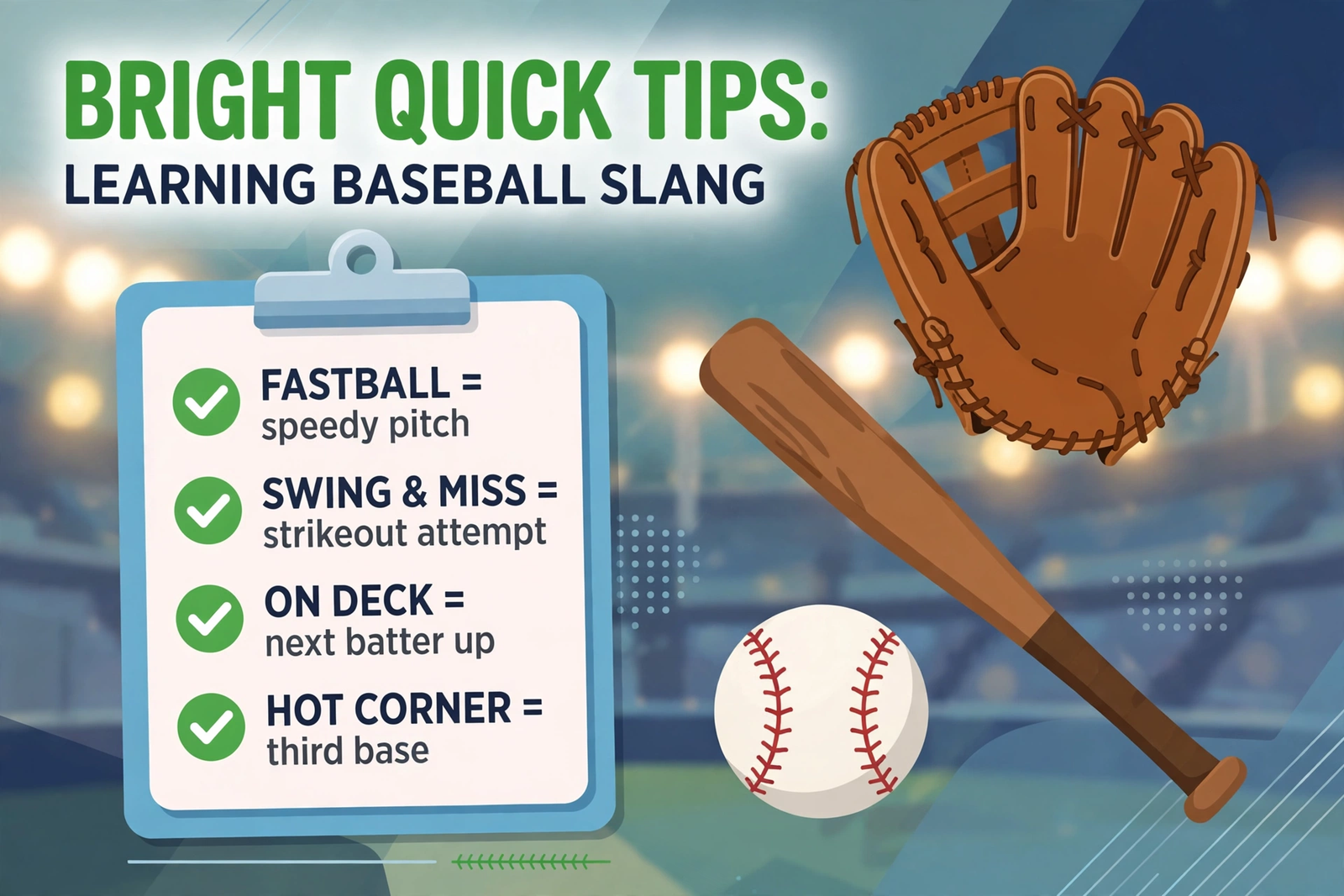
- Start with the big ten: dinger, can of corn, cheese, Uncle Charlie, chin music, walk-off, grand slam, ace, closer, and web gem. These ten words cover most of what you will hear in a single game.
- Watch with the captions on: broadcasters say the slang out loud, and the captions spell it. Hearing and reading a new word at the same time helps it stick.
- Learn one group at a time: pitching words one week (ace, cheese, bender, chin music), hitting words the next (dinger, bleeder, frozen rope), fielding words after that (web gem, can of corn, hot corner). Small groups beat one giant list.
- Use the words out loud: say “that was a dinger” the next time you watch a home run, even if you are alone. Using a word is the fastest way to own it.
- Follow baseball accounts online: highlight pages and team accounts post clips with slang in the captions. Reading a dozen captions a day teaches the vocabulary without any study.
- Ask a fan, not a search engine: baseball fans love explaining the game. “What does that mean?” is the best question at a ballpark, and the answer usually comes with a story.
- Keep a small list on your phone: jot down any new word you hear during a game and look it up after. Ten games later, your list becomes a personal glossary.
- Remember the everyday phrases: knowing that “out of left field” and “touch base” come from baseball makes the slang feel less foreign — you already use part of it every day.

FAQ
What does “dinger” mean in baseball terms slang?
A “dinger” is slang for a home run. When a batter hits the ball over the outfield fence, fans and broadcasters call it a dinger, a tater, a bomb, or a moonshot. All four words mean the same thing, though “bomb” usually suggests a particularly long home run.
What is a “can of corn” in baseball?
A “can of corn” is an easy, high fly ball that an outfielder catches without moving much. The phrase comes from 1800s grocery stores, where clerks tipped cans of corn off high shelves and caught them in their aprons. It is one of the oldest slang terms in baseball terms slang.
What does “chin music” mean?
“Chin music” is a pitch thrown high and inside, close to the batter’s chin, to push him away from the plate. It is usually a warning or a tactic rather than an attempt to hit the batter. The phrase plays on the idea of music the batter did not ask to hear.
What is “Uncle Charlie” in baseball terms slang?
“Uncle Charlie” is an old nickname for the curveball, a pitch that bends sharply as it reaches the plate. Modern players are more likely to call it a “bender,” but broadcasters still use “Uncle Charlie” for its old-fashioned charm.
What does “walk-off” mean in baseball?
A “walk-off” is a play that wins the game for the home team in the bottom of the final inning — usually a hit, and most famously a walk-off home run. The name comes from the losing team walking off the field because the game ends immediately.
What is a “golden sombrero” in baseball?
A “golden sombrero” means a batter struck out four times in a single game. Three strikeouts is a “hat trick” in baseball slang; the fourth strikeout earns the bigger, “golden” hat. It is a joking term, but no player wants to wear one.
What does “painting the corners” mean?
“Painting the corners” means a pitcher is throwing pitches that just catch the edges of the strike zone, where they are hardest to hit. It is a compliment to the pitcher’s control and accuracy, and umpires decide whether those borderline pitches count as strikes.
How many baseball slang terms are there?
There are well over 150 baseball slang terms in common use, from dugout words like “cheese” and “dinger” to official terms like “RBI” and “grand slam” that fans use every day. You do not need to know them all — the 30 to 40 most common baseball terms slang words in this guide cover almost everything you will hear in a typical game.
Conclusion
Baseball terms slang is more than a list of funny words — it is the shared language of a sport that has been talking to itself for over 150 years. From the grocery-store logic of a can of corn to the old-family nickname of Uncle Charlie, every term carries a little piece of baseball history. And because the game keeps being played, watched, and talked about, the language keeps growing: new words arrive every season, and old words find new life in memes, broadcasts, and group chats.
The key takeaways are simple. Start with the big words — dinger, can of corn, cheese, walk-off, grand slam — and let the rest come as you watch. Remember that a grand slam needs the bases loaded, that the ace is only one pitcher per team, and that a walk-off ends the game on the spot. Use the slang with fans, the official words when you are explaining the game to someone new, and never be afraid to ask what a word means — baseball fans love to explain.
If this guide helped you decode baseball terms slang, keep exploring the words that travel with it. Our fit meaning slang guide breaks down a word that means one thing in America and another in Britain, and our skibidi meaning slang guide explains the internet’s favourite nonsense word. Slang moves fast, but once you learn to read it, no broadcast, caption, or comment section can confuse you again.
For a deeper dive into the game’s official vocabulary, see the baseball lingo guide at Sports Foundation, which lists 68 terms from balk to walk-off with clear definitions.
