
1930s Slang: 40+ Words, Meanings & Examples from the Jazz Age
Quick definition: 1930s slang is the colourful, fast-talking informal language of America during the Great Depression — words like the bee’s knees, copacetic, giggle water, and swell that came out of jazz clubs, speakeasies, gangster movies, and radio shows. If you have ever called something “the cat’s pajamas” or said a plan was “copacetic,” you are already speaking 1930s slang without knowing it.
1930s Slang Meaning & Definition
1930s slang refers to the informal words, phrases, and expressions that were popular in the United States (and, to a lesser extent, Britain) during the 1930s — the decade of the Great Depression, Prohibition’s final years, swing music, and the golden age of Hollywood gangster films. It was the language of jazz musicians, flappers-turned-working-women, bootleggers, newspaper reporters, and movie stars, and it was built for speed: short, punchy, and full of pictures.
Unlike the stiff, formal English of the previous generation, 1930s slang was playful and inventive. People did not just say something was good — it was swell, keen, nifty, or the bee’s knees. They did not just drink alcohol — they drank giggle water or hooch at a speakeasy. A policeman was a flatfoot, a fool was a sap, and a tough guy was a goon — a word that started in the 1930s and, as our guide to goon slang explains, never really went away.
What makes 1930s slang special is how much of it survived. Dozens of these words are still in everyday use nearly a century later, and many more live on in movies, songs, and vintage style. This guide explains what 1930s slang means, where it came from, the 40+ words you will actually recognise, how to use them today, and the mistakes to avoid.
Introduction
Picture a smoky jazz club in 1935. A trumpet player finishes a solo, the crowd roars, and someone at the bar turns to a friend and says, “That cat is the bee’s knees!” Nobody in the room needs a translation. In the 1930s, slang was not a secret code — it was the sound of a country trying to have fun in hard times.
The 1930s were tough. The Great Depression left millions out of work, Prohibition (until its repeal in 1933) pushed drinking underground, and yet the decade produced some of the most joyful, creative language in American history. Radio brought slang into every living room, Hollywood gangster films made it glamorous, and swing music made it dance. New words appeared almost weekly, and the best ones stuck.
Today, 1930s slang pops up everywhere: in period TV shows and films, in vintage fashion and retro parties, in song lyrics, and in everyday phrases people use without realising their age. Words like swell, copacetic, and ritzy are still perfectly understood, and phrases like the bee’s knees and the cat’s pajamas are instantly recognisable as 1930s classics.
This article is the complete breakdown: the meaning and definition of 1930s slang, its origin in jazz, crime, and Hollywood, how popular it became, the 40+ words and phrases worth knowing, real examples in friendly, professional, and funny contexts, a comparison with the slang of other decades, polite modern alternatives, common mistakes, and quick tips for using it without sounding like a costume.

Origin
1930s slang did not come from one place. It bubbled up from at least five different worlds that collided in the same decade — and each one left its mark on the language.
1. Jazz and swing music. Jazz musicians were the great inventors of 1930s slang. Words like cat (a cool guy, especially a musician), hep cat, jive, swing, jitterbug, and rug cutter (a great dancer) all came from bandstands and dance halls. Musicians toured constantly, carrying their vocabulary from city to city, and radio carried it further. When a bandleader called a tune hot, everyone knew what he meant.
2. Prohibition and the underworld. From 1920 to 1933, alcohol was illegal in the United States, and an entire secret vocabulary grew up around it. Giggle water and hooch meant liquor, a speakeasy was an illegal bar, a blind pig was a hidden drinking spot, and a bootlegger was someone who smuggled booze. Gangsters added their own words: a moll was a gangster’s girlfriend, a tommy gun was a submachine gun, and to bump off someone was to kill them. Hollywood gangster films like Little Caesar (1931) and Scarface (1932) turned this underworld talk into mainstream entertainment.
3. Hollywood and radio. The 1930s were the golden age of the “talkies,” and movies spread slang faster than anything before them. Screwball comedies made fast, witty dialogue fashionable, and gangster pictures made tough-guy talk cool. Radio was even bigger: comedy shows, serials, and variety hours reached tens of millions of listeners a night, and catchphrases from popular shows entered everyday speech within days.
4. The newspapers. Tabloid reporters and gossip columnists loved slang because it sold papers. Columnists like Walter Winchell turned underworld and Broadway words into national vocabulary, and sports writers invented nicknames and phrases that fans repeated at work the next morning. The famous slang dictionaries of the era — including the work later collected in Green’s Dictionary of Slang — show just how many 1930s words first appeared in print in newspapers.
5. The street and the dance hall. Ordinary people invented plenty of slang too. Young people in cities mixed words from immigrant communities, Black American English, and vaudeville theatre into a shared urban slang. Dance crazes like the Lindy Hop and the Charleston came with their own vocabulary, and the decade’s famous animal phrases — the bee’s knees, the cat’s pajamas, the snake’s hips — were playful nonsense that caught on because they were fun to say.
Popularity
1930s slang was everywhere by the middle of the decade. It was in the movies your grandparents watched, the songs they danced to, and the newspapers they read over breakfast. Here is why it spread so fast — and why so much of it is still with us.
- Radio made it national. For the first time, the whole country heard the same voices at the same time. A phrase used on a popular radio show on Monday could be repeated in offices and schoolyards across America by Friday.
- Hollywood made it glamorous. Gangster films and screwball comedies turned slang into the language of movie stars. Audiences copied the way James Cagney and Jean Harlow talked, just as fans copy celebrity slang today.
- Swing music made it cool. Big band leaders like Benny Goodman and Duke Ellington were national celebrities, and the slang of the dance hall — hep, jive, solid, groovy (in its earliest sense) — became the slang of young people everywhere.
- Hard times made it fun. The Depression was grim, and slang was a small, free pleasure. Inventing a funny new word for a bad situation — calling nonsense applesauce or baloney, calling a boring person a flat tire — was a way of laughing at trouble.
- It never fully died. Many 1930s words were so useful that they simply stayed. Swell, copacetic, big cheese, big shot, moll, goon, stool pigeon, and on the lam are still understood today, and period dramas keep reintroducing the rest to new audiences.
Modern interest in 1930s slang is driven by vintage culture: retro-themed parties, period television, swing dance communities, classic film fans, and writers looking for authentic dialogue. Search interest spikes every time a popular show or film set in the 1930s appears, and the words themselves keep resurfacing in song lyrics and advertising.
How It Is Used
1930s slang works in three main ways today: as a fun, nostalgic flavour in casual conversation; as authentic colour in writing, theatre, and film set in the period; and as a source of phrases that have quietly become standard English.
In casual conversation, people use 1930s words for humour and emphasis. Saying a restaurant is “ritzy” or a plan is “copacetic” adds personality that plain words do not. In writing and performance, the slang sets the scene instantly — a character who says “Say, that’s swell!” sounds like the 1930s in a way that “That’s great!” never will. And in everyday English, dozens of 1930s coinages — big shot, stool pigeon, gold digger, sugar daddy, wet blanket — are now so normal that most speakers have no idea they are nearly a hundred years old.
The tone matters. Most 1930s slang is warm, playful, and a little theatrical. It suits parties, stories, jokes, and retro events. It does not suit formal business writing, legal documents, or serious news — and some words from the era (especially crime slang like bump off or rub out) sound threatening rather than funny if used carelessly.
Examples
Here are real examples of 1930s slang in action, grouped by tone so you can see how the same words change colour depending on the situation.
Friendly Examples
- “That new jazz record is the bee’s knees — I have played it ten times today!”
- “Come on, don’t be a wet blanket. The party is just getting started.”
- “Your new dress is swell, honestly — you look like a movie star.”
- “Everything’s copacetic, pal. The tickets are booked and the car is waiting.”
- “He’s a real hep cat — knows every band in town by name.”
- “Don’t worry, the whole plan is nifty. We will be home before midnight.”
Professional Examples
- “The merger is a big deal for us, but let’s keep the numbers copacetic before the board meeting.”
- “Our new client is a real big cheese in the publishing world, so let’s make a good impression.”
- “The quarterly report looks swell — revenue is up and costs are under control.”
- “She is the big shot who approved the project, so her feedback matters most.”
- “Let’s not be flat tires about this launch — we need energy in the room.”
Funny Examples
- “My cooking is the cat’s pajamas — said no one who has ever tasted it.”
- “He showed up in a tuxedo to a barbecue. Talk about ritzy — the man brought a bow tie to a burger joint.”
- “I tried to dance the Lindy Hop and became a rug cutter in the worst way — I cut a hole in the actual rug.”
- “That’s applesauce! There is no way the cat ate your homework in 1935.”
- “He calls himself a big shot, but he still asks his mum for petrol money.”
- “The Wi-Fi went down, so I told everyone we were going on the lam from the internet for the weekend.”

Comparison with Similar Terms
Every decade invents its own slang, and the 1930s version sits between the wild party talk of the 1920s and the wartime slang of the 1940s. Here is how they compare — and how 1930s slang differs from the slang young people use today.
| Era | Typical words | What it sounds like | Main influence |
|---|---|---|---|
| 1920s slang | flapper, speakeasy, bee’s knees, giggle water | Wild, rebellious, jazz-age party talk | Prohibition, jazz, flappers |
| 1930s slang | swell, copacetic, goon, jitterbug, big cheese | Fast, witty, movie-and-radio polished | Hollywood, swing, gangster films, radio |
| 1940s slang | GI, snafu, hubba-hubba, hep, cool | Tough, military, wartime shorthand | Second World War, the draft, USO shows |
| Modern slang | lit, vibe, slay, no cap, rizz | Short, ironic, internet-native | Social media, hip-hop, gaming, memes |
The biggest difference between 1930s slang and modern slang is length and picture. 1930s speakers loved long, colourful phrases — the snake’s hips, the duck’s quack, hotsy-totsy — while modern slang tends toward one-syllable words and abbreviations. The 1930s also borrowed heavily from crime, jazz, and the movies; modern slang borrows from the internet, gaming, and music videos. But the job is the same: to sound fun, current, and in-the-know.
Another difference is survival. Very little 1920s slang is still used naturally, and 1940s military slang mostly retired with the soldiers who used it. But 1930s slang had an unusually high survival rate — swell, copacetic, big shot, and wet blanket are still alive in ordinary conversation, which is why this decade’s slang feels familiar even to people who have never seen a 1930s film.

Alternate Meanings
Many 1930s slang words had more than one meaning, and context decided which one applied. A few of the trickiest ones:
- Cat: a cool guy or jazz musician in slang — but also just an animal. “That cat can really play” means the musician is talented; “that cat is asleep” means the pet is napping.
- Swell: in the 1930s it meant excellent or great (“a swell party”), but it also meant a swollen injury, and today some people use it sarcastically to mean the opposite (“Oh, swell. Another flat tire.”).
- Goon: in the 1930s it meant a hired thug or a fool. Today it can also mean a silly person in a friendly way (“you big goon”), and in Australia it means cheap boxed wine.
- Joint: a place — a nightclub, a restaurant, a cheap hotel (“a flea-bag joint”). Today the same word has a completely different drug-related meaning, so use it carefully.
- Cool: it existed in the 1930s and 1940s jazz world meaning calm and stylish, but it only became the universal word for “great” in the 1950s. A 1930s speaker would say swell or keen first.
- Dame: a woman, usually in gangster-film dialogue (“a classy dame”). It sounds old-fashioned and a little disrespectful today, so it is best left in period dialogue.
- Moolah / dough: both mean money, but dough was the more common 1930s word, while moolah became more popular later.
Professional or Polite Alternatives
1930s slang is charming, but not every word belongs in every room. Here are polite, modern alternatives for the most common situations:
| 1930s slang | What it means | Polite modern alternative |
|---|---|---|
| Swell / keen / nifty | Excellent, great | Excellent, wonderful, great |
| The bee’s knees | The very best | Outstanding, top-notch |
| Copacetic | All in order, fine | All set, everything is in order |
| Big cheese / big shot | Important person | Senior executive, key decision-maker |
| Flat tire | Boring person | Quiet guest (or say nothing at all) |
| Baloney / applesauce | Nonsense | That doesn’t sound right |
| Moll / dame / broad | Woman (dated, disrespectful) | Woman, lady, colleague |
| On the lam | Running from the law | Unreachable, away, off the grid |
| Giggle water | Alcohol | Drinks, cocktails, a glass of wine |
| Wet blanket | Killjoy | Someone who prefers a quieter evening |
The rule of thumb: the praise words (swell, copacetic, the bee’s knees) are safe almost anywhere, because they are positive and old-fashioned enough to sound charming rather than rude. The people words (dame, broad, moll, sap) are the risky ones — they were often dismissive even in the 1930s, and they sound worse now.
Common Mistakes
Using 1930s slang well is mostly about not overdoing it. These are the mistakes people make most often:
- Mixing decades. Calling someone a “groovy hep cat” mixes 1960s groovy with 1930s hep cat, and it sounds wrong to anyone who knows the period. Keep your 1930s words in the 1930s.
- Using crime slang as a joke. Words like bump off, rub out, and take for a ride meant murder in the 1930s. They are not funny party words, and they can sound threatening in real life.
- Overloading every sentence. One or two period words per paragraph sounds stylish; ten in one sentence sounds like a costume. The best vintage dialogue uses slang as seasoning, not as the whole meal.
- Calling everything “the bee’s knees.” The phrase means the absolute best. If everything is the bee’s knees, nothing is — and the phrase loses its punch.
- Using dame, broad, or moll for real women. These were gangster-film words, not compliments. In modern conversation they come across as rude and dated.
- Getting the animal phrases wrong. It is the bee’s knees and the cat’s pajamas — not “the bee’s pyjamas” or “the cat’s knees.” The exact pairings are part of the charm.
- Forgetting the tone. 1930s slang is upbeat and witty. Using it in a sad or serious moment (“Sorry about your loss, that’s a real bummer… I mean, that’s applesauce“) just sounds tone-deaf.

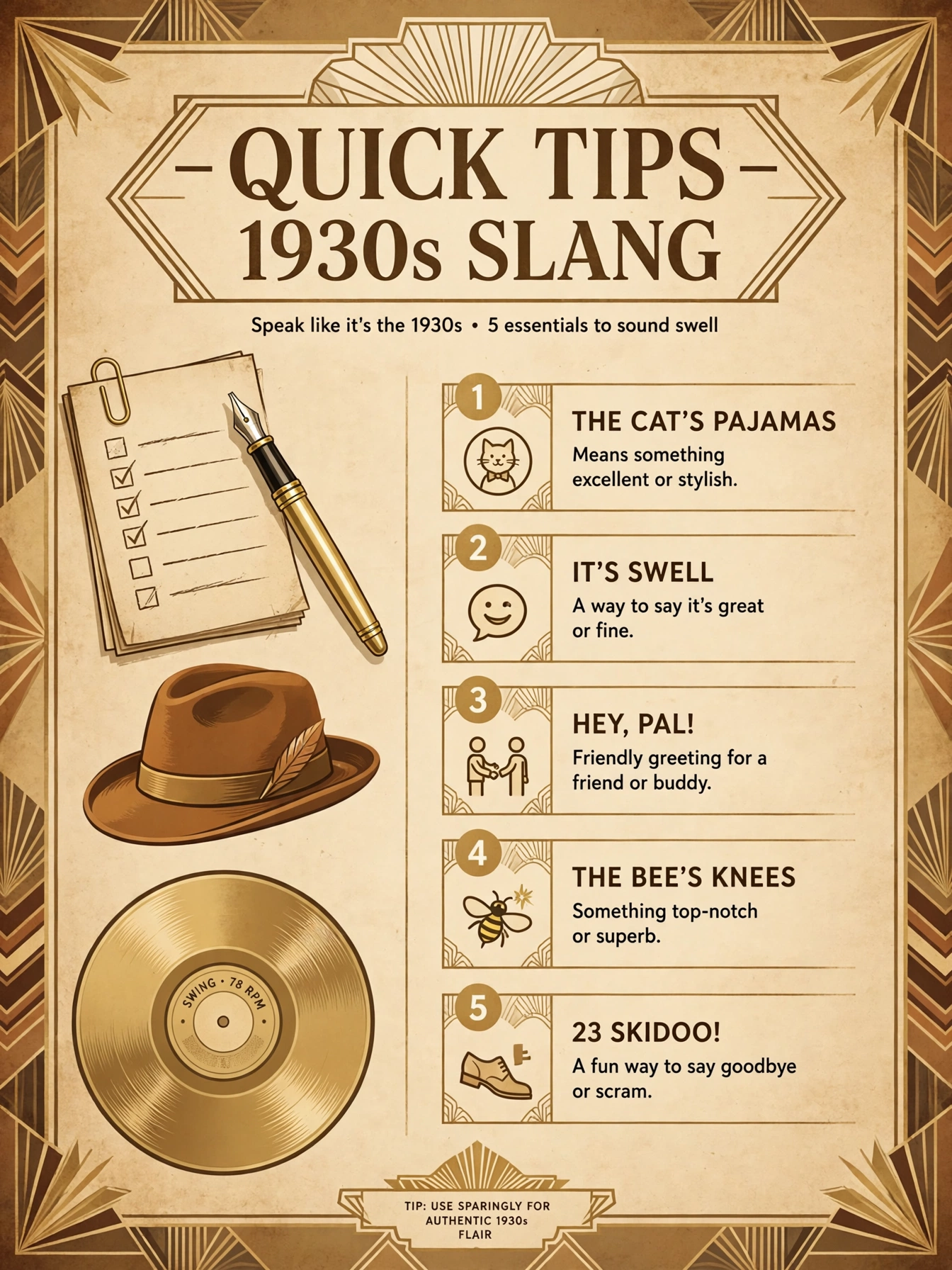
Quick Tips
- Start with the survivors. Swell, copacetic, big shot, and wet blanket are still understood by everyone, so they are the safest way to try 1930s slang in real conversation.
- One phrase per moment. Drop a single the bee’s knees into a compliment and let it land. A little vintage goes a long way.
- Match the setting. Retro parties, swing dances, vintage fashion events, and period writing are perfect. A job interview is not.
- Learn the top 10 first. Swell, copacetic, the bee’s knees, the cat’s pajamas, giggle water, speakeasy, big cheese, flatfoot, jitterbug, and goon will cover most situations.
- Watch a 1930s film. It Happened One Night (1934), The Thin Man (1934), and Top Hat (1935) are the fastest way to hear the slang used naturally — and they are genuinely fun films.
- Check the meaning before you use it. Some 1930s words have changed meaning since then (joint, cool, goon), so a quick check saves embarrassment.
- Use it in writing for instant atmosphere. A short story or party invitation with a few well-placed 1930s words feels like the Jazz Age in a way that plain modern English cannot match.
40+ Classic 1930s Slang Words & Meanings
| Word / Phrase | Meaning | Example |
|---|---|---|
| Swell | Excellent, great | “What a swell idea!” |
| Copacetic | All in order, fine | “Everything’s copacetic.” |
| The bee’s knees | The very best, outstanding | “That singer is the bee’s knees.” |
| The cat’s pajamas | Excellent, the best | “Her new car is the cat’s pajamas.” |
| Keen | Great, excellent, sharp | “That’s a keen suit you’re wearing.” |
| Nifty | Clever, stylish, great | “A nifty little gadget.” |
| Ritzy | Fancy, luxurious | “A ritzy hotel on Fifth Avenue.” |
| Swanky | Stylish, expensive-looking | “A swanky nightclub.” |
| Hotsy-totsy | Pleasing, just right | “Everything is hotsy-totsy.” |
| Giggle water | Alcohol, liquor | “Pass the giggle water.” |
| Hooch | Illegal or cheap liquor | “He brewed his own hooch.” |
| Speakeasy | Illegal bar during Prohibition | “Meet me at the speakeasy.” |
| Bootlegger | Someone who smuggled alcohol | “The bootlegger made a fortune.” |
| Big cheese | Important person, boss | “He’s the big cheese around here.” |
| Big shot | Important, powerful person | “A real big shot from Hollywood.” |
| Flatfoot | Policeman | “The flatfoot was on the corner.” |
| Gumshoe | Detective | “A gumshoe on the case.” |
| G-man | FBI agent | “The G-men raided the place.” |
| Goon | Hired thug, or a fool | “He hired a couple of goons.” |
| Moll | Gangster’s girlfriend | “The moll wore a fur coat.” |
| Dame | Woman (dated) | “A classy dame walked in.” |
| Cat | Cool guy, jazz musician | “That cat can really swing.” |
| Hep cat | Someone in the know, jazz fan | “A real hep cat.” |
| Jitterbug | Swing dancer / the dance itself | “They jitterbugged all night.” |
| Rug cutter | Great dancer | “She’s a real rug cutter.” |
| Jive | Swing music talk; also, to fool | “Don’t jive me, pal.” |
| Stool pigeon | Police informer | “Some stool pigeon tipped them off.” |
| On the lam | Running from the law | “He’s on the lam.” |
| Bump off | To kill (gangster slang) | “They bumped him off.” |
| Wet blanket | Killjoy, spoilsport | “Don’t be such a wet blanket.” |
| Flat tire | Boring person | “He’s a total flat tire.” |
| Applesauce | Nonsense | “That’s pure applesauce!” |
| Baloney | Nonsense, lies | “Don’t give me that baloney.” |
| Hooey | Nonsense | “What a load of hooey.” |
| Phooey | Expression of disgust | “Phooey! I missed the train.” |
| Malarkey | Nonsense, foolish talk | “That’s a lot of malarkey.” |
| Gold digger | Someone after money in a relationship | “She’s a gold digger.” |
| Sugar daddy | Older wealthy man supporting a partner | “Her sugar daddy bought the car.” |
| Dough / moolah | Money | “He’s got plenty of dough.” |
| Drugstore cowboy | Man who loiters, showing off | “A drugstore cowboy on the corner.” |
| Lounge lizard | Man who hangs around bars to meet women | “A lounge lizard at the hotel bar.” |
| Sap / sucker | Fool, easily tricked person | “Don’t be a sap.” |
| Wallflower | Shy person at a dance | “She was a wallflower all night.” |
| Cheaters | Eyeglasses | “He forgot his cheaters.” |
| Peepers | Eyes | “Use your peepers!” |
| Kisser | Mouth or face | “Shut your kisser!” |
| Gams | Legs | “She’s got great gams.” |
FAQ
What does 1930s slang mean?
1930s slang is the informal language popular in America during the 1930s — words like swell, copacetic, the bee’s knees, and giggle water that came from jazz, Hollywood, radio, and Prohibition-era life. It was playful, fast, and full of vivid pictures.
What is the most famous 1930s slang word?
The bee’s knees is probably the most famous 1930s slang phrase, followed closely by the cat’s pajamas and swell. All three are still recognised instantly today, nearly a century later.
Is “swell” 1930s slang?
Yes. Swell was one of the most common 1930s words for “excellent” or “great.” It had existed before, but the 1930s made it the default word of approval, the way “awesome” works today.
What did “copacetic” mean in the 1930s?
Copacetic meant everything was in order, fine, or satisfactory. Its exact origin is unknown — it may come from Italian, Yiddish, or African American slang — but by the 1930s it was widely used, and it is still used today with the same meaning.
What is giggle water?
Giggle water was 1930s slang for alcohol, especially during Prohibition (1920–1933), when drinking was illegal. The name was a joke: the drink made people giggle. It was usually served in a speakeasy, an illegal bar.
Do people still use 1930s slang today?
Yes, more than you might think. Words like swell, copacetic, big shot, wet blanket, goon, and gold digger are still in everyday use. The more colourful phrases — the bee’s knees, the cat’s pajamas — survive mainly at retro parties, in period films, and in writing.
What is the difference between 1920s and 1930s slang?
1920s slang was the language of flappers, bootleggers, and the first jazz age — wild and rebellious. 1930s slang kept many of those words but added Hollywood polish, radio catchphrases, swing-dance vocabulary like jitterbug, and Depression-era humour. The 1930s version is more movie-ready and more likely to still be understood today.
How can I use 1930s slang without sounding silly?
Use one or two words at a time, in the right setting — a retro party, a swing dance, a period story, or a light-hearted compliment. Start with the survivors like swell and copacetic, avoid crime slang and dated words for women, and never mix decades. A little vintage goes a long way.
Conclusion
1930s slang is proof that hard times can produce great language. Born in jazz clubs, speakeasies, movie studios, and radio stations during the Great Depression, it gave America words that were funny, fast, and full of life — swell, copacetic, the bee’s knees, giggle water, and dozens more. Nearly a century later, the best of them are still in use, and the rest are waiting at the next retro party, swing dance, or period film night.
The key takeaways are simple: 1930s slang means the informal, inventive language of Jazz Age America; its most famous words are still understood today; it works best as a light, playful flavour rather than a full costume; and the safest words to start with are the survivors — swell, copacetic, and the bee’s knees. If you want to explore more vintage language, our guides to Irish slang and Korean slang show how every culture builds its own playful vocabulary — and our LMS meaning guide shows how modern abbreviations do the same job today.
So the next time something is truly excellent, skip “great” and call it the bee’s knees. It is swell, it is copacetic, and it has been working for nearly a hundred years.
