
Quick definition: Korean slang is the casual, informal vocabulary Koreans use in everyday conversation, K-dramas, K-pop lyrics, and online chats — words like oppa (오빠), daebak (대박), and aegyo (애교) that carry cultural meaning no textbook translation can fully capture.
Korean Slang Meaning & Definition
Korean slang refers to the informal words, phrases, and expressions used by native Korean speakers in relaxed settings — between friends, in text messages, on social media, and in entertainment like K-dramas and K-pop songs. Unlike formal Korean, which follows strict rules of politeness and honorifics, Korean slang is playful, emotional, and deeply tied to relationships, age, and social context.
At its core, Korean slang does more than shorten words. It signals closeness, respect, affection, or attitude in a single syllable. Calling someone oppa instead of their name tells a whole story about your relationship. Shouting daebak after good news packs the excitement of “no way, that’s amazing!” into two beats. And when someone does aegyo, they are not just “being cute” — they are performing a whole cultural ritual of charm that Koreans instantly recognize.
For K-drama fans, K-pop stans, and Korean language learners, slang is the key that unlocks the parts of Korean culture subtitles can never fully explain. This guide covers the 40+ most essential Korean slang words, with Hangul, pronunciation, real meanings, and examples you can actually use.
Introduction
You have heard it a hundred times if you watch K-dramas: a character gasps “Daebak!” at a surprise, a girl calls her boyfriend “Oppa,” and someone sighs “Aigoo” when everything goes wrong. These are not random sounds — they are Korean slang, and they are everywhere in modern Korean life.
Korean slang exploded into global consciousness alongside the Korean Wave, or Hallyu. As K-pop groups topped the charts and K-dramas dominated streaming, millions of fans outside Korea started picking up these words. Today, Korean slang pops up in TikTok comments, Twitter replies, gaming chats, and group texts far beyond Korea — much like how other regional slang travels, from Baltimore slang to Boston slang, local words become global culture when the media behind them goes global.
But here is the catch: Korean slang is easy to use wrong. The wrong word to the wrong person can sound rude, flirty, or just confusing. Age and gender decide which words you can say to whom — a rule that trips up almost every learner. This guide explains not just what each word means, but who says it, to whom, and when, so you can use Korean slang naturally and confidently.

Origin
Korean slang has roots in several different places, which is why it feels so varied. Some of it comes from traditional Korean itself — old words that picked up new, playful meanings over time. Daebak (대박), for example, originally meant a “big jackpot” or huge success in business, and it gradually became a general shout of amazement. Aigoo (아이고) is an old exclamation of pain or frustration that grandmothers have used for generations.
Much of modern Korean slang comes from the way young Koreans talk online and in school. Abbreviations are huge: just as English speakers turned “oh my god” into “OMG,” Koreans compress phrases into two or three syllables. Jinjja (진짜, “really”) gets shortened in fast speech, and internet slang like ㅋㅋㅋ (kkk, laughter) and ㅠㅠ (crying eyes) became so common they moved from keyboards into spoken conversation.
K-pop and K-dramas supercharged the spread. Idol groups use slang in lyrics, variety shows, and fan livestreams, and fans repeat it worldwide within hours. A word like maknae (막내, the youngest member of a group) barely existed outside Korea a decade ago; now it is standard vocabulary in every K-pop fandom. The Korean Wave turned local slang into a shared global language.
Popularity
Korean slang is more popular globally than ever before. K-pop is a multi-billion-dollar industry with fans on every continent, K-dramas regularly top Netflix charts, and Korean words keep entering mainstream English — aegyo and oppa now appear in English-language articles, memes, and even casual conversation among non-Korean speakers.
On TikTok and Instagram, Korean slang is a whole content category. Creators post “Korean slang you need to know” videos that rack up millions of views, and comment sections are full of fans testing out saranghae (사랑해, “I love you”) and fighting (화이팅, “you can do it!”). Language apps report Korean as one of the fastest-growing languages to learn, and slang is usually the first thing new learners want to master — it is the fun part.
Part of the appeal is that Korean slang feels expressive in a way English sometimes does not. A single word can carry warmth, teasing, excitement, or sympathy depending on tone. For fans, using the words correctly feels like being part of the culture rather than just watching it from outside. That is why guides to slang — whether Korean slang or millennial slang — keep getting shared: people want the words that make them sound like insiders.
How It Is Used
Korean slang is used in casual conversation, text messages, social media, K-drama dialogue, K-pop lyrics, and variety shows. It almost never appears in formal writing, business emails, or when speaking to elders and strangers — Korea’s speech levels make formality a real social rule, not just a style choice.
The single most important rule is the age-and-gender system behind relationship words. Korean has different words for “older brother” and “older sister” depending on whether the speaker is male or female, and using the wrong one instantly marks you as a learner. Get this system right and half of Korean slang falls into place.
| Word | Hangul | Meaning | Who says it | To whom |
|---|---|---|---|---|
| Oppa | 오빠 | Older brother / older male friend | Female speaker | Older male |
| Hyung | 형 | Older brother / older male friend | Male speaker | Older male |
| Unnie | 언니 | Older sister / older female friend | Female speaker | Older female |
| Noona | 누나 | Older sister / older female friend | Male speaker | Older female |
| Dongsaeng | 동생 | Younger sibling / younger friend | Anyone | Younger person |
| Maknae | 막내 | The youngest in a group | Anyone | Youngest member |
Reaction words work differently — anyone can say them. Daebak works for good surprises, aigoo for frustration or sympathy, and jinjja for emphasis, the way English speakers say “really?!” or “seriously.” These are the safest slang words for beginners because they do not depend on who you are talking to.
In texting, Korean slang gets even shorter. ㅋㅋㅋ means laughter (like “hahaha”), ㅠㅠ means crying or sadness, and ㅇㅇ means “yes yes” or “okay okay.” If you chat with Korean friends online, you will see these constantly — they are the Korean equivalent of “lol” and “omg,” and knowing them makes your messages feel natural instead of stiff.
Examples
The best way to learn Korean slang is to see it in real situations. Here are examples across different tones, so you can feel how each word actually sounds in conversation.
Friendly Examples
- “Oppa, can you help me with this?” — A girl asking her older male friend for help. Warm, natural, and very common in K-dramas.
- “Unnie, your outfit is so pretty today!” — A younger woman complimenting an older female friend. Friendly and affectionate.
- “Daebak! You got the concert tickets?!” — Reacting to amazing news, the way you would say “No way, that’s awesome!”
- “Saranghae, unnie!” — Saying “I love you” to an older sister figure. Fans say this to their favorite female idols all the time.
- “Hyung, let’s grab dinner after practice.” — A guy inviting his older male friend out. Casual and close.
Professional Examples
Korean slang mostly stays out of professional settings, but a few words cross over. Seonbae (선배, senior) and hubae (후배, junior) describe workplace and school seniority and are used respectfully even in offices. Fighting (화이팅) is the go-to cheer before a big presentation or exam — colleagues say it to each other the way English speakers say “You’ve got this!”
- “Seonbae, could you review this report?” — Respectful, standard workplace Korean.
- “Fighting! You will do great in the interview.” — Encouragement before a big moment.
- “Our team’s maknae finished the design already.” — Calling the youngest team member the maknae, affectionately and casually.
Funny Examples
- “Aigoo, my legs hurt so much!” — The classic Korean sigh, usually said with a dramatic hand on the knee. Everyone from grandmothers to idols says it.
- “He did aegyo to get out of doing the dishes.” — Acting cute on purpose to dodge chores. It works more often than you would think.
- “Jinjja? You ate the last piece of chicken?!” — “Really?!” with full disbelief, perfect for betrayals over food.
- “Stop being such a kkondae.” — Calling someone an old-fashioned, stubborn know-it-all. Playful among friends, cutting if you mean it.
| Situation | What to say | What it means in English |
|---|---|---|
| Your friend got concert tickets | Daebak! | “That’s amazing!” |
| Your older sister helps you | Gomawo, unnie! | “Thanks, sis!” |
| Something goes wrong | Aigoo… | “Ugh, oh no…” |
| Cheering a friend on | Fighting! | “You can do it!” |
| Your boyfriend is being cute | Oppa, stop it~ | “Stop it, babe~” (playful) |
| Someone tells a shocking story | Jinjja?! | “Really?! No way!” |

Comparison with Similar Terms
Korean slang has pairs of words that look similar but mean different things — and mixing them up is the fastest way to sound confused. The biggest source of confusion is the oppa / hyung / unnie / noona system, where the speaker’s gender changes the word even when the relationship is the same.
| Term | Meaning | Speaker | Common mix-up |
|---|---|---|---|
| Oppa (오빠) | Older brother / male friend | Female | Men saying oppa to other men — wrong word, use hyung |
| Hyung (형) | Older brother / male friend | Male | Women saying hyung — wrong word, use oppa |
| Unnie (언니) | Older sister / female friend | Female | Men saying unnie — wrong word, use noona |
| Noona (누나) | Older sister / female friend | Male | Women saying noona — wrong word, use unnie |
| Aegyo (애교) | Acting cute | Anyone | Confusing it with being childish — aegyo is charming, not immature |
| Sarang (사랑) | Love (noun) | Anyone | Sarang vs. saranghae — sarang is the noun, saranghae is “I love you” |
| Jinjja (진짜) | Really / truly | Anyone | Overusing it — Koreans use it for emphasis, not in every sentence |
Korean slang also differs from English slang in one big way: English slang is mostly about attitude, while Korean slang is mostly about relationships. Words like sigma or aura describe a vibe — if you want that kind of slang, our guide to what sigma slang means covers it — but Korean slang words like oppa and noona describe exactly where you stand relative to another person. That is why they feel so personal: every time you use one, you are stating a relationship.

Alternate Meanings
Many Korean slang words have more than one meaning, and context decides which one is in play.
- Oppa can mean an older brother, a close older male friend, or a boyfriend. A girl calling her actual brother “oppa” and a girl calling her boyfriend “oppa” are using the same word with very different feelings behind it — K-drama fans know this tension well.
- Daebak can mean “jackpot” or “huge success” in its original sense, or simply “awesome!” as a reaction. “Daebak!” after a plot twist and “the movie was a daebak at the box office” use the same word in two different ways.
- Jjang (짱) means “the best” or “awesome,” but it can also be used as a playful title — “you are the jjang” means “you are the best.”
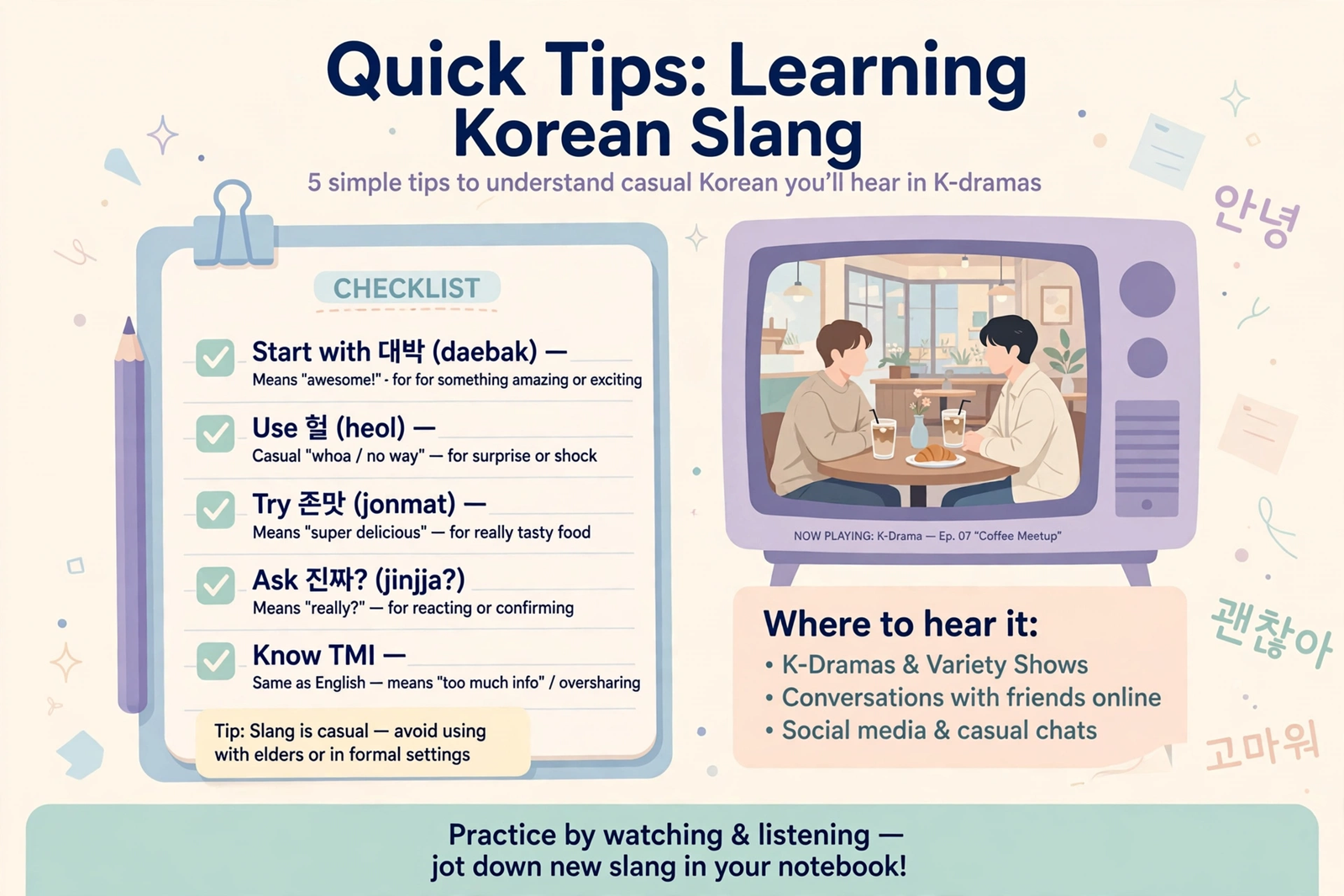
- Heol (헐) is a reaction word that can mean shock, disbelief, or speechless amazement depending on tone — like “whoa” or “wait, what?!” in English.
- Yeolshim is not slang exactly, but yeolshimhi (열심히) means “hard” or “diligently,” and fans cheer idols with it the way English speakers say “work hard!”
- Gap (갑) originally meant “the first” in a contract, but online it means someone with power in a situation — “gapjil” (갑질) is abusing that power, a word that shows up in Korean news constantly.
Professional or Polite Alternatives
Korean slang belongs in casual settings. In formal situations — work, school, speaking to elders, or meeting someone for the first time — use these polite alternatives instead:
- Instead of oppa / hyung: use the person’s name with -ssi (씨), or their job title. “Minjun-ssi” is polite and safe with someone you do not know well.
- Instead of unnie / noona: same rule — name plus -ssi, or seonbaenim (선배님) for a senior colleague, which adds respect.
- Instead of “jinjja?!”: say jeongmalyo? (정말요?) — “really?” in polite form.
- Instead of “daebak!”: say daedanhada or simply jeongmal jotha (really good) when you need to stay formal.
- Instead of “fighting!”: in formal settings, hwaiting haseyo works, or a simple “good luck” in polite speech.
- Instead of ㅋㅋㅋ in messages: in work chats, skip the laughter characters entirely — a polite emoji or a plain “haha” reads more professionally.
The general rule is simple: slang shows closeness, formal speech shows respect. Use slang with friends and people younger than you, and switch to polite forms the moment the relationship is formal, older, or unfamiliar.
Common Mistakes
Almost every Korean slang learner makes the same few mistakes. Here are the big ones — and how to avoid them.
- Using oppa / unnie with strangers. These words imply closeness. Calling a random older person oppa or unnie can feel flirty or presumptuous. With strangers, use ajeossi (아저씨, mister) or ajumma (아줌마, ma’am) instead.
- Mixing up the gender rules. Men say hyung and noona; women say oppa and unnie. This is the number one mistake learners make, and Koreans will gently correct you — but getting it right from the start makes a great impression.
- Calling your boyfriend oppa too early. In Korean dating culture, “oppa” carries romantic weight. Using it on a first date can signal more than you mean. Let the relationship set the pace.
- Overusing jinjja. Beginners sprinkle jinjja into every sentence, the way English learners overuse “very.” Koreans use it for real emphasis — save it for moments that deserve it.
- Saying aegyo wrong. Aegyo is a performance of cuteness, not just the word “cute.” Saying “that is so aegyo” is fine; saying “I am aegyo” is not — you do aegyo, you are not aegyo.
- Using ㅋㅋㅋ in formal messages. Texting slang stays in casual chats. A ㅋㅋㅋ in a message to a teacher or boss reads as unserious at best and rude at worst.
- Translating word-for-word. “Fighting” is not about fighting, “aigoo” has no clean English equivalent, and “daebak” is not just “great.” Learn the feeling behind each word, not just a one-word translation.

Quick Tips
- Learn the four relationship words first. Oppa, hyung, unnie, and noona unlock half of K-drama dialogue. Drill them until the gender rule is automatic.
- Watch K-dramas with Korean subtitles. Seeing the Hangul next to the spoken slang connects the sound to the spelling — and you will catch words the English subtitles skip entirely.
- Copy the tone, not just the word. Heol whispered and heol shouted are different feelings. Listen to how native speakers say each word and match their energy.
- Start with reaction words. Daebak, aigoo, and jinjja are safe with anyone and instantly make your Korean sound natural.
- Use slang with friends first. Practice on people your age before trying it with older speakers — the social rules matter more than the vocabulary.
- Learn the Hangul. Romanization helps at first, but knowing 오빠 vs. 언니 in Hangul removes the guesswork and helps you read real Korean chats and comments.
- Follow K-pop variety shows. Idols use the newest slang on camera weeks before it reaches textbooks — it is the fastest way to stay current.
- Keep a slang list. Every time you hear a new word in a drama, write it down with the scene it came from. Context is what makes slang stick.

FAQ
What does Korean slang mean?
Korean slang means the informal, casual words and expressions Koreans use in everyday conversation, texting, K-dramas, and K-pop — words like oppa, daebak, and aegyo that carry cultural and relationship meaning beyond their literal translations.
What is the most popular Korean slang word?
Oppa (오빠) is the most famous Korean slang word worldwide, thanks to K-dramas and K-pop. It means “older brother” when a woman says it to an older man, but it is also used for close male friends and boyfriends.
What does daebak mean in Korean slang?
Daebak (대박) means “awesome,” “amazing,” or “jackpot.” It originally meant a big success or windfall, and today it is the go-to shout when something surprisingly great happens.
What does aegyo mean?
Aegyo (애교) means acting cute on purpose — using a baby voice, pouty expressions, and sweet gestures to charm someone or get a favor. It is a well-known part of Korean pop culture, especially among K-pop idols.
Can anyone say oppa?
No. Only female speakers say oppa, and only to males older than them whom they are close to. Male speakers use hyung (형) for the same relationship. Using oppa with a stranger or in a formal setting can come across as rude or flirty.
What does saranghae mean in Korean?
Saranghae (사랑해) means “I love you” in Korean. It is the casual, intimate form used with close friends, family, and partners. The polite form is saranghamnida (사랑합니다).
What does fighting mean in Korean slang?
Fighting (화이팅, pronounced “hwaiting”) means “you can do it!” or “good luck!” Koreans say it to cheer someone on before an exam, performance, or big challenge. Despite the English word, it has nothing to do with actual fighting.
How can I learn Korean slang fast?
Watch K-dramas with Korean subtitles, follow K-pop variety shows, and learn the four relationship words (oppa, hyung, unnie, noona) first. Reaction words like daebak and aigoo are safe to start using right away, and a good glossary — like the one at 90 Day Korean’s K-drama glossary — helps you check meanings and context.
Conclusion
Korean slang is more than a list of fun words — it is a window into how Korean culture thinks about relationships, respect, and emotion. Words like oppa, unnie, daebak, and aegyo carry history, social rules, and feeling in a way that no direct translation can match, and learning them is what turns watching K-dramas into truly understanding them.
The key takeaways are simple. First, master the age-and-gender system: oppa and hyung for older men, unnie and noona for older women, and never mix up who says which. Second, start with safe reaction words like daebak, aigoo, and jinjja — they work with anyone and instantly make your Korean sound natural. Third, remember that slang signals closeness, so save it for friends and casual settings and switch to polite forms with elders, strangers, and at work. And finally, keep listening: Korean slang evolves fast, and every new drama season brings fresh words into the mix.
Whether you are a K-pop fan learning your first words, a K-drama lover decoding your favorite scenes, or a language learner building real fluency, Korean slang is the most rewarding part of the journey — it is where the language stops being a subject and starts being a culture. Keep practicing, keep watching, and soon these words will feel like second nature. For more slang guides from around the world, explore our Boston slang and millennial slang collections and keep building your vocabulary one word at a time.

1 thought on “Korean Slang: 40+ Words, Meanings & Real Examples (2026)”