
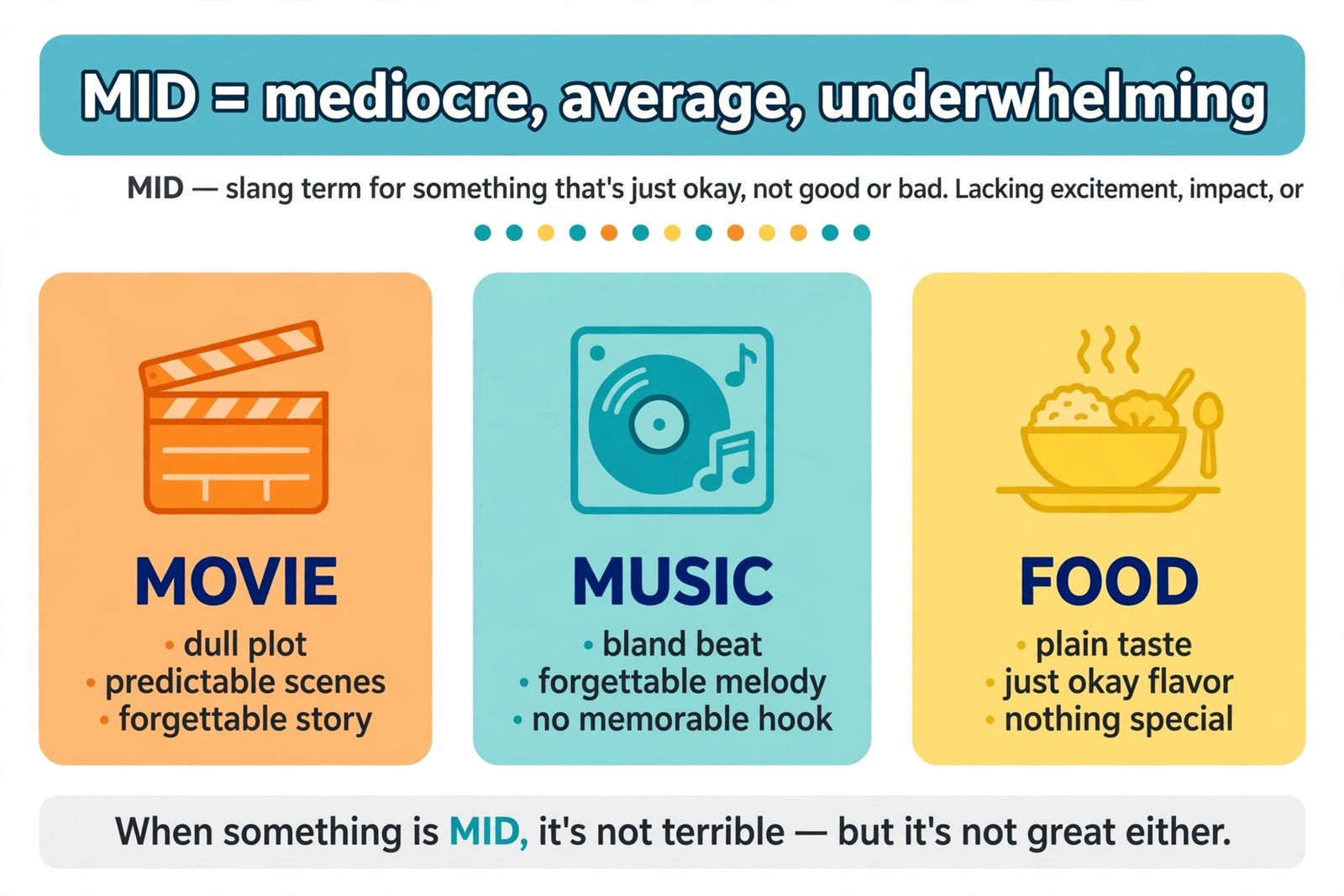
Quick definition: In slang, mid means mediocre, average, or underwhelming — something that is not terrible, but nowhere near as good as the hype promised. If a movie, song, meal, or outfit is “mid,” it is forgettable: it did not impress you, and it did not live up to expectations.
Mid Slang Meaning & Definition
The mid slang meaning is simple on the surface: mid = mediocre. When someone calls something mid, they are giving it a shrug in word form. It was not awful. It was not amazing. It was just… there. The word works as a quick verdict, and that speed is exactly why it took over TikTok comments, group chats, music reviews, and gaming lobbies.
But “mid” carries a little more sting than the word “average.” Average is neutral, almost mathematical — the middle of a range. Mid is a judgment. It says the thing had hype, promise, or a high price tag behind it, and it still landed flat. A random Tuesday sandwich is not usually “mid” because nobody expected greatness from it. A blockbuster movie with a $200 million budget and a year of trailers? That can absolutely be mid.
Think of it as a one-word review. Instead of writing “I found the new album disappointing given how much everyone hyped it up, and only two songs were memorable,” a listener just types “mid” — and everyone online instantly understands the feeling. That efficiency made the word one of the most used slang verdicts of the 2020s, and it is still going strong in 2026.
| Word | What It Means | Tone |
|---|---|---|
| Mid | Mediocre, average, underwhelming, not worth the hype | Dismissive, mildly negative |
| Mid-tier | Middle of the quality ranking, not top-tier | Neutral to critical |
| Kinda mid | A softer version — mostly average, with some good parts | Gentle, playful |
| Certified mid | Confirmed mediocre, no debate left | Confident, joking |
Introduction
You have probably seen it a hundred times without thinking twice: a TikTok comment that just says “mid.” A friend texts “the concert was mid” after months of excitement. A game review opens with “gameplay is mid, graphics carry it.” Three letters, no explanation — yet the message lands perfectly every time.
The mid slang meaning has become so common that even people who never use slang themselves recognize it instantly. Parents hear it from their kids. Teachers see it in essays about movies. Brands even use it in their own marketing to sound relatable. But where did this tiny word come from, why did it explode in 2021, and — most importantly — how do you use it without sounding rude or getting it wrong?
This guide covers everything: the real definition, the surprising origin story that starts with cannabis culture and runs through hip-hop, wrestling, and TikTok, dozens of real examples in different tones, a comparison with similar slang, the alternate meanings that trip people up, and the mistakes to avoid. By the end, you will know exactly what “mid” means, when to say it, and when to pick a kinder word instead.
Origin
The story of “mid” starts long before TikTok. Its roots sit in the early 2000s, when cannabis users shortened “mid-grade” — marijuana of medium quality, neither top-shelf nor bottom-tier — into simply “mids” or “mid.” Merriam-Webster traces this drug-culture usage as the starting point of the slang sense, and the logic was straightforward: middle quality, middle price, middle experience.
From there, the word quietly migrated into hip-hop and online music communities during the 2010s. Fans and critics started using “mid” to describe albums and artists that failed to live up to expectations. An album with huge features and a weak tracklist? Mid. A rapper everyone hyped who delivered a forgettable verse? Mid. The term fit music criticism perfectly because it said in three letters what a paragraph of review would say: not bad enough to hate, not good enough to remember.
The real explosion came in October 2021, and it came from two directions at once. First, discussions around Drake’s album Certified Lover Boy flooded timelines with the word, as listeners debated whether the massively hyped record was a classic or — the verdict that went viral — mid. Around the same time, a TikTok clip of professional wrestler Maxwell Jacob Friedman (MJF) went everywhere: during a promo in Cincinnati, Ohio, he pointed at a fan’s sign and shouted that he was not going to stay in “Mid-west” Ohio, “because it’s MID!” The clip turned a regional insult into a meme, and “mid” became the internet’s favorite way to call anything overhyped.
An earlier boost had come in 2020, when YouTuber GradeAUnderA ranked cannabis strains in a tier list and labeled one tier simply “Mid.” Each wave pushed the word further from its original niche and deeper into mainstream internet language. By 2022, it had escaped music and wrestling entirely and become a general-purpose quality verdict used on everything from movies and food to outfits and vacations.
Popularity
Why did “mid” catch on so fast? Three reasons explain its staying power. First, it is brutally efficient. In a feed where attention is measured in seconds, “mid” delivers a complete review — expectation, disappointment, and verdict — in a single syllable. Second, it is versatile. It works as an adjective (“the movie was mid”), a standalone reply (“mid.”), and even a noun-ish label (“that album is certified mid”). Third, it is social: calling something mid is often a conversation starter, a playful challenge to everyone who loved the thing. A one-word “mid” under a viral post can generate hundreds of replies.
The word also spread because it filled a real gap in the language. Before “mid,” your options for describing a letdown were clumsy: “it was okay, I guess,” “not as good as I hoped,” “kind of disappointing.” None of those had the punch of “mid.” Dictionary publishers noticed — Cambridge Dictionary now lists the slang sense (“not very good or attractive”), and the term shows up in mainstream guides to TikTok slang from Oxford and others. What started as niche internet talk is now ordinary English for millions of people under 35.
And unlike many slang words that burn out in a year, mid has shown real staying power. It survived the move from TikTok to Instagram, X, YouTube comments, gaming chats, and even spoken conversation. New variations keep it fresh: “hyper-mid” (deliberately, comically average), “mid-off” (a joking contest over whose take is worse), and “certified mid” for things beyond saving. In 2026, calling something mid is as normal as calling it “meh” — except it lands a little harder.
How It Is Used
Mid is almost always used as an adjective, placed right after the thing being judged: “the pizza was mid,” “that album is mid,” “the party was kind of mid.” It can also stand alone as a complete reply. Someone posts a photo of their new shoes and a friend comments “mid.” Everyone understands: unimpressed, moving on.
The word shows up most in four situations. The first is the hype check — when something famous or heavily promoted fails to deliver. The second is the quick review — food, movies, music, games, outfits, and events all get rated with it. The third is playful roasting between friends, where calling something mid is a joke rather than a real attack. The fourth is the hot take, where someone deliberately calls a beloved thing mid just to start an argument.
Tone matters enormously. Said with a laugh among friends, “mid” is light teasing. Said about someone’s creative work to their face, it can feel dismissive and hurtful. Said in a comment under a stranger’s post, it reads as cold judgment. The word itself is short, but the social weight depends entirely on who says it, about what, and where. A good rule: use it freely for products, media, and experiences, but think twice before using it about a person or their effort.
It also pairs naturally with intensifiers and softeners. “Kinda mid” softens the blow. “Pretty mid” is a firm verdict. “Straight mid” or “certified mid” is the harshest version. “Not mid” is a genuine compliment in disguise — it means the thing actually lived up to the hype. And “mid” almost never appears in formal writing, work emails, or serious reviews, where “underwhelming” or “average” would be the professional choice.
Examples
Real examples show how flexible “mid” is. The same three letters change meaning slightly with context, tone, and topic. Here are examples grouped by the tone people actually use them in.
Friendly Examples
- “The new boba spot? Tasted mid, but the vibes were great.”
- “Your fit is kinda mid today, swap the shoes and it goes hard.”
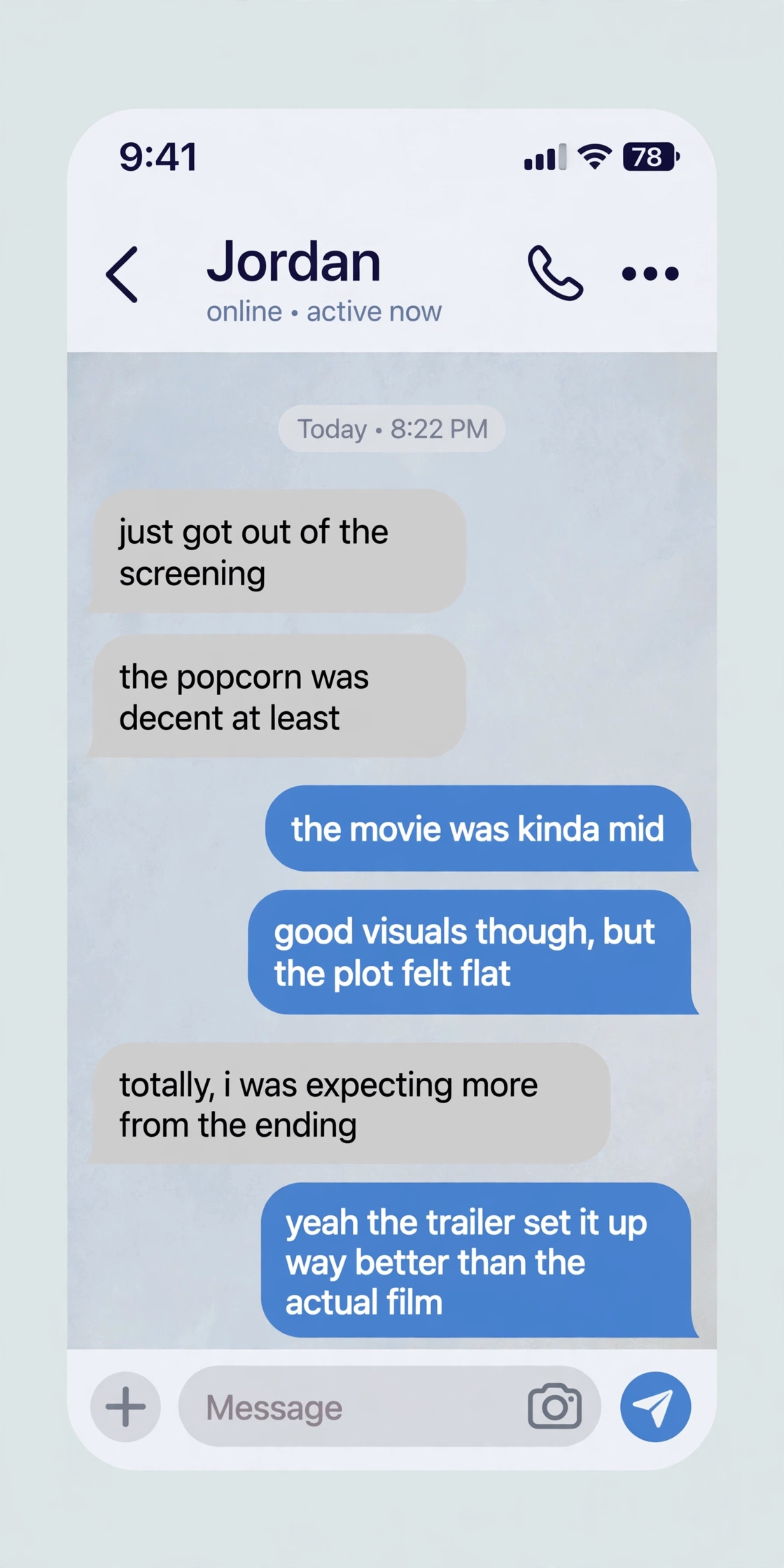
- “The movie was mid, honestly — but the popcorn was elite.”
- “I liked the first half, the ending was mid though.”
- “Bro, that game was mid. Rematch?”
Professional Examples
- “The launch event was mid — decent turnout, but the keynote dragged.”
- “Honestly, the first draft of the campaign is mid. We can do better.”
- “The hotel was mid for the price. Clean, but nothing special.”
- “The sequel felt mid compared to the original.”
- “That presentation was mid — solid data, weak delivery.”
Funny Examples
- “Everyone said the burger was life-changing. It was mid. I want my hype back.”
- “My cooking? Certified mid. Even the dog looked disappointed.”
- “That plot twist was supposed to shock everyone and barely moved me. Mid.”
- “The concert was fun, but the opening act was pretty mid — I went for snacks twice.”
- “His apology was mid. Bro said ‘sorry if you felt that way’ and called it a day.”
Notice the pattern: “mid” almost always follows hype or expectation. Nobody calls a random Tuesday lunch mid. They call the restaurant everyone on TikTok recommended mid. The disappointment is the point — the word measures the gap between what was promised and what showed up.
Comparison with Similar Terms
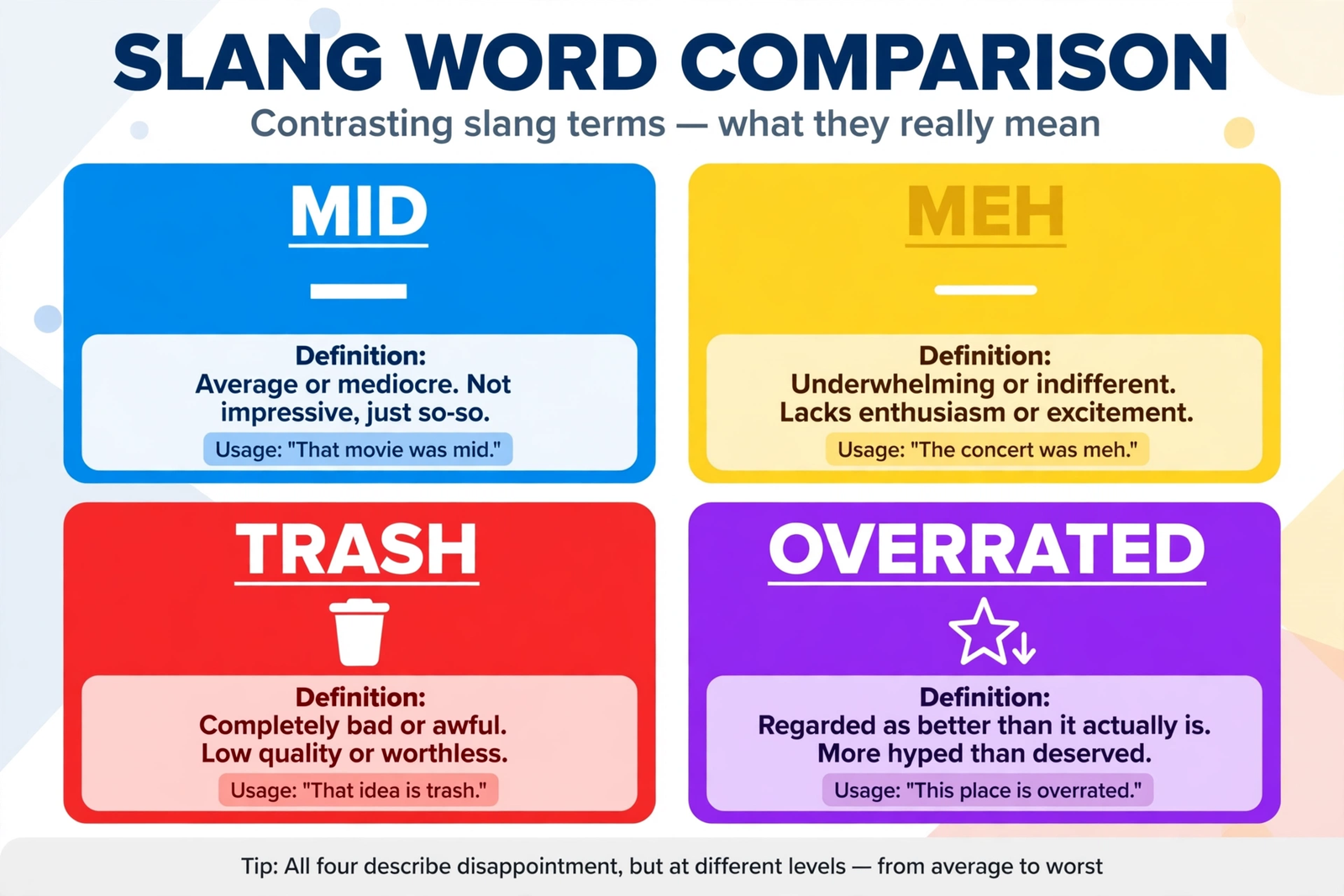
Mid has plenty of neighbors in slang, but each one hits a little differently. Knowing the difference keeps your meaning exact and your jokes landing right.
| Term | Meaning | How It Differs from Mid |
|---|---|---|
| Mid | Mediocre, underwhelming, not worth the hype | The baseline: a verdict on quality vs. expectation |
| Meh | Indifferent, “whatever” | Meh is about your feelings; mid is about the thing’s quality |
| Trash / Garbage | Terrible, awful | Much harsher — mid is not terrible, just forgettable |
| Basic | Plain, unoriginal, mainstream | Basic judges style and originality, not quality |
| Overrated | Praised more than it deserves | Overrated attacks the hype itself; mid attacks the experience |
| Average | Middle of the range, typical | Neutral and formal; mid is casual and carries disappointment |
| Ass / Booty | Very bad (slang) | Far stronger insult; mid is mild by comparison |
| Cooked | Done for, ruined, finished | Cooked is about failure or defeat, not mediocrity |
The closest cousin is “meh,” but the two are not interchangeable. “Meh” says you do not care. “Mid” says the thing did not deliver. You can feel “meh” about a great movie on a tired day, but you would only call it mid if it genuinely failed to impress you. Similarly, “overrated” and “mid” often appear together — “it was overrated AND mid” — but overrated describes the praise, while mid describes the product.
Another useful contrast is with glizzy and other hype slang. Where words like “ate,” “slay,” and “goes hard” praise something loudly, “mid” is their quiet opposite — the anti-hype word. In the same way, calling something “mid” sits at the opposite end of the scale from the energy of Gen Alpha slang favorites like “sigma,” which praise standing out. Mid is what you say when something did not stand out at all.
Alternate Meanings
Like many short words, “mid” has meanings beyond the slang verdict. Context tells you which one is in play, and mixing them up is a common source of confusion.
- Gaming — the middle lane: In games like League of Legends and Mobile Legends, “mid” is short for the middle lane, and “mid laner” is the player who takes it. “I’m going mid” has nothing to do with quality — it is a position call. This is the most common alternate meaning you will run into online.
- Middle, in general: “Mid” is also the everyday shortening of “middle” — mid-week, mid-air, mid-sentence, mid-2026. This older usage is neutral and everywhere.
- MID as an acronym: In business and tech, MID can stand for Merchant Identification Number, Mobile Identification Document, or Management Information. In finance, it appears in the S&P MidCap 400 Index. These are formal, capitalized uses — a very different world from slang “mid.”
- Music production: “Mids” can refer to mid-range audio frequencies, and in older hip-hop slang, “mids” were the medium-grade cannabis the term originally described.
- Clothing sizes: Occasionally, “mid” describes a mid-rise fit or mid-length cut, as in “mid-rise jeans” or “mid-length dress.”
When in doubt, look at the sentence. “That album is mid” is the slang verdict. “Meet me mid” is a location. “Play mid” in a game lobby is a lane call. The slang meaning dominates on TikTok, in comments, and in chats — but the other senses are alive and well everywhere else.
Professional or Polite Alternatives
Mid is casual by nature, and using it at work, in school, or with someone you respect can come across as dismissive. These alternatives say the same thing with more grace:
| Instead of “mid” | Say This | Best For |
|---|---|---|
| “The movie was mid.” | “The movie was underwhelming.” | Reviews, polite conversation |
| “That album is mid.” | “That album didn’t quite live up to the hype.” | Music talk with fans |
| “The food was mid.” | “The food was average — nothing stood out.” | Restaurants, hosts |
| “Your presentation was mid.” | “The presentation could be stronger in places.” | Work feedback |
| “The party was mid.” | “The party was fun, but a bit forgettable.” | Friends, hosts |
| “That idea is mid.” | “That idea needs more work before it stands out.” | Brainstorms, teamwork |
The trick is keeping the honesty without the sting. “Underwhelming,” “average,” “forgettable,” “could be better,” and “not my favorite” all carry the same message as “mid” while sounding like something you could say to anyone, anywhere. Save “mid” for friends, comments, and chats where the casual tone fits.
Common Mistakes
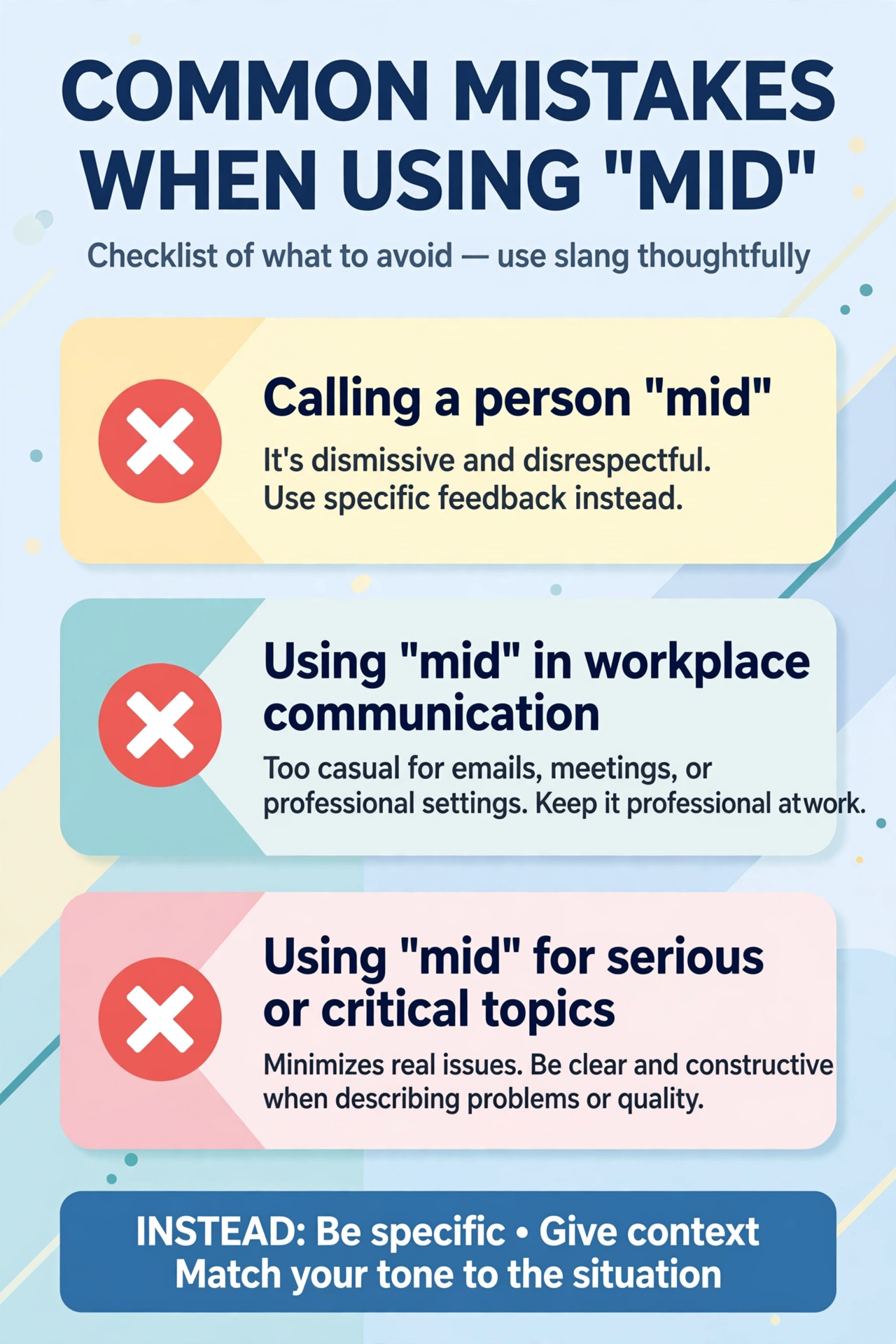
Mid is easy to say and easy to get wrong. These are the mistakes people make most often:
- Using it about people: “He’s mid” or “she’s mid” is not a review — it is an insult about someone’s looks or worth. It reads as cruel, especially to strangers. Keep “mid” for things, media, and experiences, not people.
- Thinking it means terrible: Mid does not mean awful. A mid movie is watchable; a terrible movie is unwatchable. Calling something mid when you actually mean “the worst thing ever” confuses everyone and weakens your point.
- Using it in formal settings: “The quarterly results were mid” in a work meeting sounds unprofessional. Use “below expectations” or “underwhelming” instead.
- Calling everything mid: Overuse kills the word. If every movie, meal, and song is mid, the verdict stops meaning anything — and people stop taking your opinions seriously. Save it for real letdowns.
- Confusing it with the gaming meaning: In a game lobby, “mid” is a lane, not a review. Telling your teammate “you’re mid” might mean you want them in the middle lane — or it might start a fight. Be clear about which meaning you intend.
- Using it to start fights on purpose: Dropping “mid” under a post by a creator you do not know is a quick way to look rude. Hot takes are fine among friends; drive-by dismissals of strangers’ work are just mean.
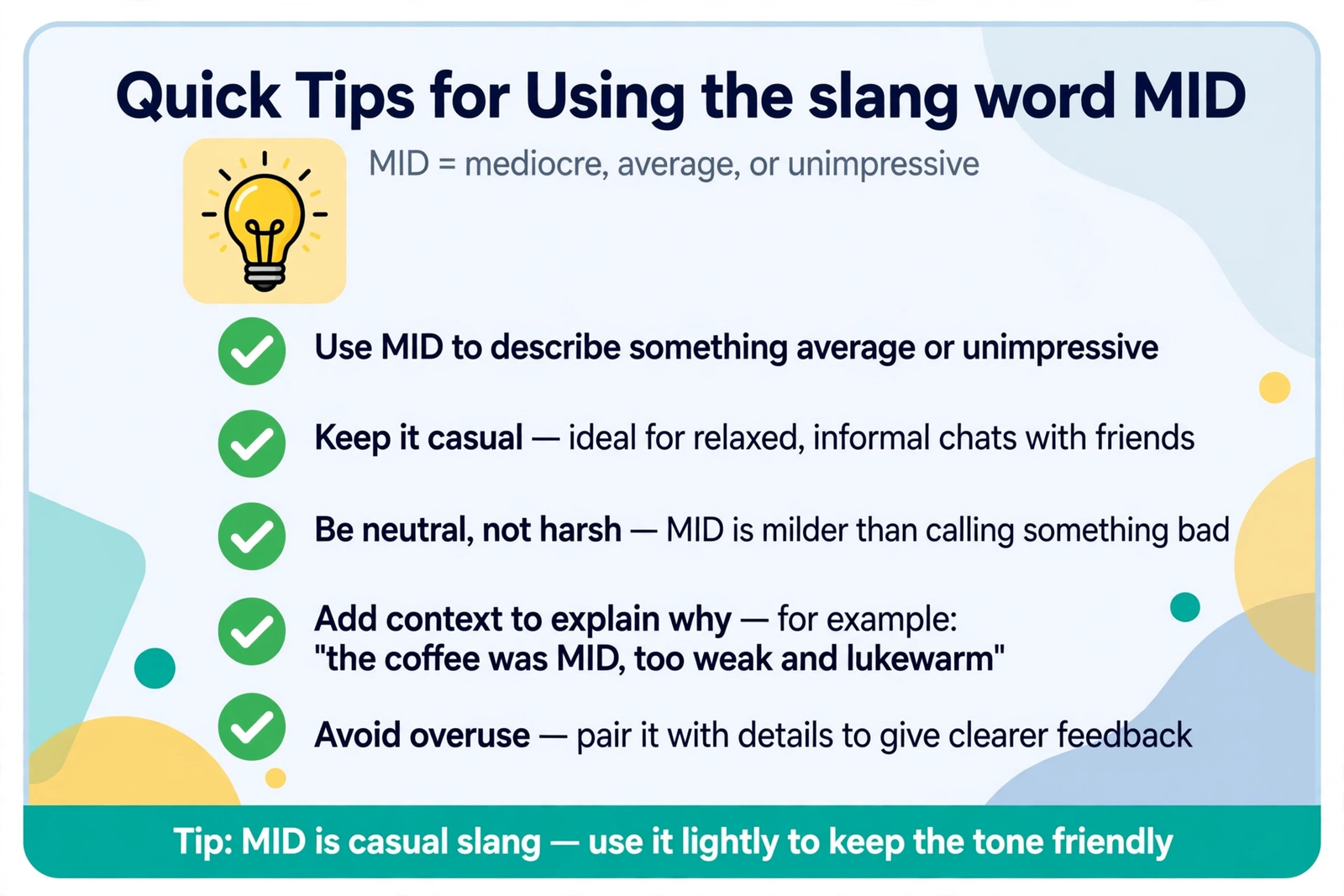
Quick Tips
- Use it for the hype gap: Mid works best when expectations were high and reality was ordinary. That contrast is the whole joke.
- Soften it with “kinda”: “Kinda mid” keeps the honesty and drops the edge — perfect when the creator might be listening.
- Pair it with specifics: “The plot was mid, but the soundtrack was amazing” is a real review. A bare “mid” is just a vibe.
- Read the room: Among friends, mid is playful. About a stranger’s art, it is dismissive. About your own cooking, it is funny and self-aware.
- Do not use it as a personality test: Liking mid things is fine. Hating popular things by calling them mid does not make your taste better — it just makes the conversation worse.
- Remember the gaming meaning: In games, check the context before reacting. “Go mid” is a strategy, not an insult.
- Keep it out of formal writing: Essays, emails, and applications need “average,” “underwhelming,” or “mediocre” — never “mid.”
FAQ
What does mid mean in slang?
Mid means mediocre, average, or underwhelming. It describes something that is not terrible but fails to impress or live up to the hype — a movie, song, meal, outfit, or event that ends up forgettable.
What does mid mean on TikTok?
On TikTok, mid usually means mediocre or not worth the hype. Users drop it in comments, captions, and reactions to dismiss something popular quickly, often right after a hyped video, product, or trend disappoints them.
Is mid an insult?
It can be. Mid is a mild insult — dismissive rather than harsh. Used about a thing (a movie, an album, a meal), it is usually playful criticism. Used about a person, it feels personal and rude, so it is best kept to things, not people.
Where did mid come from?
Mid comes from “mid-grade,” early-2000s cannabis slang for medium-quality weed. It spread through hip-hop and music criticism in the 2010s, then exploded into mainstream slang in October 2021 after debates about Drake’s Certified Lover Boy album and a viral MJF wrestling promo mocking the “Mid-west.”
What does mid mean in texting?
In texting, mid means the same as everywhere else: average or unimpressive. “The date was mid” means it was boring. “That restaurant was mid” means the food did not live up to expectations. It is usually a quick verdict with no further explanation.
What is the opposite of mid?
The opposite of mid is anything that lives up to or beats the hype: “fire,” “elite,” “goes hard,” “ate,” or “peak.” Where mid shrugs, those words celebrate. In the slang scale of quality, mid sits in the middle and “fire” sits at the top.
Does mid mean bad?
No — mid means average, not bad. Something bad is terrible or unwatchable. Something mid is just unremarkable: you finished it, shrugged, and moved on. The disappointment comes from the gap between hype and reality, not from the thing being awful.
Is mid still popular in 2026?
Yes. Mid remains one of the most common slang verdicts online in 2026, all over TikTok comments, gaming chats, group chats, and reviews. Variations like “kinda mid,” “certified mid,” and “hyper-mid” keep it fresh, and dictionaries now recognize the slang meaning.
Conclusion
The mid slang meaning is small but powerful: mediocre, average, underwhelming — not worth the hype. It began as cannabis slang for “mid-grade,” traveled through hip-hop and music criticism, and went fully mainstream in 2021 thanks to a viral album debate and a wrestling promo that turned the Midwest into a punchline. In 2026, it is the internet’s fastest way to say “I expected more.”
Use it well and it is a sharp, funny tool: save it for real letdowns, soften it with “kinda” when the creator might be listening, and keep it away from people and formal settings. Pair it with specifics — what was mid, and what was not — and your review actually says something. Overuse it, and the word goes mid itself.
Want to decode more of the words floating around the same group chats? Check out our guides to mewing, sigma slang, and Gen Alpha slang — the whole cluster, explained one term at a time. And for the dictionary view of the word, Cambridge Dictionary lists the slang sense of mid as “not very good or attractive” — the same verdict, in more formal dress.

3 thoughts on “Mid Slang Meaning: What “Mid” Really Means in Texting, TikTok & Everyday Talk (2026)”