
Quick definition: 1980s slang is the casual, colourful vocabulary that defined how Americans talked in the 1980s — words like rad, gnarly, tubular, and totally that came from surfer culture, Valley Girl speak, hip-hop, and blockbuster movies. Today, people use 1980s slang to sound fun, nostalgic, or retro, and to describe anything cool, impressive, or over the top.
1980s Slang Meaning & Definition
1980s slang refers to the informal words and expressions that were popular in the United States during the 1980s. It was the language of mall culture, MTV, skateboarding, arcade games, and John Hughes movies — a mix of surfer lingo, Valley Girl talk, hip-hop vocabulary, and plain teenage exaggeration. Words like rad (short for radical), gnarly (extreme or impressive), and bitchin’ (excellent) were everyday speech for millions of teenagers, and many of them are still recognised instantly today.
Unlike the slang of earlier decades, 1980s slang was shaped by mass media more than by any single region. A word could appear in a movie like Fast Times at Ridgemont High or Bill & Ted’s Excellent Adventure on Friday and be in every high school hallway by Monday. MTV, which launched in 1981, pushed surfer and rock-star vocabulary into living rooms across the country, while hip-hop artists introduced words like fresh, dope, and fly to a mainstream audience.
At its core, 1980s slang is about enthusiasm. The decade loved big feelings — big hair, big shoulder pads, big movies — and its language matched. Almost everything good was awesome, totally awesome, or totally tubular, and almost everything bad was bogus, grody, or barf me out. If you understand 1980s slang, you understand how an entire generation turned everyday conversation into a performance.
Introduction
Picture a teenager in 1985: neon leg warmers, a boombox on one shoulder, and a sentence that starts with “like, totally” and ends with “gag me with a spoon.” That is the world of 1980s slang — a decade when American English got louder, funnier, and far more dramatic. Whether you are writing a retro-themed party invitation, trying to understand your parents’ favourite movies, or just want to sound like you stepped out of a time machine, 1980s slang is the fastest way to get there.
This guide covers everything you need to know: the meaning and origin of 1980s slang, the 50+ most iconic words and phrases with real examples, how the slang differs from the old slang of earlier decades, the mistakes people make when using it today, and practical tips for dropping it into conversation without sounding forced. By the end, you will know exactly what it means to be rad, when something is gnarly, and why nobody says grody to the max with a straight face anymore.
Origin
1980s slang did not come from one place — it came from several subcultures colliding at once, and television and film did the rest.
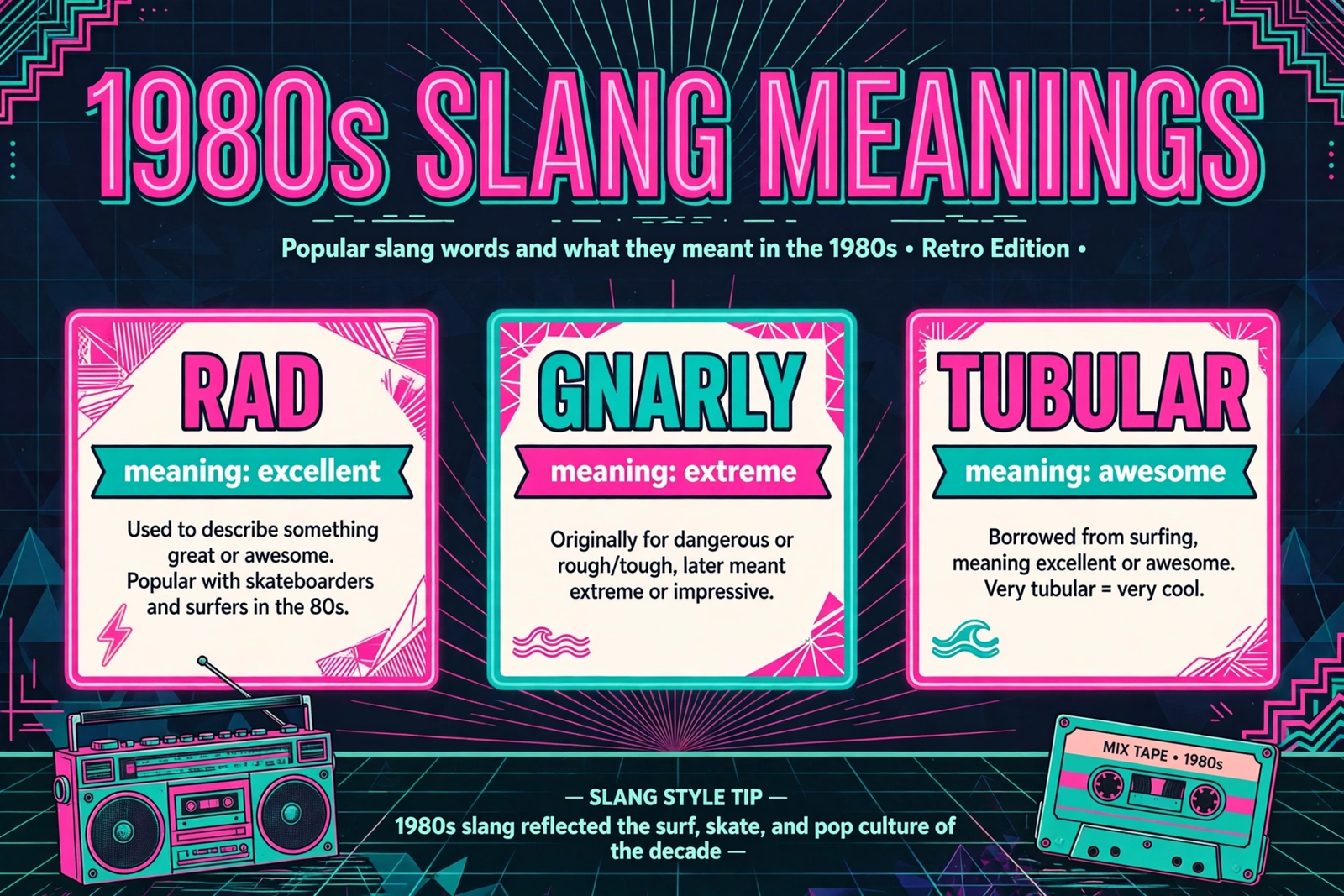
Surfer culture gave the decade its most famous words. Surfers in California had been saying gnarly (originally describing dangerous, twisted waves), radical, and tubular (describing the hollow inside of a breaking wave) since the 1970s. Hollywood picked them up — most famously in Fast Times at Ridgemont High (1982), where Jeff Spicoli turned surfer talk into national catchphrases — and suddenly kids in Ohio were calling everything totally tubular.
Valley Girl speak came out of Southern California’s San Fernando Valley and exploded after the 1982 song “Valley Girl” by Frank Zappa and his daughter Moon Unit. The Valley Girl style — “like, oh my God,” “totally,” “for sure,” “gag me with a spoon,” “grody to the max” — became a national joke and a national habit at the same time. Linguists note that the Valley Girl uptick and the word “like” as a filler genuinely changed how young Americans spoke.
Hip-hop and urban culture supplied another huge layer. As rap moved from New York block parties to MTV, words like fresh (stylish and new), dope (excellent), fly (stylish), def (definitely cool), and chill (relax) entered the mainstream. Run-DMC, the Beastie Boys, and LL Cool J made these words part of everyday teenage speech, and advertisers soon followed.
Movies and television tied it all together. E.T., Back to the Future, The Breakfast Club, Bill & Ted’s Excellent Adventure, and Valley Girl all treated slang as a character trait — the surfer, the Valley Girl, the rebel — and audiences copied what they heard. By the middle of the decade, 1980s slang was less a regional dialect and more a shared national costume.
Popularity
1980s slang was everywhere, and its popularity peaked between 1983 and 1989. A few forces explain why it spread so fast:
- MTV (launched 1981): For the first time, teenagers across the whole country watched the same videos, interviews, and VJs using the same vocabulary every single day.
- Teen movies: John Hughes films and surf comedies made slang a badge of belonging — knowing the words meant you were in on the joke.
- Advertising: Brands from soft drinks to fast food borrowed words like rad and awesome to sound young, which pushed the slang even further into the mainstream.
- Video games and arcades: Arcade culture loved short, punchy words — rad, boss, wicked — that fit on high-score screens and in trash talk.
The slang never fully died. It survives today in three ways: nostalgia (80s-themed parties, retro movies, and TV shows like Stranger Things), irony (people using it deliberately for laughs), and genuine inheritance — words like awesome, chill, dude, and cool never left the language at all. Search interest in 1980s slang spikes every Halloween and every time a new 80s reboot hits streaming, which is why so many people look it up today.
How It Is Used
1980s slang works in three main ways, depending on what you want to say:
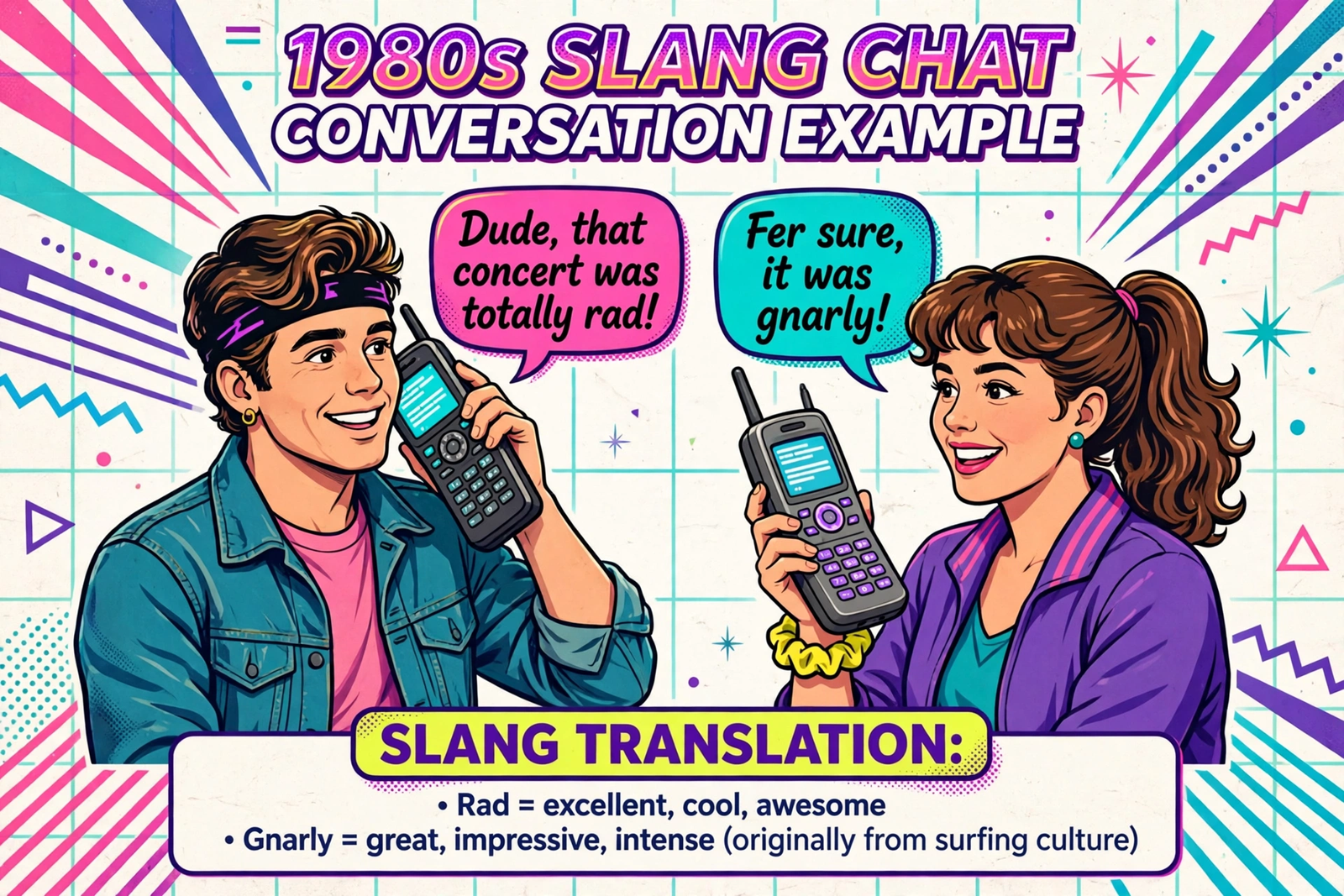
- To praise something: “That concert was totally rad!” / “Your new car is bitchin’.” / “This pizza is awesome.”
- To react with disgust or disbelief: “Grody to the max!” / “Gag me with a spoon.” / “Bogus! That’s so not fair.”
- To agree, confirm, or fill a pause: “Fer sure.” / “Totally.” / “Like, you know?” / “No duh.”
The tone matters more than the words. 1980s slang is exaggerated by design — it was meant to be said loudly, with feeling, and usually with friends. Used quietly or in a formal setting, most of it sounds like a joke, which is exactly why it still works at parties and in memes.
It also works as a social signal. Saying “gnarly” or “tubular” today instantly tells people you are referencing the 80s on purpose. That is useful for themed events, retro captions, and humour — but it is also why you should not use it in a job interview or a serious email.
Examples
Here are real-world examples of 1980s slang in everyday sentences, organised by tone.
Friendly Examples
- “Dude, that skateboard trick was totally rad!”
- “Like, oh my God, your outfit is so fresh today.”
- “Wanna go to the mall? Fer sure, let’s cruise.”
- “This song is awesome — turn it up!”
- “You look totally tubular in that jacket.”
- “Hey, chill — the party doesn’t start till seven.”
Professional Examples
Most 1980s slang is far too casual for professional settings, but a few words crossed over and are still fine at work today:
- “That’s an awesome idea — let’s run with it.” (Awesome is fully mainstream now.)
- “Let’s chill on the launch date until the numbers come in.” (Chill is acceptable in casual workplaces.)
- “The new design looks fresh and modern.” (Fresh works as a normal adjective.)
- “Dude” and “gnarly” stay out of the office — save them for friends.
Funny Examples
- “Gag me with a spoon — he asked me to the dance in front of everyone!”
- “She wore leg warmers with sandals. Grody to the max.”
- “I studied all night and still got a C. Bogus, man. Totally bogus.”
- “Psych! I wasn’t actually going to eat the last slice.”
- “Take a chill pill, bro — it’s just a video game.”
- “No duh, Sherlock. Of course the arcade is closed on Mondays.”
Comparison with Similar Terms
1980s slang overlaps with the slang of other decades, but each era has its own flavour. Here is how the big ones compare:
| Era | Word for “cool” | Word for “bad” | Signature phrase | Where it came from |
|---|---|---|---|---|
| 1970s slang | Groovy, far out | Bummer | “Can you dig it?” | Hippie and disco culture |
| 1980s slang | Rad, tubular, bitchin’ | Bogus, grody | “Totally!” / “Gag me with a spoon” | Surfers, Valley Girls, hip-hop, MTV |
| 1990s slang | Dope, phat, bomb | Wack | “Talk to the hand” | Hip-hop and sitcoms |
| 2000s slang | Tight, sick, legit | Lame | “That’s so fetch” (ironic) | Internet and reality TV |
| Gen Z slang | Slay, fire, lit | Mid, sus, cringe | “No cap” / “It’s giving…” | TikTok and social media |
The biggest difference is attitude. 1970s slang was mellow and laid-back; 1980s slang was loud and exaggerated; 1990s slang was cooler and more ironic; and Gen Z slang is faster and more internet-native. If you want to sound like the 80s, lean into the enthusiasm — that is what makes it recognisable.
50+ Iconic 1980s Slang Words and Phrases
Here is the ultimate list of 1980s slang, with meanings and examples. Learn these and you can survive any 80s movie, party, or trivia night.
| Word / Phrase | Meaning | Example |
|---|---|---|
| Rad | Excellent, cool (short for radical) | “That bike jump was rad!” |
| Tubular | Awesome, amazing (from surf waves) | “Dude, that wave was totally tubular.” |
| Gnarly | Extreme — either amazing or shocking | “That wipeout was gnarly, man.” |
| Totally | Completely, absolutely; also “yes” | “Totally! I’m in.” |
| Awesome | Amazing, impressive | “The concert was awesome.” |
| Dude | A guy, a friend, or a general “hey you” | “Dude, check this out.” |
| Bitchin’ | Excellent, impressive | “Your new stereo is bitchin’.” |
| Bogus | Unfair, fake, or bad | “That test was bogus.” |
| Grody | Disgusting, gross | “Grody! There’s gum on my shoe.” |
| Grody to the max | Extremely disgusting | “His locker smells grody to the max.” |
| Gag me with a spoon | “That’s so gross I could throw up” | “Gag me with a spoon — he wore socks with sandals.” |
| Barf me out | “That disgusts me” | “Barf me out, that cafeteria food.” |
| Like, oh my God | Valley Girl expression of shock | “Like, oh my God, did you see that?” |
| Fer sure | For sure; definitely | “Fer sure, I’ll be there.” |
| For sure | Definitely, absolutely | “For sure, that movie rules.” |
| Psych! | “Just kidding!” (after a fake-out) | “I got you a car — psych! It’s a toy car.” |
| No duh | “Obviously” / “No kidding” | “No duh, it’s raining — look outside.” |
| Whatever | “I don’t care” (dismissive) | “Whatever, do what you want.” |
| Take a chill pill | Calm down, relax | “Take a chill pill, it’s just a game.” |
| Chill | Relax; also cool or laid-back | “Just chill, everything’s fine.” |
| Chill out | Relax, calm down | “Chill out, the test is easy.” |
| Fresh | Stylish, new, cool | “Those sneakers are fresh.” |
| Dope | Excellent, cool | “That beat is dope.” |
| Fly | Stylish, attractive | “She looks fly in that dress.” |
| Def | Definitely cool (short for definite) | “That party was def.” |
| Wicked | Really, very; also excellent | “That car is wicked fast.” |
| Bodacious | Bold, remarkable, excellent | “Bodacious babes at the beach today.” |
| Boss | Excellent, top-notch | “That guitar solo was boss.” |
| Bitchin’ camaro | The ultimate cool car (from the song) | “He drives a bitchin’ Camaro.” |
| Airhead | A silly, ditzy person | “Don’t be such an airhead.” |
| Bimbo | An attractive but shallow person | “He only dates bimbos.” |
| Valley Girl | A girl from the San Fernando Valley; the whole style | “She talks like a total Valley Girl.” |
| Like | Filler word; also “said” (“he was like…”) | “And she was like, no way.” |
| Totally tubular | Completely awesome | “This party is totally tubular!” |
| Radical | Excellent, extreme (full form of rad) | “That was a radical move.” |
| Excellent | Outstanding (popularised by Bill & Ted) | “Excellent! Party on, dudes!” |
| Party on, dudes | Let’s have fun / goodbye (Bill & Ted) | “Party on, dudes!” |
| Most triumphant | The best possible (Bill & Ted) | “That was most triumphant.” |
| Most non-triumphant | Terrible, a disaster (Bill & Ted) | “Failing maths was most non-triumphant.” |
| Heinous | Awful, hateful (Bill & Ted) | “That haircut is heinous.” |
| Melvin | An uncool, nerdy person | “Don’t be a Melvin.” |
| Dweeb | A nerdy, uncool person | “That dweeb sits alone at lunch.” |
| Geek / Nerd | Someone obsessed with books or computers | “The computer geek fixed my PC.” |
| Yuppie | Young urban professional | “The yuppies moved into the loft.” |
| Couch potato | Someone who sits watching TV all day | “He’s a total couch potato.” |
| Homeboy / Homegirl | A close friend from your neighbourhood | “That’s my homeboy from school.” |
| Word | “I agree” / “I hear you” | “Word — that test was hard.” |
| Word up | A greeting; “listen up” / “I agree” | “Word up! Let’s go.” |
| Yo | “Hey” — a greeting or attention-getter | “Yo, check this out!” |
| Cruise | To drive around aimlessly for fun | “Let’s cruise the mall tonight.” |
| Hang out | To spend time together casually | “Wanna hang out after school?” |
| Spaz | To freak out (now considered offensive) | “Don’t spaz, it’s just a quiz.” |
| Spaz out | To lose control, panic | “She spazzed out when she saw the snake.” |
| Barf | To vomit; also used as “gross” | “Barf! That smell is awful.” |
| Bummer | A disappointment | “Total bummer — the concert sold out.” |
| Major bummer | A big disappointment | “Rain on prom night? Major bummer.” |
| Way cool | Very cool | “Your new Walkman is way cool.” |
| Cool beans | “Cool” / “great” (later 80s) | “You got tickets? Cool beans!” |
| As if! | “No way” / “in your dreams” (late 80s) | “As if! He’d never ask me out.” |
| Oh, snap! | “Wow” / an insult comeback (late 80s) | “Oh, snap! Did you hear that?” |

Alternate Meanings
Some 1980s slang words have other meanings, and a few mean something completely different today:
- Rad: In the 80s it meant “excellent.” In science it is a unit of absorbed radiation dose, and in maths it is short for “radian.” Context decides which one you mean.
- Dope: In 1980s slang it meant “excellent,” but it also meant illegal drugs — and it still does. Saying “that beat is dope” is a compliment; saying “he’s on dope” is not.
- Gnarly: Surfers used it for huge, twisted waves; teenagers used it for anything extreme, good or bad. Today it can also describe something twisted or deformed.
- Fresh: Beyond “cool,” it also meant new, clean, or recently made — “fresh bread” has nothing to do with 80s style.
- Chill: It meant relax in the 80s, and it still does — but it also became a noun (“let’s have a chill night”) and an adjective (“a chill person”) that the 80s barely used.
- Sick: Not a core 80s word — it became slang for “awesome” in the 90s and 2000s. If you call something “sick” at an 80s party, people would think you need a doctor.
- Bad: Thanks to Michael Jackson’s Bad (1987), “bad” could mean “good” — but only in that very specific pop-culture sense, and it confused everyone anyway.
Professional or Polite Alternatives
Most 1980s slang is too casual for work, school essays, or formal events. Here are polite replacements that keep the meaning without the retro comedy:
| 1980s Slang | Polite / Professional Alternative |
|---|---|
| Rad / Tubular / Bitchin’ | Excellent, impressive, outstanding |
| Totally awesome | Truly excellent, really great |
| Bogus | Unfair, disappointing, incorrect |
| Grody / Gag me with a spoon | Unpleasant, unappealing |
| Dude | Friend, colleague, or just the person’s name |
| Chill / Chill out | Relax, take it easy, stay calm |
| Fer sure / Totally | Absolutely, definitely, certainly |
| No duh | Obviously, of course |
| Whatever | That’s fine, as you prefer |
| Fresh / Fly / Dope | Stylish, modern, impressive |
| Psych! | Just kidding (or leave it out entirely) |
The words awesome, chill, and fresh are the safest survivors — they sound natural in almost any setting today, because the language kept them and dropped the costume around them.
Common Mistakes
People love 1980s slang, but they often get it wrong. Here are the most common mistakes to avoid:
- Mixing decades: “Slay,” “no cap,” and “lit” are Gen Z, not 80s. “Groovy” is 70s. Mixing them breaks the retro effect instantly — if you want the full guide to today’s language, check our Gen Z slang list separately.
- Overusing “like”: Valley Girls used “like” as a filler, but every second word is a parody, not a conversation. One “like” per sentence is plenty.
- Using “gnarly” for everything: Gnarly meant extreme — a huge wave, a terrible injury, an amazing stunt. It did not mean “nice sandwich.”
- Saying “bitchin'” at work or school: It sounds fun at a party, but it is still a swear-adjacent word. Keep it casual.
- Forgetting the tone: 1980s slang is enthusiastic. Saying “rad” in a flat, bored voice is funnier than you intended — and not in a good way.
- Using “spaz” today: It was common in the 80s, but it is now considered offensive because it comes from a slur for people with cerebral palsy. Skip it entirely.
- Calling everything “tubular”: Tubular specifically came from surfing. It works for waves, stunts, and parties — not for your tax return.

Quick Tips
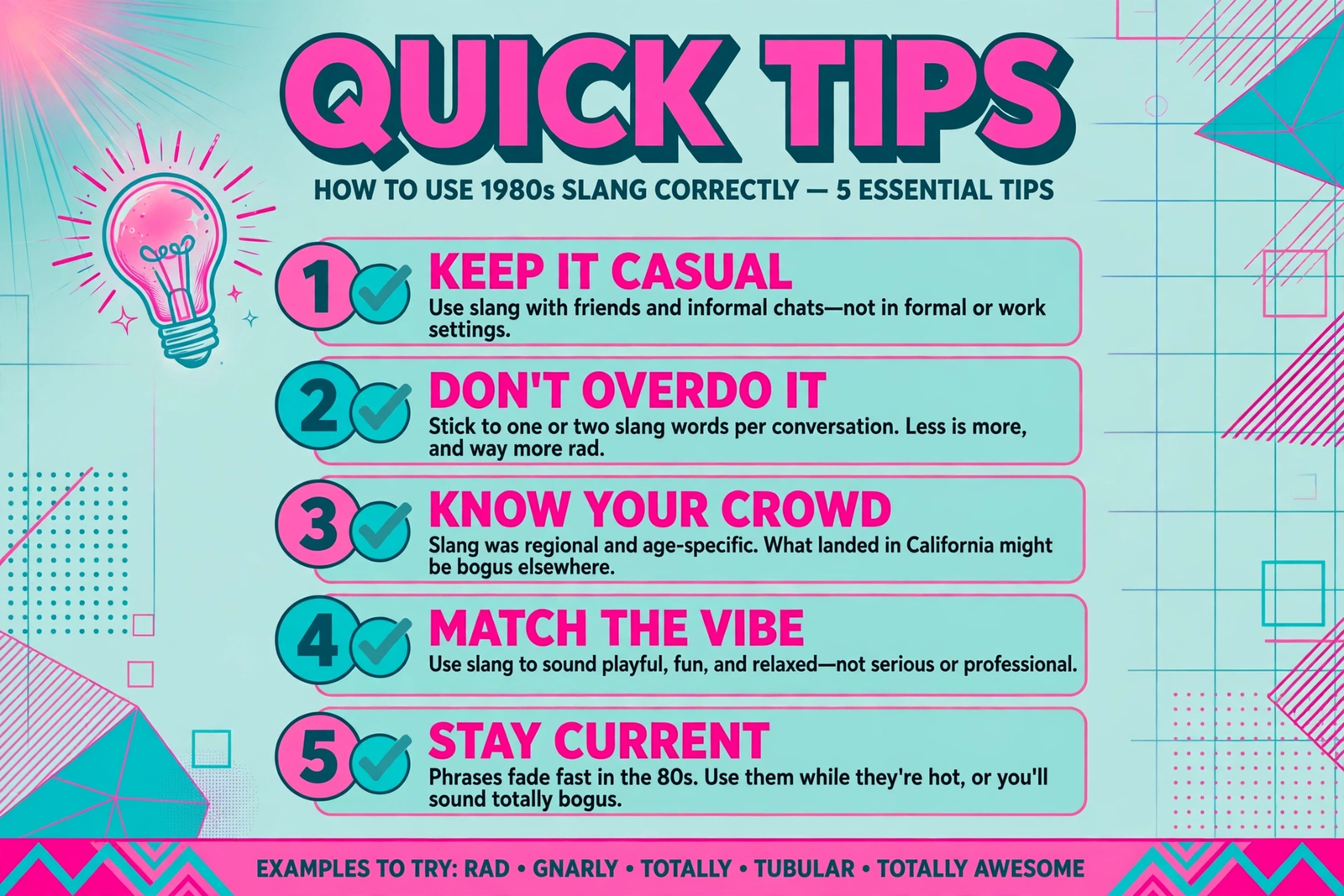
- Start with the big five: Learn rad, totally, awesome, dude, and gnarly first — they cover 80% of 80s conversations.
- Pair words for effect: “Totally rad,” “totally tubular,” and “way cool” sound more authentic than any single word on its own.
- Match the moment: Use 1980s slang at themed parties, in retro captions, in trivia, and in jokes — not in job interviews or formal emails.
- Watch the movies: One viewing of Bill & Ted’s Excellent Adventure or Fast Times at Ridgemont High will teach you the rhythm better than any list.
- Use it in captions: 1980s slang is perfect for Instagram and TikTok captions — short, visual, and instantly nostalgic. For modern caption ideas, see our TikTok slang guide.
- Don’t force it: One or two 80s words in a sentence is a joke; ten is a costume. Less is more.
- Know your audience: People who grew up in the 80s will love it; younger people may need a quick translation — which is exactly what this guide is for.
FAQ
What does 1980s slang mean?
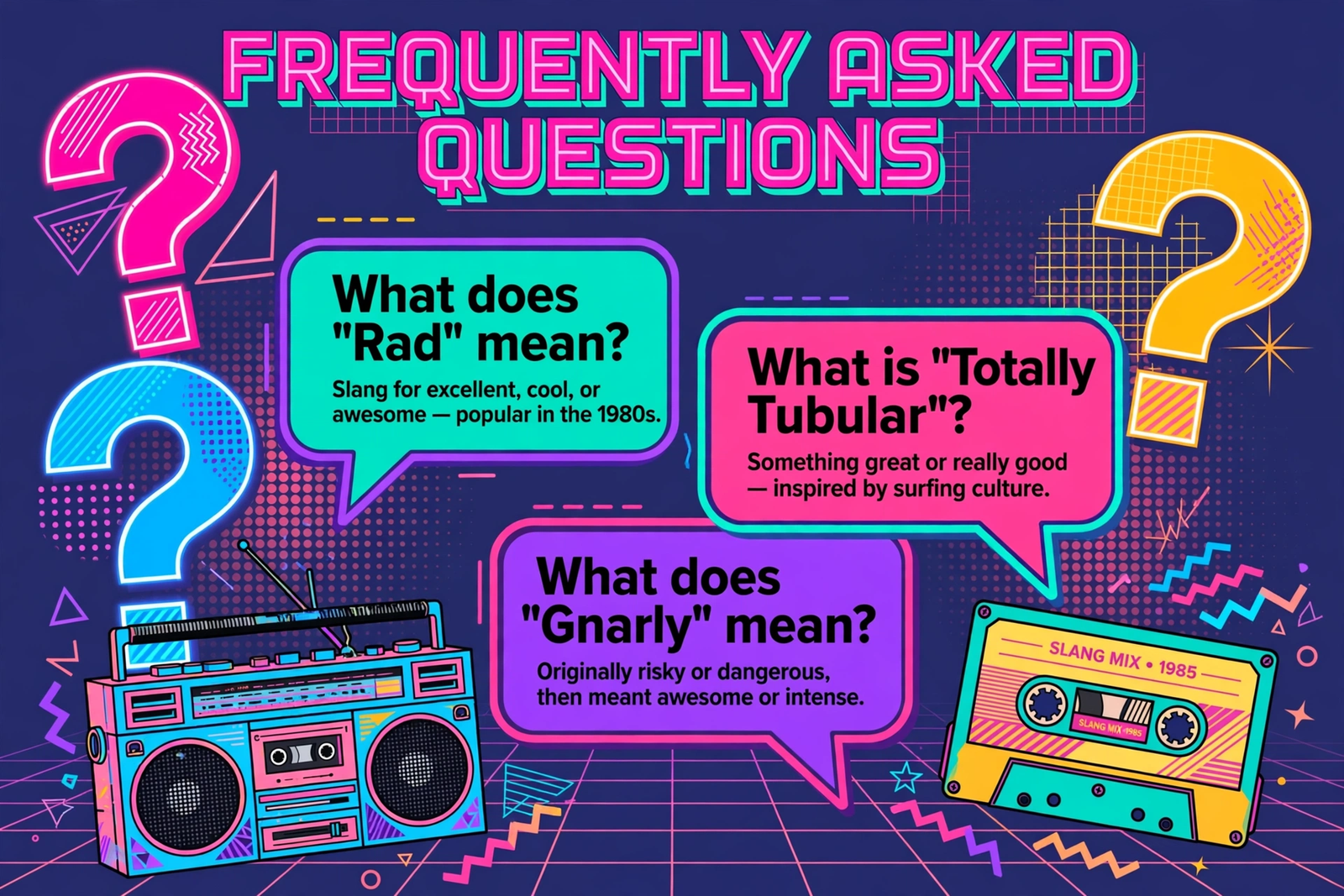
1980s slang is the informal vocabulary popular in the United States during the 1980s — words like rad, gnarly, tubular, and totally that came from surfer culture, Valley Girl speak, hip-hop, and 80s movies and music.
What is the most famous 1980s slang word?
Rad is probably the most famous, short for “radical” and meaning excellent or cool. Totally, awesome, and gnarly are close behind, and all four are still recognised instantly today.
What does “gnarly” mean in 1980s slang?
Gnarly meant something extreme — either amazing (a gnarly surf trick) or shocking (a gnarly injury). Surfers originally used it to describe twisted, dangerous waves, and teenagers extended it to anything intense.
What does “tubular” mean?
Tubular means awesome or amazing. It comes from surfing: the “tube” is the hollow space inside a breaking wave, and riding inside it was the ultimate surfer achievement — so “tubular” became surfer slang for the best thing possible.
What does “gag me with a spoon” mean?
It is a Valley Girl expression of disgust, meaning “that is so gross it makes me want to throw up.” It was usually said about something embarrassing, uncool, or repulsive, and almost always as a joke.
Is 1980s slang still used today?
Some of it is. Words like awesome, chill, dude, and cool never left everyday English. The more theatrical words — tubular, grody, bitchin’ — survive mostly at 80s-themed parties, in retro movies and TV, and in ironic or nostalgic use.
What is the difference between 1980s slang and 1970s slang?
1970s slang (groovy, far out, can you dig it?) was mellow and laid-back, shaped by hippie and disco culture. 1980s slang (rad, tubular, totally) was louder and more exaggerated, shaped by surfers, Valley Girls, hip-hop, and MTV. For more on earlier eras, see our guide to old slang.
How can I use 1980s slang without sounding cringe?
Use it lightly and on purpose: one or two words in a fun context, like a themed party, a retro caption, or a joke with friends. Learn the big five words first (rad, totally, awesome, dude, gnarly), watch a classic 80s movie for the rhythm, and never use it in formal or professional settings.
Conclusion
1980s slang was more than a list of funny words — it was the sound of a decade that loved everything big. Surfers, Valley Girls, rappers, and movie stars all threw their vocabulary into the same pot, and MTV served it to the whole country at once. The result was a language of pure enthusiasm: everything was rad, totally tubular, or gnarly, and everything bad was bogus or grody to the max.
The key takeaways are simple. Start with the big five words, use them with feeling, keep them in fun contexts, and remember where they came from — the beach, the Valley, the block party, and the movie screen. Some of these words, like awesome and chill, never left us at all; the rest are waiting whenever you want a little nostalgia. So go ahead — party on, dudes, and keep it totally tubular. And if you want to compare how slang has changed since then, our guides to Gen Z slang and slang for cool show exactly where the language went next.
For the academic side of how words like these enter formal English, the Oxford English Dictionary tracks slang terms as they move from street and screen into standard usage.
