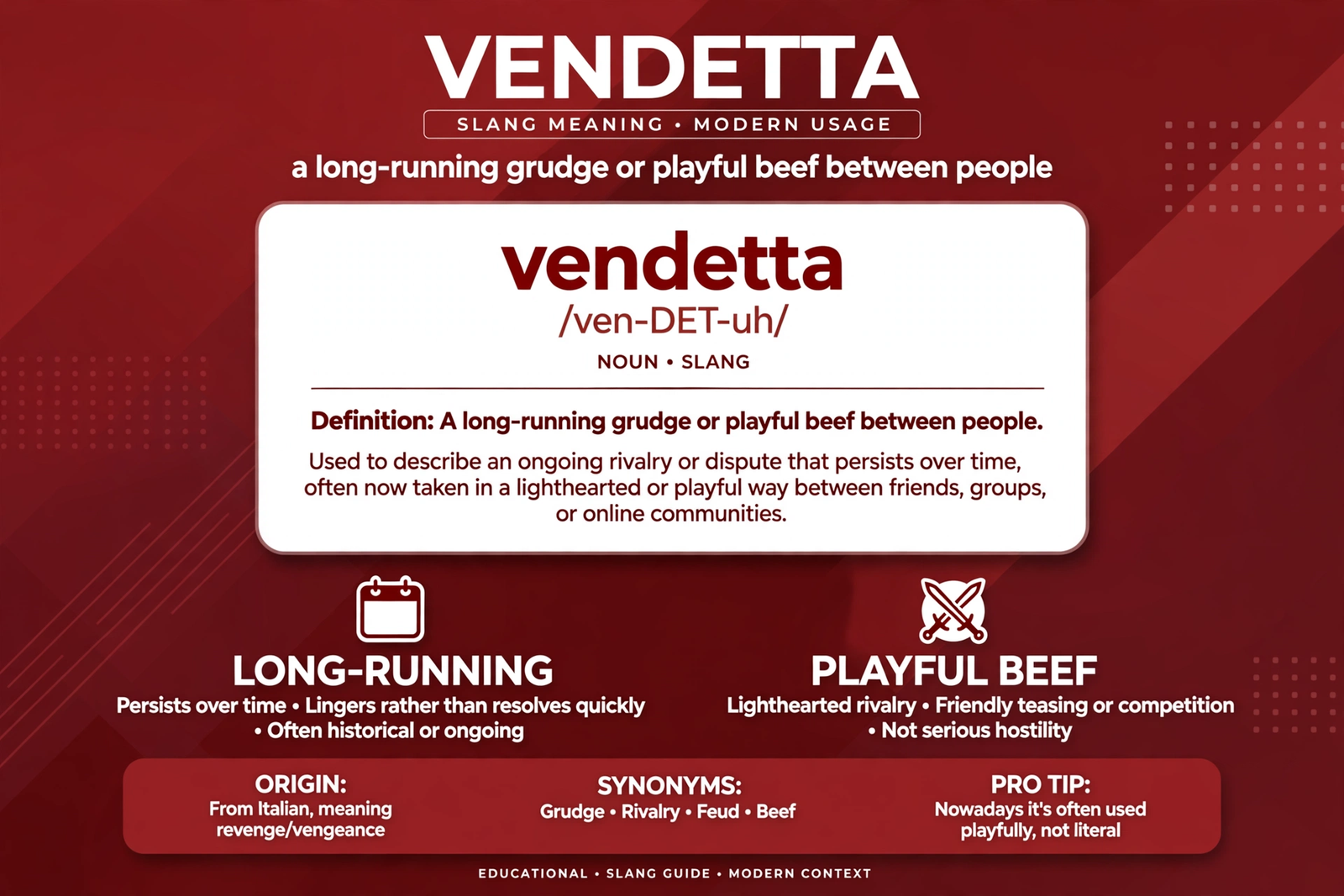
Quick definition: In slang, vendetta meaning slang refers to a long-running grudge, rivalry, or playful beef between people — a dramatic way of saying someone is holding onto a past wrong and is not ready to let it go. It comes from the Italian word for revenge, but online it is usually exaggerated for humour rather than used to describe a real feud.
Vendetta Meaning Slang Meaning & Definition
When someone says they have a vendetta against you, they are not usually declaring an actual blood feud. In modern slang, a vendetta is a stubborn, ongoing grudge — the kind where a person remembers every slight, keeps score, and brings it up long after everyone else has moved on. It can be serious, but most of the time it is playful: a friend joking that they have a vendetta against Mondays, or a gamer claiming a vendetta against the player who keeps beating them.
The slang meaning sits somewhere between a joke and a genuine rivalry. The word carries drama by design. Saying “we have beef” sounds casual; saying “I have a vendetta” sounds like the opening line of a movie. That is exactly why people love using it in texts, captions, and memes — it turns a small annoyance into an epic storyline.
At its core, the vendetta meaning slang definition is simple: a prolonged, bitter feeling of hostility towards someone, driven by a desire for payback. The difference between the dictionary definition and the slang version is scale. The dictionary talks about family feuds that last generations. Slang talks about the friend who still has not forgiven you for beating them at FIFA three months ago.
| Aspect | Traditional Meaning | Slang Meaning |
|---|---|---|
| Who is involved | Families or clans | Friends, rivals, coworkers, or online users |
| How long it lasts | Years or generations | Days, weeks, or until the joke gets old |
| What is at stake | Honour, revenge, sometimes violence | Bragging rights, a rematch, or a funny comeback |
| Tone | Deadly serious | Often playful or exaggerated |
| Where you hear it | History books and crime films | Texts, TikTok, gaming chats, and memes |
Introduction
You have probably seen it in a comment section: “Bro has a personal vendetta against me 😭” or “She has a vendetta against pineapple on pizza.” Nobody in those conversations is planning revenge in a dark alley. They are using one of the most dramatic words in English to describe something completely ordinary — a grudge that will not die.
That is the strange charm of the word vendetta. It sounds like it belongs in a mafia film, yet it fits perfectly in a group chat. It lets you describe a petty rivalry with the gravity of a centuries-old blood feud, and the exaggeration is the whole joke. When your friend says they have a vendetta against the snooze button, you know exactly what they mean: they lose to it every single morning, and they are not happy about it.
In this guide, we will break down the full vendetta meaning slang story — where the word comes from, how it travelled from Italian villages to TikTok, how people use it in real conversations, and the mistakes to avoid so you do not sound like you are starting an actual feud. By the end, you will know exactly when to drop “vendetta” into a sentence and when to leave it alone.
Origin
The word vendetta comes from Italian, where it literally means “revenge.” It traces back to the Latin vindicta, meaning vengeance or vindication — the same root that gives us words like vindictive and vindicate. English speakers borrowed the word in the 19th century, and at first it referred specifically to the blood feuds of Italy and Corsica, where families would carry grudges across generations and answer every injury with another injury.
For a long time, vendetta stayed in that serious, almost literary register. You would find it in novels, history books, and newspaper reports about organised crime. It was the kind of word a journalist used when a politician “waged a personal vendetta” against a rival — a phrase that still appears in serious news writing today.
So how did a word about blood feuds end up in group chats? Pop culture did most of the work. Films like The Godfather and V for Vendetta turned the word into shorthand for stylish, cinematic revenge. Hip-hop and rap picked it up too, using it to describe rivalries and comebacks. Then social media finished the job: once a word sounds dramatic, the internet will use it to describe the least dramatic things possible. That is how “vendetta” went from describing mafia families to describing a personal war against slow Wi-Fi.
Popularity
Vendetta has never been a top-trending slang word like rizz or slay, but it has something those words do not: staying power. It has been circulating in casual English for decades, and every new generation rediscovers it. Search interest stays steady rather than spiky, because the word is useful in so many contexts — sports rivalries, celebrity drama, gaming, office politics, and everyday jokes.
On TikTok and X (formerly Twitter), “vendetta” shows up most often in three kinds of posts:
- Sports and gaming beef: “He has a vendetta against my team, he never misses a chance to trash us.”
- Celebrity and influencer drama: fans describing an ongoing feud between two creators as a vendetta.
- Self-deprecating jokes: “The universe has a personal vendetta against me today” — usually posted after a small disaster like spilling coffee on a white shirt.
The word also thrives in memes because it is inherently over-the-top. Pairing a dramatic word with a trivial complaint is a classic internet humour formula, and “vendetta” is one of the best words for it. It is also popular as a username and gamertag, where it signals competitiveness without sounding aggressive.
Unlike fast-burning slang that disappears in a season, vendetta is a slow-burn word. It is not tied to one platform or one trend, which means it is unlikely to feel dated any time soon. If anything, its usage is growing as more people use it ironically — the less serious the situation, the funnier the word sounds.
How It Is Used
In slang, vendetta is almost always used with “have” or “against”: “I have a vendetta against…” or “She has a personal vendetta against…” The phrase “personal vendetta” is especially common, and it is the version you will hear in news, sports commentary, and everyday speech. Adding “personal” makes it sound even more intense — which is why people use it jokingly about completely impersonal things.
Here are the main ways people use it today:
- A real, ongoing rivalry: “Those two streamers have had a vendetta for years. Every time one of them goes live, the other one starts drama.”
- A playful grudge: “I have a vendetta against autocorrect. It changed my name to ‘Duck’ in front of my boss.”
- An exaggerated complaint: “My alarm clock has a vendetta against me. It only goes off on days I actually need sleep.”
- A competitive drive: “After losing the final last year, he came back with a vendetta. He trained all summer just to beat them.”
- Calling out overreaction: “Relax, it is not a vendetta. He just disagreed with you once in a meeting.”
Notice how flexible the word is. It works for genuine hostility, for jokes, and for motivation. The tone depends entirely on context, and the people around you will read that context instantly. In a serious conversation about workplace conflict, “vendetta” means something real. In a meme caption, it means the opposite — that the “conflict” is so small it is funny.
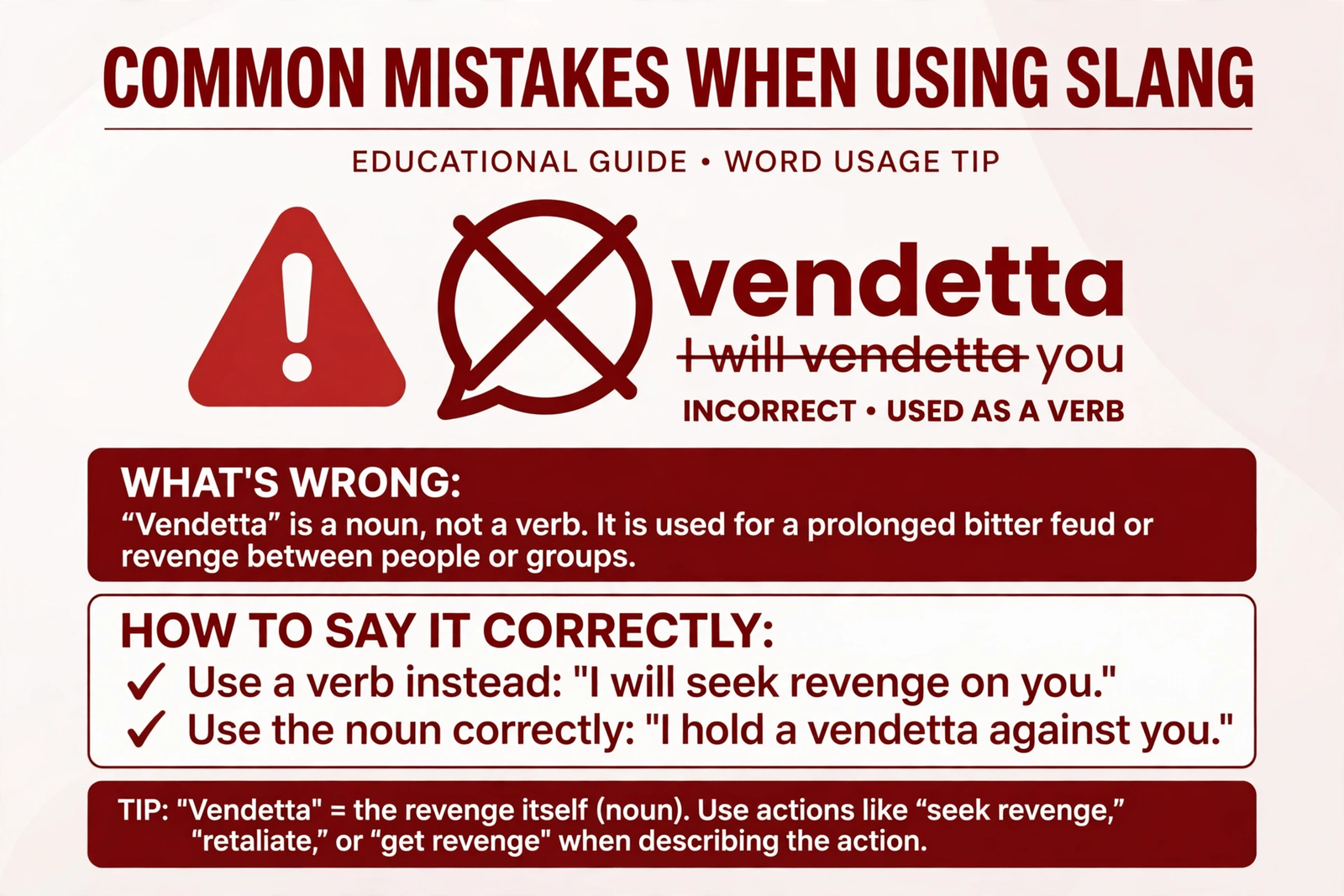
One thing to remember: in slang, vendetta is a noun, not a verb. People do not say “I am going to vendetta you.” They say “I have a vendetta against you” or “This is my vendetta.” Keeping it as a noun is the easiest way to sound natural.
Examples
The best way to understand slang is to see it in action. Here are real-world style examples of vendetta meaning slang across different tones and situations.
Friendly Examples
- “I swear my little brother has a vendetta against my snacks. Every time I buy chips, they are gone by morning.”
- “She has had a vendetta against Mondays since high school. She says the week personally attacks her.”
- “We have a friendly vendetta going — whoever loses the next game has to cook dinner for a week.”
- “My cat has a personal vendetta against my charger cables. I have replaced three this month.”
Professional Examples
- “I would not call it a vendetta, but the two departments have disagreed on every budget decision this year.”
- “After the promotion went to someone else, people whispered that he had a vendetta against the new manager. In reality, he just wanted a fair process.”
- “Be careful with that word in a work email. Saying a colleague has a vendetta against you sounds like an accusation, not a joke.”
Funny Examples
- “The printer has a vendetta against me. It only jams when I am already late.”
- “I have a vendetta against my own alarm clock. It is personal now.”
- “He lost one game of Uno and now he has a vendetta against the entire family. He has been practising his +4 strategy for weeks.”
- “The weather has a vendetta against my weekend plans. It rains every single Saturday.”
| Situation | Example sentence | Tone |
|---|---|---|
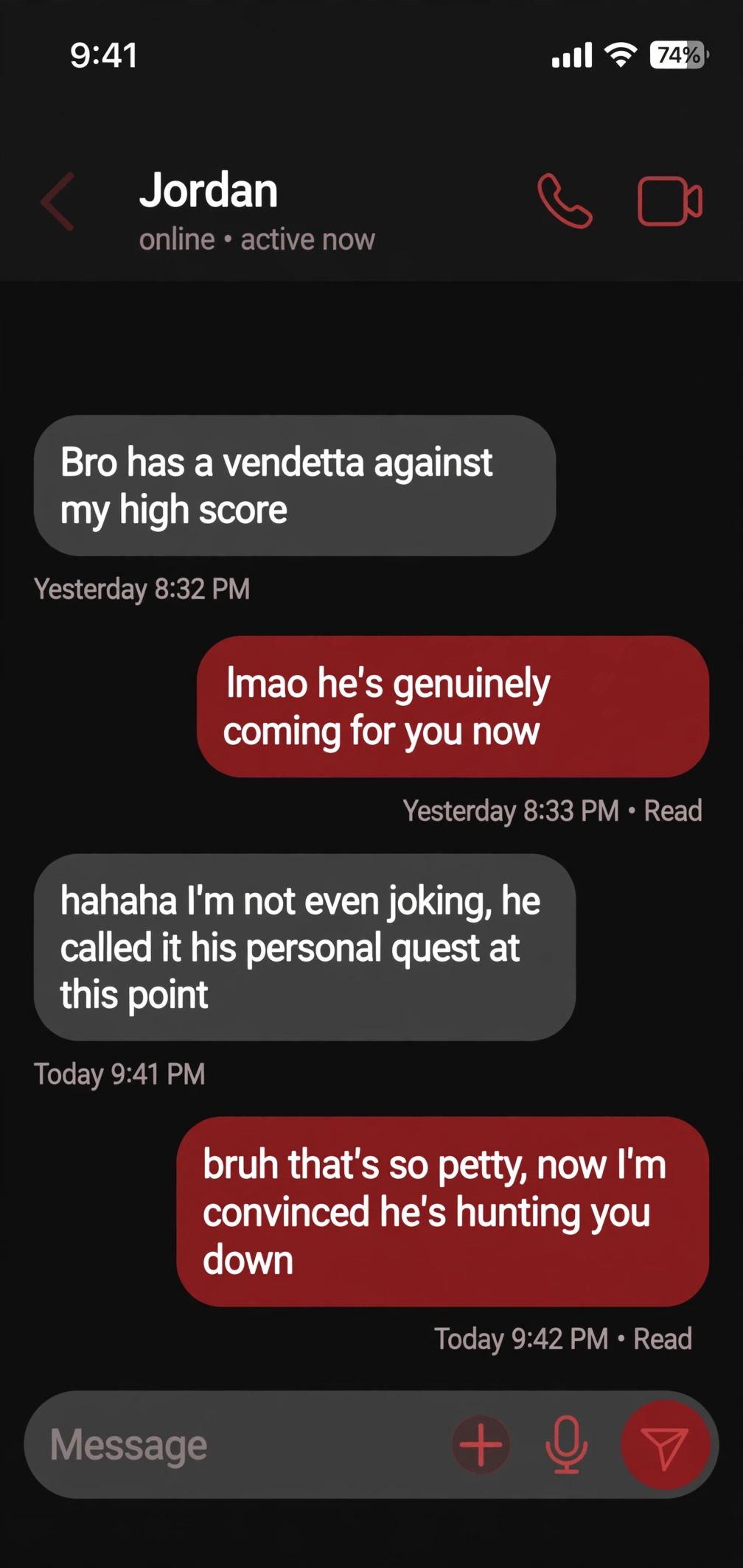
| Texting a friend | “Bro has a vendetta against my high score 😂” | Playful |
| Gaming chat | “That player has had a vendetta against me all match” | Competitive |
| Social media caption | “Me vs. Mondays: a vendetta that never ends” | Humorous |
| Talking about a rival | “They have a real vendetta — this goes back years” | Serious |
| Workplace chat | “It feels like IT has a vendetta against my laptop” | Light complaint |
Comparison with Similar Terms
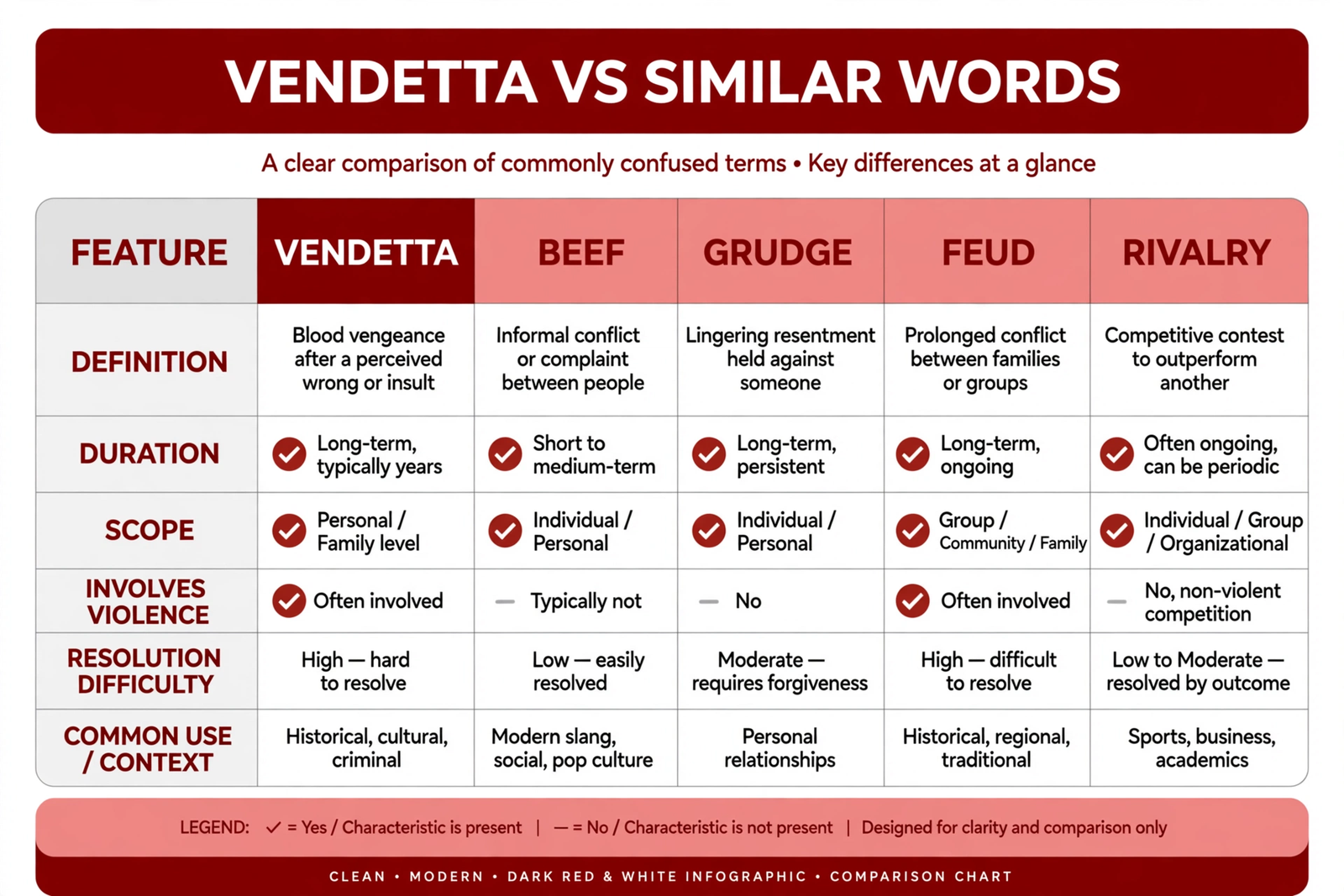
Vendetta is not the only word for a grudge, but it has a flavour that similar words do not. Here is how it compares to the terms people mix it up with most often.
| Term | Meaning | How it differs from vendetta |
|---|---|---|
| Beef | An ongoing argument or rivalry | Beef is casual and current; a vendetta feels older, deeper, and more dramatic |
| Grudge | A persistent feeling of resentment | A grudge is private and quiet; a vendetta is active and played out over time |
| Feud | A long, bitter quarrel | Almost a synonym, but feud sounds more formal and historical |
| Rivalry | Competition between two sides | Rivalry can be friendly and healthy; a vendetta implies hostility |
| Revenge | Payback for a wrong | Revenge is a single act; a vendetta is the whole long-running campaign |
| Beef (internet slang) | Public online drama | Internet beef burns fast and fades; a vendetta suggests it will never end |
The key difference is duration and drama. A grudge is something you carry. A vendetta is something you act on, again and again, over a long period. That is why “vendetta” sounds heavier than “beef” — it promises that the story is not over. In slang, though, that heaviness is usually the joke: the word promises an epic saga, and the actual story is about a stolen sandwich.
If you are choosing between these words, use beef for a current argument, grudge for a quiet resentment, and vendetta when you want to exaggerate a long-running conflict — or when the conflict genuinely has history behind it. And if you want to learn more slang for everyday chats, check out our guide to fn meaning in text, another short term that confuses a lot of people at first glance.
Alternate Meanings
Outside slang, vendetta keeps its original, heavier meanings. Knowing them helps you avoid using the word in the wrong room.
- Blood feud: The classic definition — a prolonged feud between families or clans in which each injury is answered with another. This is the meaning you will find in history books about Corsica and Sicily.
- Personal vendetta (politics and media): A campaign of hostile acts against a person, often driven by personal bias rather than principle. News outlets use this phrase regularly.
- V for Vendetta: The famous graphic novel and 2005 film, where the word is tied to a masked vigilante fighting an oppressive government. For many people, this is their first encounter with the word.
- Vendetta as a name: The word is used as a brand, band, and game title, and as a username or gamertag signalling toughness and competitiveness.
- Vendetta (gaming): In some games, a “vendetta” mission or quest line involves hunting down a specific enemy or faction as payback.
In slang contexts, though, almost nobody means the blood-feud definition. The alternate meanings matter mostly because they explain why the word sounds so serious — and why using it as a joke works so well.
Professional or Polite Alternatives
Because vendetta sounds aggressive, it is not always the right word. In professional settings, or when you are talking about a real conflict, softer language keeps things from escalating. Here are polite alternatives for different situations:
- Instead of “vendetta” at work: say “ongoing disagreement,” “long-standing tension,” or “history of friction.” These describe the same situation without accusing anyone of a personal campaign.
- Instead of “vendetta” about a person: say “we have not seen eye to eye,” “there is some bad blood,” or “we have a complicated history.” These are honest without sounding hostile.
- Instead of “vendetta” as a joke among friends: “friendly rivalry,” “running joke,” or “my personal mission” all keep the humour without the mafia-movie energy.
- Instead of “vendetta” in writing: “campaign,” “crusade,” or “determined effort” work when you mean persistence rather than hostility — for example, “her vendetta against litter” becomes “her campaign against litter.”
The rule is simple: if the conflict is real and the people involved might read your words, choose a calmer term. Save “vendetta” for jokes, fiction, and situations where everyone understands the exaggeration. If you are unsure how a message will land, a safer slang term like imk meaning in text shows how casual abbreviations work in chats — but for conflicts, plain language is always the safest choice.
Common Mistakes
People make a few predictable mistakes with this word. Avoid them and you will sound natural every time.
- Using it as a verb: “I will vendetta you” is not correct. Vendetta is a noun — you have a vendetta, you do not vendetta someone.
- Using it for a one-time argument: A single disagreement is not a vendetta. The word implies a long-running pattern. For one argument, “beef” or “falling out” fits better.
- Using it seriously about a real person in writing: Saying a coworker or a public figure “has a vendetta against you” is a strong accusation. In a work email or a public post, it can read as a claim of targeted harassment. Use neutral language instead.
- Spelling it wrong: The correct spelling is vendetta — double “t”, one “d”. Common misspellings include “vendeta” and “vendatta”.
- Overusing it: The word works because it is dramatic. If every small annoyance becomes a “vendetta,” the joke wears out fast and you start sounding genuinely bitter.
- Confusing it with “vendetta” the movie: Quoting V for Vendetta is fine, but remember the film’s hero is a vigilante, not a slang reference. Saying “remember, remember” will get you a film discussion, not a slang explanation.
- Using it to describe yourself as the victim in every conflict: If every disagreement is someone else’s “vendetta” against you, people stop believing the story. Sometimes a disagreement is just a disagreement.
Quick Tips
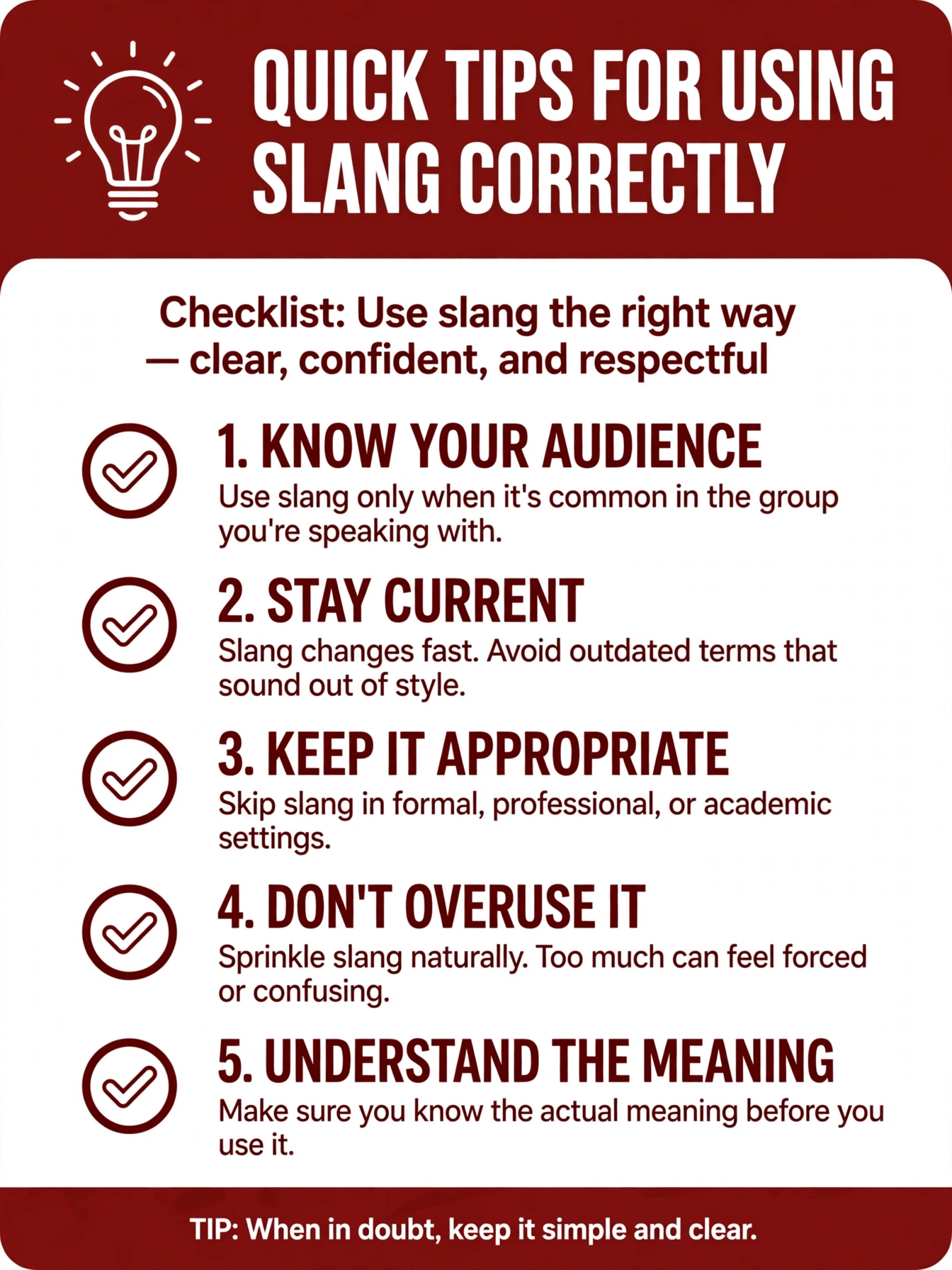
- Keep it playful: The slang use works best as a joke. Use it about Mondays, printers, and video games — not about real people you work with.
- Add “personal” for emphasis: “A personal vendetta” sounds more dramatic than “a vendetta,” which makes the joke land harder when the subject is trivial.
- Pair it with a concrete story: “He has a vendetta against me” is vague. “He has had a vendetta against me ever since I beat him at Mario Kart” is a story people will remember.
- Use it sparingly: One dramatic word per conversation is enough. Save it for the grudge that actually has history.
- Read the room: In a serious conversation about bullying or workplace conflict, drop the word entirely and describe what happened plainly.
- Try it in captions: “Me vs. the snooze button: a vendetta” is a perfect low-effort caption, and it works because everyone understands the exaggeration instantly.
- Learn the neighbours: Slang words travel in packs. Once you know vendetta, related terms like glizzy meaning and tysm meaning will help you read group chats without getting lost.
FAQ
What does vendetta mean in slang?
In slang, vendetta means a long-running grudge or rivalry — usually exaggerated for humour. It describes someone who keeps score after a past wrong and brings it up again and again, whether the “wrong” was a real betrayal or losing a video game.
Is vendetta a bad word?
No, vendetta is not a swear word or an offensive term. It is a normal English noun. It only sounds harsh because of what it describes — a campaign of revenge — so it can feel aggressive if you use it about a real person in a serious context.
Where does the word vendetta come from?
Vendetta comes from Italian, where it means “revenge,” and traces back to the Latin word vindicta. English borrowed it in the 19th century to describe blood feuds between Italian and Corsican families. The Merriam-Webster dictionary traces its first known English use to 1855.
Can vendetta be used in a funny way?
Yes — that is how most people use it today. Jokes like “my cat has a vendetta against my charger cables” work because the word is far too dramatic for the situation, and that mismatch is the humour.
What is the difference between a vendetta and a grudge?
A grudge is a private feeling of resentment. A vendetta is a grudge that is acted on over a long time — a series of hostile acts or a running rivalry. In slang, the difference is mostly one of drama: a vendetta sounds bigger and more cinematic than a grudge.
Is “personal vendetta” the correct phrase?
Yes, “personal vendetta” is a very common and correct phrase. It emphasises that the hostility is aimed at a specific person rather than a group or an idea. It appears in news writing, sports commentary, and everyday speech.
Do people still use vendetta in 2026?
Yes. Unlike trend-driven slang that fades in months, vendetta has been in casual use for decades. It appears regularly on TikTok, X, and in gaming chats, mostly as an exaggerated joke about petty rivalries and everyday frustrations.
What should I say instead of vendetta at work?
Use neutral language like “ongoing disagreement,” “long-standing tension,” or “we have not seen eye to eye.” These describe the same situation without accusing anyone of a personal campaign, which matters when the words might be read by a manager or HR.
Conclusion
The vendetta meaning slang story is a journey from Italian blood feuds to group-chat jokes. At its root, a vendetta is a long, bitter campaign of revenge — but in modern slang, it is usually a playful exaggeration, a way of turning a small grudge into an epic saga. Whether it is a friend who still has not forgiven a lost game, a cat at war with charger cables, or a Monday that always feels personal, the word works because it is dramatic, and the drama is the joke.
The key takeaways are simple. Use vendetta as a noun, save it for grudges with real history, keep it playful, and never use it to accuse a real person in a serious setting. Used well, it is one of the most expressive words in the slang toolbox — a single word that turns an everyday annoyance into a story worth telling.
Now you know exactly what vendetta means in slang, where it came from, and how to use it without sounding like you are starting a feud. Next time someone says they have a vendetta against you, check whether they are smiling — if they are, it is probably just about the last game of Uno. And if you want to keep building your slang vocabulary, start with our guides to fn meaning in text and imk meaning in text — two more terms that show up in almost every group chat.
