
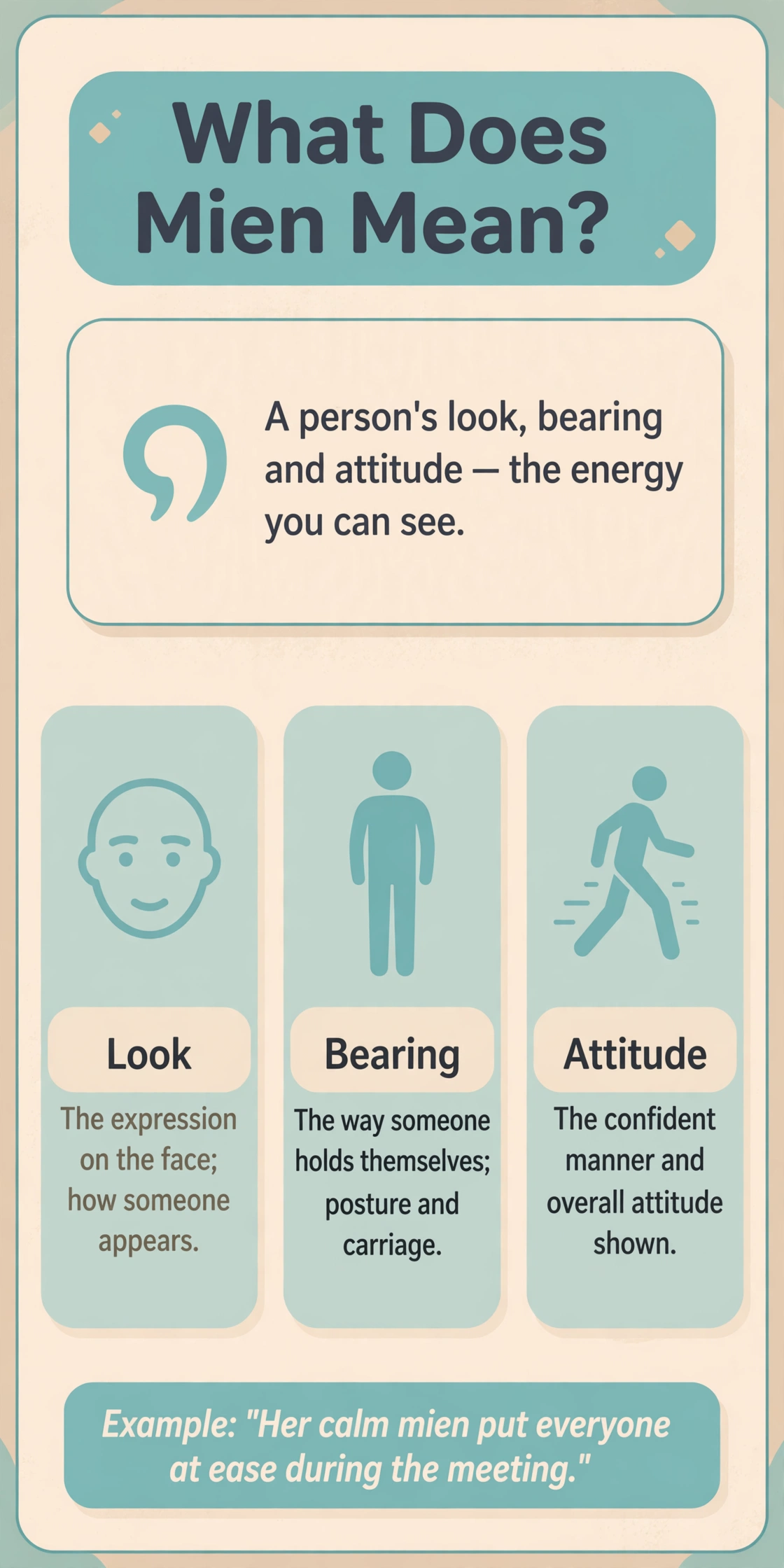
Quick definition: In slang, mien definition slang refers to a person’s vibe, look, or attitude — the energy someone gives off through their appearance, facial expression, and body language. Borrowed from the old literary word “mien” (meaning demeanor or bearing), the slang version is used on TikTok, Discord, and in group chats to describe someone’s whole aura in a single word.
Mien Definition Slang Meaning & Definition
The mien definition slang meaning is simple once you break it down: it describes the way a person carries themselves — their look, their mood, and the attitude their face and posture communicate without a single word being spoken. If someone walks into a room with a calm, confident stride and a relaxed smile, you could say they have a warm mien. If they storm in with crossed arms and a cold stare, that is a very different mien altogether.
Traditionally, “mien” is a literary noun that has been part of English since the 1500s. Dictionaries define it as a person’s appearance or manner, especially the expression on their face. The slang use keeps that core idea but makes it casual, punchy, and internet-friendly. Instead of writing a whole sentence about someone’s energy, Gen Z and TikTok users just say “mien” — and everyone in the conversation understands exactly what is meant.
Here is the key difference between the dictionary word and the slang word. In formal writing, mien is a serious, almost poetic term. In slang, it is playful and flexible. It can be a compliment (“her mien is so elegant”), a joke (“bro walked in with villain mien”), or a quick way to call out someone’s mood (“fix your mien, you look stressed”). The word works because it packs a whole observation — face, posture, attitude, energy — into four letters.
It also helps to know that “mien” is pronounced exactly like “mean” (meen). That shared sound is part of why the word confuses people at first, and why it shows up in so many “commonly confused words” lists. But the meanings could not be more different: “mean” describes unkindness or an average, while “mien” describes how someone looks and carries themselves.
Introduction
Have you ever seen a comment that says “the mien on this guy” and wondered what on earth it meant? You are not alone. The mien definition slang trend has been quietly spreading across TikTok captions, Discord servers, Instagram comments, and group chats, leaving plenty of people confused. It looks like a typo. It sounds like “mean.” And yet, once you know what it means, you start seeing it everywhere.
That is exactly why this guide exists. Slang moves fast, and words like mien jump from old literature into internet culture without warning. One day it is a word your English teacher used; the next day it is all over your For You page. The good news is that mien is one of the easiest slang terms to learn — it is just a fancier, shorter way of talking about someone’s vibe.
In this article, you will learn the full mien definition slang meaning, where the word came from, why it suddenly became popular online, and how to use it correctly in texts, captions, and everyday conversation. You will also find real examples for friendly, professional, and funny situations, a comparison table with similar words like vibe, aura, and demeanor, the most common mistakes people make, and quick tips so you never misuse it. If you have ever been puzzled by another three-letter abbreviation, our guide to FN meaning in text breaks down a similar internet mystery in the same simple way.
Origin
The word “mien” has a much longer history than most slang terms. It entered English in the early 1500s as a shortened form of “demean,” which at the time meant “to conduct oneself.” Its roots run through Middle English and Old French, and it has always been connected to the idea of how a person presents themselves to the world. For centuries, it lived mostly in novels, poetry, and formal writing — the kind of word you would find in a classic novel describing a character’s “proud mien” or “thoughtful mien.”
So how did a 500-year-old literary word become internet slang? The shift happened the way most slang shifts happen now: through social media. TikTok creators, meme pages, and Discord communities started using “mien” as a stylish shorthand for someone’s energy or aura. Part of the appeal was the sound — it rhymes with “mean,” which made it perfect for wordplay and jokes. Part of it was the vibe of the word itself: saying “mien” sounds more cultured and clever than saying “vibe,” and that irony is exactly what internet humor loves.
There is also a second, playful thread in the slang origin story. Because “mien” sounds like “mine,” some creators began using it as a joking stand-in for possession or relatability — “that mien” as a way of saying “that is so me” or “that is my mood.” This usage is less common than the demeanor meaning, but it shows how flexible the word has become online. Like many slang terms, it picked up extra shades of meaning as different communities adopted it for their own jokes.
The important thing to remember is that the slang meaning never really left the original meaning behind. Whether someone uses it in a 16th-century poem or a 2026 TikTok comment, mien is still about the same thing: the look on a person’s face and the way they carry themselves.
Popularity
Mien is not the biggest slang word on the internet, but its popularity has been climbing steadily — and that is precisely what makes it interesting. Unlike viral slang that explodes for a week and vanishes, mien has grown slowly and stuck around. It shows up in TikTok captions about outfits, red-carpet looks, and celebrity entrances. It appears in Discord servers when someone posts a photo and friends comment on their energy. It pops up in Instagram comments under fashion and aesthetic posts, where a single word can say more than a paragraph.
Part of its rise comes from the “aura” and “vibe” era of internet culture. For years, people described someone’s energy with words like “vibe,” “aura,” and “energy.” Those words are now so overused that they have lost some of their punch. Mien feels fresh by comparison — it says the same thing, but with a literary twist that makes the speaker sound clever. That is a powerful combination on platforms where sounding original matters.
The word also benefits from its confusion factor. People search for the mien definition slang meaning precisely because the word looks unfamiliar, and every search, video, and explainer pushes it further into the mainstream. Slang dictionary sites and TikTok explainer accounts have both covered it, and the word keeps appearing in “slang you should know” lists. It has not reached the saturation of words like “slay” or “rizz,” which means it still feels like an insider term — and that insider feeling is exactly what keeps people using it.
How It Is Used
Using “mien” in slang is straightforward once you know the pattern. It is almost always a noun, and it usually appears with a possessive or descriptive word in front of it: “her mien,” “his mien,” “that mien,” “the mien.” You can also pair it with adjectives to sharpen the description — “calm mien,” “cold mien,” “royal mien,” “villain mien,” “main-character mien.” The adjective does the heavy lifting, and “mien” packages the whole observation into one word.
Here are the most common ways people use it online and in conversation:
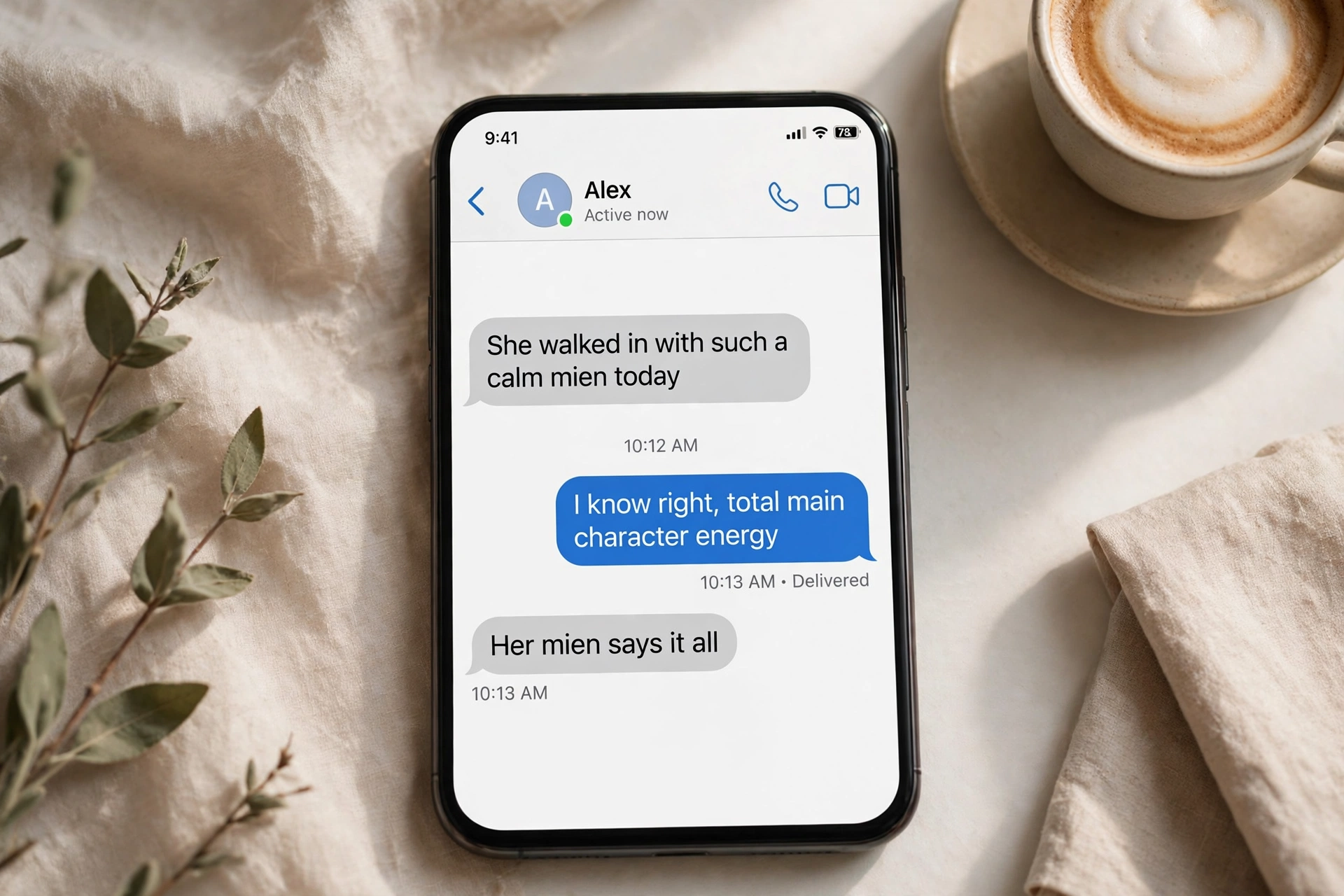
- Describing someone’s entrance or presence: “He walked in with CEO mien and the whole room went quiet.”
- Commenting on a photo or video: “The mien in this pic is unmatched.”
- Calling out a mood: “Your mien says you are done with today.”
- As a compliment: “She has such a soft, warm mien — everyone feels comfortable around her.”
- As a joke or roast: “Bro really showed up with villain mien just to ask for the Wi-Fi password.”
- In captions: “POV: your mien does all the talking.”
The tone matters a lot. “Mien” can sound elegant or mocking depending on context, and that flexibility is part of its charm. In a sincere compliment, it feels thoughtful and observant. In a joke, the slightly old-fashioned sound of the word is what makes it funny — it is the contrast between a fancy literary term and a casual chat that gets the laugh.
You will rarely see “mien” used as a verb or an adjective, and you should not force it into those roles. People do not say “he miens confident” or “that was so mien.” Keep it as a noun, keep it short, and let the adjective or the context around it set the tone. That is how native users of the slang actually write it.
Examples
Examples are the fastest way to lock in a new slang word, so here are real-world uses of “mien” across different tones and settings. Notice how the meaning stays the same — look, bearing, energy — while the feeling changes completely with context.
Friendly Examples
- “You walked into the party with such a happy mien — everyone noticed.”
- “I love her mien in photos. She always looks so relaxed and confident.”
- “His mien totally changed when he saw his friends. Instant smile.”
- “That calm mien of yours is exactly why people come to you for advice.”
- “Your mien today is giving main character energy, not gonna lie.”
Professional Examples
- “The speaker’s composed mien put the whole audience at ease before she said a word.”
- “A manager’s mien sets the tone for the team — calm leaders build calm teams.”
- “During the interview, keep a confident mien: steady eye contact, relaxed shoulders, easy smile.”
- “Her professional mien made a strong first impression on the clients.”
In professional settings, the classic dictionary meaning and the slang meaning overlap almost completely. That is actually useful: “mien” is one of the rare slang words that also works in a formal email or a job interview, as long as you use it correctly. For more internet words that cross over into real life, check out our breakdown of slime slang, another term that started online and spread far beyond it.
Funny Examples
- “Bro walked in with villain mien just to steal the last slice of pizza.”
- “My mien when the Wi-Fi dies during the final boss fight.”
- “She gave the teacher a sweet mien and then immediately failed the quiz.”
- “POV: you practice your mysterious mien in the mirror before a first date.”
- “His mien said ‘I woke up like this’ but his hair said otherwise.”
Comparison with Similar Terms
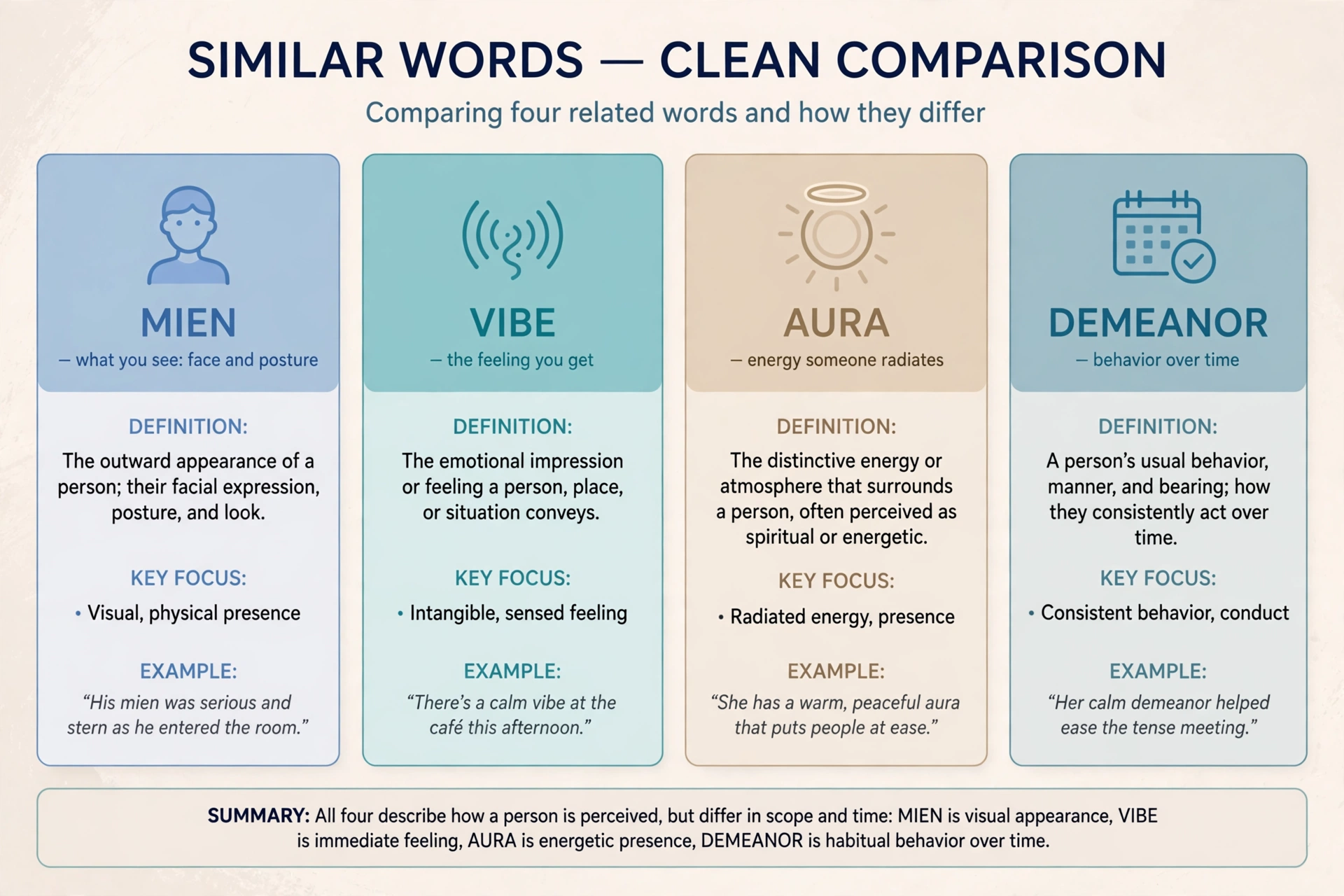
Mien is often confused with vibe, aura, demeanor, and bearing — and honestly, the words are cousins. But each one carries a slightly different shade of meaning, and choosing the right one makes your sentence sharper. Here is how they stack up:
| Term | What It Describes | Tone | Example |
|---|---|---|---|
| Mien | Outward look, facial expression, and bearing — what people see | Literary, clever, slightly fancy | “Her confident mien won the room over.” |
| Vibe | The general feeling or atmosphere around a person or place | Casual, very common online | “This cafe has such a chill vibe.” |
| Aura | An invisible energy or atmosphere a person radiates | Spiritual, dramatic, TikTok-popular | “His aura is unreal in this photo.” |
| Demeanor | Outward behavior and attitude, especially over time | Formal, professional | “Her calm demeanor reassured the team.” |
| Bearing | Physical posture and the way someone carries their body | Formal, military or classic | “He walked with the bearing of a soldier.” |
| Energy | The overall feeling someone brings into a room | Casual, broad, everyday | “She brings such good energy everywhere.” |
The simplest way to remember the difference: vibe is the feeling you get, aura is the energy someone radiates, and mien is what you actually see — the face, the posture, the look. If you can point at it in a photo, “mien” probably fits. If it is more of a feeling in the air, “vibe” or “aura” might be the better word.
Alternate Meanings
Most of the time, “mien” means one thing: a person’s look or bearing. But like many old words that found a second life online, it has picked up a few alternate shades of meaning that are worth knowing.
1. “Mine” wordplay. Because “mien” is pronounced like “mean” and spelled close to “mine,” some creators use it as a playful stand-in for possession — “that mien” meaning “that is so me” or “that belongs to my vibe.” This usage is niche and mostly appears in memes and joke captions, but it explains why you sometimes see “mien” in contexts where the demeanor meaning does not quite fit.
2. A mood or attitude. In some group chats, “mien” gets stretched to mean a whole mood: “I am in such a tired mien today.” Grammar purists would say this is a stretch, but slang is defined by use, not by rules. If you see it used this way, the speaker almost always means “mood” or “headspace.”
3. A style or aesthetic. In fashion and aesthetic communities, “mien” sometimes describes a whole look — the outfit, the hair, the attitude, all together. “Her mien today is full vintage” means more than her expression; it means the entire presentation.
4. The Mien people. Outside of slang entirely, “Mien” is also the name of an ethnic group (the Yao people of Southeast Asia and southern China) and their language. This has nothing to do with the slang term, but it is good to know so you do not confuse the two in a search. The slang word is always lowercase and always about a person’s look or bearing.
Professional or Polite Alternatives
“Mien” is fun, but it is not always the right word for every situation. If you are writing a work email, a school essay, or talking to someone who might not know the slang, these alternatives say the same thing more plainly:
- Demeanor — the safest formal swap: “a calm demeanor.”
- Appearance — neutral and clear: “her appearance was warm and welcoming.”
- Bearing — classic and dignified: “a confident bearing.”
- Presence — great for professional settings: “she has a strong presence in meetings.”
- Expression — when you mean the face specifically: “his expression gave him away.”
- Attitude — when you mean the mood behind the look: “a positive attitude.”
- Composure — when calmness is the point: “she kept her composure under pressure.”
Here is a quick rule of thumb: use “mien” with friends, in captions, and in casual writing where a little style is welcome. Use “demeanor” or “presence” in resumes, formal emails, and professional documents. And if you are ever unsure whether your reader knows the word, add a little context — “her mien, that calm confident look she always has” — so nobody is left guessing.
Common Mistakes
Because “mien” looks and sounds like other words, people make a handful of predictable mistakes with it. Here are the ones to avoid:
- Confusing it with “mean.” This is the number one error. “Mean” describes unkindness or an average; “mien” describes a look or bearing. “He has a mean mien” is actually a correct sentence — it means he has an unkind look — but “his mien is so mean” in the sense of “unkind” would be better written as “he is so mean.”
- Using it as a verb or adjective. “Mien” is a noun. Do not write “he miens confident” or “that was so mien.” The correct forms are “his mien is confident” or “he has a confident mien.”
- Overusing it. Because the word feels fresh, new users sometimes drop it into every sentence. Like any strong spice, it works best in small doses. One “mien” per caption or conversation is usually enough.
- Using it for things, not people. A person has a mien. A room, a song, or a meal does not. For places and things, “vibe” or “aesthetic” is the right word.
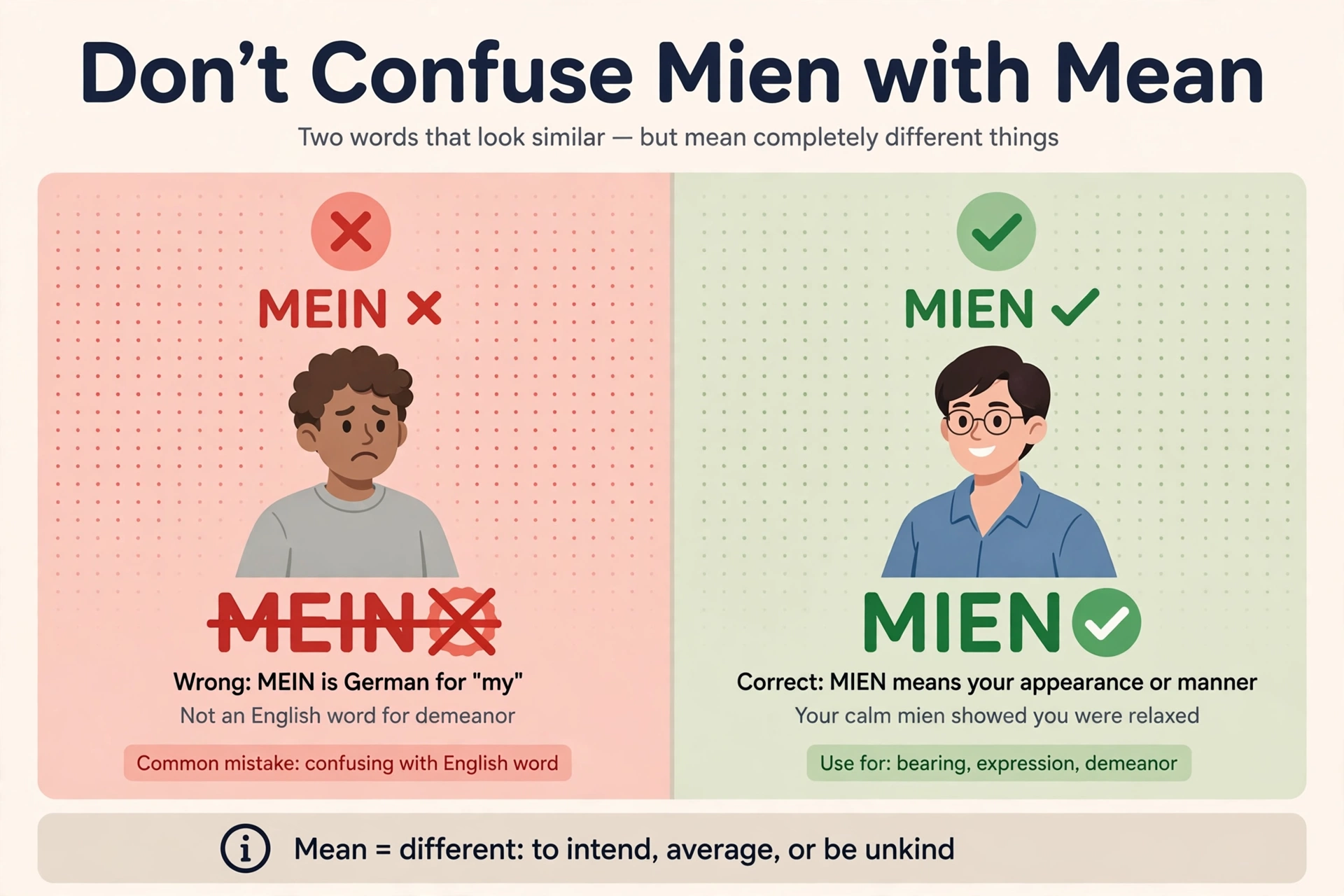
- Spelling it “mein” or “miene.” The correct spelling is M-I-E-N. “Mein” is a German word, and “miene” is a misspelling that will confuse spellcheckers and readers alike.
- Forcing the “mine” joke. The “mien = mine” wordplay only works when the audience already knows the joke. In a serious conversation, it will just look like a typo.
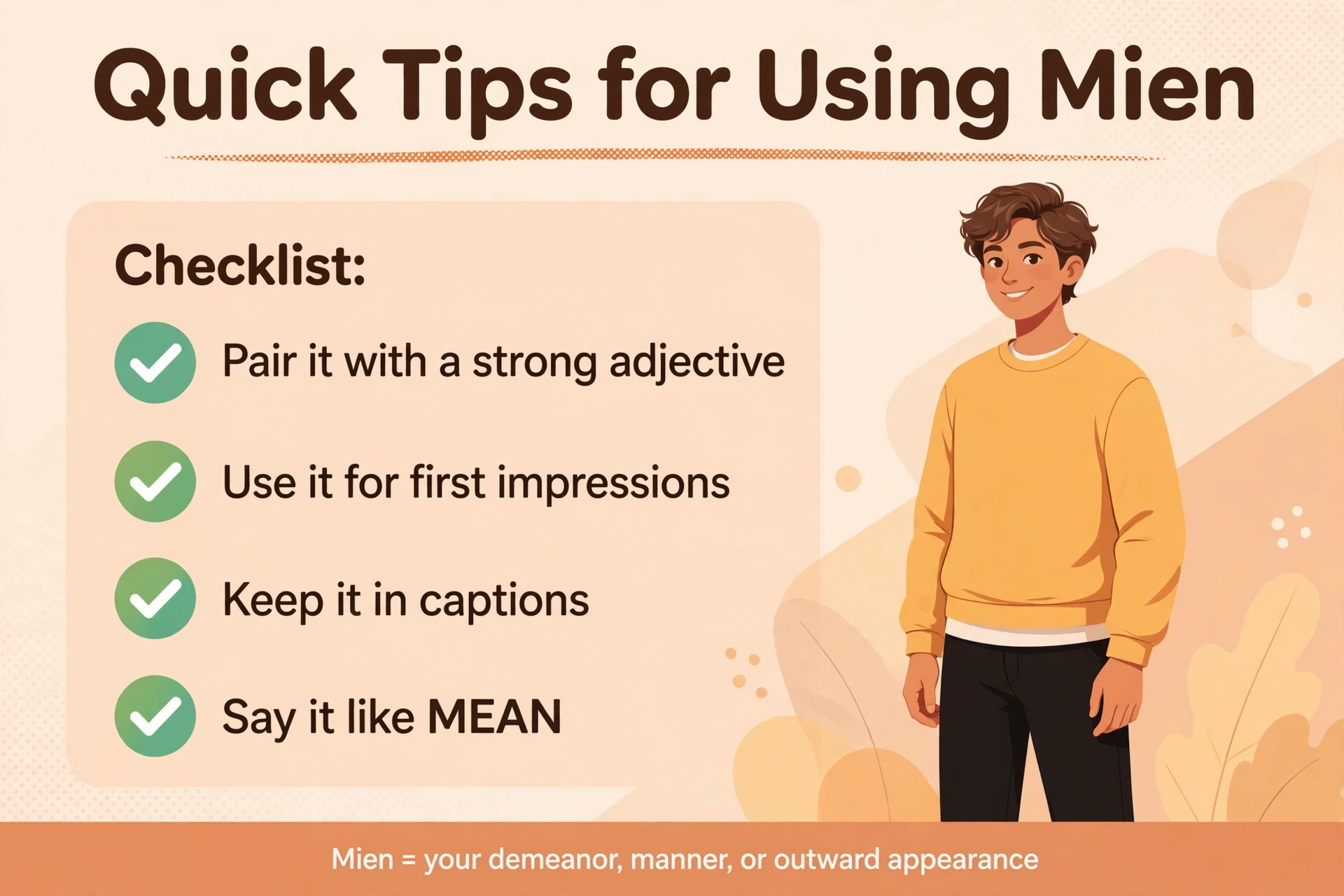
Quick Tips
- Pair it with a strong adjective: the adjective sets the tone — “calm mien,” “royal mien,” “villain mien,” “soft mien.” The word alone is vague; the adjective makes it vivid.
- Use it for first impressions: mien shines when you describe the moment someone enters a room, appears in a photo, or meets someone new.
- Keep it in captions: short-form content is where this word performs best. “The mien. That’s it. That’s the post.” is a perfectly good caption.
- Match your audience: friends and TikTok will love it; a formal report probably will not. Read the room before you use it.
- Learn the pronunciation: it is “meen,” exactly like “mean.” Saying it wrong is the fastest way to lose the clever effect.
- Try it as a compliment: telling someone “you have such a warm mien” is a more thoughtful compliment than “you look nice” — and people remember thoughtful compliments.
- Do not explain the joke: if you use “mien” in a caption, let it stand on its own. Explaining slang kills the effect.
FAQ
What is the mien definition slang meaning?
In slang, “mien” means a person’s vibe, look, or attitude — the energy they give off through their facial expression, posture, and bearing. It comes from the literary word “mien,” which has meant a person’s appearance or manner since the 1500s. Online, it is used in TikTok captions, Discord chats, and Instagram comments to describe someone’s whole presence in a single word.
How do you pronounce “mien”?
“Mien” is pronounced exactly like “mean” — “meen.” It rhymes with bean, seen, and green. The shared pronunciation is a big reason people confuse it with “mean,” but the two words have completely different meanings.
Is “mien” a real word or just internet slang?
Both. “Mien” is a real, centuries-old English word that appears in dictionaries like Merriam-Webster, where it is defined as a person’s air, bearing, or demeanor. The slang use is newer: internet culture took the old word and made it casual, using it to talk about someone’s vibe or energy in chats and captions.
What does “mien” mean on TikTok?
On TikTok, “mien” usually appears in captions and comments about someone’s look or energy — “the mien on her in this video” or “POV: your mien does all the talking.” It is a stylish way to say someone’s whole vibe is on point, and it is often used for outfit videos, entrances, and aesthetic edits.
What is the difference between mien and vibe?
“Vibe” is the general feeling or atmosphere around a person or place, while “mien” is specifically about what you can see — the face, posture, and bearing. You can photograph a mien; a vibe is more of a feeling. In practice, they overlap a lot, but “mien” sounds more literary and precise, while “vibe” is more casual and broad.
Can you use “mien” in formal writing?
Yes — “mien” is actually one of the few slang-adjacent words that also works in formal writing, because it is a genuine dictionary word. “Her composed mien reassured the audience” would be perfectly fine in an essay or a professional email. Just be sure you are using it as a noun meaning look or bearing, not as the internet joke version.
What are some synonyms for “mien”?
Common synonyms include demeanor, bearing, appearance, presence, air, manner, expression, and attitude. For the slang sense specifically, “vibe,” “aura,” and “energy” are the closest everyday equivalents, though each one carries a slightly different shade of meaning.
Why do people say “mien” instead of just “vibe”?
Mostly for style. “Vibe” and “aura” are so overused online that they have lost some of their impact. “Mien” says something similar but sounds fresher, cleverer, and a little more literary — which is exactly the kind of word that stands out in a comment section. It also packs a specific meaning (the visible look and bearing) that “vibe” does not quite capture.
Conclusion
The mien definition slang meaning is simple, but the word itself is a great example of how internet culture works: it took a 500-year-old literary term, gave it a fresh job describing someone’s vibe, and turned it into a word you now see in TikTok captions and group chats. At its core, mien is about what people see when they look at you — your expression, your posture, your bearing, your energy — all packed into four letters.
Now you know how to pronounce it (like “mean”), how to use it (as a noun, with a good adjective), where it fits (captions, chats, compliments, jokes), and where it does not (as a verb, for objects, or in every single sentence). Try it once in a caption or a text and see how it lands — chances are, someone will ask you what it means, and now you will have the answer.
If this guide helped you decode one confusing slang word, you will probably enjoy our other explainers too. Our guide to CFS meaning in text covers another abbreviation that confuses everyone at first, and the GOAT slang breakdown explains one of the most-used slang terms on the internet today. Keep exploring, keep asking what words mean, and your internet vocabulary will keep growing — one mien at a time.
