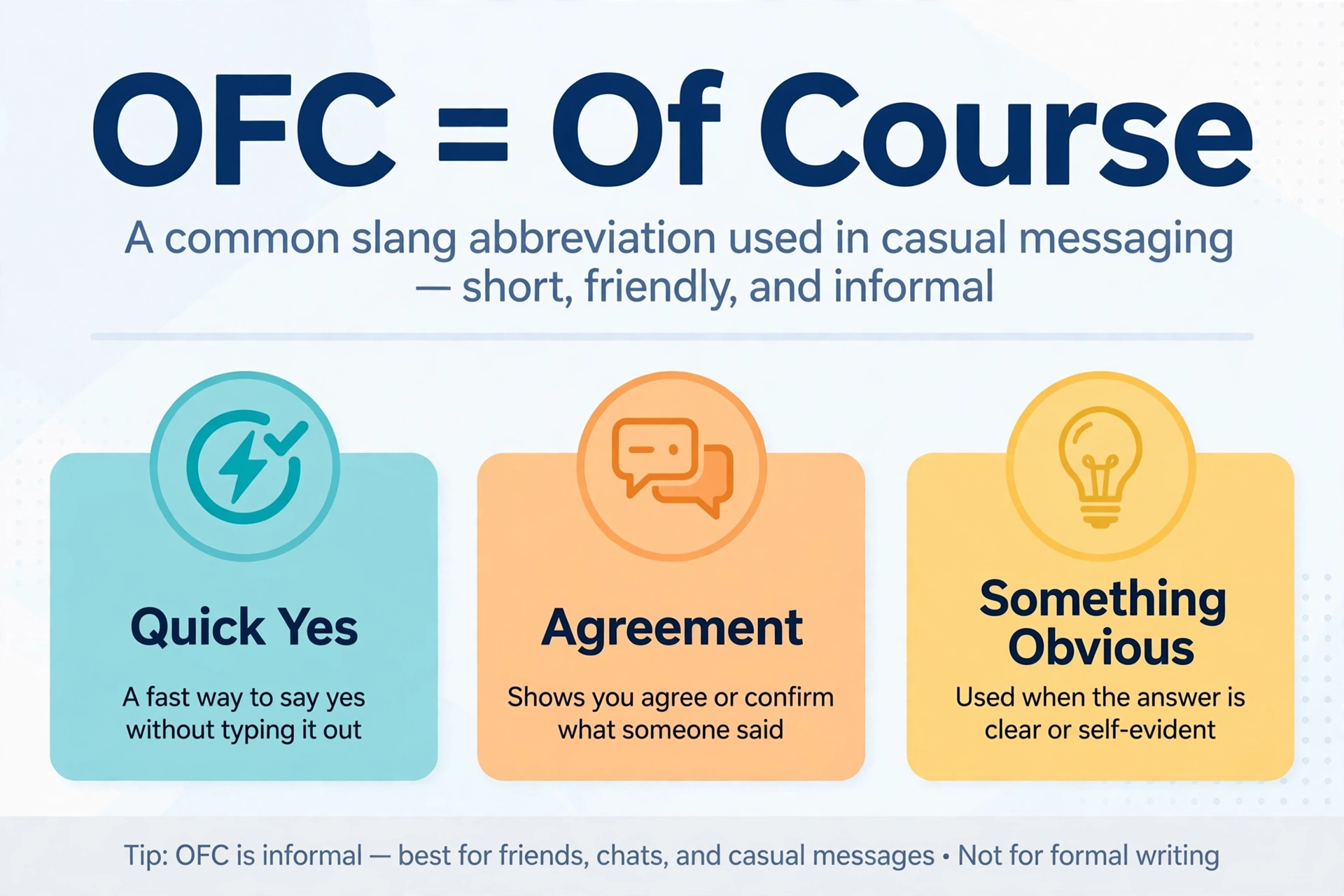
Quick Definition: OFC slang means “of course” in texting and on social media. It is a quick, casual way to say yes, to agree, or to point out that something is obvious. In fanfiction communities, OFC has a second meaning: “original female character.” Context tells you which one is meant.
OFC Slang Meaning & Definition
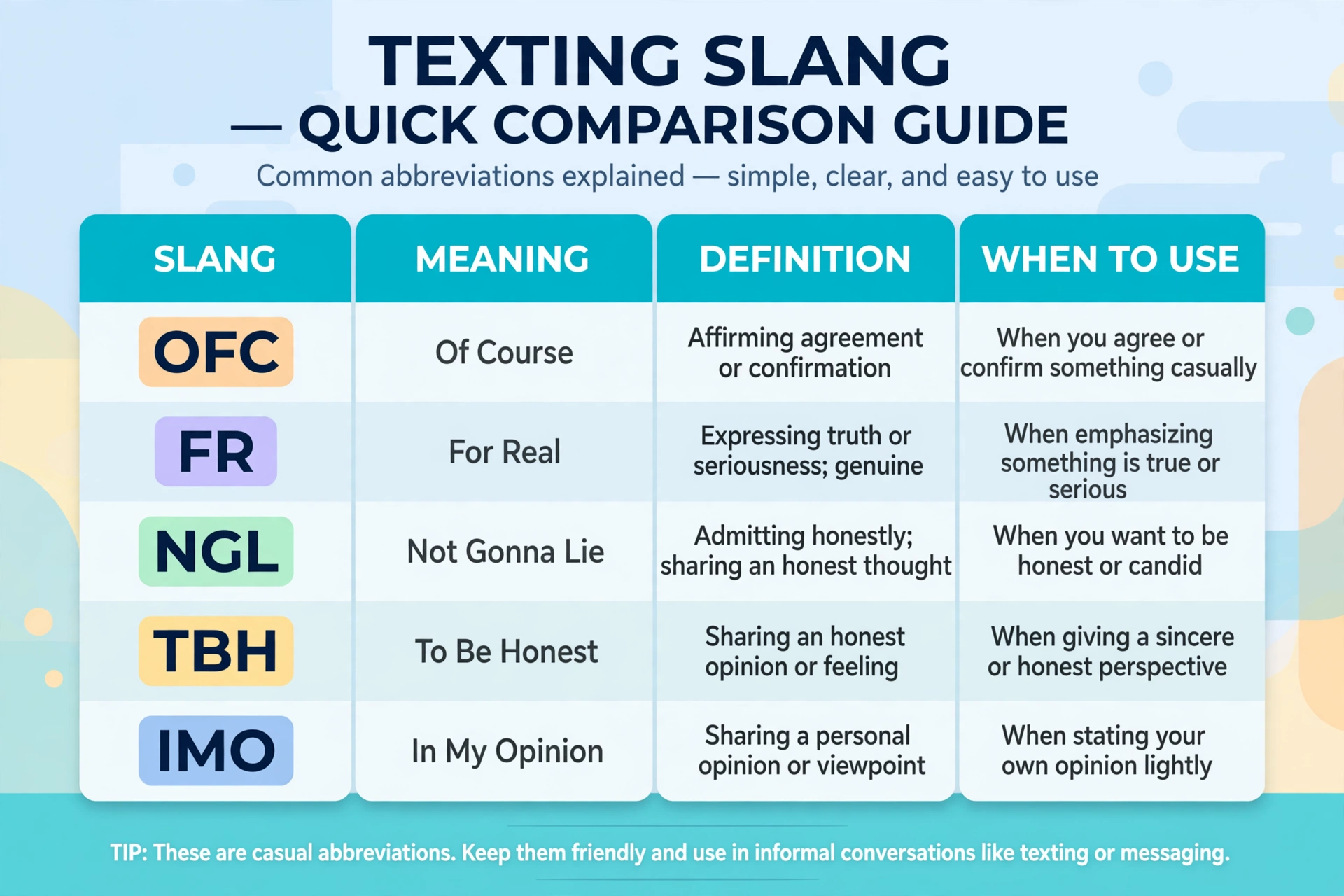
OFC slang is short for “of course.” People use it in texts, DMs, group chats, TikTok comments, and Instagram replies when they want to confirm something fast. Instead of typing out the full phrase, three letters do the whole job. If a friend asks, “Are you coming to the party tonight?” and you reply “ofc,” you have said yes, you are definitely coming, and honestly, the question barely needed asking.
That last part matters. OFC does more than mean “of course” — it carries a tone. It can sound warm and easy, like “of course, happy to help!” It can also sound a little sassy, like “of course, why would you even ask?” The exact feeling depends on where OFC sits in the sentence, who you are talking to, and whether you add an exclamation mark or a period. A friendly “ofc!!” and a flat “ofc.” are two very different messages, even though the letters are identical.
OFC is one of the oldest pieces of internet shorthand still in daily use. The first Urban Dictionary definition for “ofc” appeared in June 2004, defining it simply as “used in instant messaging to represent of course.” More than twenty years later, it is still everywhere — because it solves a real problem. In fast-moving chats, typing “of course” feels slow. OFC keeps the conversation flowing, and it works in almost every casual setting, from a one-word reply to a full sentence like “ofc I’ll send you the notes.”
Introduction
Every generation has its shortcuts. Before smartphones, people wrote “ASAP” and “FYI” in notes and memos. Texting turned that habit into a whole language, and OFC became one of its most useful words. It is short, it is clear, and almost everyone online already knows what it means. You will see it in a best friend’s reply, in a TikTok comment section, in a Discord server, and in a coworker’s casual Slack message.
What makes OFC slang interesting is how much meaning three letters can carry. On the surface, it is a simple yes. Underneath, it can mean “obviously,” “no problem,” “definitely,” “you should have known,” or even “duh.” The same reply can be sweet or sarcastic depending on the moment. Learning to read that difference is the difference between understanding a message and misreading it completely.
This guide covers everything about OFC slang: the exact meaning, where it came from, how popular it really is, how to use it in friendly, professional, and funny situations, what it means on TikTok and Snapchat, how it compares with similar terms like NGL and FN, the second meaning it has in fanfiction, the mistakes people make with it, and quick tips for using it the right way. By the end, you will never have to guess what “ofc” means again.
Origin
OFC started as plain typing efficiency. In the early 2000s, instant messaging ruled online conversation — AIM, MSN Messenger, and early texting on phones with physical keypads. Every keystroke cost effort, and “of course” was a phrase people typed constantly. Shortening it to “ofc” was the obvious move, and it caught on fast. The earliest Urban Dictionary entry from June 2004 shows the abbreviation was already common enough to need a definition by then.
The word “of course” itself is much older, of course. It comes from the idea of something following the natural course of events — something so expected that it needs no explanation. That history explains why OFC feels so natural as a reply: it does not just say yes, it says “yes, as expected.” When your friend asks whether you want pizza, “ofc” means the answer was never really in doubt.
As texting moved from keypads to smartphones and social media, OFC moved with it. It survived every platform shift — from MSN to Facebook chat, from Twitter to TikTok — because it is genuinely useful. New slang appears every month, but abbreviations that save real effort tend to stick around. OFC is in the same club as LOL, OMG, and BTW: old, simple, and still going strong.
There is also a long-running debate about the middle letter. Some people insist OFC secretly stands for a ruder version of “of course” with a swear word in the middle — “of f***ing course.” Language references such as Wiktionary’s entry for “ofc” note that this reading exists but is uncommon, and that the standard meaning remains simply “of course.” In practice, the swear-word reading only applies when the tone is emphatic and the people chatting already swear freely with each other. In a calm conversation, or with people who do not usually swear, OFC just means “of course.” If you are unsure which one someone means, the safe bet is always the polite version.
Popularity
OFC is one of the most widely recognised slang abbreviations in English-language texting. Unlike trend-driven slang that explodes on TikTok and disappears in a month, OFC has stayed relevant for over two decades. It shows up across every age group that texts regularly, though it is most common among teenagers, young adults, and anyone who grew up with instant messaging.
Several things keep OFC popular. First, it is platform-neutral: it works in a text, a Snapchat, a TikTok comment, an Instagram DM, a Discord message, and a WhatsApp group with equal ease. Second, it is tone-flexible. The same three letters can be warm, funny, confident, or sarcastic, which makes it useful in far more situations than a plain “yes.” Third, it is short. In group chats where ten messages arrive in a minute, “ofc” answers a question without slowing anything down.
On TikTok, OFC appears in captions, comments, and even spoken in videos. A creator might caption a video “ofc he said yes” or reply to a comment with a simple “ofc!!” On Snapchat, it is a staple of quick streak replies. On Instagram, it shows up when someone agrees with a story poll or accepts an invitation in DMs. The meaning stays the same everywhere — only the platform changes.
Compared with newer slang, OFC has unusual staying power. Words like “slay” or “rizz” feel tied to a moment in time, but OFC feels timeless because it is really just an abbreviation of an ordinary phrase. As long as people say “of course,” they will keep shortening it to OFC.
| Platform | How OFC Is Used | Typical Tone |
|---|---|---|
| Texting / iMessage | Quick yes to plans, questions, and favours | Friendly, casual |
| TikTok | Comments, captions, and video replies | Funny, confident |
| Snapchat | Fast streak replies and casual DMs | Relaxed, playful |
| DM replies, story reactions, comments | Warm, supportive | |
| Discord / Gaming | Agreeing with teammates mid-game | Quick, direct |
| Group chat confirmations and family chats | Easy, everyday |
How It Is Used
The most common use of OFC is as a standalone reply. Someone asks a question, and “ofc” is the whole answer. “Are you free Friday?” — “ofc.” “Can you send me the link?” — “ofc!” This works because the question already contains all the context. The reply just confirms it.
OFC also works at the start of a sentence, where it usually sounds positive and definite. “Ofc I’m coming to your birthday.” “Ofc I’ll help you move.” Here it adds confidence — the speaker is not just agreeing, they are saying the agreement was never in doubt. This is the warmest position for OFC, and it is the safest way to use it with people you do not know well.
At the end of a sentence, OFC changes character. “Yeah, I saw the trailer, ofc.” “He was late again, ofc.” In this position it usually means “obviously” or “as expected,” and it often carries a sarcastic or slightly annoyed edge. It can be funny among friends, but it can also sound dismissive if the other person does not expect it. If you are not sure how it will land, put OFC at the start of your sentence instead.
OFC can also stand alone as a reaction to good news or an obvious statement. A friend texts, “I got the job!” and you reply “ofc you did!!” — meaning “I knew you would.” Or someone states something everyone already knows, and “ofc” is the polite version of “duh.” In each case, the word does the same job: it confirms something that felt certain.
- To agree: “Want to grab lunch?” — “ofc, what time?”
- To confirm a plan: “We’re still on for Saturday, right?” — “ofc!”
- To grant permission: “Can I borrow your charger?” — “ofc, take it.”
- To show confidence: “Ofc I’ll finish it before the deadline.”
- To be sarcastic: “Ofc the Wi-Fi died right before my exam.”
- To reassure: “Are you mad at me?” — “Ofc not, don’t worry.”
Examples
OFC looks different in every kind of conversation. The examples below show how the same three letters change meaning with tone, timing, and relationship. Notice how punctuation does most of the work — “ofc!” is excited, “ofc.” is flat, and “ofc…” is almost always sarcastic.
Friendly Examples
Between friends, OFC is warm and effortless. It is the digital version of a smile and a nod.
- Friend: “Are you coming to my place tonight?”
You: “ofc!! Wouldn’t miss it.” - Friend: “Thanks for helping me study.”
You: “ofc, anytime!” - Friend: “Can I call you later?”
You: “ofc, call whenever.” - Friend: “Did you like the movie?”
You: “ofc, it was amazing!” - Friend: “Will you be my plus-one?”
You: “ofc! Who else would it be?”
In these examples, OFC does more than answer. It tells the other person that the friendship is solid and the answer was easy. That is why it works so well as a reply to invitations, thank-yous, and small favours — it makes the other person feel welcome instead of like a burden.
Professional Examples
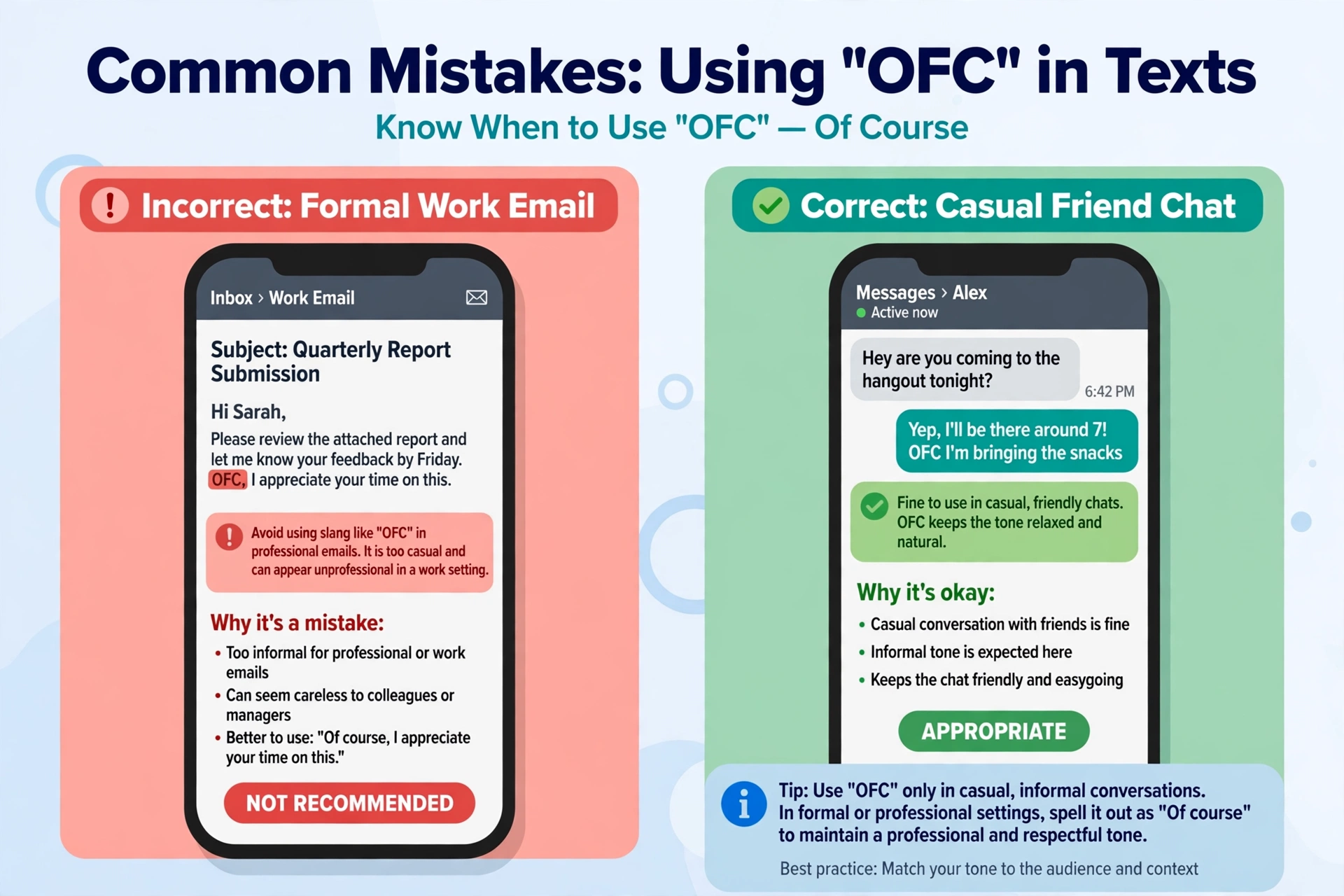
OFC is informal, so it has limits at work. With close coworkers you text regularly, a quick “ofc” is fine. With a manager, a client, or anyone in a formal email, spell out “of course” instead. The rule is simple: if you would say “of course” out loud in that conversation, “ofc” is probably fine in the chat version of it.
- Coworker (close): “Can you send me the slides?”
You: “ofc, sending them now.” - Teammate: “Are you joining the call?”
You: “ofc, I’ll be there in 2 minutes.” - Work friend: “Lunch today?”
You: “ofc! Same place?”
Notice the pattern: short, helpful, and followed by an action. “Ofc, sending them now” is a good professional reply because it confirms and acts in one breath. A bare “ofc” to a boss about a deadline, on the other hand, can read as careless. In work chats, always pair OFC with what you are actually going to do.
Funny Examples
OFC is at its funniest when the answer is so obvious that the question itself is the joke. This is the sarcastic side of the word, and it works best between people who already know each other well.
- Friend: “Did you eat the last slice of pizza?”
You: “ofc I did. It was calling my name.” - Friend: “Are you watching the new episode tonight?”
You: “ofc, I cleared my whole schedule.” - Friend: “Guess who forgot their umbrella again?”
You: “ofc it was you. It’s raining and you’re soaked.” - You: “Ofc the bus left right when I got to the stop. Classic Monday.”
- Friend: “Is water wet?”
You: “ofc. Next question.”
The humour comes from exaggeration. “Ofc” says the answer was obvious, and the rest of the sentence plays along with the joke. Used this way, it is closer to “obviously” or “duh” than to a plain yes — and that is exactly why your friends will laugh.
Comparison with Similar Terms
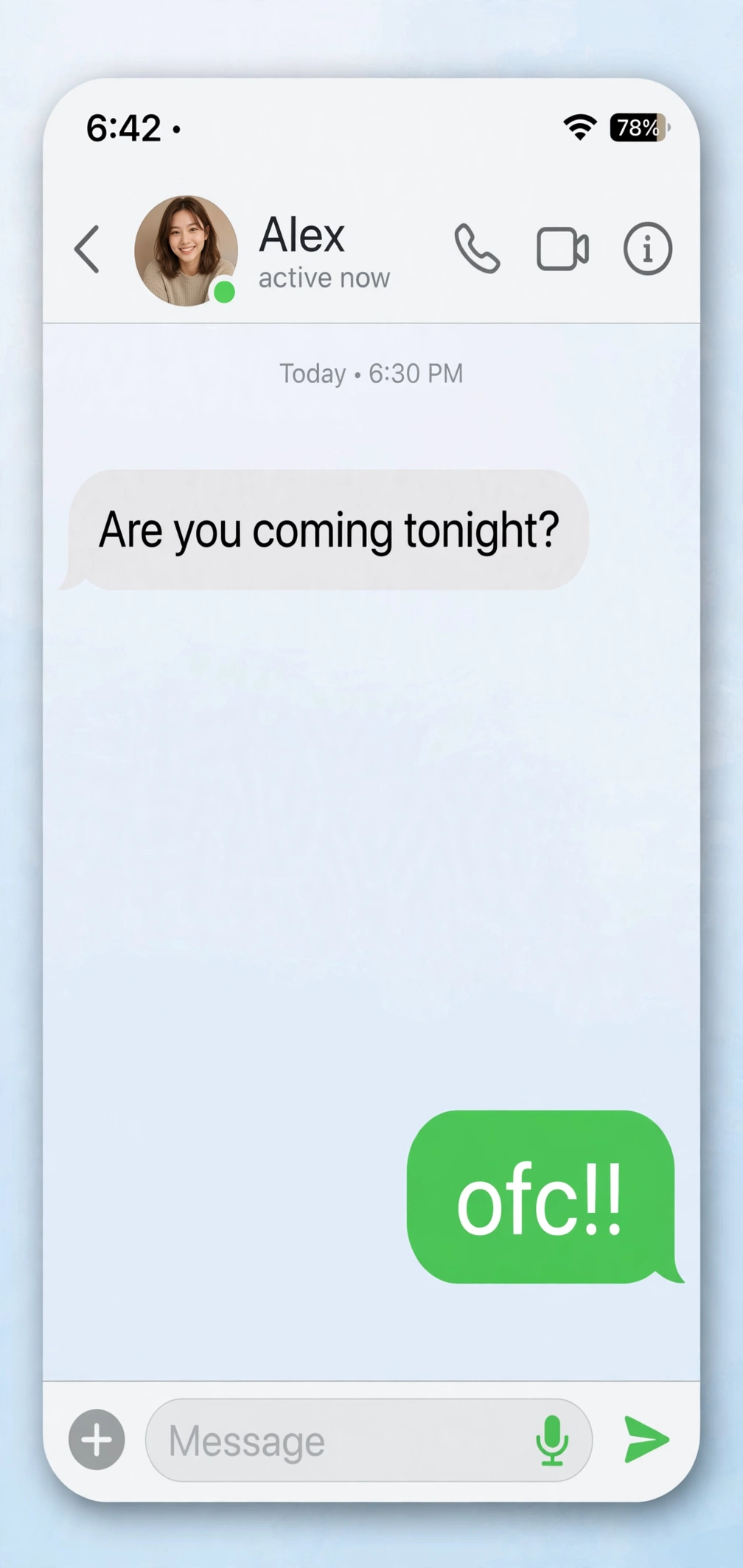
OFC is part of a big family of short agreement words in texting slang. They look similar, but each one carries a slightly different feeling. Mixing them up is rarely a disaster, but choosing the right one makes your messages sound natural instead of slightly off. The table below shows how OFC compares with its closest cousins, including IMK and TYSM, two other abbreviations you will meet constantly in the same chats.
| Term | Full Form | Meaning | When to Use It |
|---|---|---|---|
| OFC | Of course | Yes, obviously, definitely | Agreeing or confirming something expected |
| FR | For real | Seriously, I agree strongly | Reacting to surprising or relatable news |
| NGL | Not gonna lie | Honestly, to be truthful | Before an honest or unpopular opinion |
| TBH | To be honest | Honestly speaking | Sharing a sincere thought or confession |
| IMO | In my opinion | This is what I think | Softening an opinion before sharing it |
| IKR | I know, right? | I completely agree with you | Agreeing with something relatable |
| YEP / YEAH | Yes | Simple agreement | Any casual yes, with no extra attitude |
| DUH | — | Obviously, that was clear | Playful sarcasm between close friends |
The key difference is confidence. “Yeah” is neutral. “IKR” agrees with the other person’s feeling. “FR” agrees with emphasis. OFC is unique because it agrees and adds certainty — it says the answer was expected all along. That is why “ofc” works so well as a reply to invitations and favours: it makes the other person feel like asking was the easiest thing in the world.
OFC also pairs naturally with other abbreviations. “Ofc, tysm!” combines a yes with a thank-you. “Ngl, ofc I’m going” mixes honesty with confidence. Once you know the family, combining them feels automatic — and that is how fluent texting actually works.
Alternate Meanings
Most of the time, OFC means “of course.” But it is not the only meaning, and the second one causes real confusion if you do not know it exists. The table below covers every common meaning so you can tell them apart at a glance.
| Meaning | Where You See It | How to Tell |
|---|---|---|
| Of course | Texts, DMs, comments, TikTok | Reply to a question or invitation |
| Original female character | Fanfiction, Wattpad, Archive of Our Own, fandom TikTok | Talk of stories, canon, OCs, fics |
| Of f***ing course | Emphatic chats between close friends | Strong tone, swearing is normal in that chat |
| Officer | Military and police writing | Ranks, reports, formal documents |
| Oceania Football Confederation | Sports news | Football, tournaments, Pacific teams |
| Oxygen-free copper | Electronics and audio gear | Cables, wiring, product specs |
| Orbitofrontal cortex | Neuroscience and psychology | Brain research, academic papers |
The fanfiction meaning deserves a closer look. In fanfiction, an OFC is an original female character — a new character invented by the author who does not exist in the original book, show, or movie. The male version is an OMC (original male character), and the general term is OC (original character). A writer might say, “I’m writing a Star Wars fanfic with an OFC who is a Jedi smuggler,” and in that sentence OFC has nothing to do with “of course.” This is the most common source of confusion online: if the conversation is about stories, characters, or fandom, OFC almost certainly means the fanfiction definition.
The other technical meanings — officer, Oceania Football Confederation, oxygen-free copper, orbitofrontal cortex — only appear in their own specialist contexts. If you see OFC in a news story about football or a product listing for audio cables, it is not slang at all. Context is everything, and in everyday chatting, “of course” is the right reading about 99 percent of the time.
Professional or Polite Alternatives
OFC is casual by nature. It is perfect for friends, but there are plenty of situations where the full phrase — or a different phrase entirely — works better. Use this list when you want to sound warm and confident without sounding too informal.
- “Of course” — the full phrase. Safe everywhere, from a text to a job interview.
- “Absolutely” — stronger and more enthusiastic. Great for agreeing to a favour or a plan.
- “Certainly” — polite and professional. Ideal for emails, clients, and formal replies.
- “Definitely” — confident and casual. Works with friends and coworkers alike.
- “Happy to help” — warm and generous. Perfect when someone thanks you.
- “No problem” — relaxed and friendly. The classic reply to a thank-you.
- “You got it” — casual and upbeat. Great for agreeing to a small favour.
- “Sure thing” — easy and natural. Works in almost any informal situation.
- “I’d love to” — warm and willing. Best for invitations and offers.
- “My pleasure” — polite and gracious. Ideal for customer service and formal thanks.
The golden rule is simple: match your words to your audience. Text your best friend “ofc!!” all day long. Email your manager “Certainly, I’ll have that ready by Friday.” Both messages say the same thing — but each one says it in the language its reader expects.
Common Mistakes
OFC is simple, but people still get it wrong — usually by using it in the wrong place, with the wrong tone, or with the wrong person. These are the mistakes to avoid.
1. Using OFC in formal messages. A job application, a message to a professor, or an email to a client is not the place for “ofc.” It reads as careless and too casual. Spell out “of course” or use “certainly” instead. One recruiter or teacher remembering your slang-filled email is a bad trade for three saved keystrokes.
2. Using OFC with people who do not know slang. Your grandmother, a much older relative, or someone who rarely texts may have no idea what OFC means. With them, write the full phrase. Clear communication beats cool communication every time.
3. Dropping a bare “ofc” after a serious question. If someone asks something emotional — “Are you okay?” or “Do you still want to be friends?” — a one-word “ofc” can feel cold and dismissive. Match the weight of the question with a fuller reply: “Of course, I’m here for you.”
4. Putting OFC at the end when you mean to be warm. Remember, OFC at the end of a sentence often sounds sarcastic. “Yeah, I’ll do it, ofc” can read as annoyed. If you mean it warmly, put OFC first: “Ofc I’ll do it!” Position changes everything.
5. Confusing the fanfiction meaning. Replying “ofc” to a fanfiction writer who is talking about their original female character will not make sense to them — and posting about your “OFC” in a fandom space when you mean “of course” can confuse readers too. Check the context before you type.
6. Overusing it. OFC is satisfying to type, and it is easy to fall into answering everything with it. Ten “ofc” replies in a row make you sound bored or uninterested, even when you are not. Mix it up with “yeah,” “sure,” “absolutely,” or a full sentence to keep your messages feeling alive.
7. Forgetting the swear-word reading. In some friend groups, OFC carries the stronger “of f***ing course” meaning. That is fine among close friends who swear together — but it is a problem if a parent, teacher, or boss sees it and reads it that way. When in doubt, use the full phrase.
Quick Tips
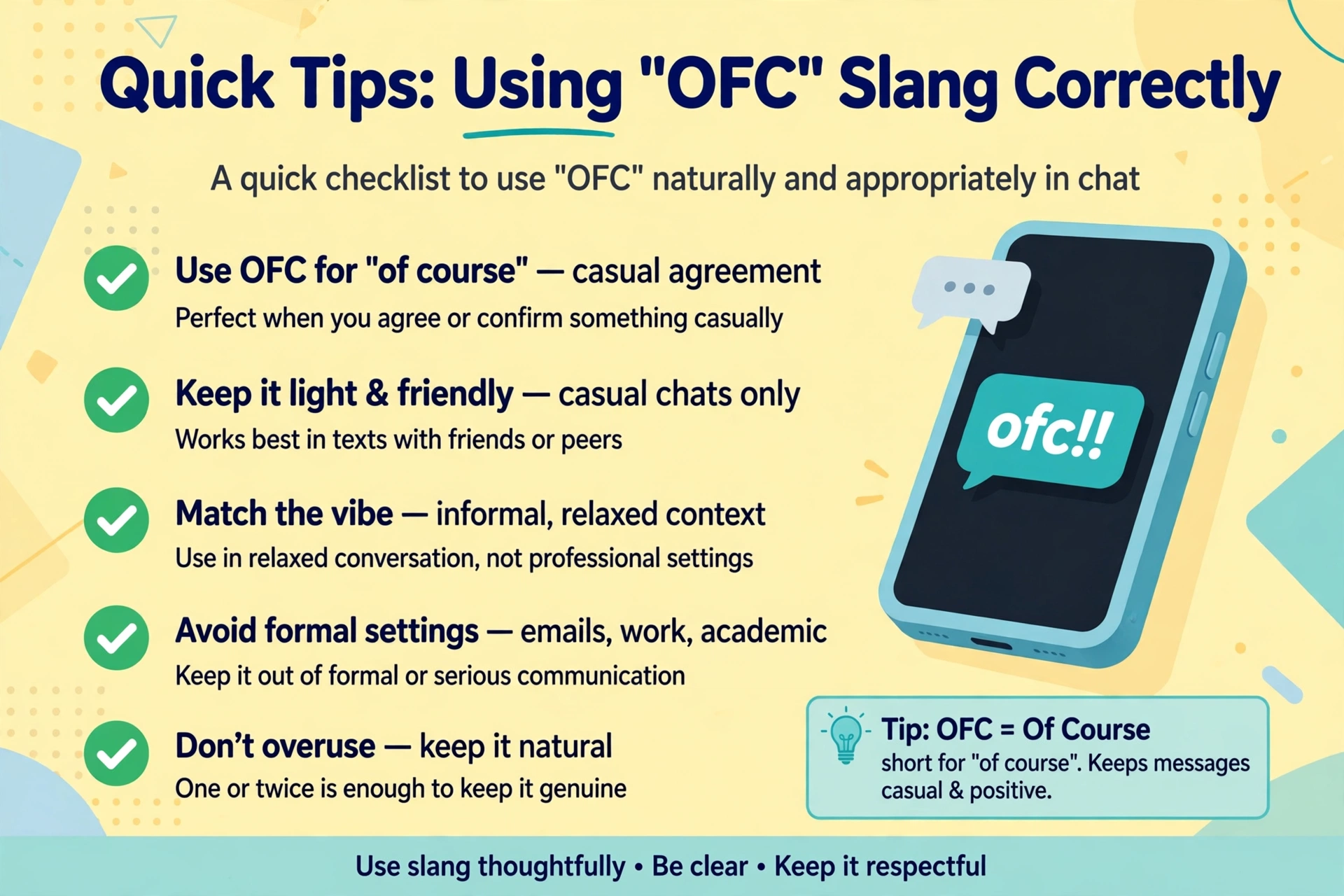
Want to use OFC like a native? These quick tips cover the essentials.
- Default to friendly: start your sentence with OFC and add an exclamation mark — “Ofc!!” is almost always read as warm.
- Match the energy: if the other person writes casually, OFC fits right in; if they write formally, write the full phrase.
- Pair it with action: “ofc, sending it now” is better than a bare “ofc” because it shows you are already helping.
- Use it for obvious answers: OFC shines when the answer was never really in doubt — invitations, favours, and easy yeses.
- Keep it lowercase in chats: “ofc” is the standard casual form; “OFC” in all caps reads louder and more emphatic.
- Skip it in serious moments: big questions and emotional conversations deserve full sentences, not abbreviations.
- Remember the fanfic meaning: in fandom spaces, OFC means “original female character” — read the room before you reply.
- Do not force it: if “of course” feels more natural in a message, just write it out. Nobody will judge you for using real words.
FAQ
What does OFC mean in texting?
In texting, OFC means “of course.” It is a quick way to say yes, to agree, or to confirm something that feels obvious. For example, if someone asks “Are you coming tonight?” and you reply “ofc,” you are saying yes, definitely. It is casual, friendly, and one of the most common abbreviations in everyday chats.
What does OFC mean on TikTok?
On TikTok, OFC also means “of course.” You will see it in video captions like “ofc he said yes,” in comments agreeing with a creator, and in replies between users. In fandom TikTok, it can also mean “original female character” when the video is about fanfiction or original characters — the context of the video tells you which meaning applies.
What does OFC mean on Snapchat?
On Snapchat, OFC means “of course,” just like everywhere else. It is mostly used as a fast reply to snaps and chats — agreeing to plans, accepting an invitation, or confirming something quickly. Because Snapchat conversations move fast, short replies like “ofc” are especially common there.
Is OFC rude?
OFC is not usually rude, but it can sound rude depending on tone and position. At the start of a sentence with an exclamation mark — “Ofc!!” — it sounds warm and happy. At the end of a sentence — “Yeah, ofc.” — it can sound sarcastic or dismissive, like “obviously.” It is also best avoided in formal settings, where it can come across as too casual or careless.
What is the difference between OFC and OC?
In fanfiction, OC means “original character” of any gender, while OFC means “original female character” specifically. In everyday texting, OFC means “of course” and OC is rarely used. So the difference depends on context: in a story or fandom discussion, OFC is a character type; in a normal chat, it is just a quick way to say “of course.”
Does OFC mean “of f***ing course”?
Sometimes, but not usually. Some people use OFC as a stronger, swear-word version of “of course” when the tone is emphatic and the people chatting already swear with each other. Language references note this reading exists but is uncommon. In most conversations — especially calm or polite ones — OFC simply means “of course,” and that is the safe interpretation.
When should I not use OFC?
Avoid OFC in formal emails, job applications, messages to teachers or managers, and conversations with people who may not know texting slang. Also skip it in serious or emotional conversations, where a full sentence shows more care. In those situations, write “of course,” “certainly,” or “absolutely” instead.
Is OFC the same as “obviously”?
They overlap, but they are not identical. “Obviously” points out that something should have been clear, and it often sounds a little smug. OFC usually just confirms something warmly — “of course I’ll help.” When OFC sits at the end of a sentence, though, it can take on the same “obviously” feeling: “He was late, ofc.” Use “of course” when you want to be kind, and save the obvious-feeling version for jokes with close friends.
Conclusion
OFC slang is small, but it does a lot of work. In three letters, it says yes, it says definitely, and it says the answer was obvious all along. It has survived more than twenty years of internet change — from AIM and MSN Messenger to TikTok and Snapchat — because it solves a real problem: how to agree quickly without slowing the conversation down.
The key to using OFC well is reading the room. With friends, it is warm, funny, and effortless — the perfect reply to an invitation or a favour. At work or in formal messages, the full phrase “of course” does the same job more gracefully. And in fandom spaces, remember the second meaning: an OFC might be an original female character, not an answer at all. Position matters too — OFC at the start of a sentence sounds confident and kind, while OFC at the end can sound sarcastic, so choose your spot with care.
Once you understand those few rules, OFC becomes one of the easiest words in your texting vocabulary. Use it for the easy yeses, pair it with a little action when you are helping someone, and save the full phrase for the moments that deserve it. And if you ever see “ofc” in a chat and wonder what it means, you already know: of course.
Want to keep building your texting vocabulary? Next, check out NGL meaning in text to learn the honest-opinion abbreviation that shows up in the same conversations, or read FN meaning in text for another everyday shortcut. The more of these you know, the faster every chat makes sense.
