Quick definition: In slang, GOAT stands for “Greatest Of All Time” — the highest compliment you can give someone in their field. When fans call an athlete, a musician, or even a friend “the GOAT,” they are saying nobody in history has ever done it better. In goat slang, the word is always praise: it crowns someone as the undisputed best, from Michael Jordan on the basketball court to Beyoncé on stage.
GOAT Slang Meaning & Definition
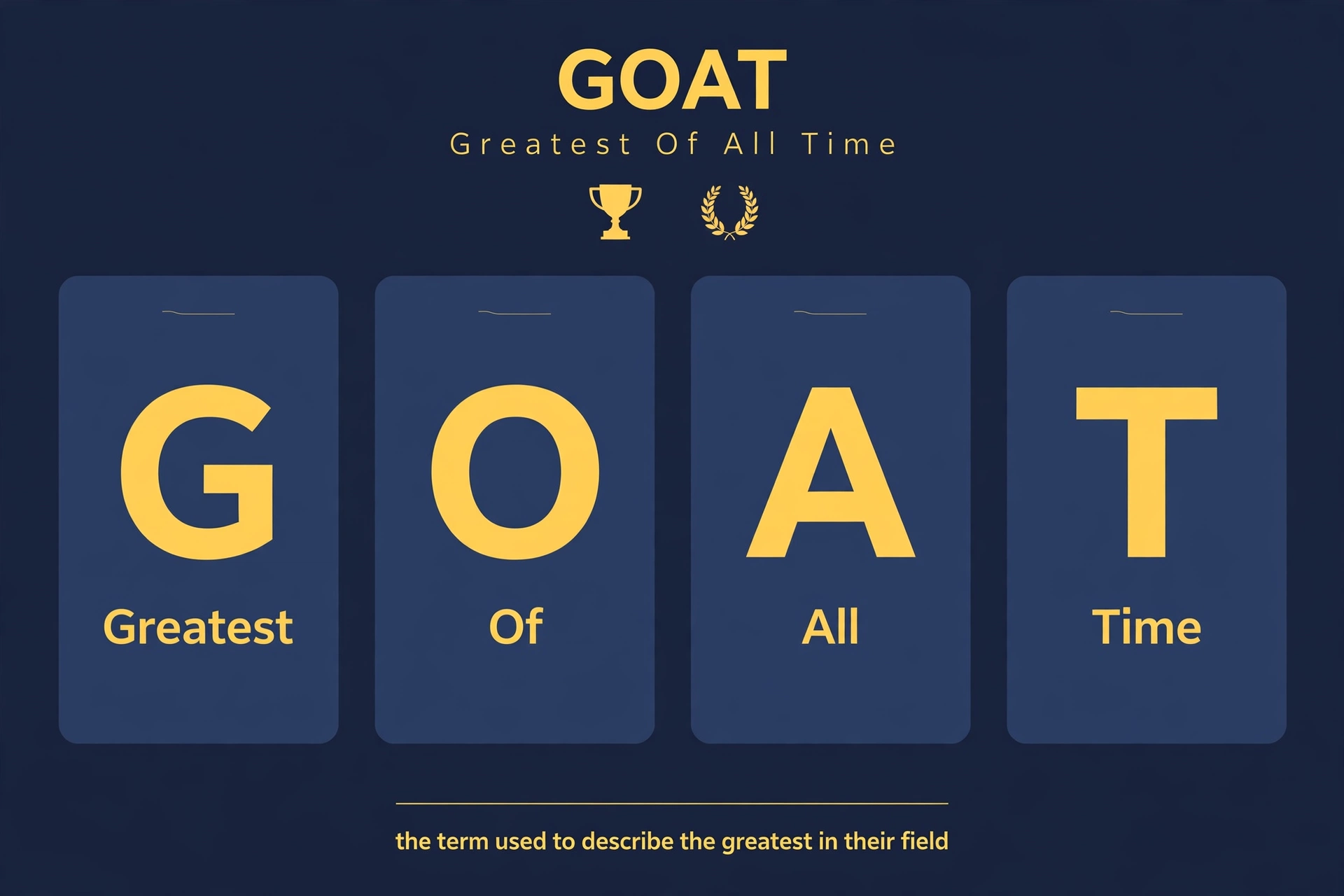
So, what does GOAT mean in slang? The short answer is that GOAT is an acronym for “Greatest Of All Time,” and people use it to describe someone who stands above every other person in a particular field — past, present, and probably future too. It is not just “great” or “the best right now.” Calling someone the GOAT means you believe no one has ever been better at what they do, and no one ever will be.
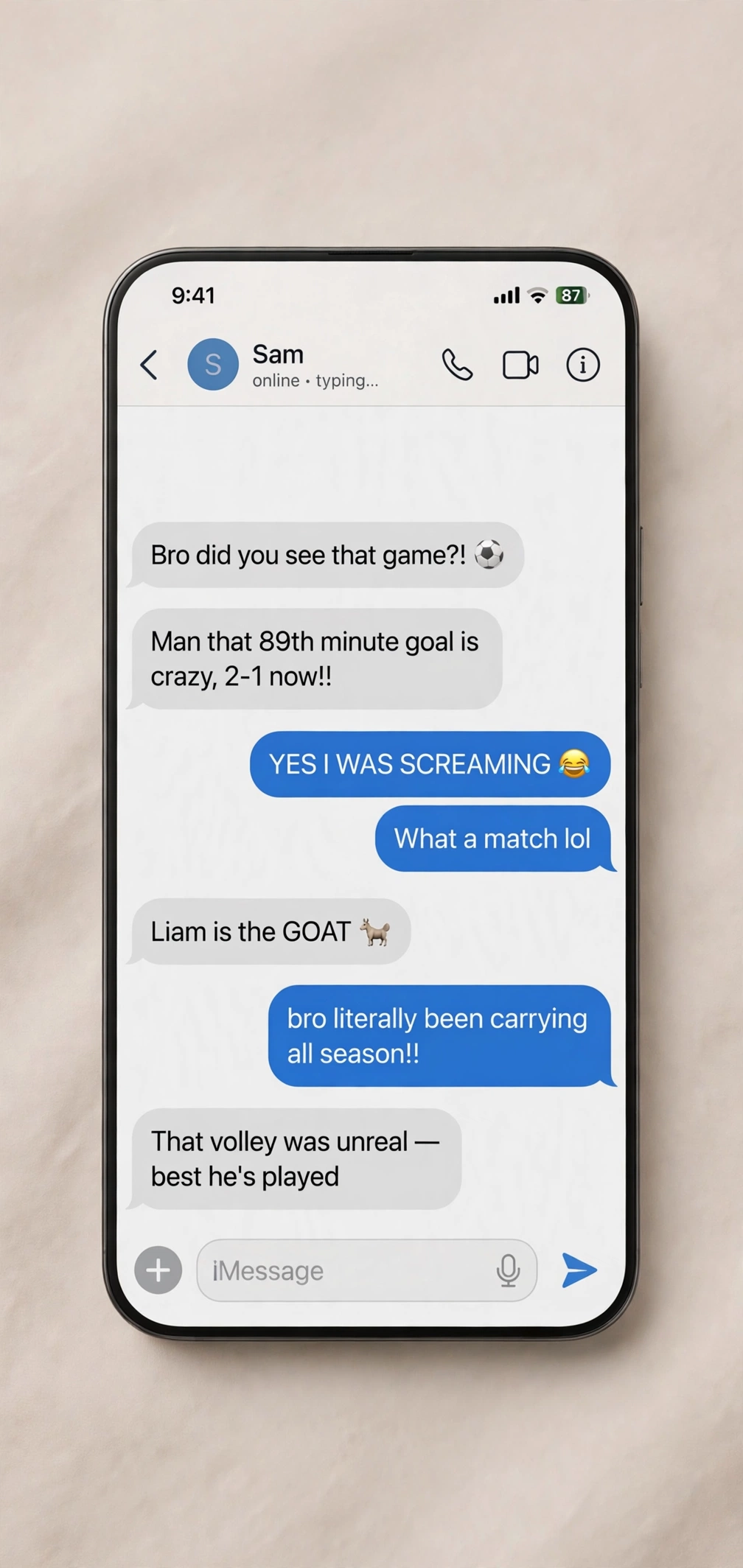
In everyday use, goat slang shows up in a few clear ways:
- The ultimate compliment: “Messi is the GOAT.” — the speaker believes Lionel Messi is the greatest footballer who ever lived, better than every player before him.
- A debate starter: “Jordan or LeBron — who is the GOAT?” — sports fans use the word to argue about who deserves the title.
- A casual exaggeration: “My grandma’s biryani is the GOAT, no debate.” — people stretch the word for fun, applying it to food, movies, or anything they love.
- An emoji shorthand: The goat emoji 🐐 on its own now means GOAT. A comment that is just “🐐🐐🐐” under a player’s highlight video is pure praise.
- Self-confidence: “I’m the GOAT at this game.” — players and rappers claim the title for themselves, usually with a grin.
The key thing to understand is that GOAT is a title, not a description of a single moment. A player can have a great game without being the GOAT. The word is reserved for a whole career, a whole body of work, or a legacy that towers over everyone else. That is what makes it such a powerful compliment — and such a heated argument.
Introduction
You have probably seen “GOAT” everywhere without ever stopping to think about it. It is in comment sections under every highlight reel, in group chats after every big game, on T-shirts, in rap lyrics, and in memes. A fan writes “🐐” under a photo of Serena Williams. A friend texts “that last goal was GOAT-level.” A streamer calls himself the GOAT after winning one match too many.
What makes GOAT interesting is that it went from a very specific sports argument to one of the most common words on the internet in less than twenty years. It started in boxing and hip-hop, spread through basketball and football debates, and then jumped to music, movies, gaming, and everyday life. Today, almost anything can be the GOAT — a footballer, a singer, a pizza place, or your mum’s cooking — and everyone instantly understands what you mean.
But the word also has a surprising twist: for most of the twentieth century, calling a sports player a “goat” was an insult, not a compliment. The journey from scapegoat to “Greatest Of All Time” is one of the strangest flips in slang history, and it explains a lot about how the word works today. In this guide, we break down every meaning of GOAT, where it came from, how to use it without sounding silly, and the mistakes that make people roll their eyes.
Origin
The story of GOAT starts with Muhammad Ali, the heavyweight boxer who spent his career calling himself “the greatest.” Ali first used the phrase “greatest of all time” in the 1960s and 1970s, and it became his trademark boast. He told reporters he wanted to be the greatest fighter of all time since he was a child, and he repeated the claim so often that it stuck to him permanently.
The acronym itself arrived a little later. In September 1992, Ali’s wife Lonnie incorporated a company called Greatest of All Time, Inc. — shortened to G.O.A.T. Inc. — to manage Ali’s business and creative rights. It was the first clear written use of “G.O.A.T.” as an acronym, and it tied the phrase directly to Ali’s legacy.
Hip-hop gave the acronym its wings. In 1993, the hip-hop group De La Soul rapped “Now I’ma take my baaad ass home ’cause I’m a goat” on their album Buhloone Mindstate. Then in 2000, LL Cool J released his eighth studio album, titled G.O.A.T. Featuring James T. Smith: The Greatest of All Time. The album debuted at No. 1 on the Billboard 200, and LL Cool J repeated “I’m the G.O.A.T.” throughout the record. He later explained that he combined Ali’s “Greatest Of All Time” with the nickname of Harlem streetball legend Earl “The Goat” Manigault — and the acronym escaped into everyday language from there.
The old insult meaning is worth knowing too. In American sports in the early 1900s, a “goat” was the player blamed for a team’s loss — a scapegoat. The word appeared in baseball dictionaries as a derisive term for the player who cost his team the game. That meaning has almost completely disappeared now, but it is a fun reminder that slang can flip its meaning entirely. Language experts have traced this strange reversal in detail, and the history of “G.O.A.T.” on Grammarphobia shows how the insult became the ultimate compliment.
By the 2010s, social media finished the job. Sports debates on Twitter, Instagram, and TikTok turned GOAT into a daily argument, and the goat emoji 🐐 became the word’s visual shorthand. By 2026, GOAT is no longer sports slang at all — it is general internet slang, understood by almost everyone under forty.
Popularity
GOAT is one of the rare slang words that never faded. Unlike TikTok terms that appear and vanish in a month, GOAT has been growing steadily for over twenty years, and its popularity now reaches far beyond sports:
- In sports: Every major sport has its own GOAT debate — Jordan vs. LeBron in basketball, Messi vs. Ronaldo in football, Brady vs. Montana in American football, Serena vs. Graf in tennis. These arguments never end, and they keep the word in daily use.
- In music: Fans call their favourite artists the GOAT after every album drop, award win, or viral performance. Rap fans in particular use the word constantly, since hip-hop helped create it.
- In gaming and streaming: Gamers call the best player in a lobby the GOAT, and streamers use it as a badge of honour. A single “🐐” in the chat after a clutch play says everything.
- On social media: The goat emoji 🐐 has become a complete sentence. Fans spam it under highlight videos, birthday posts, and retirement announcements. Brands use it in ads. It is one of the most recognisable emoji shorthands on the internet.
- In everyday life: People now call anything they love the GOAT — a restaurant, a movie, a teacher, a phone, a sandwich. The word has escaped its original meaning and become a general superlative.
Search data reflects this staying power. People search “goat slang” and “what does GOAT mean” because the word keeps appearing in new places — a comment section, a song lyric, a sports debate, a meme — and each new context makes someone curious about where it came from. GOAT’s popularity is not a spike; it is a plateau that has lasted for a generation.
How It Is Used
GOAT works as a noun, an adjective, and an emoji, and each form has its own flavour. Here is how it is used in real life:
As a noun (the title itself)
“Messi is the GOAT.” This is the classic use — naming someone as the greatest ever in their field. The word “the” matters: there can be many great players, but there is only one GOAT.
As an adjective (GOAT-level, GOAT status)
“That was a GOAT-level performance.” “She has GOAT status in the music industry.” Used this way, the word describes quality rather than crowning a person — it means the thing being described is at the highest possible level.
As a debate question
“Who’s the GOAT — Jordan or LeBron?” This is probably the most common use on the internet. The word turns a comparison into an argument about history, not just about who is better today.
As an emoji
A comment that says nothing but “🐐” is a complete statement of praise. Fans post rows of goat emojis under a player’s best moments, and the meaning is obvious to everyone reading.
As a self-claim
“I’m the GOAT at FIFA, nobody can touch me.” Claiming the title for yourself is common in gaming and rap, where confidence is part of the performance. It is usually playful — unless the person can actually back it up.
As a casual exaggeration
“This pizza is the GOAT.” Nobody literally believes a pizza is the greatest thing of all time. The word has become a fun, dramatic way to say “this is amazing,” and everyone understands the joke.
In business and pop culture
Brands, TV shows, and even award ceremonies use GOAT now. You will see “GOAT” on merchandise, in advertising slogans, and in headlines — proof that the word has fully crossed from slang into mainstream English.
Examples
The best way to learn goat slang is to see it in real sentences. Here are examples grouped by tone, so you can feel how the word changes with context.
Friendly Examples
- “Messi is the GOAT, and I will not be taking questions.”
- “My dad’s BBQ is the GOAT. Nobody else comes close.”
- “That goal was unreal — straight-up GOAT behaviour.”
- “Beyoncé is the GOAT. Her live shows prove it every single time.”
- “You’re the GOAT for helping me move, seriously, thank you.”
- “Just watched the highlights again. Jordan 🐐🐐🐐.”
Professional Examples
- “Many analysts consider Serena Williams the GOAT of women’s tennis.”
- “The CEO called her the GOAT of sales after she closed the biggest deal in company history.”
- “His GOAT-level performance in the final earned him a place in the history books.”
- “The debate over the GOAT of football continues to drive record engagement.”
- “She is widely regarded as the greatest chef of her generation.”
- “The film is often described as a GOAT contender in its genre.”
Funny Examples
- “My bed is the GOAT. Ten hours of sleep and I feel unstoppable.”
- “The Wi-Fi guy who fixed our router is the GOAT. Give that man a raise.”
- “Nobody: … Me at 2am: ‘Actually, Shrek 2 is the GOAT of animated movies.'”
- “He called himself the GOAT after winning one game of Uno. The confidence is unreal.”
- “My grandma’s biryani vs. everyone else’s — there is no debate. She’s the GOAT.”
- “That cat knocking things off the table? Chaos GOAT. Zero fear.”
Comparison with Similar Terms
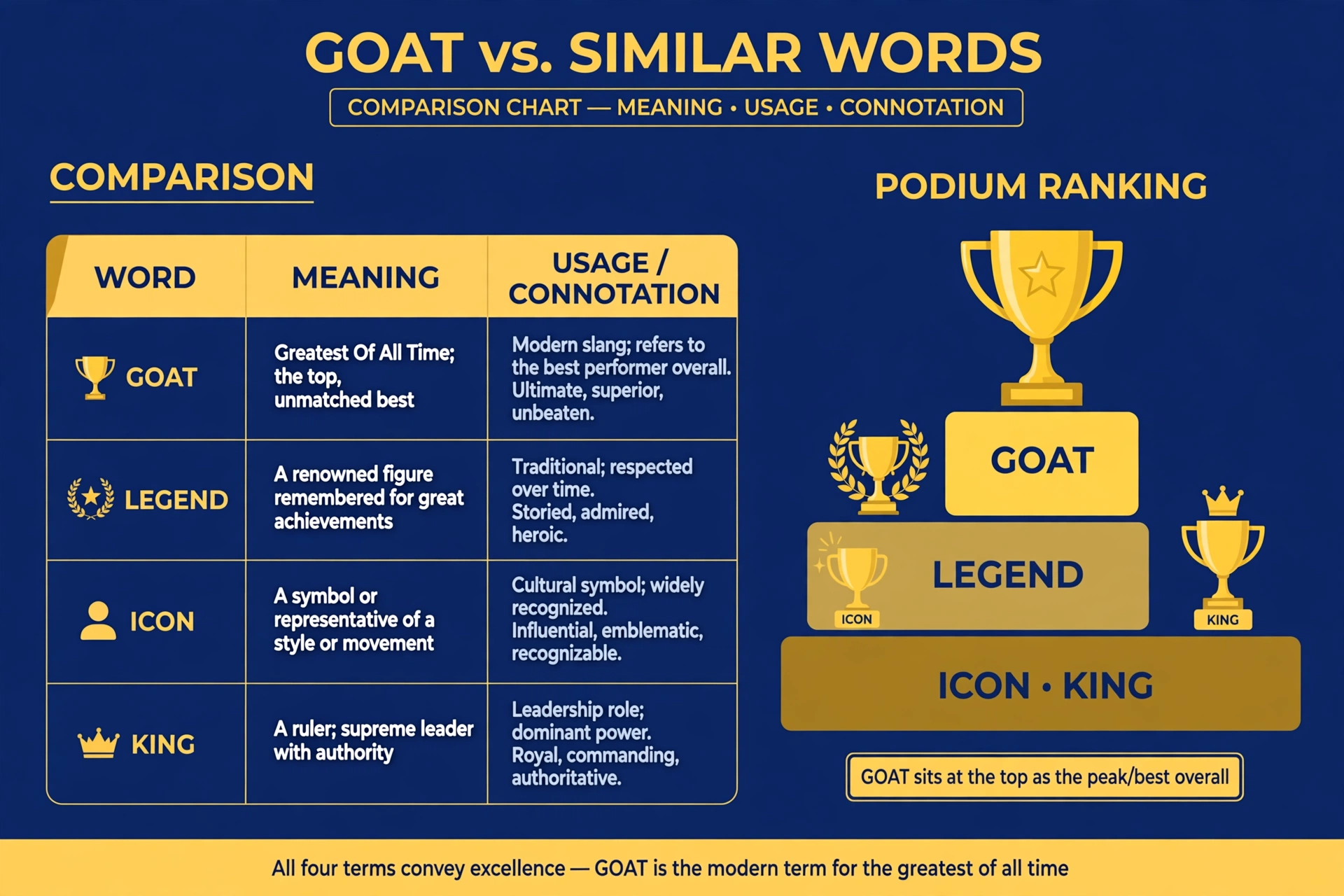
GOAT overlaps with several other slang words for greatness, but each one has its own flavour. This table makes the differences clear:
| Term | Meaning | How It Differs from “GOAT” | Example |
|---|---|---|---|
| GOAT | Greatest Of All Time — the best ever | The ultimate, all-time title | “Messi is the GOAT.” |
| Legend | A famous, iconic person | About fame and legacy, not necessarily No. 1 | “He’s a living legend.” |
| Icon | A cultural symbol or role model | About influence and image, not just skill | “She’s a fashion icon.” |
| King / Queen | The best right now, or the most dominant | About current reign, not all of history | “LeBron is the King.” |
| Best | Better than everyone else | Plain and general; GOAT adds the “of all time” weight | “She’s the best player on the team.” |
| Elite | Top-level, among the best | Describes a group; GOAT describes one person | “He’s an elite defender.” |
| Cracked | Extremely skilled (gaming slang) | About raw skill in the moment, not a career legacy | “He’s cracked at Fortnite.” |
| Aura | A person’s energy, presence, or vibe | About how someone feels, not how good they are | “His aura is unreal.” |
The closest cousins are “legend” and “icon,” but neither one makes the claim GOAT makes. A legend can be one of many; an icon can be famous without being the best. GOAT says there is one person at the top and everyone else is below them. That is why the word starts arguments: it leaves no room for ties. If you want to see how gaming slang handles skill differently, our guide to what “cracked” means in slang breaks it down, and our guide to what “aura” means in slang explains the vibe-based compliment that often shows up in the same conversations as GOAT.
Alternate Meanings
Beyond the slang use, “goat” has several other meanings that are worth knowing, because they sometimes appear in the same conversations:
- The animal: A goat is a farm animal — the literal meaning. The slang joke works partly because the acronym spells an ordinary animal’s name, which is why the goat emoji 🐐 became the perfect visual shorthand.
- A scapegoat: In old sports slang, a “goat” was the player blamed for losing a game. This is the opposite of the modern meaning, and it still appears in history books and old sports writing.
- To “get someone’s goat”: An old idiom meaning to annoy or irritate someone. “Don’t let him get your goat” means don’t let him bother you.
- A stubborn person: Calling someone “an old goat” is a teasing way to describe a stubborn or grumpy older man, though this use is old-fashioned now.
- In astrology: The goat is the symbol of Capricorn, the zodiac sign, and appears in the sign’s imagery.
- The G.O.A.T. brand: GOAT is also the name of a popular sneaker and streetwear marketplace, which took its name directly from the slang.
- “Goat” in other languages: The acronym has travelled worldwide, and in many countries fans use “GOAT” in English even when the rest of the conversation is in another language.
- The “GOAT debate” itself: People now say “the GOAT debate” to mean the endless argument about who is the greatest in a sport — the debate has become a cultural event of its own.
Because the word has two opposite histories — the scapegoat insult and the greatest-of-all-time compliment — the context always matters. In a modern group chat, GOAT is always praise. In a 1950s baseball book, a “goat” is the player who lost the game. The date of the writing tells you which meaning applies.
Professional or Polite Alternatives
Sometimes “GOAT” is too casual, too dramatic, or too internet-flavoured for the situation. Here are polished alternatives for each meaning:
| Instead of saying | Say this in formal settings |
|---|---|
| “She’s the GOAT of tennis.” | “She is widely regarded as the greatest tennis player of all time.” |
| “He’s the GOAT at sales.” | “He is our top-performing salesperson in company history.” |
| “That was a GOAT-level performance.” | “That was an exceptional, career-defining performance.” |
| “Who’s the GOAT?” | “Who do you consider the greatest of all time?” |
| “You’re the GOAT.” | “You are truly outstanding — thank you.” |
| “This pizza is the GOAT.” | “This is the best pizza I have ever had.” |
| “He’s cracked, absolute GOAT.” | “He is an exceptionally skilled player.” |
| “No debate, she’s the GOAT.” | “In my opinion, she is unmatched in her field.” |
The general rule: in work emails, formal writing, academic essays, and conversations with people who may not know internet slang, use the plain version. The meaning stays the same, but you sound more measured — and nobody will wonder whether you are talking about a farm animal.
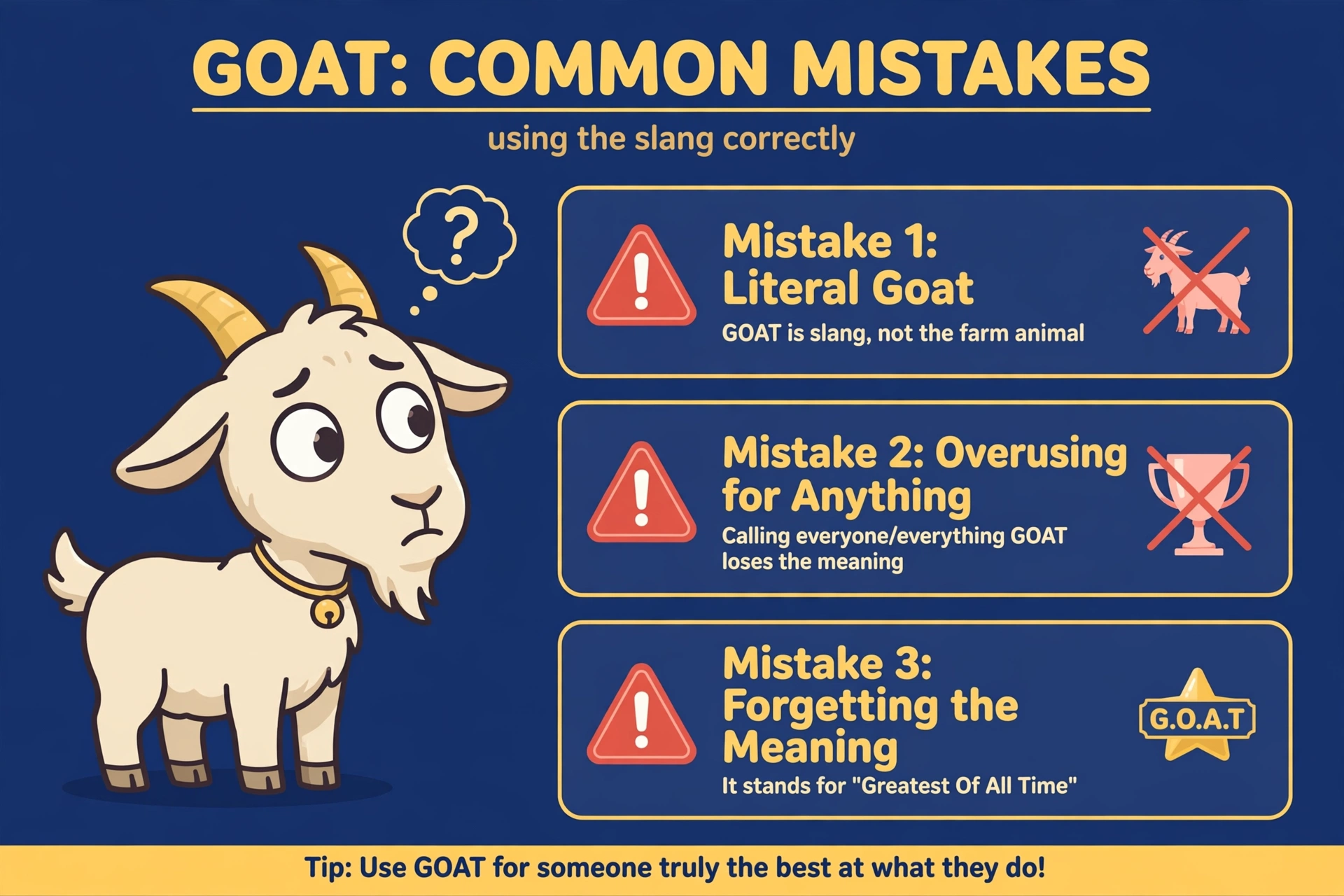
Common Mistakes
People get GOAT wrong in a few predictable ways. Avoid these and you will use the word like a native speaker:
- Calling someone the GOAT after one good game: GOAT is a career title, not a single-performance award. A player can have a great night without being the greatest of all time. Overusing it weakens the compliment.
- Using it for things that are merely good: If everything is the GOAT — your lunch, your socks, your Wi-Fi — the word stops meaning anything. Save it for things that are genuinely exceptional.
- Confusing GOAT with “legend”: A legend is famous and respected. The GOAT is the single best ever. Many legends are not the GOAT, and that is fine — the words are not interchangeable.
- Writing “goat” in lowercase in formal contexts: The acronym is usually written GOAT or G.O.A.T. in full capitals. Lowercase “goat” reads as the animal, which can confuse readers.
- Starting a GOAT debate you cannot finish: “Who’s the GOAT?” is an invitation to a long argument. Do not ask it unless you have time — sports fans will happily debate it for hours.
- Using it sarcastically without a signal: “Yeah, you’re the real GOAT” after someone makes a mistake can sound mocking. Add an emoji or a laugh if you mean it as a joke, or people will think you are serious.
- Assuming everyone agrees on the GOAT: There is no official GOAT committee. The title is always a matter of opinion, and reasonable people disagree — that disagreement is the whole point of the word.
- Forgetting the old meaning: In historical sports writing, “goat” meant the scapegoat. If you are reading old articles, do not assume GOAT means the same thing it does today.
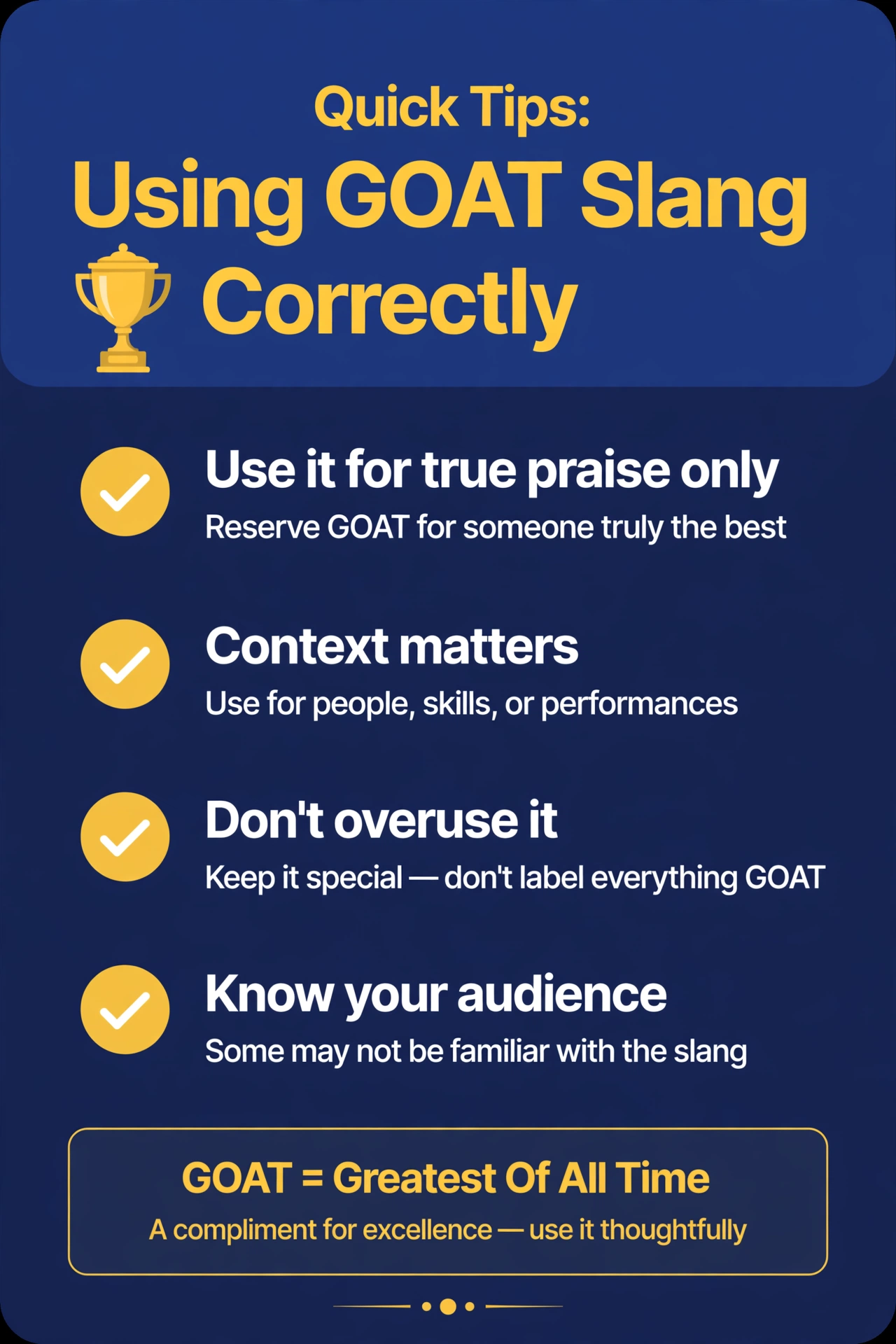
Quick Tips
- Save GOAT for the truly exceptional: The word only works because it is rare. If you call everything the GOAT, nobody will believe you when you use it for something that really deserves it.
- Use the goat emoji 🐐 for instant praise: One emoji under a highlight video says more than a paragraph. It is the fastest way to join the conversation.
- Know your sport’s debate: Every sport has its own GOAT argument. Knowing the names — Jordan vs. LeBron, Messi vs. Ronaldo — lets you join any sports conversation instantly.
- Pair GOAT with a reason: “Messi is the GOAT because of his eight Ballon d’Ors” is far stronger than just “Messi is the GOAT.” The reason makes the claim real.
- Use it for people, not just athletes: Musicians, actors, chefs, teachers, and even friends can be the GOAT. The word works anywhere someone is the best at what they do.
- Keep it playful in casual chats: Calling your friend’s cooking the GOAT is a compliment and a joke at the same time. That light tone is exactly how the word is meant to be used.
- Don’t take the debate personally: GOAT arguments get heated because people love their heroes. Enjoy the debate, but remember it is an opinion — there is no final answer, and that is what makes it fun.
FAQ
What does GOAT mean in slang?
In slang, GOAT stands for “Greatest Of All Time.” It is used to describe someone who is considered the best ever in their field — the greatest athlete, musician, or performer in history. In goat slang, calling someone the GOAT is the highest compliment you can give them.
Who is the GOAT in football (soccer)?
The football GOAT debate is almost always between Lionel Messi and Cristiano Ronaldo. Messi’s supporters point to his eight Ballon d’Or awards and the 2022 World Cup win, while Ronaldo’s supporters point to his goal-scoring records and success in multiple leagues. There is no official answer — it depends on who you ask.
Who is the GOAT in basketball?
The basketball GOAT debate is usually Michael Jordan vs. LeBron James. Jordan’s supporters point to his six championships and perfect Finals record, while LeBron’s supporters point to his longevity, all-round stats, and scoring record. Like football, it is one of the most argued questions in sports.
Where did the term GOAT come from?
GOAT comes from Muhammad Ali, who called himself “the greatest of all time” in the 1960s and 1970s. His wife Lonnie formalised the acronym in 1992 with G.O.A.T. Inc., and LL Cool J popularised it worldwide with his 2000 album G.O.A.T., which debuted at No. 1 on the Billboard 200.
Is GOAT a compliment?
Yes — in modern slang, GOAT is always a compliment. It means someone is the greatest ever at what they do. The only exception is the old sports meaning, where a “goat” was the player blamed for a loss, but that meaning has almost completely disappeared.
What does the goat emoji 🐐 mean?
The goat emoji 🐐 is visual shorthand for GOAT. When someone posts it under a photo, video, or comment, they are saying that person or thing is the greatest of all time. A row of goat emojis is pure praise — no words needed.
Can a woman be the GOAT?
Absolutely. GOAT is gender-neutral. Serena Williams is widely called the GOAT of women’s tennis, Simone Biles is called the GOAT of gymnastics, and Beyoncé is called the GOAT of live performance. The title belongs to whoever earns it, regardless of gender.
What is the difference between GOAT and legend?
A legend is someone famous and iconic with a lasting legacy, while the GOAT is specifically the single best ever in a field. Many legends are not the GOAT — there can be many legends, but only one GOAT. “Legend” is about fame and respect; “GOAT” is about being No. 1 of all time.
Conclusion
GOAT is a small word with a huge claim. It started as a boxer’s boast, became a company’s name, turned into a hip-hop album title, and then spread across the internet until it became the default way to crown the best of the best. From Muhammad Ali to LL Cool J to the comment sections of 2026, the word has carried the same message: this person is not just great — they are the greatest of all time.
The trick to using GOAT well is the same trick that works for all slang: save it for what truly deserves it, and know the debate you are stepping into. In a group chat, a GOAT call is a compliment and a conversation starter. In a sports argument, it is a position you should be ready to defend. And if someone calls you the GOAT, take it as the honour it is — there is no higher praise in modern slang.
Slang keeps moving, and GOAT will keep crowning new champions as new stars rise. The names in the debate will change, but the word itself is here to stay — and if you want to keep building your slang vocabulary, our guides to what “sigma” means in slang and what “aura” means in slang are the perfect next reads. Pick your GOAT, defend them proudly, and enjoy the debate — because there is no wrong answer, only a great argument.
