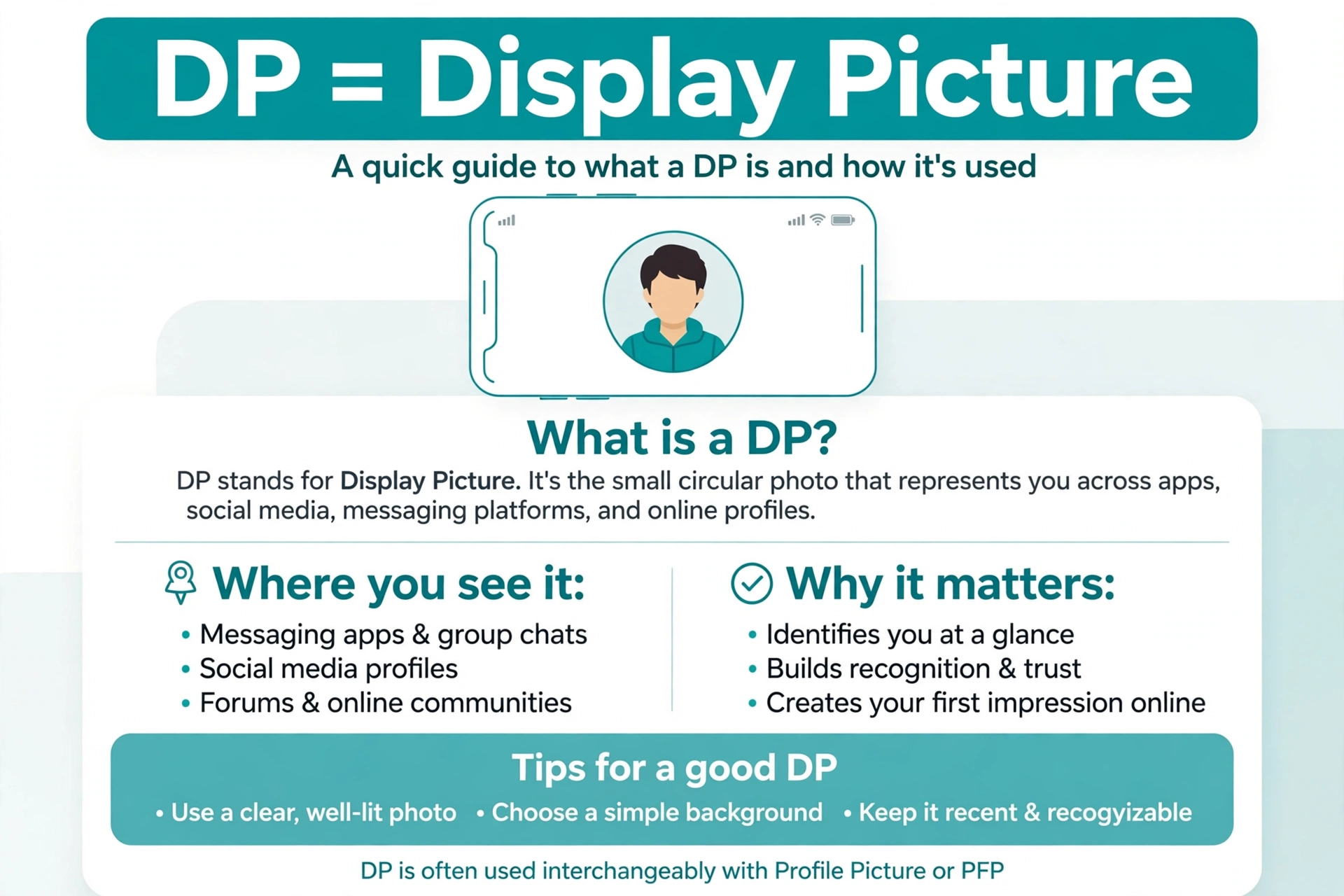
Quick definition: In slang, DP most commonly means “display picture” — the profile photo you use on WhatsApp, Instagram, Facebook, or any other social app. When someone says “nice DP” or “change your DP,” they are talking about your profile picture. In other contexts, DP can also stand for things like “director of photography,” “data processing,” or an adult slang term, so the meaning depends heavily on where you see it.
DP Meaning & Definition
DP meaning slang is one of those abbreviations that looks simple but carries several different meanings depending on the platform, the conversation, and the people talking. The most widely used meaning — and the one you will see most often in everyday texting and social media — is display picture.
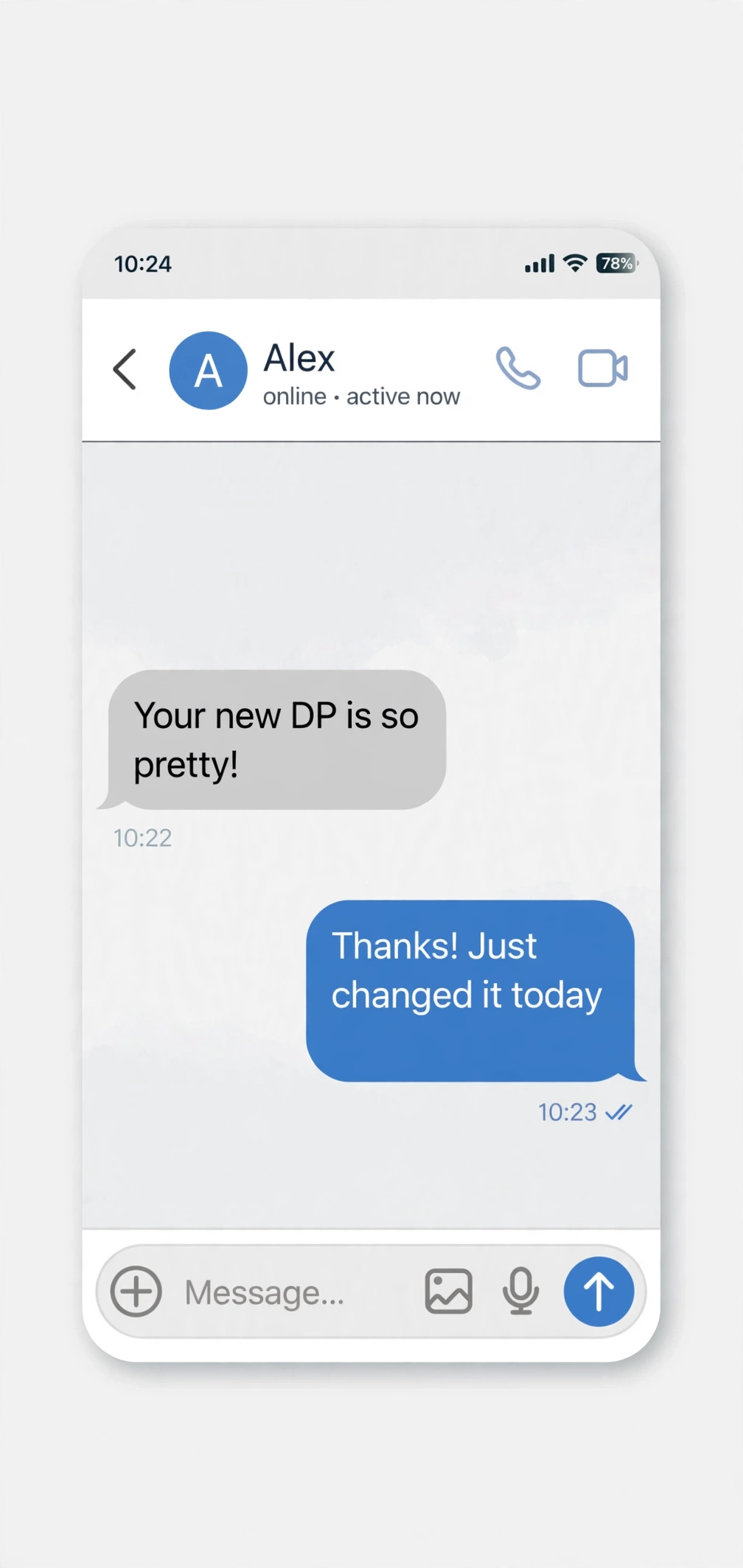
A display picture is the image that represents you on a messaging or social app. On WhatsApp it is the photo people see next to your name in every chat. On Instagram and Facebook it is your profile photo. On dating apps it is often the first thing someone notices about you. So when a friend texts “your DP is so cute” or “bro, update your DP, that photo is from 2019,” they are commenting on that picture, not on anything complicated.
That said, DP is a classic example of a multi-meaning abbreviation. In film and photography circles it means “director of photography.” In offices and tech it can mean “data processing.” In gaming it sometimes means “damage points” or “defense points.” And in adult contexts it has a very different, explicit meaning that you should be aware of so you do not use it in the wrong place. This guide covers the main meaning in depth and explains the alternates, so you can read any “DP” you come across with confidence.
Introduction
Open WhatsApp, scroll through your chats, and you will almost certainly see the letters DP somewhere — in a status update, a group chat joke, or a friend’s request to “send me your new DP.” For millions of people in the United States, India, Pakistan, and across the English-speaking world, DP has become everyday internet vocabulary. It is short, it is casual, and it saves time — exactly the kind of word that thrives in texting culture.
But here is the catch: because DP is so short, it gets reused everywhere. A photographer, a gamer, a corporate manager, and a teenager on TikTok can all write “DP” and mean four completely different things. That is why so many people search for dp meaning slang — they saw it in a chat, a comment, or a meme, and they want to know which meaning applies to them.
In this guide, you will learn the primary meaning of DP in slang, where the term came from, how it spread from early chat apps to TikTok and Instagram, and how to use it correctly. You will also find real examples in friendly, professional, and funny tones, a comparison table with similar terms, the alternate meanings you should know, polite alternatives for formal settings, and the common mistakes that make people look out of touch. By the end, you will never have to guess what DP means again.
Origin
The term “display picture” comes from the early days of instant messaging. In the 2000s, apps like Yahoo! Messenger, MSN Messenger, and later Skype let users set a small image next to their username. That image was literally called the display picture — the picture on display while you chatted. As people typed quickly, “display picture” was shortened to DP, and the abbreviation stuck.
WhatsApp played the biggest role in making DP a household word. When WhatsApp exploded in popularity in the early 2010s, its profile photo feature was widely referred to as the DP, especially in South Asia, where WhatsApp became the default way to communicate. Phrases like “DP change karo” and “nice DP” became part of daily conversation, and from there the term spread to Facebook, Instagram, and Telegram.
Interestingly, DP existed long before messaging apps. Photographers have used DP for “director of photography” since the film era, and computer professionals used it for “data processing” in the 1970s and 80s. The slang meaning simply borrowed the same two letters and gave them a new, social-media life. That long history is exactly why context matters so much with this abbreviation — the letters are old, but the slang meaning is a product of the smartphone era.
Popularity
DP is popular for a simple reason: profile pictures matter. Your display picture is often the first impression you make online. On WhatsApp, it is what your contacts see every single day. On Instagram, it sits next to every comment and DM you send. On dating apps, it can decide whether someone swipes right or left. Because the picture matters so much, people talk about it constantly — and “DP” is the fastest way to do that.
The term is especially common among younger users and in group chats. Friends compliment each other’s DPs, tease each other about old ones, and ask for opinions before changing them. It also shows up in social media captions and bios: “New DP, same me,” “DP credit goes to my bestie,” or “Rate my DP out of 10.” Influencers and content creators use it too, often asking followers to judge a new profile photo.
Search interest in dp meaning slang stays steady year-round, with small spikes whenever a viral TikTok or meme uses the abbreviation in an unexpected way. It is also a term that travels well across languages — in Roman Urdu and Hindi chats, “DP” is used exactly the same way, which has helped it stay relevant in multilingual friend groups. Like other short slang terms we have covered, such as fn meaning in text, DP survives because it is useful, quick, and universally understood in the right context.
How It Is Used
DP is used as a noun in almost every case. It refers to a picture, never to an action. You do not “DP someone” — you change your DP, update your DP, like someone’s DP, or ask someone to send their DP (meaning their photo, in a friendly context).
Here are the most common ways you will see it used:
- Complimenting: “Your new DP is amazing!”
- Asking to change it: “You should change your DP, that one is so old.”
- Asking for an opinion: “Which photo should I put as my DP?”
- Describing someone: “I recognized her from her DP.”
- On social media: “New DP after ages!” or “DP game strong today.”
The tone is almost always casual and friendly. People rarely use DP in formal writing — in a work email you would write “profile picture” instead. But in texts, DMs, comments, and captions, DP is perfectly natural. Just be careful in mixed or adult contexts: because DP also has an explicit adult meaning, using it with strangers or in a flirtatious conversation can be misunderstood. When in doubt, say “profile picture” instead.
DP also appears in compound phrases. “DP battle” is a fun contest where friends compare profile pictures. “DP download” refers to saving someone’s profile photo. And “DP dekh ke” (in Roman Urdu chats) means “after seeing the display picture.” These little phrases show how deeply the term has settled into everyday online speech.
Examples
Seeing DP in real sentences is the fastest way to learn it. The examples below cover the friendly, professional, and funny tones you will actually encounter — notice how the meaning stays the same (profile picture) while the mood changes completely.
Friendly Examples
- “Omg your new DP is so pretty! Where was this taken?”
- “I finally changed my DP after two years, lol.”
- “Send me that photo, I want to use it as my DP.”
- “Your DP and mine match — bestie goals!”
- “I saw your DP and instantly knew it was your birthday week.”
Professional Examples
In work settings, DP is rare, but it does appear in casual workplace chats. Even then, most professionals prefer “profile picture” to stay clear and polite:
- “Could you update your DP on Slack? The team directory pulls it automatically.”
- “Your LinkedIn DP looks great — very professional.”
- “Please use a clear headshot as your DP for the company portal.”
A good rule: if you are talking to a manager, a client, or anyone in a formal channel, write “profile picture” instead of DP. It costs you two seconds and removes all ambiguity — the same advice applies to other casual abbreviations like the ones explained in our guide to csl meaning in text.
Funny Examples (if applicable)
- “My DP is from 2016 and I refuse to change it. It is vintage now.”
- “Bro changed his DP 5 times today. Someone is bored.”
- “My DP is a cat. My cat has more followers than me.”
- “New DP, who dis? (It is still me, calm down.)”
- “That awkward moment when your mom likes your DP before your friends do.”
Comparison with Similar Terms
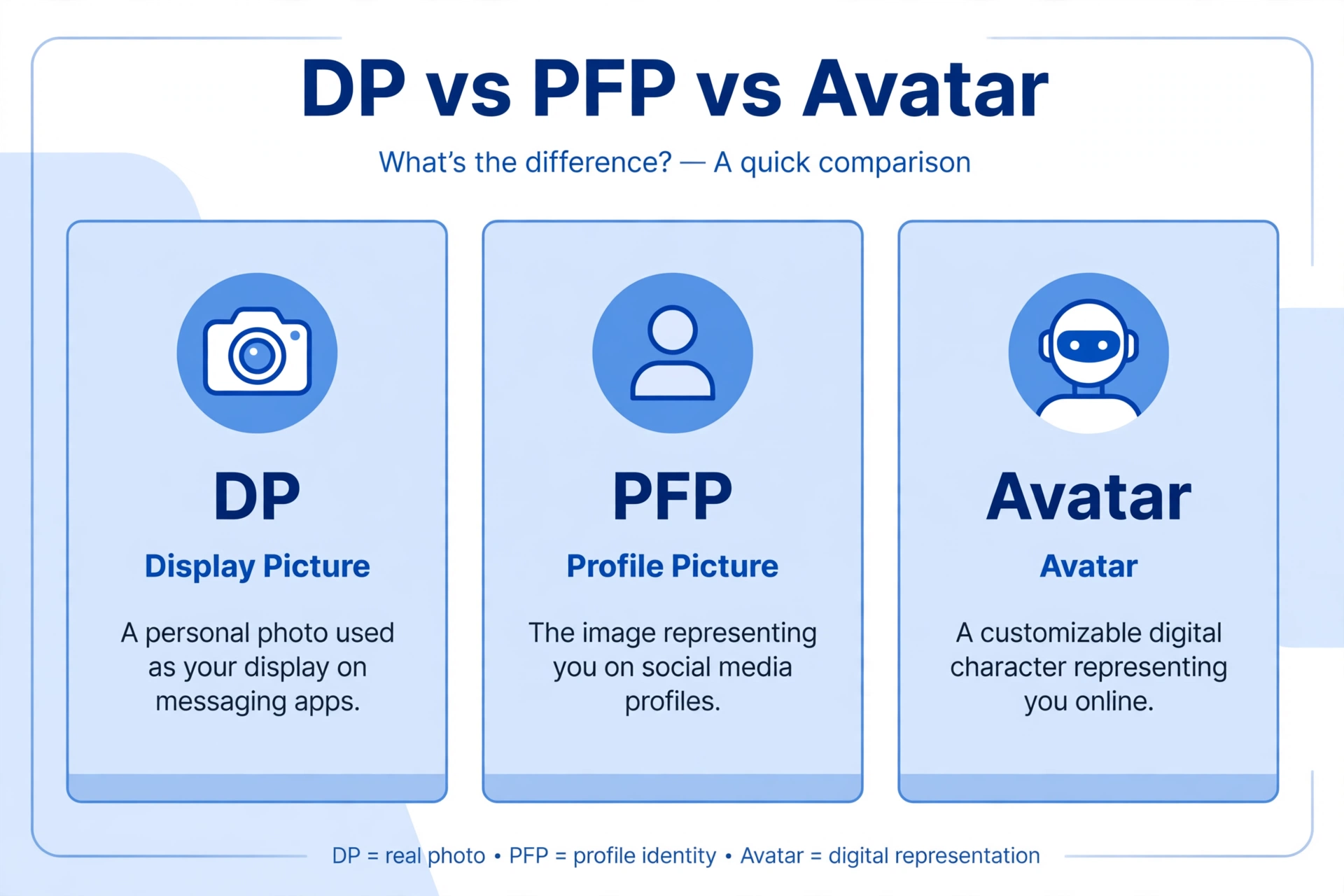
DP is often confused with a few nearby terms. This table clears up the differences at a glance:
| Term | Full Form | Meaning | Where You See It |
|---|---|---|---|
| DP | Display Picture | Your profile photo on a chat or social app | WhatsApp, Instagram, Facebook, Telegram |
| PFP | Profile Picture | Same idea as DP — your profile photo | Twitter/X, Discord, TikTok, gaming |
| Avatar | — | A digital image or character representing you (can be a drawing, not a photo) | Gaming, forums, Reddit, Discord |
| Profile Pic | Profile Picture | The full, formal version of DP/PFP | Everywhere, formal and casual |
| Cover Photo | — | The wide banner image at the top of a profile, not the small round photo | Facebook, LinkedIn, Twitter/X |
| PP | Profile Picture | A shorter variant of profile picture, less common than DP | WhatsApp, casual chats |
The closest synonym is PFP. In practice, DP is more common on WhatsApp and in South Asian English, while PFP dominates on Twitter/X, Discord, and TikTok in the United States. They mean the same thing, so you can use whichever one your friend group uses — just stay consistent so nobody gets confused.
One important distinction: your DP is not your cover photo. The DP is the small, usually circular photo next to your name. The cover photo is the big banner behind it. Mixing the two up is a common beginner mistake.
Alternate Meanings
Because DP is only two letters, it has collected many meanings across different fields. Here are the ones you are most likely to run into, so you can tell them apart from the slang meaning:
- Display Picture (slang / social media): Your profile photo. This is the meaning covered in this article and the one used in everyday texting.
- Director of Photography (film & TV): The person in charge of a film’s camera work and visual style. You will see this in movie credits: “DP: Roger Deakins.”
- Data Processing (technology): Handling and organizing information with computers. An older business and computing term.
- Dynamic Programming (computer science): A problem-solving method used by programmers. Common in coding interviews and textbooks.
- Double Penetration (adult slang): An explicit sexual term. This is the meaning that causes misunderstandings — in a flirty or adult conversation, “DP” may mean this instead of display picture, so read the context carefully before replying.
- Damage Points / Defense Points (gaming): A stat in role-playing and card games, referring to how much damage a character deals or blocks.
- Dead President (US slang): Money, especially dollar bills (which feature former presidents). Rare today, but you may see it in old hip-hop lyrics.
- Diploma Programme (education): The International Baccalaureate Diploma Programme, often shortened to “IB DP” by students.
The trick to reading DP correctly is always context. If you are on WhatsApp and someone says “nice DP,” it is your profile photo. If you are reading film credits, it is the director of photography. If the conversation is flirtatious, slow down and check the tone before assuming the innocent meaning. Crowd-sourced dictionaries like Urban Dictionary’s entry for DP show just how many of these meanings circulate side by side, which is why the surrounding conversation is always your best clue.
Professional or Polite Alternatives
In formal or professional situations, skip the abbreviation and use one of these instead:
- Profile picture — the safest, clearest choice everywhere.
- Profile photo — equally formal, slightly warmer.
- Headshot — best when the photo is a professional portrait (LinkedIn, company directory, press bio).
- Avatar — use this only when the image is an illustration or character, not a real photo.
- Display photo — the full form of DP, polite without sounding stiff.
Examples: “Please update your profile picture on the company portal” sounds professional, while “change your DP” sounds like a text to a friend. Match your words to your audience and you will never go wrong. The same principle shows up across internet slang — for instance, our guide on idt meaning in text makes the same point about keeping casual abbreviations out of formal messages.
Common Mistakes
DP is easy to use, but a few mistakes trip people up again and again:
- Using it in flirty chats without thinking: Because DP also has an adult meaning, dropping it into a conversation with someone you just met on a dating app can send the wrong message. In that setting, say “profile picture.”
- Confusing DP with cover photo: Your DP is the small round photo by your name; the cover photo is the wide banner. Asking someone to “change your cover DP” will confuse everyone.
- Using it in formal emails: “Please update your DP” in a work email looks careless. Write “profile picture” instead.
- Assuming everyone knows it: Older relatives or people new to smartphones may have no idea what DP means. If they look confused, just explain it once — it takes five seconds.
- Sharing or saving someone’s DP without permission: Downloading a stranger’s display picture and reposting it is creepy and, on some platforms, against the rules. A compliment is fine; taking the photo is not.
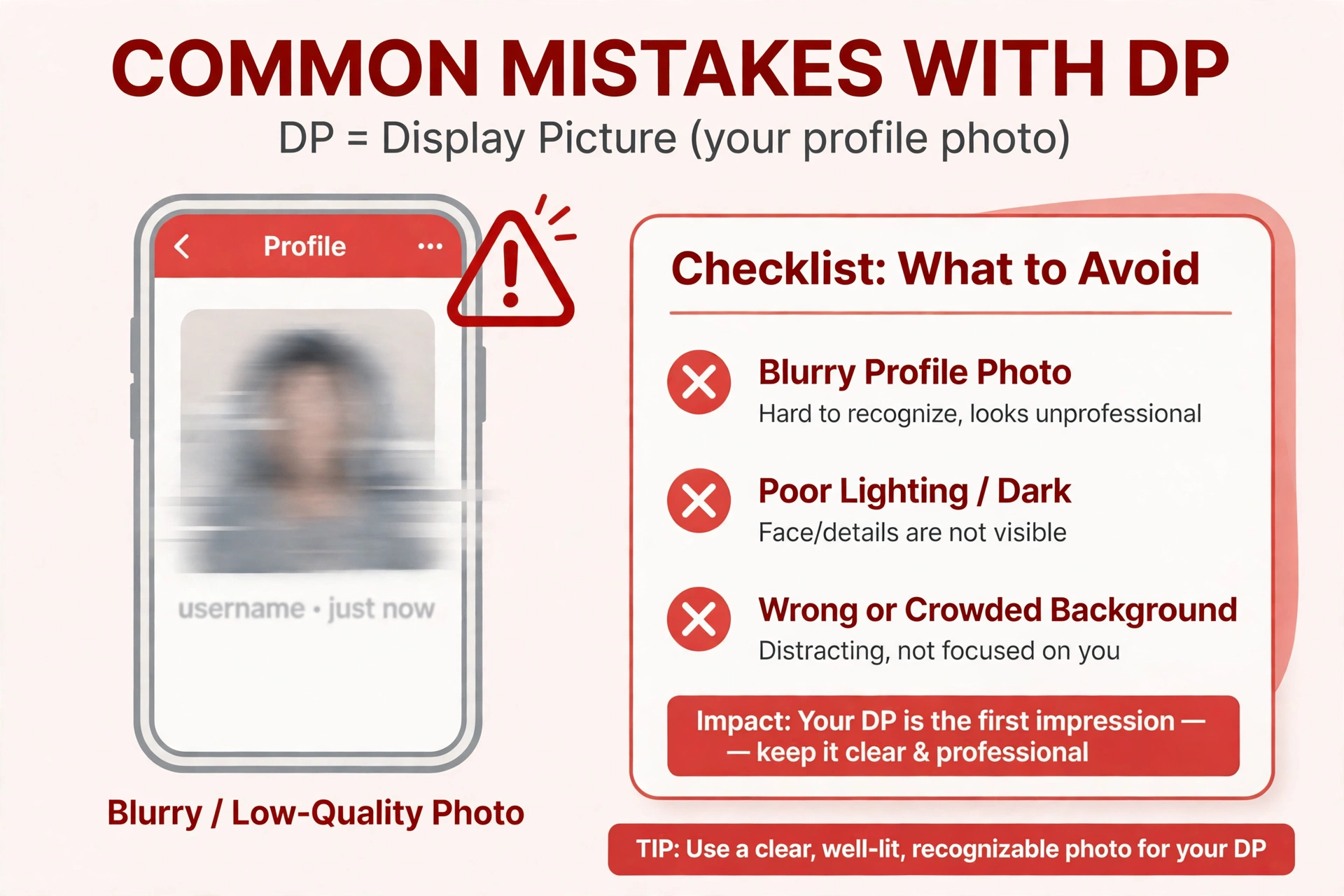
- Using a blurry or cropped photo as your DP: Your display picture is your first impression. A pixelated screenshot or a photo where half your face is cut off makes a worse impression than no photo at all.
Quick Tips
Want your DP game to be strong? These tips take two minutes and make a real difference:
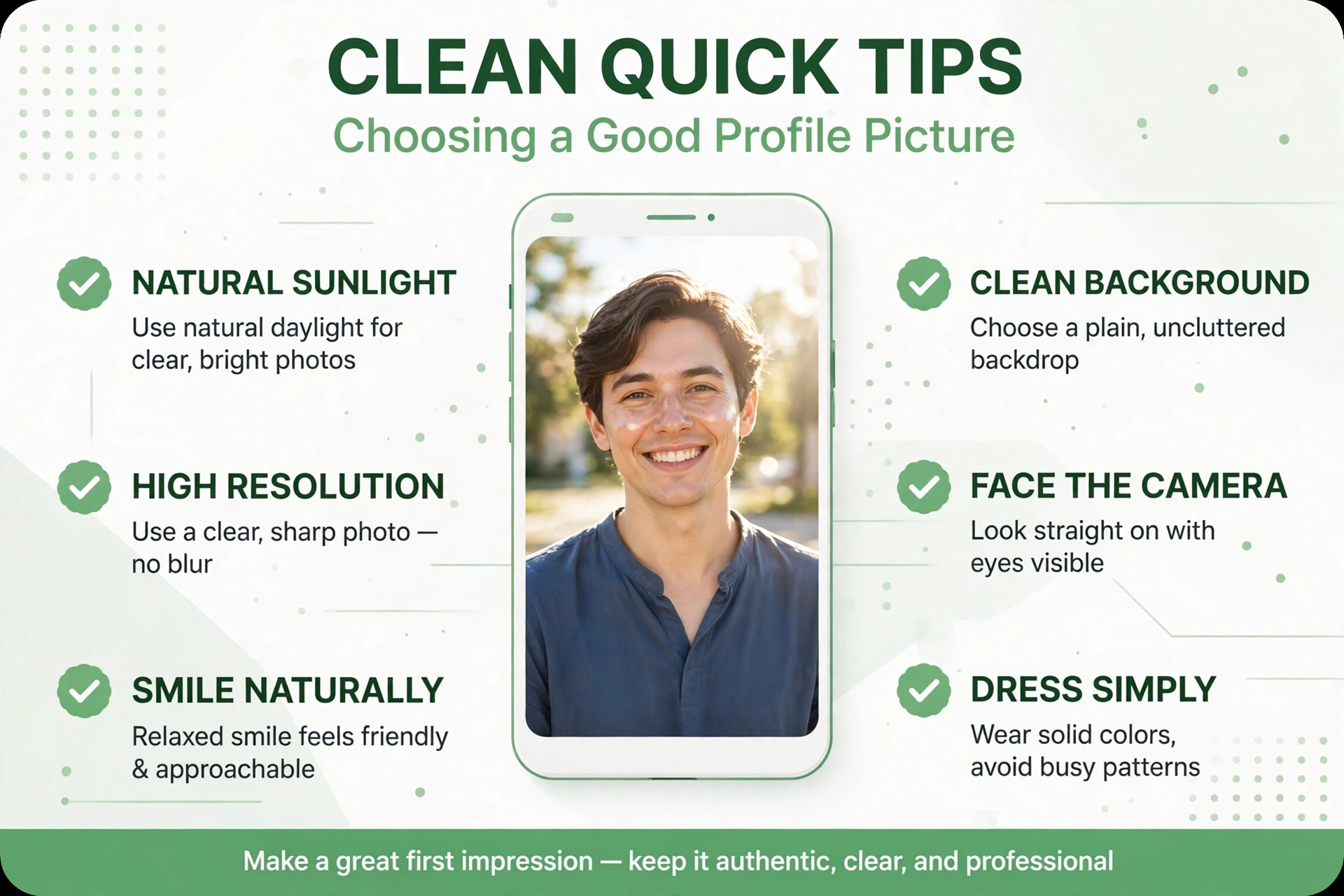
- Use a clear, well-lit photo: Natural daylight and a simple background beat a fancy filter every time.
- Keep your face visible: People trust a DP where they can actually see you — sunglasses and far-away group shots hide the person everyone is looking for.
- Update it every few months: A photo from five years ago confuses people who meet you in real life. Fresh is friendly.
- Match the platform: A fun, casual DP works on WhatsApp; a clean headshot works on LinkedIn. One photo does not fit everywhere.
- Ask a friend before changing it: A second opinion takes ten seconds and saves you from a photo with a photobomb in the background.
- Check the crop: WhatsApp and Instagram crop your DP into a circle — make sure the important part of the photo is in the center.
- Remember the context rule: In friendly chats, DP is fine. In flirty, formal, or professional conversations, spell it out as “profile picture.”
FAQ
What does DP mean in slang?
In slang, DP most commonly means “display picture” — the profile photo you use on WhatsApp, Instagram, Facebook, or any other social app. When someone says “nice DP,” they are complimenting your profile photo.
What is a DP on WhatsApp?
On WhatsApp, your DP is the photo that appears next to your name in every chat and in the contacts list. You can change it from your profile settings, and your contacts will see the new photo immediately.
Is DP the same as PFP?
Yes, they mean the same thing. DP (display picture) is more common on WhatsApp and in South Asian English, while PFP (profile picture) is more common on Twitter/X, Discord, and TikTok in the United States. Use whichever your friend group prefers.
What does DP mean on TikTok?
On TikTok, DP usually still means display picture — your profile photo. However, TikTok comments move fast and attract many slang terms, so always check the context of the video and the comment before deciding which meaning applies.
Does DP have another meaning?
Yes. Besides display picture, DP can mean director of photography (film), data processing (technology), dynamic programming (coding), or an explicit adult term. The correct meaning always depends on the context of the conversation.
Is it rude to ask someone to change their DP?
No, it is completely normal among friends — people ask each other for DP opinions all the time. Just keep it friendly, and never pressure someone about their photo. A light comment like “you should update your DP, that one is old” is fine; mocking someone’s appearance is not.
Can I use DP in a professional setting?
You can, but it is better not to. In work emails, company chats, or LinkedIn messages, write “profile picture” instead. It is clearer, more professional, and removes any chance of the adult-meaning misunderstanding.
How do I change my DP on WhatsApp and Instagram?
On WhatsApp, tap your profile photo in Settings, then tap the camera icon to choose a new photo. On Instagram, go to your profile, tap “Edit profile,” then “Change profile photo.” Pick a clear, well-lit picture and check the circular crop before saving.
Conclusion
So, what does dp meaning slang come down to? In almost every everyday conversation, DP simply means display picture — your profile photo on WhatsApp, Instagram, Facebook, or any app where people see your face before they read your name. It is short, friendly, and useful, which is why it has survived from the Messenger era to the TikTok era without losing relevance.
The key takeaways are simple. First, default to “display picture” whenever you see DP in a chat or a comment. Second, remember the alternate meanings — especially the adult one and the film term — so context never catches you off guard. Third, keep it casual: DP belongs in friendly texts and captions, while “profile picture” belongs in emails and formal messages. And fourth, treat your own DP with a little care, because it is often the first thing people notice about you online.
Slang moves fast, and two-letter abbreviations are the fastest of all. But once you know the rules — check the context, match the platform, and spell it out when it matters — DP becomes one of the easiest terms in your internet vocabulary. If you enjoyed this guide, keep exploring similar terms: learn the friendly tone of tysm meaning, or compare notes with our other slang explainers on the site. The more of these little words you know, the less time you spend guessing — and the more time you spend actually enjoying the conversation.
