Quick definition: Italian slang is the informal, everyday language Italians actually use with friends, family, and online — short words, filler sounds, and expressive phrases like dai, allora, che bello, and mamma mia that rarely appear in textbooks but fill every real conversation in Italy.
Italian Slang Meaning & Definition
Italian slang means the casual, colloquial side of the Italian language: the words and expressions people use in daily life, on WhatsApp, in TikTok comments, and around the dinner table. Standard Italian — the kind taught in classrooms — is only half the story. Real Italian is full of shortcuts, borrowed English words, regional flavour, and hand-gesture energy that textbooks can never quite capture.
If you have ever watched an Italian film, followed an Italian creator on TikTok, or visited Rome and wondered why everyone seems to say allora every ten seconds, you have already met Italian slang. It is not a separate language. It is Italian at its most relaxed and most human — faster, warmer, and much more emotional than the formal version.
This guide covers 60+ Italian slang words and phrases, with plain-English meanings, pronunciation hints, real examples, and honest advice about when to use each one — and which ones to avoid.
Introduction
Picture this: you land in Naples, walk into a café, and order a coffee. The barista smiles and says “Prego, tesoro!” A man at the next table is telling a story and punctuates every sentence with allora, dai, and a wave of his hands. Outside, a teenager greets her friend with a double-cheek kiss and a loud “Ciao, bella!” Nobody is speaking textbook Italian — and yet everyone understands each other perfectly.
That is the magic of Italian slang. It is the language of belonging. Italians use it to show warmth, to joke, to complain, to flirt, and to cut through formality in seconds. A single word like dai can mean “come on,” “hurry up,” “please,” or “you must be joking,” depending on the tone. A phrase like che casino can describe a messy room, a chaotic party, or a whole disastrous day.
For learners, Italian slang is the difference between sounding like a phrasebook and sounding like a person. For travellers, it is the fastest way to get a smile from a local. And for anyone who loves Italian culture — the food, the films, the football, the music — slang is the soundtrack. In this guide, you will learn the most useful Italian slang words, how Italians really use them, the mistakes learners always make, and the polite alternatives for formal situations.
Origin
Italian slang has deep roots. Modern standard Italian grew out of the Tuscan dialect, but everyday speech in Italy has always been shaped by dozens of regional dialects — Neapolitan, Romanesco, Milanese, Sicilian, Venetian, and many more. For centuries, most Italians spoke their local dialect at home and only used standard Italian in school or official settings. Slang grew in that gap: informal words, dialect borrowings, and shortcuts that felt natural in conversation.
Several forces shaped the slang Italians use today:
- Dialects: Words like mo (now, from Roman dialect), mannaggia (damn, from the south), and ganzo (cool, from Tuscan) started regional and went national through television and migration.
- Television and cinema: From classic Italian comedy films to modern Netflix series, screenwriters spread slang from one region to the whole country.
- Youth culture and music: Rap, trap, and pop music constantly coin new expressions — figo, pazzesco, and che figata all got boosts from songs and street culture.
- The internet: TikTok, Instagram, and WhatsApp accelerated everything. Young Italians mix English words like cringe, bro, and okay into Italian sentences without thinking twice.
- Immigration and emigration: Italian communities abroad, from New York to Buenos Aires, kept old slang alive while adding local flavour — which is why Italian-American slang sounds different from slang in Milan.
The result is a living, fast-moving vocabulary. Some Italian slang words are centuries old; others were born on TikTok last year. That is exactly why a good guide matters — slang changes fast, and the context matters as much as the word.
Popularity
Italian slang is more popular — and more visible — than ever before. A few numbers and trends explain why:
- Tourism: Italy welcomed more than 60 million international visitors a year before the pandemic, and numbers have surged again since. Travellers want to sound like locals, not tourists, and slang is the first thing they search for.
- Social media: Italian creators dominate TikTok and Instagram Reels with comedy sketches built entirely on slang — the “Italian hand gesture” videos alone have billions of views.
- Language learning: Italian is one of the most studied languages in the world, and learners quickly discover that textbook phrases like “Come sta?” sound stiff compared with the “Come va?” and “Tutto bene?” Italians actually say.
- Food and pop culture: From pizza and pasta to the global success of Italian series and songs, Italian culture exports its vocabulary everywhere — and slang travels with it.
- Search demand: Queries like “Italian slang words,” “Italian slang phrases,” and “funny Italian slang” spike every summer travel season and every time an Italian phrase goes viral online.
In short, Italian slang is not a niche curiosity. It is one of the most searched language topics in the world — and the words below are the ones people actually ask about most.
How It Is Used
Italian slang shows up in almost every informal setting, but almost never in formal ones. Here is where you will hear it — and where you should not use it:
| Situation | Italian slang? | Example |
|---|---|---|
| Chatting with friends | Yes — constantly | “Dai, andiamo!” (Come on, let’s go!) |
| Texting and WhatsApp | Yes — the main place | “Che figata!” (How cool!) |
| TikTok and Instagram | Yes — everywhere | “Pazzesco, bro!” (Insane, bro!) |
| Family dinners | Yes — warm and playful | “Mamma mia, che buono!” |
| At work with colleagues | Light slang only | “Va bene, ci sentiamo dopo.” |
| Job interview or official letter | No — use standard Italian | “La ringrazio per l’opportunità.” |
| Talking to strangers or elders | Polite forms first | “Mi scusi, per favore.” |
One thing makes Italian slang special: tone and gesture do half the work. The same word can be affectionate, annoyed, or joking depending on how it is said — and Italians often pair slang with the famous hand gestures. Dai with an open palm means “come on”; ma che vuoi? with pinched fingers means “what do you want?” Learning the words without the tone is like learning the lyrics without the music.
The most useful Italian slang words at a glance
| Italian slang | Pronunciation | Meaning | When to use it |
|---|---|---|---|
| Ciao | chow | Hi / bye | Friends, family, casual greetings |
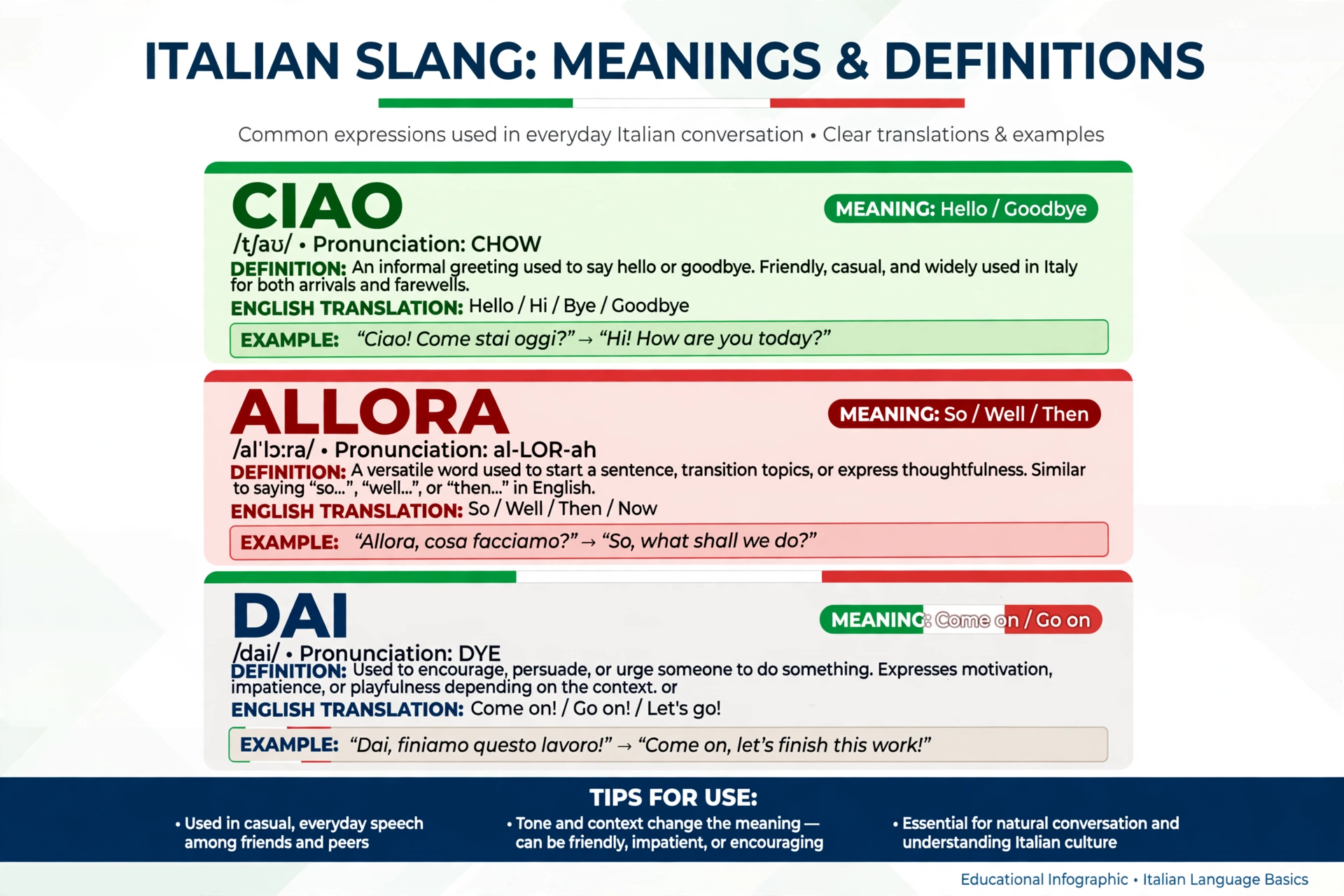
| Allora | al-LOH-ra | So / well / then | Starting a sentence, buying time |
| Dai | die | Come on / please / hurry | Encouraging, teasing, urging |
| Va bene | va BEH-neh | Okay / all right | Agreeing to anything |
| Che bello! | keh BEL-loh | How beautiful / great! | Admiring anything |
| Mamma mia! | MUM-ma MEE-a | Oh my goodness! | Surprise, shock, delight |
| Basta | BAH-sta | Enough / stop it | Ending a discussion or behaviour |
| Prego | PREH-goh | You’re welcome / please | After thanks, or inviting someone in |
| Grazie mille | GRAH-tsyeh MEE-leh | Thanks a lot | Any thank-you, warmer than grazie |
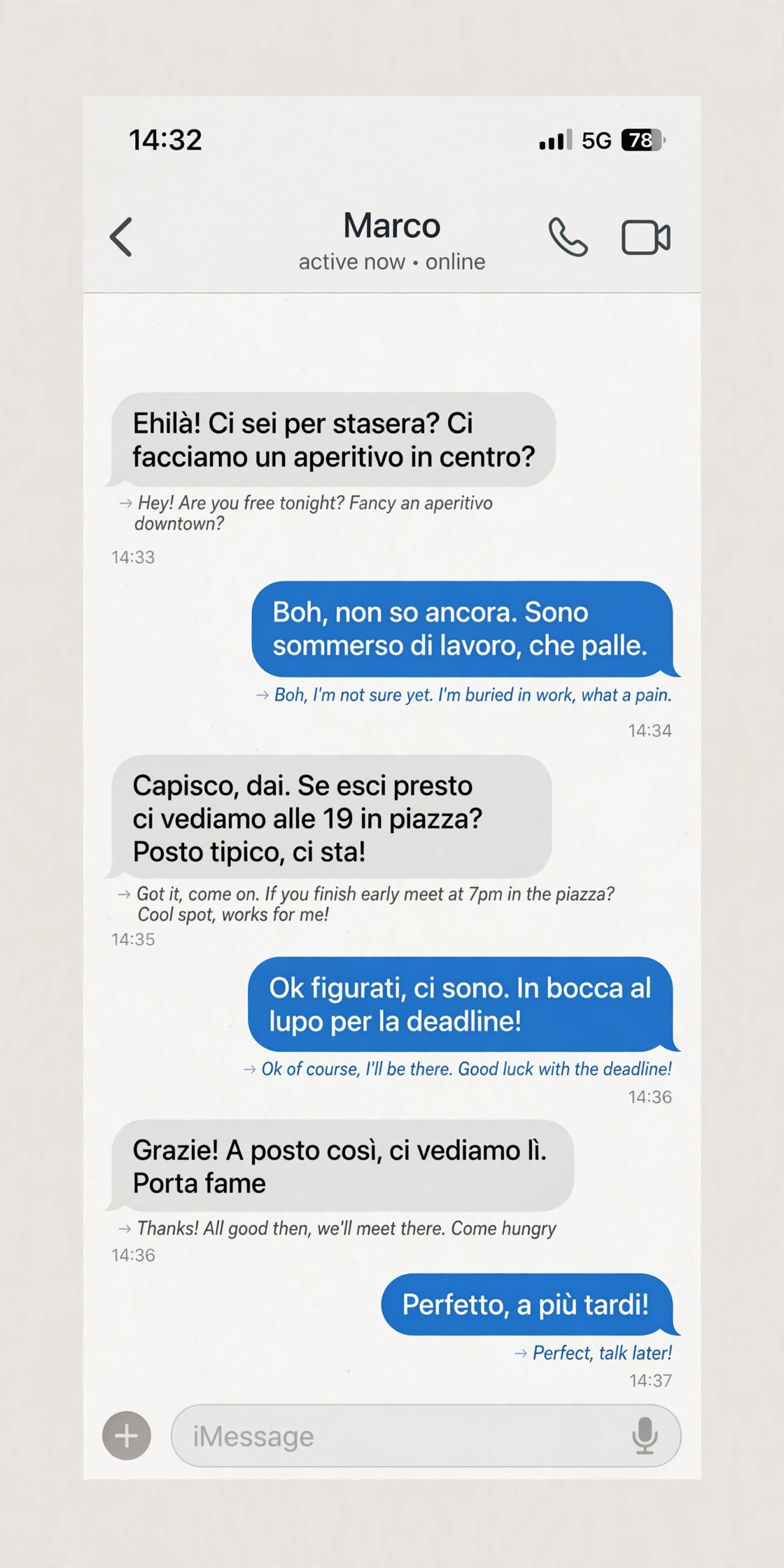
| Boh | boh | I don’t know / dunno | Shrugging answer to any question |
| Figo / figa | FEE-goh / FEE-ga | Cool / hot / awesome | Praising a person, thing, or idea |
| Pazzesco | pat-TSEH-skoh | Insane / crazy / amazing | Reacting to something wild |
| Tesoro | teh-SOH-roh | Sweetheart / darling | Affectionate nickname |
| Che casino! | keh ka-SEE-noh | What a mess / chaos! | Messy rooms, crazy situations |
| Andiamo! | ahn-DYAH-moh | Let’s go! | Leaving, starting, cheering on |
Examples
The fastest way to learn Italian slang is to see it in real sentences. Below are examples grouped by tone — friendly, professional, and funny — so you can match the right phrase to the right moment.
Friendly Examples
- “Ciao, bella! Come va?” — “Hi, beautiful! How’s it going?” (A warm greeting between friends; bella is friendly, not flirty, in this context.)
- “Dai, andiamo a prendere un gelato!” — “Come on, let’s go get an ice cream!”
- “Tesoro, ti voglio bene.” — “Sweetheart, I love you.” (Ti voglio bene is the everyday “I love you” for family and close friends.)
- “Che bello vederti!” — “How great to see you!”
- “Va bene, ci vediamo domani.” — “Okay, see you tomorrow.”
- “Grazie mille, sei un mito!” — “Thanks so much, you’re a legend!”
- “Non ci posso credere, che figata!” — “I can’t believe it, how cool!”
Professional Examples
At work, Italians soften slang and mix it with polite forms. These examples are safe with colleagues you know well:
- “Allora, cominciamo la riunione.” — “So, let’s start the meeting.” (Allora is perfectly fine at work.)
- “Va bene, ci sentiamo dopo.” — “All right, we’ll talk later.”
- “Mi scusi, posso chiederle una cosa?” — “Excuse me, may I ask you something?” (Polite Lei form for formal settings.)
- “In bocca al lupo per la presentazione!” — “Good luck with the presentation!” (Literally “in the wolf’s mouth” — the Italian way to say break a leg. Reply: “Crepi!”)
- “Piano piano, ce la facciamo.” — “Slowly slowly, we’ll manage.” (A classic Italian attitude to work: step by step.)
Funny Examples (if applicable)
- “Mamma mia, che casino! La mia stanza sembra un campo di battaglia.” — “Oh my goodness, what a mess! My room looks like a battlefield.”
- “Ho mangiato talmente tanto che sono morto di fame… no, aspetta, sono pieno come un uovo!” — “I ate so much I’m starving… no wait, I’m full as an egg!” (Italians joke about food constantly.)
- “Che palle, un’altra riunione!” — “What a drag, another meeting!” (Mildly rude — fine with friends, never with your boss.)
- “Sei proprio un rompiscatole!” — “You’re such a pain!” (Playful teasing between friends.)
- “Mannaggia, ho dimenticato le chiavi di nuovo!” — “Damn, I forgot my keys again!” (Southern-flavoured, affectionate frustration.)
- “Oddio, non ci posso credere — ho vinto!” — “Oh my God, I can’t believe it — I won!”
Comparison with Similar Terms
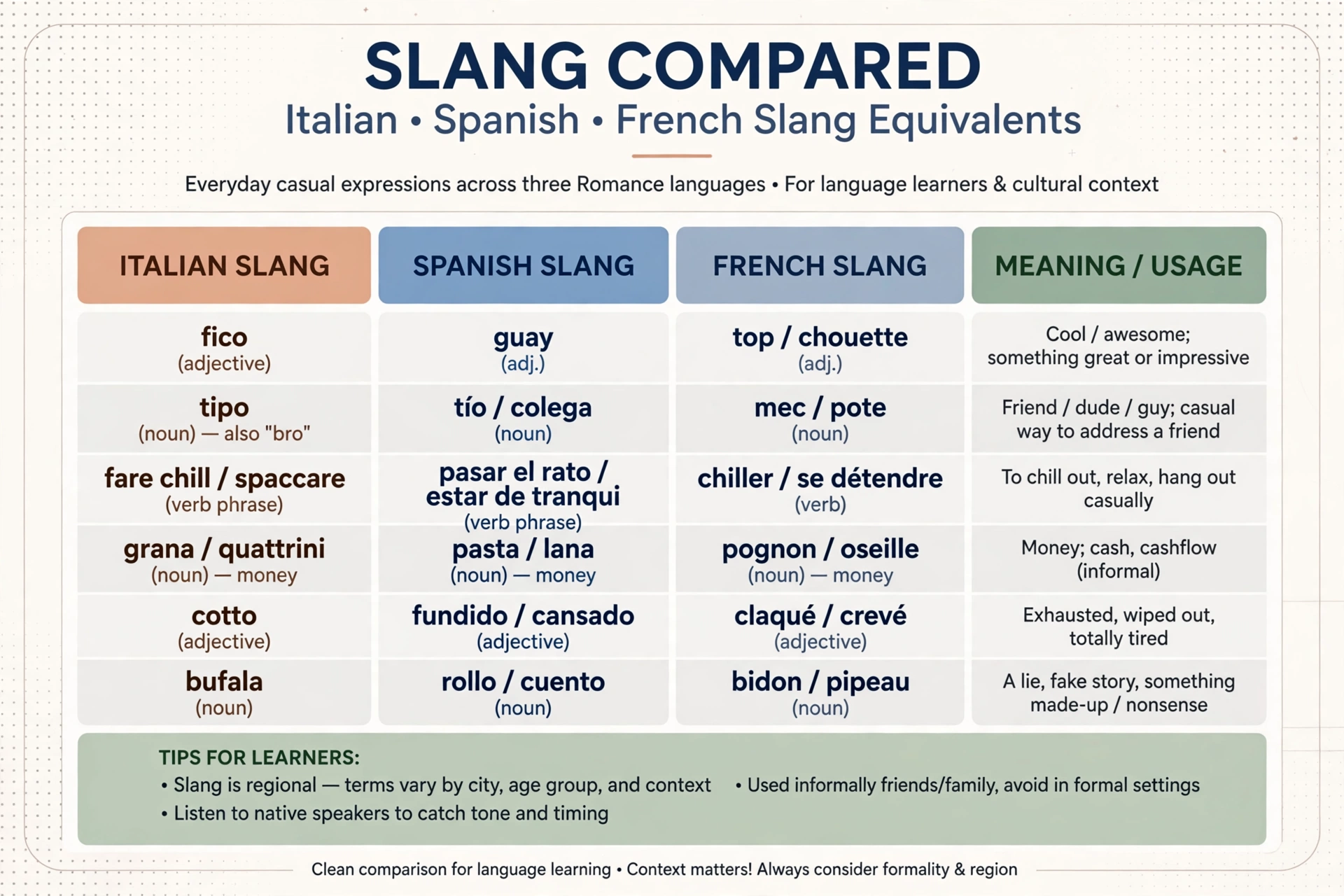
Italian slang overlaps with slang in other Romance languages and with English internet slang. The table below shows how similar ideas are expressed in Italian, Spanish, and French — useful because learners often mix them up.
| Meaning | Italian slang | Spanish slang | French slang |
|---|---|---|---|
| Cool / awesome | Figo | Guay / chido | Trop cool / génial |
| Come on / hurry | Dai | Venga / vamos | Allez |
| I don’t know | Boh | No sé / ni idea | Je sais pas / bof |
| Oh my God! | Mamma mia / Oddio | ¡Madre mía! / ¡Dios mío! | Oh mon Dieu ! |
| What a mess! | Che casino! | ¡Qué desastre! | Quel bordel ! |
| Let’s go! | Andiamo! | ¡Vamos! | On y va ! |
| Sweetheart | Tesoro / amore | Cariño / amor | Chéri(e) / mon amour |
| Good luck! | In bocca al lupo! | ¡Mucha suerte! | Bonne chance ! |
Italian slang also borrows from English constantly. Young Italians say bro, cringe, okay, cool, fake, and mood inside Italian sentences — and they say che cringe or che mood with a completely Italian accent. If you already know Spanish slang or French slang, you will recognise the pattern: every language has its own fillers, its own “oh my God,” and its own way of saying “cool.” Italian just says them with more hand gestures.
Alternate Meanings
Many Italian slang words change meaning with context. Here are the most confusing ones for learners:
- Ciao: Means both “hello” and “goodbye.” Among friends it is the default for both. In formal settings, use buongiorno (good morning) or arrivederci (goodbye) instead.
- Prego: Means “you’re welcome,” but also “please, go ahead” or “come in.” A shopkeeper saying prego is inviting you to enter or to speak.
- Allora: Literally “then,” but used as “so,” “well,” or simply as a thinking sound — the Italian “um.” It can also mean “at that time.”
- Dai: Can mean “come on,” “give,” “hurry up,” “please,” or “no way!” — tone decides everything.
- Figo / figa: Figo means cool or handsome; figa can mean cool (feminine) but is also a vulgar word in some regions — learners should stick to figo and che figata to stay safe.
- Bello / bella: Means beautiful, but Italians also use it as a friendly address: “Ciao, bello!” is like “Hey, mate!” between male friends.
- Casino: Literally a brothel in old Italian, but in slang che casino simply means “what a mess” or “what chaos.” The literal meaning is never intended.
- Boh / mah: Both mean “I don’t know,” but boh is a shrug and mah is a doubtful “hmm, maybe.”
- Va bene vs va beh: Va bene means “okay”; va beh (shortened) often means “whatever, fine” — slightly resigned.
Professional or Polite Alternatives
Slang is wonderful with friends — and a mistake in a formal setting. Here is how to translate the most common Italian slang into polite, standard Italian:
| Slang (informal) | Polite / formal alternative | When to switch |
|---|---|---|
| Ciao | Buongiorno / Buonasera | Strangers, officials, older people |
| Boh | Non lo so | Work, school, any formal answer |
| Dai! | Per favore / La prego | Asking something of a stranger |
| Che palle! | Che noia! / Che peccato! | Anywhere polite — the slang is rude |
| Va beh | Va bene, d’accordo | Meetings, emails, official talk |
| Scusa | Mi scusi | Addressing someone formally |
| Stai zitto! | Per favore, un momento di silenzio | Never say the slang version to a superior |
| Che casino! | Che confusione! | Professional descriptions of chaos |
| Sei un mito! | La ringrazio molto, è stato gentilissimo | Thanking someone formally |
| Ti voglio bene | Le voglio bene | Formal “I care for you” (rare, careful) |
The golden rule is simple: use slang with people who use slang with you. When in doubt, default to the polite form — Italians will warm to you for trying, and they will happily teach you the casual version themselves.
Common Mistakes
Learners make the same five mistakes with Italian slang. Avoid them and you will already sound more natural than most students:
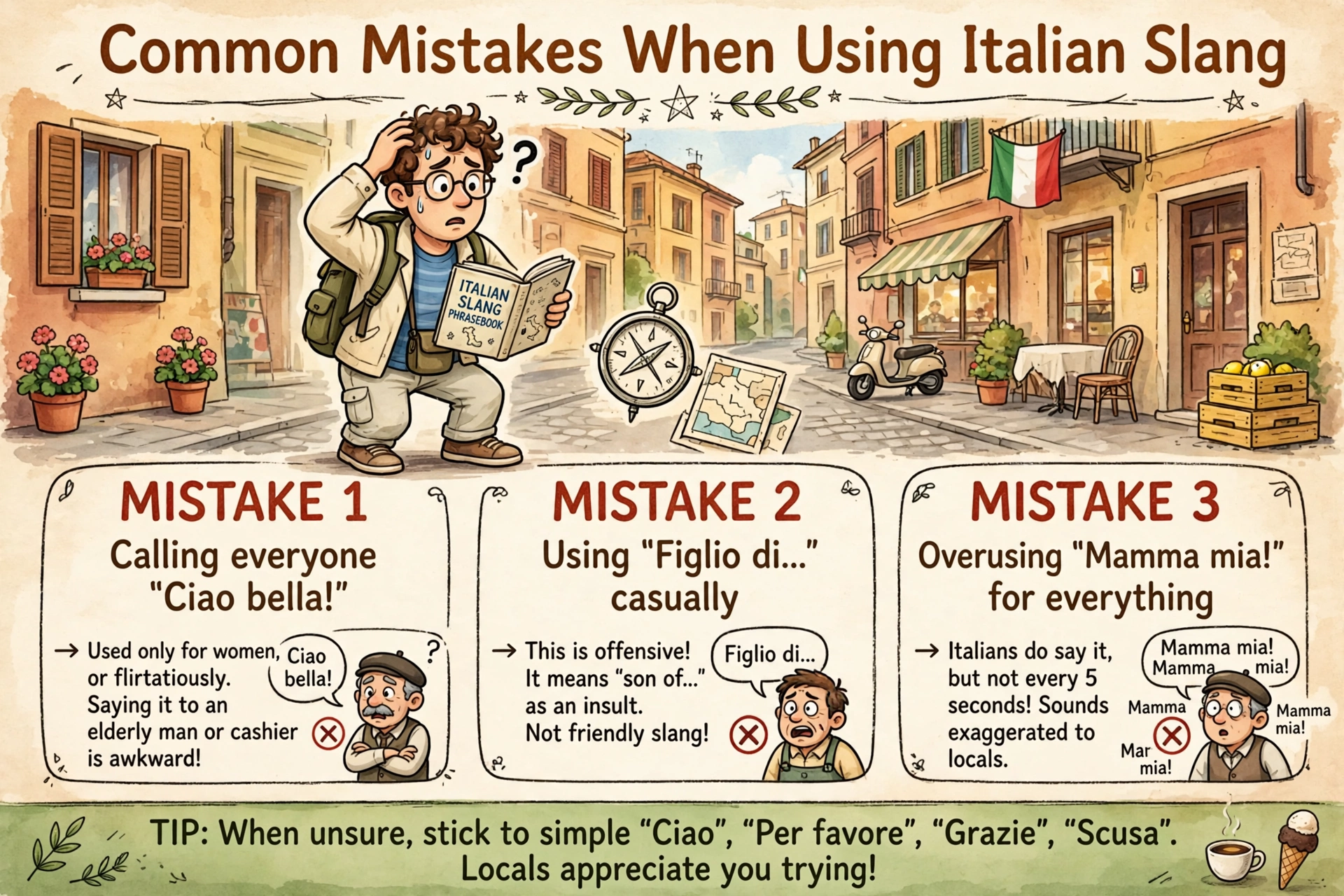
- Using ciao with everyone: Ciao is informal. Saying it to a police officer, a doctor, or an elderly stranger can come across as rude. Start with buongiorno and let them switch to ciao first.
- Overusing mamma mia: Italians do say it — but not in every sentence. Non-Italians who say it constantly sound like a caricature. Once in a while, with genuine surprise, is perfect.
- Mixing up figo and figa: As noted above, figa is vulgar in several regions. Stick with figo, che figo, and che figata until you know the local rules.
- Saying che palle at work: It literally refers to a vulgar body part. Friends laugh; bosses do not. Use che noia (how boring) instead.
- Translating word for word: In bocca al lupo is not about wolves; che casino is not about gambling; sono morto di fame does not mean you are dying. Italian slang is idiomatic — learn the phrase as a whole, not word by word.
- Forgetting the gestures: Italians communicate with their hands as much as their mouths. You do not need to master the gestures, but watching them helps you understand the tone — and the tone is half the meaning.
- Using dialect words in the wrong region: Mo is Roman, mannaggia is southern, ganzo is Tuscan. They are understood everywhere, but using heavy local slang far from home can sound odd. Keep the national words first.
Quick Tips
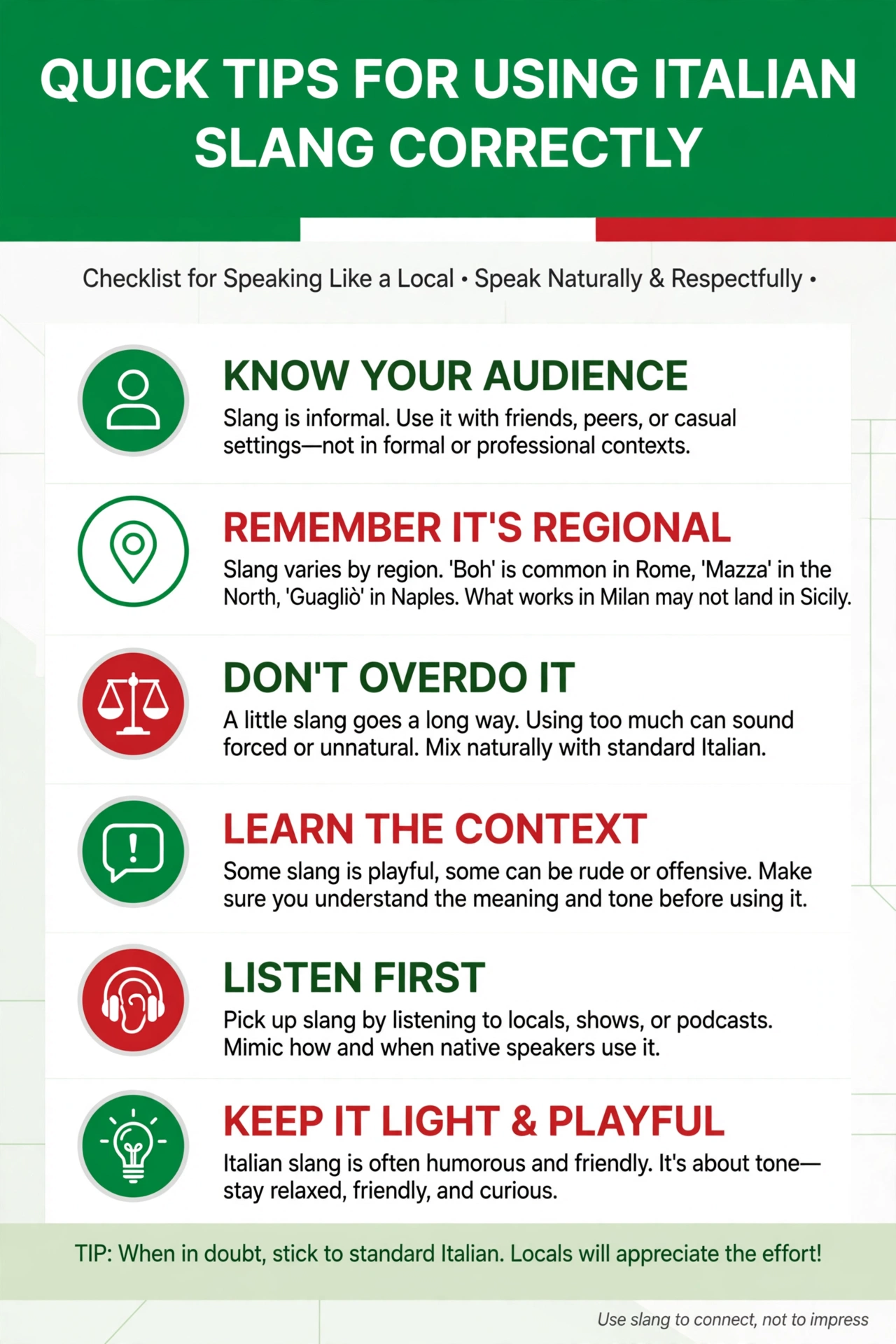
- Learn five first: Ciao, grazie, prego, va bene, allora — these five cover half of daily conversation. Master them, then add dai, boh, and mamma mia.
- Listen before you speak: Watch Italian YouTubers, series, and TikTok creators and note which words repeat. Spoken slang is learned by ear, not by list.
- Copy the tone, not just the word: Dai said flatly is a request; daiii with a rising voice is excitement. Imitate the melody you hear.
- Use slang in texts first: Texting friends is the lowest-risk place to try new slang — you have time to think, and autocorrect will not judge you.
- Keep a slang notebook: Write the word, the situation where you heard it, and who said it. Context beats translation every time.
- Ask Italians to correct you: Italians love it when learners try their slang — and they will happily tell you when a word is too rude, too old, or too regional.
- Pair slang with what slang really is: Understanding why slang exists — identity, humour, belonging — helps you use it naturally instead of forcing it.
- Stay curious about regional words: From New York slang to Neapolitan dialect, every region has its own flavour. Italian slang is a map of Italy itself.
FAQ
What does Italian slang mean?
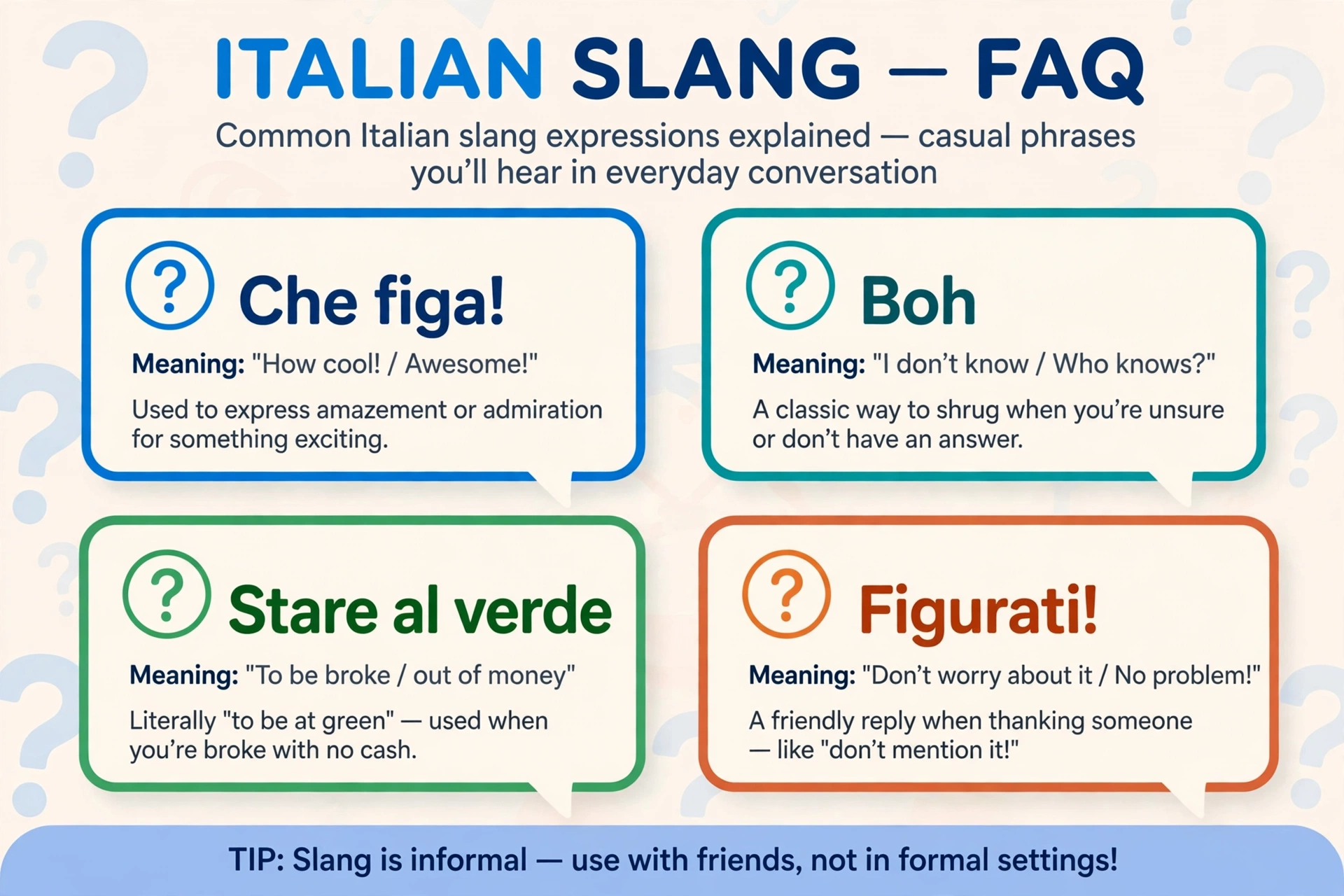
Italian slang is the informal vocabulary Italians use in everyday conversation — words like dai, allora, che bello, and mamma mia that express feelings, reactions, and social closeness. It is not a separate language, just the casual register of Italian.
What is the most common Italian slang word?
Allora is probably the most common — Italians use it to start sentences, pause while thinking, and connect ideas, much like “so” or “well” in English. Dai, va bene, and boh are close behind.
What does “dai” mean in Italian slang?
Dai is one of the most flexible words in Italian. It can mean “come on,” “hurry up,” “please,” “go on,” or “no way!” depending on tone. It comes from the verb dare (to give) but works as an all-purpose encouragement or reaction word.
What does “mamma mia” mean?
Mamma mia literally means “my mother,” but as slang it is an exclamation like “oh my goodness!” or “wow!” Italians use it for surprise, shock, delight, or frustration. It became world-famous through songs, films, and memes.
Is “che casino” rude?
No — in modern usage che casino just means “what a mess” or “what chaos.” The word casino once had a different, vulgar meaning, but nobody intends that today. It is safe with friends and family.
What does “figo” mean in Italian slang?
Figo means “cool,” “awesome,” or “good-looking.” You can say che figo about a car, a song, or a person. Its feminine form figa can be vulgar in some regions, so learners should prefer figo and che figata.
How do Italians say “I don’t know” in slang?
Boh — usually with a shrug and raised eyebrows. It is the universal Italian “dunno.” In formal situations, say non lo so instead.
What Italian slang should I avoid?
Avoid che palle (rude), vaffanculo (a serious insult), and figa in regions where it is vulgar. Also avoid using ciao with strangers, officials, and elders until they use it first. When in doubt, use the polite alternative — Italians will respect the effort.
Conclusion
Italian slang is the living, breathing side of one of the world’s most beautiful languages. Words like allora, dai, che bello, and mamma mia are more than vocabulary — they are the sound of Italian life: warm, expressive, a little dramatic, and always social. Learning them is the fastest way to move from “I study Italian” to “I speak Italian.”
The key takeaways are simple. Start with the five essentials — ciao, grazie, prego, va bene, allora — then add the expressive words one at a time. Pay attention to tone and context, because the same word can be affectionate or annoyed. Use slang with friends and keep polite Italian for formal moments. And never be afraid to try: Italians genuinely love hearing learners attempt their slang, and they will correct you with a smile.
Language is how cultures invite you in. Italian slang is Italy’s open door — walk through it, one dai at a time. And when you are ready for the next language, explore how slang works across cultures, from French slang to the regional colour of New York slang. For the formal side of the language, the Accademia della Crusca — Italy’s official language academy — is the authoritative reference for standard Italian.
