
HY Meaning in Text: What Does HY Stand For? Real Examples & 2026 Guide
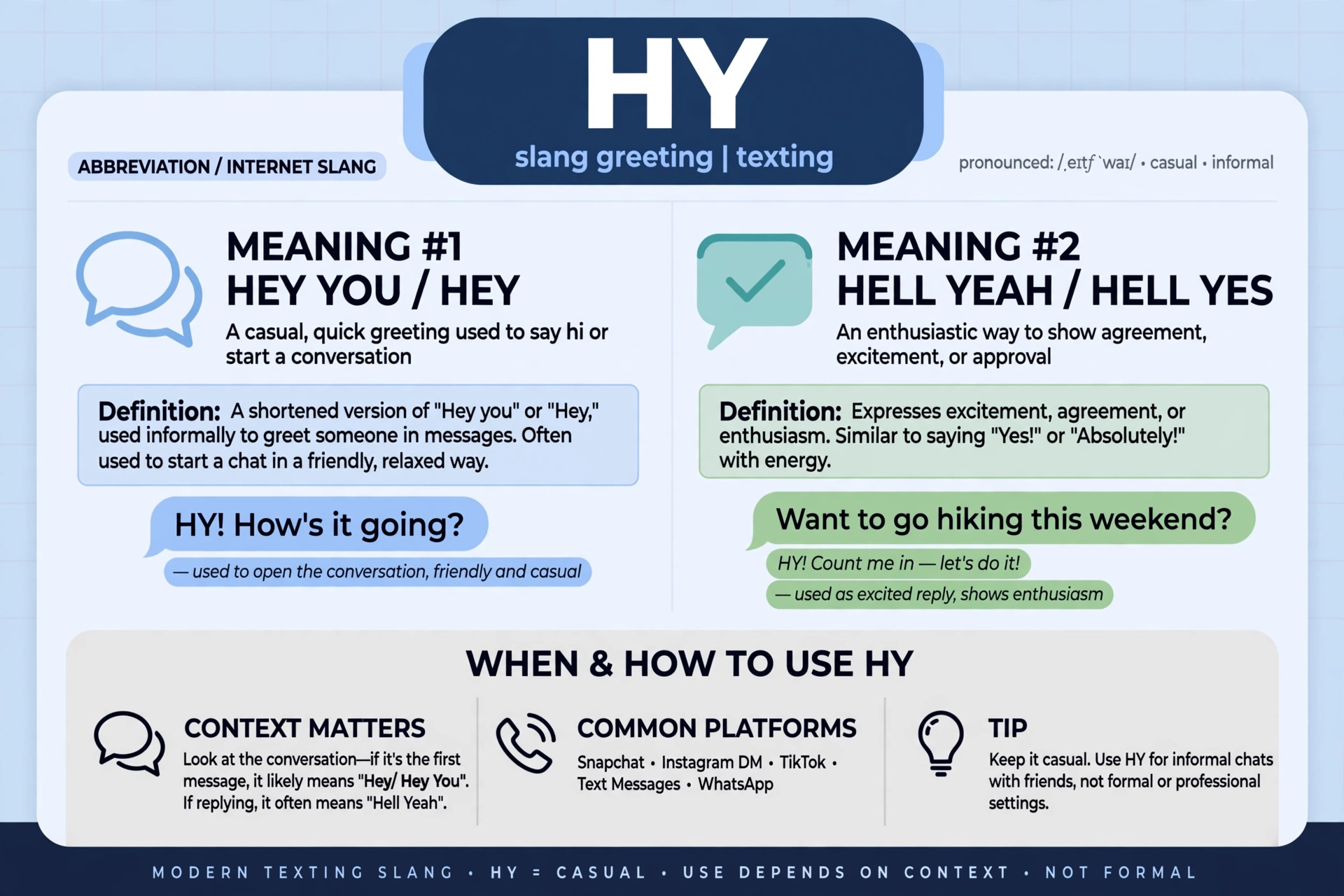
Quick Answer: In texting, HY most commonly means “Hell Yes” — an enthusiastic way to show excitement or strong agreement — but it can also mean “Hey You” (or simply “hi”) when used as a greeting. Which meaning applies depends on where it appears: as a reply to something, HY almost always means “Hell Yes”; at the very start of a conversation, it usually means “Hey You.” For example: “Want to come to the concert?” — “HY! I wouldn’t miss it” means Hell Yes, while “HY! Long time no talk” means Hey You.
| Term | Stands For | Means | Example |
|---|---|---|---|
| HY | Hell Yes / Hey You | “Absolutely!” or “Hi there” — high-energy agreement/excitement, or a casual friendly greeting | “HY! That sounds amazing 🔥” |
HY Meaning & Definition
Let’s settle this properly, because most guides you find online actually disagree with each other about what HY means — and that’s the whole reason this page exists. Some blogs insist HY means “hi.” Others swear it means “Hell Yes.” A few claim it means “Hey You.” The honest truth is: all of them are right, in different contexts. HY is one of those rare slang terms with two genuinely popular meanings, and the conversation around it decides which one applies.
Here’s the simple framework that untangles everything:
- HY as a reply → almost always means “Hell Yes.” Someone asks you a question or shares exciting news, and “HY!” is the fastest possible way to say yes, absolutely, I’m in. Example: “Pizza tonight?” — “HY 🍕”
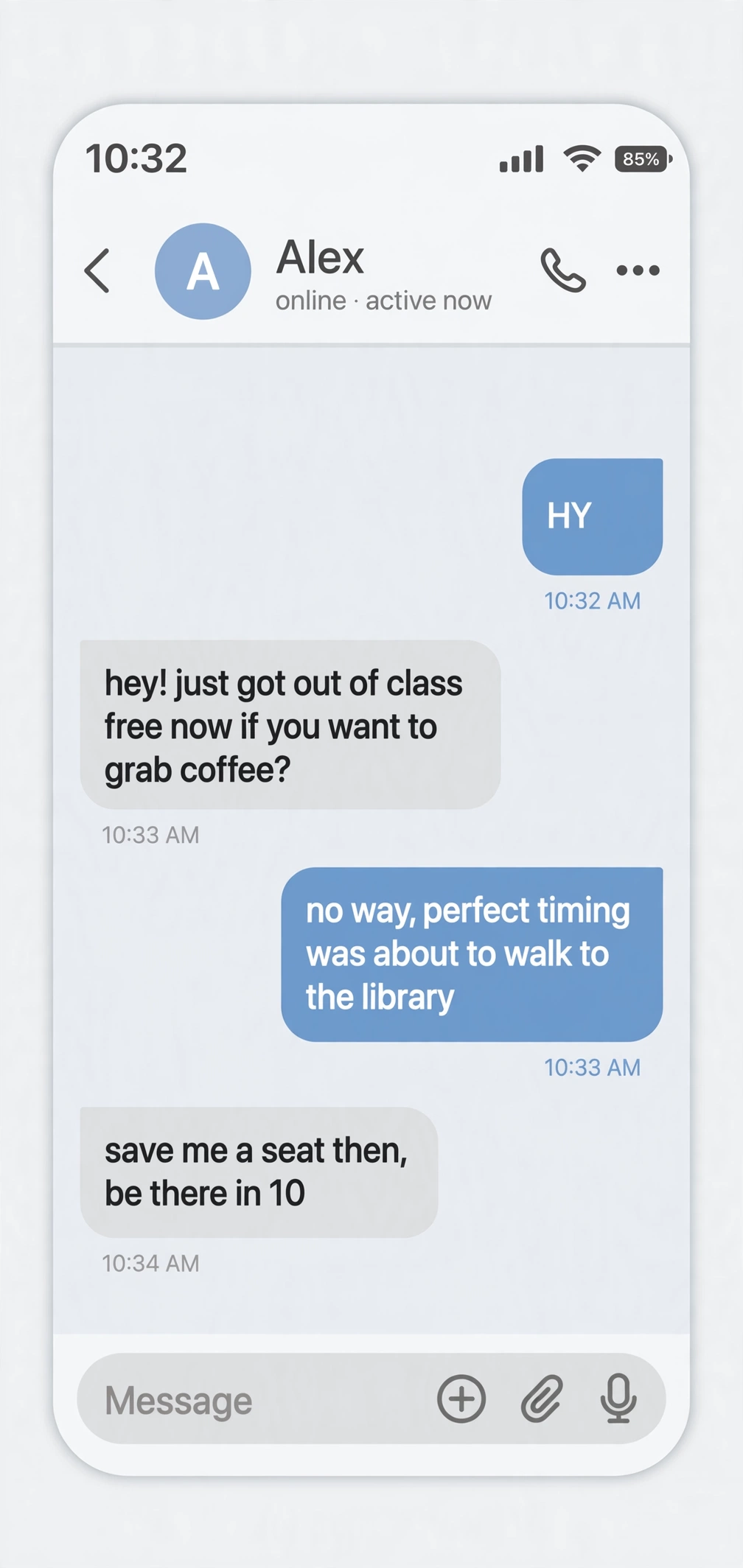
- HY at the start of a chat → almost always means “Hey You” / “Hi.” It’s a quick, warm opener — shorter and breezier than typing “hey.” Example: “HY! What are you up to?”
Why does one tiny abbreviation carry two meanings? Because HY isn’t really a strict acronym — it’s a texting compression. Written fast, “hell yes” squeezes down to its two loudest sounds (H-Y), while “hi” naturally stretches into “hy” the same way “hey” stretches into “heyy.” Two different shortcuts crashed into the same two letters, and both survived because they almost never appear in the same spot in a conversation.
The final clue is energy. “Hell Yes” HY is loud — it usually comes with exclamation marks, fire emojis 🔥, or all-caps. “Hey You” HY is soft — it shows up at the start of a message, often with a smiley 🙂 or a name attached. Learn to read those two signals and you’ll never misread HY again.
Introduction
Picture this: you’re having a perfectly normal day when your phone lights up with a message that just says “HY.” That’s it. Two letters. No context. Now your brain starts spinning — is this person excited about something? Saying hello? Being flirty? Are they yelling at you, or just being casual?
Welcome to the beautifully confusing world of HY, one of texting’s most misunderstood abbreviations. It’s short, it’s punchy, and it’s used millions of times a day across Snapchat, TikTok, Instagram DMs, and WhatsApp — yet almost nobody agrees on what it actually means.
In this complete guide, you’ll learn exactly what HY means in texting, how to tell its two main meanings apart in seconds, where it came from, real examples for every situation (friendly, funny, and even workplace-adjacent), how it compares to every similar slang term, the mistakes people make with it, and — most importantly — how to reply naturally no matter which HY you receive. By the end, those two little letters will hold zero mystery for you. If you enjoy decoding texting slang, you may also like our guides on IMK meaning in text and TYSM meaning.
Origin
HY doesn’t have one single birthplace — it has two origin stories, one for each meaning, which is exactly why it’s so confusing today.
The “Hell Yes” origin: The phrase “hell yes” has been part of spoken American English for decades — an emphatic, slightly rebellious way to say yes with full commitment. When texting culture exploded in the early 2000s, enthusiastic replies needed to be fast. Typing “hell yes” takes 8 characters; “HY” takes 2. Gamers, forum users, and early social media adopters compressed it the same way they compressed laughing out loud into LOL and “oh my god” into OMG. By the 2010s, “HY” as “Hell Yes” was standard equipment in Snapchat streaks, group chats, and Twitter replies.
The “Hey/Hi” origin: The second story is simpler and quieter. People have always typed greetings loosely — “hi” becomes “hii,” “hey” becomes “heyy,” and in fast, careless typing, “hi” frequently comes out as “hy.” It wasn’t planned; it was a happy accident of thumbs moving too fast on tiny keyboards. Friends kept typing it, friends kept understanding it, and it stuck. Over time, “hy” developed its own identity as a greeting slightly breezier and more casual than “hey” — the texting equivalent of a quick wave 👋.
The smartphone era (2010s–today): TikTok, Instagram, and Snapchat supercharged both meanings at once. “HY 🔥” became the default enthusiastic reply in comment sections, while “hy 😊” became a standard DM opener — especially among teens and Gen Z. Emojis became the unofficial disambiguator: fire and exclamation marks signaled “Hell Yes,” while smileys and waves signaled “Hey You.”
Popularity
HY will never trend on the news, but in the world of everyday texting, it’s enormously popular — and its popularity comes from three things:
- Speed: Two letters. Nothing beats it for effort-to-energy ratio. In a group chat moving at full speed, “HY” lands faster than “hell yes,” “sounds great,” or even “yeah.”
- Emotional range: Most abbreviations do one job. HY does two — it can open a conversation and react inside one. That double duty makes it unusually sticky.
- Platform universality: Unlike slang that’s trapped on one app, HY works everywhere — Snapchat, TikTok comments, Instagram DMs, WhatsApp, Discord, iMessage. It’s platform-agnostic, which is why it keeps spreading.
Search interest in “HY meaning” has stayed remarkably steady year after year, which tells you something important: HY isn’t a fad — it’s vocabulary. New waves of young texters keep encountering it, keep getting confused, and keep looking it up. And here’s a fascinating detail: much of that confusion is caused by the guides themselves. Because different blogs picked different “official” meanings, a person who reads one guide and then sees the other usage in the wild feels lost all over again. This guide exists to end that cycle — both meanings, one page, no confusion.
How It Is Used
HY’s spelling never changes, so the skill isn’t memorizing letters — it’s reading the situation around them. Here are the four real-world uses, plus the instant test that tells them apart.
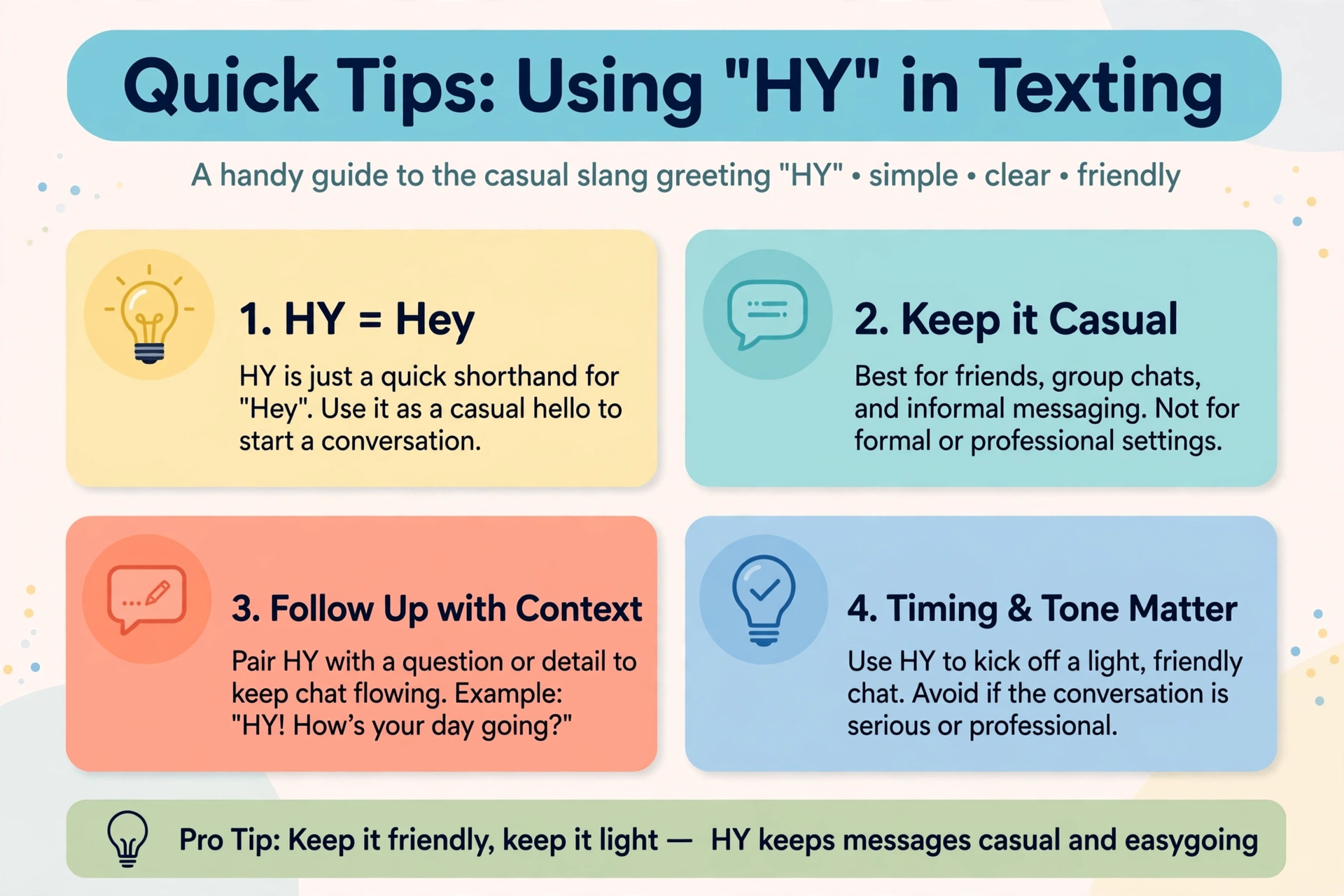
1. As an enthusiastic “yes” (the #1 use). Someone proposes something, and HY is the reply. “Road trip this weekend?” — “HY 🚗💨”. This is HY at its purest: maximum agreement, minimum typing. It says not just yes, but yes and I’m genuinely excited about it.
2. As a greeting at the start of a chat. No question asked, no news shared — HY just opens the door. “HY! How have you been?” This version is warm and casual, the digital equivalent of bumping into a friend and waving.
3. As hype or encouragement. Someone shares good news or a bold plan, and HY cheers them on. “I finally submitted my application!” — “HY! Let’s gooo 🔥”. Here it’s less “yes” and more “that’s awesome” — the energy of a high-five in two letters.
4. As a flirty opener. With the right emojis, “Hey You” HY turns playful. “HY you 😏” lands very differently from “HY! What’s up?” — tone and emoji do all the work.
The 3-second position test: Look at where HY sits. At the start of a conversation, before anything else? → greeting (“Hey You”). As a reply to a question, invite, or news? → “Hell Yes.” This single test resolves the meaning correctly the vast majority of the time. The backup clue is punctuation: exclamation marks and 🔥🔥🔥 scream excitement; a smiley or a name signals a friendly hello.
Examples
Nothing teaches slang like seeing it alive in real conversations. Here are natural examples for every tone.
Friendly Examples
- “HY! I haven’t heard from you in forever — how’s college?” — a warm greeting after a long gap.
- “Want to grab coffee tomorrow?” — “HY ☕ definitely!” — enthusiastic agreement between friends.
- “I got the job!!” — “HY! I knew you’d crush it 🎉” — hype and celebration.
- “HY guys, who’s coming to the game tonight?” — opening a group chat casually.
- “Movie night at my place, you in?” — “HY 🍿 wouldn’t miss it.” — the classic excited yes.
Professional Examples
⚠️ Important: HY is not professional language — never use it with a boss, client, teacher, or in any formal email. But it does appear in casual workplace friendships (think Slack with teammates you’re close to). Here are realistic examples with the boundary clearly marked:
- Teammate on Slack: “Pizza Friday is back 🍕” — You: “HY! Finally.” — fine among close coworkers, never to your manager.
- Work friend: “They approved our time off!” — “HY 🎉” — celebrating with a peer, not in a formal channel.
- Colleague: “hy, did you see the updated schedule?” — a casual greeting between friendly coworkers (still better as “hey” here).
- 🚫 Never: replying “HY” to your boss’s “Can you send the report?” — that reads as flippant. Use “Absolutely, sending it now.”
Funny Examples
- “The WiFi is finally fixed.” — “HY 😭 we’ve been saved.” — dramatic relief over small wins.
- “I ate the entire pizza by myself.” — “HY, respect 🍕” — celebrating questionable life choices.
- “HY” — “…that’s it? That’s the whole message?” — “HY 😌” — the minimalist greeting, doubled down.
- “Group project meeting at 8 AM.” — “HY 🥲” — sarcastic enthusiasm (context is everything).
- “I just parallel parked on the first try.” — “HY!! Teach me your ways 🙌” — hyping a tiny victory like it’s the Olympics.
Comparison with Similar Terms
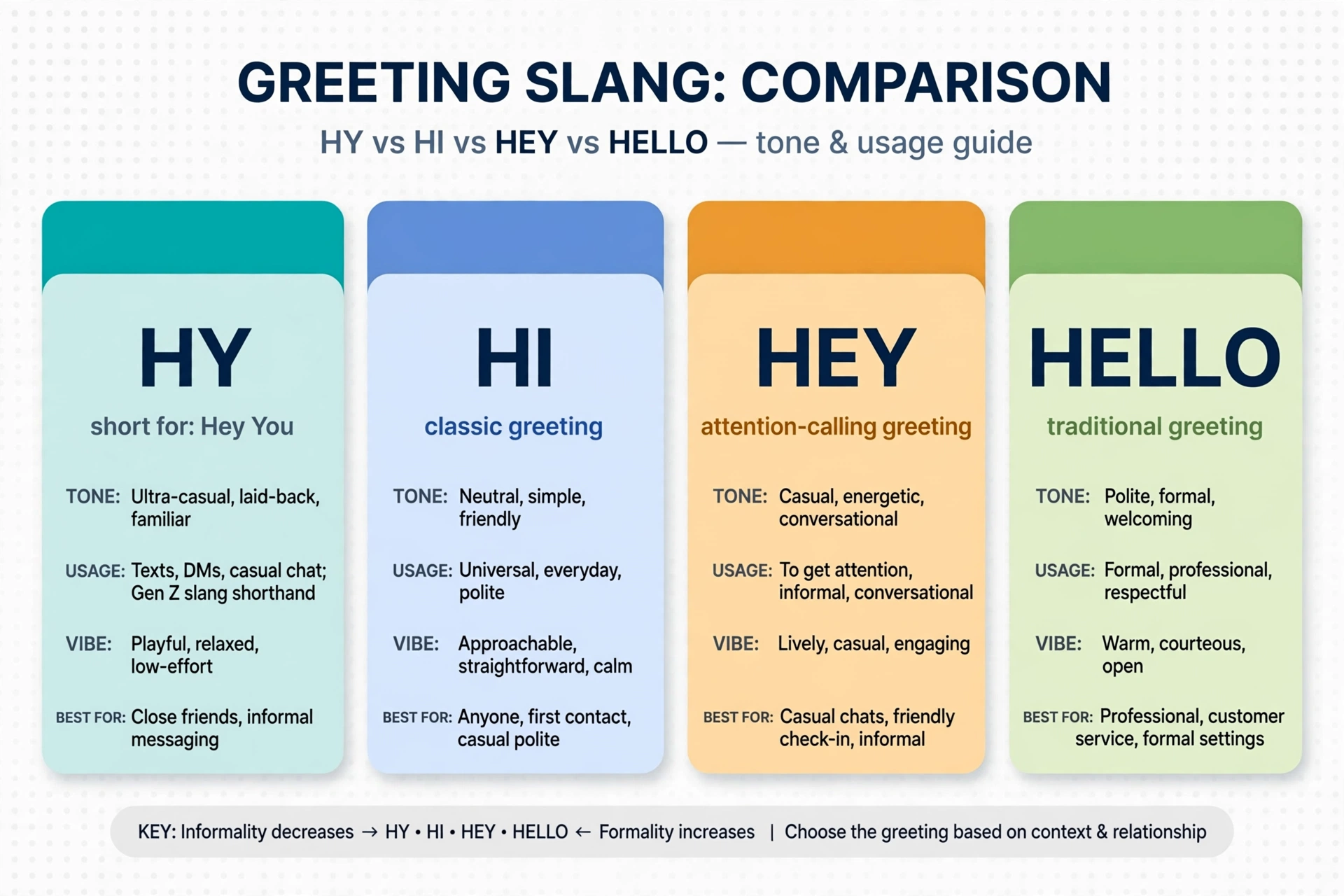
HY sits in a crowded neighborhood of short, punchy slang. Here’s how it stacks up so you never mix them up:
| Term | Means | Energy Level | How It’s Different from HY |
|---|---|---|---|
| HY | Hell Yes / Hey You | 🔥🔥🔥 High | Two meanings; the most enthusiastic of the bunch |
| Yeah / Yep | Yes | 🙂 Low–medium | Plain agreement with zero excitement — “HY” is “yeah” with fireworks |
| FS | For sure | 🔥 Medium–high | Confident agreement, but cooler and less emotional than HY |
| Bet | Okay, deal / yes | 😎 Medium | Gen Z agreement with swagger; HY is warmer and more hyped |
| ONG | On God (I swear) | 🔥🔥 High | Emphasis/truth-telling, not excitement — “ONG that’s true” vs “HY let’s go” |
| HBU | How ’bout you? | 🙂 Low | A question back at you, not a greeting or a yes — totally different job |
| Heyy / Hii | Hi (extra friendly) | 🙂 Medium | Greeting only — the “Hey You” side of HY without the “Hell Yes” side |
The key takeaway: HY is the only term on this list that works as both a greeting and an exclamation. Everything else picks one job. That dual role is HY’s superpower — and the reason it’s worth learning properly.
Alternate Meanings
Beyond the two main meanings, HY pops up with a few rarer interpretations. Most are uncommon, but knowing them saves you from the occasional head-scratcher:
| Meaning | Full Form | When It Shows Up | How Common |
|---|---|---|---|
| Hell Yes | — | Excited agreement, hype, celebration | ⭐⭐⭐⭐⭐ Very common |
| Hi / Hey | — | Quick casual greeting | ⭐⭐⭐ Common |
| Heck Yeah | — | Milder version of “Hell Yes” | ⭐⭐ Occasional |
| Hungry Yet? | — | Food plans with close friends | ⭐ Rare |
| Heard You | — | Short acknowledgment (“got it”) | ⭐ Rare |
| Are You Home Yet? | — | Parents/partners checking in | ⭐ Rare |
| Typo for “hey” | — | Fast careless typing | ⭐⭐ Occasional |
Bottom line: in everyday texting, Hell Yes and Hey You cover the overwhelming majority of uses. The rest are edge cases you’ll rarely meet — but now you won’t be confused if you do.
Professional or Polite Alternatives
Since HY is strictly casual, here’s what to use when the situation calls for something more polished:
- Instead of “Hell Yes” HY: “Absolutely!” • “Definitely!” • “I’d love to.” • “Of course.” • “Sounds great — count me in.” • “Yes, that works perfectly.”
- Instead of greeting HY: “Hello!” • “Hi there!” • “Hey, how are you?” • “Good to hear from you!”
- The workplace rule: if the person signs their emails, don’t send them HY. Save it for friends, peers you’re close with, and casual group chats.
- The age rule: with parents, grandparents, teachers, or anyone who might not know the slang, HY can read as confusing or even rude — a clear “Yes, I’d love to!” is always safer.
Common Mistakes
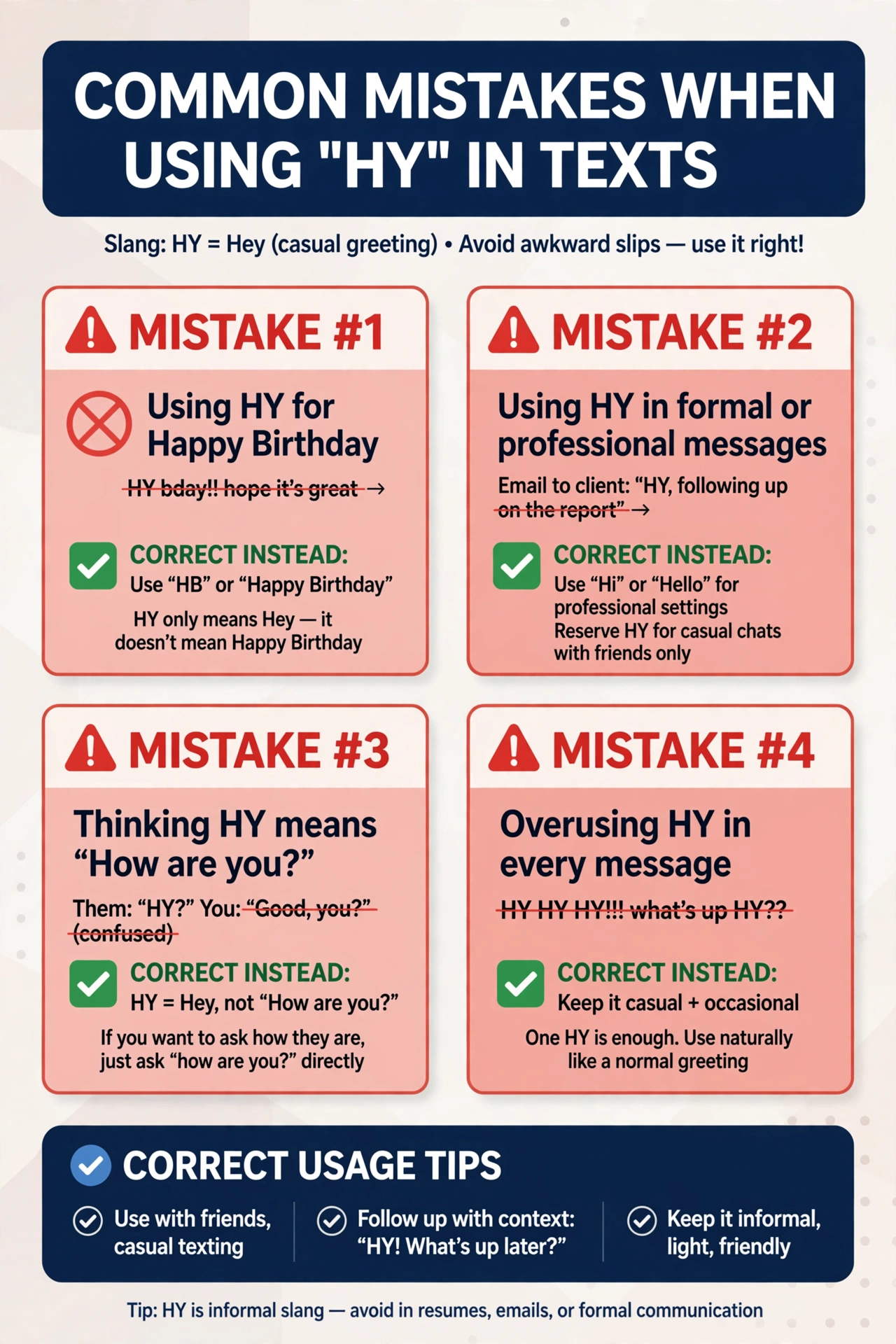
HY is simple, but people still get tripped up. Here are the mistakes to avoid:
- ❌ Mixing up the two meanings. Replying “You’re welcome!” to an excited “HY!” (they meant Hell Yes, not hello) or answering a greeting “HY!” with “Glad you’re excited” (they just said hi). Always run the position test first.
- ❌ Using HY with authority figures. Texting “HY” to your boss, professor, or a client reads as careless or disrespectful. The informality that makes it fun with friends makes it risky at work.
- ❌ Answering a real question with just “HY.” “Did you finish the assignment?” — “HY” is ambiguous (yes? hello?). A bare HY only works as a reply when the question is an invitation or exciting news.
- ❌ Confusing HY with HBU. They look similar at a glance, but HBU means “how ’bout you?” — a question, not a greeting or a yes. Replying “HY” to “HBU” creates a nonsense loop.
- ❌ Reading sarcasm wrong. “Meeting moved to 7 AM” — “HY 🥲” is almost certainly sarcastic. Take the emoji and context seriously before assuming enthusiasm.
- ❌ Overusing it. HY is high-energy by design. Drop it into every message and it loses all impact — like shouting everything you say. Save it for moments that deserve the hype.
Quick Tips
Master HY with these practical rules — including exactly how to reply based on the tone you receive:
| The HY You Got | What It Means | How to Reply | Example Reply |
|---|---|---|---|
| Friendly greeting: “HY! What’s up?” | Hey You | Greet back warmly, ask a question | “Heyy! Not much, you?” |
| Excited: “HY 🔥🔥” | Hell Yes | Match the energy | “I KNOW right?! 🔥” |
| Flirty: “HY you 😏” | Hey You (playful) | Match tone only if welcome | “Hey you 😊” |
| As a yes: “Beach tomorrow?” — “HY” | Hell Yes | Confirm the plan | “Yesss! What time?” |
| Sarcastic: “HY 🥲” (bad news) | Mock enthusiasm | Acknowledge the joke | “Lol I know, brutal 😅” |
- ✅ Mirror the energy. Excited HY gets excitement back; chill HY gets a chill reply. Matching tone is the #1 rule of natural texting.
- ✅ When in doubt, ask. “Haha — HY as in hell yes, or just saying hi?” is a perfectly fine reply. Nobody minds; everyone has been confused by HY.
- ✅ Use emojis as your disambiguator. Sending HY? Add 🔥 for excitement or 🙂 for a greeting so the other person doesn’t have to guess.
- ✅ Keep it out of formal chats. School emails, work messages, first-time introductions — HY doesn’t belong there. Ever.
FAQ
1. What does HY mean in texting?
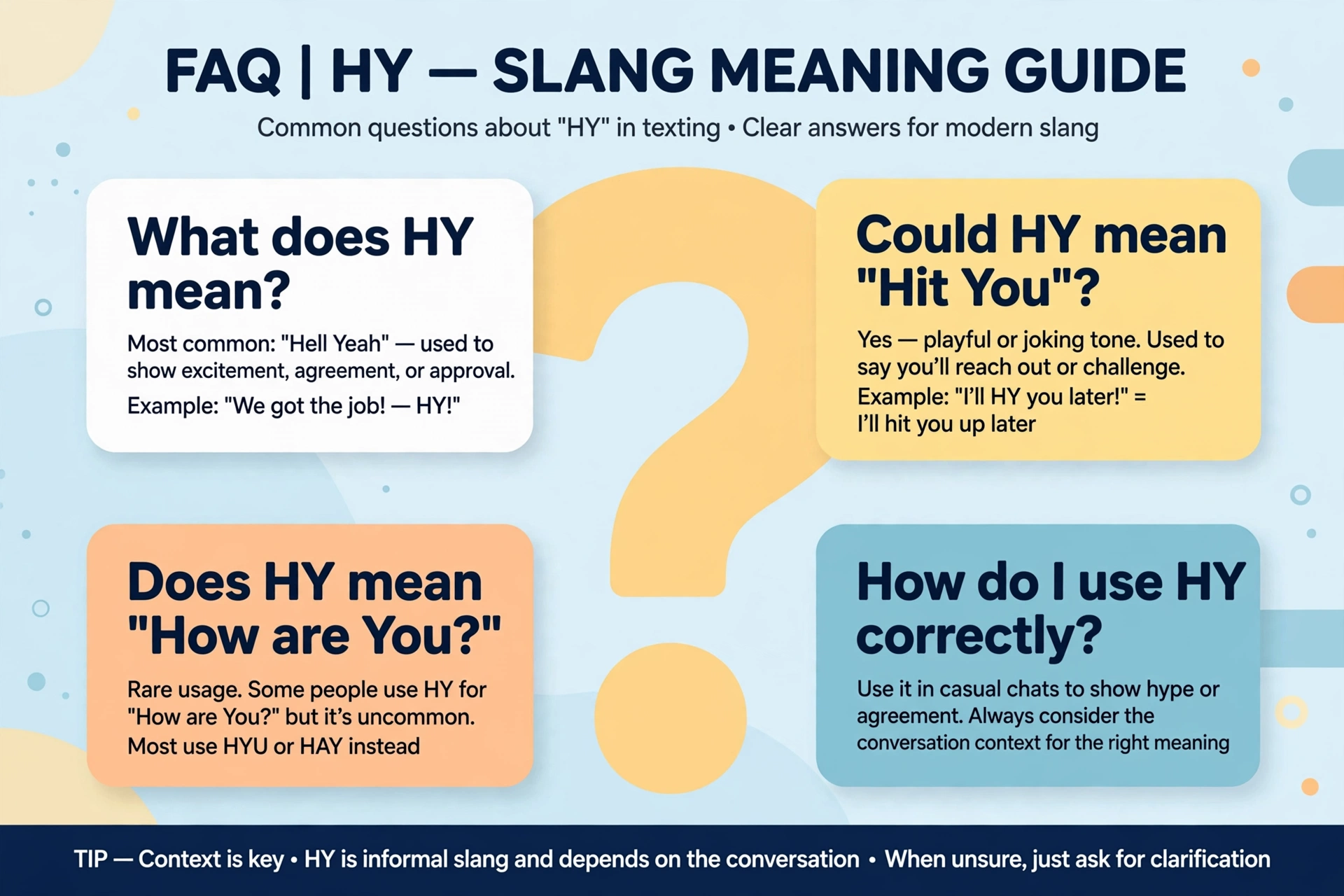
HY most commonly means “Hell Yes” — an enthusiastic way to agree or show excitement. It can also mean “Hey You” (or “hi”) when used as a greeting at the start of a conversation. Context and position in the chat tell you which one applies.
2. Does HY mean “hell yes” or “hey”?
Both — that’s what makes HY tricky. As a reply to a question or news, it means “Hell Yes.” At the start of a conversation, it means “hey/hey you.” If you see “HY!” answering an invitation, it’s excitement; if it opens a DM, it’s a greeting.
3. Is HY flirty?
It can be, but usually isn’t. “HY you 😏” with a smirk emoji is flirty; “HY! What’s up?” is just friendly. The flirtiness comes from the emojis, the timing (late-night texts), and your relationship with the sender — not from the letters themselves.
4. What does HY mean on Snapchat?
The same as everywhere else: usually “Hell Yes” as an excited reply, or “Hey You” as a greeting. On Snapchat it’s especially common in streak chats and story replies — “HY 🔥” on your story means they love it.
5. How do you reply to HY?
Match the tone: reply to an excited HY with excitement (“I know, right?!”), and reply to a greeting HY with a greeting (“Heyy! What’s up?”). If you’re unsure which meaning was intended, it’s fine to ask: “HY as in hell yes, or just saying hi? 😄”
6. Is HY rude or unprofessional?
HY isn’t rude among friends — it’s warm and fun. But it is unprofessional: never use it with bosses, clients, teachers, or in formal messages. In those settings, replace “Hell Yes” HY with “Absolutely!” and greeting HY with “Hello!”
7. What’s the difference between HY and HBU?
They’re completely different. HY = “Hell Yes” or “Hey You” (excitement/greeting). HBU = “How ’bout you?” (a question asking for your news). Don’t mix them up — replying “HY” to “HBU” makes no sense. See our guide to HBU meaning in chat for the full breakdown.
8. Is HY still popular in 2026?
Yes — HY remains a staple of casual texting, especially among teens and Gen Z on Snapchat, TikTok, Instagram, and WhatsApp. Unlike fad slang that spikes and vanishes, HY has stayed relevant for over a decade because it does a simple job (fast excitement, fast greeting) that never goes out of style.
Conclusion
Two letters, two meanings, zero mystery — that’s HY in a nutshell. Most of the time, it’s either an enthusiastic “Hell Yes” fired back as a reply, or a breezy “Hey You” opening a conversation. The position test (start of chat = greeting, reply = excitement) will decode it correctly almost every time, and matching the sender’s energy will make your replies feel completely natural.
Now the next time your phone lights up with a lonely little “HY,” you won’t freeze — you’ll know exactly what it means, exactly how to read the tone, and exactly what to send back. And honestly? That’s worth celebrating. HY! 🎉
Keep decoding texting slang with our other guides: HBU meaning in chat and FN meaning in text.
