
Quick definition: A spanish slang translator is a tool, app, or online dictionary that translates informal Spanish slang words and phrases — the kind of language people actually use in chats, on TikTok, and on the street — into plain English (or standard Spanish), along with the tone, context, and country where each expression is used.
Spanish Slang Translator Meaning & Definition
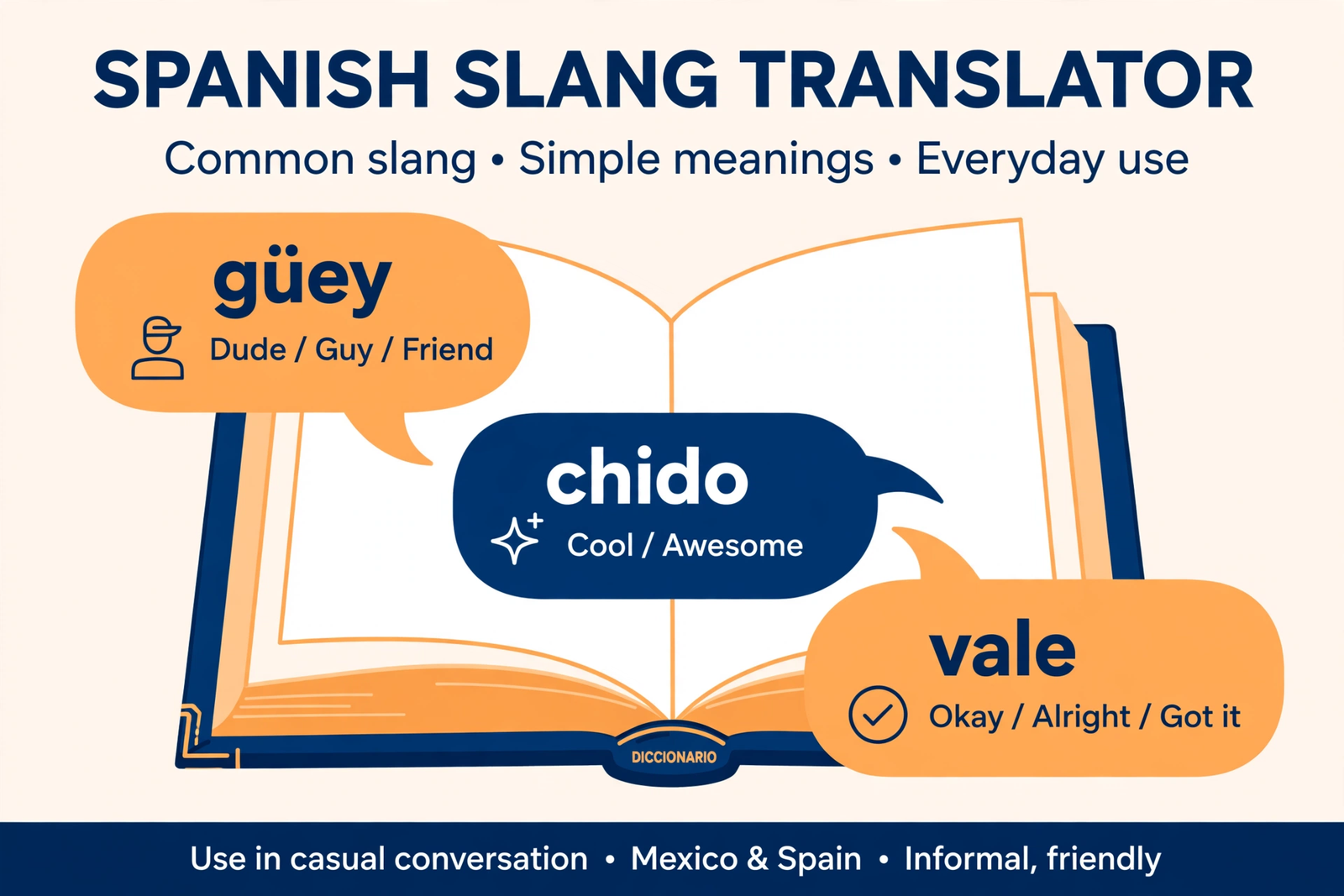
A spanish slang translator does what a regular translator cannot: it decodes the casual, playful, and sometimes rude Spanish that never appears in textbooks. When someone texts you “¿Qué onda, güey?” or comments “¡Qué chido!” under a video, a standard translator might give you a stiff, literal answer — or fail completely. A spanish slang translator, on the other hand, tells you that qué onda means “what’s up?” in Mexico, that güey is a casual way of saying “dude,” and that qué chido is excitement, roughly “how cool!”
The difference matters because Spanish slang is not one language — it is dozens of local dialects packed into one. The same word can be friendly in one country and insulting in another. Chulo can mean cute in Spain and cocky somewhere else. Boludo is a warm “dude” among friends in Argentina and an insult if you say it to a stranger. A good spanish slang translator keeps track of all of that: the literal meaning, the real meaning, the tone, and the place where people say it.
Most of these tools work in two directions. You can type a Spanish slang word and get its English meaning, or type an English phrase and get the slang version a local would actually say. The best ones also explain pronunciation, give example sentences, and warn you when a word is vulgar or only safe with close friends. In short, a spanish slang translator is less like a dictionary and more like a local friend who explains what people really mean.
Introduction
Imagine this: you are chatting with a friend from Mexico City, and they reply “¡No manches!” You paste it into a normal translator and get “Don’t stain yourself!” — which makes no sense at all. What they actually meant was “No way!” or “You’re kidding me!” That gap between literal translation and real meaning is exactly why the spanish slang translator exists, and why millions of learners, travelers, and social media users search for one every month.
Spanish is spoken by more than 500 million people across 20 countries, and every country has its own slang. The Spanish you hear in a Madrid café sounds nothing like the Spanish in a Mexico City group chat, a Buenos Aires bar, or a Havana street. Textbooks teach you “¿Cómo estás?” — real people say “¿Qué onda?”, “¿Qué tal, tío?”, or “¿Qué más, parce?” depending on where they live. If you only know formal Spanish, half of real conversations will fly straight past you.
That is where a spanish slang translator earns its place. It bridges the gap between classroom Spanish and street Spanish, helping learners understand song lyrics, memes, TV shows, and messages from native-speaking friends without embarrassing misunderstandings. In this guide, you will learn exactly what a spanish slang translator is, how it works, where it came from, the most popular Spanish slang words by country, and the best free tools you can try today. If you are curious about how slang tools work in general, our guide to the slang translator explains the wider world of slang translation apps before you dive into the Spanish-specific ones.
Origin
Spanish slang itself is as old as the language. Every generation of Spanish speakers has invented shortcuts, jokes, and code words — from the caló of Spain’s streets centuries ago to the lunfardo of Buenos Aires, a slang born in the port districts and tango halls of the late 1800s. What changed is not the slang, but the need to translate it. For most of history, you learned slang by living somewhere, not by looking it up.
The first real spanish slang translator tools appeared in the early 2010s, when smartphones and social media pushed slang into everyone’s pocket. Learners were suddenly reading real Spanish on Twitter, YouTube, and WhatsApp — and standard tools like Google Translate kept failing them. A normal translator is trained on formal text: news articles, books, and official documents. It has no idea that chamba means “work” in Mexico and Peru, or that plata means “money” across much of Latin America. Early slang dictionaries moved online to fill that gap, and then dedicated translator apps followed, built on crowdsourced slang databases where native speakers submitted the words they actually used.
The second wave came with AI. Modern tools no longer just match a word to a stored definition — they read the whole sentence, guess the country from the vocabulary, and pick the meaning that fits the context. Type “estoy en la luna” and a modern spanish slang translator knows you are daydreaming, not claiming to be on the moon. That context awareness is the biggest leap the technology has made, and it is why today’s tools feel far more natural than the word lists of ten years ago. The Real Academia Española, the official guardian of the Spanish language, still defines the formal standard — but slang lives outside its pages, which is exactly why dedicated slang translators became necessary.
Popularity
So why has the spanish slang translator become so popular, so fast? The short answer is that Spanish-language pop culture went global. Reggaeton, Latin trap, Spanish-language Netflix series like La Casa de Papel, and Mexican and Colombian creators on TikTok put slang in front of audiences who never studied Spanish formally. A viewer hears “¡Qué chimba!” in a show and wants to know what it means right now — not next semester.
Search interest tells the same story. Learners look up slang translators before trips to Spain and Latin America, before language exams with listening sections full of casual speech, and before replying to a crush who texts in slang. Language apps report that slang is one of the most requested features after basic conversation skills, because learners quickly discover that sounding natural matters more than sounding correct. Nobody wants to reply to “¿Qué onda?” with a stiff textbook sentence.
Social media made the need daily rather than occasional. Group chats, dating apps, gaming lobbies, and comment sections are full of slang, and a single misunderstood word can change the whole tone of a conversation. A spanish slang translator turns those moments from confusing to fun — and for many users, it is the first step from “I studied Spanish” to “I actually speak Spanish.”
How It Is Used
Using a spanish slang translator is simple, but using it well takes a little know-how. Here is how most people use one, step by step:
- Paste or type the phrase: Enter the slang word, sentence, or chat message you received. The more context you include, the better the result — a full sentence beats a single word.
- Pick the country or region: The best tools let you choose Mexican, Spanish, Argentine, Colombian, or Caribbean Spanish. This one choice fixes most wrong translations, because slang is regional first and Spanish second.
- Read the meaning and the tone: A good result gives you three things: what it literally says, what it really means, and whether it is friendly, funny, rude, or romantic. Never skip the tone — it decides whether you can repeat the word safely.
- Check the example sentence: Examples show you the word in a real sentence, which is how you learn to use it instead of just recognizing it.
- Try the reverse direction: Type an English phrase and see how a local would say it in slang. This is the fastest way to make your own messages sound natural.
Most tools also offer extras that are worth using: audio pronunciation so you can hear the word before you say it, a favorites list for the slang you keep forgetting, and offline mode for travel. Some newer tools add AI chat, where you can ask follow-up questions like “is this rude?” or “would a teenager say this?” — and get an honest answer. That conversational layer is where a spanish slang translator starts to feel less like a dictionary and more like a tutor, similar to how slang AI tools explain English slang with context and tone built in.
Examples
The fastest way to understand what a spanish slang translator does is to see it in action. Below are real examples of Spanish slang, what a literal translator gives you, and what the words actually mean — with the tone and country for each.
| Spanish Slang | Country | Literal Translation | Real Meaning | Tone |
|---|---|---|---|---|
| ¿Qué onda, güey? | Mexico | What wave, ox? | What’s up, dude? | Friendly, casual |
| ¡Qué chido! | Mexico | How cool (slang) | How cool! / Awesome! | Excited, positive |
| ¡No manches! | Mexico | Don’t stain! | No way! / You’re kidding! | Surprised, playful |
| Vale, tío | Spain | It’s worth it, uncle | Okay, mate / Alright, dude | Friendly, casual |
| ¡Qué guay! | Spain | How cool | How cool! / Awesome! | Excited, positive |
| Che, boludo | Argentina | Hey, fool | Hey, dude / mate | Friendly (with friends only) |
| ¡Qué chévere! | Colombia, Venezuela, Caribbean | How nice | How cool! / Great! | Warm, positive |
| ¡Qué bacán! | Chile, Peru | How cool | Awesome! / Great! | Excited, casual |
| Chamba | Mexico, Peru | — | Work / job | Neutral, everyday |
| Plata | Many Latin American countries | Silver | Money / cash | Neutral, everyday |
Friendly Examples
Friendly slang is the safest place to start, and it is where a spanish slang translator shines. A friend texts “¿Qué más, parce?” (Colombia) and you learn it simply means “what’s up, friend?” — parce is short for parcero, a Colombian word for a close friend. In Spain, someone might greet you with “¡Hola, tío!” — literally “hello, uncle,” but really just “hey, mate.” In Chile, “¿Qué onda, compa?” is a warm hello between friends. These are the words that make you sound like you belong, and a translator helps you answer them naturally instead of freezing up or replying with a formal sentence that sounds like a textbook.
Professional Examples
Slang also shows up in work settings, but the rules change. In a casual office in Mexico, a coworker might say “hay que ponerse las pilas” — literally “put in the batteries,” really “we need to step it up / get moving.” A spanish slang translator explains the idiom so you can nod along instead of wondering what batteries have to do with your deadline. In Spain, “estar liado” means being busy or tied up with work, not being in a fight. The professional rule is simple: understand slang at work, but answer in standard Spanish unless your coworkers use slang with you first. A translator keeps you in the loop without pushing you into language that could sound too casual for the room.
Funny Examples
Some slang is just funny once you know what it means. “Hablar por los codos” literally means “to talk through your elbows” — it describes someone who talks nonstop. “Estar en la luna” means “to be on the moon,” used when someone is daydreaming and not paying attention. In Argentina, if something is a mess, people say “es un quilombo” — a word with a wild history that now just means chaos. Funny slang is also where literal translators fail hardest, which is why people love pasting these phrases into a spanish slang translator and laughing at the difference between the robot answer and the real one.

Comparison with Similar Terms
A spanish slang translator is often confused with other language tools. They look similar, but they solve different problems. Here is how they compare:
| Tool | What It Does | Best For | Weakness |
|---|---|---|---|
| Spanish slang translator | Translates informal slang with tone, country, and context | Chats, memes, songs, TV shows, street Spanish | Not for formal or legal documents |
| Standard translator (e.g. Google Translate) | Translates standard Spanish accurately | Formal text, articles, instructions, travel signs | Often fails or misleads on slang |
| Spanish dictionary | Gives definitions of standard words | Studying vocabulary and grammar | Usually lists no slang, no tone, no examples |
| Slang dictionary website | Lists slang words with definitions | Looking up one word you already know | No full-sentence translation, no country filter |
| AI chatbot | Explains slang in conversation and answers follow-ups | Learning why a word is used and when it is safe | Answers vary; needs a good prompt |
The practical takeaway is to use the right tool for the job. A standard translator is still the best choice for a hotel booking or a work email. But the moment the language turns casual — a meme, a lyric, a voice note from a friend — a spanish slang translator is the tool that actually understands what is being said. Many learners keep both open side by side: the standard translator for the sentence structure, the slang translator for the words that carry the real meaning.

Alternate Meanings
The phrase “spanish slang translator” can mean a few different things depending on who is searching for it, and each meaning points to a slightly different tool:
- A slang-to-English translator: The most common meaning — you paste Spanish slang and get plain English. This is what most people want.
- An English-to-slang translator: You type normal English and get the slang version a native speaker would use, for example turning “that’s cool” into “¡qué chido!” in Mexico or “¡qué guay!” in Spain.
- A regional slang translator: A tool focused on one country’s slang, like a Mexican Spanish slang translator or an Argentine slang translator, with deeper local vocabulary.
- A slang dictionary with translation: Less of a translator and more of a searchable word list, useful when you want to browse slang by topic instead of translating a specific message.
- A translator app with a slang mode: Some full translator apps now include a casual or slang setting, so the same app handles both formal and informal Spanish.
There is also a playful alternate meaning: some people use “spanish slang translator” to describe a friend — the one person in the group chat who always explains what the slang means. If you become that person, congratulations: the tools in this guide will make you even better at it.
Professional or Polite Alternatives
Slang is fun, but it is not always appropriate. Here are polite, standard-Spanish alternatives for the most common slang situations, so you can switch registers when the moment calls for it:
| Situation | Slang Version | Polite / Professional Alternative |
|---|---|---|
| Greeting a friend | ¿Qué onda, güey? | ¿Cómo estás? / ¿Qué tal? |
| Saying something is cool | ¡Qué chido! / ¡Qué guay! | ¡Qué interesante! / ¡Me encanta! |
| Agreeing | Vale / Órale | De acuerdo / Perfecto |
| Talking about work | Tengo mucha chamba | Tengo mucho trabajo |
| Talking about money | No tengo plata | No tengo dinero |
| Saying goodbye | ¡Nos vemos, parce! | ¡Hasta luego! / ¡Nos vemos pronto! |
The golden rule is to match your language to your audience. With friends, slang builds closeness. With a teacher, a client, or someone older, standard Spanish shows respect. A good spanish slang translator helps with both sides: it teaches you the slang, and the example sentences usually show you the formal version too, so you learn when to switch.
Common Mistakes
Even with a great tool, learners make the same mistakes with Spanish slang again and again. Avoid these and you will sound far more natural:
- Using slang from the wrong country: Calling a Spaniard güey or a Mexican tío will confuse people at best. Always check the country tag on your translation before you repeat a word.
- Trusting the literal translation: “No manches” has nothing to do with stains, and “estar en la luna” has nothing to do with space. If the literal meaning sounds strange, it is slang — look up the real one.
- Using rude words with strangers: Many slang words are warm between friends and insulting to strangers. Boludo is the classic example: friendly in Argentina among friends, offensive if you say it to someone you just met.
- Overusing slang to sound fluent: Stuffing every sentence with slang has the opposite effect — it sounds forced. Native speakers mix slang into normal sentences; they do not speak in pure slang.
- Forgetting tone and gender: Some words change meaning with tone of voice or gender, like chulo/chula, which can mean cute, cool, or cocky depending on how you say it and who you say it about.
- Copying slang from song lyrics word for word: Lyrics exaggerate for rhythm and attitude. What sounds great in a reggaeton chorus can sound strange in a normal conversation.
Regional mix-ups deserve special attention. Vaina means “a thing” in Colombia and Venezuela, but in other places it can sound odd or even rude. Coger means “to take” in Spain and something far more vulgar in most of Latin America — a mistake every learner hears about exactly once. If you want to see how much slang changes from one Spanish-speaking community to another, compare the words in our Venezuelan slang guide with the Italian American slang guide: same language family, completely different street vocabulary.

Quick Tips
- Learn five words per country, not fifty words from everywhere: Pick one country’s slang — the one you visit, or where your friends live — and master its basics before branching out.
- Always translate the full sentence: Single words mislead. A whole sentence gives the translator the context it needs to pick the right meaning.
- Save the slang you actually hear: Keep a note on your phone for slang from your chats, shows, and songs. Reviewing your own list beats memorizing a generic one.
- Listen before you speak: Hear how natives use a word — in what situation, with what tone — before you try it yourself.
- Ask “is this rude?” before using a new word: A quick check in your translator or with a native friend saves you from an awkward moment.
- Watch shows with Spanish subtitles: Hearing slang while reading the same words locks both the sound and the meaning into memory.
- Practice in low-stakes chats: Try new slang with close friends first, not with a boss or a stranger.
- Pair the translator with a standard one: Use both tools together — standard for grammar and structure, slang for the words that carry the attitude.

FAQ
What is a spanish slang translator?
A spanish slang translator is a tool or app that translates informal Spanish slang words and phrases into plain English or standard Spanish. Unlike a regular translator, it explains the real meaning, the tone, and the country where the expression is used, so you understand what people actually mean in chats, songs, and shows.
Is there a free spanish slang translator?
Yes. Several free options exist, including SpanishDict’s slang entries, dedicated slang translator websites, and free tiers of AI chatbots that explain slang in context. Free tools cover the most common words well; paid apps usually add offline mode, audio, and deeper regional lists.
Can Google Translate understand Spanish slang?
Only partly. Google Translate handles standard Spanish very well, but it often gives literal translations for slang — like turning “¡No manches!” into “Don’t stain!” — which misses the real meaning. For slang, a dedicated spanish slang translator or an AI chatbot with context gives far better results.
What is the most common Spanish slang word?
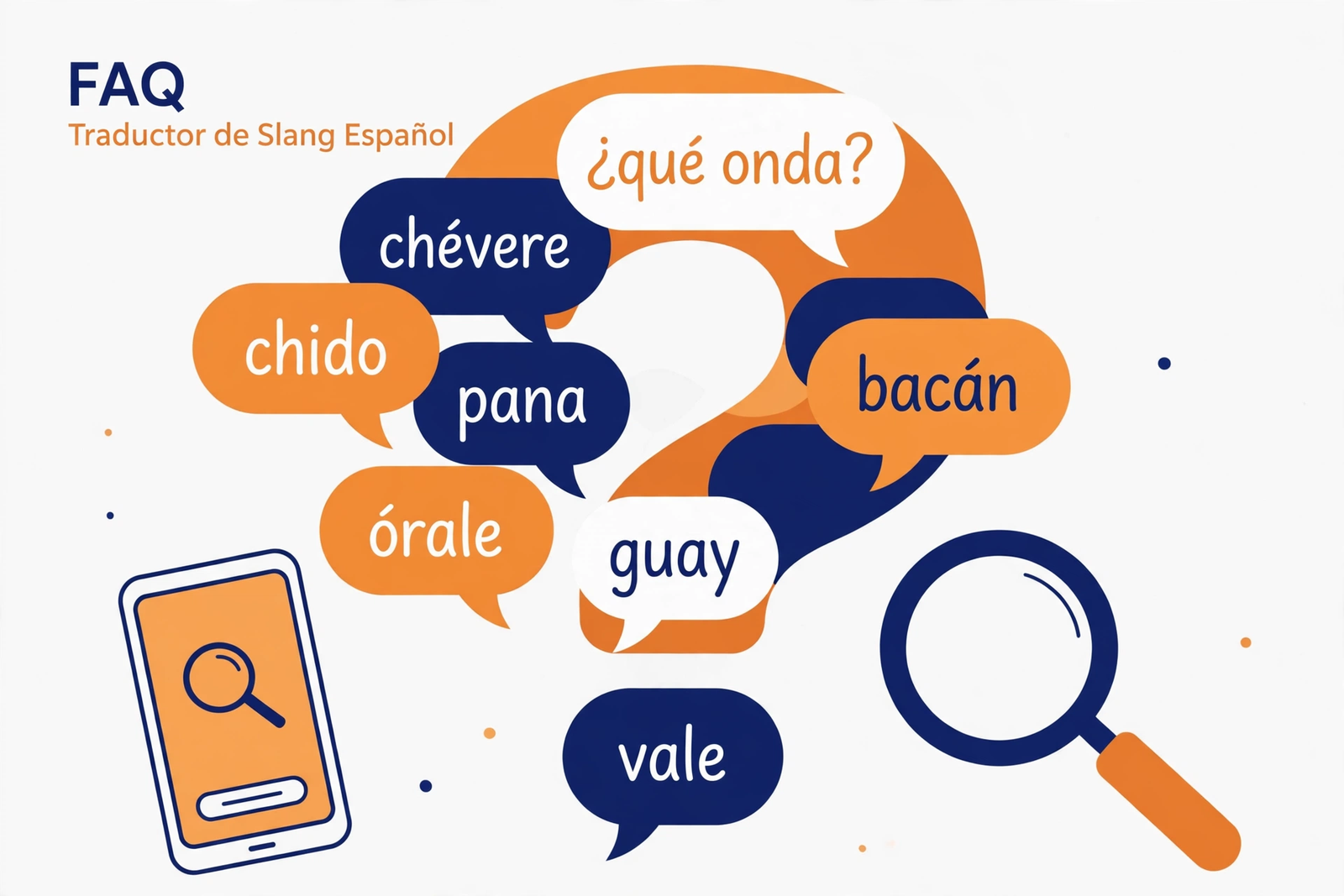
There is no single winner because slang is regional, but qué onda (Mexico), vale (Spain), che (Argentina), and chévere (Colombia and the Caribbean) are among the most used. Güey in Mexico and tío/tía in Spain are also extremely common in everyday speech.
How do you say “what’s up” in Spanish slang?
It depends on the country: ¿Qué onda? in Mexico, ¿Qué tal, tío? in Spain, ¿Qué más, parce? in Colombia, and ¿Qué hacés, che? in Argentina. A spanish slang translator with a country filter will give you the right version for the place you care about.
Is Spanish slang rude?
Some of it is, and some of it is warm and friendly — it depends on the word, the tone, and who you say it to. Words like boludo or güey are friendly between close friends but can be rude to strangers. Always check the tone label before using a new slang word.
What is the best app to learn Spanish slang?
The best app depends on your goal. For quick lookups, a dedicated slang translator site or SpanishDict works well. For learning in context, AI chatbots and language apps with slang lessons are better, because they explain when and how to use each word. Many learners use one of each.
How can I learn Spanish slang fast?
Watch shows and listen to music from the country whose slang you want to learn, keep a personal list of the words you actually hear, and translate full sentences — not single words — with a spanish slang translator. Practicing a few words a day in real chats will make them stick far faster than memorizing a long list.
Conclusion
A spanish slang translator is the bridge between the Spanish you studied and the Spanish people actually speak. It turns confusing messages like “¿Qué onda, güey?” into something you understand instantly, and it teaches you the tone, the country, and the context behind every word — the things a standard translator leaves out. Whether you are texting a friend in Mexico City, watching a series from Madrid, or planning a trip to Buenos Aires, this one tool can save you from misunderstandings and help you sound like you belong.
The key lessons are simple: translate full sentences, not single words; always check which country the slang comes from; learn the tone before you repeat a word; and mix slang naturally into normal Spanish instead of forcing it. Start with the friendly words — qué onda, vale, chévere — and build from there. Your chats will get funnier, your shows will make more sense, and your Spanish will sound more like a real person and less like a textbook.
Now you know what a spanish slang translator is, how it works, and which free tools to try first. Paste in the next slang phrase you do not understand, pick the country, and see what it really means — you might be surprised how much you have been missing. And if you enjoyed decoding Spanish slang, keep exploring the slang guides on this site: every word has a story, and every story makes your Spanish a little more real.
