
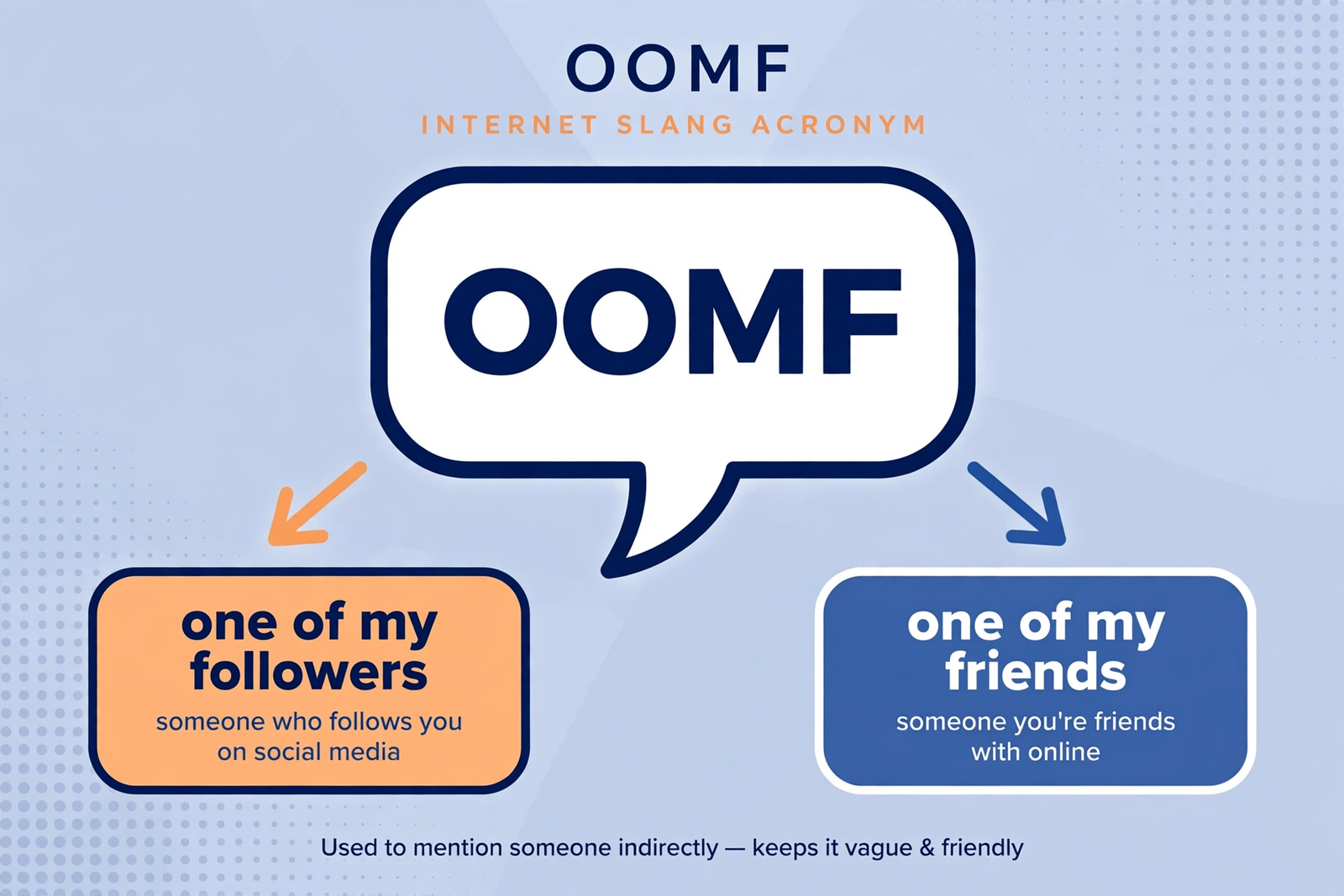
Quick definition: OOMF is internet slang short for “one of my followers” or “one of my friends.” People use it on X (Twitter), Tumblr, Instagram, and TikTok to talk about someone without naming or tagging them directly. If you have ever seen a tweet like “oomf just made my whole day” and wondered who on earth oomf is, this guide explains the oomf meaning slang in full — where it came from, how to use it, and the mistakes to avoid.
OOMF Meaning & Definition
The oomf meaning slang is simple once you know the trick: OOMF is an acronym for “one of my followers” or “one of my friends.” It works like a blank name tag. Instead of writing a person’s username, you write “oomf,” and everyone reading understands you mean one specific person — they just do not know exactly who.
That deliberate vagueness is the whole point. On social media, people constantly want to talk about someone — a crush, a funny mutual, an annoying follower — without starting a public conversation with that person. OOMF lets them do exactly that. The post feels personal and specific, yet it names nobody.
Here are the two meanings side by side:
- One of my followers — the original Twitter meaning. You are talking about someone who follows your account.
- One of my friends — the broader, warmer meaning that grew on Tumblr and later spread everywhere. The person is an online friend, not just a follower count.
Both meanings are in active use today, and context usually tells you which one applies. On X, “followers” is the safer reading; on Tumblr and in fandom spaces, “friends” is more common. Either way, the oomf meaning slang stays the same at its core: one of my people, unnamed on purpose.
OOMF is also a noun you can pluralize. “My oomfs” means your group of online friends or followers, and “oomfie” is the affectionate, cuter version — usually reserved for one particular mutual you really like.
Introduction
Scroll through X (formerly Twitter) for five minutes and you will probably meet an oomf. “Oomf is so real for this.” “I miss oomf already.” “Oomf just dropped the funniest thread.” Newcomers read these posts and feel left out of a joke everyone else seems to get. The good news is that there is no secret club — just four letters with a very practical job.
Social media runs on vagueposting: saying something pointed without pointing at anyone. Before OOMF, people wrote “someone” or “a certain person.” OOMF turned that habit into a single word that sounds like internet culture itself — short, playful, and instantly recognizable to anyone who spends time on timeline-based platforms. It also pairs naturally with the way people already talk about their online circles. If you know what moots slang means — your mutual followers, the people you follow back — then oomf is the next word in the same vocabulary: a single one of those people, mentioned without a name.
In this article, we will break down the oomf meaning slang from every angle: its origin story on early Twitter and Tumblr, how it spread to TikTok and Instagram, real examples in friendly, professional, funny, and even shady tones, a comparison with similar terms like moots and oomfie, and the common mistakes that make people use it wrong. By the end, you will not only understand oomf — you will know exactly when to use it yourself.
Origin
OOMF was born in the early days of Twitter and Tumblr, two platforms built around following strangers and forming fast, anonymous-feeling friendships. The hashtag #oomf was already in use by March 2010, and it began catching on more widely in 2011. On February 27, 2011, it was entered into Twittonary, the early Twitter slang dictionary, defined as shorthand for “one of my followers.” Urban Dictionary picked it up around the same time.
One of the earliest known tweets using the hashtag came from @MissShantae_ on February 21, 2011, who was upset that one of her followers had not texted her back. That is a perfect snapshot of how OOMF worked from day one: a small, personal complaint aimed at a real person, posted publicly, with the name carefully left out.
Tumblr played an equally important role. Tumblr’s culture was anonymous and confessional, full of blogs run under pseudonyms where people talked about their dashboards, their mutuals, and their online friendships. “One of my friends” fit Tumblr even better than “one of my followers,” because Tumblr friendships felt like real friendships even when nobody knew anyone’s real name. The acronym jumped between the two platforms for years, and each one shaped it a little.
There is also an older, unrelated “oomph” — the word for energy, flair, or that extra something (“add some oomph to your outfit”). The slang OOMF is a separate invention, even though the spelling overlap causes confusion. The acronym version is always written OOMF, never “oomph,” when it means a person.
Popularity
OOMF never really went away. Unlike slang that explodes for a month and dies, it has survived for more than a decade because it solves a problem that never goes away: how to talk about someone online without tagging them.
Its popularity comes in waves. In the early 2010s it was a Twitter and Tumblr staple. In the early 2020s, “oomfie” — the affectionate variant — became a meme in its own right, used ironically and sincerely at the same time. Then in 2024, the catchphrase “That’s oomf 😭😭😭” went viral on X as a punchline: people joked about imagining their oomfs showing up in huge numbers for weddings, parties, and other occasions. The joke works precisely because everyone knows what an oomf is — your people, your crowd, your corner of the internet.
Today, OOMF shows up in several places:
- X (Twitter): still its home turf, especially in subtweets, fandom posts, and quote posts.
- Tumblr: alive in dashboard culture, fandom, and “my oomfs” appreciation posts.
- Instagram: in captions, stories, and comments about followers and close friends.
- TikTok: in comments and captions, as TikTok’s social dynamics have become more follower-based. If you are decoding TikTok slang in general, OOMF belongs on the same list as the platform’s other community words.
The term has even escaped pure slang into mainstream media. In a 2022 New York Times interview, playwright Jeremy O. Harris explained OOMF to fellow artist Devan Shimoyama as “one of my friends — someone you know only in a digital space, from Twitter or Tumblr,” adding that “the oomfs run the world.” When a word gets explained in the Style Magazine, it has officially arrived.
How It Is Used
OOMF is flexible. It works as a noun, it takes a plural, and it carries almost any tone — sweet, neutral, funny, or shady. The meaning stays the same; the attitude changes with context.
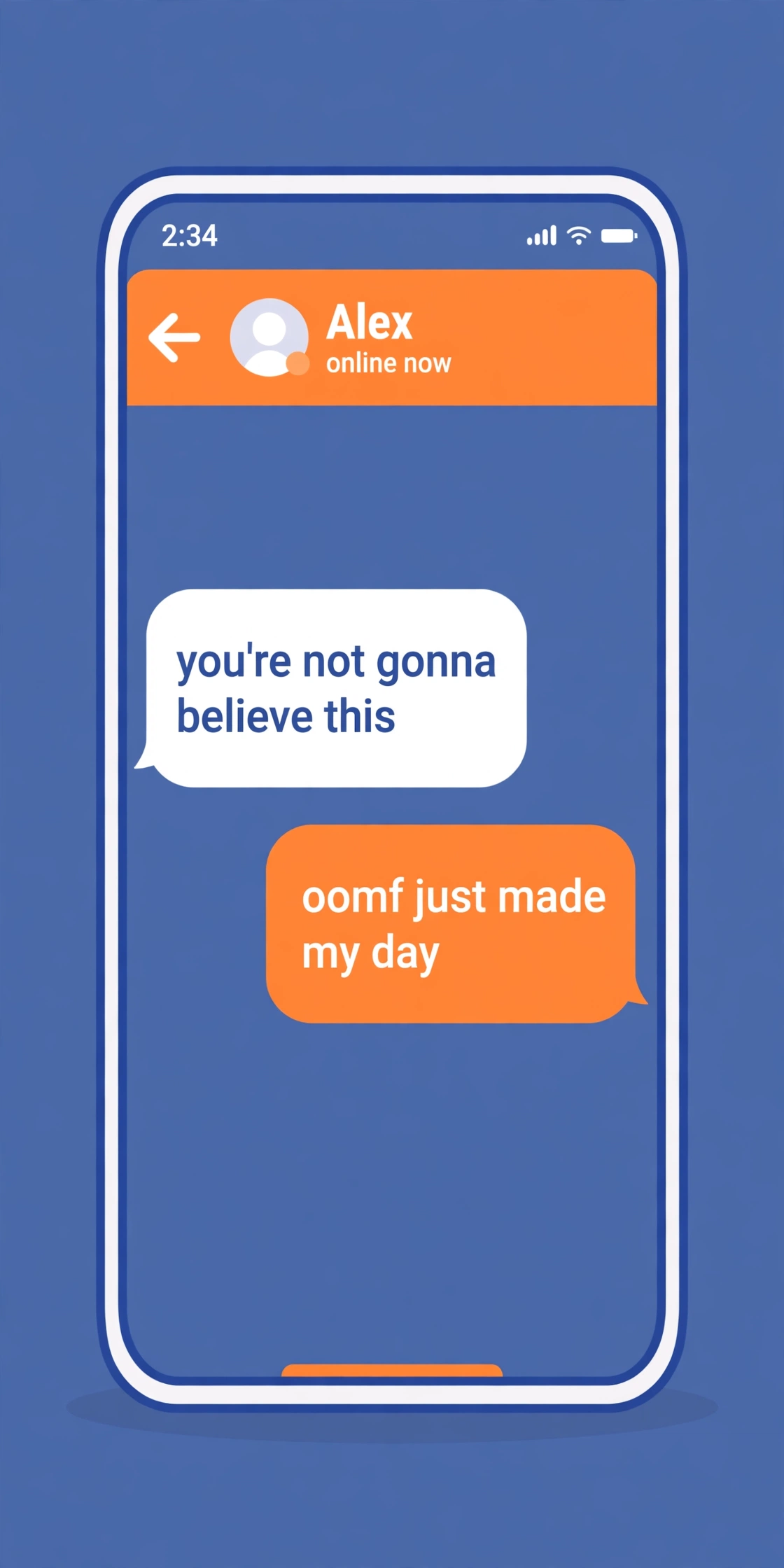
As a noun: “Oomf just sent me the funniest meme.” Here, oomf is a person — one follower or friend.
As a plural: “I love my oomfs so much.” Now it means your whole circle of online friends.
As a hashtag: “#oomf” still appears on X and Tumblr, usually attached to a post about a follower.
As “oomfie”: the warmer version. “Oomfie” usually points to one specific mutual the poster is fond of — a favorite, not just any follower. People also use it ironically, calling someone “oomfie” with exaggerated affection as a joke.
The most important usage rule is the one people forget: OOMF always refers to a specific person, even though it names nobody. “Oomf did something nice today” means a real, particular follower did something nice. If you write “oomf” when you mean people in general, the sentence sounds odd — like pointing at someone in a crowd while talking about the weather.
It is also, by nature, a subtweeting tool. A subtweet is a post that addresses someone without mentioning them, and OOMF is the classic subtweet word. “Oomf really needs to stop liking my posts at 3 a.m.” is a message for one person, delivered to the whole timeline. Everyone knows it is about someone. Only the poster — and maybe the subject — knows who.
Examples
Real examples make the oomf meaning slang click. Notice how the same word shifts tone completely depending on what follows it.
Friendly Examples
- “Oomf just surprised me with the sweetest birthday message. I am so lucky to have them.”
- “Shoutout to my oomfs — you all make my timeline the best place on the internet.”
- “Oomfie and I stayed up till 2 a.m. talking about our favorite show. Best night ever.”
- “One of my oomfs drew fanart of my character and I am genuinely emotional about it.”
Professional Examples
- “An oomf of mine just launched their small business — go support them, the work is beautiful.”
- “Huge thanks to oomf for the referral. Networking on here actually works.”
- “My oomfie is hiring for a design role, DM them if you are interested.”
Even in a work context, OOMF keeps things casual. It fits creators, freelancers, and community managers who want to spotlight a follower without making it a formal announcement. Brands sometimes use it too, but only when their voice is already playful and community-focused — a stiff corporate account saying “oomf” usually sounds like it is trying too hard.
Funny Examples
- “Oomf just liked a tweet from 2019. The FBI investigation begins now.”
- “That’s oomf 😭😭😭” — the viral 2024 punchline, usually posted over a photo of a huge crowd, as if all your online friends just showed up at once.
- “Me explaining to my mom that oomf is not a person named Oomf.”
- “Oomf said ‘we should hang out sometime’ and I have been hiding ever since.”
Negative or Dismissive Examples
- “Oomf really needs to stop subtweeting me and just say it to my face.”
- “One of my oomfs unfollowed me after I posted my opinion. Good riddance.”
- “Oomf keeps stealing my tweets word for word. Be original.”
These are classic subtweets: the complaint is public, the target is unnamed, and the tension is obvious. That is OOMF doing its oldest job.
Comparison with Similar Terms
OOMF sits in a small family of internet words about online friends and followers. They look similar, but each one has its own job.
| Term | Meaning | Key Difference from OOMF |
|---|---|---|
| OOMF | One of my followers / friends | The baseline word — one specific person, unnamed. |
| Oomfie | Affectionate version of OOMF | Warmer and more specific; usually a favorite mutual. |
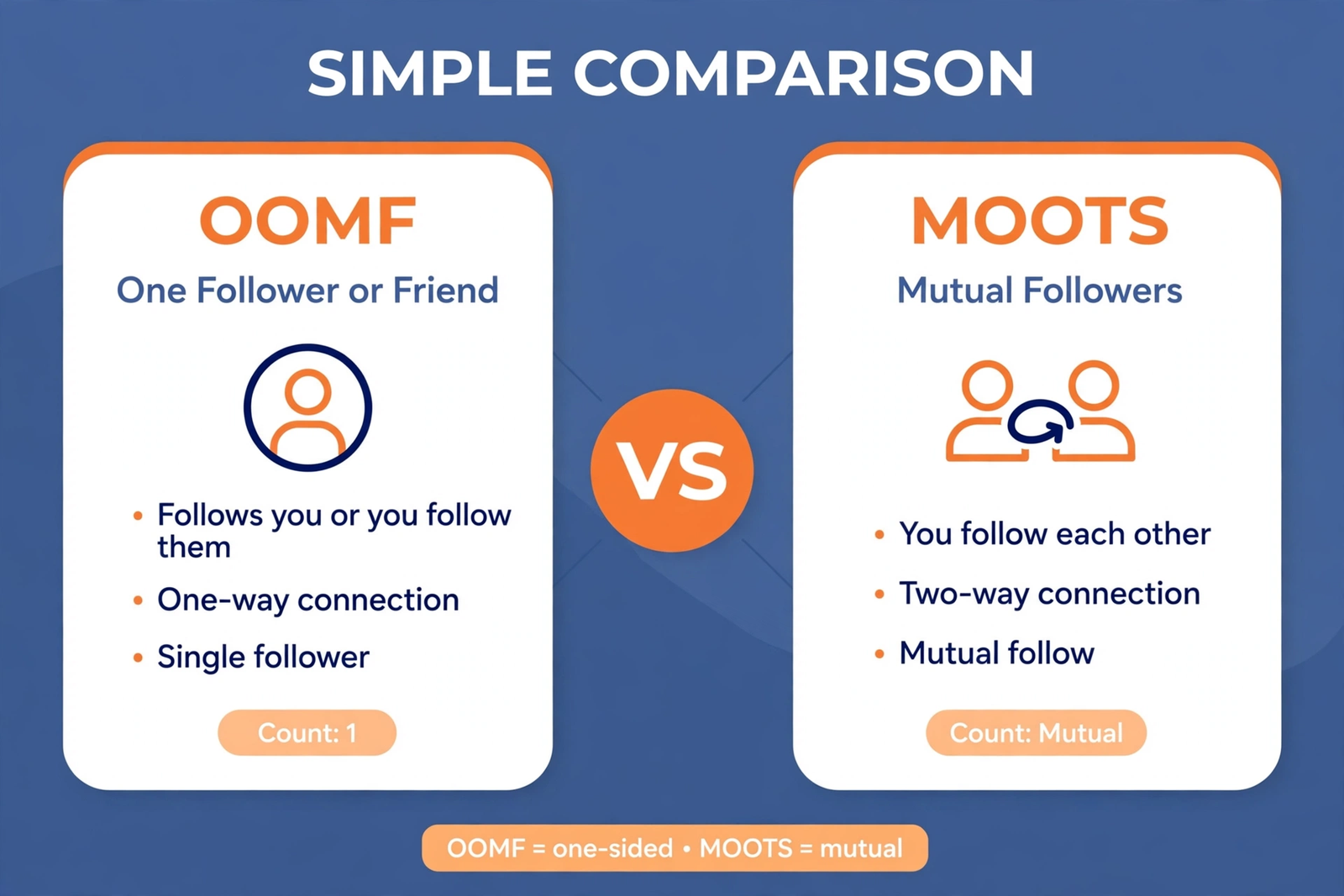
| Moots | Mutual followers (you follow each other) | Always mutual; OOMF can be any follower, mutual or not. |
| Mutual | Someone you follow and who follows you | The full word behind “moots”; more formal than OOMF. |
| Bestie | Best friend, often used playfully online | Implies closeness; OOMF can be anyone, even a stranger. |
| Follower | Someone who follows your account | Plain and literal; OOMF is the slang, in-group version. |
| IRL friend | A friend you know in real life | The opposite of an oomf — OOMF almost always means online-only. |
The most useful distinction is OOMF versus moots. A moot is always mutual — you follow each other. An oomf might follow you without you following back, or might be an online friend you know from a group chat or fandom, not from a follow at all. And “oomfie” is not a separate word with a separate meaning; it is OOMF with a hug built in.
One more comparison helps: OOMF is like the internet’s version of “a friend of mine” in a story where you do not want to name the friend. “A friend of mine said something funny today” and “oomf said something funny today” do the same work — OOMF just says it in four letters, with the added hint that the friend lives mostly on your timeline.
Alternate Meanings
OOMF has a few alternate readings worth knowing, because they explain most of the confusion around the word.
- “One of my followers” vs. “one of my friends”: the two expansions coexist. Twitter leaned toward “followers” because that was the platform’s language; Tumblr leaned toward “friends.” Neither is wrong.
- “Oomph” the noun: energy, vigor, or extra flair — as in “this song needs more oomph.” This is a different word with a different history. If someone writes “oomph” with a “ph,” they almost certainly mean energy, not a person.
- “Oomf” as a sound: the noise you make when you get winded or flop onto a couch. Again, a different usage — context makes it obvious.
- “Oomfs” as a community: in fandom and Tumblr spaces, “my oomfs” can mean your whole online friend group, not one person at a time. The plural stretches the meaning from a single unnamed friend to your entire circle.
None of these change the core oomf meaning slang. When you see OOMF in a post about a person — especially with a verb after it, like “oomf said” or “oomf did” — it means one of my followers or friends, every time.
Professional or Polite Alternatives
OOMF is casual slang, so it does not belong in every setting. Here is how to say the same thing when the room is more formal:
| Instead of | Say this | When to use it |
|---|---|---|
| “Oomf just shared my post.” | “A follower just shared my post.” | Work posts, announcements, brand accounts. |
| “Shoutout to my oomfs.” | “Thank you to everyone in this community.” | Public thank-yous, newsletters, captions. |
| “My oomfie helped me out.” | “A close friend of mine helped me out.” | Anywhere you want warmth without slang. |
| “Oomf said something interesting.” | “Someone in my network raised an interesting point.” | Professional discussions, LinkedIn, email. |
| “One of my oomfs…” | “A mutual follower…” | When the person follows you back. |
The polite alternatives lose the playful, in-group feeling — that is the trade. OOMF signals that you belong to timeline culture; “a follower” signals that you are reporting a fact. Choose based on who is reading.
Common Mistakes
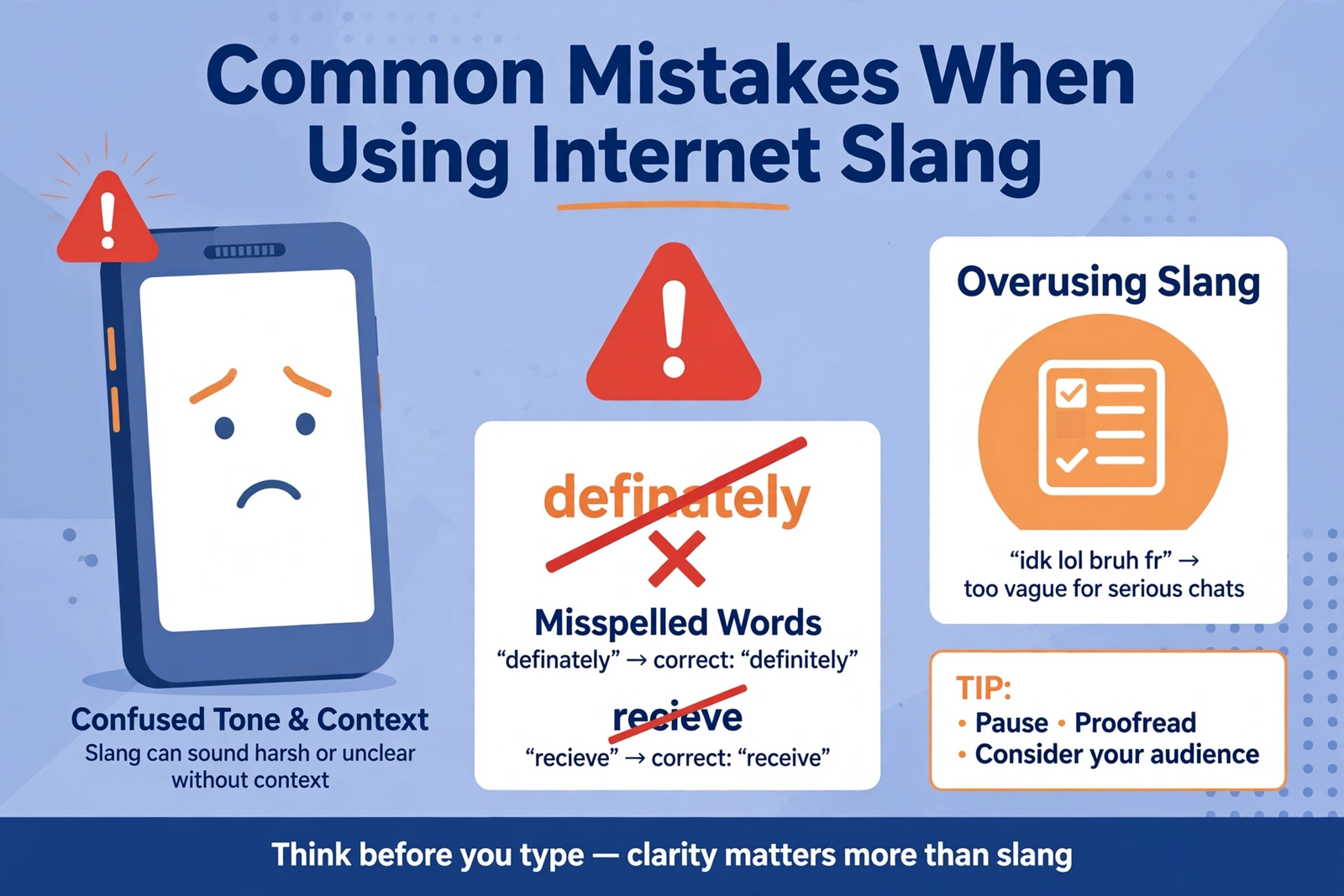
OOMF is a short word, but people still get it wrong. These are the mistakes that give you away as someone who just learned it five minutes ago.
- Using it for real-life friends: OOMF almost always means an online friend or follower. Calling your next-door neighbor “oomf” will confuse everyone. If you know them in real life, just say “my friend.”
- Using it for a group when you mean one person: “Oomf are coming over” is wrong — one oomf is one person. Use “my oomfs” for the group.
- Spelling it “oomph”: “Oomph” is the energy word. The person word is OOMF. Mixing them up changes the meaning completely.
- Using it in formal writing: a work email that says “oomf sent the files” reads as a joke. Keep OOMF on social platforms, in chats, and in casual captions.
- Tagging the person anyway: the whole point of OOMF is not naming someone. Writing “oomf @username” defeats the purpose — and it is also a little rude, like whispering someone’s name loudly.
- Assuming everyone knows it: outside X, Tumblr, and TikTok, plenty of people have never seen the word. In mixed company, a quick “one of my followers” the first time saves confusion.
- Using it as an insult by default: OOMF itself is neutral. It only turns shady when the sentence around it is shady. “Oomf is so sweet” and “oomf is so annoying” use the exact same word with opposite energy.
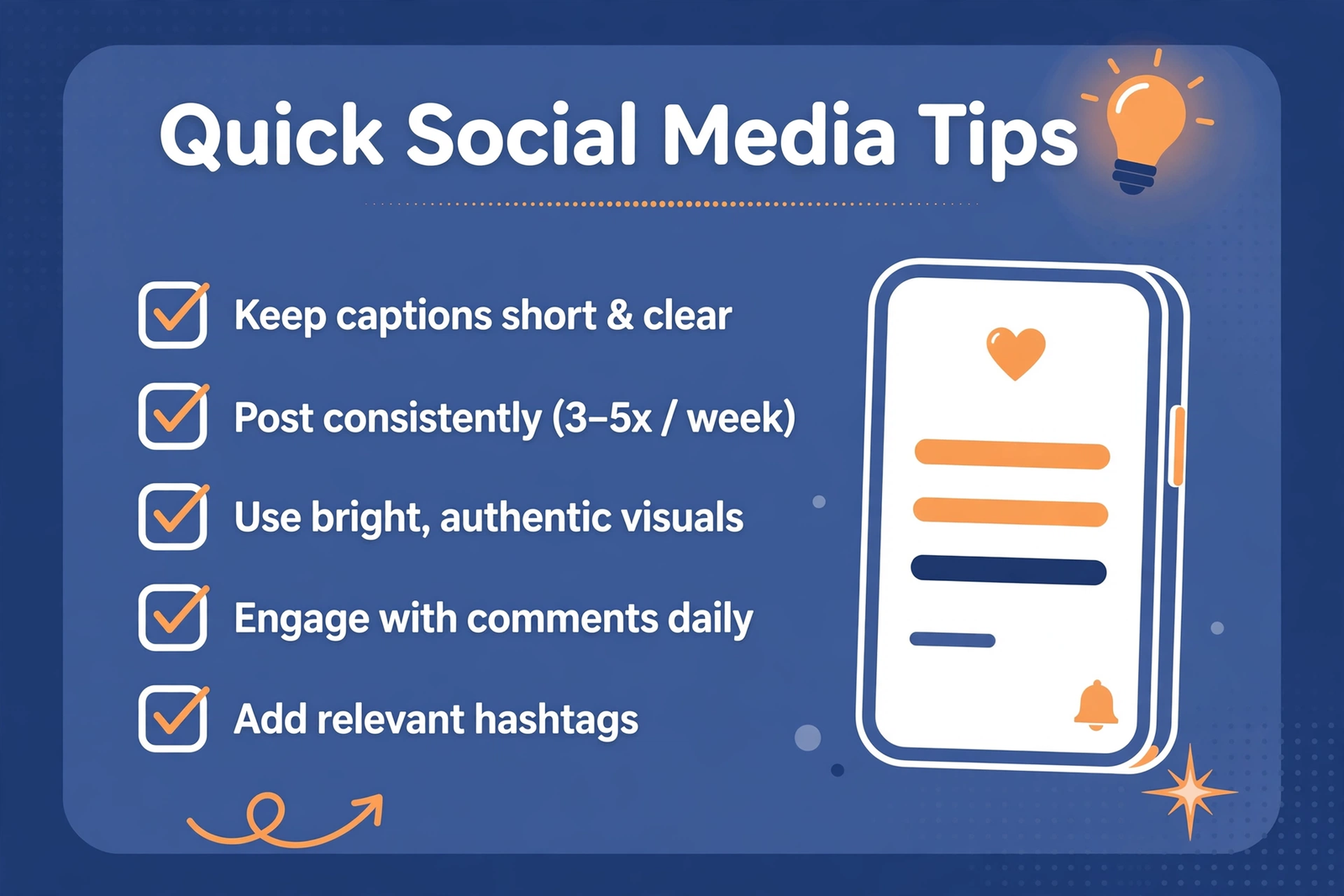
Quick Tips
- Use it for one specific person: OOMF works best when there is a real person behind it. Vague for effect, specific in your head.
- Try “oomfie” for favorites: if one mutual matters more than the rest, “oomfie” says so without a paragraph of explanation.
- Keep the tone in the sentence, not the word: OOMF is neutral — the words around it decide whether the post is loving, funny, or a subtweet.
- Pair it with “my oomfs” for community posts: appreciation posts, group jokes, and fandom shoutouts sound natural with the plural.
- Do not overuse it: three oomfs in one post reads like a bit. One per post is usually plenty.
- Check the platform: OOMF lands best on X, Tumblr, Instagram, and TikTok. On Facebook or LinkedIn, most readers will need a translation.
- Remember the privacy trade: OOMF hides a name, not an identity. Mutual friends often figure out exactly who you mean — post accordingly.
FAQ
What does OOMF mean in slang?
OOMF means “one of my followers” or “one of my friends.” It is internet slang used on X (Twitter), Tumblr, Instagram, and TikTok to refer to someone without naming or tagging them directly.
What does OOMF mean on Twitter / X?
On X, OOMF means “one of my followers.” It started there as a hashtag in March 2010 and caught on in 2011. People use it to mention a follower in a post — often a subtweet — without using their handle.
What does OOMF mean on TikTok?
On TikTok, OOMF means the same thing: one of my followers or friends. It appears in comments and captions as TikTok’s culture has become more follower-based, and it usually refers to a mutual or a favorite creator the poster follows.
What is the difference between OOMF and oomfie?
Oomfie is the affectionate version of OOMF. While OOMF can mean any follower or online friend, “oomfie” usually points to one specific mutual the poster really likes. It is also used ironically, with exaggerated sweetness, as a joke.
Is OOMF the same as moots?
No. Moots are mutual followers — people you follow who follow you back. An oomf can be any follower or online friend, mutual or not. The words overlap but are not interchangeable; our guide to moots slang explains the mutual side in detail.
What does “That’s oomf” mean?
“That’s oomf 😭😭😭” is a viral 2024 catchphrase from X. It is used as a punchline over photos or videos of huge crowds, joking that all of your oomfs — your online friends — have shown up at once for some occasion.
Is OOMF rude or offensive?
No, OOMF itself is neutral and not offensive. It only feels negative when the sentence around it is a complaint or a subtweet. Used warmly — “oomf is the best” — it is a compliment.
Where did OOMF come from?
OOMF comes from early Twitter and Tumblr culture. The hashtag #oomf existed by March 2010, was added to the Twitter slang dictionary Twittonary in February 2011, and spread through both platforms before reaching Instagram and TikTok. For more short-form internet words like this one, see our fn meaning in text guide.
Conclusion
The oomf meaning slang is one of those small internet words that earns its keep: four letters that let you talk about a real person without naming them. It means “one of my followers” or “one of my friends,” it was born on Twitter and Tumblr in the early 2010s, and it is still going strong on X, Tumblr, Instagram, and TikTok — from sincere shoutouts to the viral “That’s oomf” joke.
Use it for one specific online friend, keep the tone in the sentence around it, save “oomfie” for your favorites, and do not drag it into formal writing. And remember the golden rule of the word: it hides a name, not an identity. Your mutuals can usually guess exactly who you mean — so post like they already know. Now that you know what OOMF means, the next time an oomf makes your timeline better, you will know exactly who to thank — even if you never say their name.
