
Quick definition: Nonce meaning slang — in British slang, a “nonce” is a deeply offensive insult for a sex offender, especially someone who has committed sexual offences against children. It comes from UK prison slang of the 1970s. The word has completely different, innocent meanings elsewhere: in cryptography a nonce is a “number used once,” and in the old phrase “for the nonce” it simply means “for the present occasion.” In slang, though, it is one of the strongest insults in British English, and using it casually can be defamatory and dangerous.
Nonce Meaning Slang: Meaning & Definition
So what does nonce mean in slang? The short answer is that it is not a light, funny piece of internet slang like the words you might see on TikTok every day. In British and Irish slang, “nonce” is a derogatory noun used to describe a sex offender — most specifically, a person convicted of sexual offences against children. It is an accusation of a serious crime, not a nickname, and it carries enormous weight every time it is said.
The slang meaning is so strong that it has almost completely taken over the word in everyday British English. If you call someone a nonce in the UK, people will not hear a joke. They will hear an accusation that the person is a paedophile. That is why the word sits in a category of its own among British insults: most insults attack someone’s intelligence, appearance, or manners, but this one attacks their character in the most serious way possible.
At the same time, “nonce” is a classic example of a word with several unrelated lives. Long before the slang meaning existed, the phrase “for the nonce” was common in Middle English, meaning “for the present occasion” or “for this one time.” In modern computing and cryptography, a nonce is a “number used once” — a random value generated for a single authentication or security task. In linguistics, a “nonce word” is a word invented for one single occasion. None of those meanings is offensive. The problem — and the reason so many people search for “nonce meaning slang” — is that the slang meaning is the one most people meet first today, usually in a TV show, a news report, or an argument online.
Introduction
If you have heard the word “nonce” recently, you are probably not alone. Millions of viewers outside the UK first met it in Netflix’s hit drama Adolescence, where British school slang — including the word “nonce” — left American audiences confused and searching for explanations. Social media filled up with posts from viewers asking what the word meant, why it sounded so serious, and whether it was something people actually say.
The confusion is understandable. To an American ear, “nonce” sounds almost playful. It rhymes with “once” and “ponce,” and it has a bouncy, old-fashioned sound. Nothing about how it sounds prepares you for what it means. In the UK, though, it is widely understood as one of the harshest words in the language — the kind of word that can end friendships, start fights, and even end up in a defamation courtroom.
This guide explains the full picture: the slang definition, where the word actually came from, how it is used today, the innocent meanings it also carries, and — most importantly — the mistakes people make with it. Whether you heard it in a TV show, read it in a headline, or saw it in a comment thread, you will leave here knowing exactly what “nonce” means in slang, and why it is a word to understand rather than a word to use. If you enjoy decoding regional slang, our Australian slang guide is a good next read, because it shows how another English-speaking country built a very different slang vocabulary from its own history.

Origin
The origin of the slang “nonce” is messy, and linguists still argue about it — but the broad story is clear. The word’s first recorded slang use as an insult dates to around 1975 in the UK, and it grew out of British prison culture.
The most popular story about its origin is also the least likely to be true. Many people claim “nonce” is an acronym for “Not On Normal Communal Exercise” or “Not On Normal Courtyard Exercise,” supposedly the label used for prisoners who were kept apart from the general prison population. It is a neat story, and it gets repeated everywhere, from pub conversations to newspaper articles. The problem is that there is no solid evidence for it. Language experts, including Jonathon Green, the author of Green’s Dictionary of Slang, treat the acronym theory as a folk etymology — a clever explanation invented after the fact.
The more likely origin is older and less dramatic. In 19th-century dialect, the word “nonse” meant a “good-for-nothing” or a “stupid, worthless person,” and it was probably a shortened form of “nonsense.” There is also a possible link to “nonesuch” — a person like no other, in a bad way — and to “ponce,” another piece of British slang. Over time, the spelling settled as “nonce,” and inside UK prisons in the 1970s the word attached itself to a specific group: prisoners convicted of sex offences, who were often segregated from other inmates for their own safety. From there, the meaning narrowed and hardened into what it is today: a label for a sex offender, especially a child sex offender.
That prison history explains why the word feels so heavy. It was not born as a joke or a piece of youth slang. It was born in a place where the label marked someone as the lowest of the low among prisoners, and it carried that weight with it when it moved into everyday British speech. For the full dictionary picture, including the word’s older senses, the Wiktionary entry for “nonce” lays out each meaning separately.
Popularity
For decades, “nonce” was mainly a British word, rarely heard outside the UK and Ireland. That changed in 2025, when Netflix’s Adolescence became a global hit. The four-part drama follows a 13-year-old boy accused of murder, and its dialogue is packed with authentic British school slang — including words like “nonce” spray-painted on walls and thrown around in arguments. American viewers, in particular, flooded social media and search engines asking what the word meant, and “nonce meaning slang” became one of the most-searched slang questions of the year.
The show also showed how the word is actually used by teenagers today. In Adolescence, it is not always used with its full literal meaning. Young people sometimes throw it around as a general insult for someone they see as creepy, weird, or socially outcast — a hyperbolic put-down rather than a literal accusation. That casual, diluted use is real, and it is part of why the word has spread, but it does not make the word safe. The literal meaning is always sitting underneath it, and the person on the receiving end — or anyone overhearing — may hear the full accusation.
The word’s prominence has even reached regulators. In October 2026, Ofcom published a revised guide to offensive language for British broadcasters, based on a survey of more than 4,000 adults, and “nonce” was one of 183 words given a specific acceptability rating. It was classed as needing “clear and strong contextual justification” before the 9pm watershed, and as more acceptable only after it — a reminder that, even in a media landscape full of strong language, this word is treated as something special.
Online, the word’s popularity is driven by the same forces as most slang: TV, TikTok, Reddit threads, and British users arguing in comment sections. But unlike most slang, its spread comes with a warning attached. Every article, video, and thread about it repeats the same point: understand it, do not throw it around.
How It Is Used
In British slang, “nonce” is used in three main ways, and the differences between them matter a great deal.
1. As a literal accusation. In its fullest sense, it is used to call someone a sex offender, usually a child sex offender. This is how it is used in prison contexts, in news reporting about convicted offenders, and in serious accusations. Used this way, it is not slang at all in tone — it is a direct, grave charge against a person.
2. As a general insult. In casual British speech, especially among teenagers and in online arguments, it is sometimes used as an extreme insult for someone seen as creepy, pathetic, or worthless — similar to how other insults get thrown around without their literal meaning. A teenager might call a rival a nonce in a gaming lobby or a comment thread without literally believing the person is a sex offender. This is the use that has spread fastest, and it is also the most dangerous use, because the literal meaning does not disappear just because the speaker did not mean it literally.
3. In reported speech and media. Most people actually encounter the word in news reports, court reporting, TV dramas, and true-crime content. Journalists use it when reporting on cases, writers use it in dialogue to signal a character’s background, and commentators use it when discussing British slang itself. This is the safest way the word appears — quoted, explained, and clearly separated from the speaker’s own opinion.
What you will almost never hear is “nonce” used warmly, affectionately, or as a joke between friends. There is no friendly version of this word. Unlike slang such as “mate,” “lad,” or even mild insults like “idiot,” there is no context in which calling someone a nonce reads as playful. That is the single most important thing to understand about how it is used.
Examples
Because this word is an accusation of a crime, examples need to be handled carefully. The examples below show how the word appears in real contexts — in media, in reporting, and in online speech — so you can recognise it. None of them is an invitation to use it yourself.
Friendly Examples
There are no friendly examples of “nonce,” and that is itself the point. Some slang words have a warm side — friends call each other “idiot” or “weirdo” and everyone laughs. “Nonce” does not work that way. Even said with a smile, it lands as an accusation, because the word’s meaning is the accusation. If you hear it used between people who seem friendly, what you are hearing is either a very dark joke between people who know each other extremely well, or — much more often — the start of a real argument. There is no safe, friendly register for this word, and no version of it that works as a term of endearment.
Professional Examples
In professional and formal contexts, the word appears in reported speech and legal discussion, not as casual language:
- News reporting: “The defendant was described in court as a ‘nonce’ by fellow inmates, a term prison officers said marked him out as a sex offender.” Here the word is quoted, not used by the reporter.
- Legal discussion: In a well-known English defamation case, a claimant argued that being called a nonce meant being accused of being a paedophile, and the court agreed — the judge ruled that the word’s natural meaning was an accusation of sexual interest in children. That ruling is why lawyers take the word so seriously.
- TV and film dialogue: In Adolescence, the word appears as graffiti and as an insult between schoolboys, which is exactly how the show’s writers use it to establish the characters’ world. Viewers hear it and understand, without anyone explaining it, that something very serious has been said.
- Broadcasting guidance: Ofcom’s 2026 offensive-language guide treats the word as one that needs strong justification before the watershed, placing it among the words broadcasters must think hardest about.
Funny Examples (if applicable)
There are no funny examples of “nonce” in the usual sense, and trying to make one is the most common mistake people make with this word. It is not a punchline word. Jokes that rely on it tend to land badly, because the audience hears an accusation of child sexual abuse, not a joke. The only humour that ever surrounds the word is the shocked, nervous kind — the reaction of an American viewer realising what a funny-sounding British word actually means. That reaction is about the surprise, not about the word being funny. If you are looking for light, playful slang to use with friends, words like the ones in our delulu meaning guide or our sigma meaning slang guide are far better choices — they are fun, harmless, and nobody’s reputation is at stake.
Comparison with Similar Terms
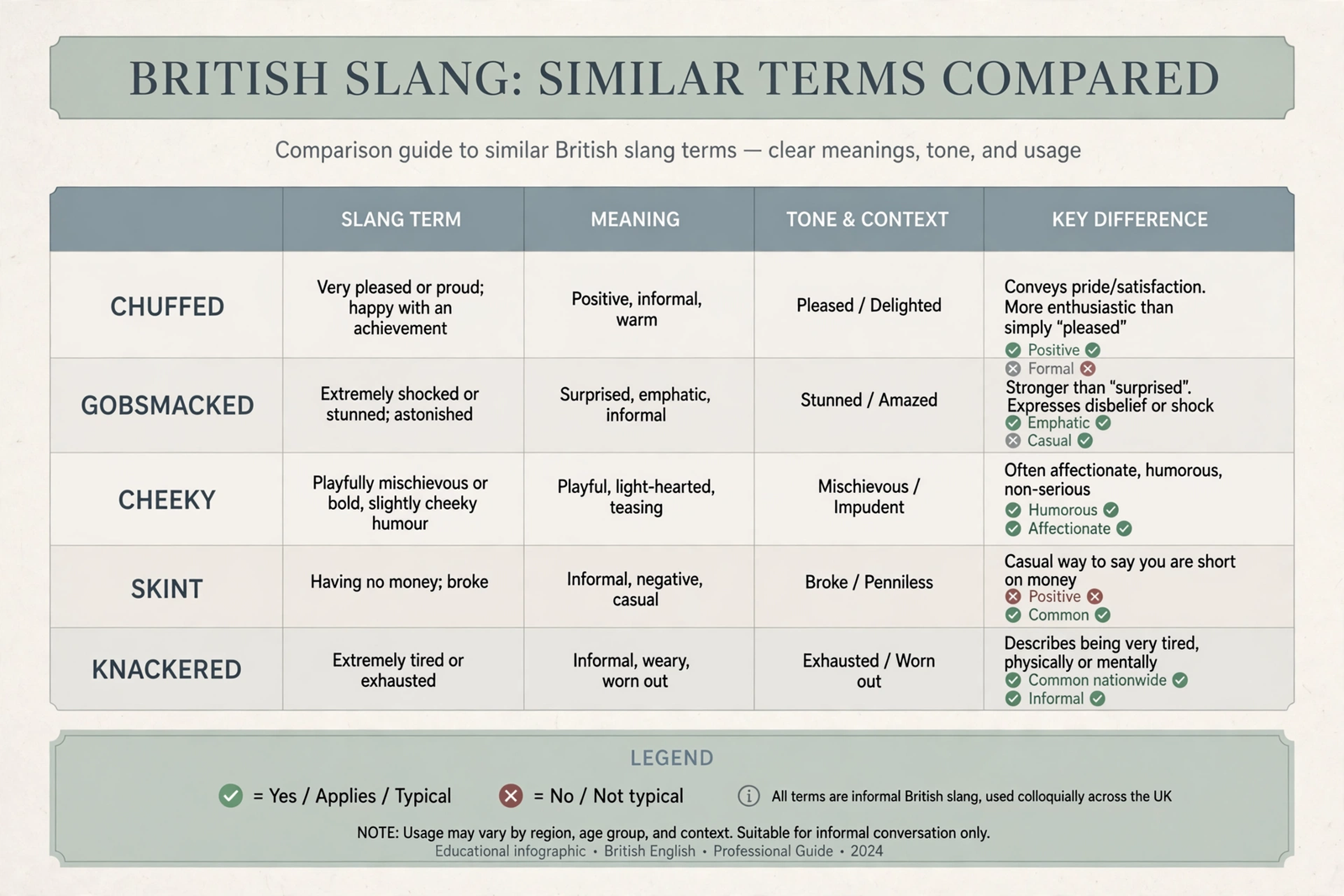
“Nonce” is often confused with other British insults and with its own innocent homonyms. This table clears up the differences.
| Term | Meaning | How serious is it? | Can you use it casually? |
|---|---|---|---|
| Nonce | British slang for a sex offender, especially a child sex offender | Extremely serious — an accusation of a crime | No — never as an insult |
| Creep / creepy | Someone whose behaviour feels unsettling or predatory | Serious, but a judgement of behaviour, not a crime | Yes, in casual speech, with care |
| Weirdo | Someone strange or socially odd | Mild — usually teasing | Yes, among friends |
| Ponce | Old British slang: a pimp, or an effeminate man (dated, offensive) | Offensive and dated | No — avoid it |
| Nonce (cryptography) | A “number used once” in security and blockchain | Not an insult at all | Yes — it is a technical term |
| Nonce word | A word invented for one single occasion (linguistics) | Not an insult at all | Yes — it is a technical term |
| For the nonce | An old phrase meaning “for the present occasion” | Not an insult at all | Yes — formal or literary use |
The key takeaway from the table is simple: the same four letters can be a crime accusation, a technical term, or an old-fashioned phrase, and the context decides which one you are hearing. In a cryptography lecture, “nonce” is boring and harmless. In a British playground argument, it is the nuclear option. The slang meaning is the one that dominates in everyday speech, which is why most people searching for “nonce meaning slang” are looking for the British insult, not the maths term. For a wider look at how internet slang words differ from each other, our Ohio slang meaning guide is a useful comparison, because it shows how regional slang builds its own vocabulary.
Alternate Meanings
“Nonce” has at least four distinct meanings, and they come from completely different histories. Knowing them all is the best way to avoid confusion — and embarrassment.
1. The British slang insult (the one this article is about). A derogatory term for a sex offender, especially a child sex offender. First recorded in UK prison slang in the 1970s. This is the meaning that dominates in the UK today.
2. “For the nonce” — for the present occasion. This is the oldest meaning, from Middle English. “For the nonce” means “for this one time” or “for the present purpose.” You will still see it in older literature and formal writing — for example, “a word coined for the nonce.” It is completely innocent, and it is the source of the linguistic term below.
3. A nonce word (linguistics). A word invented for a single occasion and not expected to enter general use. Authors and poets coin nonce words all the time. Lewis Carroll’s “chortle” started as a nonce word, and so did many words in science fiction. When a linguist says “nonce word,” they mean this, not the slang insult.
4. A nonce in cryptography and computing. Short for “number used once,” a nonce is a random or semi-random value used a single time in a security protocol — for example, in authentication, hashing, or blockchain mining. If you work in tech, you will hear “nonce” every week and it will never mean anything offensive. Blockchain developers talk about nonces constantly.
There is also a rarer, older slang sense recorded in dictionaries: in some UK and Irish use, “nonce” has meant a stupid or worthless person, or a police informer. Both senses are related to the prison history of the word, and both are derogatory. When Americans hear the word, they sometimes know only the cryptography meaning and are shocked to learn about the British one — which is exactly the “false friend” problem that makes this word so risky for non-British speakers.
Professional or Polite Alternatives
There is no polite synonym for “nonce,” because there is no polite situation in which you need the slang word. What you need instead depends on what you actually mean:
- If you mean someone’s behaviour is unsettling: say “creepy,” “uncomfortable,” or “inappropriate.” These describe behaviour without accusing someone of a crime.
- If you mean someone is strange or odd: say “weird,” “odd,” or “eccentric.” These are mild and do not carry a criminal accusation.
- If you mean someone is foolish: say “silly,” “foolish,” or “idiot.” These are ordinary insults that do not accuse anyone of anything criminal.
- If you are discussing a real case: use precise, factual language — “a convicted sex offender,” “a person convicted of sexual offences against children.” In news, legal, and professional writing, precision is both more accurate and more defensible than slang.
- If you are writing about the word itself: quote it, explain it, and keep it in reported speech, as this article does. That is the professional way to handle a word like this.
The general rule is worth repeating: if you would not say it in a courtroom or a job interview, do not say it in a comment thread either. The words above cover every situation in which someone might reach for “nonce,” without any of the risk.
Common Mistakes
Most mistakes with “nonce” come from people who do not know what it means, or who think it is milder than it is. Here are the ones to avoid.
Mistake 1: Treating it like a funny British word. It sounds funny — it rhymes with “once” and has a soft, old-fashioned feel. Newcomers hear it in a comedy or a drama and assume it is on the level of “bloke,” “chap,” or “git.” It is not. It is closer to the strongest accusation in the language, and treating it as a joke is the fastest way to cause real offence.
Mistake 2: Using it as a casual insult online. In gaming lobbies, comment threads, and group chats, people throw “nonce” at strangers the way they throw “noob” or “loser.” Online, that is especially risky: the words are written down, they can be screenshotted, and the person on the receiving end may take legal action. In England, calling someone a nonce has led to defamation claims, because the court treats it as an accusation of paedophilia.
Mistake 3: Assuming it means the same thing in America. In American English, “nonce” is mainly the cryptography term or the old phrase “for the nonce.” An American developer who says “nonce” at work means a number used once. A British listener who hears the same word in a pub hears something else entirely. If you are American and you hear a British person use the word, do not assume they mean the technical term — and if you are British and you use it around Americans, do not assume they understand the weight of it.
Mistake 4: Believing the acronym story. The “Not On Normal Communal Exercise” story is repeated so often that most people believe it. Linguists consider it a folk etymology — a story invented after the word already existed. Repeating it as fact is a small mistake, but it is a very common one, and it shows up in articles about the word constantly.
Mistake 5: Using it about a real, named person. This is the most serious mistake of all. Calling a real person a nonce — in speech, in print, or online — is an accusation that they have committed sexual offences against children. If it is not true, it can be defamatory, and it can destroy a person’s reputation, job, and safety. Never use it about a real person unless you are reporting a court conviction, and even then, use the precise legal language instead.
Quick Tips
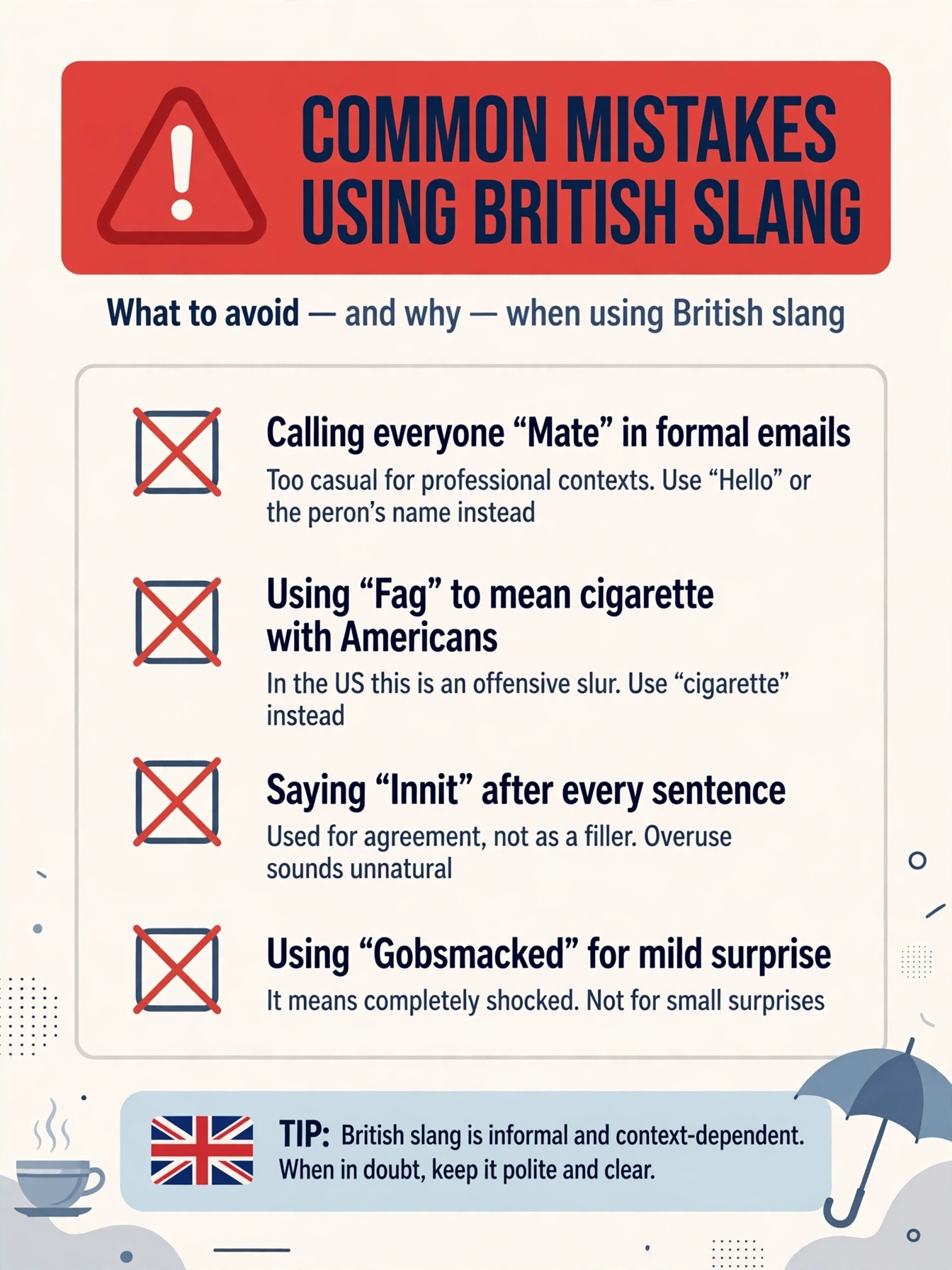
- Understand it, don’t use it. The best relationship most people will ever have with this word is as a reader, not a speaker. Know what it means so you can understand TV, news, and British conversation — and leave it there.
- Remember the context rule. In tech, “nonce” is harmless. In British slang, it is an accusation. Always check which world you are in before you react to the word — or use it.
- Never use it about a real person. No exceptions, no jokes, no “I was only kidding.” The accusation is the meaning, and “I didn’t mean it literally” is not a defence that works in real life.
- If someone calls you it, take it seriously. Because the word is an accusation of a crime, being called a nonce is not ordinary teasing. If it happens at school, at work, or online, report it through the proper channels rather than answering in kind.
- Use “creepy” or “weird” instead. If all you mean is that someone’s behaviour is off, those words say it without accusing anyone of a crime.
- Watch for it in British media. Once you know the word, you will hear it in UK dramas, true-crime podcasts, and news reports. Now you will know exactly what is being said — and how serious it is.
- Teach the difference to American friends. If you have friends in the US who work in tech, they may know only the cryptography meaning. A quick explanation saves everyone an awkward moment.
FAQ

What does nonce mean in slang?
In British slang, “nonce” is a deeply offensive insult for a sex offender, especially someone who has committed sexual offences against children. It comes from UK prison slang of the 1970s. It is an accusation of a serious crime, not a light or funny insult.
Is nonce a bad word?
Yes — it is one of the strongest insults in British English. Because its meaning is an accusation of child sexual abuse, it is treated far more seriously than ordinary swear words. Ofcom’s 2026 offensive-language guide says it needs clear and strong justification before the 9pm watershed on British television.
What does nonce mean in America?
In American English, “nonce” is mainly a technical term: in cryptography it means a “number used once,” and in the old phrase “for the nonce” it means “for the present occasion.” Most Americans only learn the British slang meaning from TV shows like Netflix’s Adolescence, which is why the word confuses so many US viewers.
Where did the word nonce come from?
Its slang use began in UK prisons in the 1970s. The popular story that it is an acronym for “Not On Normal Communal Exercise” is almost certainly a folk etymology. Linguists think it more likely comes from the 19th-century dialect word “nonse,” meaning a good-for-nothing or stupid person, possibly related to “nonsense” and “nonesuch.”
What does nonce mean in Adolescence on Netflix?
In Adolescence, “nonce” is used as British school slang for a sex offender, and also as a general insult for someone seen as creepy or an outcast. The show’s use of the word is one reason “nonce meaning slang” became a hugely searched question in 2025, especially among American viewers.
Can you call someone a nonce as a joke?
No. There is no joking or friendly version of this word. Even said lightly, it is heard as an accusation of a serious crime, and in England it has been the subject of defamation cases, because courts treat its natural meaning as an accusation of paedophilia. Use “creepy” or “weird” instead if that is what you mean.
What is a nonce in crypto?
In cryptography and blockchain, a nonce is a “number used once” — a random value generated for a single use in authentication, hashing, or mining. It has nothing to do with the slang meaning. This is a classic case of the same word having two completely unrelated lives in different worlds.
What should I say instead of nonce?
It depends on what you mean. For unsettling behaviour, say “creepy” or “inappropriate.” For strange behaviour, say “weird” or “odd.” For foolish behaviour, say “silly” or “foolish.” And if you are discussing a real case, use precise language such as “a convicted sex offender” rather than slang.
Conclusion
“Nonce” is a word with two faces. In cryptography and old-fashioned English, it is harmless — a number used once, or a phrase meaning “for the present occasion.” In British slang, it is one of the most serious words in the language: an accusation of sexual offending against children, born in 1970s prison slang and still carrying that weight today.
The key takeaways are simple. First, the slang meaning is the dominant one in the UK, and it is an accusation, not a joke. Second, the word has no friendly or funny register — there is no version of it that works as a light insult. Third, using it about a real person can have legal consequences, because English courts have treated it as an accusation of paedophilia. And fourth, the innocent meanings are real too, so context is everything: a blockchain developer and a British teenager are using the same four letters to mean completely different things.
If you came here because you heard the word in Adolescence, a news report, or a comment thread, you now know exactly what it means — and, just as importantly, what not to do with it. Understand it, recognise it, and leave it unused. That is the right way to handle a word like this one, and it is the reason this guide exists: so the next time you hear “nonce,” you will know the full story behind it, not just the sound of it.
