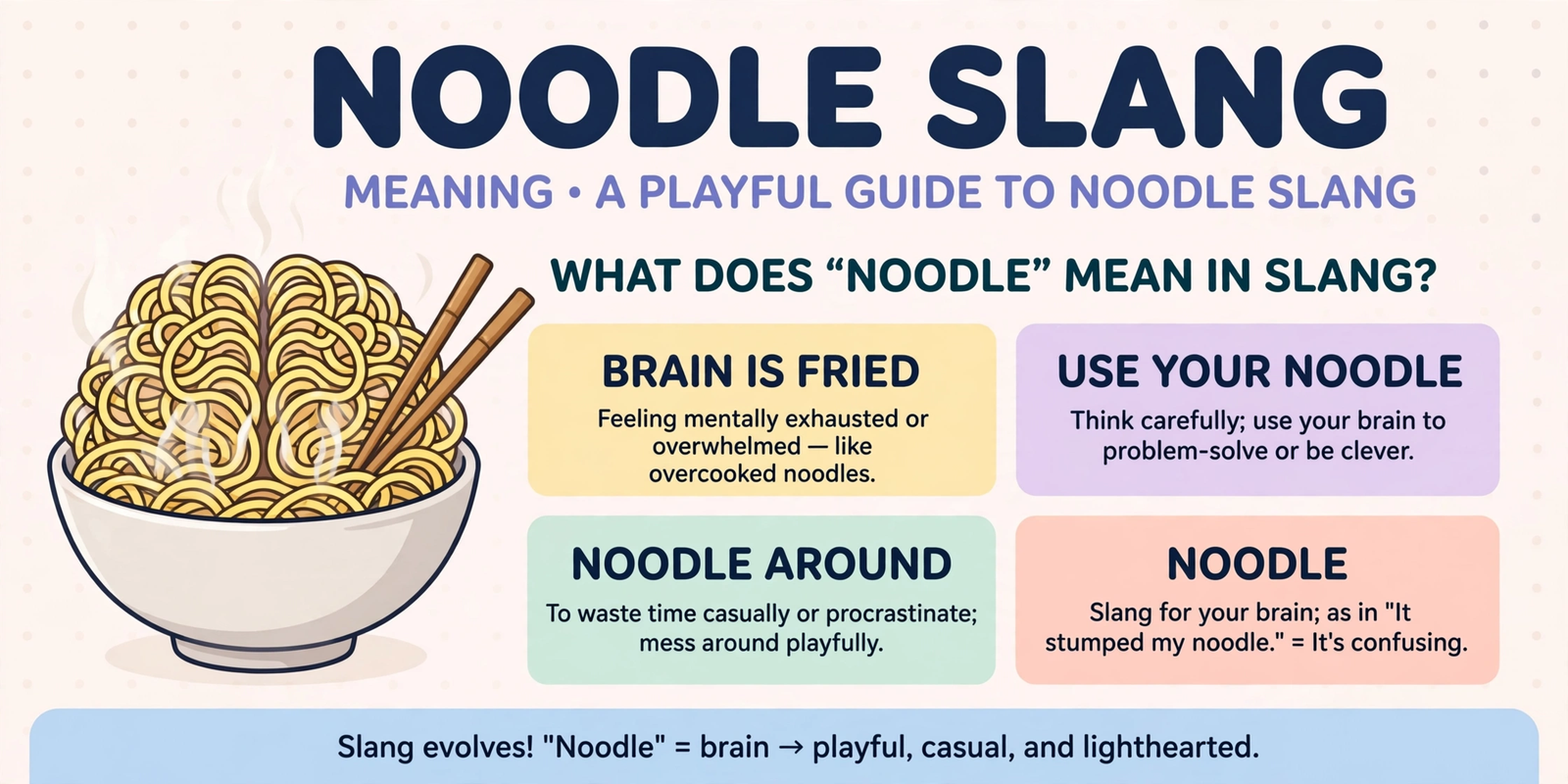
Quick Definition: In slang, noodle most commonly means your head or your brain — as in “use your noodle.” But noodle slang covers much more: as a verb, to noodle means to improvise on a musical instrument, to play around with an idea, or to think something over. From “noodle around” to “wet noodle” to the fishing trick called “noodling,” one little word carries a surprising number of meanings — and context always decides which one you are hearing.
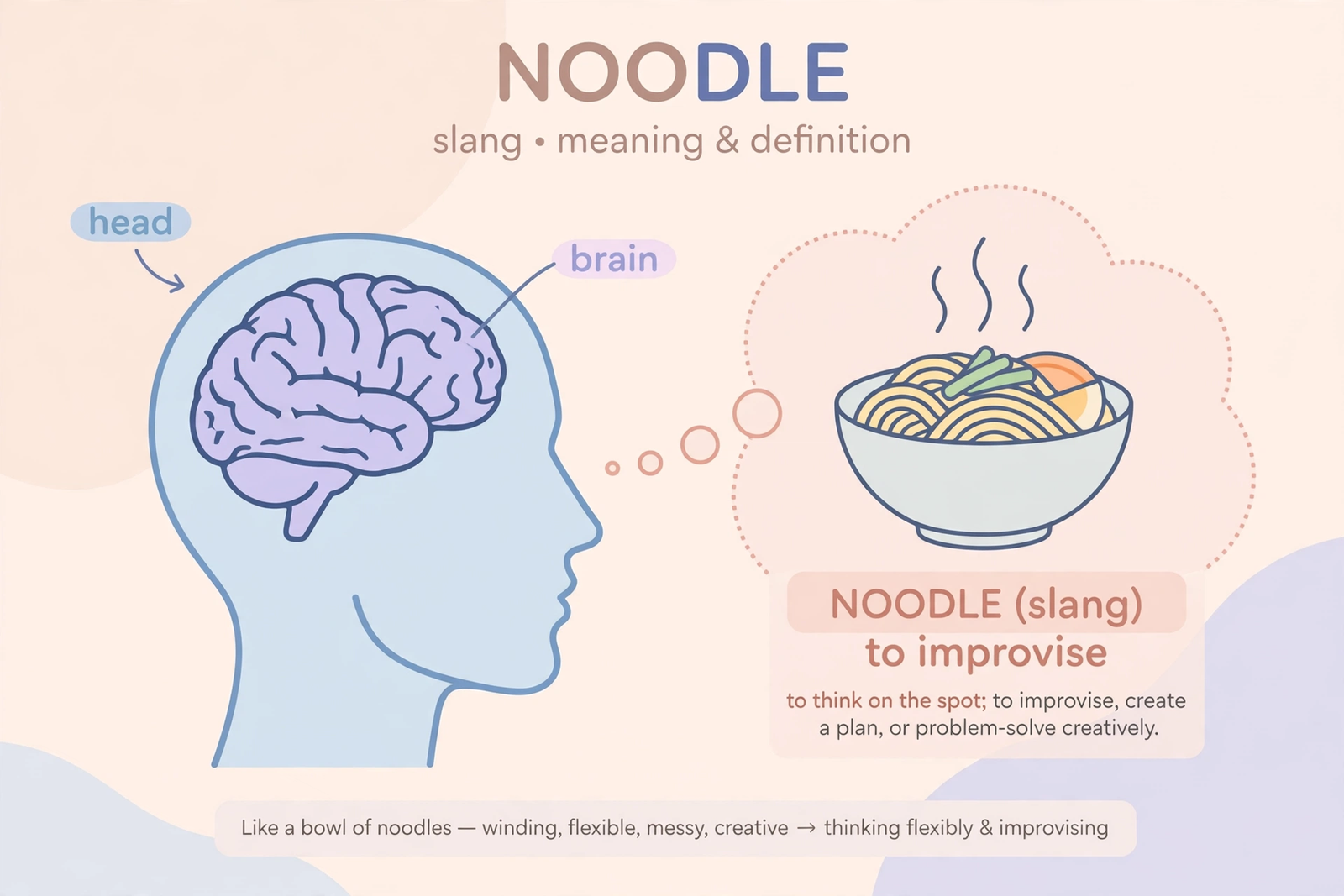
noodle slang Meaning & Definition
So, what does noodle slang mean exactly? At its simplest, noodle slang is the informal, playful side of a very old English word. As a noun, a noodle is your head — or, by extension, your brain. When someone says “use your noodle,” they are telling you to think. When they call someone a noodle, they are calling them a fool, though usually in the gentle, old-fashioned way you would tease a friend rather than insult a stranger.
As a verb, to noodle means to improvise, experiment, or play around — most famously on a guitar or piano, but also with ideas, numbers, and plans. A musician noodles between songs. A writer noodles over a plot twist. A thinker noodles around with a half-formed idea until it becomes something real. The Dictionary.com entry for noodle lists all of these senses side by side: the head, the mind, the fool, the improviser, and even the bare-handed catfish catcher.
That range is what makes noodle slang so fun — and so easy to misunderstand. The same word can be a compliment, a joke, a musical term, or a fishing technique, and the only way to tell them apart is the sentence around it. This guide breaks down every major meaning of noodle slang, with real examples, comparisons, and the mistakes to avoid.
Introduction
You have probably heard “use your noodle” at least once in your life — maybe from a teacher, a grandparent, or a cartoon character. It sounds silly, and that is exactly the point. Noodle slang has survived for centuries because it is light, funny, and impossible to take too seriously. It turns the serious business of thinking into something playful, and it turns a musical warm-up into a word that sounds like lunch.
But noodle slang is not just one phrase. In texts and on TikTok, “noodle” shows up in jokes, in music talk, in gaming chats, and even in fishing videos. Some people use it to mean “brain,” others use it for aimless creativity, and a few use it in ways that have nothing to do with either. If you have ever paused mid-scroll and wondered what someone meant by noodle slang, you are in the right place.
In this guide, you will learn the quick definition, the surprising origin of the word, how popular it is today, and how to use every sense of it naturally — plus the common mistakes that make people sound confused, and polite alternatives for formal settings. For more playful food-based slang, check out our guide to goose slang — another animal word that somehow became an insult, a joke, and a compliment all at once.
Origin
The story of noodle slang starts long before the food. The slang sense of “noodle” as the head dates back to the mid-18th century, and it probably comes from an older word, noddle, which also meant the head. Linguists believe the “oo” sound crept in from the word “fool” — because a noodle, in its oldest slang sense, was a foolish person. A noodle was someone whose head was full of nothing much, like a hollow tube of pasta.
The food sense arrived around the same time from a different direction. The pasta “noodle” comes from the German word Nudel, first recorded in English in the late 18th century. So the two meanings — the food and the head — grew up side by side, and English speakers have been mixing them up, joking about them, and enjoying the confusion ever since.
The musical verb is much newer. To “noodle” on an instrument — to play around improvising without a plan — dates to the 1920s, with the verb form following in the 1930s. Jazz musicians were the first noodlers: warming up, testing melodies, and wandering through chords before the real song began. From jazz, the verb spread into everyday speech, so today anyone can noodle — with a guitar, a spreadsheet, or an idea.
There is one more origin worth knowing. In the American South and Midwest, “noodling” is also the name for catching catfish with your bare hands — you wiggle your fingers in the water like bait, and the fish bites your hand. It is a real, legal-in-some-states fishing method, and it has nothing to do with pasta at all. When you see a video captioned “gone noodling,” check whether there is a river nearby before you assume it is about music.
Popularity
Noodle slang is not a trending TikTok word in the way newer terms are — it is something better: a permanent resident of the language. “Use your noodle” has been in continuous use for roughly 250 years, and it still appears in cartoons, classrooms, sitcoms, and everyday conversation. It is the kind of phrase grandparents say, parents repeat, and kids pick up without ever being taught.
Online, noodle slang has found a second life. Musicians post “noodling” clips of themselves warming up on guitar or piano. Writers talk about noodling over ideas. Gamers and streamers use “noodle” as a light, funny insult — a softer cousin of words like “noob” or “clown.” And on TikTok, the word pops up in playful phrases and in the clipped form “noods,” which works as a censor-friendly joke in some corners of the internet.
Search interest in noodle slang stays steady rather than spiky, which is typical of a classic slang word: people do not discover it in a viral moment, they bump into it in real life and look it up. That is also why so many people search for it alongside phrases like “use your noodle meaning” and “noodle around meaning” — they heard it somewhere, they half-understood it, and they want the full picture.
How It Is Used
Noodle slang works as a noun, a verb, and the heart of several idioms. Here are the main uses you will actually encounter:
- The head or brain (noun): “Use your noodle” means “think.” “He’s got a good noodle on him” means he is smart. This is the most common slang use by far.
- A fool (noun, old-fashioned): “Don’t be such a noodle” is a gentle way of calling someone silly. It is an insult with the edges sanded off — playful, not cruel.
- To improvise musically (verb): A guitarist noodles between songs, playing riffs that go nowhere in particular. A pianist noodles while waiting for the singer.
- To play around with an idea (verb): “I’ve been noodling over this problem all week” means thinking about it in a loose, creative, unpressured way.
- To waste time aimlessly (verb): “Stop noodling around and finish your homework” means stop messing about and get on with it.
- To catch catfish bare-handed (verb): Regional American use — “we went noodling on the river” means hand-fishing, not cooking.
The idioms deserve their own spotlight, because they are where noodle slang really shines:
- Use your noodle: Think. Figure it out. The most famous noodle phrase in English.
- Noodle around: Play, experiment, or waste time, depending on tone. “I spent the afternoon noodling around in the garage” could mean tinkering happily or killing time.
- Noodle over (something): Ponder or consider it. “Let me noodle over the offer for a day” is a polite way of saying you need time to think.
- Wet noodle: A weak, limp, or ineffective person or thing. “His handshake was like a wet noodle” — not a compliment.
- Noodle juice: Old slang for tea, and in some online circles, the water left after boiling ramen — which some people save for a second meal.
Tone matters enormously with noodle slang. “Use your noodle” from a friend is warm teasing. The same phrase from a boss, said sharply, can feel condescending. And calling someone “a noodle” is almost always meant as a joke — but if the person is already upset, even a soft insult can land badly. When in doubt, use it on yourself first: “I’m being such a noodle today” is self-deprecating, safe, and usually gets a laugh.
Examples
The fastest way to understand noodle slang is to see it in real sentences. Here are examples across friendly, professional, and funny contexts.
Friendly Examples
- “Come on, use your noodle — the answer is right in front of you!”
- “Don’t be a noodle, of course I’ll help you move on Saturday.”
- “We spent the whole afternoon noodling around on our guitars and somehow wrote a song.”
- “She’s got a great noodle on her — she solved the puzzle in five minutes.”
- “Let me noodle over it tonight and I’ll text you in the morning.”
Professional Examples
- “Let’s noodle around with a few headline options before we commit to one.”
- “I’ve been noodling over the budget numbers, and I think we can make it work.”
- “The team noodled with three different layouts during the brainstorm.”
- “Give me a day to noodle over the proposal — I want to think it through properly.”
Notice how, in professional settings, the verb form does all the work. Nobody says “use your noodle” in a board meeting unless they know the room very well — but “let me noodle over it” sounds creative, relaxed, and perfectly acceptable. It is the polite, productive face of noodle slang.
Funny Examples
- “My brain has officially turned into a wet noodle after that exam.”
- “He tried to explain crypto to me and my noodle just gave up halfway through.”
- “I’m not lazy, I’m just noodling around — it’s called creative thinking, Karen.”
- “Use your noodle? I left mine at home today, sorry.”
- “That handshake was like a wet noodle — I almost asked if he was okay.”

Comparison with Similar Terms
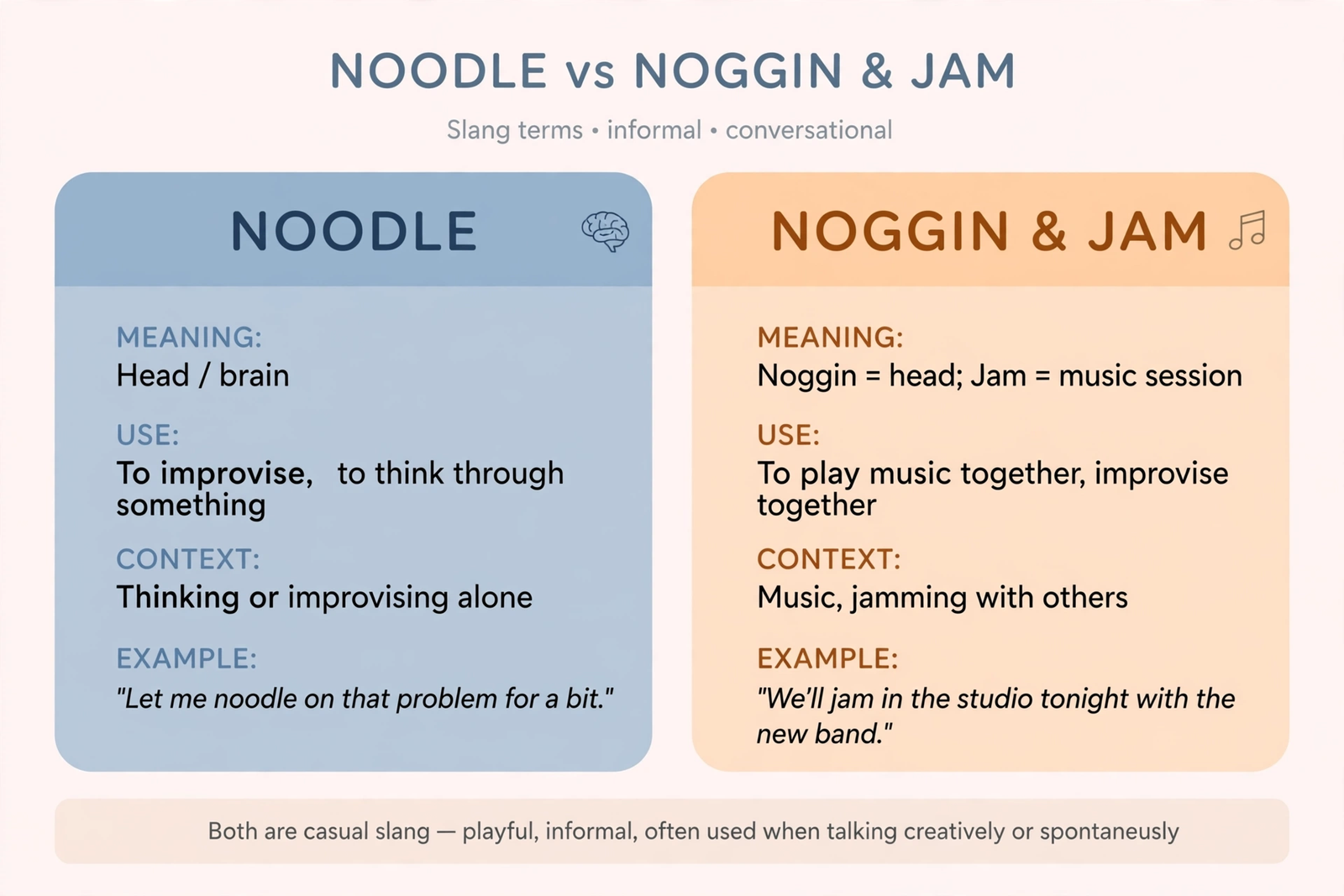
Noodle slang overlaps with several other words, but each one carries a different flavor. This table makes the differences clear:
| Term | What It Means | Tone | Best Used When |
|---|---|---|---|
| Noodle | Head, brain; or to improvise / play around | Playful, light, old-fashioned charm | Teasing friends, creative thinking, music talk |
| Noggin | Head or brain | Casual, slightly goofy | “Use your noggin” — a close cousin of “use your noodle” |
| Bean | Head (as in “use your bean”) | Old-fashioned, warm | Friendly advice; rarer than noodle today |
| Jam | To improvise music with others | Cool, collaborative | Musicians playing together, unlike solo noodling |
| Mess around | To play or waste time aimlessly | Neutral to slightly negative | General use; less charming than “noodle around” |
| Brainstorm | To generate ideas as a group | Professional, structured | Work meetings; “noodling over” is the relaxed version |
The key difference is charm. “Noggin” and “bean” are near-synonyms for the head, but “noodle” is the only one that also works as a verb for creative play — and the only one that doubles as a food joke. “Jam” is the musical cousin, but jamming is social and structured, while noodling is solo and aimless. And where “mess around” can sound like a scolding, “noodle around” sounds like a hobby. If you want the full spectrum of silly-to-serious slang, our guide to cringe meaning slang shows how one word can swing from playful to painful depending on context — just like noodle.
Alternate Meanings
Like many classic slang words, “noodle” has collected alternate meanings over the years. Here are the ones you are most likely to run into:
- The food: The literal meaning — long, thin strips of pasta, from ramen to spaghetti. When someone says “I had noodles for dinner,” no slang is involved at all.
- The pool noodle: The long foam tube used as a swimming toy. “Grab a pool noodle” is a summer sentence, not a slang one — but it is the same word, which is why the joke writes itself.
- Noodling (fishing): Catching catfish with bare hands, mostly in the American South and Midwest. Videos of it go viral every summer, and the comments are always full of people who had no idea it was a real thing.
- “Noods” online: A clipped, censor-friendly spelling that some people use online as a joke reference to nude photos — because it sounds like “nudes” and looks like “noodles.” It is a filter-avoidance gag, not a standard meaning of noodle slang, and it is best avoided in any serious context.
- Wet noodle: As an insult, a person who is weak, floppy, or ineffective — or a handshake with no grip at all. It is the one noodle phrase that is genuinely unkind.
- The borzoi dog: In some internet circles, long, slender borzoi dogs are affectionately called noodles. It is a niche meme meaning, but if you see a photo of a very long dog captioned “noodle,” now you know.
The practical rule is simple: if food, a pool, a river, or a guitar is in the picture, the literal or regional meaning is probably the right one. If someone is telling you to think, the head meaning is the one you want. And if the conversation is about photos online, treat “noods” as a joke you do not need to repeat.
Professional or Polite Alternatives
Noodle slang is friendly, but it is not formal. In a job interview, a client email, or a serious conversation, swap it for one of these:
| Instead of… | Say… | Why It Works |
|---|---|---|
| “Use your noodle” | “Think it through” / “Give it some thought” | Direct, respectful, no teasing |
| “Don’t be a noodle” | “Let’s think this through together” | Supportive instead of mocking |
| “Let me noodle over it” | “Let me consider it” / “I’ll review it” | Professional and clear |
| “We were noodling around” | “We were exploring options” / “We brainstormed” | Sounds intentional, not idle |
| “He’s a wet noodle” | “He seemed unsure” / “He lacked confidence” | Describes the behavior, not the person |
That said, the verb form is the exception: “let me noodle over it” and “we noodled around with a few ideas” are increasingly accepted in creative and tech workplaces, where sounding playful is a feature, not a bug. If your workplace runs on brainstorms and whiteboards, noodling fits right in. If it runs on suits and boardrooms, keep it for the group chat.
Common Mistakes
Most noodle slang mistakes come from mixing up the meanings. Here is what to watch out for:
- Confusing the verb with the food: “I was noodling all afternoon” means you were playing around or thinking — not eating. Context usually saves you, but a bare “I love noodling” in a group chat can get some very confused replies.
- Using “noodle” as a serious insult: Calling someone a noodle in anger does not land like a real insult — it lands like a cartoon. If you are genuinely upset, it will sound like you are joking, which can make things worse.
- Saying “use your noodle” to a stranger or a superior: It is teasing by nature. With friends it is warm; with a boss or a stranger it can sound condescending. Save it for people who know you are joking.
- Mixing up “noodle around” and “noodle over”: “Noodle around” means to play or waste time; “noodle over” means to think about something specific. “I noodled over the guitar all day” sounds odd — you noodle around on a guitar and noodle over a decision.
- Assuming “noodling” always means music: In the American South, it might mean catfishing. On a fishing forum, it almost certainly does. Check the context before you reply.
- Using “noods” without knowing the joke: The online “noods” gag is a filter-avoidance joke with an adult meaning. Using it innocently can embarrass you — and using it deliberately is rarely a good idea.
- Forgetting the tone: Noodle slang is almost always light. Dropping it into a serious conversation — a condolence, a complaint, an apology — can make you sound like you are not taking things seriously.
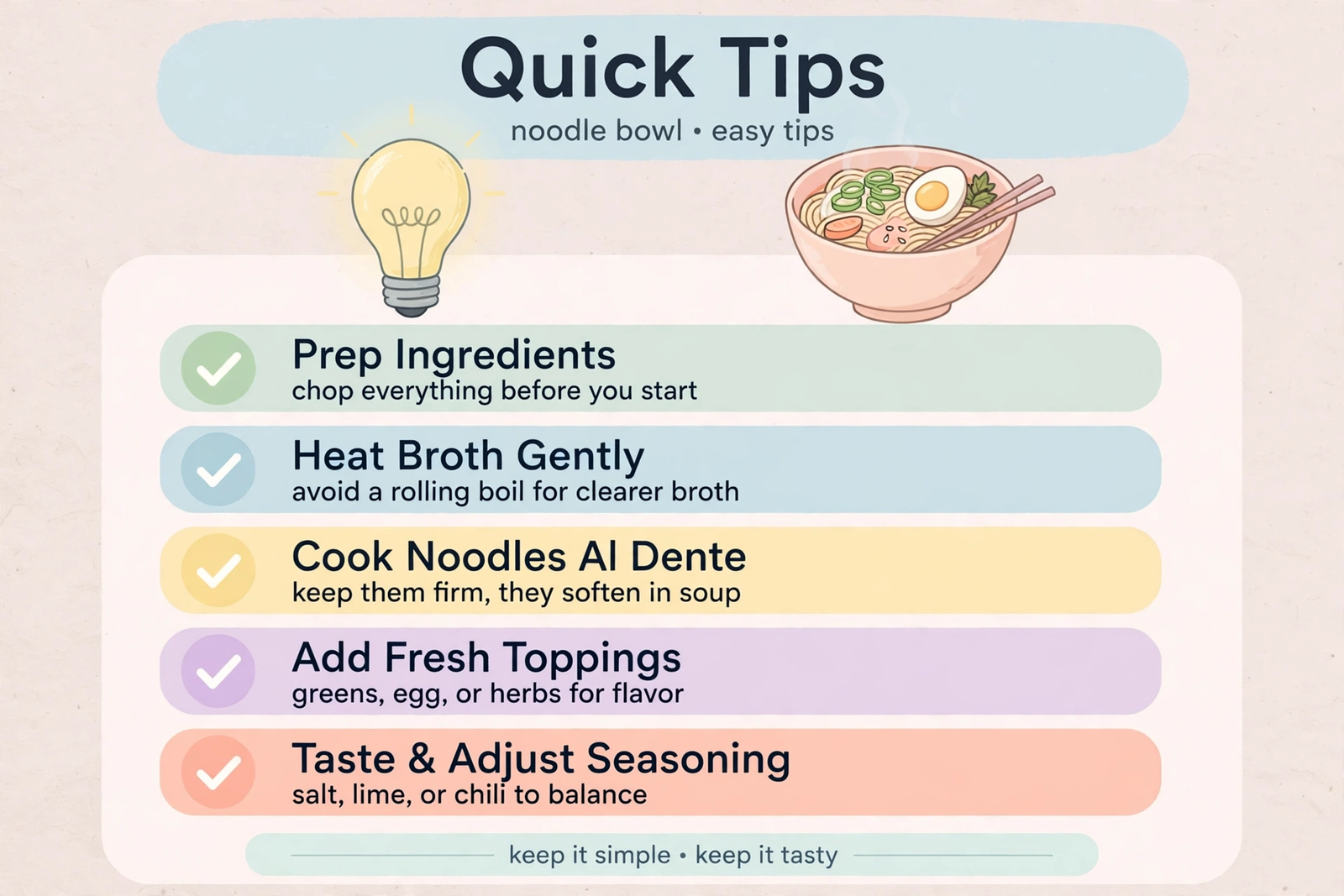
Quick Tips
- Lead with “use your noodle”: It is the most recognized noodle phrase in English. If you only learn one, learn that one.
- Use the verb for creativity: “Noodling over an idea” is the most useful modern sense — it makes thinking sound fun instead of stressful.
- Self-deprecate first: “My noodle isn’t working today” is the safest way to use the word, and it almost always gets a smile.
- Keep it casual: Noodle slang belongs in friendly chats, creative work, and music talk — not in formal emails or serious meetings.
- Pair it with music: If you play guitar or piano, “noodling” is the correct technical word for warming up. Musicians will know exactly what you mean.
- Watch the preposition: Noodle around with things, noodle over decisions. Getting this right is the difference between sounding fluent and sounding confused.
- Don’t force it: Noodle slang works best when it slips out naturally. Forcing it into every sentence turns a charming word into a tired joke.
FAQ
What does noodle slang mean?
In slang, noodle slang most commonly means your head or brain — “use your noodle” means “think.” As a verb, to noodle means to improvise on an instrument or to play around with an idea. Older uses include calling someone a fool, and regional uses include bare-handed catfish fishing.
What does “use your noodle” mean?
“Use your noodle” is a friendly way of telling someone to think or figure something out. It has been used since the 18th century, and it comes from “noodle” as slang for the head. It is warm teasing between friends, but it can sound condescending if said sharply to a stranger or a superior.
What does it mean to noodle on a guitar?
To noodle on a guitar means to play around improvising — running through riffs, scales, and chord shapes without a plan, usually as a warm-up or while thinking. Jazz musicians popularized the term in the 1920s and 1930s, and it is still standard musician vocabulary today.
Is noodle slang rude?
Usually not. Calling someone “a noodle” is one of the gentlest insults in English — playful rather than cruel. But tone matters: said angrily, even a soft word can sting, and “wet noodle” is a genuinely unkind description of a weak or ineffective person.
What does “noodle around” mean?
“Noodle around” means to play, experiment, or waste time in an aimless way. “I spent the afternoon noodling around in the garage” could mean happily tinkering or killing time, depending on context. It comes from “noodle” as the head — thinking or playing without a fixed plan.
What is noodling in fishing?
In fishing, “noodling” is the practice of catching catfish with your bare hands — wiggling your fingers underwater as bait until a fish bites. It is a real, traditional method in parts of the American South and Midwest, and it has nothing to do with pasta or music.
What does noodle mean on TikTok?
On TikTok, noodle slang usually keeps its classic meanings — head, or playing around — but it also appears in jokes and in the clipped form “noods,” which some users employ as a censor-friendly reference to nude photos. The classic meanings are far more common than the joke one.
What is a wet noodle in slang?
A “wet noodle” in slang describes a person or thing that is weak, limp, or ineffective — most famously a handshake with no grip. It comes from the image of a cooked noodle: soft, floppy, and unable to hold its shape. Unlike most noodle slang, it is not a compliment.
Conclusion
Noodle slang is proof that the silliest words often last the longest. For more than two centuries, noodle slang has meant your head, your brain, a gentle insult, a musical warm-up, and a way of thinking out loud — and it is still going strong, from jazz clubs to group chats to TikTok. The word works because it never takes itself seriously: it makes thinking sound playful, creativity sound fun, and teasing sound kind.
The key takeaways are simple. As a noun, a noodle is your head — so “use your noodle” means think. As a verb, to noodle is to improvise, experiment, or ponder — on a guitar, over a decision, or around the garage. Watch the prepositions, keep it casual, and save it for people who will hear the joke. And remember that context is everything: a noodle can be a brain, a song, a fish, or dinner, and only the sentence around it tells you which.
So go ahead — use your noodle, noodle over your next big idea, and don’t be afraid to noodle around a little. Some of the best ideas start exactly that way. For more slang that sounds funny but means something serious, see our guide to mid definition slang — and for a word that means the opposite of a wet noodle, check out guap meaning slang, where the energy is all the way up.
