Quick definition: In texting and on social media, fml slang stands for “F*** My Life.” It is a short, dramatic way to say that something frustrating, embarrassing, or unlucky just happened to you. People usually drop it at the end of a story about a bad day, a silly mistake, or a streak of terrible luck — most of the time as a joke, not as a serious complaint.
fml slang Meaning & Definition
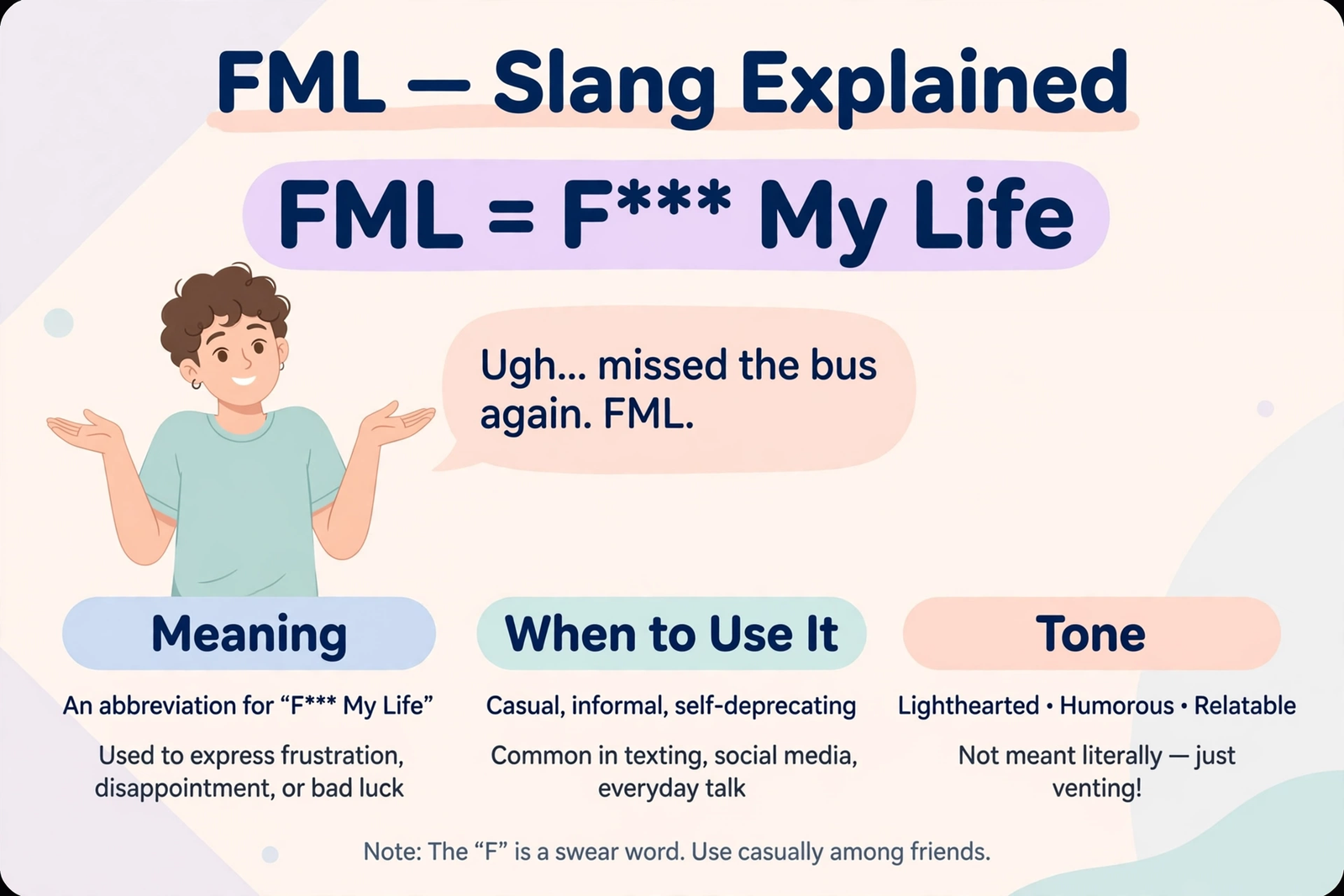
fml slang is internet shorthand for “F*** My Life.” It packs a whole mood — frustration, disbelief, bad luck, and a little self-pity — into just three letters. When someone texts “FML” after describing what went wrong, they are really saying, “I cannot believe this just happened to me.”
The expression works because it is exaggerated on purpose. Most of the time, the person using it is not actually having the worst day of their life. They spilled coffee on a white shirt, missed the bus by ten seconds, or dropped their phone face-down on concrete. The drama is the point: saying “FML” turns a small disaster into a funny story that friends can laugh at and relate to.
That is also why fml slang has survived for nearly two decades while hundreds of other texting abbreviations faded away. It describes a feeling everyone knows — the moment when everything goes wrong at once — and it does it in three keystrokes. Whether it shows up in a group chat, a tweet, a TikTok caption, or a meme, the meaning stays the same: life just threw a curveball, and the person on the other end wants you to know about it.
One thing to remember from the start: the “F” in FML stands for a swear word. The abbreviation hides it, which makes it feel softer than saying the full phrase out loud, but the meaning is still there. That is why you will see it everywhere in casual chats and almost never in a work email or a school essay. Context decides whether it fits — and this guide will show you exactly when to use it and when to pick a cleaner alternative instead.
Introduction
Picture this: your alarm does not go off, you wake up forty minutes late, you spill coffee all over your favourite shirt, and then your car refuses to start. You finally make it to work, only to realise you left your laptop charger at home. What do you text your best friend? For millions of people, the answer is one short line: “FML.”
If you have ever seen those three letters at the end of a text, a tweet, or an Instagram caption and wondered what they meant, you are in the right place. This guide explains the fml slang meaning in plain English, traces where it came from, and shows you how people actually use it in real conversations — with examples for friendly chats, work situations, and funny moments.
By the end, you will know not only what FML stands for, but also when it sounds natural, when it sounds too strong, and which polite alternatives to use when the audience is not right for it. You will also see how it compares with similar slang like SMH, WTF, and OMG, so you can pick the exact reaction that fits your mood.
Origin
The phrase “f*** my life” existed in spoken English long before the internet turned it into an acronym. People have been groaning it after bad luck for generations. But the three-letter version, FML, was born on the early internet — on message boards and forums in the mid-2000s, where users shared short, funny stories about their misfortunes.
The first definition of FML appeared on Urban Dictionary in 2005, and the abbreviation spread quickly through texting, MySpace, and early Twitter, where short character limits rewarded short expressions. The real explosion came in 2008 and 2009, when the website FMyLife (fmylife.com) launched. The site invited users to submit brief, anonymous stories about embarrassing or unlucky moments from their lives — each one ending with the punchline “FML.” Millions of people read and shared these stories, and the acronym became a staple of internet culture almost overnight.
From there, FML moved into everyday texting, group chats, and social media captions. It also crossed into spoken conversation: in real life, people often say “eff my life” instead of spelling out the letters, which keeps the joke without the swear word. According to Babbel’s guide to FML, the term remains a go-to phrase for Millennials and Gen Z alike, both online and in face-to-face conversation — a rare piece of internet slang that outlived the platforms where it started.
Popularity
FML is one of the most recognisable slang acronyms on the internet. Unlike trend-driven slang that spikes for a month and disappears, it has stayed in steady use for almost twenty years. A few reasons explain why it never went away.
First, bad days are universal. Everyone has a story about the day everything went wrong, and FML gives that story a ready-made ending. Second, it is short. In fast-moving chats, three letters do the work of a whole sentence. Third, it is flexible: it can sound genuinely frustrated, playfully dramatic, or completely sarcastic, depending on the story around it.
You will find it on every major platform. On X (Twitter), it often closes a tweet about a small disaster. On TikTok and Instagram, it appears in captions under videos of fails, pranks gone wrong, and relatable everyday chaos. In group chats, it is the standard reply when a friend shares an unlucky story. It even shows up in memes, reaction images, and merchandise — proof that a piece of slang has fully entered pop culture when it starts appearing on mugs and T-shirts.
Popularity has also softened the word over time. Many people now use FML without thinking about the swear word hiding inside it, the same way “OMG” no longer feels religious to most users. That said, it is still casual slang. It fits group chats, friends, and social media — not classrooms, job interviews, or messages to your boss.
How It Is Used
Using fml slang correctly is simple once you know the pattern. It almost always comes after the story, not before it. The person describes the unlucky event first, then adds “FML” as the punchline. That order matters: the acronym works as a reaction to something specific, not as a standalone greeting.
Here is the basic formula:
- Describe what happened: “I studied all night and still failed the quiz.”
- Add FML: “I studied all night and still failed the quiz. FML.”
It can also appear on its own as a reply. If a friend texts you that their flight was cancelled and their luggage is lost, replying with a simple “FML” says, “That is awful, I feel for you,” in one word. In that case, you are borrowing their frustration, not expressing your own — and it works because everyone understands the tone.
A few usage notes that native speakers follow without thinking about them:
- Uppercase or lowercase both work. “FML” feels a bit louder and more dramatic; “fml” feels more casual and tired. The meaning does not change.
- It usually ends the message. Putting it at the end lets it land like a punchline. Starting a message with it sounds odd.
- It pairs well with other reactions. You will often see it with laughing emojis, facepalms, or crying-laughing faces, which signal that the person is joking about their bad luck.
- It is not for formal settings. Keep it out of work emails, school assignments, and messages to people you do not know well.
- It can be sarcastic. “Got stuck in traffic for two hours. FML.” might be a real complaint — or a joke about a mildly annoying morning. The story around it tells you which one it is.
If you are texting about a frustrating moment and want a different flavour, the FN meaning in text is worth knowing too — another short acronym people use when they are annoyed, but with a very different tone.
Examples
The best way to understand fml slang is to see it in real conversations. The same three letters can sound sympathetic, annoyed, or hilarious depending on the situation. Here are examples grouped by tone, so you can match the right version to your own chats.
Friendly Examples
Between friends, FML is usually playful. Nobody is truly upset — they are turning a bad moment into a joke.
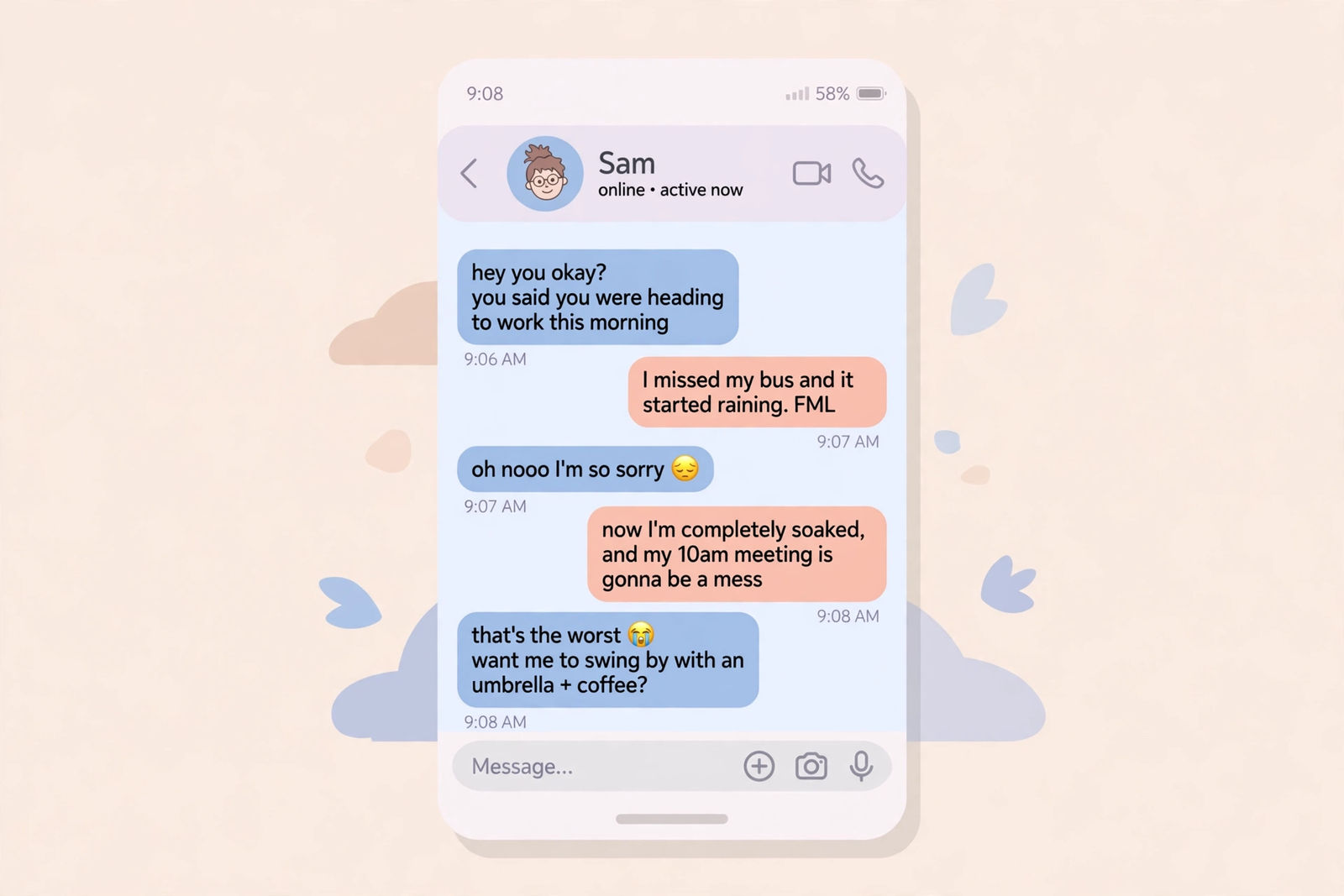
- “I locked myself out of my apartment and it is pouring rain. FML.”
- “I just realised I have been wearing my shirt inside out all day. FML.”
- “My phone died right when I was about to take the perfect sunset photo. FML.”
- “I waved back at someone who was actually waving at the person behind me. FML.”
- “I spent an hour cooking dinner and dropped the whole pan on the floor. FML.”
In these cases, the person is inviting their friends to laugh with them. The expected reply is usually a laughing emoji, a “same,” or a story about an even worse day.
Professional Examples
At work, FML is rare — and that is the point. Even in a casual office group chat, most people soften it. If it appears at all, it is usually among close coworkers, and it is aimed at a shared frustration, not a person.
- “The printer jammed again five minutes before the client meeting. FML.”
- “I forgot to hit save and lost two hours of work. FML.”
- “My laptop updated itself in the middle of my presentation. FML.”
A safer move in any work context is to swap it for a cleaner phrase, such as “Of course this happens today,” or “Just my luck.” You will find a full list of professional alternatives later in this guide. The rule of thumb is simple: if your boss or a client might see the message, leave FML out of it.
Funny Examples
Funny uses of FML lean into exaggeration. The situation is small, but the reaction is huge — and that gap is the joke.
- “I opened the fridge and realised I ate the last slice of pizza yesterday. FML.”
- “My cat knocked my coffee off the table for the third time today. FML.”
- “I tried to look cool in front of my crush and tripped over absolutely nothing. FML.”
- “I finally found my favourite show online and it needs a subscription I do not have. FML.”
- “I told everyone I was going to the gym, then took a three-hour nap instead. FML.”
Notice the pattern: nothing here is a real crisis. The humour comes from treating a tiny inconvenience like a tragedy. That is the heart of how most people use fml slang today — not as a cry for help, but as a shared joke about the small chaos of everyday life.
Comparison with Similar Terms
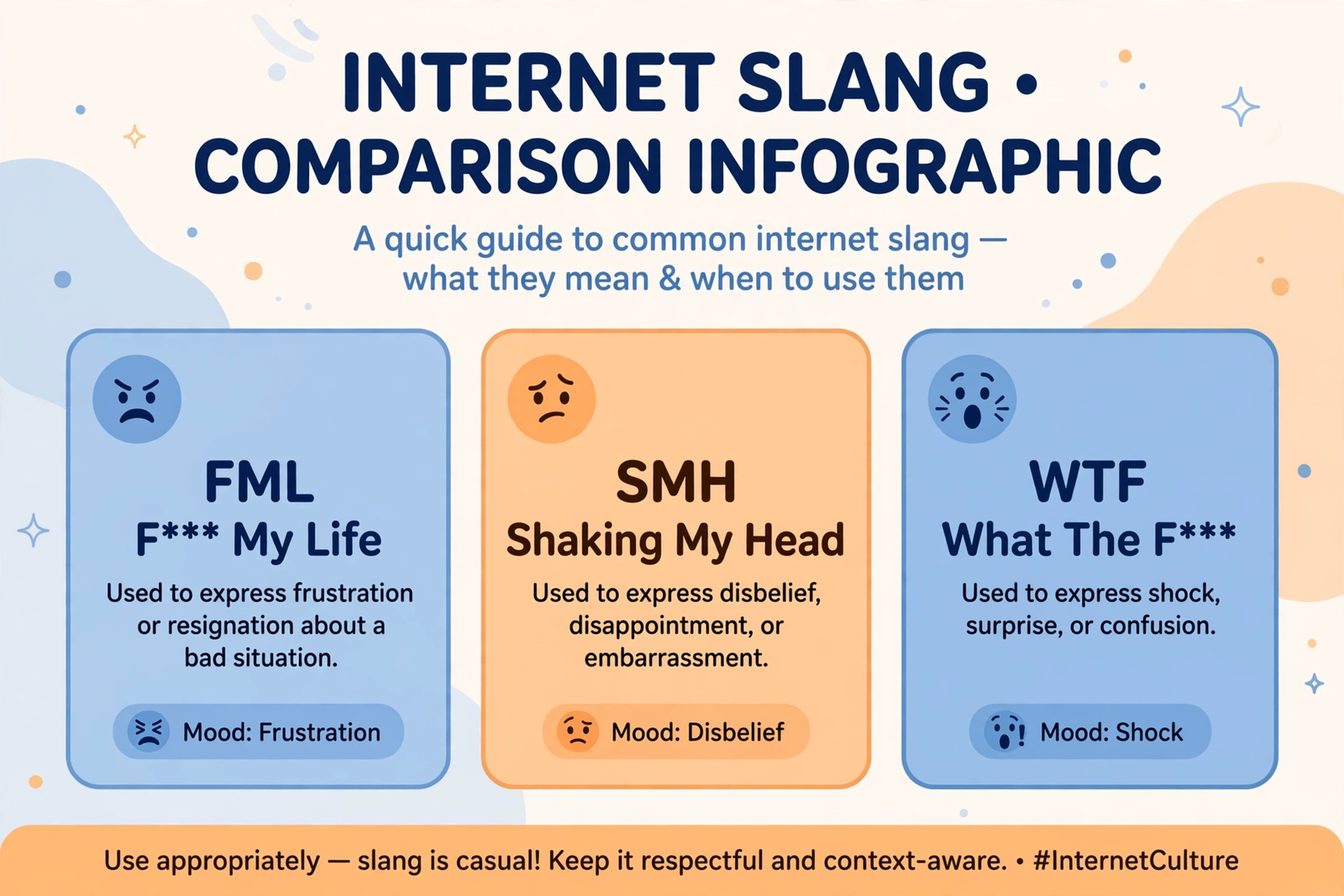
FML is not the only way to react to bad luck online. Several other acronyms cover nearby feelings, but each one has its own flavour. Picking the right one depends on whether you are frustrated, shocked, disappointed, or just amused.
| Term | Stands For | Feeling | When to Use It |
|---|---|---|---|
| FML | F*** My Life | Frustration, bad luck | Something unlucky happened to you personally |
| SMH | Shaking My Head | Disappointment, disbelief | Someone did something foolish or unbelievable |
| WTF | What The F*** | Shock, confusion | Something surprising or outrageous just happened |
| OMG | Oh My God | Surprise, excitement | Good or bad news that catches you off guard |
| FFS | For F***’s Sake | Annoyance, impatience | You are fed up with a repeated problem |
| TYSM | Thank You So Much | Gratitude | Opposite mood — thanking someone warmly |
The closest cousin is SMH. The difference is direction: FML is about something that happened to you, while SMH is about something someone else did that you cannot believe. “I dropped my phone in the toilet. FML.” is self-directed. “He dropped his phone in the toilet again. SMH.” is aimed at someone else.
WTF, on the other hand, is a reaction to surprise rather than bad luck. You might say WTF when you hear shocking news, then follow it with FML once you realise the bad news affects you personally. And while FML and FFS both express annoyance, FFS is sharper and more impatient — it sounds like you are scolding the situation, while FML sounds like you are sighing at it.
On the positive side of the spectrum, TYSM shows how the same short-form style works for gratitude. Knowing the whole family of acronyms — the frustrated ones and the friendly ones — helps you sound natural in any chat.
Alternate Meanings
Most of the time, FML means “F*** My Life.” But like many three-letter abbreviations, it has picked up a few other meanings in specific contexts. These are rare, and the slang meaning is the default almost everywhere online. Still, it helps to know them so a strange use does not confuse you.
| Meaning | Context | Example |
|---|---|---|
| F*** My Life | Texting, social media (default) | “Missed my flight. FML.” |
| For My Lady | Romantic messages | “I bought these flowers FML.” |
| For My Lover | Romantic messages | “I would do anything FML.” |
| For My Life | Dedication, commitment | “I want to win this championship FML.” |
| Fix My Life | Self-improvement | “I am trying to FML and get organised.” |
| Football Manager Live | Gaming (old online game) | “I spent all night on FML bidding.” |
| Formal (dress code) | Workplace, events | “The team wore FML dress for the event.” |
Context is everything. If a friend texts “FML” after a story about losing their keys, the slang meaning is obvious. If a gaming forum mentions FML, it might mean the old Football Manager Live game. And in a romantic note, “for my lady” is possible — though honestly, most people would write that out in full rather than risking the confusion.
When in doubt, assume the slang meaning. It accounts for the overwhelming majority of uses, and every other meaning needs a very specific context to make sense.
Professional or Polite Alternatives
Because FML hides a swear word, there are plenty of situations where you need the same feeling without the same letters. Here are clean swaps that work in any setting, from work chats to family group messages.
- “Just my luck.” — The closest clean equivalent. Short, natural, and works everywhere.
- “Of course that happened.” — Perfect for sarcastic bad-luck stories.
- “Ugh, what a day.” — Friendly and safe, even with older relatives.
- “I cannot catch a break today.” — Great for a string of small disasters.
- “That is so frustrating.” — Direct and honest, with no slang at all.
- “Well, that went wrong.” — Light and funny, ideal for minor mishaps.
- “Story of my life.” — The polite cousin of FML; same self-pitying joke, zero swearing.
- “Today is not my day.” — The classic line for a bad-luck streak.
These alternatives also solve the audience problem. “Story of my life” gets the same laugh in a family group chat that FML gets in a friends-only chat, and it will never embarrass you if a parent, teacher, or manager is reading. Keep the original for close friends and casual social media, and keep the clean versions ready for everyone else.
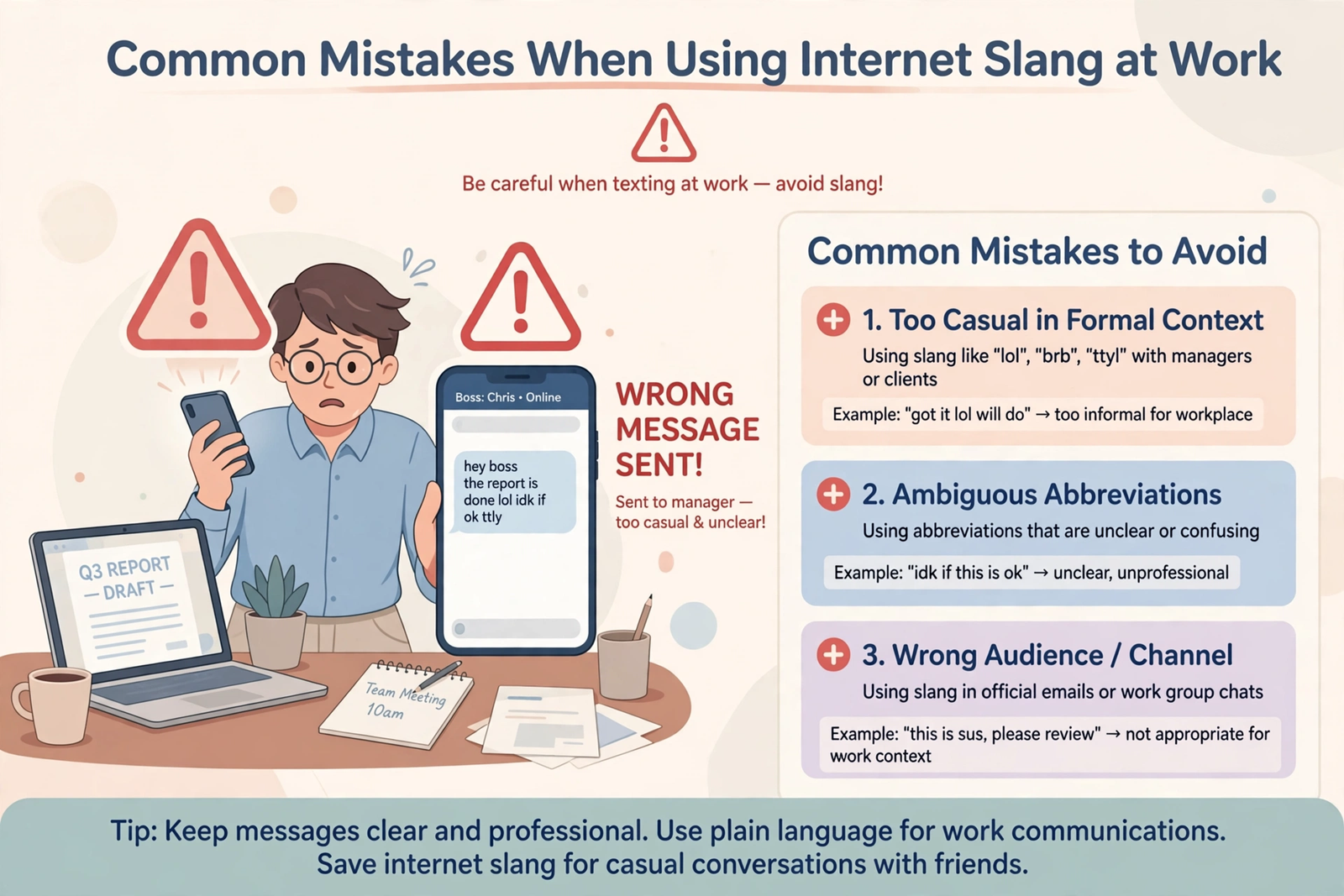
Common Mistakes
FML is easy to use, but a few common mistakes can make it land wrong. Avoid these and your texts will sound natural every time.
- Using it for someone else’s bad news. If a friend tells you something genuinely serious — an illness, a job loss, a family emergency — replying “FML” sounds dismissive. Save it for small, everyday frustrations, and answer real problems with real sympathy.
- Using it at work or school. The hidden swear word makes it inappropriate for professional messages, even if your coworkers use slang. Use one of the polite alternatives instead.
- Putting it at the start of the message. “FML, my car broke down” sounds off. Describe the event first, then let FML close the story: “My car broke down. FML.”
- Using it when nothing went wrong. FML is a reaction to bad luck. Dropping it into a normal or happy message confuses people, because they will keep looking for the disaster.
- Overusing it. If every message ends with FML, it stops being funny and starts sounding like you are always complaining. Save it for moments that deserve the drama.
- Using it with kids or older relatives. Many people do not know the abbreviation, and those who do may find the hidden swear word rude. Choose a cleaner phrase for mixed-age chats.
- Confusing it with SMH. FML is about your own bad luck; SMH is about someone else’s foolish behaviour. Mixing them up makes the reaction point the wrong way.
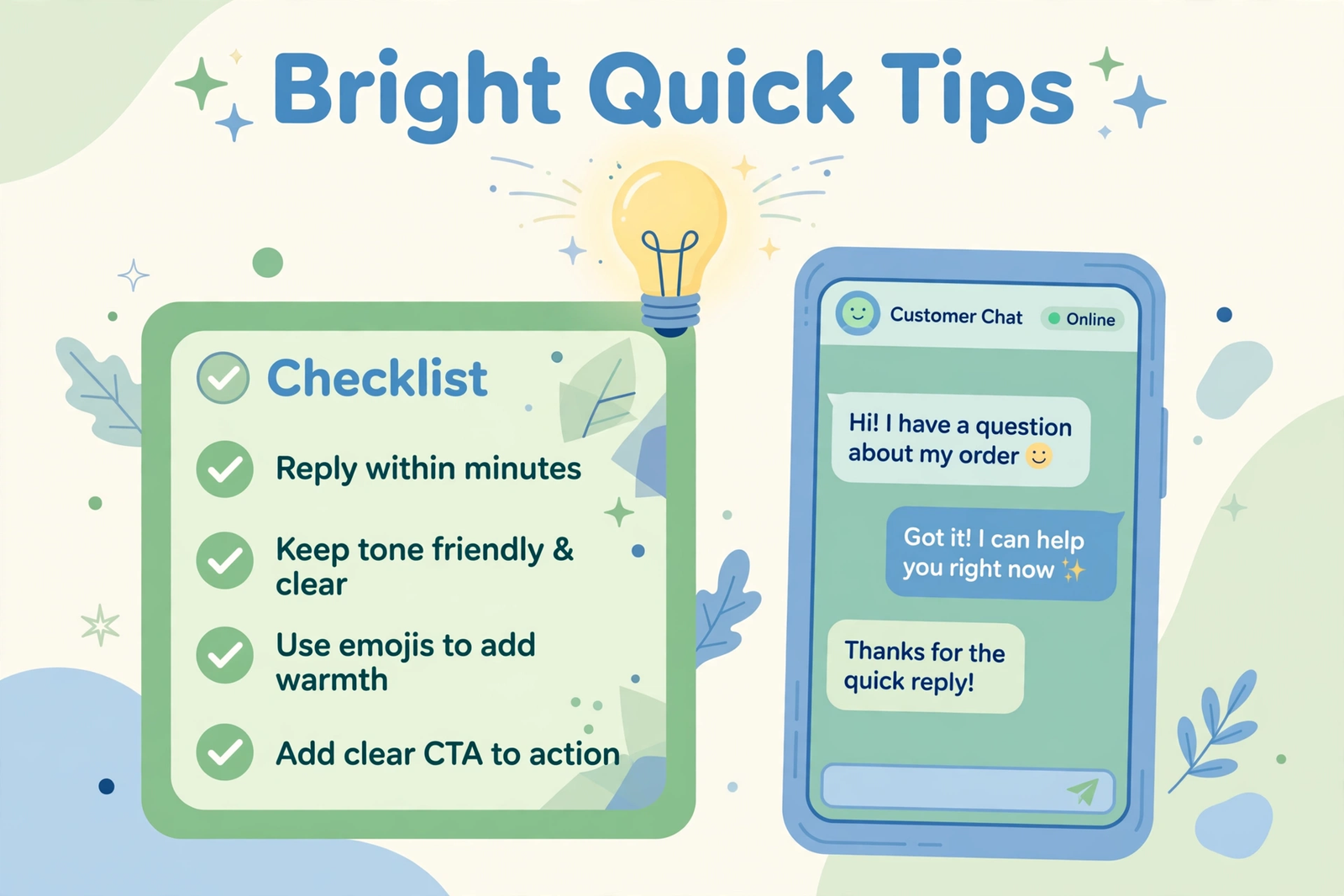
Quick Tips
Want to use fml slang like a native speaker? These quick tips cover the essentials.
- Story first, FML last. Always describe the unlucky event before the acronym — it is a punchline, not an opener.
- Match the drama to the disaster. Small problems get a playful FML; genuinely bad days deserve a real conversation, not an acronym.
- Lowercase reads calmer. “fml” feels like a tired sigh; “FML” feels like a loud groan. Pick the volume that matches your mood.
- Pair it with an emoji. A laughing face, a facepalm, or a crying-laughing emoji instantly signals that you are joking about your bad luck.
- Reply with empathy, not just the acronym. When a friend shares a bad moment, “FML, that is the worst!” lands warmer than a bare “FML.”
- Know your audience. Friends and social media: fine. Boss, teacher, parents, or kids: use a clean alternative.
- Do not use it to vent about a person. FML is for situations and bad luck, not for insulting someone — use a direct, honest message instead.
FAQ
What does FML mean in text?
In text messages, FML stands for “F*** My Life.” It is used to express frustration, annoyance, or bad luck after something unlucky happens. Most of the time it is playful or exaggerated rather than serious.
Is FML rude or offensive?
It is casual slang, not a direct insult. The “F” hides a swear word, so it can feel rude in formal settings or to people who dislike swearing. Among friends and on social media, it is widely accepted and rarely considered offensive.
Is FML safe for kids?
Not really. Because the full form contains a swear word, it is best avoided around children. Kids may also repeat it without understanding what it stands for, so a cleaner phrase like “just my luck” is a better choice.
When should I use FML?
Use it in casual chats with friends, in group messages, and in social media captions — always after describing the unlucky event. Avoid it at work, at school, and in messages to people you do not know well.
What is the difference between FML and SMH?
FML is about your own bad luck: something unfortunate happened to you. SMH (shaking my head) is about someone else doing something foolish or unbelievable. One points inward, the other points outward.
Can FML be used sarcastically?
Yes, very often. Many people use it to joke about tiny inconveniences — a spilled drink, a dead phone battery, a missed bus. The exaggeration is the humour: treating a small problem like a disaster makes the story funnier.
What does FML mean on TikTok and Instagram?
It means the same thing as in texting: “F*** My Life.” On TikTok and Instagram it usually appears in captions under fail videos, relatable everyday chaos, and memes about bad days. It signals that the poster is laughing at their own bad luck.
What are polite alternatives to FML?
Good clean swaps include “just my luck,” “story of my life,” “today is not my day,” “of course that happened,” and “I cannot catch a break today.” They carry the same feeling without the hidden swear word, so they work in any setting.
Conclusion
fml slang is one of the internet’s most durable abbreviations for a simple reason: everyone has bad days, and three letters say it all. Short for “F*** My Life,” it turns frustration, embarrassment, and rotten luck into a short, shareable punchline — a joke friends can laugh at, relate to, and answer with a story of their own.
The rules for using it well are simple. Tell the story first, then let FML land at the end. Keep it for casual chats and social media, and swap in a polite alternative like “just my luck” or “story of my life” whenever the audience is formal, mixed-age, or professional. And remember the difference between FML and its neighbours: FML is your own bad luck, SMH is disbelief at someone else, and a quick HBU can change the subject and ask your friend how they are doing instead.
So the next time your alarm fails, your coffee spills, and your phone dies all before 9 a.m., you know exactly what to text. Describe the disaster, add those three letters, and let your friends laugh with you — because some days, FML is the only word that fits.
