
Quick definition: In slang, dub most commonly means a win — short for the letter “W.” When someone says “we got the dub,” they mean “we won.” In other contexts, a dub can also mean a $20 bill or a $20 bag (usually of cannabis). The exact meaning depends on the conversation, so context is everything.
Introduction
If you have spent any time on TikTok, in a gaming lobby, or in a group chat, you have probably seen someone celebrate with the word “dub.” A teammate types “easy dub” after a match, a friend captions a video “took the dub,” or someone asks “you got a dub on you?” — and suddenly one tiny three-letter word is doing three very different jobs. That is exactly why people keep searching for the dub meaning slang: the word is short, casual, and everywhere, but its meaning shifts completely depending on who is saying it and where.
The good news is that once you know the three main slang meanings of dub, you will never be confused by it again. In this guide, we break down each meaning with real examples, explain where the word came from, compare it with similar slang terms like drip and BFE, and show you how to use it naturally — plus the mistakes to avoid so you do not accidentally say the wrong thing in the wrong room.
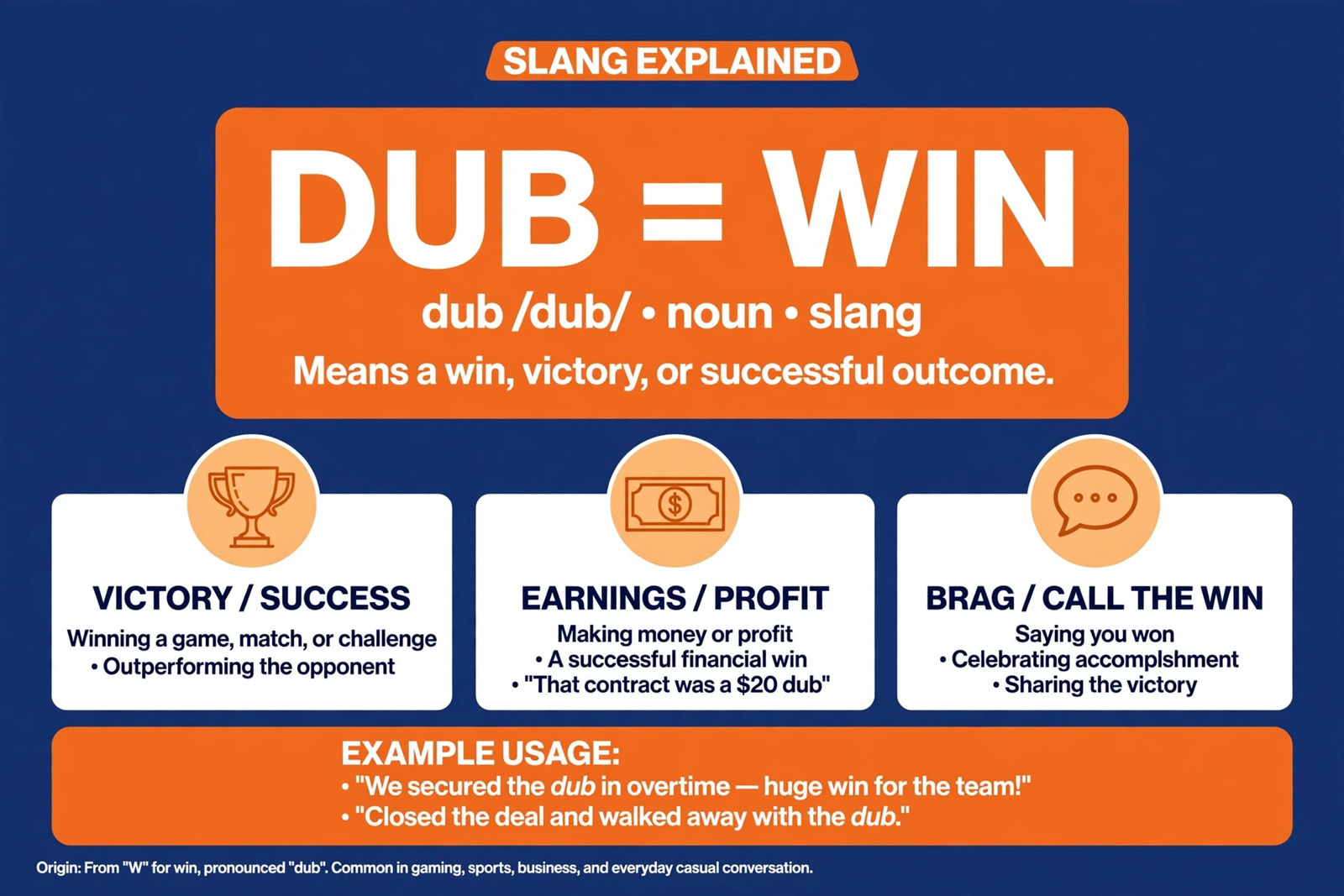
Dub Meaning Slang & Definition
The dub meaning slang changes with context, but it almost always falls into one of three buckets:
| Meaning | Where you hear it | Example |
|---|---|---|
| A win (from “W”) | Gaming, sports, TikTok, group chats | “We got the dub last night!” |
| A $20 bill | Street slang, rap lyrics, casual money talk | “That cost me a dub.” |
| A $20 bag (of cannabis) | Drug-culture slang, some rap lyrics | “He sells dubs on the corner.” |
The “win” meaning is by far the most common one you will meet online today. It comes from pronouncing the letter “W” — the first letter of “win” — as “dub,” which is how the letter W is said in the NATO-style spoken alphabet style (“double-u” shortened to “dub”). Gamers started calling victories “dubs” years ago, and TikTok and sports Twitter carried the word into the mainstream. When a team wins a championship, fans flood the comments with “DUBS.” When a creator posts a success story, the replies say “big dub.”
The money meaning is older. In American street slang, a “dub” has meant twenty dollars for decades — a “dub” is short for “double ten,” since twenty is double ten. Rappers have used it for years, and it still shows up in lyrics and casual conversation about cash. The third meaning grows out of the second: because a “dub” is twenty dollars, a “dub sack” or “dub” of weed is simply twenty dollars’ worth.
So how do you tell them apart? Look at the sentence around the word. If someone is talking about a game, a match, a bet, or a competition, dub means a win. If they are talking about prices, paying, or cash, it means twenty dollars. If the conversation is about buying or selling something green, it means a twenty-dollar bag. In most texts and TikToks you will see in 2026, it is the win meaning.
Origin of Dub
The word “dub” itself is old — it has meant “to name something” or “to add a voice track to a film” for more than a century. But the slang meanings took separate paths. The money sense appeared in American hip-hop and street culture, where “dub” as twenty dollars was already common in the 1990s and 2000s. Artists used it so often that it became a standard slang term for a twenty, alongside “a Jackson” (Andrew Jackson is on the $20 bill).
The win sense has a different story. In online gaming culture of the 2010s, players started calling a victory a “W” in chat — “W in the chat” after a win. Saying the letter out loud gave it a sound: “dub.” Streamers picked it up, then NBA fans, then TikTok. By the early 2020s, “dub” had become the standard casual word for a win across gaming, sports, and social media. Its opposite is an “L” (a loss), and you will often see the pair together: “take the dub, forget the L.”
Music also helped. Dub as a genre — dub music, the Jamaican-born style built on remixed reggae — kept the word in circulation for decades, and the verb “to dub” (to name or nickname someone) gave us phrases like “don’t dub me that.” All of these threads share the same short, punchy sound, which is part of why the word stuck: “dub” is fast to type, fun to say, and instantly recognizable.
Popularity of Dub Slang
Dub is not a passing trend. It has survived across three different subcultures — gaming, hip-hop, and sports fandom — and each one keeps it alive for a new generation. On TikTok, videos tagged with “dub” range from sports highlights to gaming clips to money jokes, and the comments under them are full of people calling wins “dubs.” In gaming lobbies on Fortnite, Warzone, Valorant, and Rocket League, “dub” is simply the normal word for a victory; saying “we won” sounds almost formal by comparison.
Sports fans use it constantly. After a big game, team accounts and fans post “DUBS ONLY” or “another dub in the books.” The word works because it is shorter than “victory,” cooler than “win,” and carries a little celebration in it. It also travels well across age groups: teenagers use it in chats, college students use it about exams and parties, and adults use it about sports bets and fantasy leagues.
Search interest in the dub meaning slang stays steady rather than spiky, which tells you something important: this is not a viral word that will vanish next month. It is a settled piece of internet slang, the same way “GOAT” or “no cap” became permanent. If you want to sound natural online in 2026, knowing dub is not optional — it is basic vocabulary.
How Dub Is Used
Dub works as a noun, and sometimes as a verb. As a noun, it is the win itself or the twenty dollars: “that was a huge dub,” “I need a dub for gas.” As a verb, “to dub” someone can mean to name them or, in some contexts, to reject or ignore them — “she dubbed me” can mean she ignored my message. That verb sense is less common, so pay attention to context.
Here is how the win meaning shows up in everyday use:
- Celebrating: “Let’s gooo, dub!” after a victory.
- Predicting: “Easy dub tonight, our team is stacked.”
- Recapping: “Took the dub in overtime, unreal game.”
- Counting: “That’s three dubs in a row.”
And here is how the money meaning shows up:
- Paying: “Cover me, I only got a dub.”
- Pricing: “Tickets are a dub each.”
- Bragging: “Made three dubs today, not bad.”
Notice how different the two sets of sentences feel. Nobody says “easy dub tonight” about money, and nobody says “tickets are a dub each” about a game. The surrounding words do the work of telling you which dub you are looking at.
Examples of Dub in Real Conversations
Real examples make the meaning stick. Here is how dub sounds in the wild, across different moods and settings.
Friendly Examples
- “We finally got the dub in ranked! I was shaking the whole last round.”
- “Big dub today — I passed my driving test on the first try!”
- “Our group project got an A. Total dub.”
- “He asked her out and she said yes. That’s a dub, bro.”
Professional Examples
- “Landing that client was a huge dub for the whole team.”
- “We closed the quarter with a dub — sales beat the target by 12%.”
- “Getting the promotion after two years? Absolute dub.”
In professional settings, people usually say “win” instead of “dub,” but in casual workplace chats — especially among younger teams — “dub” shows up as a light, playful way to celebrate a result. Use it with coworkers you know well, not in a formal email to a client.
Funny Examples
- “Me: loses every game. Also me: ‘dub incoming.'”
- “My bank account after payday: one dub and a dream.”
- “Told my mom I got a dub and she asked why I’m selling things for twenty dollars.”
- “POV: you call it a dub and your grandma thinks you’re talking about movies.”
The last two jokes land because they play on the exact confusion this article solves: dub genuinely has multiple meanings, and mixing them up is funny — unless you mix them up in a serious conversation.
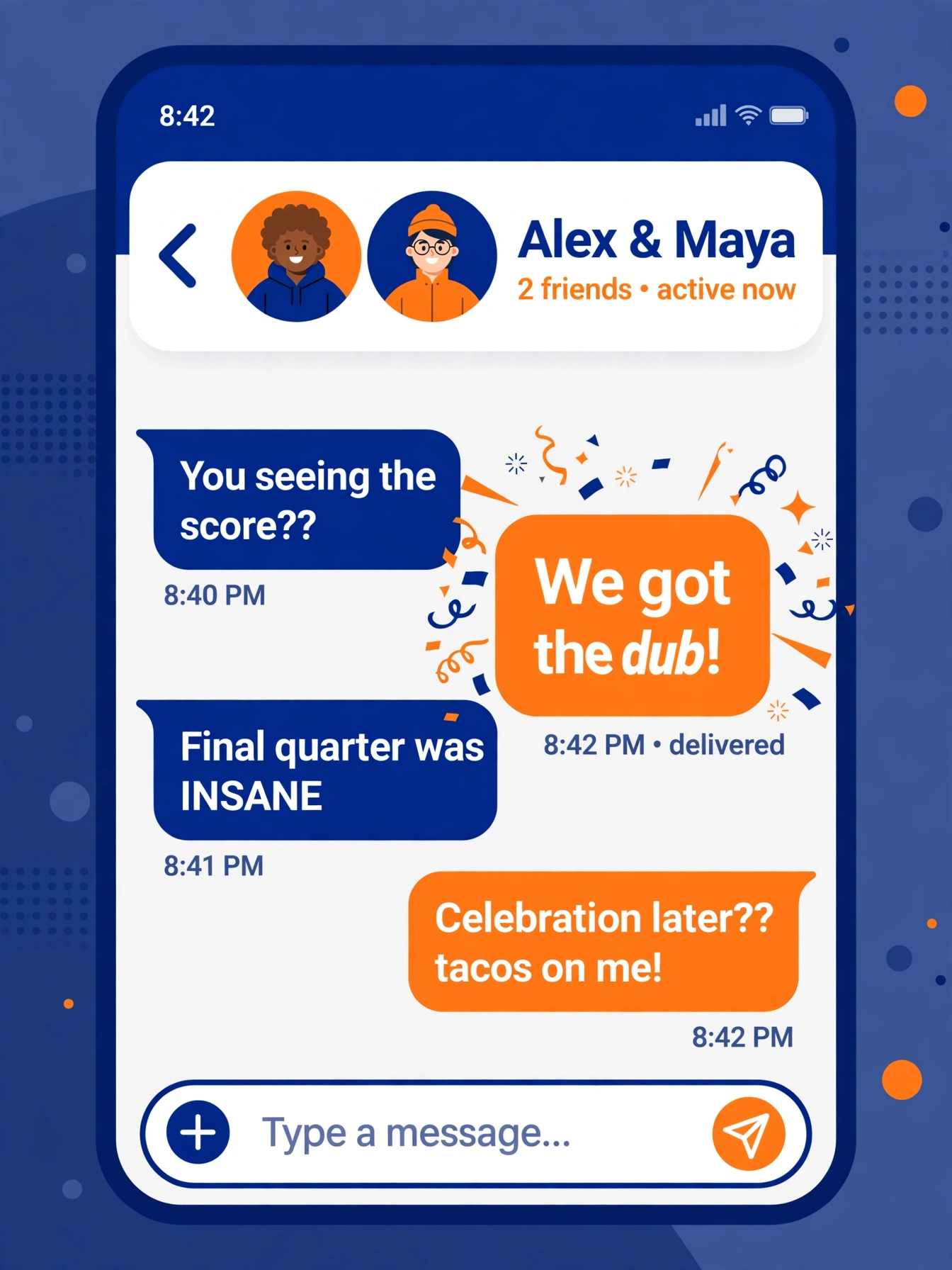
Comparison with Similar Terms
Dub sits in a crowded family of short slang words for winning, money, and success. This table sorts them out:
| Term | Meaning | How it differs from dub |
|---|---|---|
| W | A win | The letter itself; “dub” is the spoken form of W |
| L | A loss | The opposite of a dub — never a win |
| GOAT | Greatest of all time | A title for a person, not a single win |
| Clutch | Performing under pressure | Describes how you won, not the win itself |
| Bread / guap | Money in general | Any amount; a dub is specifically $20 |
| Buck | One dollar | Twenty bucks = one dub |
| Drip | Style, fashion, swagger | About how you look, not winning — see our guide to drip meaning slang |
| Bussin | Really good (food, music) | Describes quality, not victory |
The closest cousin is “W.” In text, people type “W” and say “dub” out loud — they are two forms of the same idea. You will also see “dubs” plural for a winning streak, and “dub city” as a playful nickname for a team on a hot streak. If you already know PMO and WYB, dub fits the same pattern: a tiny word that carries a whole attitude in a group chat.
Alternate Meanings of Dub
Outside slang, dub has several legitimate meanings worth knowing so you do not get confused:
- To dub (verb): to give someone a name or nickname — “they dubbed him ‘the professor.'” Also, to replace the original voice track of a film or show with a new language, as in “the anime was dubbed in English.”
- Dub music: a genre of electronic music that grew out of Jamaican reggae in the late 1960s, built on heavy bass, echo, and remixing. If someone says “I love dub,” they might mean the music, not a win.
- Dub (film/TV): a copy of a recording, or a version with replaced audio.
- Dub in sports (golf): an old-fashioned word for a poor golfer, rarely used today.
- Double: in older slang, “dub” could shorten “double” — for example, a “dub” as a double portion. This use is rare now.
The dictionary definition of dub as a verb — to name or to voice over — is the original sense, and the slang meanings grew out of the word’s short, punchy sound rather than from that definition. For the standard dictionary entry, see Merriam-Webster’s definition of dub.
Professional or Polite Alternatives
Dub is casual. In formal writing, school, or work, swap it for a plain word:
| Instead of | Say | When |
|---|---|---|
| “We got the dub” | “We won” | Any formal context |
| “Big dub” | “A great success” | Work updates, emails |
| “That’s a dub” | “That’s a win” | Mixed-age groups |
| “It cost a dub” | “It cost twenty dollars” | Anytime money is involved |
The rule is simple: if you would not say “no cap” in that room, do not say “dub” either. With friends, in gaming, and on social media, dub is perfect. In a job interview, a college essay, or a message to your grandmother, use “win” or “twenty dollars” instead.
Common Mistakes with Dub
Most mistakes with dub come from mixing up its meanings or using it in the wrong room. Here are the ones to avoid:
- Using the money meaning in a gaming chat: “I need a dub” in a game lobby sounds like you want a win, not twenty dollars. Keep money talk out of game chat unless everyone knows what you mean.
- Using the drug meaning casually: the “$20 bag” sense is real slang, but saying it around the wrong people can create an awkward — or serious — misunderstanding. If you are not sure your audience knows that meaning, do not use dub for it.
- Calling every good thing a dub: a good meal is not a dub. A nice outfit is not a dub. Reserve the word for actual wins and victories, or it loses its punch.
- Confusing dub with “dubbed”: “I got dubbed” (voiced over, or named) is not the same as “I got a dub” (I won). One extra letter changes the meaning completely.
- Using it formally: “dub” in a resume, a cover letter, or a school paper will look out of place. Save it for casual conversation.
- Assuming everyone knows it: older relatives and people outside gaming or TikTok culture may not know the win meaning at all. If they look confused, just say “win.”
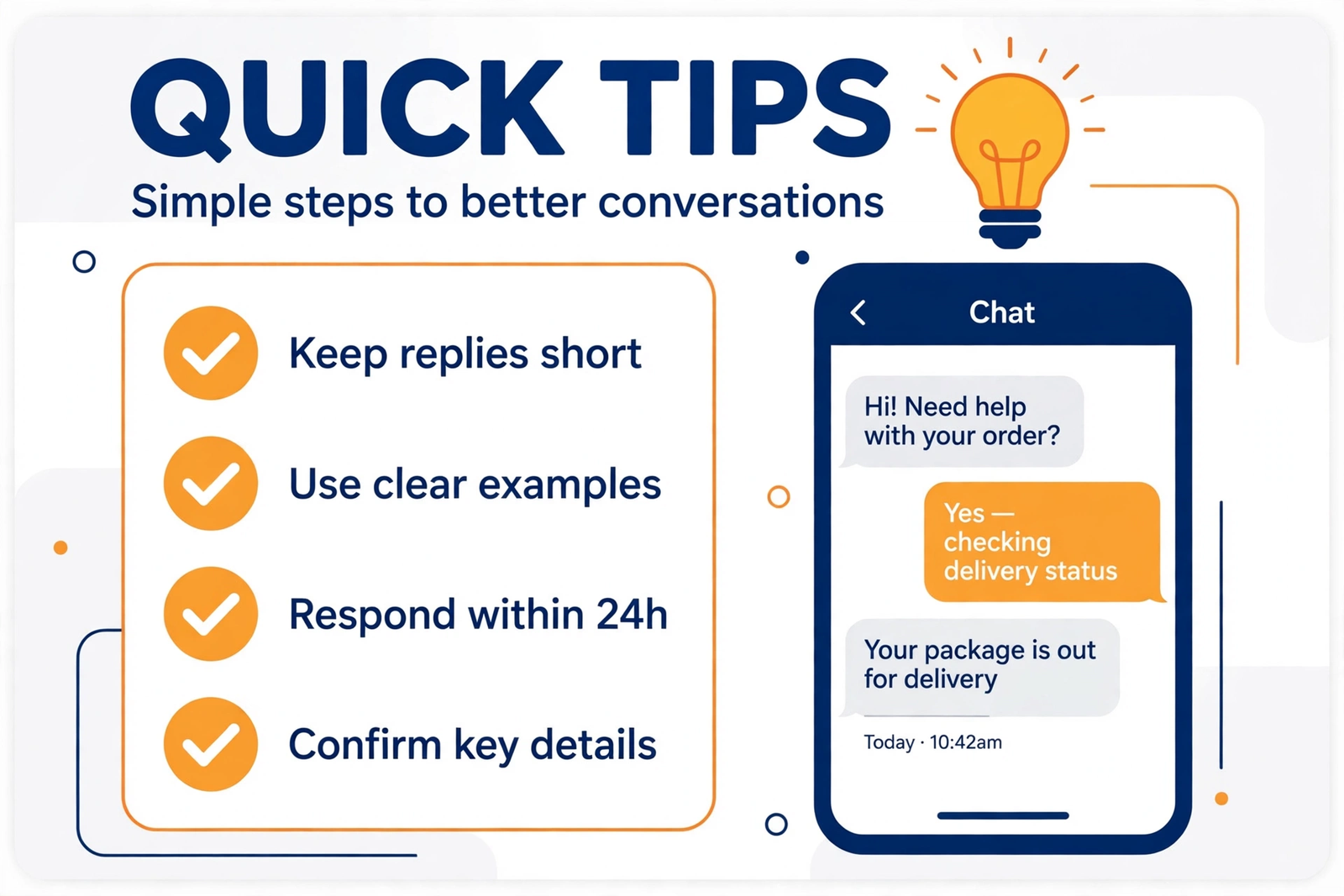
Quick Tips for Using Dub
- Check the context first: game, money, or something else? The sentence around dub tells you the meaning.
- Use it to celebrate: dub works best as a quick, happy word after a win — in chats, comments, and captions.
- Pair it with an L: “took the dub, left the L behind” is a natural, confident way to talk about a victory.
- Keep it plural for streaks: “three dubs in a row” sounds far more natural than “three wins in a row” in a gaming chat.
- Do not force it: if “win” feels more natural in the sentence, use “win.” Slang works when it is effortless.
- Know your audience: friends and gaming lobbies love it; formal settings do not. Match the room.
FAQ
What does dub mean in slang?
In slang, dub most commonly means a win — it is the spoken form of the letter “W” (for “win”). It can also mean a $20 bill or a $20 bag of cannabis, depending on context. In gaming and on TikTok, the win meaning is by far the most common.
What does “got the dub” mean?
“Got the dub” means “we won” or “I won.” Gamers, athletes, and TikTok creators use it to celebrate a victory, as in “we got the dub in the finals!”
Is dub the same as W?
Yes, basically. “W” is the letter people type, and “dub” is how you say that letter out loud. Both mean a win. You will often see them used together: “W. Huge dub.”
What is the opposite of a dub?
An “L” — short for “loss.” Taking a dub means winning; taking an L means losing. The pair shows up constantly in gaming and sports talk.
Does dub mean $20?
Yes, in street and hip-hop slang a dub is twenty dollars, because twenty is double ten. It can also mean twenty dollars’ worth of cannabis (a “dub sack”). But in most online conversations today, dub means a win, not money.
Where did dub slang come from?
The money meaning comes from American street and hip-hop culture, where “dub” meant $20 for decades. The win meaning comes from gaming culture: players typed “W” for a win, and saying the letter out loud sounded like “dub.” TikTok and sports fans then spread it everywhere.
Is it okay to say dub at work or school?
In casual chats with people you know well, yes — “that was a dub” is a fun way to celebrate a team success. In formal emails, presentations, or essays, use “win” or “success” instead.
What does “dub” mean on TikTok?
On TikTok, dub almost always means a win. Creators caption victories, glow-ups, and good news with “dub,” and commenters reply “DUBS” to celebrate. If a TikTok is about money, it can mean $20 — but the win meaning dominates the platform.
Conclusion
The dub meaning slang is simple once you know the three uses: a win, a twenty-dollar bill, or a twenty-dollar bag. Online — in gaming, on TikTok, and in group chats — it almost always means a win, the spoken form of “W.” In money talk and rap lyrics, it means twenty dollars. Context tells you which one you are hearing, and now you know how to read it.
Use dub when you celebrate a victory, keep it casual, and pair it with confidence: “took the dub, moving on to the next one.” And if you want to keep building your slang vocabulary, check out our guides to drip meaning slang and BFE meaning next — they will make the next group chat a lot easier to follow.

1 thought on “Dub Meaning Slang: What Does Dub Mean in Text, Gaming & TikTok?”