
Quick definition: out of pocket meaning slang — “Out of pocket” has two main slang meanings. It can mean unavailable or unreachable (“I’ll be out of pocket this weekend”), or it can mean acting wild, out of line, or saying something inappropriate (“That comment was out of pocket”). Which meaning applies depends entirely on the context.
Out of Pocket Meaning & Definition
The out of pocket meaning slang definition is not one single idea — it is two. That is exactly why the phrase confuses so many people. In one conversation, “out of pocket” means someone cannot be reached. In another, it means someone has gone too far. Both uses are correct, both are common, and the only way to tell them apart is the sentence around them.
Meaning 1 — Unavailable: When someone says “I’ll be out of pocket,” they mean they will be away, offline, or hard to reach. No phone signal, no Wi-Fi, travelling, or simply not checking messages. It is the polite, professional-sounding way of saying “don’t expect a reply from me for a while.”
Meaning 2 — Out of line: When someone says “That was out of pocket,” they mean the comment or behaviour was wild, inappropriate, disrespectful, or just plain crazy. It is the slang way of saying “you went too far” — often with a mix of shock and amusement.
There is also a third, literal meaning that still shows up: paying for something yourself. “Out-of-pocket expenses” are costs you cover from your own money instead of being reimbursed. This is the original meaning of the phrase, and it is still the standard one in business and finance. The slang meanings grew out of it over time.
- Full phrase: Out of pocket (sometimes shortened to “OOP”).
- Slang meaning 1: Unavailable, unreachable, or offline.
- Slang meaning 2: Wild, out of line, or inappropriate behaviour.
- Literal meaning: Paid for from your own money.
- Tone: casual and conversational — the “unavailable” sense is neutral, the “out of line” sense is playful or critical.
- Where you see it: texts, Twitter/X, TikTok, Instagram comments, group chats, Discord, and work chats.
Introduction
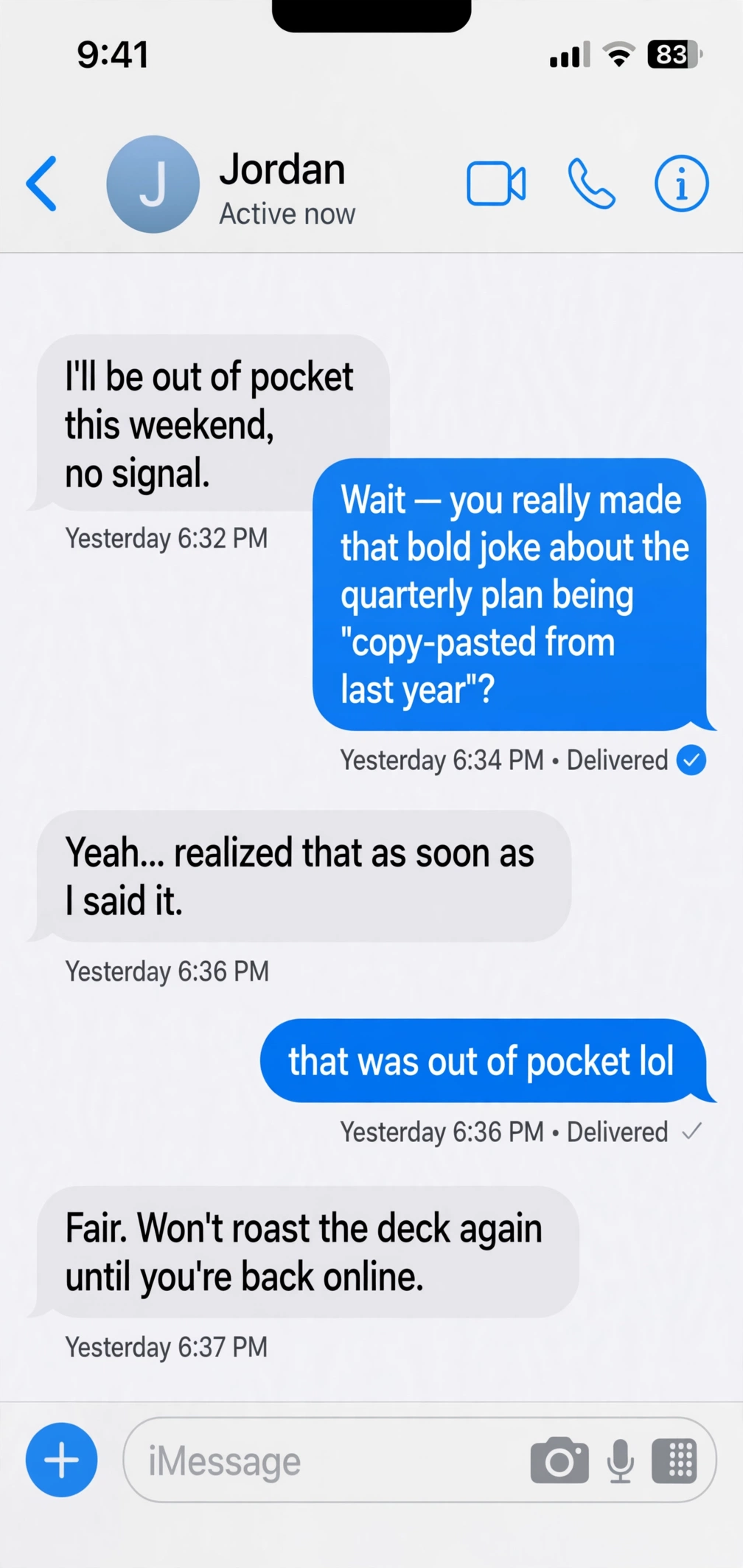
You are scrolling through a group chat when someone drops a comment so bold that another friend replies, “Bro, that was out of pocket.” A few days later, your boss sends a message saying she will be “out of pocket” all weekend. Same phrase, completely different meanings — and if you only know one of them, the other sentence makes no sense at all.
You are not alone. “Out of pocket” is one of those phrases that quietly carries two lives. In professional settings, it is a polite way to say you will be unreachable. In casual slang, it is a warning that somebody crossed a line — or a compliment for someone brave enough to say what everyone else was thinking. The phrase has travelled from business emails to hip-hop lyrics to TikTok comments, picking up new meaning at every stop.
In this guide, you will learn the full out of pocket meaning slang breakdown: both slang meanings, the literal money meaning, where the phrase came from, how people use it in texts and on social media, and the mistakes that make you sound rude when you meant to sound polite. By the end, you will know exactly which meaning fits every situation — and when to use the phrase yourself. If you enjoy decoding chat shortcuts, you will also like our guide to FN meaning in text, another abbreviation that changes meaning with context.

Origin
The phrase “out of pocket” started in the world of money, not slang. In the 1800s, to be “out of pocket” meant to have spent your own money — the cash had literally come out of your pocket. By the early 1900s, businesses were using “out-of-pocket expenses” as a standard term for costs an employee paid personally and later claimed back: travel, meals, supplies. That meaning is still alive today in every workplace and insurance form.
The “unavailable” meaning grew out of the business world too. In American corporate language, an employee who was travelling or away from the office was “out of pocket” — away from their desk, away from the phone, and therefore unreachable. The logic was simple: if your money and your paperwork stayed in your pocket while you were gone, you were out of pocket in every sense. By the 1990s and 2000s, people were using it in emails and voicemails: “I’ll be out of pocket until Monday.”
The “wild” or “out of line” meaning has a different story. It grew out of African American Vernacular English (AAVE) and hip-hop culture, where “out of pocket” described someone acting outside the expected bounds — saying something too bold, too rude, or too crazy for the situation. The image is the same: something has come out of where it belongs. A comment that should have stayed in your pocket came out instead. The phrase exploded on Twitter and TikTok in the late 2010s and early 2020s, where a single out-of-pocket reply can get thousands of likes precisely because it was too much.
Today both slang meanings live side by side, and context is the only guide. A work email uses one; a meme comment uses the other. For a clear outside explanation of the phrase’s different senses, Merriam-Webster’s entry for “out of pocket” covers the literal and figurative uses.
Popularity
“Out of pocket” is popular because it does two jobs with three small words. In professional life, it is a softer, more polished way to say “I won’t be available.” It sounds better than “I won’t answer my phone” and more human than “I will be unreachable.” Managers, freelancers, and travellers use it constantly in emails, Slack messages, and out-of-office notes.
In slang, it is popular for the opposite reason: it is the perfect reaction to a moment that goes too far. When a friend roasts someone in the group chat, when a celebrity tweets something unhinged, or when a TikTok comment is brutally honest, “out of pocket” is the word everyone reaches for. It can be a criticism (“That was out of pocket, apologise”) or a compliment (“That joke was out of pocket, I can’t breathe”) — and the tone of voice, or the laughing emoji next to it, tells you which one it is.
Social media made the slang meaning mainstream. Reaction videos, quote-tweets, and comment sections are full of out-of-pocket moments, and the phrase itself became a label for that kind of content. Unlike slang that belongs to one app or one generation, “out of pocket” works everywhere: a work email, a text to your mum, a tweet, or a TikTok caption. It survives because it is genuinely useful — and useful phrases tend to stick around.
Search interest stays steady year after year, because every new wave of internet users meets the phrase in a confusing context and looks it up. Someone reads “I’ll be out of pocket” from a colleague, then sees “that was so out of pocket” under a meme, and realises the same words mean two different things. That confusion is exactly what keeps the phrase interesting.
How It Is Used
The “unavailable” meaning almost always appears as a warning before someone disappears. The pattern is simple: “I’ll be out of pocket” + a time frame. “I’ll be out of pocket this weekend — no signal at the cabin.” “She’s out of pocket until Monday, email her then.” It is a heads-up, not an apology. The speaker is telling you not to expect a fast reply, so you can plan around it.
The “out of line” meaning almost always appears as a reaction after something happens. The pattern is: something wild is said or done, then someone labels it. “Did you see what he said to her? So out of pocket.” “That outfit choice was out of pocket.” Here the phrase judges the behaviour — it says the person went beyond what the situation allowed.
There are three main situations where the phrase fits perfectly. The first is announcing unavailability: travelling, camping, a flight, a digital detox, or just a busy weekend. The second is calling out wild behaviour: a rude joke, an overshare, an unfiltered opinion, or a roast that went too far. The third is praising boldness: when someone says the quiet part out loud and everyone secretly agrees, “out of pocket” becomes a badge of honour.
One thing the phrase is not: a synonym for “broke” or “poor.” Being “out of pocket” in the money sense means you paid for something yourself — it says nothing about how much money you have. Confusing the expense meaning with the slang meanings is the most common mistake people make with this phrase.
Examples
Real examples make the two meanings click instantly. Notice how the same phrase changes completely when the sentence around it changes. Pay attention to the time frame in the first group and the reaction in the second — that is the fastest way to tell them apart.
Friendly Examples
- “I’ll be out of pocket this weekend, camping with no signal — text me Monday!”
- “Sorry for the late reply, I was out of pocket all day at my cousin’s wedding.”
- “Heads up, I’m out of pocket tomorrow, so if you need anything, ask Sarah.”
- “That roast was out of pocket, I’m still laughing about it.”
- “You really told the teacher that? You’re so out of pocket for that one.”
Professional Examples
- “Please note that I will be out of pocket from Friday to Monday and will respond on my return.”
- “Our manager is out of pocket this afternoon, so the meeting has moved to tomorrow.”
- “I paid the taxi fare out of pocket and will submit the receipt for reimbursement.”
- “The team’s travel costs came out of pocket before the company reimbursed them.”
- “If you need approval while I’m out of pocket, please contact the duty manager.”
Funny Examples
- “My grandma said the new neighbour’s haircut is ‘a cry for help.’ Grandma is so out of pocket.”
- “He brought a karaoke machine to a funeral. Out of pocket doesn’t even begin to cover it.”
- “She told her date his shoes looked like clown cars — on the first date. Out of pocket behaviour.”
- “I told my boss ‘you’re not my real dad’ in the meeting. I know, I was out of pocket.”
- “My phone died, my charger broke, and I’m out of pocket in the middle of nowhere. Send help.”
Comparison with Similar Terms
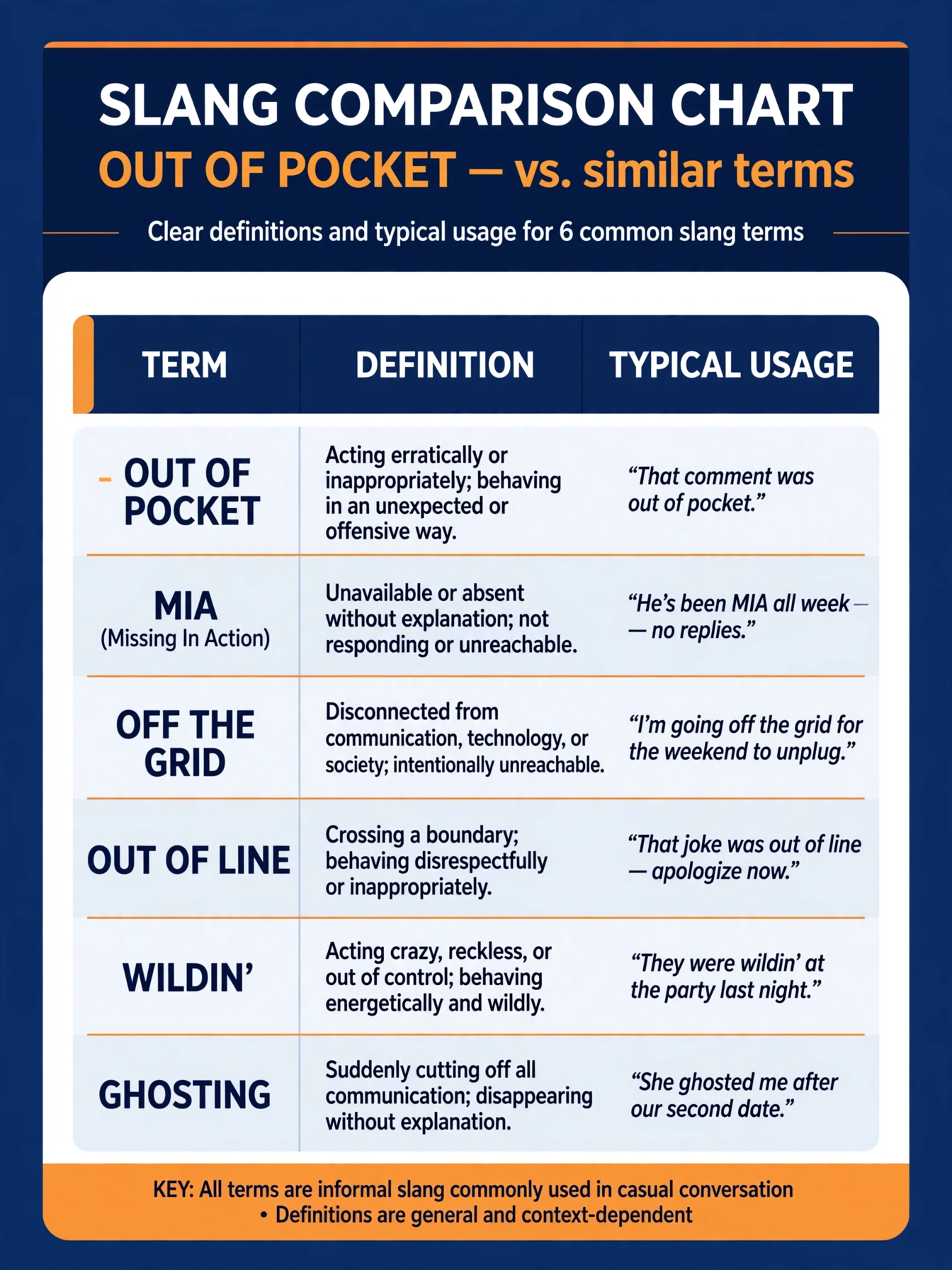
“Out of pocket” overlaps with several other expressions, but each one has its own shade of meaning. The table below shows the closest matches — and the small differences that decide which one fits your sentence.
| Term | What It Means | How It Differs from “Out of Pocket” |
|---|---|---|
| Out of pocket | Unavailable, or acting wild / out of line | The original — covers both unavailability and bold behaviour |
| MIA | Missing in action; gone without explanation | MIA sounds more dramatic and often implies worry; out of pocket is usually planned |
| Off the grid | Completely disconnected from phones and internet | Stronger than out of pocket — it suggests total isolation, not just a busy weekend |
| Out of line | Behaving inappropriately or disrespectfully | Almost the same as the slang sense, but “out of line” is always critical — never a compliment |
| Wildin’ | Acting crazy, reckless, or unrestrained | Wildin’ describes the behaviour itself; “out of pocket” judges it against what was acceptable |
| Ghosting | Ignoring someone’s messages on purpose | Ghosting is deliberate and rude; being out of pocket is usually innocent unavailability |
| OOP | Short form of “out of pocket” | Same meaning, shorter — mostly used in fast chats and captions |
The easiest way to choose: if someone is simply hard to reach, “out of pocket” or “off the grid” both work, with “off the grid” sounding more extreme. If someone said something shocking, “out of pocket” and “out of line” both work — but only “out of pocket” can also be praise. That double life is what makes the phrase so flexible, and so easy to get wrong.
Alternate Meanings
Beyond the two slang meanings, “out of pocket” has a few other uses worth knowing — because they still show up in everyday life.
Money and expenses: This is the original meaning, and it is still the standard one in business, insurance, and healthcare. “Out-of-pocket costs” are expenses you pay yourself: a medical co-pay, a taxi fare, a hotel bill before reimbursement. If a health plan says “maximum out-of-pocket cost,” it means the most you will personally pay in a year. This use is formal, literal, and has nothing to do with behaviour.
Sports: In American football commentary, a quarterback who leaves the pocket — the protected area behind the offensive line — is sometimes described as “out of the pocket.” It is a different phrase with a similar image, and it occasionally causes confusion online when sports fans and slang users cross paths.
Gaming: In some gaming communities, “out of pocket” describes a player making an unpredictable or reckless move — a strategy so strange that nobody saw it coming. It borrows directly from the slang sense of acting wild, and it is usually said with admiration.
The key point: if money, insurance, or a receipt is involved, the phrase means “paid by you.” If a person or a comment is involved, it means “unavailable” or “out of line.” The topic of the sentence tells you which world you are in.
Professional or Polite Alternatives
Slang is fun, but it does not fit every room. Here are polished replacements for each meaning of “out of pocket,” so you can sound right in any setting.
Instead of “unavailable” (out of pocket):
- “I will be unavailable this weekend.”
- “I won’t have access to email until Monday.”
- “I’ll be travelling and largely offline.”
- “Please expect a delayed response.”
Instead of “out of line” (out of pocket):
- “That comment was inappropriate.”
- “That went too far.”
- “That was out of place for this setting.”
- “That crossed a line.”
Instead of “paid by me” (out of pocket):
- “I covered the cost personally.”
- “I paid for it myself.”
- “It was a personal expense.”
As a rule of thumb, use the slang freely with friends and online, but switch to the polite version in work emails, formal messages, and anything your boss or a client will read. The “unavailable” sense of “out of pocket” is already professional enough for most workplaces — it is the “wild behaviour” sense that needs translating.
Common Mistakes
“Out of pocket” is easy to use and easy to misuse. These are the mistakes people make most often — and how to avoid them.
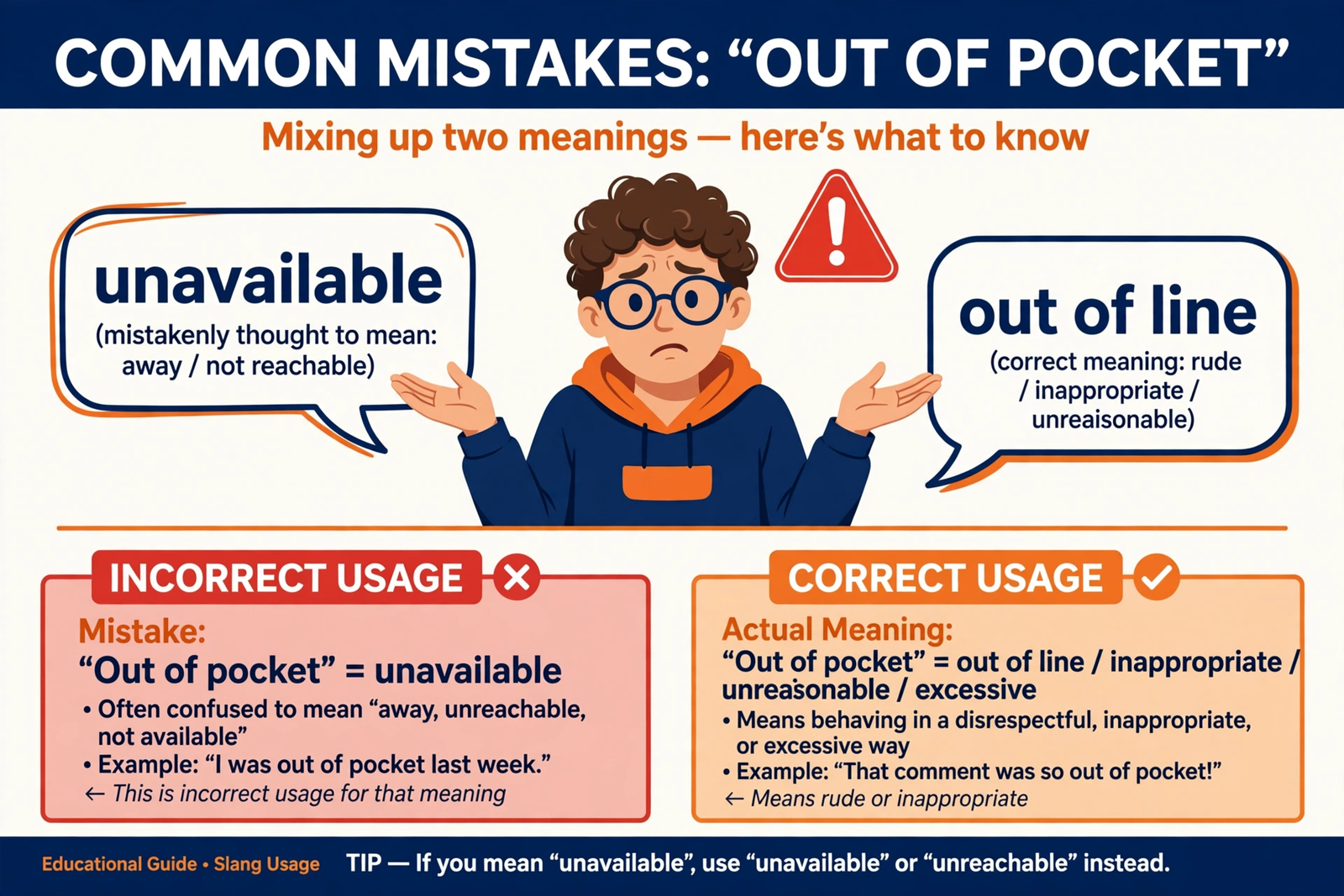
Mixing up the two meanings. Telling your boss you will be “out of pocket” is perfectly professional. Telling a friend someone’s joke was “out of pocket” is perfectly casual. The mistake is using the wrong one in the wrong room: saying “my manager was so out of pocket today” to your colleagues might sound like you are calling your boss rude, when you meant she was just away from her desk. Always check which meaning your listener will hear.
Using it as an excuse for rudeness. “I was just being out of pocket” is not an apology. If a comment hurt someone, the phrase does not undo it — it just labels what happened. Own the behaviour first, then use the phrase to describe it, not to excuse it.
Confusing it with being broke. “Out of pocket” does not mean you have no money. It means you spent your own money on something specific, or that you are unavailable, or that you acted wild. Saying “I’m out of pocket” when you mean “I’m broke” will confuse everyone — use “I’m broke” or “I’m short on cash” instead.
Overusing it until it means nothing. Like every popular slang term, “out of pocket” loses its punch when it describes everything. If every joke, every comment, and every weekend away is “out of pocket,” the phrase stops telling anyone anything. Save it for the moments that genuinely go too far, or the absences that genuinely matter.
Using it in formal writing. The “unavailable” sense survives in business emails, but the slang sense does not belong in reports, applications, or official documents. “The client was out of pocket” in a formal report reads as unprofessional — write “the client behaved inappropriately” instead.
Quick Tips
- Check the context first: a time frame (“this weekend”) means unavailable; a reaction (“that was…”) means out of line.
- Use it as a heads-up: “I’ll be out of pocket” works best before you disappear, not after.
- Pair it with a return time: “Out of pocket until Monday” is far more useful than “out of pocket” alone.
- Read the room: the slang sense is for friends and social media, not for clients or formal emails.
- Watch the emoji: a laughing emoji after “out of pocket” usually means praise; a serious tone means criticism.
- Keep it short: “OOP” works in fast chats, but spell it out when clarity matters.
- Don’t use it to dodge accountability: label the behaviour, then own it.
- Remember the money meaning: if receipts or reimbursements are involved, “out of pocket” is literal, not slang.

FAQ
What does “out of pocket” mean in slang?
In slang, “out of pocket” has two meanings: unavailable or unreachable (“I’ll be out of pocket this weekend”), and acting wild, inappropriate, or out of line (“That comment was out of pocket”). The context of the sentence tells you which one is meant. There is also a literal meaning — paying for something with your own money.
What does “I’ll be out of pocket” mean?
It means “I will be unavailable or hard to reach.” The person is travelling, offline, or away from their phone and will not reply quickly. It is a polite heads-up, commonly used in work emails and texts before a holiday, a trip, or a weekend without signal.
What does “that was out of pocket” mean?
It means “that went too far” — the comment or action was wild, inappropriate, or disrespectful. Depending on the tone, it can be a criticism (“That was out of pocket, apologise”) or a compliment for boldness (“That joke was out of pocket, I’m crying”). The tone and the emoji around it tell you which one it is.
Is “out of pocket” rude?
The phrase itself is not rude. Saying you will be “out of pocket” is polite and professional. But calling someone’s behaviour “out of pocket” is a judgement — it says they crossed a line. Whether it lands as rude depends on who says it, who hears it, and whether it is said with a laugh or with anger.
Where did “out of pocket” come from?
It started in the 1800s as a money phrase: to be “out of pocket” meant to have spent your own cash. Businesses adopted “out-of-pocket expenses,” and corporate language later used it for employees away from the office and unreachable. The “wild behaviour” sense grew out of African American Vernacular English and hip-hop culture, then spread through Twitter and TikTok in the late 2010s.
What is the difference between “out of pocket” and “out of line”?
They overlap, but “out of line” is always critical — it only means inappropriate behaviour. “Out of pocket” can also mean unavailable, and its slang sense can even be praise for boldness. If someone is simply away, only “out of pocket” works; if someone misbehaved, both work, but “out of line” sounds more serious.
Can I use “out of pocket” at work?
Yes — the “unavailable” sense is perfectly professional: “I will be out of pocket until Monday” is standard in business emails. The slang sense, however, should stay out of formal work messages. Don’t write “that client was out of pocket” in a report; write “the client behaved inappropriately” instead. If you want another workplace-friendly abbreviation explained, check out IMK meaning in text.
What does OOP mean in texting?
OOP is the short form of “out of pocket.” It carries the same two slang meanings — unavailable or acting wild — and it is mostly used in fast chats, captions, and comments where typing the full phrase feels too slow. If you see “OOP” under a shocking tweet, it almost always means the “out of line” sense.

Conclusion
“Out of pocket” is small, but it carries two big ideas: sometimes you are gone, and sometimes you have gone too far. It started as a line about money in the 1800s, became corporate shorthand for “unreachable,” and then grew a second life in slang as the perfect label for wild, out-of-line behaviour. Both meanings are alive today, and the sentence around the phrase is the only thing that tells them apart.
Here are the key takeaways: “I’ll be out of pocket” means you will be unavailable — use it as a heads-up before you disappear, and add a return time to make it useful. “That was out of pocket” means someone went too far — it can be criticism or praise, and the tone decides which. And when money, receipts, or insurance are involved, the phrase is literal: you paid for it yourself. Use the slang freely with friends and online, switch to polite alternatives at work, and never use it to excuse rudeness.
The next time you see “out of pocket” in a message, pause for one second and check the context. A time frame means someone is away; a reaction means someone went too far. Once you know both meanings, the phrase stops being confusing — and starts being one of the most useful expressions in your texting vocabulary. For more chat shortcuts explained the same way, explore the rest of our slang guides — from FN to TYSM — and you will never have to guess at a text abbreviation again.
