
Quick definition: In slang, OP is short for “overpowered” or “original poster,” depending on where you see it. In gaming chats, OP describes a weapon, character, or strategy that is unfairly strong. On Reddit, forums, and TikTok comments, OP means the person who started the post or thread. And in hip-hop and street slang, lowercase “op” (usually “ops” in the plural) means an opponent or rival. The correct meaning always depends on context — the same two letters can praise a game character, point at a post’s author, or warn about an enemy.
OP Slang Meaning & Definition
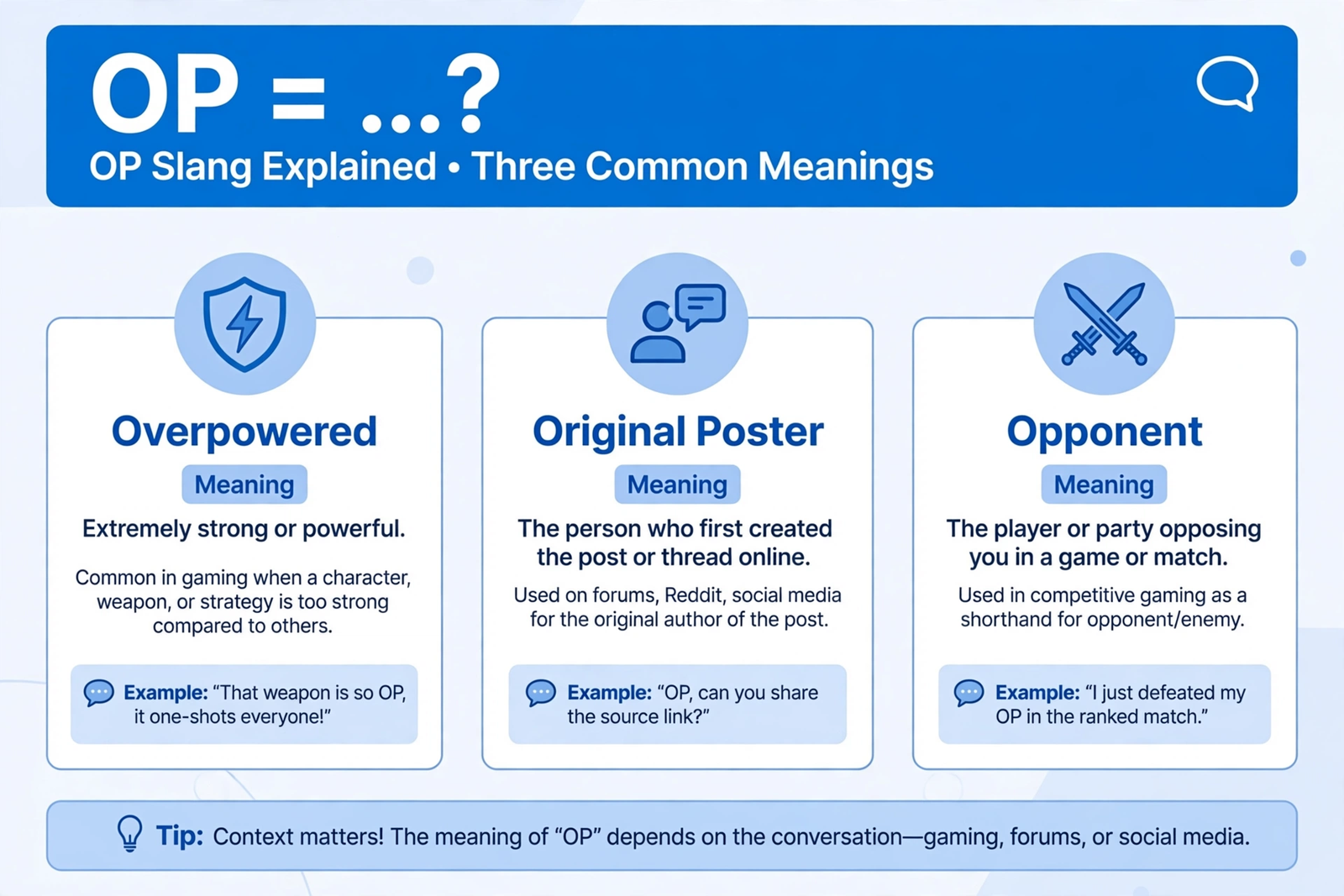
The phrase op slang covers one of the most confusing two-letter words on the internet, because OP is really three different slang words wearing the same outfit. The capital letters matter, the platform matters, and the conversation matters. Get any of those wrong and you will completely misunderstand what someone is saying.
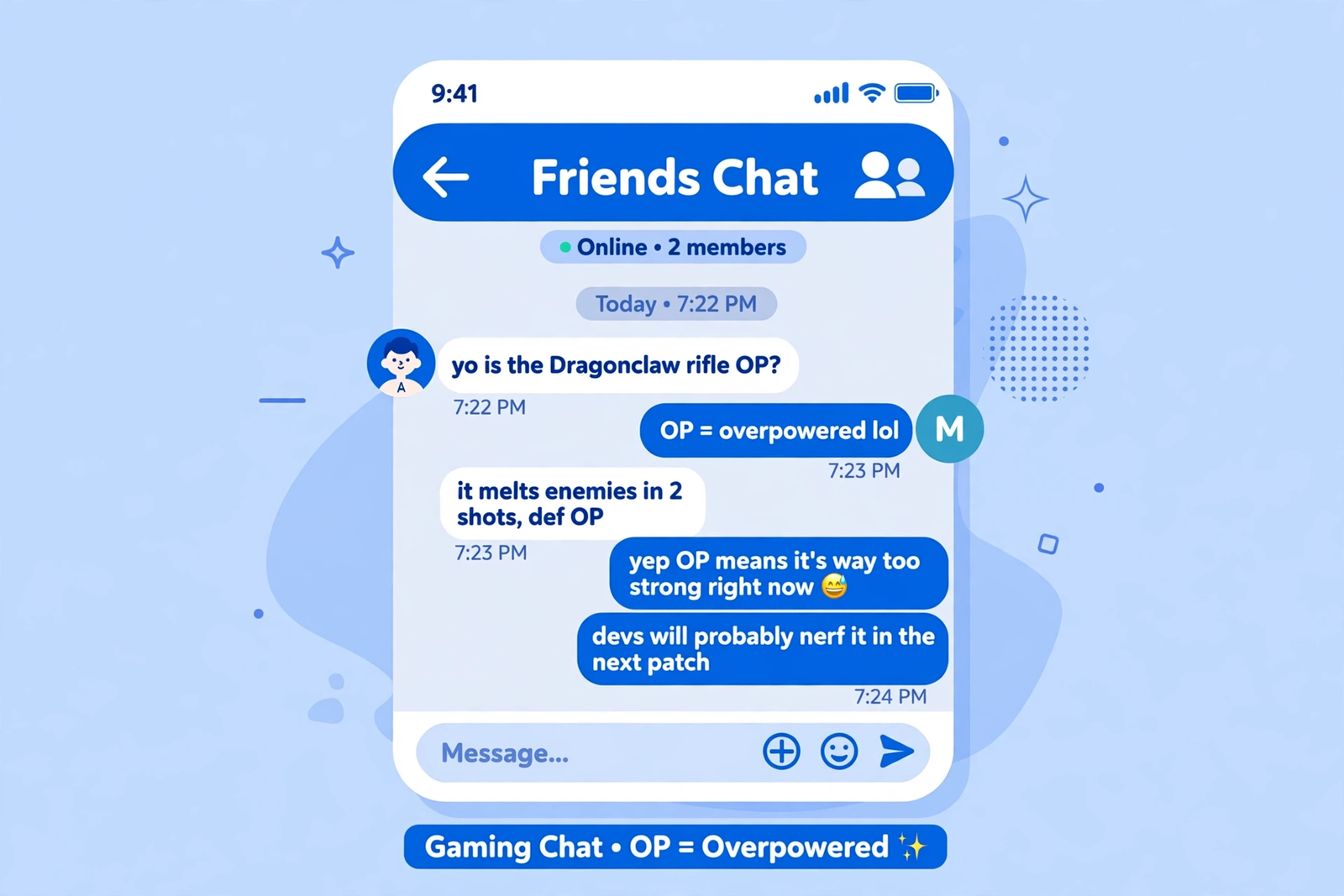
The first meaning, overpowered, is the gaming one. When a player says “that gun is OP,” they mean the weapon is so strong it breaks the balance of the game. It deals too much damage, it is too easy to use, or it has almost no counter. Developers eventually “nerf” OP items — they weaken them in an update — because an OP weapon makes the game unfair for everyone else. The word can also be praise: calling a teammate “OP” means they played incredibly well, almost impossibly well.
The second meaning, original poster, is the forum one. On Reddit, message boards, and comment sections, OP is the person who started the thread. If someone writes “OP deleted their account,” they mean the person who made the original post is gone. If a comment says “OP is lying,” it is aimed at the author of the post, not at anyone else in the replies. This meaning is so standard on Reddit that it appears in nearly every popular thread.
The third meaning, opponent, is the street and music one — and it is usually written in lowercase. An “op” is a rival, an enemy, or someone working against you. You will hear it in rap and drill lyrics, in TikTok captions about rival friend groups, and in gaming lobbies where players trash-talk the other team. Unlike the other two meanings, this one is personal: an op is a person, not a thing or a post.
Here is the fast way to tell them apart. If the conversation is about a game and something feels too strong, OP means overpowered. If the conversation is about a post or thread and someone is being pointed at, OP means original poster. If the conversation is about people, rivals, or beef, op means opponent. Once you learn that three-way split, the word stops being confusing and starts being useful.
Introduction
You are scrolling through TikTok and a comment says “OP ate that edit.” In your game chat, a teammate types “this sniper is so OP.” On Reddit, someone replies “OP never came back with an update.” Three different posts, three different meanings — and all three are correct. That is the strange power of op slang: two letters that change meaning every time they change rooms.
OP is one of the oldest pieces of internet slang still in daily use. It started in the forums and gaming communities of the late 1990s and early 2000s, long before TikTok existed, and it never went away. Instead, it spread. Gamers carried it into every new game, forum users carried it onto Reddit and Discord, and musicians carried the lowercase version into rap lyrics that millions of people now quote in captions and comments.
What makes OP tricky is that context is everything. There is no single definition to memorize. You have to read the room: what platform you are on, what the conversation is about, and whether the word is capitalized. This guide breaks down all three meanings of OP, shows you exactly where each one lives, and gives you real examples so you never mix them up again. You will also learn how OP compares to similar terms, the mistakes people make with it, and quick tips for using it naturally — plus a full FAQ that answers the questions people actually search for. If you want to understand how fast new words travel across platforms, our guide to TikTok slang is a good place to see the same process in action.
Origin
OP slang has two separate birthplaces, and that is exactly why it has two capital-letter meanings today.
The “original poster” meaning came first. In the late 1990s and early 2000s, internet forums and message boards were the main way people talked online. A thread could run to hundreds of replies, and people needed a short way to refer to the person who started it. Typing “the person who started this thread” every time was slow, so forum users shortened it to “OP” — original poster. The abbreviation spread through sites like 4chan, Something Awful, and early Reddit, and by the time Reddit became the internet’s front page, OP was standard vocabulary. Today, even people who have never visited a forum use OP this way in comment sections everywhere.
The “overpowered” meaning grew up alongside it in gaming. In early online multiplayer games, players argued constantly about balance: which character was too strong, which weapon was unfair, which strategy had no counter. “Overpowered” was the word for it, and in fast-moving game chats, it got clipped to “OP.” A weapon that one-shotted enemies was OP. A character with too much health was OP. The word was both a complaint and a compliment — players demanded that OP items be nerfed, while secretly loving to use them. As competitive games like League of Legends, Call of Duty, and Fortnite exploded in popularity, OP went with them into every lobby, stream, and Discord server.
The third meaning, “op” as opponent, comes from a different world entirely: hip-hop and street slang. In rap and drill music, “opps” are rivals — opposing crews or enemies. The word comes from “opposition” and was popular in Chicago drill and UK drill scenes before spreading into mainstream rap lyrics. From music it jumped to TikTok, where creators use “opps” playfully to mean rivals, haters, or anyone on the other side of a joke. This meaning is almost always lowercase, which is a useful clue: “OP” in caps usually means overpowered or original poster, while “op” in lowercase usually means opponent. You can see how everyday users define the term on Urban Dictionary’s page for op, where the top definitions cover all three meanings — overpowered, original poster, and opponent.
So OP is not one word with one history. It is three words that collided into the same two letters — a forum shortcut, a gaming complaint, and a rap lyric — and all three survived because each one is useful in its own world.
Popularity
OP slang is popular with almost everyone who spends time online, and that is rare for a slang word. Most slang belongs to one generation or one platform. OP belongs to all of them.
Gamers use it the most. In game chats, streams, and Discord servers, OP appears dozens of times a day — every time a new update drops, players argue about which weapon is OP and which character needs a nerf. Esports commentators use it on live broadcasts. Streamers say it on camera. It is so normal in gaming that new players learn it within their first week.
Reddit runs on the original poster meaning. With millions of threads posted every day, OP is one of the most-used abbreviations on the site. Comments like “OP, please update us” or “I feel bad for OP” appear under stories, advice posts, and confession threads constantly. If you read Reddit at all, you read OP every day.
TikTok made all three meanings mainstream. Gaming TikToks use OP for overpowered edits and plays. Comment sections use OP for the video’s creator — “OP did not expect this to blow up” is a classic comment. And music TikToks use “opps” for rivals and haters, often as a joke: “my opps are watching, so I have to look good.” Because TikTok mixes gaming, comments, and music in one feed, it is the one place where you can see all three meanings of OP in a single scroll.
Search interest in the term stays strong year after year because new users keep arriving. Every new gamer, every new Reddit user, and every new TikTok scroller eventually asks what OP means — and the answer is never just one thing.
How It Is Used
OP slang is used in three main ways, and the setting always tells you which one applies.
1. In gaming, as “overpowered.” This is the most common use overall. Players call a weapon, character, ability, or strategy OP when it feels unfairly strong. Examples include “that shotgun is OP,” “the new character is so OP they need to nerf her,” and “his aim is OP.” It can also be a compliment: “You are OP at this game” means you are unbelievably good. The tone decides whether it is praise or a complaint, but the meaning stays the same — too strong to be fair.
2. In forums and comments, as “original poster.” On Reddit and message boards, OP is the person who started the thread. People write “OP, what happened next?” when they want an update, “OP is a legend” when they like the post, and “do not believe OP” when they doubt the story. The word points at one specific person — the author — and everyone in the thread knows who that is.
3. In music and casual talk, as “opponent.” Lowercase “op” or “ops” means a rival or enemy. A rapper might say “my opps are watching,” a TikTok creator might joke “the opps are mad today,” and a gamer might call the other team “the ops.” The meaning ranges from serious — real-life rivals — to playful, like a rival school or a competing friend group. Context and tone tell you how serious it is.
OP also shows up in texting, usually borrowed from gaming. A friend might text “that deal was OP” about an unbeatable sale, or “your comeback was OP” about a perfect reply. In texts, it almost always means impressive or unbeatable, not original poster or opponent.
Examples
The fastest way to learn OP slang is to see it in real conversations. These examples cover all three meanings in different tones.
Friendly Examples
- “That new skin is OP, I need it right now.”
- “OP, thank you for posting this — it helped me so much.”
- “Your playlist is OP, every song is a hit.”
- “Shoutout to OP for actually coming back with an update.”
- “My friend group has no opps, we all get along.”
Professional Examples
OP slang is casual, so it rarely appears in professional settings. But people in gaming, streaming, and community jobs do use it in a light professional way:
- “The new character looks OP on paper, so we are watching the balance data closely.”
- “OP raised a good point in the thread, and we are looking into it.”
- “Thanks to OP for flagging this issue in the forum — the fix is on the way.”
- “Our latest update nerfed the most OP weapon, based on player feedback.”
Funny Examples
- “That mosquito is OP. It bit me five times and I never even saw it.”
- “My grandma’s cooking is OP. Nobody can beat it.”
- “OP posted ‘I am never drinking again’ and then posted again the next morning.”
- “The opps saw me looking good today and suddenly went quiet.”
- “My alarm clock is the final boss. It is so OP that I sleep through it every day.”
Notice how the same two letters do completely different jobs in these examples. In one sentence OP is a compliment, in the next it is a complaint, and in another it points at a stranger on Reddit. That flexibility is why the word has lasted for decades. For another term that changes meaning with context, our guide to twin meaning slang shows how one word can describe two very different ideas.
Comparison with Similar Terms
OP is often confused with words that look or sound similar. This table clears up the differences:
| Term | What It Means | How It Is Different from OP |
|---|---|---|
| OP (overpowered) | Something unfairly strong, usually in games | The gaming meaning — about strength and balance |
| OP (original poster) | The person who started a post or thread | The forum meaning — about authorship, not strength |
| op / ops (opponent) | A rival or enemy | Usually lowercase; about people and rivalry, not games or posts |
| Opp | Short for opponent, same as op | Same meaning as op, just a different spelling common in lyrics |
| Nerf | To weaken something in a game update | The fix for an OP item, not the item itself |
| Buff | To strengthen something in a game update | The opposite of a nerf; makes weak things stronger |
| GG | “Good game,” said at the end of a match | A sign-off, not a description of strength or a person |
| GOAT | “Greatest of all time” | Praise for a person, while OP (overpowered) usually describes a thing or ability |
The most important distinction is OP versus opp. They look almost identical and both come from the idea of opposition, but they are used differently. “OP” in caps usually means overpowered or original poster. “Opp” (with two p’s) almost always means opponent. If you see “opps” in a rap lyric or a TikTok caption, it means rivals — not overpowered items and not original posters.
The second key distinction is OP versus nerf and buff. OP describes the problem: something is too strong. A nerf is the solution: developers weaken it. A buff is the reverse solution for something too weak. Gamers use all three words together constantly: “That gun is OP, it needs a nerf,” or “This character is so weak, it needs a buff.” Learning the set together makes each word easier to remember.

Alternate Meanings
Outside of slang, OP has a few other meanings that are worth knowing so you do not get confused.
- OP as “opening” (anime): In anime communities, OP means the opening theme song of a show. Fans argue about which anime has the best OP, meaning the best intro music and visuals. This is completely different from the gaming and forum meanings.
- OP as “operator” (military and gaming): In games like Rainbow Six Siege, an “operator” is a playable character, and players shorten it to OP. In military talk, an operator is a special forces soldier. Context makes it clear which one is meant.
- OP as “overpowered” beyond games: People now use OP for anything unfairly good in real life — an unbeatable deal, a perfect comeback, a meal so good it feels illegal. The gaming meaning escaped gaming and became general praise.
- OP in medical and technical writing: In hospitals, OP can mean outpatient or operation. In tech, it can mean original post in a slightly different sense. These formal uses have nothing to do with slang, so they rarely cause confusion online.
Context makes the meaning obvious almost every time. If someone is talking about anime music, OP is the opening theme. If they are talking about a Reddit thread, OP is the original poster. If they are talking about a game, OP is overpowered. When in doubt, look at what the conversation is about before you guess.
Professional or Polite Alternatives
Because OP slang is informal, you may want different words in professional or formal situations. Here are polite alternatives for each meaning:
- Instead of OP (overpowered): “exceptionally strong,” “unbalanced,” “overly dominant,” or “too powerful.” In a work report about a game, “the weapon is currently unbalanced” sounds far more professional than “the weapon is OP.”
- Instead of OP (original poster): “the author of the post,” “the person who started this thread,” or simply “the poster.” In a formal summary, “the original author” is clear and respectful.
- Instead of op (opponent): “rival,” “competitor,” or “the other side.” In business, “our competitors” replaces “our opps” completely. In sports, “the opposing team” is the standard phrase.
That said, there is nothing wrong with OP in casual creator spaces. Streamers, gaming writers, and community managers use it openly because their audiences expect it. The rule is simple: use OP with gamers and online communities, and switch to the formal version when the setting is work, school, or anything official. If you want more words that work the same casual-to-formal way, our guide to fw meaning slang covers another short term with a very specific social meaning.
Common Mistakes
Even a two-letter word can be misused. Here are the most common mistakes people make with op slang:
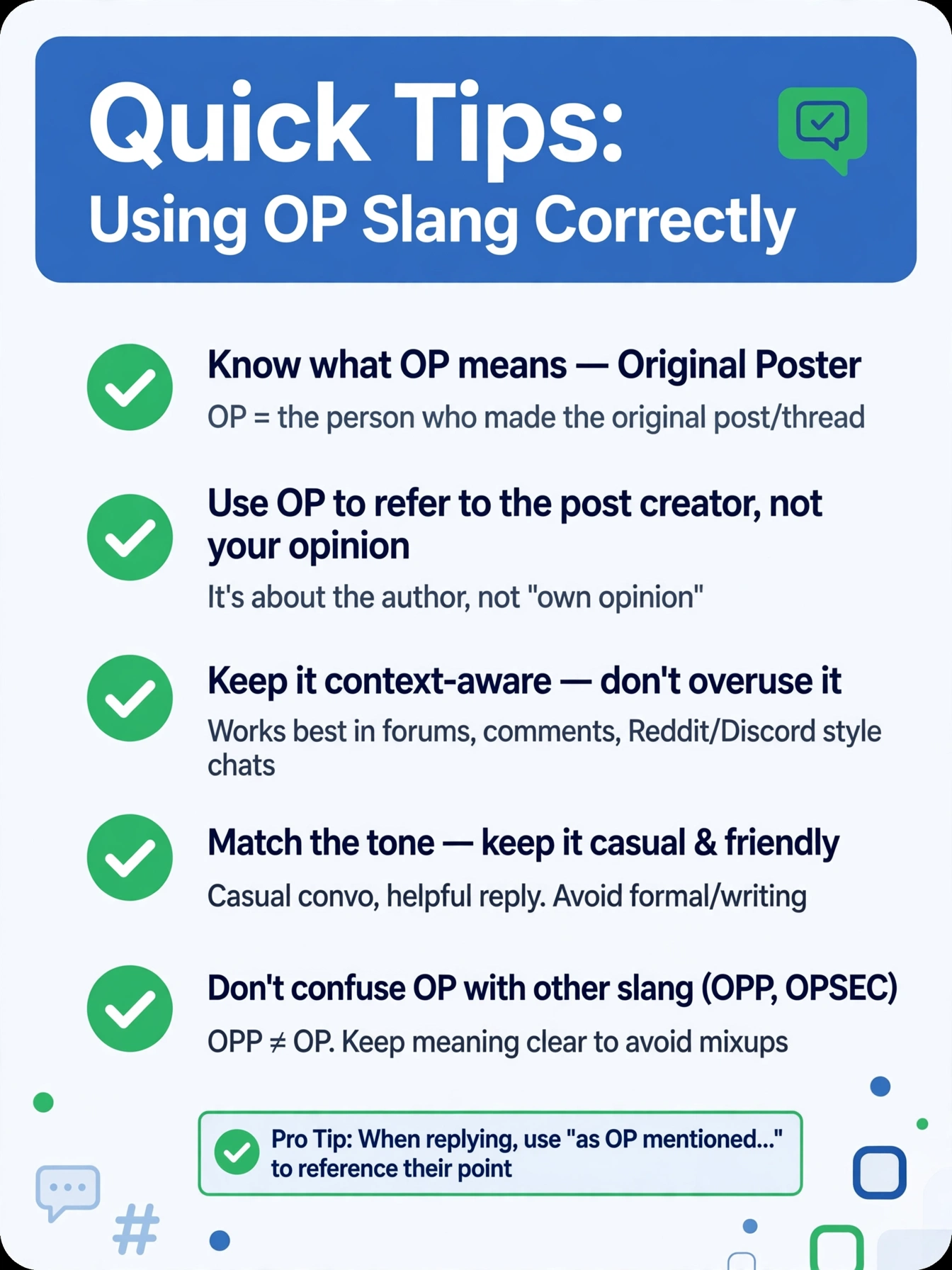
- Mixing up the three meanings. The biggest mistake is assuming OP always means one thing. Saying “OP is so strong” about a Reddit post makes no sense — on Reddit, OP is a person, not a weapon. Always check the context first.
- Confusing OP with opp. Writing “that gun is opp” when you mean overpowered will confuse gamers, and writing “my OPs are watching” when you mean rivals looks wrong to rap fans. OP (caps, one p) is usually overpowered or original poster; opp (two p’s) is opponent.
- Using lowercase “op” for original poster. On Reddit, OP is capitalized by convention. Writing “op said” in lowercase is not wrong exactly, but it can make readers think you mean “opponent” instead. Capitalize OP when you mean the original poster.
- Calling everything OP. If every weapon, every player, and every meal is OP, the word loses its meaning. OP is supposed to mean something stands out as unusually strong. Save it for the things that really are on another level.
- Using “opps” seriously in the wrong room. In a rap lyric, “opps” is normal. In a work chat or a school group, calling people “opps” can sound hostile even if you meant it as a joke. Know your audience before you use the rivalry meaning.
- Using OP in formal writing. OP is internet slang. It does not belong in a school essay, a business email, or a job application. Use “overpowered” spelled out, or “the original author,” in formal writing instead.
Quick Tips
Want to use OP slang naturally and never get the meaning wrong? These tips will help:
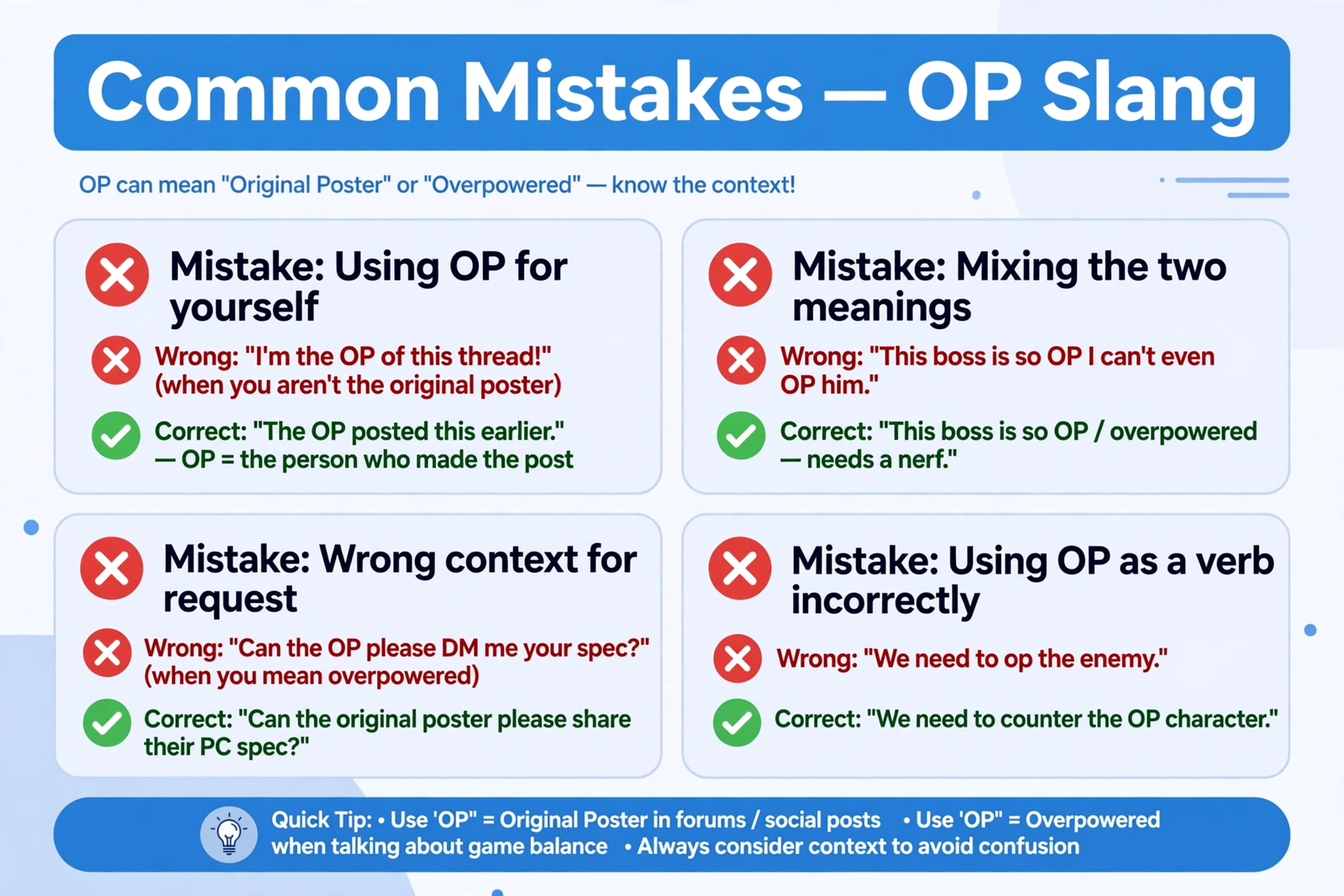
- Check the platform first. On Reddit, OP almost always means original poster. In a game chat, it almost always means overpowered. In a rap lyric or TikTok caption, lowercase op usually means opponent. The platform is your biggest clue.
- Watch the capitalization. OP in all caps usually means overpowered or original poster. Lowercase “op” usually means opponent. It is not a perfect rule, but it is right most of the time.
- Look at what OP is describing. If OP describes a weapon, character, or ability, it means overpowered. If OP is a person being talked about, it means original poster. If OP is a rival being warned about, it means opponent.
- Use it sparingly for impact. Calling one thing OP in a conversation hits harder than calling ten things OP. Save the word for the strongest example and people will take it seriously.
- When in doubt, ask. If someone says “OP is crazy” and you genuinely cannot tell which meaning they intend, just ask: “Do you mean the poster or the weapon?” Nobody minds the question — the word is confusing for everyone.
- Pair it with context in your own posts. Instead of writing just “so OP,” write “that sniper is so OP.” Adding the subject removes all confusion for your readers.
- Learn the gaming set together. OP, nerf, buff, and GG form a natural vocabulary. Learning them as a group makes each one easier to use correctly.
If you enjoy decoding words that change meaning with context, you will probably also like learning what tea slang meaning is — another term that sounds like one thing and means something completely different online.
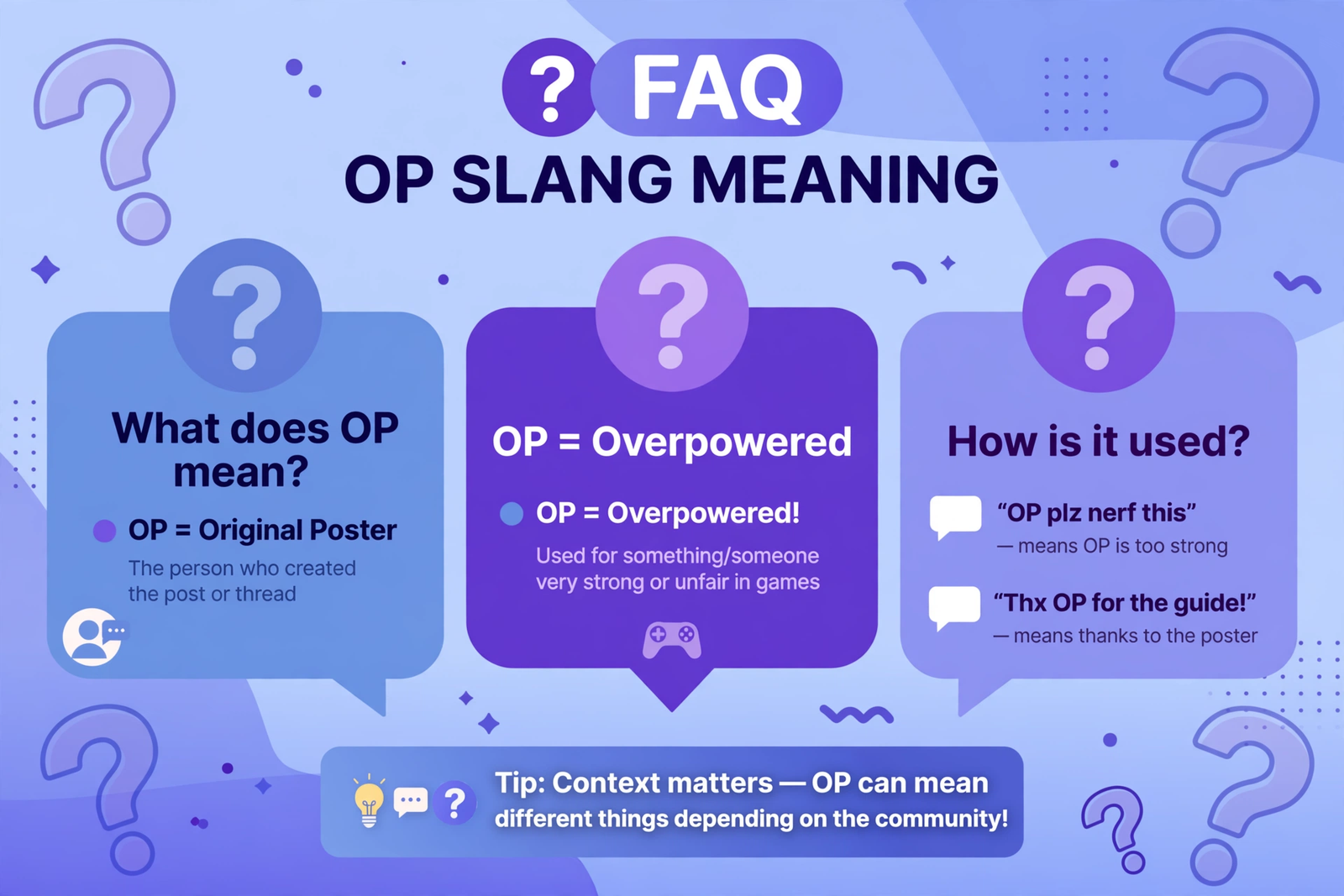
FAQ
What does OP mean in slang?
In slang, OP usually means “overpowered” (unfairly strong, mostly in gaming) or “original poster” (the person who started a post or thread, mostly on Reddit and forums). Lowercase “op” usually means opponent or rival. Context decides which meaning applies.
What does OP mean in gaming?
In gaming, OP means overpowered. It describes a weapon, character, ability, or strategy that is so strong it breaks the balance of the game. Players often ask developers to nerf OP items to make the game fair again.
What does OP mean on Reddit?
On Reddit, OP means original poster — the person who created the post or started the thread. Comments use OP to refer to that person, for example “OP, please give us an update” or “I agree with OP.”
What does OP mean on TikTok?
On TikTok, OP usually means the creator of the video, as in “OP did not expect this to blow up.” In gaming TikToks it can also mean overpowered, and in music TikToks lowercase “opps” means rivals. The video’s topic tells you which meaning is intended.
What does “opps” mean in slang?
“Opps” is short for opposition — rivals or enemies. It comes from hip-hop and drill music and is now used on TikTok and in gaming to mean the other team or a rival group. It is usually playful, but it can be serious depending on the context.
Is OP the same as opp?
Almost, but not quite. “Opp” (with two p’s) always means opponent. “OP” (one p, usually capitalized) usually means overpowered or original poster. They are spelled differently because they come from different words, so do not swap them.
What is the difference between OP and nerf?
OP describes the problem — something is too strong. A nerf is the fix — developers weaken the OP item in an update so the game becomes balanced again. Gamers often say both together: “That gun is OP, it needs a nerf.”
Can I use OP in a text message?
Yes. In texts, OP usually means overpowered or impressive, as in “that deal was OP” or “your reply was OP.” It is casual slang, so keep it out of formal messages, work emails, and school writing.
Conclusion
OP slang is a small word with three big meanings. In gaming, OP means overpowered — something so strong it breaks the balance. On Reddit and forums, OP means original poster — the person who started the conversation. In music and casual talk, lowercase op means opponent — a rival on the other side. The word has survived for more than twenty years because each meaning is useful in its own world, and the internet keeps all three worlds side by side.
Now you know how to tell them apart: check the platform, watch the capitalization, and look at what the word is describing. A weapon that is OP needs a nerf. A poster called OP deserves a reply. And opps? They are watching — so make sure your next post is worth their attention. The next time you see those two letters in a comment, a game chat, or a caption, you will not have to guess. You will know exactly which OP you are looking at, and exactly what to say back.

1 thought on “OP Slang: What Does OP Mean in Text, Gaming & TikTok?”