
TOS Meaning Slang: What It Really Means in Texting, Gaming & TikTok
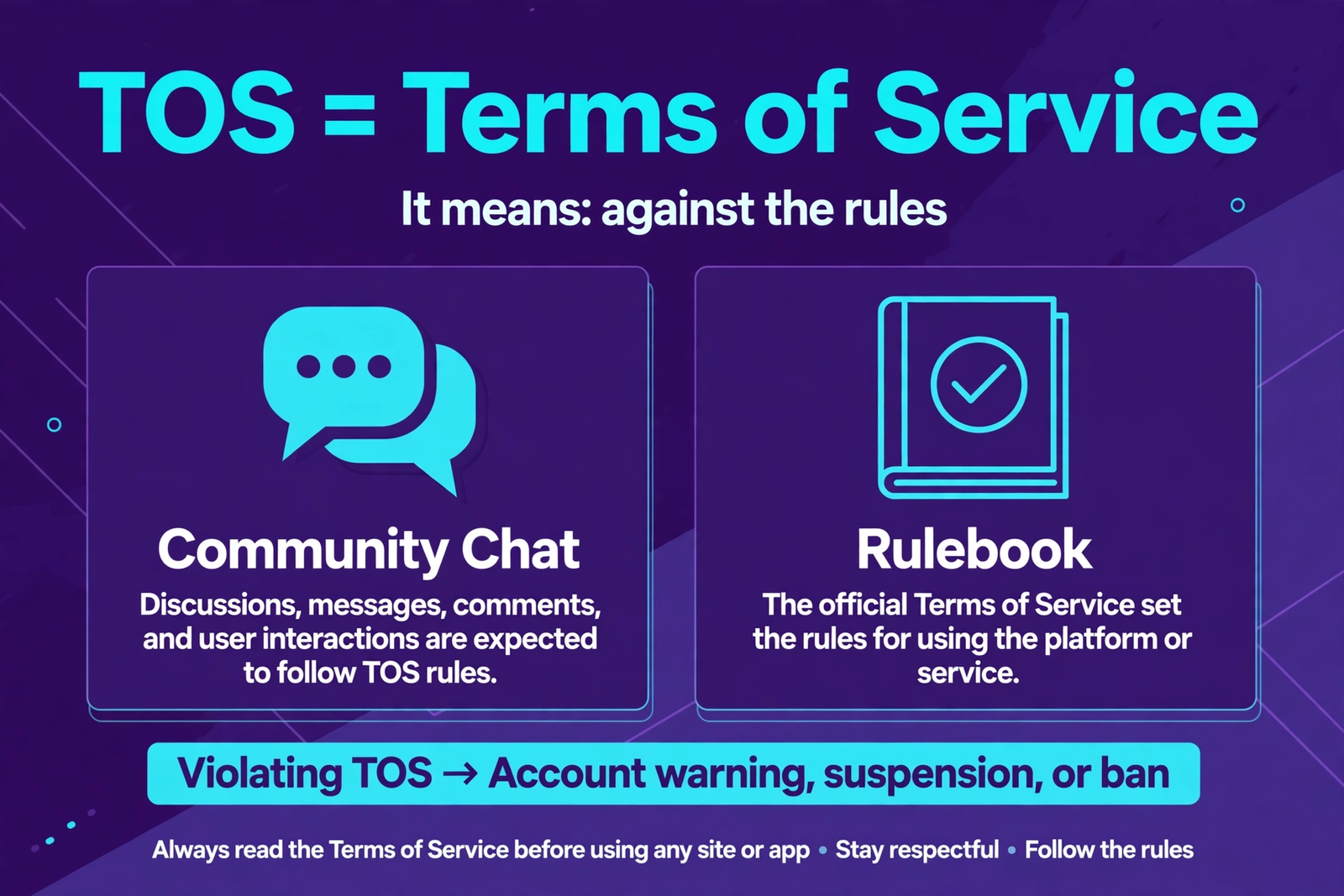
Quick definition: In slang, TOS stands for Terms of Service — the rules every app, game, and website makes you agree to. Online, people say “that’s against TOS” as a playful way to call out rule-breaking, cheating, or sketchy behavior, especially on Twitch, Discord, TikTok, and in gaming chats.
TOS Meaning Slang: Meaning & Definition
TOS meaning slang is simple once you know the trick: TOS is short for Terms of Service, the long legal agreement you click “I agree” on before using almost any app, website, or online game. In everyday internet slang, though, nobody is talking about the actual legal document. Instead, “TOS” has become shorthand for the rules — and calling something “against TOS” is a quick, funny way to say someone broke the rules, crossed a line, or did something that could get them banned.
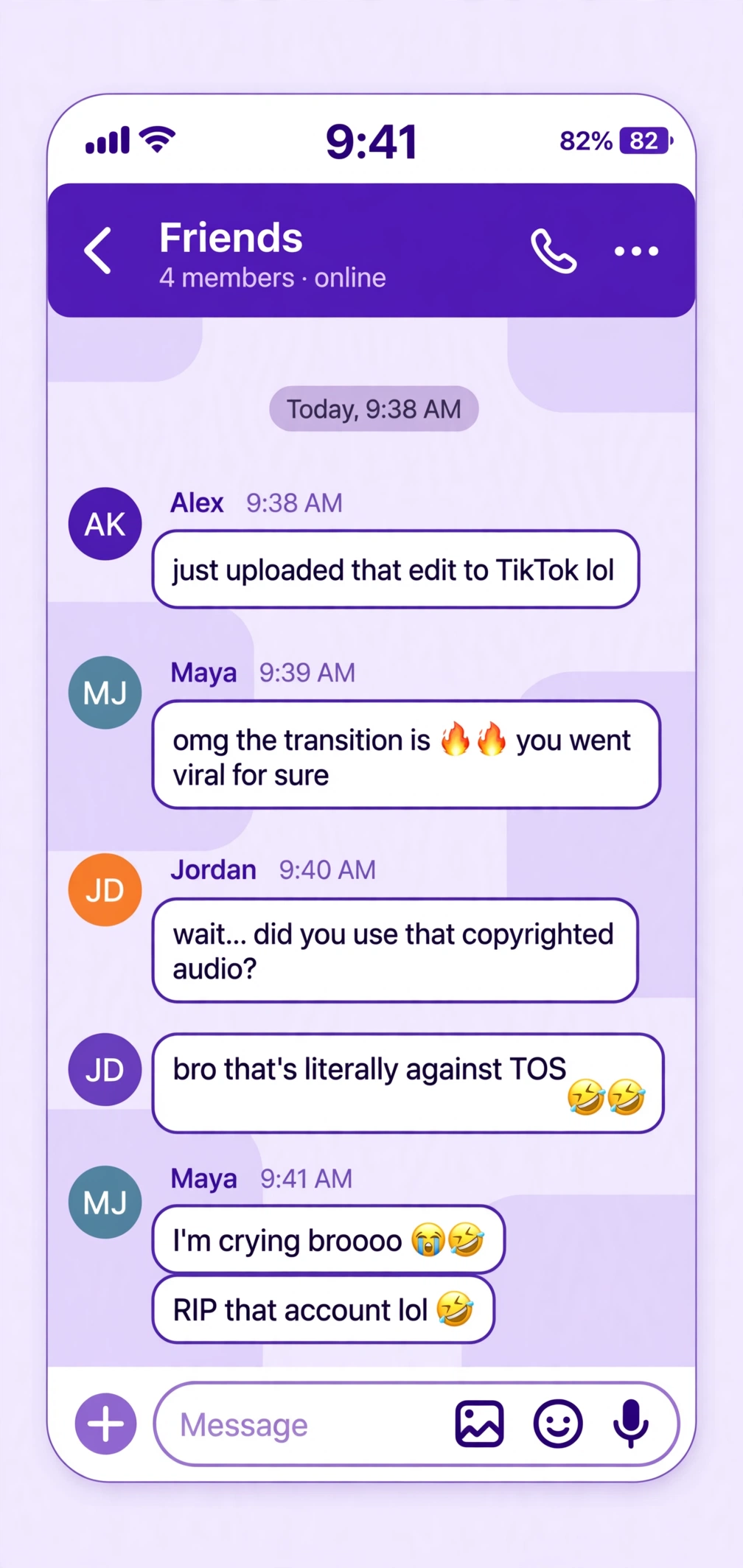
Think of it like this: if a friend steals your kill in a game, posts a spoiler, or uses an obvious cheat, you do not write a formal complaint. You just type “bro that’s literally against TOS” and everyone in the chat gets the joke. The phrase works because it borrows the serious, official sound of a legal term and drops it into a casual, low-stakes moment. That contrast is exactly what makes it funny.
Here is the core meaning in one line: TOS in slang means “against the rules” — usually said jokingly when someone does something shady, unfair, or ban-worthy online. It is almost always used with a wink, not as a real legal threat. Nobody saying “TOS violation” in a group chat is planning to contact a lawyer. They are teasing a friend, flagging a cheater, or memeing about a platform’s strict rules.
The term is also used in a more literal way. When streamers and moderators say “that will get you a TOS ban,” they mean the platform’s actual Terms of Service — posting hate speech, sharing copyrighted content, or harassing other users really can get an account suspended. So TOS slang lives on a spectrum: at one end it is a joke between friends, and at the other end it is a genuine warning that someone is about to lose their account.
Introduction
You are scrolling through Twitch chat when the streamer does something wild, and suddenly the whole chat explodes with one word: “TOS.” Or you are in a Discord server and someone posts a meme so edgy that a moderator replies, “Careful, that’s TOS.” Or a friend in your group chat drops a spoiler for the show you have been avoiding all week, and someone answers with three letters and a laughing emoji: “TOS 😂”.
If you have seen this and felt lost, you are not alone. TOS is one of those internet abbreviations that sounds like it belongs in a lawyer’s office but actually lives in gaming lobbies, comment sections, and group chats. It is short, it is punchy, and it carries a whole attitude in three letters — part rulebook, part inside joke.
This guide breaks down everything about the tos meaning slang trend: what TOS stands for, where the slang version came from, how people actually use it on TikTok, Discord, Twitch, and in texting, and the mistakes that make you sound like you just discovered the internet yesterday. You will also find real examples for friendly, professional, and funny situations, a comparison with similar slang terms, alternate meanings you should know, and answers to the eight questions people search for most. By the end, you will not just know what TOS means — you will know exactly when to drop it and when to leave it alone.
And if you are into decoding the rest of the slang flying around the same chats, our guide to glizzy meaning covers another term that confuses almost everyone the first time they see it.
Origin
The letters TOS started life as a purely legal abbreviation. Terms of Service (sometimes called Terms of Use or Terms and Conditions) are the contracts that websites, apps, and games have required users to accept since the early days of the commercial internet in the 1990s and early 2000s. You know the ritual: you download an app, a wall of legal text appears, you scroll to the bottom without reading a word, and you tap “Agree.” That document is the TOS.
For years, TOS stayed in that boring, official world. The shift happened in the mid-2000s, when online communities, forums, and multiplayer games exploded. Moderators on forums and in games constantly warned players with phrases like “read the TOS” and “that breaks the TOS” when someone cheated, spammed, or harassed other players. The phrase was everywhere in gaming culture because getting banned for a TOS violation was a real, shared fear — lose your account, lose your skins, your rank, and your friends list.
From there, internet culture did what it always does: it took something serious and turned it into a joke. On Reddit threads, Twitch streams, and Discord servers, people started using “TOS” ironically — calling out tiny, harmless “violations” with the same dramatic language moderators used for real bans. Your friend takes the last slice of pizza in a game lobby? “TOS violation.” Someone posts a meme at 3 a.m.? “Straight-up TOS.” The humor comes from treating a small social crime like a federal offense.
Twitch played a huge role in spreading the slang. Streamers get banned live for TOS violations — sometimes for genuinely serious reasons, sometimes for absurd ones, like a copyrighted song playing in the background for ten seconds. Chat turned those moments into memes, spamming “TOS” every time a streamer did anything remotely risky. TikTok picked it up next, where creators now use “TOS” in skits about strict parents, school rules, and workplace policies, extending the joke far beyond gaming. By 2025, the slang version of TOS had become a mainstream piece of internet vocabulary, even as most people using it had never read a single Terms of Service document in their lives.
Popularity
TOS slang is popular because it is useful in a way few abbreviations are. It packs a judgment, a joke, and a reference to authority into three letters, and it works in almost any online setting. Gamers use it, streamers use it, TikTok creators use it, and group chats use it. It shows up on Reddit, Discord, X (Twitter), Instagram comments, and YouTube livestreams — anywhere people gather online and someone needs a fast way to say “you can’t do that.”
Part of its staying power is that it never really goes out of date. Unlike slang that depends on a single viral video or a celebrity moment, TOS is anchored to something permanent: every platform has Terms of Service, and every platform enforces them. As long as people get banned, muted, or warned for breaking rules, “TOS” will have a job to do. New platforms appear, new rules get written, and the same three letters keep working.
The term also benefits from a generational bridge. Older internet users know TOS from the literal legal sense — they have been clicking “agree” since the dial-up era. Younger users know it from memes and streams. That overlap means the word travels easily between age groups without losing its meaning, which is rare for internet slang. A parent, a teacher, and a teenager can all use “TOS” in the same conversation and understand each other, even if they are joking about completely different things.
Search interest in TOS slang has stayed steady rather than spiking and crashing like most meme terms. People keep Googling it because it keeps appearing in new contexts — a streamer gets banned, a TikTok trend uses it, a game updates its rules — and each wave brings a fresh batch of confused viewers who want to know what everyone is laughing about. That is exactly why a clear, complete guide like this one matters.
How It Is Used
TOS slang is flexible, but almost every use falls into one of a few patterns. Learning these patterns is the fastest way to sound natural instead of forced.
1. Calling out rule-breaking (the classic use). This is the most common pattern. Someone does something against the rules — cheats in a game, posts banned content, spoils a show — and you reply with “that’s against TOS” or simply “TOS.” Example: “You used an aimbot? Bro, that’s literally TOS.”
2. Joking about minor “crimes.” The ironic version. You apply the heavy language of platform rules to something tiny and harmless, and the exaggeration is the joke. Example: “He took the last chicken nugget. TOS violation, I’m reporting him.” Nobody is actually reporting anyone. The humor is in pretending a nugget theft is a bannable offense.
3. Warning a friend. A quick heads-up that someone is about to cross a real line. Example: “Careful, if you keep spamming that link the mods will call it TOS and ban you.” Here the slang is doing genuine work — it is a friendly warning wrapped in internet language.
4. Describing content or behavior. People use “TOS” as an adjective to describe something risky, edgy, or borderline. “That video is so TOS” means the video pushes against platform rules. “His whole account is TOS” means the person constantly posts things that could get them banned.
5. Reacting to a ban or punishment. When a streamer or creator gets suspended, chat and comments fill with “TOS” as both an explanation and a meme. “He got hit with the TOS hammer” is a common way to say someone was banned, and it usually comes with a mix of sympathy and laughter.
Grammatically, TOS works as a noun (“that’s a TOS violation”), an adjective (“that clip is so TOS”), and even a standalone reaction (“TOS.”). It is usually written in all caps when people want to sound serious or dramatic, and in lowercase (“tos”) when the tone is casual and chatty. Both forms are correct — the capitalization just changes the energy. In formal or professional writing, always use the capital letters, since you are referring to an actual legal document.
Examples
The best way to learn TOS slang is to see it in real conversations. The examples below show how the term changes with tone — friendly, professional, and funny — so you can match the version to the moment.
Friendly Examples
Between friends, TOS is almost always a joke. It is a teasing way to call out a friend without starting a real argument.
- Friend 1: “I just spoiled the finale in the group chat lol”
Friend 2: “Bro that’s a TOS violation, you’re getting reported 😂” - Alex: “I used your Netflix profile and changed the language to Spanish”
Sam: “TOS. That’s it, you’re banned from movie night.” - Maya: “I ate the last slice and I’m not even sorry”
Jordan: “Straight-up TOS behavior. Unbelievable.” - Chris: “I peeked at your cards during the game, no regrets”
Taylor: “Cheating is against TOS, my guy. I’m telling the group chat.”
Notice the pattern: nobody is actually angry. The phrase works because everyone knows the “punishment” is not real. It is the internet version of saying “hey, not cool” with a smile.
Professional Examples
In professional or semi-formal settings, TOS returns to its literal meaning — the actual Terms of Service. Here the word is not a joke, and you should use it precisely.
- “Before we publish the campaign, legal needs to confirm it complies with the platform’s TOS.”
- “The account was suspended for repeated TOS violations, including posting copyrighted material.”
- “Our onboarding guide should include a plain-language summary of the TOS so new users actually understand the rules.”
- “The update changes the TOS around data sharing — please review section 4 before our next meeting.”
The key difference: in professional contexts, TOS refers to a real document with real consequences. If you are writing to a client, a manager, or a support team, never use the slang meaning — say “Terms of Service” in full the first time, then “TOS” after that. And if you want to see how other texting abbreviations behave in professional chats, our guide to fn meaning in text breaks down a term that causes the same kind of confusion at work.
Funny Examples
The funniest TOS jokes work by treating something completely harmless as a serious offense. The bigger the gap between the “crime” and the “punishment,” the funnier the line.
- “He microwaved fish in the office. That’s not just rude, that’s a TOS violation and possibly a war crime.”
- “Posting memes past midnight? Straight to TOS jail. Do not pass go.”
- “My mom just said ‘let’s circle back’ at the dinner table. Someone call the mods, that’s TOS.”
- “He replied ‘k’ to my three-paragraph message. TOS. I’m filing a formal complaint with the group chat admins.”
- “She changed the group chat name without asking anyone. This is a dictatorship and a clear TOS violation.”
The formula is simple: take a small annoyance, describe it like a platform moderator would, and let the exaggeration do the work. Once you get the rhythm, you can make a TOS joke out of almost anything.
Comparison with Similar Terms
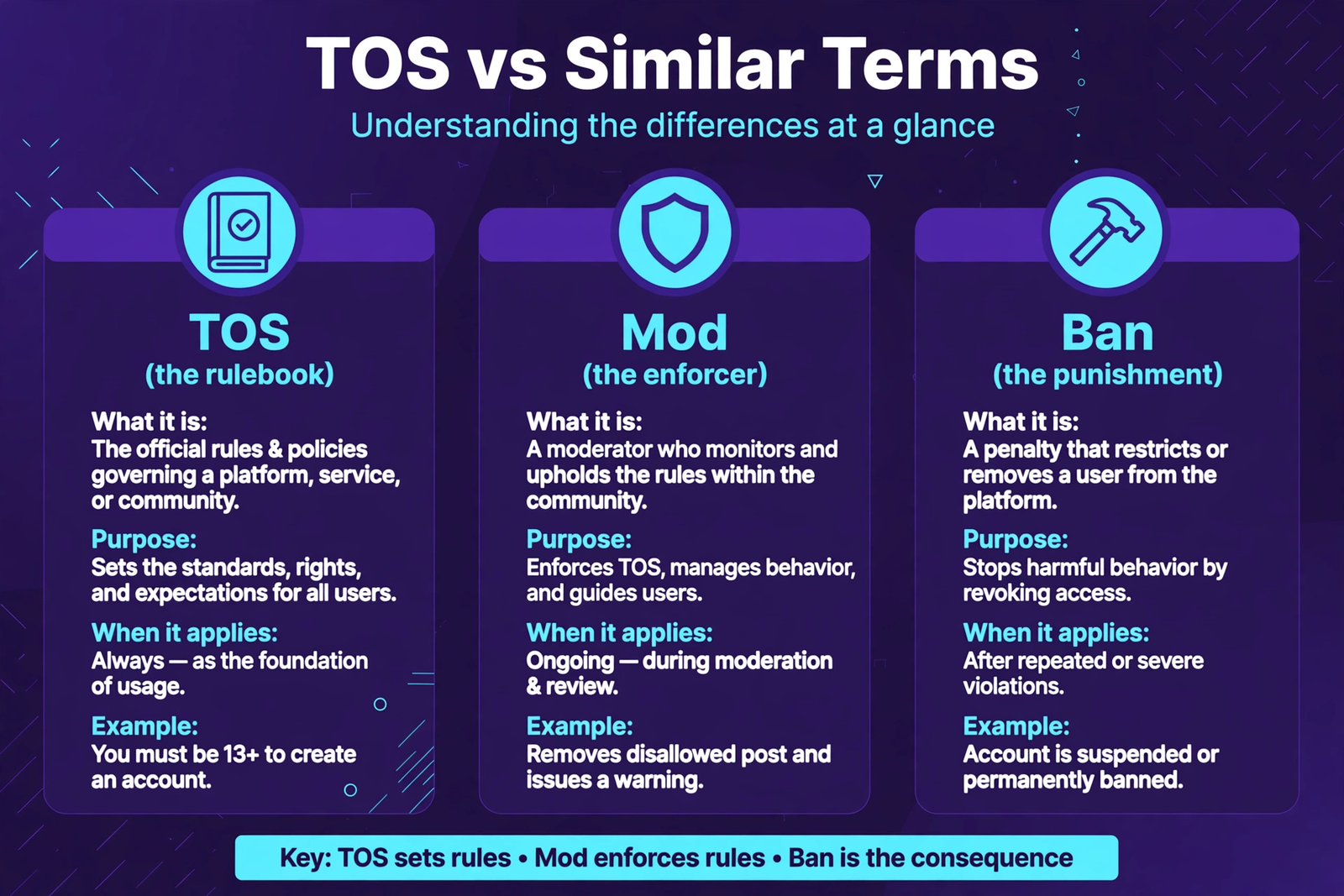
TOS is often confused with other rule-related slang. The table below shows how it differs from the terms people mix it up with most.
| Term | What It Means | How It Differs from TOS | Example |
|---|---|---|---|
| TOS | Terms of Service; “against the rules” | The baseline term — refers to a platform’s official rules | “That’s against TOS, you’re getting banned.” |
| Ban / Banned | Removed from a platform or game | The punishment; TOS is the rule that was broken | “He got banned for breaking TOS.” |
| Mod / Moderator | The person who enforces the rules | The enforcer; TOS is what they enforce | “The mods said it’s a TOS violation.” |
| Report | Flagging someone to the platform | The action you take; TOS is the reason you take it | “I’m reporting you for a TOS violation.” |
| Shadowban | Secretly limiting someone’s reach | A hidden punishment; TOS violations can cause it | “I think I got shadowbanned for a TOS thing.” |
| Against the rules | Plain-language version of the same idea | The same meaning, but without the internet flavor | “That’s against the rules of the server.” |
| ToS / ToU | Terms of Service / Terms of Use | Same concept, different name; ToU is used less often | “Check the ToU before you post that.” |
The important distinction is that TOS is the rulebook, while words like “ban” and “report” describe what happens when the rulebook is broken. Mixing them up is common, but once you see the pattern — rule, enforcer, punishment — the vocabulary clicks into place. If you enjoy this kind of word-by-word decoding, our cfs meaning in text guide uses the same approach for another abbreviation that means completely different things depending on where you see it.
Alternate Meanings
Like most short acronyms, TOS has more than one meaning, and context is everything. If someone uses TOS outside of a gaming or social media conversation, they may mean something entirely different.
- Terms of Service (the main meaning). The legal agreement between a user and a platform. This is the meaning behind the slang and the one this article is about.
- Thoracic Outlet Syndrome (medical). In health and medical contexts, TOS is a condition where nerves or blood vessels get compressed between the collarbone and the first rib, causing pain, numbness, or weakness in the arm and shoulder. If you see “TOS” in a doctor’s note or a health forum, this is almost certainly what it means.
- The Old School / The Original Series (entertainment). Among Star Trek fans, TOS means “The Original Series” — the 1960s show with Kirk and Spock. Among gamers, “old school” versions of games are sometimes called TOS too, though OSRS (Old School RuneScape) is more common.
- Terms of Sale (business). In e-commerce and contracts, TOS can occasionally mean Terms of Sale — the conditions under which a product is sold. Businesses usually write this out in full to avoid confusion with Terms of Service.
- Toss (texting shorthand). Rarely, in very casual texting, “tos” is used as a shortened form of “toss” — as in “tos me the ball” — but this is uncommon and usually clear from context.
The rule of thumb: if the conversation is about a platform, a game, a stream, or the internet, TOS means Terms of Service. If it is about health, it means Thoracic Outlet Syndrome. If it is about Star Trek, it means The Original Series. When in doubt, the surrounding words will almost always tell you which one it is.
Professional or Polite Alternatives
TOS slang is perfect for group chats and streams, but it sounds out of place in a work email, a classroom, or a conversation with someone who does not live online. Here are polished alternatives for the same ideas:
- Instead of “that’s against TOS”: “That goes against the platform’s rules” or “That violates our community guidelines.”
- Instead of “TOS violation”: “A breach of the Terms of Service” or “a policy violation.”
- Instead of “you’ll get hit with TOS”: “That could lead to your account being suspended.”
- Instead of “that’s so TOS”: “That seems to conflict with the platform’s policies.”
- Instead of “TOS, lol”: “Ha — I don’t think the moderators would approve of that.”
The goal in professional settings is clarity. Saying “Terms of Service” in full, or naming the specific rule that was broken, avoids confusion and sounds more credible than internet shorthand. Save the three-letter version for the group chat, where the joke is the whole point. For another abbreviation that changes completely between casual and professional settings, see our guide to tysm meaning — it is polite in every context, but people still misuse it constantly.
Common Mistakes
TOS is easy to use, but a few mistakes will instantly mark you as someone who does not quite get it. Avoid these:
- Using it as a real threat. Saying “that’s TOS, I’m reporting you” to a stranger over a minor disagreement comes across as aggressive, not funny. The slang only works when everyone knows it is a joke. With strangers, keep it light or skip it entirely.
- Using it in serious situations. If someone is actually being harassed or scammed, “TOS lol” is the wrong response. Real rule-breaking needs a real report, not a meme. Save the joke for low-stakes moments.
- Confusing it with “ToS” the game term. In some gaming communities, “ToS” with a lowercase “o” is also used for specific game mechanics or titles. Context matters — read the room before you reply.
- Assuming it only means the legal document. If a friend says “that’s TOS” after you steal their fries, they are not quoting a contract. They are teasing you. Responding with a serious explanation of Terms of Service kills the joke instantly.
- Overusing it. Like any catchphrase, TOS gets tired fast if you drop it into every message. One well-timed “TOS violation” is funny. Ten in a row is just noise. Use it when the moment earns it.
- Using it with people who will not get it. Your grandparents, your boss, or a customer support agent will probably not laugh at a TOS joke. Match the slang to the audience, not the other way around.

Quick Tips
Want to use TOS slang like someone who has been online forever? Keep these tips in mind:
- Time it right. The best TOS jokes land immediately after the “violation” happens. A delayed “TOS” three hours later is just confusing.
- Pair it with an emoji. A 😂 or 💀 after “TOS” signals clearly that you are joking. Without it, the same message can read as a genuine complaint.
- Keep it short. “TOS” alone is often funnier than a full sentence. The brevity is part of the humor — it sounds like a moderator’s stamp.
- Use caps for drama. All-caps “TOS” hits harder and sounds more official. Lowercase “tos” feels casual and chatty. Pick the energy that fits the moment.
- Learn the platform’s real rules. The joke is funnier when you actually know what the TOS says. You will also avoid accidentally getting yourself banned while joking about bans.
- Do not use it to bully. Ganging up on someone with repeated “TOS” spam can feel like harassment, even if you mean it as a joke. If the target is not laughing, stop.
- Watch streamers to learn the rhythm. Twitch chat is the best classroom for TOS slang. Watch how chatters deploy it during a ban, a rule break, or a funny moment, and you will pick up the timing naturally.


FAQ
What does TOS mean in slang?
In slang, TOS stands for Terms of Service — the rules of an app, game, or website. People say “that’s against TOS” to playfully call out rule-breaking, cheating, or sketchy behavior, especially on Twitch, Discord, TikTok, and in gaming chats. It usually means “you broke the rules” said as a joke.
What does “that’s against TOS” mean?
It means “that breaks the rules.” Literally, it refers to violating a platform’s Terms of Service, which can lead to a warning or a ban. In slang, it is usually an exaggerated joke about a small offense — like stealing a friend’s kill in a game or posting a spoiler — rather than a serious accusation.
Is TOS slang rude or offensive?
No, TOS is not rude or offensive on its own. It is a neutral term that becomes teasing or funny depending on tone. It only feels aggressive if it is used as a genuine threat against a stranger, or repeated to gang up on someone. Among friends, it is one of the gentlest callouts in internet slang.
Where did TOS slang come from?
TOS comes from the legal phrase Terms of Service, which websites and games have used since the 1990s. The slang version grew out of gaming forums and multiplayer games in the mid-2000s, where moderators constantly warned players about TOS violations. Twitch chat and TikTok later turned it into a meme by using it ironically for tiny, harmless “crimes.”
What does TOS mean on TikTok?
On TikTok, TOS usually appears in skits and comments about rules — strict parents, school policies, or platform bans. Creators use it to joke that a harmless action is a “violation,” or to explain why a video was removed. If a TikTok comment says “TOS,” it almost always means “that breaks the rules” in a playful way.
What does TOS mean in gaming?
In gaming, TOS refers to a game’s Terms of Service — the rules players agree to when they create an account. Cheating, hacking, exploiting bugs, or harassing other players are TOS violations and can get an account banned. Gamers also use “TOS” as a joke when a friend does something unfair in a match, like stealing loot or team-killing.
Can TOS mean anything besides Terms of Service?
Yes. In medical contexts, TOS means Thoracic Outlet Syndrome, a condition affecting nerves and blood vessels near the collarbone. Among Star Trek fans, TOS means The Original Series. In business, it can occasionally mean Terms of Sale. Context almost always makes the intended meaning clear.
Is it okay to use TOS slang at work or school?
In casual conversations with coworkers who are also online, a light TOS joke is usually fine. In formal writing, emails, or messages to a manager, use the full phrase “Terms of Service” or say “against the platform’s policies” instead. And in school, it is best to keep it to chats with friends rather than assignments or messages to teachers.
Conclusion
The tos meaning slang story is a perfect snapshot of how the internet remixes language. Three letters that started as a boring legal abbreviation — Terms of Service — became one of the most flexible jokes online: a callout, a warning, a punchline, and a meme, all at once. Whether it is Twitch chat exploding after a streamer ban, a Discord mod warning a spammer, or a friend in your group chat pretending your stolen fries are a federal crime, TOS works because everyone instantly understands the gap between the serious words and the silly situation.
The key takeaways are simple. First, TOS means Terms of Service, and in slang it means “against the rules,” almost always said with a wink. Second, it lives on Twitch, Discord, TikTok, and in gaming chats, where rules and bans are part of daily life. Third, the best TOS jokes exaggerate — the smaller the offense, the funnier the “violation.” And fourth, context decides everything: the same three letters can be a legal term, a medical condition, or a Star Trek reference, so read the room before you reply.
Now that you know exactly what TOS means, you will spot it everywhere — and you will know when to drop a perfectly timed “TOS violation” of your own. Just remember the golden rule: use it to tease, not to threaten, and save it for the moments that earn it. If you enjoyed decoding this one, keep exploring the slang in your own group chats — our guides to glizzy meaning, fn meaning in text, and cfs meaning in text will help you crack the next three abbreviations that leave you confused.
For the record, the actual Terms of Service of major platforms are public documents — Wikipedia’s overview of Terms of Service is a good starting point if you want to understand what these agreements really contain and why platforms enforce them.
