Quick definition: In slang, zip means nothing or zero — as in “I know zip about cars” (I know nothing) or “the score was 4–zip” (4–0). In cannabis culture, a zip is also an ounce (28.35 grams) of marijuana, named after the Ziploc bag it fits in. It can also mean energy or speed (“put some zip in your step”) and, in the phrase “zip it,” it means “be quiet.”
Zip Meaning Slang & Definition
So, what does zip mean in slang? At its core, zip is one of the shortest, punchiest ways to say nothing at all. When someone says “I got zip,” they are not talking about a zipper — they mean they got zero, nada, zilch. It is casual, a little old-school, and still very much alive in American English, from sports commentary to group chats.
But zip is a shape-shifter. Depending on the conversation, it can mean zero, an ounce of cannabis, energy, speed, or a firm request to stop talking. That is exactly why people search for the zip meaning slang — the word looks simple, but context changes everything. In this guide, we break down every meaning, where the slang came from, how to use it naturally in texts, and the mistakes to avoid.
If you have ever heard a friend say “zip it” during an argument, seen a score written as “7–zip,” or read about a “zip” in a song lyric, this article covers all of it. We also compare zip with similar words like zilch, nada, and zero, so you always pick the right one.
Introduction
Slang words come and go, but zip has survived for more than a century — and that is rare. Most slang from the 1900s faded away, yet zip still shows up in everyday speech, text messages, sports broadcasts, and even rap lyrics. Why? Because it is short, it sounds like what it means (a quick, empty hiss), and it works in almost any sentence.
Think about how often you need to say “nothing” in a day. “What did you learn?” — “Zip.” “How much money is left?” — “Zip.” “What is the score?” — “Three to zip.” One tiny word replaces a whole explanation, and everyone understands it instantly. That efficiency is the secret of great slang.
At the same time, zip has picked up new meanings along the way. In the 1990s, cannabis culture adopted it as a measurement. In everyday speech, it became a synonym for energy (“this party needs more zip”) and speed (“he zipped past me”). And “zip it” became one of the most recognizable ways to tell someone to be quiet. Each meaning is covered in detail below, with real examples you can copy into your own conversations.
Origin of Zip Slang
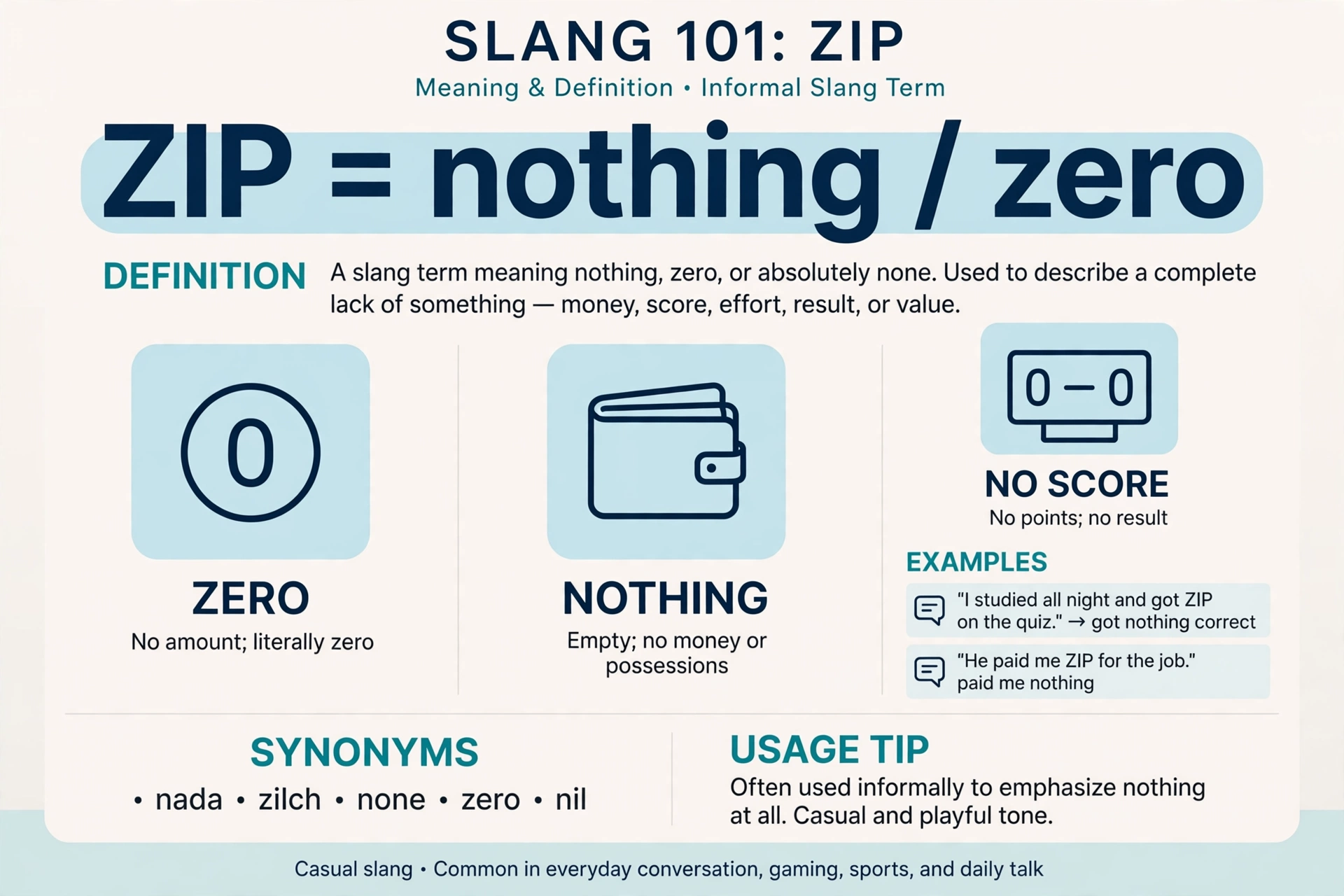
The story of zip starts with sound. Language experts trace the “move rapidly” sense of zip back to 1852, when it imitated the sharp hissing noise of something flying past — like a bullet. The word is echoic: it sounds like the thing it describes. From that buzzing, zipping sound came the idea of speed and energy.
The “zero” meaning appeared around 1900 as American student slang. Students used zip to mean a grade of zero on a test, and it spread from classrooms into general speech. Etymologists believe it connects to the letter “z” in “zero” — the same family as zilch, another famous word for nothing. The sports world loved it: saying a game ended “4–zip” is far more fun than saying “four to zero.”
The cannabis meaning is much newer. Since at least the 1990s, a “zip” has meant one ounce (28.35 grams) of marijuana in the United States. The nickname comes from the Ziploc bag: an ounce fits neatly into a standard zip-seal bag, so buyers and sellers started calling the amount itself a zip. The term stuck and remains common in both legal and unregulated markets today.
Meanwhile, “zip it” — short for “zip your lip” or “zip your mouth” — grew out of the zipper itself. The image is vivid: closing your mouth the way you close a zipper. First recorded as a slang command in the mid-20th century, it is now one of the most widely recognized phrases in English.
Popularity of Zip Slang
Zip has never been a trendy, viral word — and that is part of its strength. It never needed TikTok to survive. Instead, it lives in three steady places: sports, everyday conversation, and music. Sports commentators still say “three to zip” several times a week during football and hockey season. Parents still tell kids to “zip it.” Friends still text “I know zip” when they are clueless about a topic.
Search interest in the term stays consistent year-round, with spikes whenever a song or show uses it. Rappers and lyricists love the word because it rhymes easily and lands hard — “zip” is a one-syllable punch. In texting, it competes with newer zero-words like “zilch” and “nada,” but zip wins on brevity: three letters, one syllable, impossible to misunderstand.
Among younger users, the cannabis meaning has given zip a second life. On social media, “a zip” is now a standard measurement term, and people learning cannabis vocabulary search for it constantly. That dual life — old-school “nothing” and modern cannabis ounce — makes zip one of the most searched slang words of its kind in the United States.
How It Is Used
Zip works as a noun, a verb, and part of fixed phrases. As a noun meaning “nothing,” it usually appears after a verb: “I got zip,” “She knows zip,” “We scored zip.” As a verb, it means to move fast: “He zipped past the finish line,” or “I will zip to the store.” As a command, “Zip it!” means “Stop talking right now.”
In texts and chats, zip shows up in short, blunt replies. Someone asks a question you cannot answer, and “zip” is your whole answer. It carries a casual, slightly playful tone — it softens “I know nothing” into something funny. But tone matters: “zip it” said with a laugh is a joke; said sharply, it is a shut-down. Always read the room before using it as a command.
In sports talk, zip replaces the number zero in scores: “The home team won 5–zip.” The verb form is used too — a team that loses without scoring was “zipped.” In cannabis conversations, zip is a unit: “He picked up a zip for the weekend.” In energy talk, it is a quality: “This team has no zip today.”
| Form | Meaning | Example |
|---|---|---|
| Noun | Nothing / zero | “I earned zip this week.” |
| Noun | An ounce of cannabis | “A zip costs more here.” |
| Noun | Energy / vigor | “Put some zip in your step.” |
| Verb | To move fast | “She zipped through traffic.” |
| Command | Be quiet | “Zip it — the movie is starting.” |
Examples of Zip in Slang
The best way to understand zip is to see it in real sentences. Below are examples grouped by tone, so you know exactly when each version fits — and when it does not.
Friendly Examples
- “I asked him about the test, but he knew zip.” — He knew absolutely nothing about it.
- “What did you get on the quiz?” — “Zip, man. I blanked completely.” — A casual, honest zero.
- “She has so much zip today — did she drink three coffees?” — She is full of energy.
- “Let me zip to the store and grab snacks before the game.” — I will go quickly.
- “Our team won 3–zip! Easiest game of the season.” — A 3–0 victory.
- “I know zip about fixing cars, so I called a mechanic.” — A friendly admission of ignorance.
Professional Examples
- “The report shows zip growth this quarter, so we need a new plan.” — Zero growth, stated plainly.
- “We received zip complaints after the update — customers seem happy.” — No complaints at all.
- “The new intern has real zip — she finished the task in an hour.” — Energy and drive at work.
- “Let me zip you the file before the meeting starts.” — Send it quickly (informal, but common in fast-paced offices).
- “Sales were zip on Monday, so we moved the promotion earlier.” — Zero sales that day.
Funny Examples
- “My bank account after payday: zip. My plans for the weekend: also zip.” — Broke and bored, with humor.
- “Zip it, Dave. Nobody asked for your hot take on pineapple pizza.” — A joking way to shut a friend down.
- “I studied all night and still got zip right. My brain said nope.” — A self-deprecating joke about failing.
- “He tried to impress her with his cooking and burned zip-level food. Even the smoke alarm gave up.” — Playfully exaggerating a disaster.
- “What is my motivation today? Zip. What is my energy? Also zip.” — A relatable Monday mood.
Notice the pattern: in friendly and funny use, zip replaces “nothing” with extra attitude. In professional use, it is best kept to the energy sense (“she has zip”) or the plain zero sense in casual internal chats — avoid “zip it” with your boss.
Comparison with Similar Terms
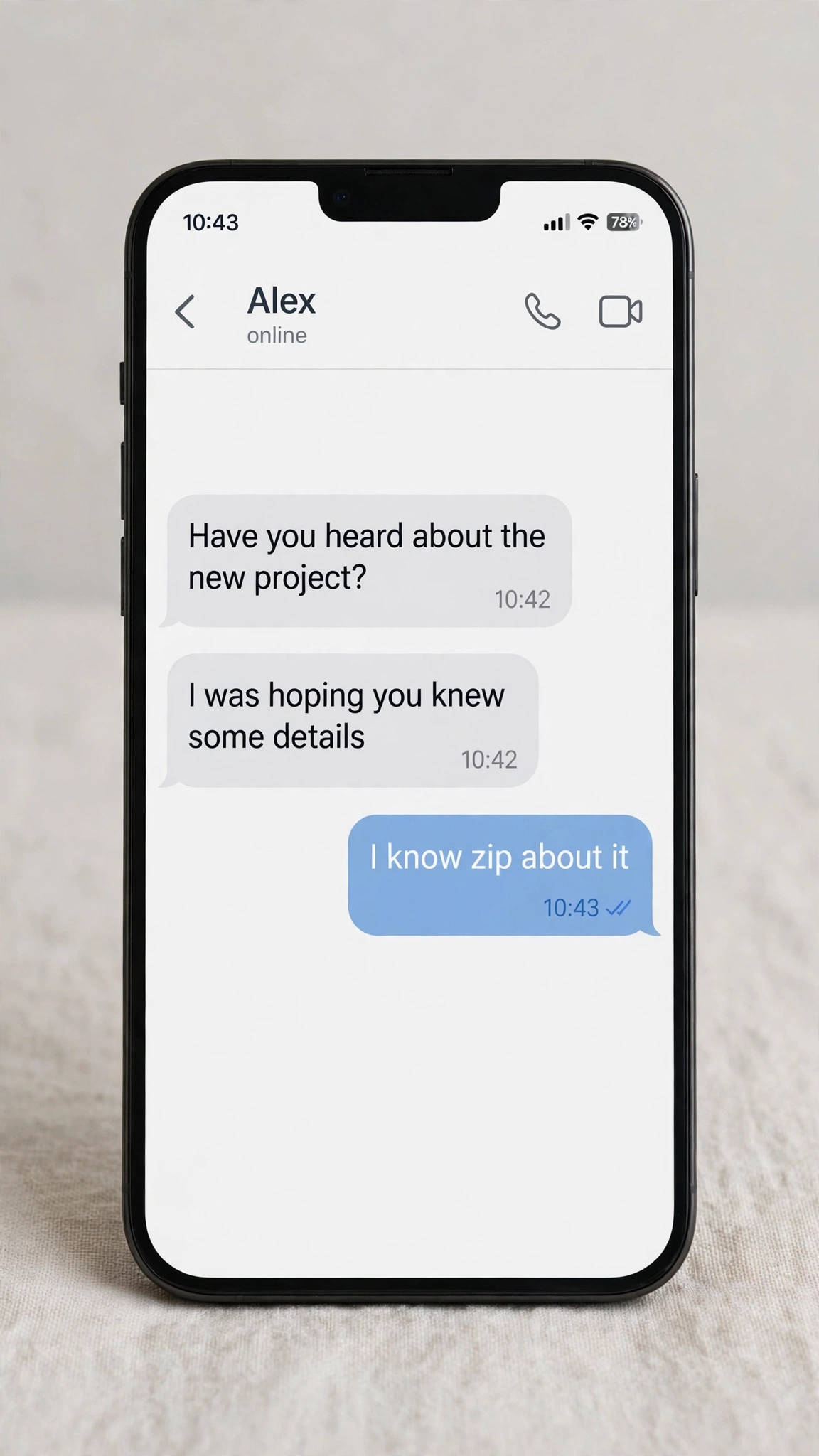
Zip is not the only word for nothing. English has a whole family of zero-words, and each one has a slightly different flavor. Choosing the right one makes your sentence sound natural instead of forced.
| Term | Meaning | Tone | Best Use |
|---|---|---|---|
| Zip | Nothing / zero | Casual, punchy | Scores, quick replies, “I know zip” |
| Zilch | Nothing / zero | Playful, old-school | “I got zilch for my birthday” |
| Nada | Nothing (from Spanish) | Cool, laid-back | “Nada. Not a single call.” |
| Zero | The number 0 | Neutral, literal | Formal writing, math, data |
| Zippo | Nothing (US slang) | Vintage, rare today | “He had zippo luck” |
| Nil | Nothing (British/sports) | Formal, British | “The match ended two–nil” |
| Squat | Nothing (emphatic) | Blunt, rude-ish | “You know squat about this” |
Zip and zilch are cousins — both likely come from the “z” of zero — but zip is shorter and more common in sports scores, while zilch sounds more deliberately funny. Nada comes from Spanish and feels relaxed; zero is the safe, neutral choice for formal writing. Zippo is the vintage relative that has mostly faded, though it survives in phrases like “zippo luck.”
The cannabis sense sets zip apart from all of these: none of the others mean an ounce of marijuana. That is why context matters so much. “I need a zip” at a dispensary means one thing; “I scored zip” after a test means the opposite. The same word, two worlds — and the conversation around it tells you which one.
For more slang explained the same way, check out fn meaning in text and tmp meaning in text — both are short slang words with surprising double meanings, just like zip.
Alternate Meanings of Zip
Beyond “nothing,” zip carries several alternate meanings that are worth knowing — especially the cannabis one, which is the most-searched alternate sense today.
1. An Ounce of Cannabis (A “Zip”)
In cannabis slang, one zip equals one ounce, or 28.35 grams. It breaks down into 8 eighths (3.5 grams each), 4 quarters (7 grams each), or 2 halves (14 grams each). The name comes from the Ziploc bag: an ounce fits perfectly in a standard zip-seal bag. The term has been in use since at least the 1990s and is now standard vocabulary in legal dispensaries and cannabis communities across the United States. If someone says “I grabbed a zip,” they bought an ounce — not a zipper.
2. Energy, Vigor, and Pep
“Put some zip in your step” is a classic encouragement phrase. Here zip means energy, enthusiasm, or liveliness. A boring presentation “needs more zip.” A tired team “has no zip today.” This sense dates back to the early 1900s and is still common in both speech and writing.
3. Speed and Fast Movement
As a verb, zip means to move very fast: “The car zipped past us,” “She zipped through her homework.” Adding “up” changes it again — “zip up” can mean to hurry (“zip up here!”) or to fasten a zipper. The speed sense is the oldest one, going back to the hissing sound of something flying past.
4. “Zip It” — Be Quiet
“Zip it,” “zip your lip,” and “zip your mouth” all mean the same thing: stop talking. The image is a mouth closing like a zipper. It can be playful between friends (“Zip it, I am trying to watch this”) or sharp in an argument. Use it carefully — as a command, it can sound rude, especially to strangers or in professional settings.
5. ZIP Code and Computer Files
Outside slang, ZIP is also the US postal code system (Zone Improvement Plan, introduced in 1963) and the .zip file format for compressed files. In casual speech, people say “What is your zip?” to ask for a ZIP code, and “zip that file” to mean compress it. These are standard uses, not slang — but they add to the confusion, which is why the full picture matters.
Professional or Polite Alternatives
Zip is casual by nature. In formal emails, job interviews, or serious conversations, swap it for a cleaner alternative:
- Instead of “I know zip”: “I am not familiar with that topic” or “I do not have information on that yet.”
- Instead of “We got zip”: “We received no responses” or “The result was zero.”
- Instead of “Zip it”: “Could we pause here?” or “Let us hold that thought for a moment.”
- Instead of “She has zip”: “She is very energetic” or “She brings great enthusiasm.”
- Instead of “The score was 4–zip”: “The final score was 4–0” (for formal reports).
In texts with friends, zip is perfect. In a work Slack channel, the energy sense (“lots of zip in this launch”) is fine, but save “zip it” for people you know well. When in doubt, the polite version never hurts — and it keeps you sounding professional without losing your personality. For another casual word that needs the same care, see hbu meaning in chat.
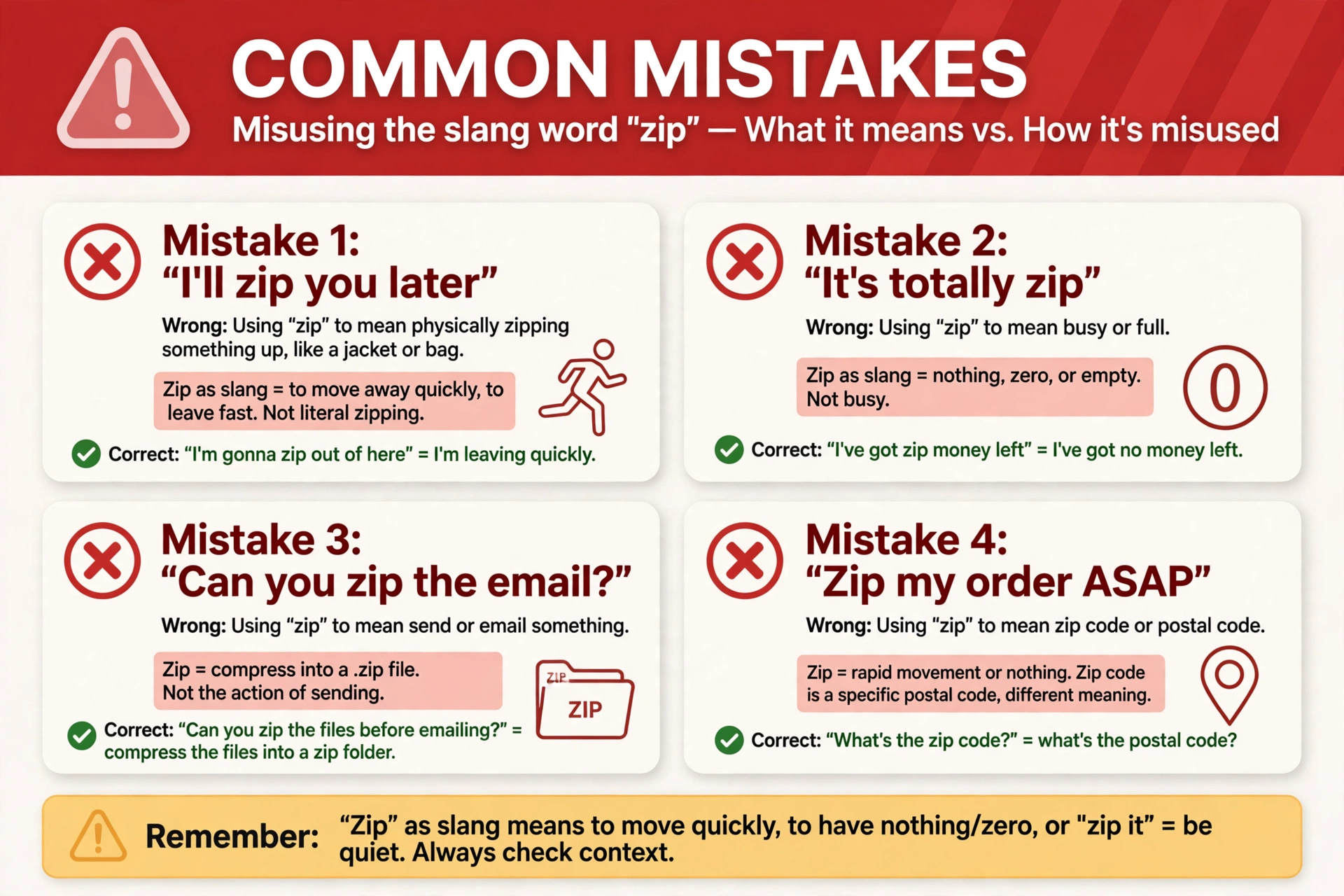
Common Mistakes When Using Zip Slang
Zip is easy to use, but a few mistakes show up again and again — especially for people learning English slang or meeting the word for the first time.
- Using “zip it” with strangers or seniors. It is a command, and it can sound rude. With people you do not know well, say “Could you give me a second?” instead.
- Confusing the cannabis meaning. “I need a zip” in the wrong conversation can cause a very awkward misunderstanding. If you mean “nothing,” say “I have zip” — the verb around it makes the meaning clear.
- Using zip in formal writing. “The company earned zip last quarter” sounds careless in a report. Use “zero” or “no revenue” in formal documents.
- Mixing up zip and zilch. They are close, but “zilch” never means an ounce of anything, and “zip” never works as an adjective the way some people try (“a zip chance” sounds wrong — say “zero chance”).
- Overusing it. Zip is punchy because it is rare in a sentence. Drop it into every reply and it loses its impact — and starts to sound like a catchphrase.
- Forgetting the sports score format. It is “4–zip” with the winner’s number first. Saying “zip–4” confuses everyone.
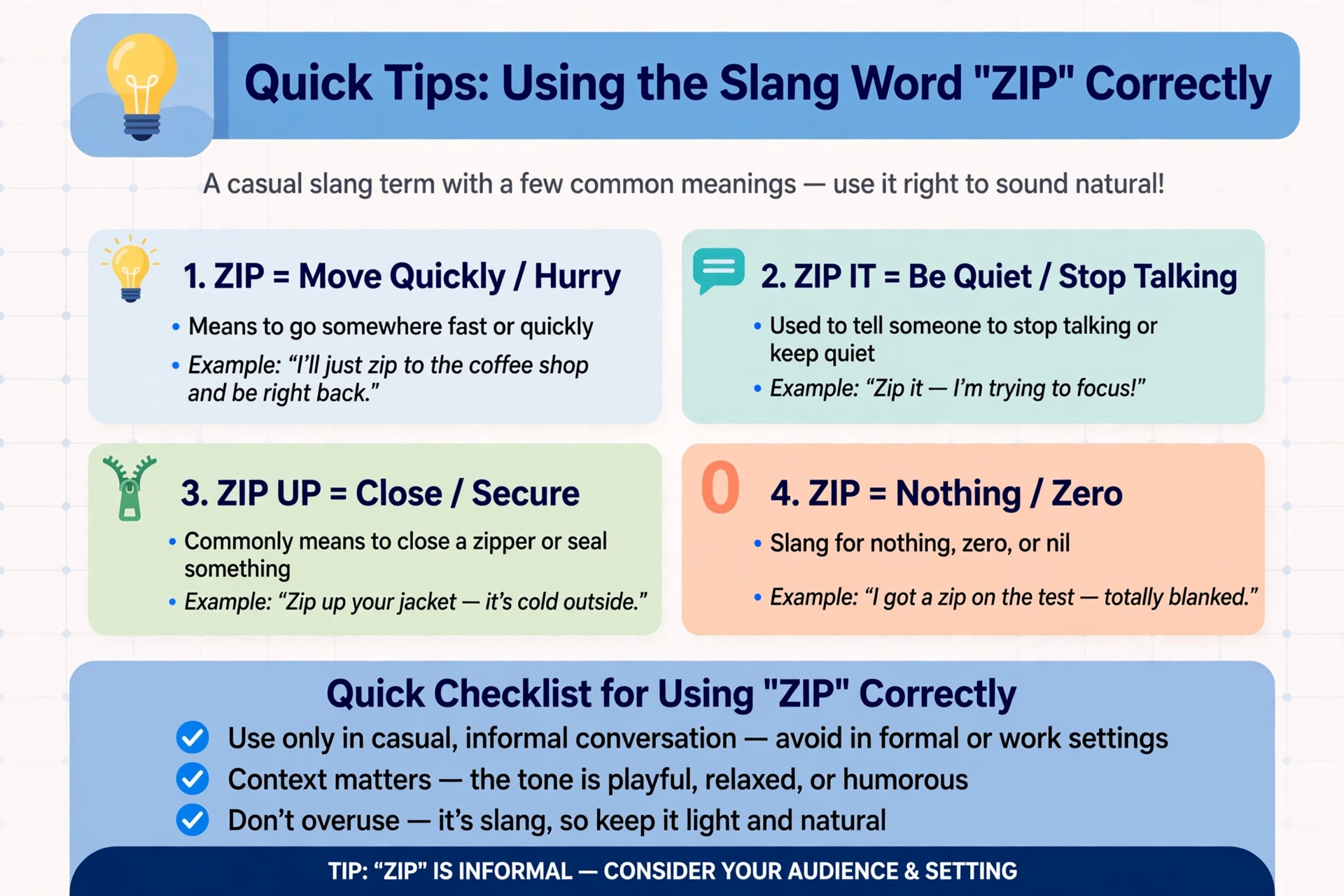
Quick Tips for Using Zip Slang
- Keep it short. Zip works best as a one-word answer or inside a short sentence. Long explanations kill the effect.
- Match the meaning to the moment. Nothing, energy, speed, or silence — pick the sense your listener will hear, and make sure the sentence supports it.
- Use it in scores. “Three to zip” is the most universally understood use of the word. It is safe in almost any casual setting.
- Pair it with humor. Zip lands best when it is a little funny: “My motivation today is zip.” Deadpan delivery helps.
- Do not force the cannabis sense. If you are not talking about cannabis, do not bring up the ounce meaning — it will only confuse the conversation.
- Learn “zip your lip” too. The full phrase is softer and funnier than the blunt “zip it,” and it works better with friends and family.
- Listen first. If you hear a native speaker use zip, copy their exact sentence pattern. Slang is learned by ear, not by dictionary alone.
FAQ About Zip Meaning Slang
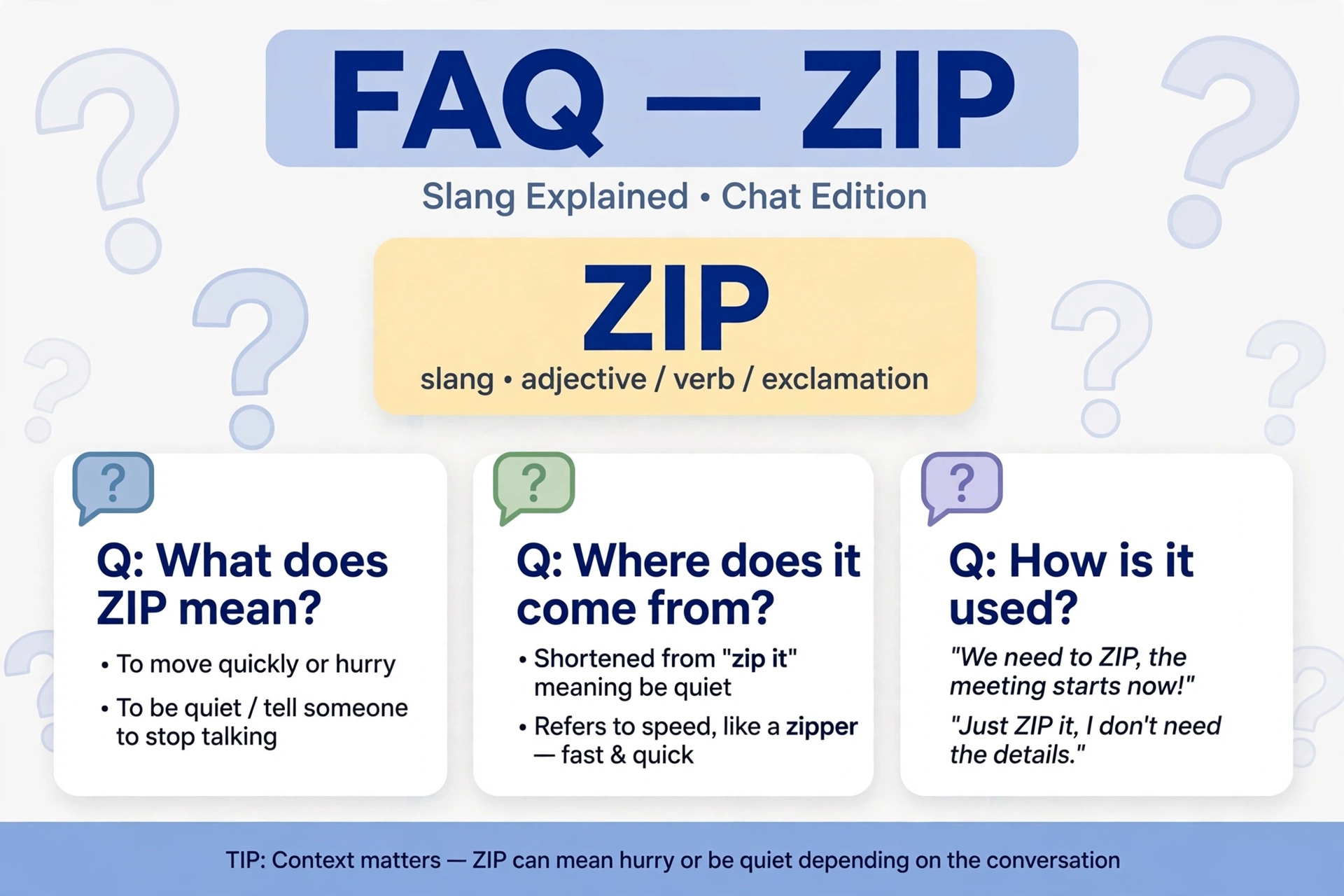
1. What does zip mean in slang?
In slang, zip most commonly means nothing or zero — “I know zip” means “I know nothing.” It can also mean an ounce of cannabis, energy or speed, and in the phrase “zip it,” it means “be quiet.”
2. What does “zip it” mean?
“Zip it” means stop talking / be quiet. It is short for “zip your lip” or “zip your mouth” — the image is a mouth closing like a zipper. It can be playful between friends or rude, depending on tone.
3. How much is a zip in slang?
In cannabis slang, a zip is one ounce (28.35 grams) of marijuana. It equals 8 eighths, 4 quarters, or 2 halves. The name comes from the Ziploc bag an ounce fits into.
4. What does “I got zip” mean?
“I got zip” means I got nothing — no money, no information, no results. For example: “Did any payments come through?” — “Zip.” It is a casual, slightly humorous way to say zero.
5. What does “4–zip” mean in sports?
“4–zip” means the score is 4 to 0. Zip replaces zero in sports scores because it is short and emphatic. The losing team is sometimes said to have been “zipped.”
6. Is zip rude to say?
Zip itself is not rude — “I know zip” is harmless. But “zip it” as a command can be rude, especially to strangers, elders, or at work. With close friends it is usually fine and often funny.
7. What is the difference between zip and zilch?
Both mean nothing, and both likely come from the “z” in zero. Zip is shorter and more common in sports scores, while zilch sounds more playful and old-fashioned. Only zip has the cannabis-ounce meaning.
8. Where did zip slang come from?
The speed sense comes from the hissing sound of something moving fast (1852). The “zero” sense appeared around 1900 as American student slang. The cannabis sense dates to the 1990s, named after the Ziploc bag. Dictionary.com defines zip across all of these senses, from “zero or nothing” to energy and speed.
Conclusion
Zip is proof that the smallest words can carry the biggest load. In three letters, it can mean nothing, zero, an ounce, energy, speed, or silence — and native speakers switch between those meanings without even thinking about it. The trick is context: the sentence around zip always tells you which meaning is in play.
For everyday use, remember the core rule: zip = nothing. “I know zip,” “we scored zip,” “the game ended 3–zip” — that is the meaning you will hear most, and the safest one to use yourself. Learn “zip it” for fun with friends, keep it away from formal settings, and know the cannabis meaning so you are never caught off guard by it.
Slang like zip survives because it is useful, and zip has been useful for more than a hundred years. Use it sparingly, use it with the right tone, and it will make your English sound natural, confident, and a little bit fun. And if you want to keep building your slang vocabulary, glizzy meaning is another short word with a surprisingly big story behind it.
