Quick Definition: 1950s slang is the informal vocabulary that American teenagers and young adults used during the 1950s — words like cool, daddy-o, dreamboat, and ginchy that captured the decade’s jazz clubs, drive-in movies, hot rods, and sock hops. It was the language of a brand-new youth culture, and while some of these words faded fast, others like cool never left us at all.
1950s Slang Meaning & Definition
1950s slang means the casual, playful words and phrases that defined how young Americans talked in the decade after World War II. It was not a formal dialect and it never appeared in a dictionary as one language. Instead, it was a fast-growing collection of expressions that spread through jukeboxes, radio shows, drive-in theaters, high school hallways, and the new teenage hangout — the malt shop.
What makes 1950s slang special is that it was the first slang of the modern teenager. Before the fifties, teenagers were mostly treated as small adults. After the war, they suddenly had pocket money, cars, rock and roll, and their own world — and they needed their own words for it. A dreamboat was not a boat. A pad was not a cushion. And being cool had nothing to do with temperature. If you want the bigger picture of how this kind of language works, our guide on what is slang explains where slang comes from and why every generation invents its own.
At its core, 1950s slang did three jobs. It showed belonging — using the right word told your crowd you were one of them. It kept adults out — parents and teachers often had no idea what the kids were saying. And it made ordinary life sound more fun: a car became a chariot, clothes became threads, and a good party became a bash.
Introduction
Picture a Friday night in 1957. A teenager in a leather jacket slides into a shiny Chevrolet, turns the radio up to a rock and roll station, and heads to the drive-in with his best girl. He is not going to a movie — he is going to the passion pit. He is not driving fast — he is burning rubber. And the girl beside him is not just pretty — she is a dreamboat.
That is the world 1950s slang came from. The 1950s gave America the teenager as we know the idea today: rock and roll, Elvis Presley, James Dean, drive-in movies, sock hops, poodle skirts, and the first real youth rebellion. Young people had money to spend, cars to drive, and records to buy — and they built a whole vocabulary around that new freedom.
This guide covers everything about 1950s slang: what it means, where it came from, why it exploded in popularity, and more than 50 words and phrases with their real meanings. You will find examples of how people actually used these words, a comparison with other decades, and the common mistakes people make when they try to talk like a fifties teenager today.
Origin
1950s slang did not appear out of nowhere. It grew out of three powerful sources that collided after World War II: jazz culture, Beat culture, and car culture.
Jazz gave the decade its coolest words. Musicians in the 1940s jazz scene had already been calling each other cats, saying things were cool, and describing something great as real gone. In the fifties, white teenagers picked up this language from the radio and the records, and words like cool, hip, and dig went mainstream. The word cool itself came from African American jazz culture and originally described a calm, controlled, stylish attitude — the opposite of hot-headed. Mental Floss traces how jazz and Beat culture fed the decade’s vocabulary in its roundup of 21 ginchy 1950s slang terms, including words like beatnik and ginchy that most people have never heard today.
Beat culture added the second layer. In 1958, newspaper columnist Herb Caen took the word beat — the name of the Beat generation of writers like Jack Kerouac and Allen Ginsberg — and added -nik from the Soviet satellite Sputnik, which had launched the year before. The result was beatnik: a young person in a black turtleneck, hanging around coffee houses, reading poetry, and rejecting straight, square, middle-class life. The word caught on so fast that it became the label for a whole subculture.
Car culture added the third layer. The 1950s saw an explosion of American car ownership, and teenagers turned cars into freedom machines. Hot-rodders invented their own vocabulary: burn rubber for accelerating hard, agitate the gravel for leaving in a hurry, and a bent eight for a V-8 engine. The drive-in movie theater gave us the passion pit, and the back seat of the family car gave us backseat bingo.
Popularity
So why did 1950s slang become so popular, so fast? The answer is that the fifties created the first true youth market in history. Teenagers had something no earlier generation of young people had: disposable income. Post-war prosperity meant that a sixteen-year-old could have a part-time job, a car, and money to spend on records, clothes, and movies.
Television helped too. Shows like American Bandstand, which started nationally in 1957, beamed teenage dancing and slang into living rooms across the country. Movies like Rebel Without a Cause (1955) made James Dean the face of teenage cool, and rock and roll stars like Elvis Presley and Chuck Berry put slang into songs that millions of kids sang along to.
There was also a simple social reason: slang was fun, and it was secret. In a decade famous for politeness, conformity, and “behaving yourself,” using words your parents did not understand felt like a small rebellion. Saying someone was a square or that a party was a blast marked you as young, modern, and in the know.
Some of the words survived and became permanent English. Cool is the most famous example — it is still one of the most-used slang words in the world today, seventy years later. Cloud nine, burn rubber, and backseat driver also stuck around, though often with slightly different meanings than they had in the fifties.
How It Is Used
1950s slang was mostly spoken, not written. Teenagers used it in face-to-face conversation, on the telephone, at school, at the malt shop, and in the car. It was the language of hanging out, flirting, showing off, and joking around — not the language of essays or job interviews.
Here is how the words worked in real sentences:
- To praise something: “That new record is really ginchy!” or “Man, that car is boss.”
- To describe a person: “He’s a real cool cat.” / “She’s a total dreamboat.” / “Don’t be such a square.”
- To talk about dating: “Did you hear? Jimmy got pinned to Mary last week.” / “They’re going to the passion pit tonight.”
- To talk about leaving: “Let’s agitate the gravel before the heat shows up.”
- To show excitement: “That concert razzed my berries — it was the most!”
The tone mattered as much as the words. Fifties slang was almost always playful and light. Even an insult like calling someone a square was usually teasing rather than cruel. The words were meant to sound relaxed, confident, and fun — never formal, never stiff.
Examples
Below are real-style examples of 1950s slang in action, grouped by tone. Notice how the same word can feel different depending on the situation.
Friendly Examples
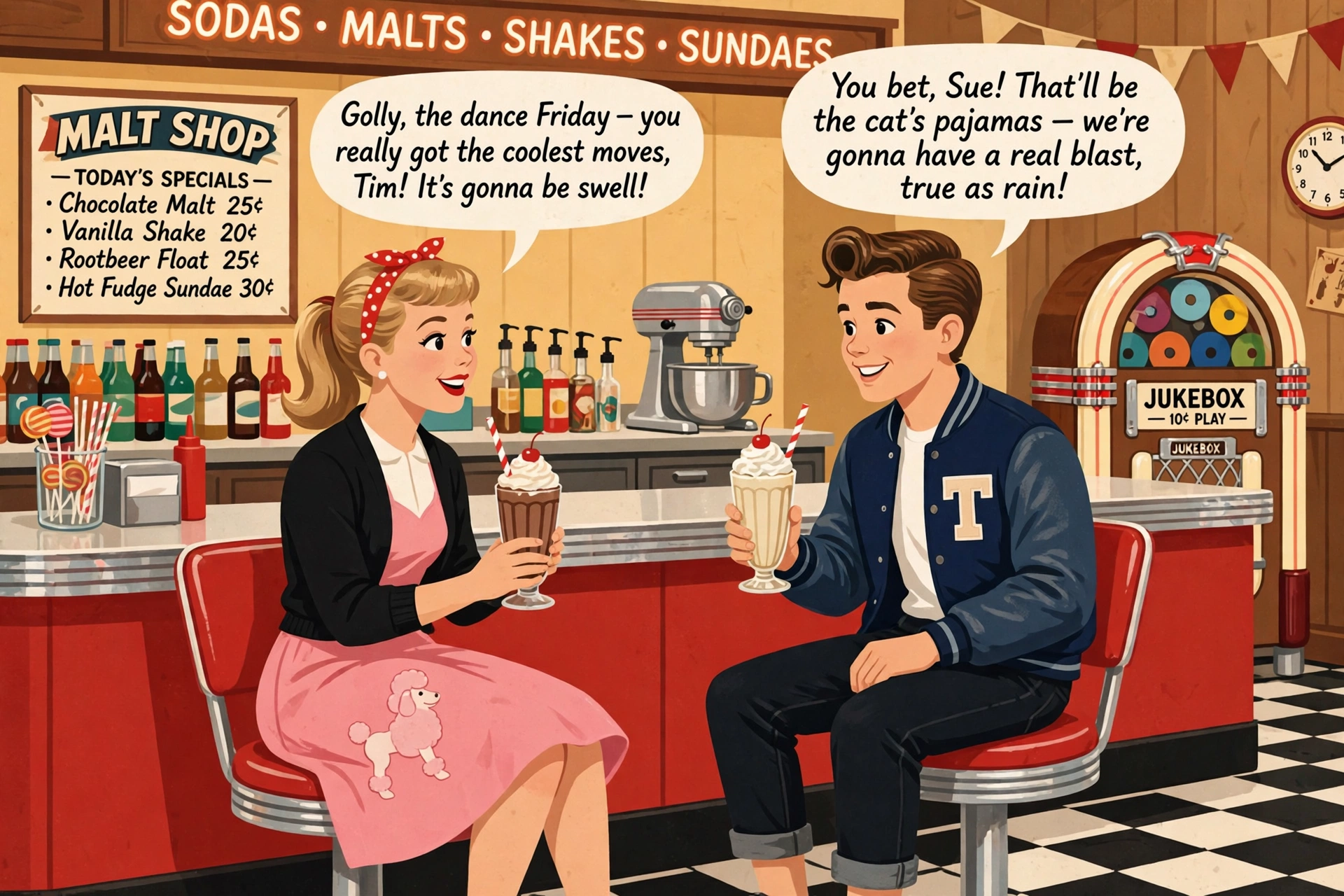
- “Hey daddy-o, let’s cruise down to the malt shop after school.”
- “You’re looking real sharp in those new threads, man.”
- “This party is a blast! The band is really cookin’ tonight.”
- “Come on, let’s split — the movie starts in ten minutes.”
- “You’re the ginchiest girl in school, you know that?”
Professional Examples
Fifties slang rarely appeared in professional settings, but when adults used it, it usually sounded like this:
- “The new model is selling well — customers say it’s made in the shade this year.” (a car salesman)
- “Our band is really cookin’ tonight, folks — stick around for the next set.” (a bandleader on stage)
- “That young singer is the real gone thing — the crowd loves her.” (a radio DJ)
- “Let’s not flip our wigs over one bad review. We’ll be fine.” (a manager calming the team)
Funny Examples
- “He tried to dance and fell flat on his face — what a spaz!”
- “My little brother is such an ankle biter, always following me around.”
- “Don’t be a wet rag, man — come to the sock hop with us!”
- “She asked me a hundred questions. I said, ‘Are you writing a book or something?'”
- “He got so frosted when we beat him at poker that he flipped his wig.”
Comparison with Similar Terms
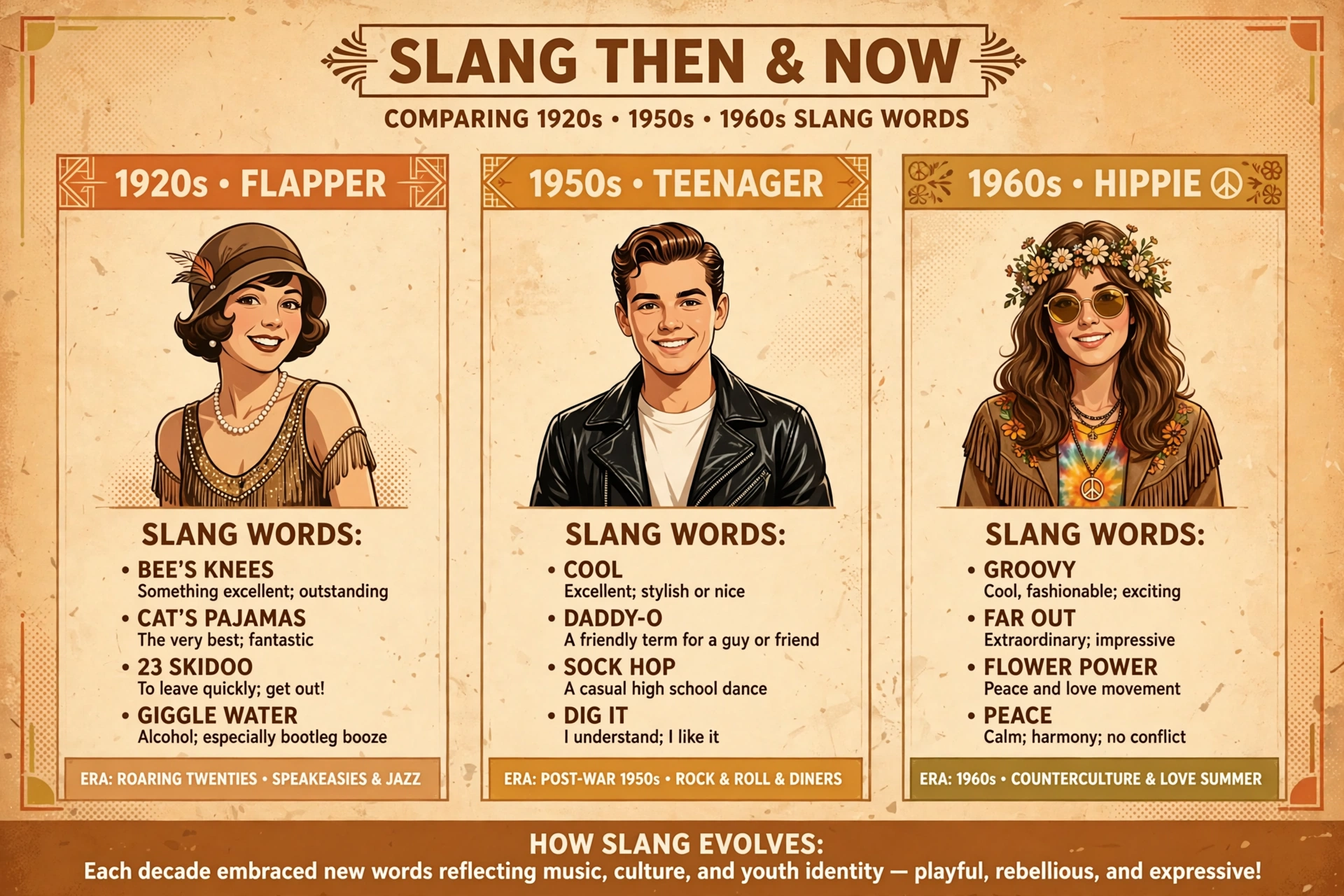
Slang changes fast from one decade to the next. A word that meant one thing in the 1920s could mean something different by the 1950s, and something else again by the 1960s. Here is how 1950s slang compares with the slang of nearby decades — and if you enjoy this kind of time travel, you will love our guides to 1920s slang and 60s slang, which show how the language kept changing.
| 1950s Word | Meaning | Similar Term (Other Decade) | Difference |
|---|---|---|---|
| Cool | Awesome, stylish, calm | Groovy (1960s) | Cool is understated; groovy is more excited and hippie-flavoured |
| Daddy-o | Buddy, pal | Man (1960s) | Daddy-o is jazz-age friendly; man is more casual and universal |
| Square | Conventional, uncool person | Straight (1960s) | Square mocks boring conformity; straight often means not using drugs |
| Bread | Money | Dough (1920s) | Same idea, different food — dough was the older word |
| Pad | Home, apartment | Crib (2000s) | Pad is fifties beatnik; crib is modern hip-hop |
| Cat | Hip person | Dude (1980s) | Cat is jazz-scene cool; dude is surfer and skater casual |
| Threads | Clothes | Duds (1920s) | Threads sounds sharp and stylish; duds sounds old-fashioned |
| Burn rubber | Drive fast | Peel out (1970s) | Same action, different image — rubber versus tyres squealing |
| Blast | A great time | Rager (2010s) | Blast is a fifties party; rager is a loud modern party |
| Hep | In the know | Woke (2010s) | Hep is about style and jazz; woke is about social awareness |
The biggest difference between 1950s slang and the slang of other decades is its source. Twenties slang came from jazz clubs and speakeasies, fifties slang came from rock and roll and car culture, and sixties slang came from the hippie movement and the counterculture. Each decade’s slang is really a snapshot of what young people cared about at the time.
Alternate Meanings
Many 1950s slang words had more than one meaning — or their meanings changed over time. Here are the most important ones to know:
- Cool: In the fifties it meant fashionable, calm, and admirable. Today it can also mean “okay” or “I agree” (“Cool, see you at six”). It can even describe temperature, which is the original, non-slang meaning.
- Pad: In the fifties it meant a home or apartment, sometimes with a hint of a beatnik crash pad. Today it can also mean a notepad, a launch pad, or a sanitary pad — context decides everything.
- Dig: Fifties teenagers said “I dig it” to mean “I understand and enjoy it.” Today, dig more often means to excavate with a shovel, though music fans still say “I dig that song.”
- Cloud nine: In the fifties it meant being blissfully happy, often in love. The phrase is still used today with exactly the same meaning — one of the rare fifties phrases that never changed.
- Kicks: In the fifties, kicks were shoes (“nice kicks!”). Later, the phrase “just for kicks” turned it into a word for fun or thrills — and both meanings are still alive today.
- Far out: In the late fifties it meant amazing or wild. In the sixties it became a hippie catchphrase for anything strange or psychedelic. Today it is mostly used jokingly, as a retro throwback.
- Crazy: “Crazy, man!” in the fifties meant something was wonderful or impressive, not that it was insane. That positive use has mostly faded, and today crazy is usually negative again.
Professional or Polite Alternatives
Fifties slang was fun, but it was not appropriate everywhere. If you are writing an essay, speaking at work, or talking to someone formal, here are polite alternatives for common 1950s slang words:
| 1950s Slang | Polite Alternative |
|---|---|
| Cool / boss / ginchy | Excellent, wonderful, impressive |
| Dreamboat | Very attractive person |
| Daddy-o / cat | Friend, colleague |
| Square | Traditional, conventional person |
| Pad | Home, apartment |
| Bread | Money |
| Threads | Clothes, outfit |
| Blast | A wonderful time, a great party |
| Flip your wig | Lose your temper, become upset |
| Get bent | Please leave me alone |
| Backseat bingo | Kissing in a car (best avoided in polite conversation) |
| Ankle biter | Small child, toddler |
One word deserves a special warning: spaz. In the fifties, teenagers used it casually to mean an uncooperative or clumsy person. Today, it is considered offensive because it comes from a word for a medical condition. Do not use it — say “clumsy” or “goofy” instead.
Common Mistakes
People love throwing fifties slang into conversation, but it is easy to get it wrong. Here are the most common mistakes:
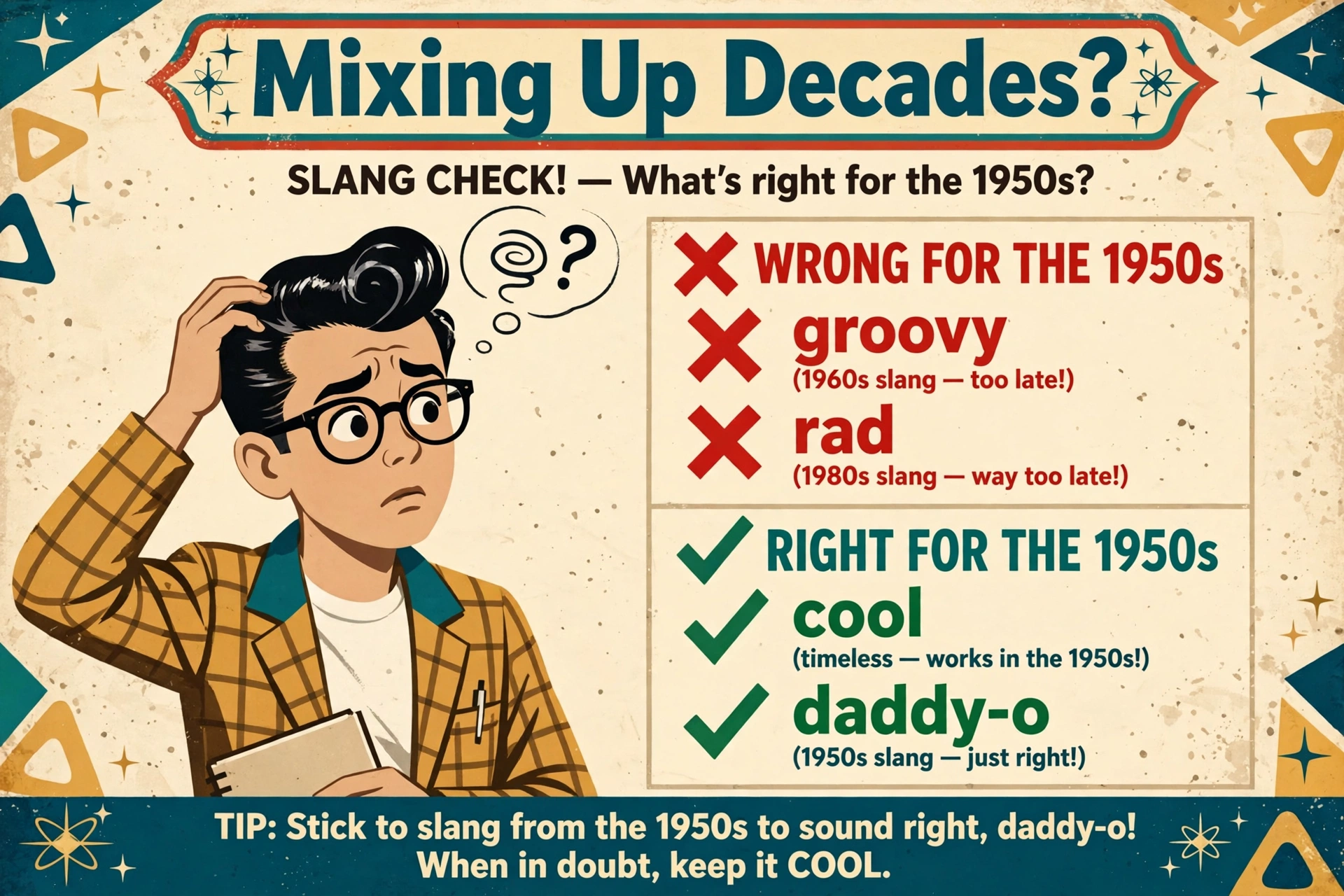
- Mixing up the decades. Groovy, far out, and peace are sixties words, not fifties words. Rad and awesome are eighties words. Using them in a fifties conversation sounds wrong to anyone who knows the era.
- Using ginchy wrong. Ginchy means excellent or attractive — it is a compliment, not a general filler word. Saying “that’s so ginchy” about a sandwich is fine; saying it about bad news is not.
- Calling everyone daddy-o. Daddy-o was a friendly address between guys in the jazz and beat scene. Calling your teacher or your boss daddy-o would have been strange even in 1957.
- Forgetting the tone. Fifties slang was light and playful. Using it angrily — shouting “you square!” during a real argument — misses the point. The words were meant to tease, not to wound.
- Overdoing it. A real fifties teenager used a few slang words mixed into normal sentences, not a whole sentence of slang. Saying “Hey daddy-o, let’s agitate the gravel in my chariot to the passion pit” sounds like a costume, not a conversation.
- Using outdated words that sound offensive now. Spaz is the big one — it was casual in the fifties and is offensive today. Always check a word’s modern meaning before using it.
Quick Tips
- Start with the survivors. Cool, cloud nine, and burn rubber still work today, so they are the safest fifties words to use in normal conversation.
- Use slang for fun, not for real communication. Fifties slang shines at theme parties, in retro writing, and in jokes. For everyday talking, keep it light.
- Learn the big five first. Cool, daddy-o, dreamboat, ginchy, and square cover most fifties conversations. Master those five and the rest will follow.
- Watch old movies for the rhythm. Films like Rebel Without a Cause and Grease (set in the fifties) show how the words actually sounded when people said them.
- Check the decade before you borrow a word. If you are writing about the fifties, keep groovy, rad, and lit out of it — they belong to other decades.
- Use the words in writing sparingly. A little fifties slang adds flavour to a story or a party invitation. A whole paragraph of it is hard to read.
FAQ
What is 1950s slang?
1950s slang is the informal vocabulary used by American teenagers and young adults in the 1950s. It includes words like cool, daddy-o, dreamboat, ginchy, pad, and square, and it grew out of jazz culture, Beat culture, rock and roll, and car culture.
What does “cool” mean in 1950s slang?
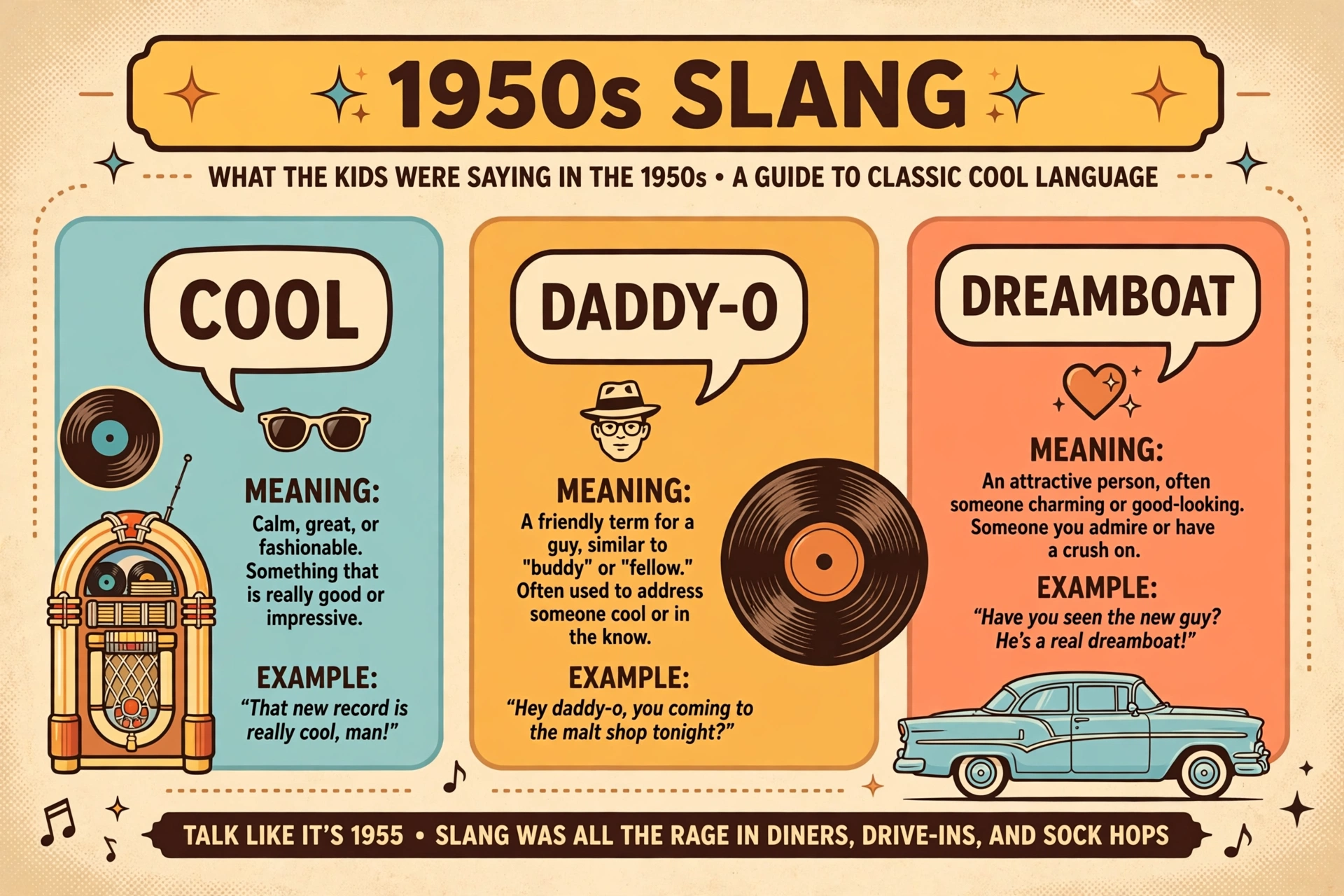
In 1950s slang, cool meant fashionable, calm, stylish, and admirable. It came from the jazz scene of the 1940s, where it described a relaxed, controlled attitude. It is one of the few fifties slang words that is still used the same way today.
What does “daddy-o” mean?
Daddy-o was a friendly way to address a guy, similar to saying buddy or pal. It came from the jazz and beatnik scenes of the 1950s and was used between friends. It is not used seriously today — mostly in jokes or retro references.
What is a “dreamboat” in 1950s slang?
A dreamboat was a very attractive person, usually someone you had a crush on. Teenagers in the fifties would say “he’s a real dreamboat” about a handsome boy, or “she’s a dreamboat” about a pretty girl.
What does “ginchy” mean?
Ginchy meant excellent, wonderful, or attractive. If someone in the fifties said you were “the ginchiest,” it was high praise. The word did not survive the decade the way cool did, which is why it sounds so old-fashioned today.
What is “backseat bingo”?
Backseat bingo was a playful fifties phrase for kissing or making out in the back seat of a car. It came from the car culture of the decade, when teenagers spent a lot of time in cars — and drive-in movies gave them a reason to be there.
Why did 1950s slang become so popular?
1950s slang became popular because teenagers suddenly had money, cars, and their own culture. Rock and roll, television, and movies spread the words across the country, and using slang was a fun way for young people to mark themselves as different from their parents.
Do people still use 1950s slang today?
Some of it, yes. Cool, cloud nine, and burn rubber are still part of everyday English. Most other fifties words — like ginchy, daddy-o, and backseat bingo — are now used only as jokes, in theme parties, or in writing about the era.
Conclusion
1950s slang is more than a list of funny old words — it is a window into the decade that invented the modern teenager. From jazz clubs to drive-in movies, from hot rods to sock hops, young people in the fifties built a language that matched their new freedom, and a few of those words — above all, cool — never went away.
The next time you call something cool or say you are on cloud nine, you are speaking a little bit of 1950s slang. And if you want to keep exploring how slang changes from one decade to the next, check out our guide to 90s slang words — you will be surprised how much stayed the same, and how much changed completely.
So go ahead: put on a record, cruise to the malt shop, and remember — stay cool, daddy-o.
50 Essential 1950s Slang Words — Quick Reference Table
| # | Word / Phrase | Meaning |
|---|---|---|
| 1 | Cool | Awesome, stylish, calm |
| 2 | Daddy-o | Buddy, pal |
| 3 | Dreamboat | Very attractive person |
| 4 | Ginchy | Excellent, attractive |
| 5 | Beatnik | Member of the Beat subculture |
| 6 | Pad | Home, apartment |
| 7 | Square | Conventional, uncool person |
| 8 | Cat | Hip person |
| 9 | Hep / Hip | In the know |
| 10 | Threads | Clothes |
| 11 | Bread | Money |
| 12 | Kicks | Shoes; later, fun or thrills |
| 13 | Cloud nine | Blissfully happy |
| 14 | Backseat bingo | Kissing in the back seat of a car |
| 15 | Burn rubber | Drive very fast |
| 16 | Cruisin’ for a bruisin’ | Looking for trouble |
| 17 | Get pinned | Going steady with someone |
| 18 | Passion pit | Drive-in movie theater |
| 19 | Ankle biter | Small child |
| 20 | Made in the shade | Set for success, life is easy |
| 21 | Flip your wig | Lose control, get very excited |
| 22 | Ring-a-ding-ding | Exciting, impressive |
| 23 | Real gone | Fantastic, mind-blowing |
| 24 | Cool cat | Stylish, laid-back person |
| 25 | The heat | The police |
| 26 | Agitate the gravel | Leave quickly |
| 27 | Cast an eyeball | To look at someone or something |
| 28 | Frosted | Angry |
| 29 | Radioactive | Very popular |
| 30 | Wet rag | Someone who is no fun |
| 31 | Peepers | Eyeglasses |
| 32 | Razz my berries | Very exciting |
| 33 | Wazoo | A person’s rear end |
| 34 | Spaz | Uncooperative person (now offensive — avoid) |
| 35 | Get bent | Go away |
| 36 | Rattle your cage | To upset you badly |
| 37 | Big tickle | Really funny |
| 38 | Blast | A great time, a great party |
| 39 | Dig | To understand or enjoy |
| 40 | Far out | Amazing, wild |
| 41 | Boss | Great, excellent |
| 42 | Crazy, man | Wonderful, impressive |
| 43 | Cookin’ | Doing something really well |
| 44 | Chariot | Car |
| 45 | Bash | A great party |
| 46 | Big daddy | An older, respected man |
| 47 | Chrome-plated | Dressed up, looking sharp |
| 48 | Circled | Married |
| 49 | Squaresville | A boring, conventional place |
| 50 | Antsville | A dull, unexciting place |
