Quick definition: In modern slang, “unc” is short for “uncle” — and when someone calls you unc online, they are not talking about your family tree. They are saying you are old, you are getting old, or you are acting older than your age. The phrase “unc status” means someone has officially crossed the line into being considered old, usually in a joking or teasing way. It is a Gen Z and Gen Alpha slang term that started as a term of respect in Black communities and turned into the internet’s favorite way to roast anyone who seems out of touch.
Unc Slang Meaning & Definition
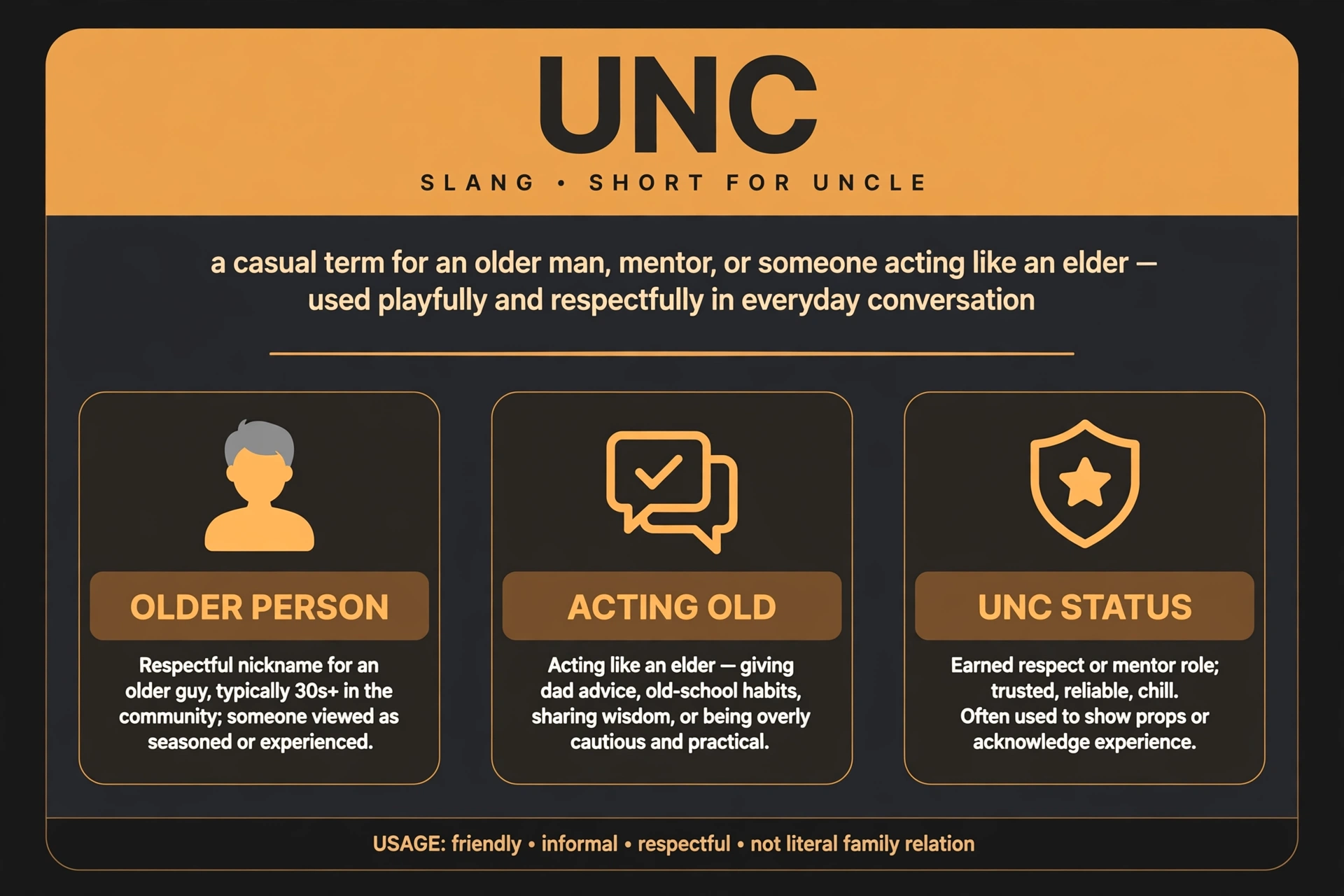
So what does “unc” actually mean? At its simplest, unc is a shortened form of “uncle.” But the slang meaning depends heavily on who is saying it, where they are saying it, and who they are saying it to. In its original sense, unc was a warm, respectful word for an older male relative or a trusted older man in the community — someone like an uncle, even if there was no blood relation. In today’s internet slang, the meaning has flipped into something more playful and a little sharper: calling someone unc is a light way of saying they are old or acting old.
Merriam-Webster captures the modern sense well, noting that “unc” is “often used humorously on the internet in the phrase ‘unc status’ to imply that someone is old, getting old, or acting older than their age.” Dictionary.com describes it as Gen Z and Gen Alpha slang with a light pejorative edge — a teasing label rather than a full insult. The phrase “chopped and unc” has also spread online, combining “chopped” (unattractive) with “unc” (old) for a double roast that stings more than either word alone.
The key thing to understand is that unc slang meaning is not one fixed thing. It lives on a spectrum:
- Affectionate: A younger person calls an older mentor, family friend, or favorite uncle “unc” as a sign of respect and closeness.
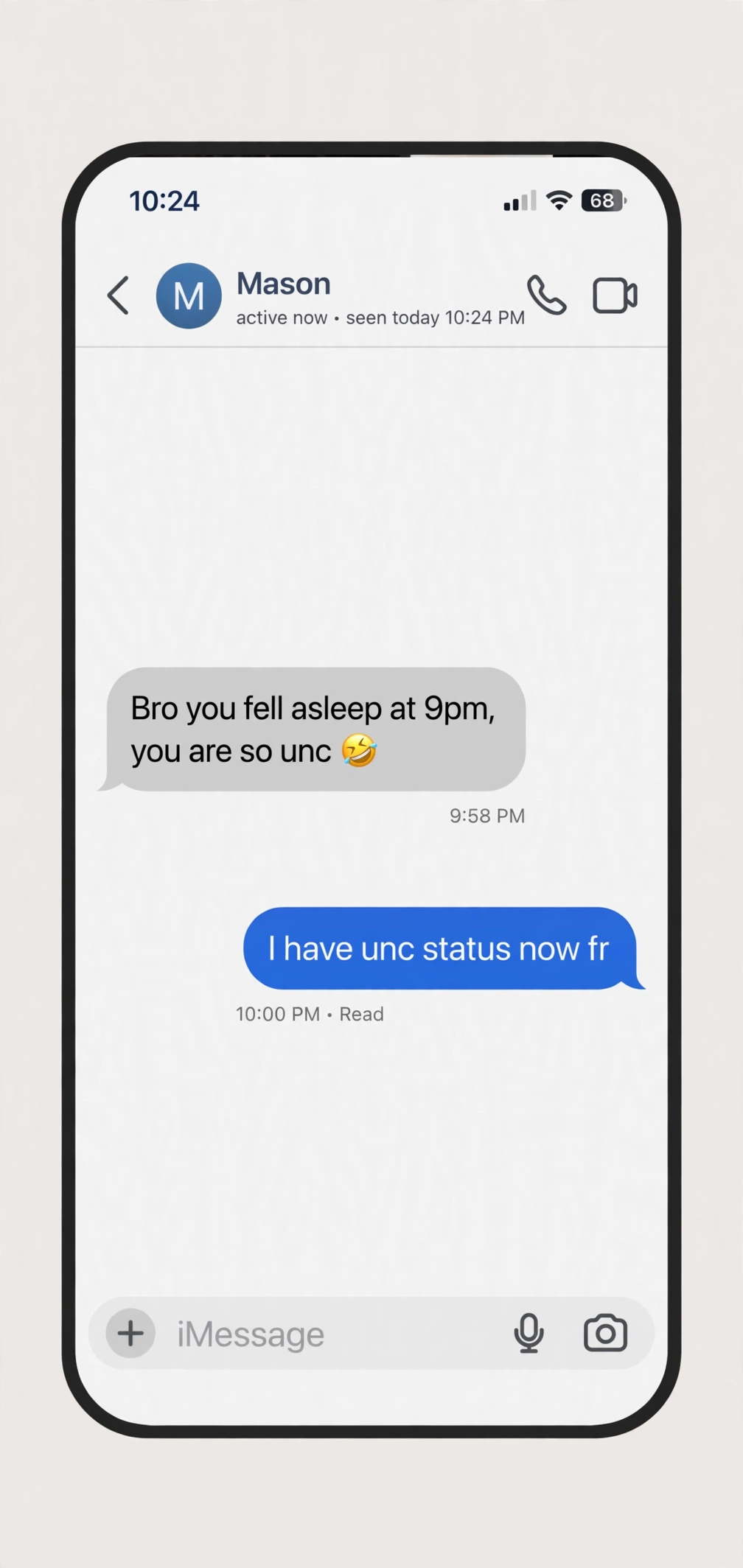
- Playful: Friends in their twenties joke that one of them is “unc” because he goes to bed at 9 p.m. or does not know the latest TikTok trend.
- Teasing: Someone online gets called unc for having an outdated opinion, a dated haircut, or a phone full of apps they barely understand.
- Mocking: At its sharpest, it is a way of saying someone is washed, irrelevant, or past their prime.
Context is everything. The same word can be a hug or a roast, and the difference is the relationship between the people involved. If your nephew calls you unc at a family cookout, it probably comes with love. If a stranger in your comment section calls you unc, it probably does not.
It is also worth clearing up one big misunderstanding right away: unc is NOT short for “uncool.” That is one of the most common misconceptions about the word, and it is wrong. Unc comes from “uncle,” not “uncool.” The fact that being called unc often feels uncool is a coincidence, not an etymology. Keep this in mind, because confusing the two is the fastest way to misuse the term — and to get corrected loudly in a group chat.
Introduction
If you spend any time on TikTok, X (formerly Twitter), or Instagram, you have probably seen it by now: a comment that just says “unc” under a video of a thirty-year-old struggling to understand a new dance trend, or a caption that reads “unc status achieved” under a photo of someone wearing socks with sandals. The word is everywhere, and it is confusing if you are not in on the joke — because on the surface, it looks like people are randomly calling each other “uncle.”
That confusion is understandable. Slang moves fast, and unc has moved faster than most. In the space of a few years it went from a community term of respect to a mainstream internet label that gets thrown at athletes, celebrities, influencers, and regular people in comment sections. NBA fans call veteran players unc. Gamers call the oldest person in the lobby unc. Younger siblings call their twenty-five-year-old brother unc for watching cable news. The word has become a shorthand for a whole idea: you are not young anymore, and everyone can tell.
But why did this particular word take off? Part of the answer is that every generation needs a word for “old person,” and the internet loves a short, punchy label. Words like “boomer” felt too tied to a specific generation, and “oldhead” never quite broke into the mainstream. Unc is short, it is funny, and it carries just enough warmth that it works as a joke between friends instead of a genuine insult. It is the kind of word that lets you roast someone without actually starting a fight — most of the time.
Another reason unc spread so quickly is that it fits perfectly into the slang ecosystem of the 2020s. Modern internet slang is full of short, repurposed words — think of how sigma went from a Greek letter to a whole personality type, or how delulu became the standard word for being delightfully out of touch with reality. Unc belongs in that same family: an old word given a new job. If you are trying to keep up with the current slang landscape, understanding unc is not optional — it is one of the most used terms of the moment, and it shows up in conversations, captions, memes, and group chats every single day.
This guide breaks down everything you need to know about unc slang meaning: where it came from, how it is used, what “unc status” really means, when it is funny and when it crosses a line, and how to use it without embarrassing yourself. By the end, you will know exactly what someone means when they call you unc — and whether you should laugh, clap back, or just accept it.
Origin
The story of unc starts long before TikTok. The word is rooted in African American Vernacular English (AAVE), where “unc” has been used for decades as a shortened, affectionate form of “uncle.” In Black communities, calling an older man “unc” was a sign of respect and familiarity — a way of saying “you are family to me” even when there was no blood relation. An “unc” could be a real uncle, a family friend, a neighborhood mentor, or any older man who had earned trust and affection. It was a title, not a joke.
Hip-hop helped carry the word into wider culture. Rapper Defari used it in his 2003 track “For the Love” with the line “yo that’s my unc,” and Gucci Mane name-dropped it in his 2010 song “On the Way.” J. Cole has also used the term in his lyrics, including on “Brackets.” In these songs, unc still carried its original warmth — it was about loyalty, respect, and the bond between generations.
So how did a term of respect become a roast? The shift happened gradually as the word moved from music and community speech into mainstream internet culture. As younger generations adopted unc, the emphasis moved from the “respected elder” part of the meaning to the “older” part. On social media, calling someone unc stopped being mainly about respect and started being mainly about age. The affection did not disappear entirely — plenty of people still use it warmly — but the internet version of the word is much more likely to be a tease than a tribute.
For a fuller breakdown of the term’s definitions and cultural background, see the Dictionary.com guide to “unc” slang, which traces how the word moved from AAVE into Gen Z and Gen Alpha speech. The timeline matters because it explains the tension in the word today: older users and people inside the culture it came from may still hear respect in it, while younger internet users mostly hear a joke about age. Both readings are real, and knowing which one applies depends on the room you are in.
Popularity
Unc exploded in popularity during the early 2020s, riding the same wave of slang that made words like “rizz,” “skibidi,” and “gyat” household terms. TikTok was the main engine: creators started using unc in skits about getting old, in videos roasting their older siblings, and in comments under videos of millennials discovering they no longer understand youth culture. The word’s shortness made it perfect for comments and captions — a single three-letter word could deliver a whole joke.
One of the biggest drivers was the phrase “unc status.” Once that phrase caught on, it became a meme format in itself. People started declaring unc status for anyone who did something that felt old: falling asleep on the couch at 8 p.m., complaining about loud music, not knowing what a certain emoji means, or struggling to use a new app. “Unc status” turned aging into a game with a threshold, and crossing it became a running joke. The phrase is so common now that Merriam-Webster specifically calls it out in its definition of the term.
Sports fandom gave unc another huge boost. In NBA and NFL circles, fans routinely call veteran players unc once they pass a certain age or start showing signs of slowing down. A thirty-five-year-old player who misses a step gets called unc in the comments within minutes. The same thing happens in gaming, where the oldest player in a lobby is automatically the unc, regardless of how good they are. These uses are almost always playful — a way of bonding over shared jokes about age — but they also show how deeply the word has entered everyday speech.
The word also fits neatly into the current era of generational humor. Gen Z and Gen Alpha love roasting millennials, and millennials love roasting themselves right back. Unc is the perfect weapon for that back-and-forth because it is gentle enough to use on friends but pointed enough to land. It has become part of the same slang vocabulary as delulu and other viral terms — words that started in specific communities, went mainstream on TikTok, and now show up everywhere from group chats to news articles. Cambridge has even flagged the slang sense of unc as sometimes offensive, which is a sign of just how far the word has traveled: it is now common enough for major dictionaries to weigh in on its tone.
How It Is Used
Unc is flexible, and it shows up in several different grammatical forms. Understanding the patterns will help you recognize it instantly — and use it correctly if you choose to.
As a direct label: The most common use is simply calling someone unc. “Bro is unc now.” “You’re such an unc.” “My dad is a certified unc.” In these sentences, unc works like a noun — a label for a person. The tone is usually teasing, but the exact sting depends on context and delivery.
As “unc status”: This is the internet’s favorite version. “He just hit unc status.” “Unc status unlocked.” “That’s unc status behavior.” The phrase frames aging as a milestone or achievement — like leveling up in a game, except the level is being old. It is almost always meant as a joke, and it is often used self-deprecatingly by people in their late twenties and thirties who are starting to feel the gap between themselves and teenagers.
As an adjective or descriptor: Unc also works as a modifier. “That’s such an unc take.” “You’re acting unc right now.” “Those are unc shoes.” Here it means “old-fashioned,” “out of touch,” or “something an older person would do or say.” This is the most versatile use, because it can describe behavior, opinions, fashion choices, or anything else that reads as dated.
In combinations: Internet slang loves a combo, and unc has spawned several. “Chopped and unc” pairs old with unattractive for a harsher roast. “Unc energy” describes a vibe — someone who gives off older-person energy even if they are not actually old. “Big unc” is an affectionate, emphatic version, often used for someone who is genuinely respected. The combos let speakers fine-tune exactly how much warmth or bite they want.
Where you will see it most: TikTok comments, X replies, Instagram captions, Discord servers, gaming lobbies, group chats, and meme pages. It is far more common in writing than in formal speech, and it is almost never used in professional settings — which brings us to an important point. Unc is casual slang. Using it at work, with a client, or with someone you do not know well can come across as rude or disrespectful, even if you meant it as a joke. The same word that gets laughs in a group chat can get you a stern look in an office. Read the room before you use it.
It is also worth noting that unc is not usually self-bestowed. You do not call yourself unc to be cool — that is something other people decide about you. Claiming unc status for yourself is either a self-deprecating joke (“I’m unc now, I went to bed at 9”) or a misunderstanding of how the word works. In most cases, if you have to announce that you are unc, you are probably not using it the way the internet does.
Examples
Real examples are the fastest way to understand how unc actually sounds in conversation. Below are realistic text and chat examples, organized by tone, so you can see how the word shifts between friendly, professional, and funny contexts.
Friendly Examples
These are the warm, affectionate uses — the ones that come from people who actually like each other. The tone is teasing but loving, and nobody’s feelings get hurt.
- Group chat, joking about a friend’s early bedtime:
Jake: “Alright guys I’m heading out, it’s 9:30 😴”
Mia: “bro you’re actually unc now 💀”
Jake: “I’m just tired leave me alone lol” - Nephew to his uncle at a family barbecue:
“Unc, you gotta teach me how to grill like that. Nobody does it like you.” - Friend hyping up an older mentor:
“That’s my unc right there. He’s the reason I even got into music production.” - Siblings teasing each other:
“My brother turned 27 and suddenly he’s unc. He watches the news now. The NEWS.”
Notice how in the friendly examples, the word is softened by context — a compliment, a joke between people who know each other, or an obvious term of endearment. That is the original spirit of unc, and it is still alive in these uses.
Professional Examples
Here is the honest truth: unc has almost no place in professional communication. It is casual slang, and using it at work is risky. But it does show up in informal workplace-adjacent settings — a Slack channel with close coworkers, a creative team brainstorm, or a social media post from a brand trying to sound relatable. Even then, it should be used with extreme caution.
- Casual team chat (only with close coworkers):
“I just explained what a floppy disk was to the intern. I am officially unc now.” - Self-deprecating joke in a creative meeting:
“I had to Google that reference. Unc status, I know. Carry on.” - What NOT to say:
“Hey unc, can you send me that report?” — Never call a boss, client, or older colleague “unc” at work. It reads as disrespectful, even if you meant it as a joke. Use their name or title instead.
The professional rule is simple: if you are not sure it will land, do not say it. A self-deprecating joke about your own unc status is usually safe. Calling someone else unc at work is almost never safe. When in doubt, keep it out of the office entirely.
Funny Examples
These are the uses that made unc famous — the roasts, the memes, and the jokes that thrive on TikTok and X. The tone is exaggerated, playful, and deliberately over the top.
- TikTok comment under a millennial’s video:
“POV: you’re 28 and a 14-year-old just called you unc in the comments 😭” - Roasting a friend’s music taste:
“You still listen to songs from 2015?? Bro that’s unc behavior fr 💀” - Gaming lobby:
“Yo our teammate is 30 years old?? We got an unc in the squad 😂” - Reacting to an outdated opinion:
“He said TikTok is a waste of time. Certified unc take. Somebody check on him.” - Sports fan comment:
“My favorite player just got called unc by a rookie. It’s over for him, he’s washed 😭”
The funny examples work because they exaggerate a small, relatable truth: everyone eventually becomes the “old person” in someone else’s eyes. The humor comes from the gap between how young someone feels and how old the internet thinks they are. A twenty-eight-year-old is not actually old — but in a comment section full of teenagers, they might as well be.
Comparison with Similar Terms
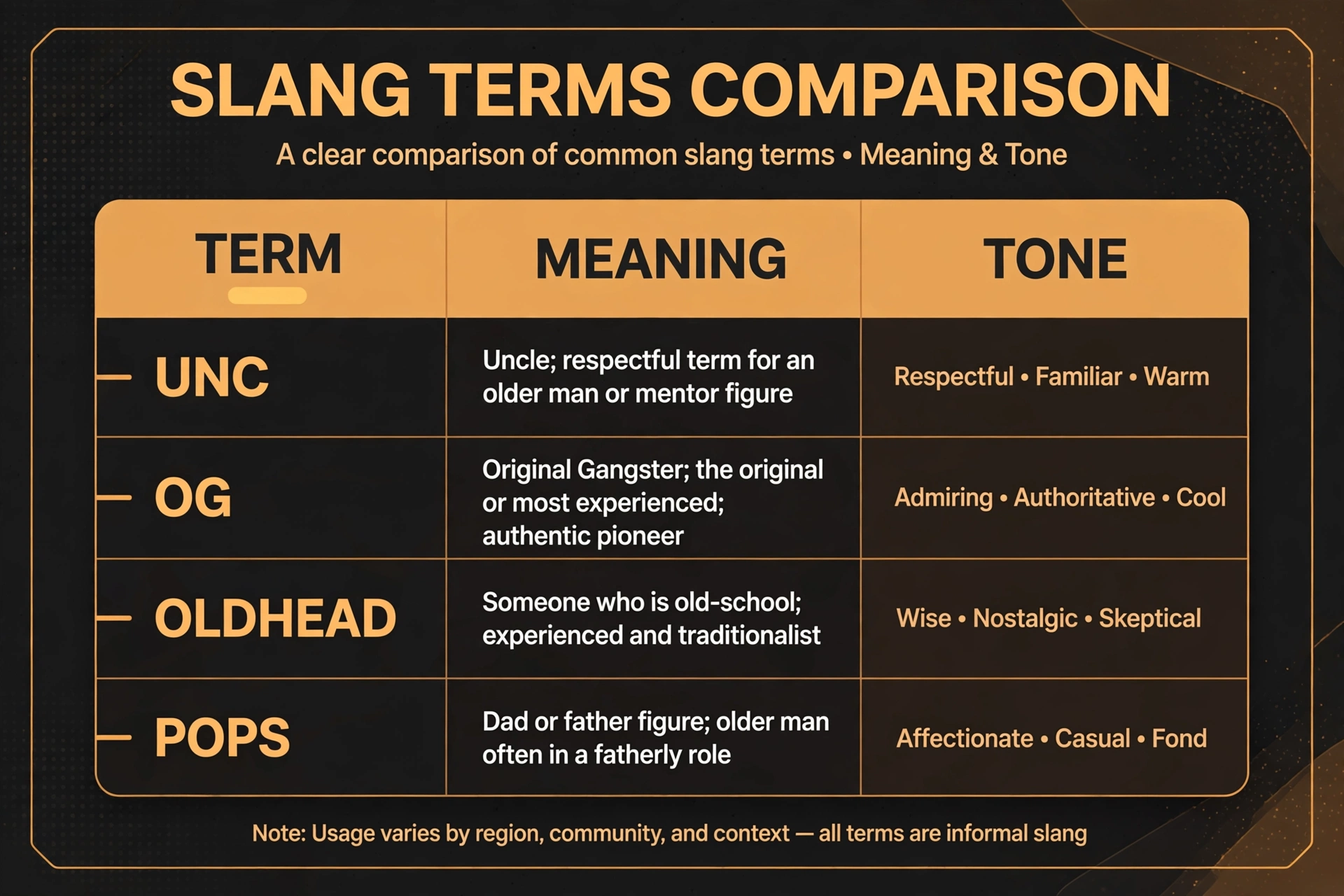
Unc is not the only word for an older person in slang, and the differences between these terms matter. Using the wrong one can change the meaning of your sentence entirely — or offend someone you did not mean to offend. Here is how unc stacks up against the closest alternatives.
| Term | Meaning | Tone | Best Used For |
|---|---|---|---|
| Unc | Short for uncle; someone old or acting old | Playful to teasing; sometimes affectionate | Friends, internet jokes, “unc status” memes |
| OG | Original gangster; a respected veteran or pioneer | Respectful, admiring | Someone who was there from the start and earned respect |
| Oldhead | An older person, often with old-school views | Neutral to mildly teasing | Someone older who holds traditional opinions |
| Unk | Another spelling/variant of unc (uncle) | Similar to unc; slightly more hip-hop rooted | Same contexts as unc, often in rap lyrics |
| Pops | Father or father figure | Affectionate, familiar | Your dad or a fatherly older man you are close to |
| Boomer | A baby boomer, or anyone acting like one | Mocking, generational | Generational jokes; can feel dismissive or hostile |
| Auntie | The female equivalent of unc | Playful to teasing; sometimes affectionate | An older woman, or a woman acting older than her age |
A few distinctions are especially important. Unc vs. OG: an OG is someone you admire for their experience and history, while an unc is someone you are teasing for their age. You can be both — a respected OG who is also unc — but the words point in different directions. Unc vs. boomer: boomer is tied to a specific generation and often carries real generational tension, while unc is lighter and can apply to someone of any age who is acting old. A twenty-five-year-old can be unc; a twenty-five-year-old cannot be a boomer. Unc vs. auntie: these are the gendered pair — unc for men, auntie for women. Calling a woman “unc” is a mistake (more on that below); the equivalent term is auntie, which carries the same mix of teasing and affection.
The closest relative is unk, which is essentially the same word with a different spelling. Unk shows up more often in hip-hop lyrics, while unc has become the dominant spelling on TikTok and in mainstream internet slang. For most practical purposes, they mean the same thing — but if you are writing for a general audience, unc is the spelling people will recognize.
Alternate Meanings
Like a lot of slang, unc does not have just one meaning. Context decides which one applies, and the wrong reading can cause real confusion. Here are the main alternate meanings you should know:
- Literal uncle: The original and still valid meaning. “That’s my unc” can simply mean “that’s my uncle” — a real family member. If someone says “I’m going to my unc’s house for dinner,” they are almost certainly talking about their actual uncle, not making a joke about age.
- UNC — University of North Carolina: In all caps, UNC is the standard abbreviation for the University of North Carolina at Chapel Hill. Sports fans, students, and alumni use it constantly. If you see “UNC won last night” or “UNC basketball,” it has nothing to do with slang — it is the university. Capitalization is your clue: the slang is almost always lowercase “unc,” while the university is uppercase “UNC.”
- A name or nickname: Some people go by “Unc” as a nickname, either because they are the uncle in their family or because friends gave them the name. In this case it functions like any other nickname — a personal label rather than a general slang term.
- A term of respect in hip-hop and street culture: In its original AAVE context, unc can still mean a respected older man or mentor. This is the meaning that predates the internet joke, and it is still used this way in many communities. The respectful meaning and the teasing meaning coexist — which is exactly why tone and relationship matter so much.
The practical takeaway: before you react to someone being called unc, check the context. A sports headline about UNC, a family member talking about their uncle, and a TikTok comment calling someone unc are three completely different situations that happen to share the same three letters.
Professional or Polite Alternatives
There are plenty of situations where unc is the wrong word — at work, with strangers, with elders you respect, or anywhere a joke about age could land badly. In those moments, you need alternatives that say what you mean without the slang baggage. Here are polite options for different situations:
- For an older colleague or mentor: Use their name, or a respectful title like “Mr.” or “Ms.” if that fits the culture. “My mentor,” “my senior colleague,” or simply “a veteran in the field” all convey respect without the age joke.
- For a family member: “Uncle” itself is the polite version — warm, respectful, and never misunderstood. If you want something casual but still respectful, “my uncle” or their first name works in most families.
- For someone acting old-fashioned: Instead of “that’s so unc,” try “that’s a bit old-school,” “that’s a classic take,” or “that’s from a different era.” These phrases make the same observation without labeling the person.
- For someone with experience: If you actually mean respect, say so directly: “a veteran,” “an OG in the best sense,” “someone with a lot of experience,” or “a pioneer.” These carry the admiration that unc sometimes hints at but rarely delivers.
- For a light joke among friends: If the setting is casual and everyone is in on the joke, “oldhead,” “grandpa” (said affectionately), or “veteran” can work — but only if you are sure the other person will take it well.
The golden rule: if you would not say it to someone’s face in a room full of their colleagues, do not say it at all. Unc is a word for close relationships and casual spaces. Everywhere else, the polite alternatives are not just safer — they are more accurate about what you actually mean.
Common Mistakes
Unc is a simple word, but people misuse it constantly. Here are the most common mistakes — and how to avoid them.
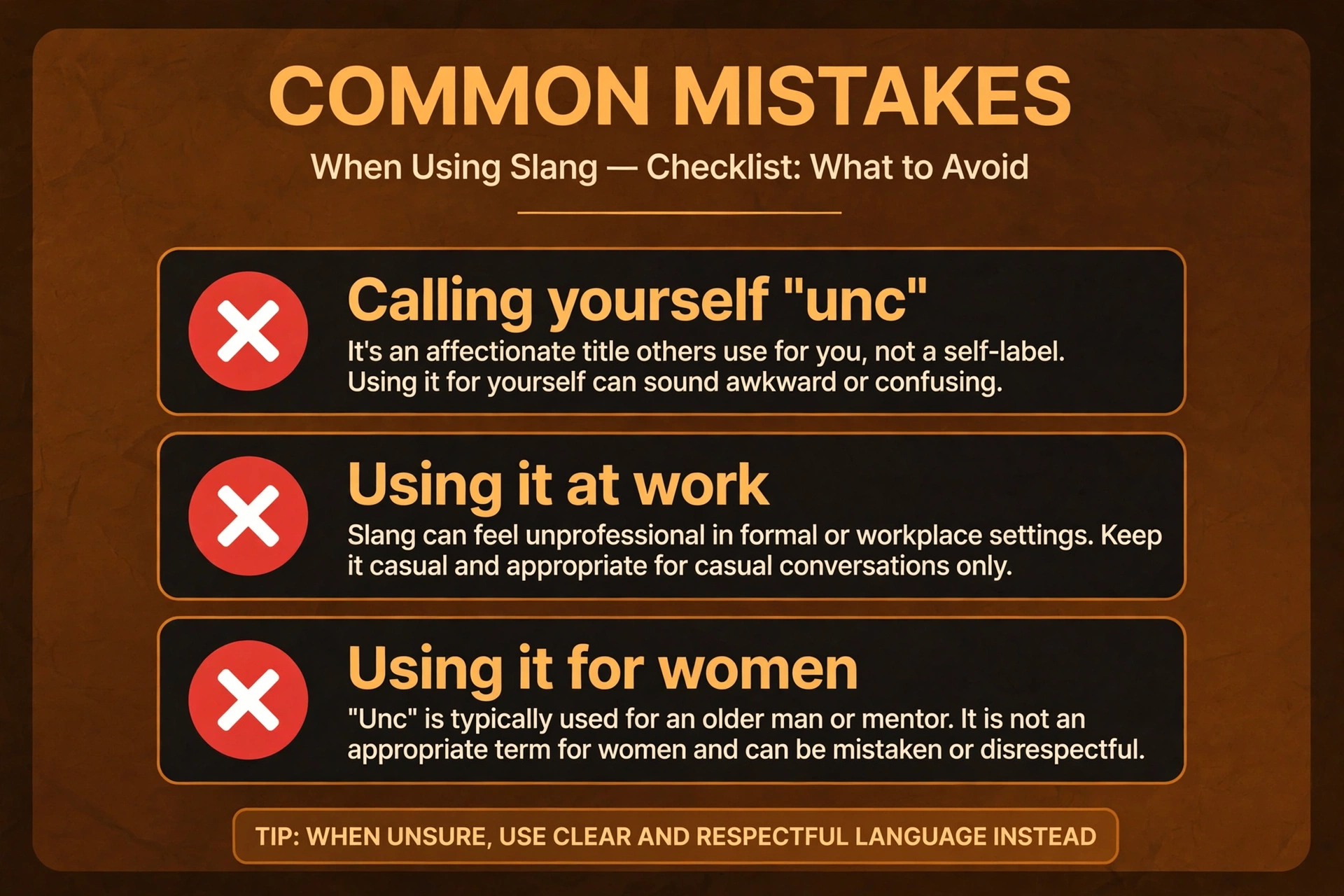
1. Calling yourself unc. Unc is a label other people give you, not a title you claim for yourself. Saying “I’m unc” to sound cool usually has the opposite effect — it reads as trying too hard. The one exception is self-deprecating humor (“I’m unc, I fell asleep at 8”), where the joke is that you know you are acting old. Even then, let it be a punchline, not a personality.
2. Using it for women. Unc is short for uncle — it is a male-coded term. Calling a woman unc is confusing at best and insulting at worst. The equivalent term for women is “auntie,” which carries the same playful-teasing energy. If you would not call her “uncle,” do not call her “unc.”
3. Using it at work or with strangers. Age jokes are sensitive, and unc is fundamentally an age joke. Dropping it in a professional setting, or on someone you barely know, can come across as rude or disrespectful — even if every comment section on the internet does it. Keep it in casual spaces with people who know you are joking.
4. Confusing it with “uncool.” As explained earlier, unc comes from “uncle,” not “uncool.” The two words sound vaguely related and the confusion is common, but it is wrong — and people who know the term will correct you. If you use unc to mean “uncool,” you are using a different word than everyone else, and your sentence will not mean what you think it means.
5. Overusing it. Unc is funny partly because it is specific. If you call everyone unc, the word loses its punch — and you start sounding like someone who just learned a new slang term and cannot stop using it. The internet notices overuse fast, and the joke turns on you: suddenly you are the one acting unc. Use it when it fits, not as a filler word.
6. Using it to genuinely insult someone. Unc works as a joke because it is light. If you use it with real hostility — to dismiss someone’s opinion because of their age, or to make someone feel bad about getting older — it stops being funny and starts being ageist. The line between a roast and an insult is real, and unc sits very close to it. If your goal is to hurt someone, the word is not the problem — the intent is. But even with good intentions, check that the other person is actually laughing.
7. Ignoring the cultural origin. Unc comes from AAVE and Black community speech, where it carried real warmth and respect. Using it without knowing that history — or using it in a way that mocks the culture it came from — is a mistake. You do not need a lecture on linguistics to use slang, but knowing where a word comes from helps you use it with the respect it deserves.
Quick Tips
If you want to use unc correctly — and get the laugh instead of the awkward silence — keep these tips in mind:
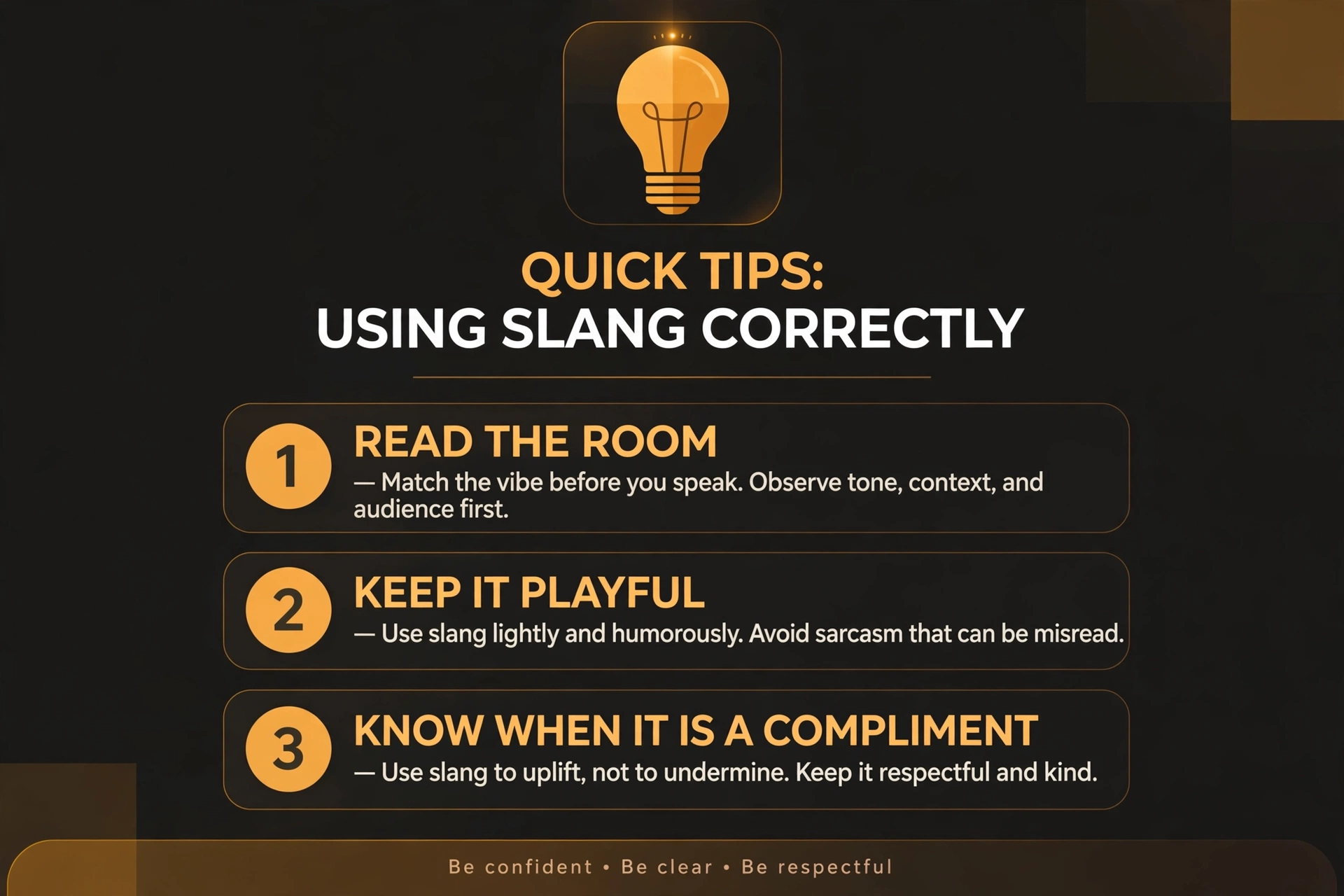
- Read the room. Unc works in group chats, comment sections, and casual conversations with friends. It does not work in meetings, formal messages, or with people you do not know well. The setting decides whether it is a joke or an insult.
- Only use it for people who are clearly older or acting older. The joke only lands if there is a visible gap — real or exaggerated — between the person’s age and the situation. Calling a teenager unc makes no sense and will confuse everyone.
- Keep it playful, not mean. The best unc jokes are the ones where the target laughs too. If you are using the word to genuinely put someone down, you have crossed from roasting into being rude. Aim for a smile, not a wince.
- Know when it is a compliment. In its original sense, being called unc can be a sign of respect — it means you are trusted, valued, and seen as family. If an older mentor or a younger relative calls you unc with warmth, take it as the compliment it is.
- Pair it with context. A bare “unc” in a comment can read as random or hostile. Adding context — “unc status for falling asleep at the function 😭” — makes the joke clear and lands much better.
- Do not force it. Slang that is forced is worse than no slang at all. If unc does not come naturally in the moment, skip it. The word will still be there next time — and it will be funnier when it fits.
- Watch the spelling. The slang is “unc” (lowercase, three letters). “UNC” in all caps usually means the University of North Carolina. Getting the capitalization wrong can change your sentence’s meaning entirely.
- Know your audience’s age. The joke hits differently depending on who hears it. A twenty-year-old calling a thirty-year-old unc is funny. A teenager calling a sixty-year-old unc can feel disrespectful. Age gaps matter — the smaller the gap, the safer the joke.
FAQ
What does unc mean in slang?
Unc is short for “uncle.” In modern slang, it means someone who is old, getting old, or acting older than their age. It is used playfully or teasingly, especially online, and the phrase “unc status” means someone has officially been deemed old.
What does “unc status” mean?
“Unc status” means someone has crossed the line into being considered old — usually as a joke. It is used when a person does something that feels old, like going to bed early, not knowing a trend, or having an outdated opinion. Merriam-Webster defines it as being used humorously on the internet to imply someone is old or acting older than their age.
Is unc short for uncool?
No. Unc is short for “uncle,” not “uncool.” This is a common misconception. The word comes from AAVE, where it was an affectionate term for an older male relative or mentor. The fact that being called unc often feels uncool is a coincidence, not the origin of the word.
Where did unc slang come from?
Unc comes from African American Vernacular English (AAVE), where it has long been used as a shortened, respectful form of “uncle.” It was popularized in hip-hop — Defari used it in 2003, Gucci Mane in 2010, and J. Cole has used it in his lyrics — before spreading to mainstream internet culture and TikTok in the early 2020s.
Is calling someone unc offensive?
It depends on context. Among friends and family, it is usually playful or even affectionate. Online, it is typically a light roast. But it can be offensive if used to genuinely mock someone’s age, if used at work, or if used with strangers or elders who do not expect it. Cambridge flags the slang sense as sometimes offensive, so read the room before using it.
Can you call a woman unc?
No — unc is short for “uncle,” so it is a male-coded term. The equivalent term for a woman is “auntie,” which carries the same mix of playful teasing and affection. Calling a woman unc is one of the most common mistakes people make with this slang.
What is the difference between unc and OG?
An OG (original gangster) is someone respected for their experience and history — a veteran or pioneer. Unc is someone being teased for being old or acting old. OG is admiration; unc is a playful roast. A person can be both, but the words point in different directions.
What does “chopped and unc” mean?
“Chopped and unc” is a harsher online insult that combines two slang terms: “chopped” (unattractive) and “unc” (old). Together they mean someone is both unattractive and old. It is much more cutting than unc on its own, and it is generally used as a genuine insult rather than a friendly joke.
Conclusion
Unc slang meaning is a perfect example of how language evolves online: a word that started as a term of respect in Black communities, traveled through hip-hop, and landed on TikTok as the internet’s favorite way to joke about getting old. It means someone is old or acting old — but whether that is an insult, a joke, or a compliment depends entirely on who says it, who hears it, and the relationship between them.
The most important things to remember are simple. Unc is short for “uncle,” not “uncool.” “Unc status” is the internet’s playful way of declaring that someone has officially crossed into old territory. The word is for casual spaces and close relationships — not for work, not for strangers, and not for women (that is what “auntie” is for). And if you use it with warmth and good timing, it is one of the funniest words in the current slang vocabulary.
So the next time someone calls you unc in a comment section, do not panic. Check the context. If it is a friend joking about your 9 p.m. bedtime, laugh along. If it is a stranger trying to dismiss you, you now know exactly what they mean — and exactly how little it matters. And if you are the one doing the calling, use the word well: playfully, accurately, and only where it will land. That is the difference between someone who knows slang and someone who just repeats it.
If you enjoyed this breakdown, you may also like our guides to other trending terms — from the viral world of Ohio slang to the full Gen Z slang glossary — so you can stay ahead of the next word before it shows up in your comments.
