What Does Establish Justice Mean? Definition, Origin & Real-Life Examples Explained
Quick definition: “Establish justice” means to create and maintain a fair, impartial legal system where laws are applied equally to everyone, individual rights are protected, and disputes are resolved through transparent, unbiased procedures. The phrase comes from the Preamble of the United States Constitution, where it is listed as one of the six founding goals of the American government.
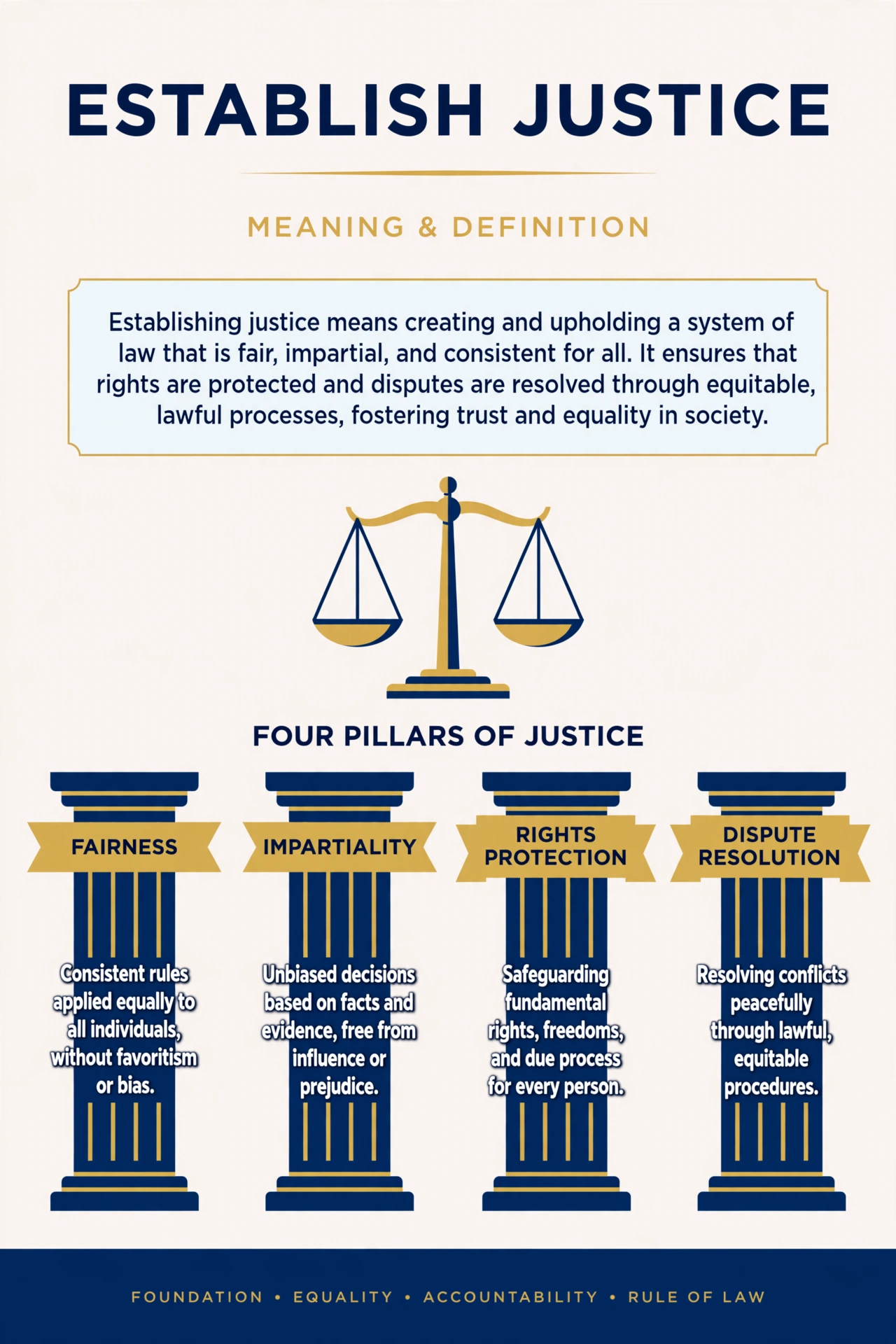
What Does Establish Justice Mean & Definition
If you have ever read the opening lines of the U.S. Constitution — the famous “We the People of the United States, in Order to form a more perfect Union…” — you have already met this phrase. To establish justice means to build a system of government that guarantees fairness for every person under the law. It is a promise: no matter who you are, how much money you have, or what you believe, you will be treated equally by the courts and by the law.
At its core, the meaning of “establish justice” rests on four pillars:
- Fairness: Laws must be just, not written to favor the powerful or punish the weak.
- Impartiality: The same rules apply to everyone — including the people who run the government.
- Protection of rights: Individual freedoms (speech, religion, fair trial, property) must be actively defended.
- Orderly dispute resolution: Conflicts are settled in courts through open, predictable procedures — not by violence or favoritism.
This is not just a nice-sounding idea from the 1700s. It is a working principle that shapes modern laws, court rulings, and civil-rights protections today.
Introduction
Every year, millions of American students memorize the Preamble of the Constitution — and every year, most of them pause at the same two words: establish justice. What did the Founding Fathers actually mean by it? Was it a promise to the people, a job description for the government, or both?
The short answer is: it was a deliberate break from the past. Under British rule, colonists watched laws applied unevenly — friends of the king got one treatment, ordinary people got another. The framers of the Constitution wanted a government that would do the opposite: set up a legal system so fair that justice was not a favor granted by the powerful, but a right held by everyone.
In this guide, we will unpack what “establish justice” means in plain English, trace its origin back to 1787, compare it with the other five goals in the Preamble, show how it appears in everyday life (from civics class to courtroom dramas), and answer the questions people search for most about this phrase. If you enjoy decoding famous phrases, you may also like how we break down modern terms — for example, what “fn” means in text or the lumon definition and meaning guide.
Origin
The phrase “establish justice” first appeared in the Preamble of the United States Constitution, ratified in 1788. The full sentence reads:
“We the People of the United States, in Order to form a more perfect Union, establish Justice, insure domestic Tranquility, provide for the common defence, promote the general Welfare, and secure the Blessings of Liberty to ourselves and our Posterity, do ordain and establish this Constitution for the United States of America.”
Read the complete, official text of the Preamble in the National Archives’ transcript of the U.S. Constitution.
The man who drafted the Preamble’s final wording was Gouverneur Morris, a delegate from Pennsylvania at the Constitutional Convention of 1787. The convention met in Philadelphia after the Articles of Confederation — America’s first governing document — proved too weak to hold the country together. Under the Articles, there was no national court system at all, and states could each run their own version of “justice.”
Why did establishing justice matter so much to the framers? Consider what they had lived through:
- Unequal treatment: British colonial authorities often punished colonists without fair trials or representation.
- No national courts: Under the Articles of Confederation, the federal government could not create courts or enforce judgments.
- Fear of tyranny: Having just fought a revolution against a king, Americans wanted a government where no one was above the law.
So when the framers wrote “establish justice,” they were assigning the new government a clear task: create courts, write fair laws, enforce them evenly, and protect individual rights. Article III of the Constitution carried this out by creating the federal judiciary — including the Supreme Court.
Popularity
More than 235 years later, “establish justice” remains one of the most quoted phrases in American civics. Here is where it shows up today:
- Schools: It is a staple of U.S. history and civics curricula, and a frequent question on citizenship tests and standardized exams.
- Courtrooms and law schools: Judges and legal scholars reference the phrase when discussing the purpose of the justice system.
- Political speeches: Leaders invoke it when talking about civil rights, criminal-justice reform, and equal treatment under law.
- Social movements: Advocates for racial equality, voting rights, and fair sentencing frame their causes as efforts to “establish justice” in the spirit of the Preamble.
- Popular culture: The phrase appears in patriotic songs, documentaries, museum exhibits, and TV courtroom dramas.
Online, thousands of people search for “what does establish justice mean” every month — most of them students writing essays, teachers preparing lessons, and curious readers who want a clear, plain-English answer. The top-ranking pages on this topic are mostly short Q&A snippets, which is exactly why a complete, well-organized guide like this one is worth reading.
How It Is Used
The phrase is used in several distinct ways depending on who is saying it and why:
- Constitutional meaning: The original, legal sense — the government’s duty to create a fair legal system.
- Classroom meaning: Teachers use it as a teaching anchor for the six goals of the Preamble, often asking students to give examples.
- Moral or rhetorical meaning: Speakers and activists use “establish justice” to call for fairness in society — for example, arguing that a new law would help “establish justice” for a marginalized group.
- Historical meaning: Historians use it to describe the framers’ intent in 1787: replacing arbitrary colonial rule with a system of laws.
Here is a quick summary table of how the phrase functions in different contexts:
| Context | What It Signals | Example Sentence |
|---|---|---|
| Civics textbook | One of six Preamble goals | “The second goal of the Preamble is to establish justice.” |
| Courtroom speech | Fair legal process | “Our duty in this courtroom is to establish justice for both sides.” |
| Political rally | Call for reform | “We march today to establish justice for communities that have been ignored.” |
| Essay / exam | Analysis of founding principles | “The framers wanted to establish justice because British rule had been unfair.” |
Examples
Context changes tone. Here is how “establish justice” and its meaning appear in different registers:
Friendly Examples
- “In civics class today we learned that to establish justice basically means the government has to play fair with everyone.”
- “Think of it like this: the founders wanted to establish justice the same way a good referee calls a fair game — same rules for both teams.”
- “If you’re writing your essay, just say establishing justice means setting up courts and laws that treat people equally.”
Professional Examples
- “The judiciary’s constitutional role is to establish justice by interpreting laws impartially and safeguarding due-process rights.”
- “Any reform proposal must be measured against the Preamble’s directive to establish justice through fair and consistent enforcement.”
- “In her opinion, the judge wrote that establishing justice requires the law to be applied without regard to wealth or status.”
Formal / Academic Examples
- “Scholars agree that the phrase ‘establish justice’ expressed the framers’ commitment to the rule of law as a corrective to colonial arbitrariness.”
- “The establishment of the federal judiciary under Article III was the institutional mechanism chosen to establish justice.”
- “In Federalist No. 78, Hamilton argued that courts were essential if the nation hoped to establish justice and limit legislative overreach.”

Comparison with Similar Terms
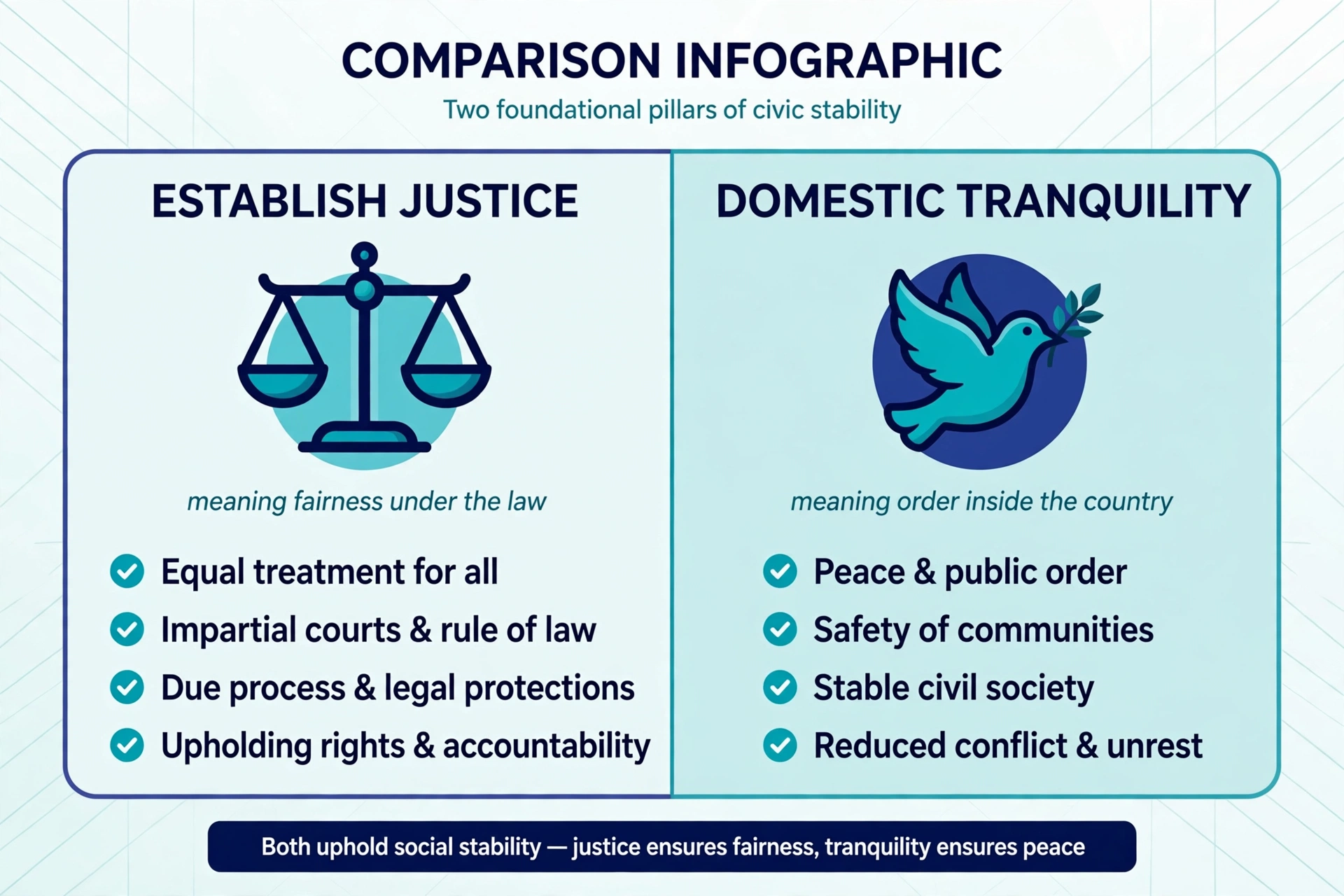
“Establish justice” is often confused with neighboring ideas — including the other goals of the Preamble itself. Here is how it differs from the terms people mix it up with most:
| Term | What It Means | How It Differs from “Establish Justice” |
|---|---|---|
| Establish justice | Create a fair, impartial legal system | The baseline concept — fairness under the law itself |
| Insure domestic tranquility | Keep peace and order inside the country | About preventing conflict and violence, not about courtroom fairness |
| Promote the general welfare | Advance the well-being of the public | Broader social good (health, economy); justice is specifically about fairness |
| Due process | Fair legal procedures (fair trial, legal representation) | A mechanism of establishing justice, not the whole concept |
| Equal protection | Laws must treat similar people similarly | A specific guarantee (14th Amendment); establishing justice is the wider mission |
| Rule of law | Everyone, including leaders, is subject to the law | The operating principle behind establishing justice |
| Social justice | Fairness in how wealth, opportunities, and privileges are distributed | A modern, broader movement; the Preamble’s phrase is about the legal system |
The key takeaway: “establish justice” is the foundation. Due process, equal protection, and the rule of law are the tools used to build on that foundation, while “domestic tranquility” and “general welfare” are sibling goals sitting next to it in the Preamble.
Alternate Meanings
While the constitutional sense is the primary one, the phrase also carries secondary meanings worth knowing:
- Moral sense: In philosophy and ethics, “establishing justice” can mean creating a morally right social order — what is fair in the deepest sense, beyond just the courts.
- Restorative sense: In criminal-justice reform discussions, it can mean repairing harm: victim restitution, community healing, and rehabilitation rather than punishment alone.
- Historical sense: Historians sometimes use it to describe post-conflict nation-building — for example, when new democracies “establish justice” after periods of dictatorship by creating tribunals and truth commissions.
- Religious or literary sense: In older English literature and some religious texts, “to establish justice” simply meant to set things right or make things fair.
None of these replace the constitutional meaning, but they show how the phrase has grown beyond 1787 into a general call for fairness wherever it is needed.
Professional or Polite Alternatives
If you are writing an essay, legal brief, or formal speech, you can express the same idea with these polished alternatives:
- “Uphold the rule of law”
- “Ensure equal treatment under the law”
- “Safeguard due process for all citizens”
- “Create a fair and impartial legal framework”
- “Administer justice without bias or favoritism”
- “Protect individual rights through the courts”
Each of these captures part of what “establish justice” means — pick the one that fits your context. For exam answers, sticking with the original phrase plus a one-sentence definition is usually the safest choice.
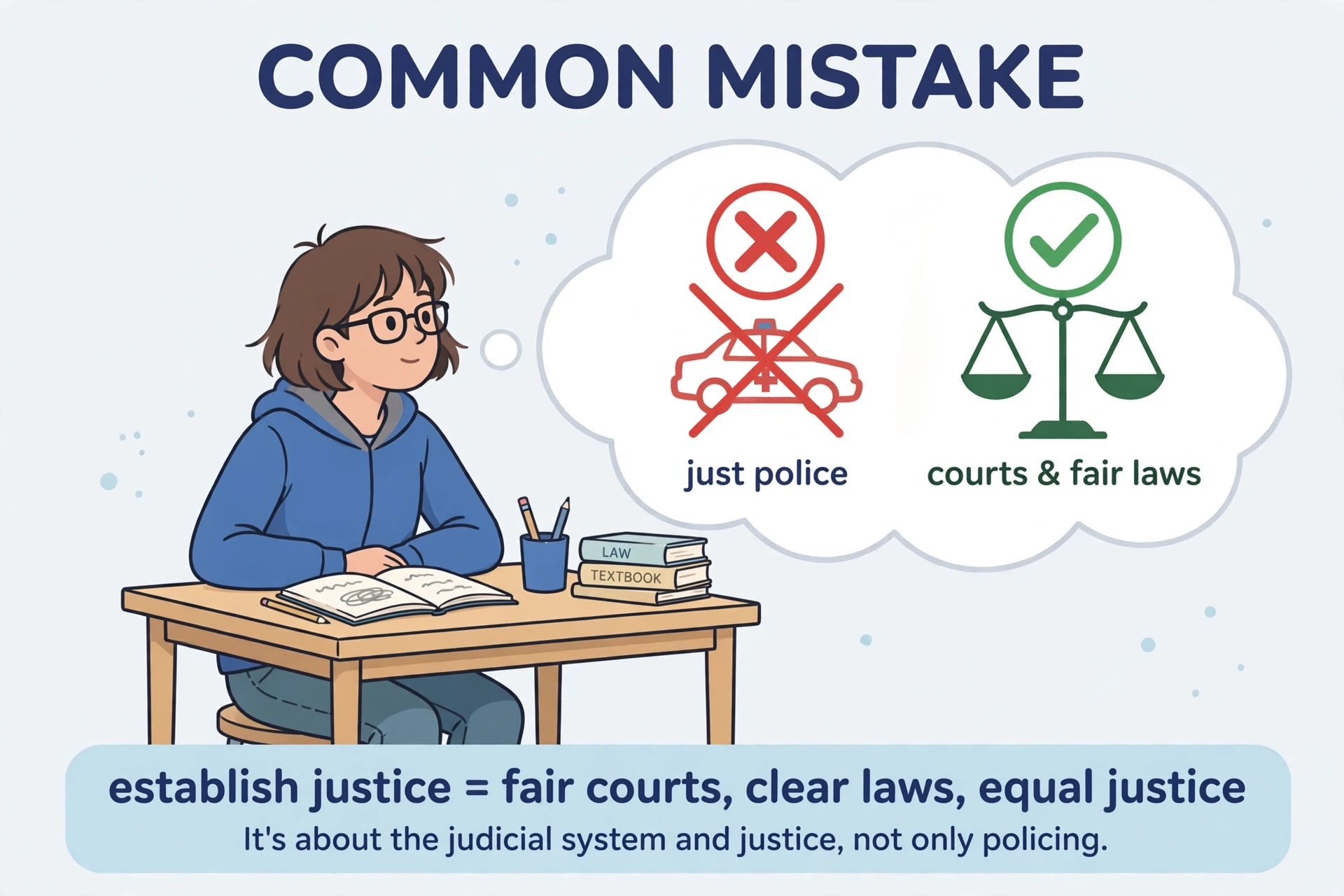
Common Mistakes
Here are the errors students and readers make most often when explaining this phrase:
- Mixing it up with “insure domestic tranquility”: Tranquility is about peace and order; justice is about fairness. They are separate goals in the Preamble.
- Saying it means “punish criminals”: Punishment is only one part. Establishing justice also means protecting the innocent, ensuring fair trials, and applying laws equally.
- Limiting it to the 1700s: The phrase describes an ongoing duty — every new law and court decision continues the work of establishing justice.
- Thinking only judges do it: Legislatures write the laws, police enforce them, juries decide cases, and citizens serve on juries and vote — establishing justice is a shared task.
- Confusing it with “social justice”: Related, but not identical. The Preamble’s phrase is about the legal system; social justice covers economics, opportunity, and culture too.
Quick Tips
- For exams: Memorize the one-liner — “to establish justice means to create a fair legal system that treats everyone equally.” Then add one historical reason (unfair British rule) and one modern example (the court system).
- For essays: Connect the phrase to Article III (the judiciary) and to real cases like Brown v. Board of Education or Miranda v. Arizona to show you understand it in action.
- For speeches: Pair the phrase with a concrete injustice you want fixed — it carries more weight when tied to a specific cause.
- For everyday conversation: Use the referee analogy — same rules, same calls, both teams — and people will get it instantly.
- Avoid overcomplicating: You do not need legal jargon. Fairness, equal treatment, and protection of rights are the three ideas to keep front and center.

FAQ
1. What does “establish justice” mean in the Preamble?
In the Preamble of the U.S. Constitution, “establish justice” means the government’s duty to create a fair and impartial legal system — one where laws are applied equally to all people, individual rights are protected, and disputes are resolved through transparent, unbiased procedures.
2. Why did the framers include “establish justice” in the Constitution?
The framers had lived under British colonial rule, where laws were often applied unfairly and colonists were denied basic rights like fair trials. They wanted the new American government to do the opposite: build courts and write laws that would treat everyone fairly, so no one would suffer the injustices of arbitrary power again.
3. Is “establish justice” the same as “insure domestic tranquility”?
No. They are two separate goals in the Preamble. “Establish justice” is about fairness under the law, while “insure domestic tranquility” is about keeping peace and order within the country — preventing rebellion, violence, and chaos. Justice is about how the system treats people; tranquility is about stability.
4. How does the government establish justice today?
Through the court system (federal and state courts, including the Supreme Court), fair laws passed by legislatures, law enforcement that applies rules evenly, constitutional protections like due process and equal protection, and civic participation — citizens serving on juries and voting.
5. What is an example of establishing justice in real life?
A fair trial is the classic example: a person accused of a crime gets a lawyer, an impartial jury, and the chance to present evidence — regardless of their background. Landmark rulings like Brown v. Board of Education (ending school segregation) are also powerful examples of the legal system establishing justice.
6. Who is responsible for establishing justice?
Everyone plays a role. The framers gave the judiciary the central job (Article III created the federal courts), but legislators write the laws, the executive branch enforces them, and citizens contribute by serving on juries, voting, and holding officials accountable.
7. Does “establish justice” mean the same thing as “social justice”?
They are related but not identical. The Preamble’s “establish justice” is specifically about creating a fair legal system. “Social justice” is a broader, more modern concept covering fairness in wealth, opportunity, education, and culture — not just the courts.
8. Can the meaning of “establish justice” change over time?
The core meaning — a fair legal system treating everyone equally — stays the same. But how America pursues it evolves: ending segregation, expanding voting rights, reforming sentencing laws, and guaranteeing legal aid are all modern chapters of the same 1787 promise to establish justice.
Conclusion
“Establish justice” is one of the most powerful two-word promises in American history. In 1787, it meant building something the colonists had never had: a legal system where fairness was the rule, not a favor. More than two centuries later, it still means the same thing — and the work is still underway.
The next time you hear the phrase, remember the three ideas at its heart: fairness in how laws are written, impartiality in how they are enforced, and protection for the rights of every person. Whether you are writing a civics essay, preparing for a citizenship test, or simply trying to understand your country a little better, those three ideas are everything you need to explain what “establish justice” means.
Justice, the framers believed, is not something a nation finds — it is something a nation builds. And building it, one fair law and one fair trial at a time, remains the job of every generation. Keep exploring the meanings behind famous words with us — see what “fein” means next.
