White Heart Emoji Meaning: The Ultimate Guide to Its Soft, Pure Power
Quick Definition: The white heart emoji 🤍 means pure love, gentle affection, and sincere care. It is a softer, calmer alternative to the red heart ❤️ — used for platonic warmth, sympathy, remembrance, spiritual love, and minimalist aesthetics in texts and social media.
White Heart Emoji Meaning & Definition
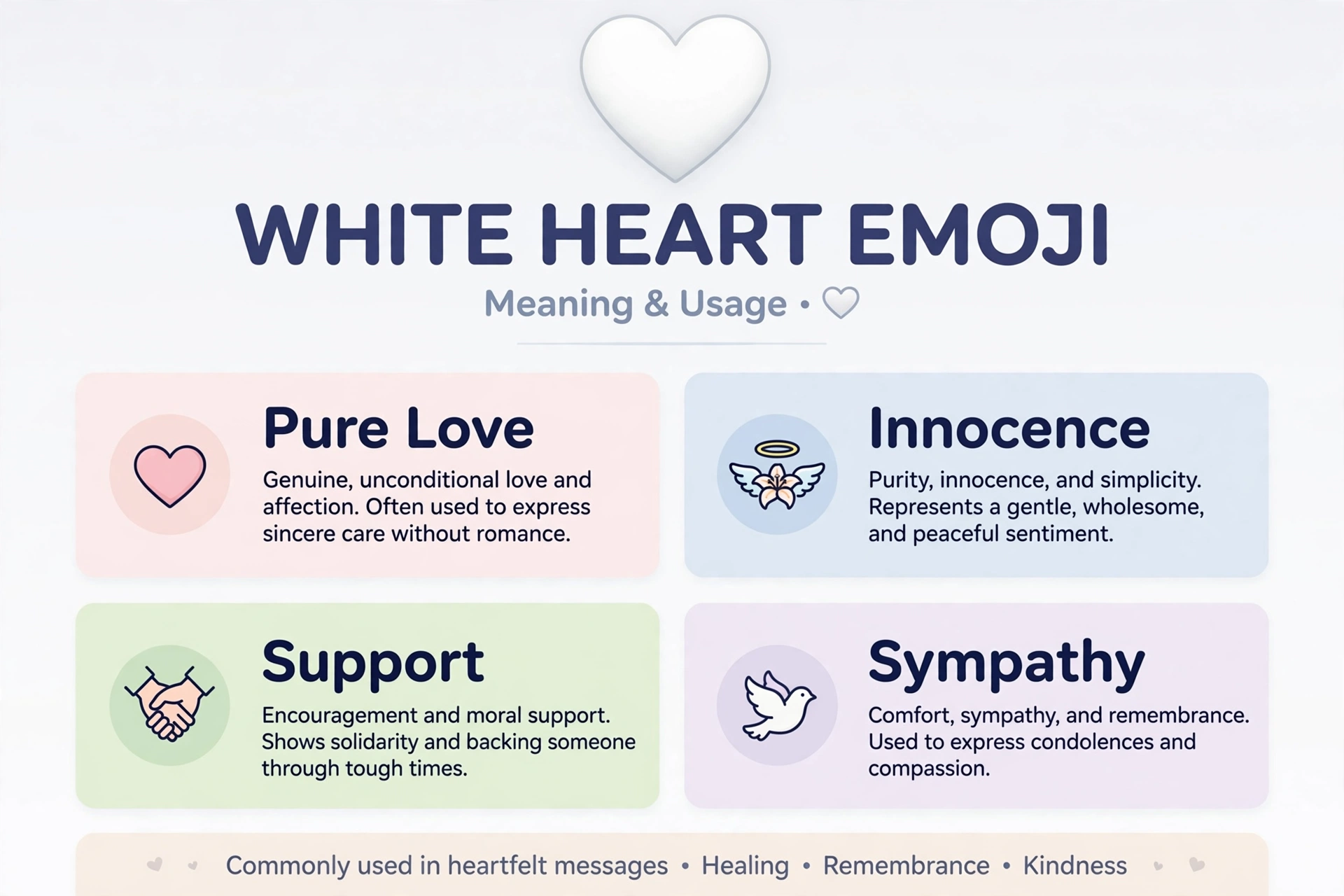
The white heart emoji (🤍) is one of the most emotionally versatile symbols on your keyboard. At its core, the white heart emoji meaning revolves around purity, peace, and gentle, sincere affection. Unlike the red heart, which blazes with romance and passion, the white heart speaks softly. It says, “I care about you” — without the intensity, pressure, or romantic charge.
Here is what the white heart emoji typically means in different contexts:
| Context | White Heart Emoji Meaning |
|---|---|
| Friendly texts | Pure, platonic affection — warm care with no romantic agenda |
| Condolences & tributes | Sympathy, remembrance, and quiet support after a loss |
| Romantic relationships | A calm, sincere “I love you” — love expressed gently |
| Family messages | Unconditional love for parents, siblings, children, and pets |
| Faith & spirituality | God’s unconditional love, purity, and spiritual connection |
| Social media captions | Minimalist aesthetic — clean, neutral, “soft girl” or neutral style |
| New beginnings | Weddings, fresh starts, simplicity, and new chapters |
Because the white heart carries so many gentle meanings, context is everything. The relationship between the sender and receiver, the conversation’s tone, and the surrounding words all shape what 🤍 actually says. In this guide, you will learn how to read it perfectly — and use it confidently.
Introduction
Have you ever received a 🤍 in a text and paused for a second, wondering what it really means? You are not alone. The white heart emoji is one of the most popular — and most quietly misunderstood — emojis on the internet today. Is it romantic? Is it friendly? Does it mean the same as the red heart, or something completely different?
The truth is, the white heart emoji meaning is richer than most people realize. In texting culture, heart colors carry emotional shades: red means passion, pink means sweetness, black can mean dark humor or grief, the orange heart emoji means warm care and support — and white means purity. It is the heart you reach for when you want to show love without shouting it, comfort someone without overstepping, or keep things classy and clean.
In this complete guide, we will break down everything about the 🤍 emoji: where it came from, why it became so popular, how people use it across WhatsApp, Instagram, TikTok, and Snapchat, how it compares to other hearts, the mistakes people make with it, and 8 of the most-searched questions about it — all answered. Whether you are decoding a crush’s text or choosing the perfect emoji for your caption, this guide has you covered.
Origin
The white heart emoji was officially added to the Unicode Standard in 2019 as part of Unicode 12.0, making it one of the newer members of the heart emoji family. It arrived in the same wave of colored hearts as the brown heart 🤎 and the orange heart 🧡 — a deliberate move by Unicode to give users more emotional precision. Before 2019, people had to squeeze every shade of love into the red heart ❤️, which often felt too intense for a simple “thanks” or a condolence message.
But the idea of the white heart is far older than any phone keyboard. White has symbolized purity, holiness, and spiritual truth across nearly every major culture in history. Ancient Greeks associated white with divine light. In East Asian traditions, white carries deep spiritual meaning tied to ancestry and the afterlife. In Western culture, white wedding dresses, white doves, and white candles all carry the same thread of innocence and sincerity.
So when 🤍 finally appeared on our phones in 2019, it was not inventing a new symbol — it was joining a very old conversation. Emojis themselves originated in Japan in the late 1990s, and as digital communication matured, users demanded symbols for tone, not just feeling. The white heart filled that gap: a heart for comfort, sincerity, and calm — the emotions the red heart was too loud to carry.
Popularity
Since its 2019 debut, the white heart emoji has exploded in popularity — and the reasons are worth understanding. First, it became the go-to heart for the minimalist aesthetic movement. Clean, neutral, “that girl” and soft-lifestyle content on Instagram and TikTok leans heavily on white, beige, and grayscale visuals — and 🤍 matches that palette perfectly. A red heart would clash with a minimalist white-feed aesthetic; the white heart blends right in.
Second, texting culture has grown more emotionally careful. People are more aware that a red heart can be misread as flirtation, especially in professional chats, friendships, and cross-gender conversations. The white heart solves that problem elegantly: it delivers warmth without the romantic charge. It is the safe, sincere option.
Third, the white heart found a powerful role in sympathy and mental-health messaging. White is a color of mourning in many cultures, and the 🤍 became the natural emoji for condolences, remembrance posts, and supportive replies — places where a red heart would feel too passionate and no emoji would feel too cold.
Today, the white heart ranks among the most-used heart emojis on platforms like Instagram and Snapchat. It shows up in wedding announcements, graduation posts, faith-based content, brand marketing for “clean” products, and millions of everyday texts. It has become, in short, the empathy heart of the internet.
How It Is Used
The white heart emoji is used in three main ways: emotionally, socially, and aesthetically. Emotionally, it expresses gentle love — the kind you feel for family, close friends, or a partner you want to reassure calmly. Socially, it signals support: “I’m here for you,” “congratulations,” “rest in peace.” Aesthetically, it is a design choice — a clean white accent that makes captions, bios, and comments look soft and curated.
Here is how its usage breaks down across major platforms:
| Platform | How 🤍 Is Used |
|---|---|
| Friendly warmth in chats and statuses; common in family groups and condolence messages | |
| Captions and comments with minimalist or neutral aesthetics; wedding and lifestyle posts | |
| TikTok | Paired with uplifting, wholesome, or aesthetic captions; soft, calm video vibes |
| Snapchat | Close friendships and streaks; gentle reactions without romantic pressure |
| Twitter / X | Tributes, remembrance threads, and supportive replies to public figures |
| Faith communities | Bible study groups and church posts — symbolizing God’s pure, unconditional love |
A key rule of thumb: read the relationship and the tone, not the gender of the sender. From a friend, 🤍 usually means gentle care. From a partner, it can be a quiet, understated “I love you.” From a colleague, it signals warm appreciation. And on its own, because it is so soft and neutral, the white heart is weaker evidence of a crush than a red or pink heart would be — so do not overthink a single emoji.
Examples
Seeing the white heart in real conversations is the fastest way to understand it. Below are realistic examples across friendly, professional, and funny tones — notice how the same emoji shifts meaning with context.
Friendly Examples
- “You always know how to cheer me up 🤍” — warm, platonic gratitude toward a friend.
- “Happy birthday to my person 🤍” — deep affection, not necessarily romantic.
- “Congrats on the new job, so proud of you! 🤍” — supportive celebration.
- “Thank you for everything you do 🤍” — sincere appreciation.
- “Miss you! Let’s catch up soon 🤍” — gentle longing, completely pressure-free.
Professional Examples
- “Wishing you strength and peace during this difficult time 🤍” — a tasteful condolence, safer than a red heart at work.
- “Thank you for your support on this project 🤍” — warm professional appreciation.
- “Congratulations to the whole team — we did it! 🤍” — celebration without crossing professional lines.
- “Hope you feel better soon 🤍” — kind, appropriate well-wishes to a colleague.
Funny Examples
- “This pizza is the love of my life 🤍🍕” — playful appreciation, joking tone.
- “My bed at 9pm >>> everything else 🤍😴” — wholesome, self-aware humor.
- “Finally deleted 500 screenshots off my phone 🤍” — the white heart as a symbol of a fresh, clean start.

Comparison with Similar Terms
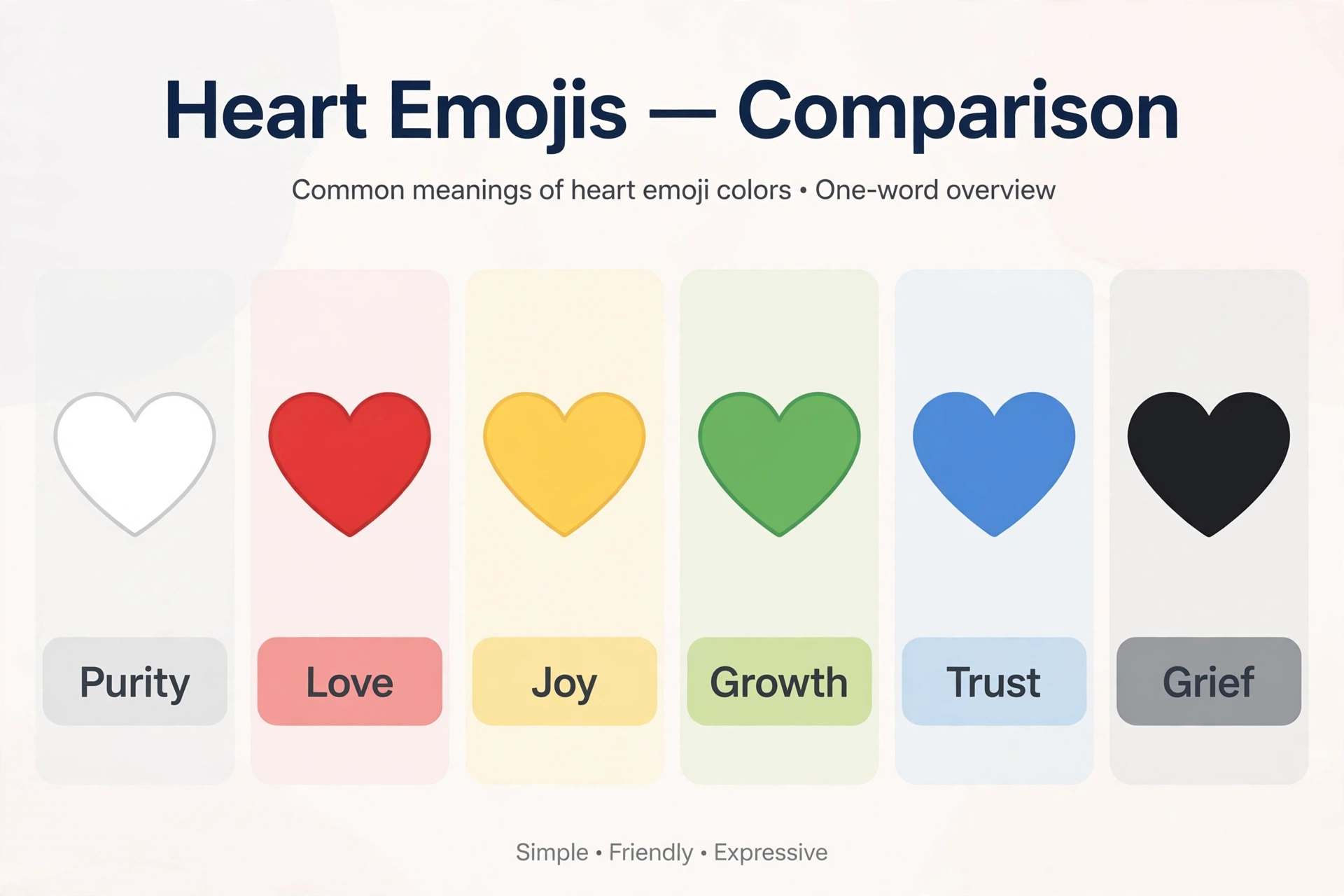
The white heart is most often confused with the red, pink, and black hearts. The differences are about emotional temperature: red burns hot, pink runs sweet, white stays cool and calm, and black goes dark or edgy. Choosing the right one is about matching the intensity of your feeling — and the message you do not want to send by accident.
| Emoji | Core Meaning | Emotional Temperature | Best For |
|---|---|---|---|
| ❤️ Red Heart | Passionate, romantic love | Hot — intense and direct | Partners, crushes, strong romance |
| 🤍 White Heart | Pure, gentle, sincere affection | Cool — calm and understated | Friends, family, sympathy, aesthetics |
| 💗 Growing Heart / 💕 Pink Hearts | Sweet, budding affection | Warm — playful and flirty | Early crushes, cute compliments |
| 💛 Yellow Heart | Friendship and happiness | Sunny — cheerful and platonic | Best friends, happy news (Snapchat bestie) |
| 💙 Blue Heart | Trust, loyalty, calm support | Steady — reliable and deep | Close friends, causes, brand loyalty |
The white heart’s closest cousin is the yellow heart 💛 — both are platonic-friendly. The difference: yellow is cheerful and sunny, while white is calm and serene. And compared to the red heart ❤️, the white heart is simply the “soft volume” version of love — same sincerity, far less fire. That is why so many people switch from ❤️ to 🤍 when a relationship is friendly but not romantic, or when they want love without the spotlight.
Alternate Meanings
Beyond pure love and affection, the white heart carries several alternate meanings depending on the community and context:
- Sympathy and mourning: Because white is associated with funerals and remembrance in many cultures, 🤍 frequently appears in condolence messages and memorial posts.
- Spiritual purity: In faith-based circles, the white heart represents God’s unconditional love, forgiveness, and a clean conscience — a nod to verses like Psalm 51:7 about being “washed whiter than snow.”
- New beginnings: Weddings, engagements, and fresh starts — white symbolizes a blank page and a pure beginning.
- Minimalist aesthetic: On Instagram and TikTok, 🤍 is sometimes used with no emotional meaning at all — just a clean visual accent matching a neutral color palette.
- Mental health support: The white heart has become a quiet symbol of compassion, solidarity, and calm in mental-health awareness conversations.
- Appreciation for white things: Occasionally literal — a comment on a white outfit, white car, white sneakers, or snowy photo.
If an alternate meaning feels possible, look at the surrounding words. “Rest in peace 🤍” is mourning; “to the bride and groom 🤍💍” is celebration; “new chapter 🤍” is a fresh start. The emoji borrows its meaning from the sentence it lives in.
Professional or Polite Alternatives
Not every situation calls for a heart emoji. If the white heart feels too informal for the setting, here are polished alternatives that carry similar warmth:
| Situation | Instead of 🤍, try… |
|---|---|
| Work email to a client | “Thank you so much for your time” — warm words, no emoji |
| Condolence to a colleague’s family | “My thoughts are with you and your family” |
| Formal thank-you note | 🙏 (folded hands) or a simple “With gratitude” |
| Professional congratulations | 🎉 or “Congratulations on your well-deserved success” |
| Customer-facing message | ✨ or “We’re so glad to have you with us” |
Common Mistakes
The white heart is gentle, but it is not foolproof. Here are the most common mistakes people make with it — and how to avoid them:
| Mistake | Why It’s a Problem | Do This Instead |
|---|---|---|
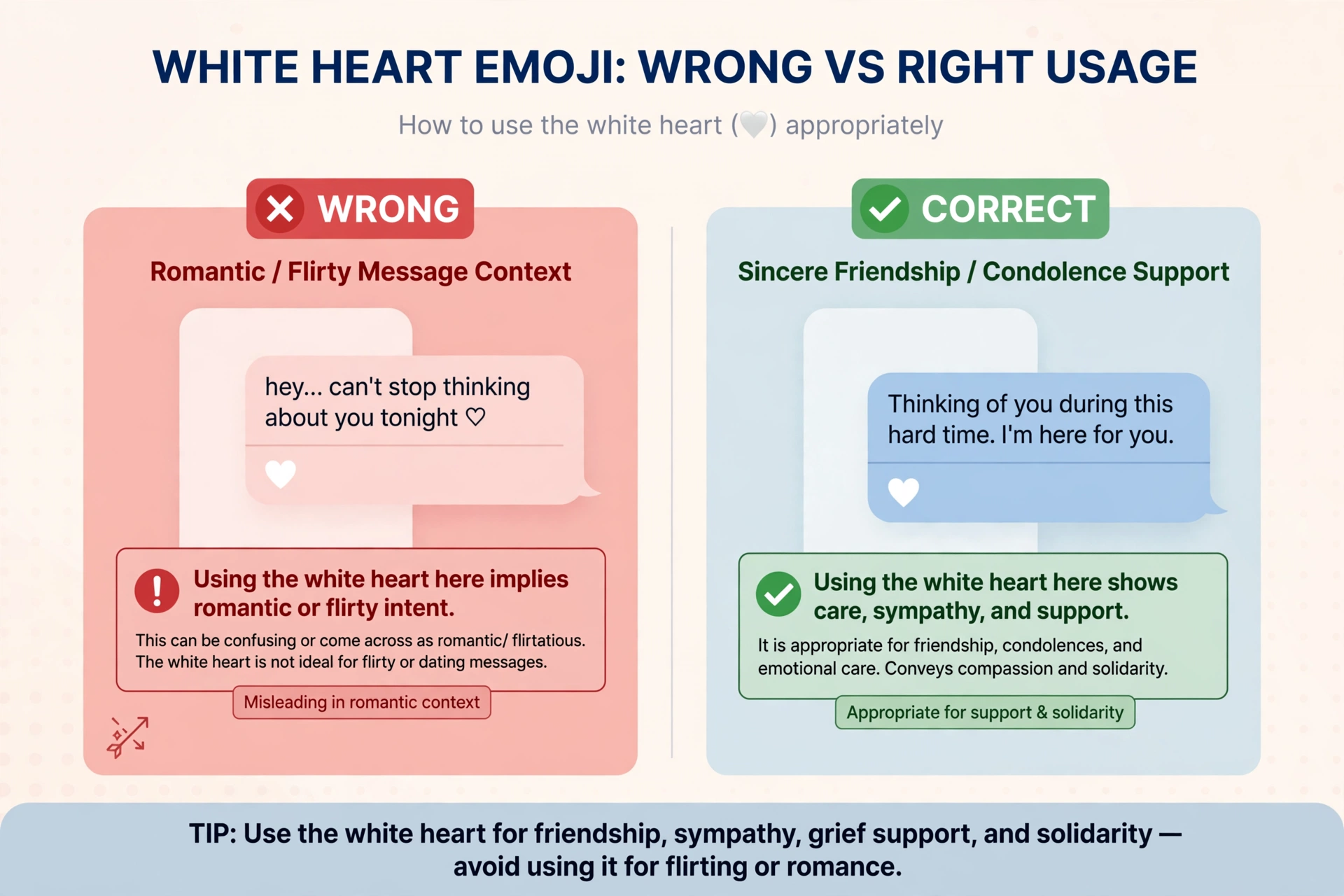
| Sending 🤍 to signal strong romantic interest | It reads as soft and possibly platonic — your crush may miss the signal | Use ❤️ or 💗 when you want romance to be unmistakable |
| Using 🤍 in a heated argument | It can feel passive-aggressive or dismissive mid-conflict | Resolve the issue in words first; save hearts for peacetime |
| Stacking too many (🤍🤍🤍🤍🤍) | Overuse dilutes the “calm and sincere” effect it is known for | One or two is plenty — restraint is the point of this emoji |
| Sending it to someone grieving without words | A lone emoji can feel hollow in serious moments | Always pair it with a genuine sentence of support |
| Assuming it always means “just friends” | In romantic relationships, partners use it as a quiet “I love you” | Read the relationship, not just the emoji |
Quick Tips
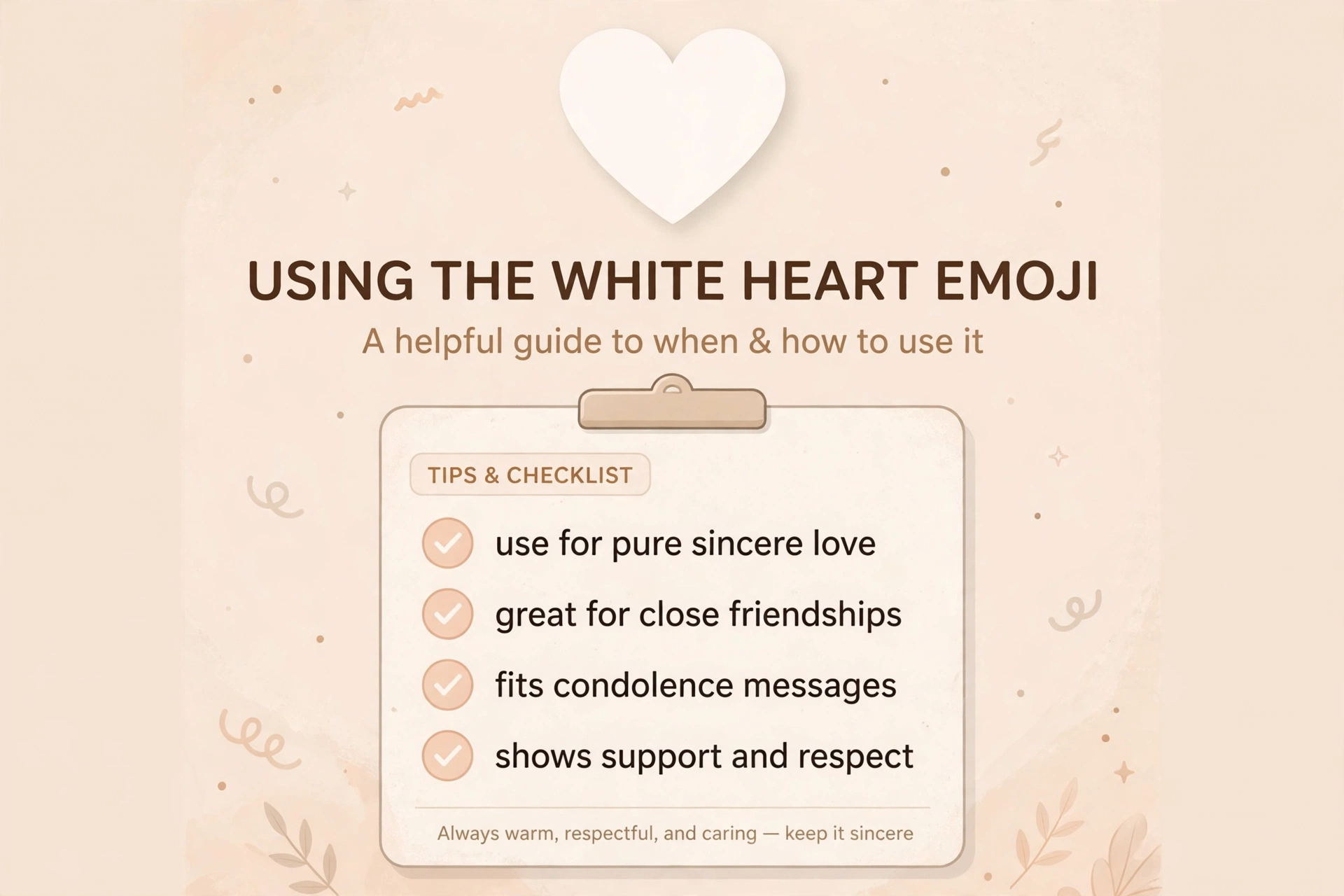
- Match the temperature: Use 🤍 when your feeling is warm but calm. If it is passionate, pick ❤️.
- Keep it rare to keep it meaningful: The white heart’s power comes from restraint. One per message is the sweet spot.
- Pair it with words: In emotional moments — condolences, apologies, big news — the emoji supports the sentence; it should never replace it.
- Check the aesthetic: For Instagram and TikTok captions, 🤍 blends beautifully with neutral, white, or minimalist feeds.
- Read before you react: When you receive a 🤍, look at the relationship and tone. A friend means gentle care; a partner often means quiet love.
- Copy and paste freely: The white heart (Unicode U+1F90D) renders on all modern phones — just copy 🤍 and paste it anywhere.
- Work-safe by default: Of all the hearts, 🤍 is the safest for professional chats — warm without romantic ambiguity.

FAQ
What does the white heart emoji 🤍 mean?
The white heart emoji means pure love, gentle affection, and sincere care. It expresses warmth in a calm, understated way — platonic love, sympathy, spiritual connection, or simple appreciation — without the romantic intensity of the red heart.
What does 🤍 mean from a girl or a guy?
Read the relationship, not the gender. From a girl or a guy, 🤍 usually signals gentle, sincere affection — friendly care, calm support, or a soft “I love you” from a partner. Because it is so neutral, it is weaker evidence of a crush than a red or pink heart.
What is the difference between 🤍 and ❤️?
The red heart ❤️ means passionate, romantic love — intense and direct. The white heart 🤍 means pure, gentle love — calm and understated. Use ❤️ for romance and strong emotion; use 🤍 for platonic warmth, sympathy, or a quieter kind of love.
Does the white heart emoji mean sympathy or condolences?
Yes. The white heart is one of the most common emojis for condolences and remembrance, because white symbolizes mourning, peace, and purity in many cultures. It is a tasteful, respectful choice — but always pair it with sincere words, never send it alone in serious moments.
What does 🤍 mean on Snapchat?
On Snapchat, the white heart typically signals a close, comfortable friendship — gentle affection in streaks and snaps without romantic pressure. Unlike the yellow heart 💛 (Snapchat’s official best-friend symbol), 🤍 is a personal choice of tone rather than a status.
Is the white heart emoji romantic?
It can be, but softly. Partners often use 🤍 as a calm, sincere “I love you.” However, it is not inherently romantic the way ❤️ is — it leans platonic, spiritual, or supportive by default. Context decides: “goodnight 🤍” from a partner is romantic; “thanks 🤍” from a friend is not.
When should I not use the white heart emoji?
Avoid 🤍 when you want unmistakable romance (use ❤️), in the middle of an argument (it can read as passive-aggressive), and in very formal settings like job applications or legal correspondence, where no emoji belongs.
How do I type or copy the white heart emoji?
On most phones, long-press or search “white heart” in the emoji picker. Its Unicode is U+1F90D (added in Unicode 12.0, 2019). You can also simply copy and paste this: 🤍 — it renders on all modern iOS, Android, and desktop devices.
Conclusion
The white heart emoji meaning is simple at its core and rich in practice: pure, gentle, sincere love. It is the heart for the moments that do not need fireworks — a friend’s encouragement, a family’s unconditional love, a quiet tribute, a partner’s calm reassurance, a faith-filled post, or a beautifully minimalist caption.
The key takeaway is context. 🤍 borrows its exact shade of meaning from the words around it and the relationship behind it. Used thoughtfully, it is one of the most versatile emojis you have: warm enough for love, calm enough for work, respectful enough for grief, and clean enough for aesthetics.
So the next time you reach for a heart, ask yourself what temperature your feeling is. If it burns, go red ❤️. If it glows softly and purely — you already know which heart to send. 🤍
If you are exploring other heart colors, our guide to the orange heart emoji meaning breaks down another warm, caring shade in the same detail.
And if you are brushing up on other texting essentials, do not miss our guide to what TYSM means in text — another small abbreviation doing a big job in everyday chats.

1 thought on “White Heart Emoji Meaning: The Ultimate Guide to Its Soft, Pure Power”