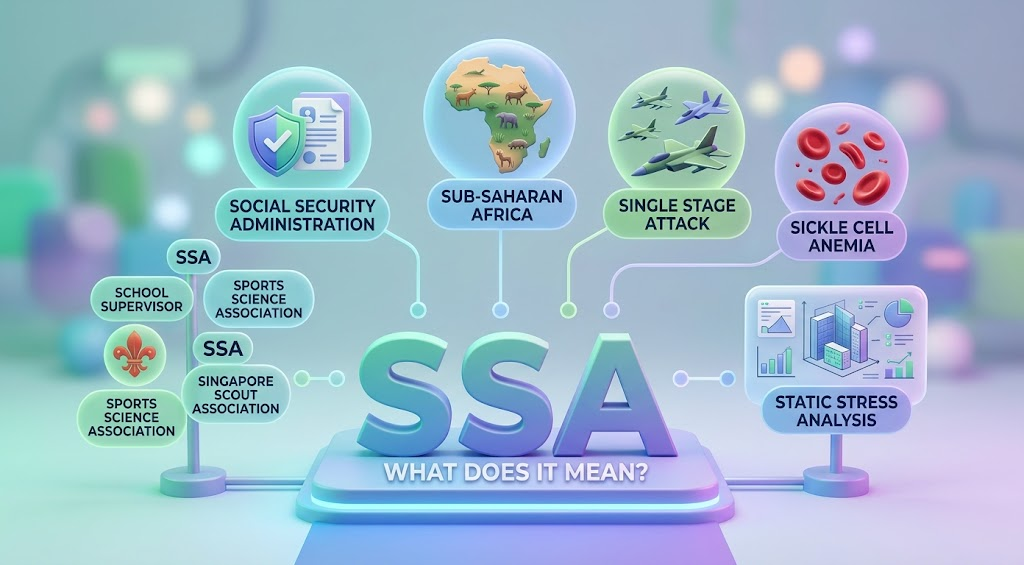
If you searched for SSA meaning, chances are you saw the letters “SSA” somewhere unexpected — a text message, a government letter, a medical report, a line of code, or a comment on TikTok — and none of the obvious guesses fit. That’s not a coincidence. SSA is one of the more overloaded three-letter acronyms in English, and the correct SSA meaning depends almost entirely on the context you found it in.
This guide breaks down every real-world SSA meaning by context, so you don’t have to guess. No fluff, no filler — just the actual definitions, examples, and the reasoning behind each one.
Quick Answer: What Does SSA Mean?
In most everyday US contexts, SSA means one of these three things:
- Social Security Administration — the federal agency (most common meaning overall)
- Internet slang for “ass” spelled backward (most common on TikTok and social media)
- Same-Sex Attraction — used in dating profiles, LGBTQ+ discussions, and identity contexts
Beyond these three, SSA also has specific meanings in medicine, finance, and programming. The table below gives you the fastest way to identify which SSA meaning applies to what you’re reading.
SSA Meaning by Context: Quick Reference Table
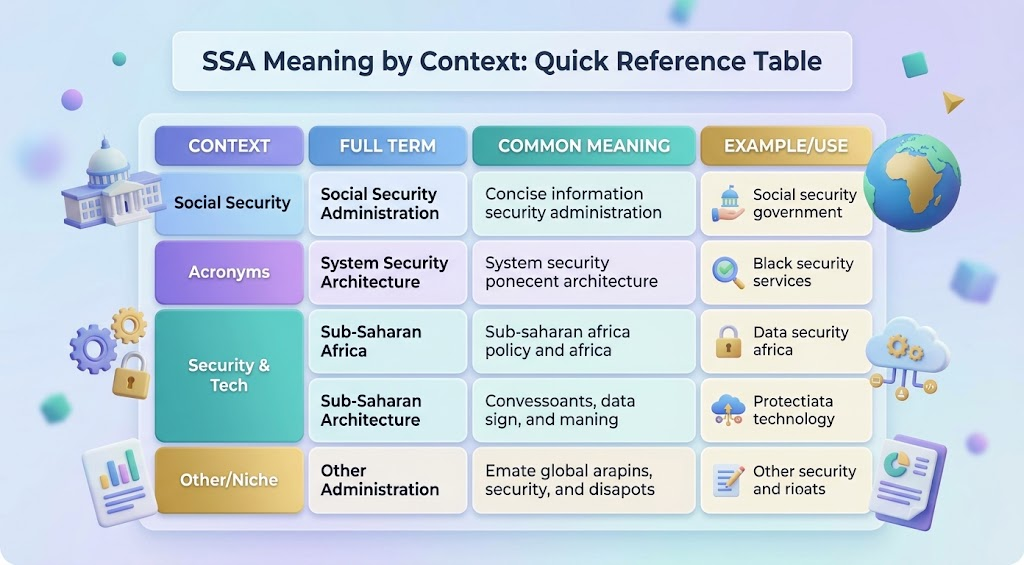
| Where You Saw “SSA” | Likely Meaning | Example |
|---|---|---|
| Government letter, benefits form, retirement paperwork | Social Security Administration | “Contact the SSA to update your address.” |
| TikTok, Snapchat, Instagram comments | “Ass” spelled backward (censorship dodge) | “She got that SSA.” |
| Dating app bio, LGBTQ+ forum | Same-Sex Attraction | “Struggling with SSA and faith.” |
| Medical lab report, autoimmune panel | Anti-SSA/Ro antibody test | “SSA antibody test came back positive.” |
| Programming, compiler documentation | Static Single Assignment | “The compiler converts code to SSA form.” |
| UK local government budget document | Standard Spending Assessment | “The council’s SSA was reduced this year.” |
| Text message, short email | “Subject Says All” | Subject line: “Running late” — body: “SSA” |
Now let’s go through each of these in detail, because the general table only gets you halfway to understanding the correct SSA meaning for your specific situation.
SSA Meaning #1: Social Security Administration
This is the single most searched and most important SSA meaning in the United States, and it’s the one that actually affects people’s lives and finances.
The Social Security Administration is a federal agency that:
- Issues Social Security numbers
- Administers retirement benefits
- Manages disability benefits (SSDI)
- Oversees Supplemental Security Income (SSI)
- Handles survivors’ benefits for families of deceased workers
Where the SSA Came From
The Social Security Administration wasn’t always called that. It traces back to the Social Security Act, signed into law in 1935 by President Franklin D. Roosevelt in response to the Great Depression. That law created the framework for federal social insurance — retirement income, unemployment support, and disability protections. The agency itself, the SSA, was established to administer that law.
SSA (Agency) vs. Social Security Act — Don’t Confuse These
This is where a lot of confusion comes from, and even some reference sites get it wrong. Here’s the clean distinction:
| Term | What It Is |
|---|---|
| Social Security Act | The 1935 law that created the benefits system |
| Social Security Administration (SSA) | The federal agency that runs the system today |
When someone says “I called the SSA about my benefits,” they mean the agency — not the law. That’s the SSA meaning you’ll encounter in almost every practical, everyday scenario involving retirement, disability, or survivor benefits.
When You’ll Actually Deal With the SSA
- Applying for retirement benefits
- Filing for disability (SSDI)
- Requesting a replacement Social Security card
- Reporting a name change after marriage or divorce
- Appealing a benefits decision
- Reporting the death of a beneficiary
If you’re dealing with any of these situations, this is the SSA meaning relevant to you, and it’s worth going directly to the agency’s official channels rather than third-party guides for anything involving your actual benefits.
SSA Meaning #2: Internet Slang (TikTok, Snapchat, Social Media)
If you saw “SSA” in a comment section, a caption, or a DM and it seemed to have nothing to do with the government, you’re dealing with a completely different SSA meaning — one rooted in how social platforms moderate content.
On TikTok specifically, SSA is commonly used as “ass” spelled backward. Here’s why:
- TikTok’s moderation system automatically flags or limits posts containing certain words
- Users reverse-spell restricted words to avoid getting flagged
- The reversed spelling still reads clearly to other users, but slips past automated filters
Example Usage
| Original Phrase | Slang Version |
|---|---|
| “She’s got a nice figure” | “She got that SSA” |
| Direct compliment | Coded compliment using SSA |
This isn’t a new phenomenon — it’s part of a broader pattern of algorithm-resistant slang, where users constantly invent new spellings, spacing tricks, and substitutions to say things platforms don’t want said outright. The SSA meaning here only makes sense once you understand the moderation context behind it.
Same-Sex Aggression (A Less Common Slang Meaning)
There’s a secondary, much less common usage: SSA as “same-sex aggression,” typically used in discussions about animal behavior — for example, describing why two female dogs in the same household might be more prone to conflict than a mixed-sex pair. pda meaning slang This meaning shows up occasionally in pet behavior forums and is unrelated to the TikTok usage entirely.
SSA Meaning #3: Same-Sex Attraction
In dating app bios, personal essays, religious discussion forums, and LGBTQ+ community spaces, SSA commonly stands for Same-Sex Attraction.
This usage differs from a sexual orientation label in an important way: some people specifically use “SSA” instead of terms like “gay” or “lesbian” because they’re describing an experience of attraction without necessarily adopting an identity label — this phrasing shows up often in religious or cultural contexts where someone is processing their attraction separately from how they identify publicly.
Where You’ll See This SSA Meaning
- Dating app profiles (as a self-descriptor or search filter)
- Religious support groups and forums
- Personal essays or coming-out narratives
- Mental health and counseling discussions
If the context involves identity, attraction, relationships, or a personal bio, this is almost certainly the SSA meaning intended.
SSA Meaning #4: Medical Term (Anti-SSA/Ro Antibodies)
This is the SSA meaning most people never expect — and the one with the least information available online, despite being medically significant.
Anti-SSA (also called Anti-Ro) antibodies are autoantibodies that show up in blood tests, most commonly associated with:
- Sjögren’s syndrome (an autoimmune condition affecting moisture-producing glands)
- Lupus (systemic lupus erythematosus)
- Certain pregnancy-related risks, including neonatal lupus in infants born to SSA-positive mothers
If you’ve had bloodwork done and your report mentions “SSA antibody” or “Anti-SSA,” this is the relevant SSA meaning — and it’s worth discussing directly with your doctor rather than relying on general definitions, since antibody results need clinical context to interpret properly.
Quick Facts on Anti-SSA/Ro Antibodies
- Detected through a blood test, usually as part of an autoimmune antibody panel
- A positive result doesn’t automatically mean a diagnosis — it’s one data point among several
- Relevant to pregnancy planning, since it can affect fetal heart development in rare cases
- Often tested alongside Anti-SSB/La antibodies
SSA Meaning #5: Static Single Assignment (Programming)
In compiler design and software engineering, SSA stands for Static Single Assignment — a property used in intermediate code representations.
In plain terms: SSA form is a way of writing code internally (inside a compiler) so that every variable is assigned a value exactly once. This makes it much easier for compilers to optimize code, track how data flows, and catch errors before a program runs.
You’ll encounter this SSA meaning almost exclusively if you’re:
- Studying compiler design
- Reading LLVM or GCC documentation
- Working on programming language theory
- Debugging low-level optimization issues
This meaning has zero overlap with the government, medical, or slang meanings — it’s purely a technical term used by software engineers and computer science students.
SSA Meaning #6: Standard Spending Assessment (UK Government Finance)
Outside the US, particularly in the United Kingdom, SSA can refer to Standard Spending Assessment — a now largely historical method used to calculate how much funding local councils should receive from central government based on factors like population and local needs.
This meaning is far less relevant to US searchers but shows up in UK-based financial and government documents, older council budget reports, and public finance textbooks.
SSA Meaning #7: “Subject Says All”
A smaller, more niche SSA meaning used in email and messaging: “Subject Says All.”
This is used when someone writes their entire message inside the subject line and just puts “SSA” in the body to confirm there’s nothing more to read. It’s a practical shorthand for short, single-point messages like:
- Subject: “Running 10 min late” → Body: “SSA”
- Subject: “Meeting moved to 3pm” → Body: “SSA”
It’s not widely known outside professional email culture, but it’s a legitimate and still-used SSA meaning in workplace communication.
How to Figure Out Which SSA Meaning Applies to You
Since SSA has this many valid meanings, the fastest way to identify the right one is to ask three questions:
- Where did you see it? (Government letter vs. social media vs. medical report vs. code)
- Who wrote it? (A federal agency vs. a stranger online vs. your doctor vs. a developer)
- What’s the surrounding context? (Benefits and forms vs. captions and comments vs. lab values vs. syntax)
Use this simple decision list:
- Government form or benefits letter → Social Security Administration
- Social media caption or comment → Slang (reversed spelling)
- Dating bio or identity discussion → Same-Sex Attraction
- Blood test or medical chart → Anti-SSA/Ro antibodies
- Code documentation → Static Single Assignment
- UK council budget document → Standard Spending Assessment
- Short email with a subject-only message → Subject Says All
Frequently Asked Questions
Is SSA the same as the Social Security Administration?
Yes, in almost all US government and benefits contexts, SSA is the standard abbreviation for the Social Security Administration.
What does SSA mean on TikTok?
On TikTok, SSA is most often “ass” spelled backward, used to avoid content moderation filters that flag certain words.
Is SSA the same as the Social Security Act?
No. The Social Security Act is the 1935 law; the SSA (Social Security Administration) is the federal agency created to administer that law.
What does SSA mean in a medical test result?
It usually refers to Anti-SSA (Anti-Ro) antibodies, which are linked to autoimmune conditions like Sjögren’s syndrome and lupus.
What does SSA mean on a dating app?
It typically stands for Same-Sex Attraction, used by people describing their attraction independent of a specific identity label.
Does SSA always mean something negative or slang-related?
No. Most formal, professional, and medical uses of SSA are neutral or institutional — the slang meaning is specific mainly to social media platforms like TikTok.
What does SSA mean in programming?
It stands for Static Single Assignment, a technique compilers use internally to simplify and optimize how code is analyzed.
Final Takeaway
There isn’t one single SSA meaning — there are at least seven, and picking the right one depends entirely on context. If you’re dealing with benefits or retirement, it’s the Social Security Administration. If you saw it on TikTok, it’s almost certainly slang. If it showed up on a lab report, it’s an antibody test. The letters don’t change, but the meaning shifts completely depending on where you encountered them — and now you know exactly how to tell the difference.
