Quick Definition: Trade slang is the informal language traders use to talk about buying, selling, and holding assets — words like HODL, diamond hands, bag holder, and “to the moon” that sound strange to outsiders but carry precise meaning inside trading communities. In a broader sense, it also covers the slang of any trade or craft, and in gaming it means the shorthand players use when swapping items. The exact meaning depends on where you hear it: on a stock or crypto forum, trade slang is market jargon; in a text, “trade” usually means an exchange of some kind.
Trade Slang Meaning & Definition
Trade slang means the special vocabulary that develops inside any trading community. At its simplest, it is shorthand: a faster, more colorful way for people who trade stocks, crypto, or in-game items to say things they say a hundred times a day. Instead of writing “I am holding this asset despite a sharp price drop because I believe it will recover,” a trader writes “diamond hands.” Instead of “this asset’s price is rising very fast,” they write “to the moon.” The slang saves time, signals that you belong to the group, and turns stressful market moments into something people can joke about.
The phrase has two common readings, and the context tells you which one applies. The first and most common is trading slang — the jargon of financial markets, especially stocks and cryptocurrency. This is the meaning most people are searching for when they type “trade slang” into Google. The second is trade slang in the older sense: the jargon of a trade or craft, like the slang of plumbers, chefs, or truck drivers. Gamers add a third use: trading items in games like Roblox, CS2, or FIFA Ultimate Team has its own slang — “LF” (looking for), “NFT” (not for trade), and “overpay” are everyday words in those communities.
What makes trade slang interesting is that it is not just vocabulary — it is culture. Terms like HODL started as a typo and became a whole investing philosophy. “Paper hands” is not just a description; it is a mild insult. “Ape in” is not just a trade; it is a warning about risky behavior. To understand trade slang is to understand how online trading communities think, joke, and cope with winning and losing money in public.
Introduction
You have probably seen it in a comment section or a group chat: “HODL, diamond hands, we’re going to the moon,” or “bro got rekt, he paper-handed at the bottom.” Maybe a friend texted you “wanna trade?” about a game, or a crypto Discord server was full of words that looked like English but made no sense at all. If you nodded along while understanding nothing, you are not alone — trade slang is one of the fastest-growing vocabularies on the internet, and it changes every time the market does.
Part of the confusion is that trading slang borrows words from everywhere: gaming, memes, sports, and internet humor. A “bag” is not a bag. A “whale” is not an animal. “Rekt” is not a real word, and “moon” is not a place. Each term is a small piece of shared history — a joke, a famous loss, or a viral moment that the community turned into permanent vocabulary. People who trade together every day develop this language naturally, the same way any close group develops inside jokes.
This guide breaks down the full trade slang picture: where the language came from, the most important terms you will actually see, what they mean in stocks, crypto, and gaming, how to use them without embarrassing yourself, and the mistakes beginners make. By the end, you will be able to read a trading thread, a crypto chat, or a game-trading post and understand every word of it — and you will know which terms are useful, which are jokes, and which are red flags.

Origin
Trading slang is much older than the internet, but the internet made it explode. On Wall Street, traders have always had nicknames for things: a “bull” market rises, a “bear” market falls, and those animal metaphors date back to the 1700s. Floor traders in the 1980s and 1990s shouted their own shorthand across crowded pits. But that language stayed inside the industry — ordinary people never heard it.
Everything changed when trading moved online. In the 2010s, forums like Reddit’s r/wallstreetbets and crypto communities on Twitter and Discord turned trading into a spectator sport. Millions of new, young traders arrived at once, and they brought internet culture with them. The most famous example is HODL, which began in 2013 as a typo in a Bitcoin forum post titled “I AM HODLING.” The author meant “holding,” but the misspelling was so perfect — it captured the stubborn, emotional act of refusing to sell — that the community adopted it permanently. HODL is now in dictionaries and even has a backronym: “Hold On for Dear Life.”
The GameStop saga of January 2021 was the second great wave. When millions of retail traders pushed GameStop’s stock price to historic highs, the language of r/wallstreetbets — diamond hands, paper hands, “to the moon,” “apes together strong” — went mainstream overnight. News channels that had never covered meme stocks started explaining these terms to their audiences. Crypto’s bull runs added their own wave: “rekt” (wrecked), “FOMO” (fear of missing out), “FUD” (fear, uncertainty, doubt), and “NGMI” (not gonna make it) all spread from crypto Twitter into everyday online speech. Investopedia’s trading glossary now documents many of these terms alongside traditional market vocabulary, which shows how far trading slang has traveled from message boards into mainstream finance.
Gaming trade slang has a parallel history. Players trading virtual items have used shorthand like “WFL” (win/fair/lose) and “LF” (looking for) since the early 2000s, and games like Roblox turned item trading into its own economy with its own slang. Today, the three worlds — stocks, crypto, and gaming — constantly borrow from each other, which is why a term born in crypto can show up in a gaming chat a week later.
Popularity
Trade slang is more popular now than at any point in history, and the reason is simple: more people trade than ever before. Commission-free trading apps, crypto exchanges, and social media turned investing from a quiet professional activity into a public, social one. When millions of people watch the same charts and talk in the same chats all day, a shared language forms fast — and it spreads faster than any textbook ever could.
Search interest in trading slang spikes with the market itself. During bull runs and meme-stock moments, terms like “diamond hands” and “to the moon” trend on TikTok and Twitter, and creators make explainer videos that rack up millions of views. During crashes, the darker vocabulary takes over: “rekt,” “bag holder,” and “dead cat bounce” dominate the conversation. The language is a weather report for market sentiment — read the slang, and you can tell whether traders are euphoric, panicked, or just joking to cope.
The slang has also escaped trading entirely. “Diamond hands” now appears in sports commentary, dating profiles, and motivational posts that have nothing to do with stocks. “HODL” is used jokingly about everything from snacks to relationships. That is the ultimate sign a slang term has made it: people use it even when they have never placed a trade. But inside trading communities, the words still carry their original, precise meanings — and using them wrong is the fastest way to reveal yourself as a beginner.
How It Is Used
Trade slang shows up in four main places: trading forums and Discord servers, social media (especially X/Twitter and TikTok), gaming trade chats, and private group chats between friends who trade. The tone is almost always casual, fast, and emotional — people type in fragments, react in real time to price moves, and use slang to compress a whole opinion into one or two words.
In practice, the slang does three jobs. First, it saves time: “I aped into a low-cap at 2x and now I’m down 40%, diamond hands though” packs a full trade story into one sentence. Second, it signals identity: using the right terms at the right moment tells the group you are one of them. Third, it manages emotion: jokes and memes soften losses. Calling yourself “rekt” after a bad trade is funnier — and easier — than writing a serious post about losing money.
The same term can be a joke, a strategy, or a warning depending on tone. “Ape in” is playful when a friend says it, but it is a red flag when an influencer says it about a coin they are paid to promote. “Diamond hands” is praise when a trade recovers, and mockery when it does not. Context and timing decide the meaning, which is why beginners should watch and listen before they start using the words themselves.
Examples
Here is what trade slang actually looks like in real conversations. Notice how each message carries a full opinion — confidence, fear, humor, or regret — in just a few words.
| Situation | What someone says | What it means |
|---|---|---|
| Refusing to sell during a dip | “Diamond hands. I’m not selling.” | Holding despite a price drop |
| Someone sells too early | “Bro paper-handed at the bottom.” | Sold out of fear at the worst time |
| A coin is pumping fast | “This is going to the moon.” | The price is rising sharply |
| A bad trade | “I got rekt on that one.” | Lost a lot of money |
| Stuck with a losing asset | “I’m a bag holder now.” | Holding a coin that crashed |
| Jumping into a trade fast | “I aped in without checking.” | Bought impulsively, without research |
| Gaming item trade | “LF your rare pet, NFT unless overpay.” | Looking for your pet; not trading unless you overpay |
Friendly Examples
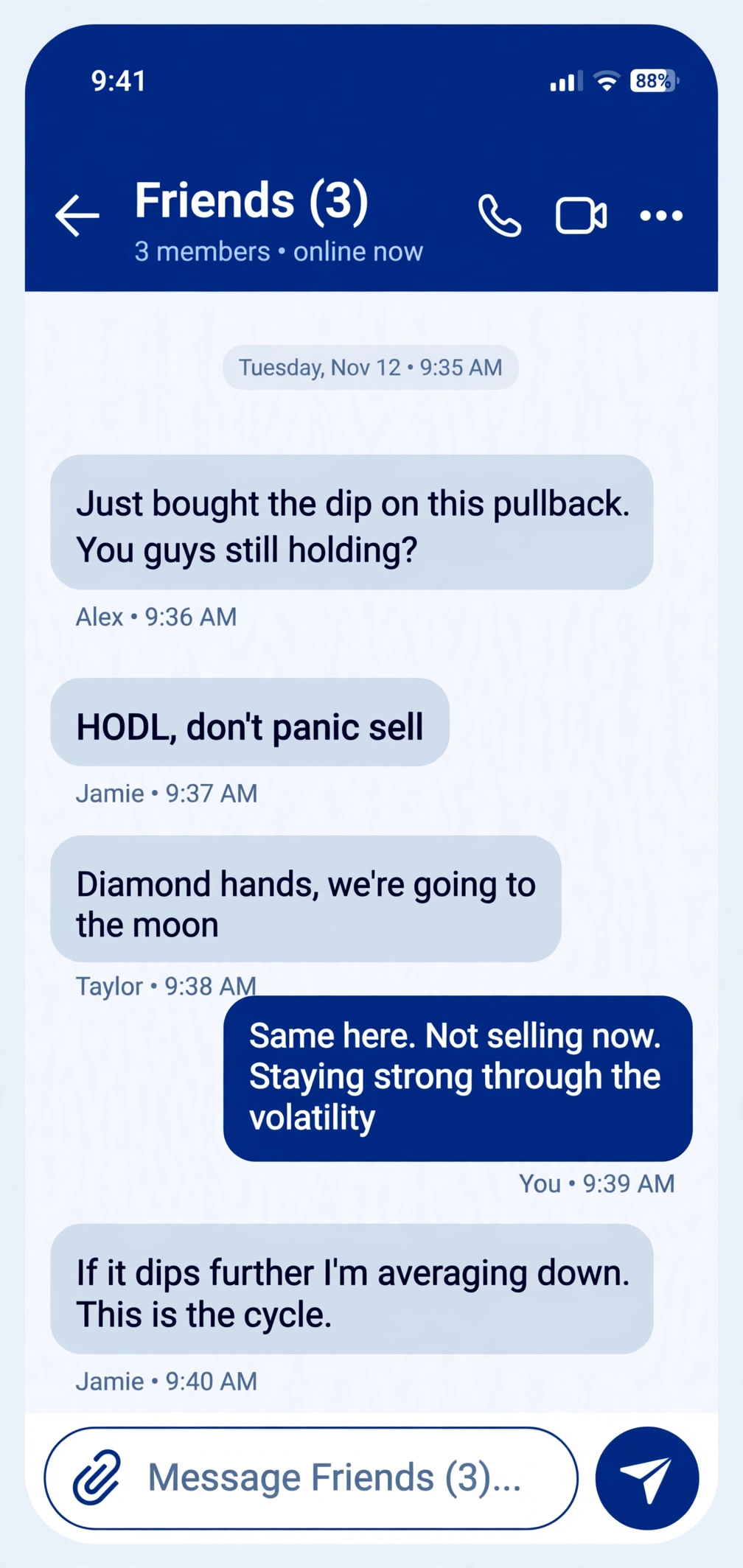
In friendly chats, trade slang is playful and encouraging. A friend might text, “HODL with me, we’re going to the moon together,” or “diamond hands, don’t let the FUD get to you.” These messages are half joke, half pep talk — the slang turns a stressful market day into a shared experience. You will also see it in gaming: “wanna trade? I have an extra rare, LF your legendary” is a normal, friendly opener in a trading server. If you spend time in trading chats, you will notice the same thing you see in any slang-heavy group — people use the words to bond, not just to inform. That is why terms like PMO and other texting abbreviations often sit right next to trading slang in the same group chats: the communities overlap, and the vocabulary mixes freely.
Professional Examples
In professional or semi-professional settings, the slang is used more carefully. A trading newsletter might write, “Long-term holders — the diamond hands of this cycle — absorbed the selling pressure,” using the slang term but explaining it for a wider audience. A crypto analyst might say on a stream, “FOMO is driving this move, so manage your risk,” turning slang into a genuine warning. Even here, the words do real work: “FOMO” names a specific psychological trap faster than any formal term could. The rule in professional contexts is to use slang sparingly and always in a way your audience understands — one unexplained term is flavor, five is noise.
Funny Examples
The funniest trade slang comes from losses. “I bought the top and now I’m the proud owner of a very expensive bag” is a classic self-own. “My portfolio is a museum of bad decisions” gets laughs because everyone has been there. Memes turn these jokes into permanent vocabulary: a trader who sells early and watches the price rocket is a “paper hands” legend, and screenshots of terrible trades get shared with captions like “rekt speedrun.” The humor is a coping mechanism — trading is stressful, and laughing at a loss is often healthier than hiding it. Just remember the line: joking about your own losses is funny; joking about someone else’s is not.
Comparison with Similar Terms
Many trade slang terms sound alike but mean opposite things. The table below sorts out the pairs beginners mix up most often.
| Term | Meaning | Opposite / contrast |
|---|---|---|
| Diamond hands | Holding through dips and volatility | Paper hands — selling at the first sign of trouble |
| HODL | Long-term holding strategy | Day trading — buying and selling within a day |
| Bag holder | Stuck holding a crashed asset | Early seller — exited before the crash |
| To the moon | Price rising very fast | Going to zero — price collapsing |
| FOMO | Buying because you fear missing out | FUD — fear, uncertainty, doubt that makes people sell |
| Whale | A trader holding a huge amount | Shrimp / minnow — a small retail trader |
| Ape in | Buying impulsively with a large amount | DCA (dollar-cost averaging) — buying slowly over time |
| Bullish | Expecting prices to rise | Bearish — expecting prices to fall |
The most important distinction is diamond hands vs. paper hands, because it is really a debate about strategy disguised as slang. Diamond hands sounds heroic, but holding a bad asset forever is not smart — it is just stubborn. Paper hands sounds weak, but selling a bad trade early is often the right call. Smart traders know the labels are jokes, not advice. Similarly, FOMO and FUD are two sides of the same coin: both are emotions that push people into bad decisions, one by making them buy too late and the other by making them sell too early.

Alternate Meanings
Outside of finance, “trade” slang takes on different meanings, and mixing them up causes real confusion.
- The trade (a craft): In older usage, “the trade” means a skilled profession — the building trade, the printing trade. “Trade slang” in this sense is the jargon of a craft: plumbers, electricians, and chefs all have their own words for tools and techniques.
- Trade in gaming: In games, “trade” means swapping items with another player, and trade slang means the shorthand of those deals — LF, WFL, NFT, “overpay,” and “downgrade.” A “trade” here involves no money at all, just virtual items.
- Trade in texts: In texting, “trade” can mean exchanging anything — photos, accounts, or favors. “Wanna trade?” usually needs the object spelled out, or the message is confusing. A term like NGL often appears in these same conversations, since trading chats and casual texting slang share the same group chats.
- Trade as an exchange of insults: In some online communities, “trading” means exchanging jokes or insults — “we were just trading roasts.” The meaning is friendly, but only if both people know it is a joke.
- Sports trades: In sports talk, “trade slang” can mean the language of player trades — “trade deadline,” “trade bait,” “blockbuster trade.” A player being “on the trade block” is available to be traded to another team.
The financial meaning dominates search results today, but if someone says “trade slang” about a job site or a video game, they probably mean the craft or gaming sense. Always check the setting before assuming which one applies.
Professional or Polite Alternatives
Trade slang is fun in casual chats, but it has no place in formal writing, work emails, or conversations with people who do not trade. Here are polite, professional ways to say the same things:
| Slang | Professional alternative |
|---|---|
| HODL / diamond hands | “I am holding this position long term.” |
| To the moon | “The asset is experiencing strong upward momentum.” |
| Rekt | “I took a significant loss on that position.” |
| Bag holder | “I am holding an asset that has declined sharply.” |
| Ape in | “I entered the position quickly without full due diligence.” |
| Paper hands | “I exited the position early due to risk concerns.” |
| FOMO | “I bought in because I was concerned about missing the move.” |
| Whale | “A large holder with significant market influence.” |
The professional versions are longer, but they are also clearer — and they do not make you sound like you are repeating memes in a meeting. A good rule: slang with friends and fellow traders, plain language with everyone else. If you are writing a work email, a school assignment, or a message to someone outside trading culture, use the right-hand column.
Common Mistakes
Beginners make the same mistakes with trade slang over and over. Avoid these and you will sound like you actually know what you are doing.
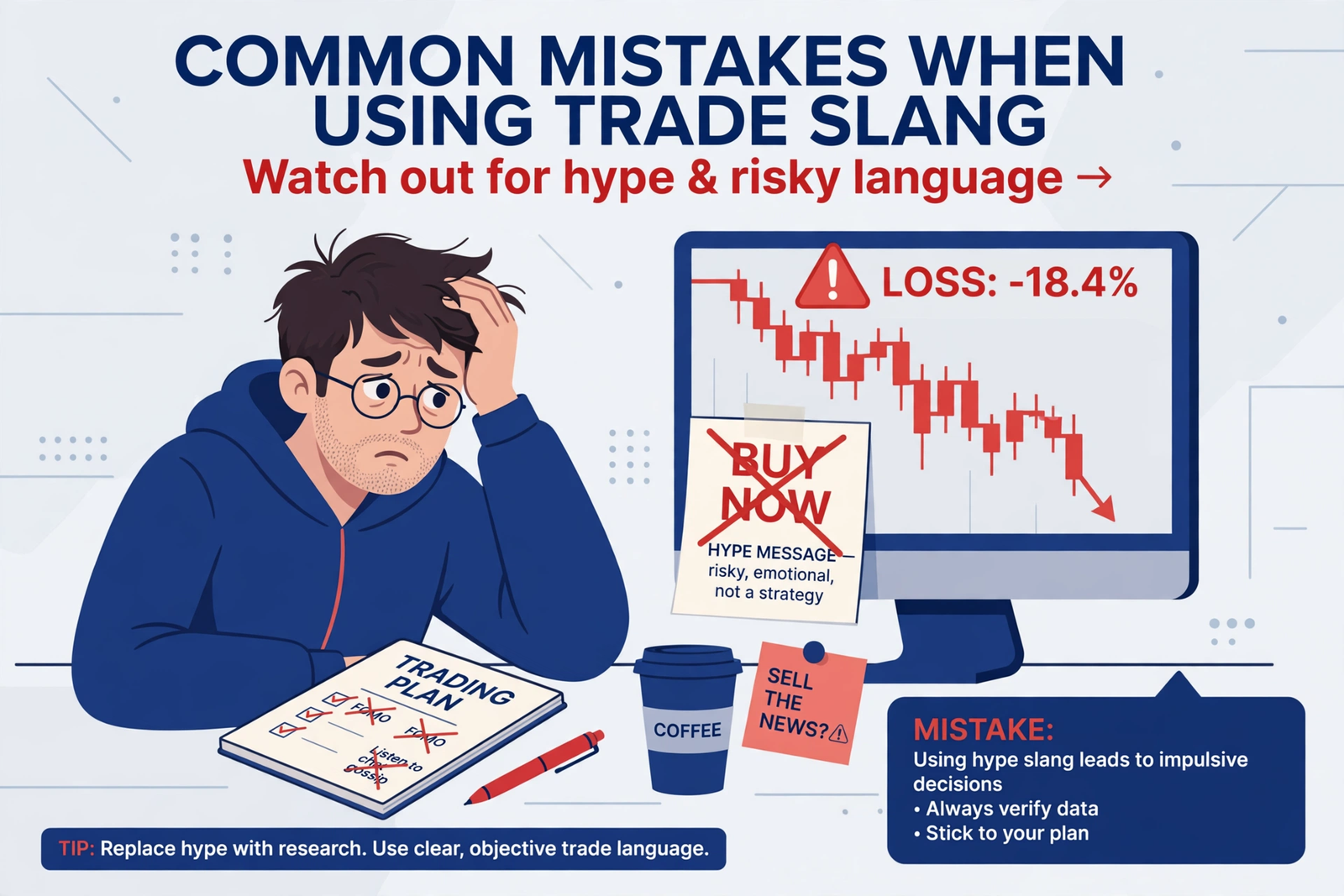
- Using slang as strategy: “Diamond hands” is not an investing plan. Holding a bad asset because a meme told you to is how people become bag holders. The slang describes behavior; it does not justify it.
- Buying on FOMO: If you are buying something because everyone is shouting “to the moon,” you are probably buying at the top. FOMO is a warning sign, not a buy signal.
- Calling everything a “moon shot”: Not every small coin is going to 100x. Calling every trade a moon shot makes people stop listening to you.
- Using “rekt” about other people’s losses: It is fine to joke about your own bad trade. Mocking someone else’s loss is rude, and in a trading community it will get you ignored fast.
- Confusing gaming trade slang with finance slang: “NFT” in a game trade means “not for trade,” not a non-fungible token. “LF” means “looking for,” not a finance term. Context decides.
- Trusting slang-heavy influencers: If someone’s entire pitch is “ape in, we’re going to the moon, diamond hands,” they are selling excitement, not analysis. Real research does not need hype words.
- Saying “trade slang” when you mean one term: The phrase describes a whole vocabulary. If you want to know what one word means, ask about that word — “what does HODL mean” gets a better answer than “what is trade slang.”
Quick Tips
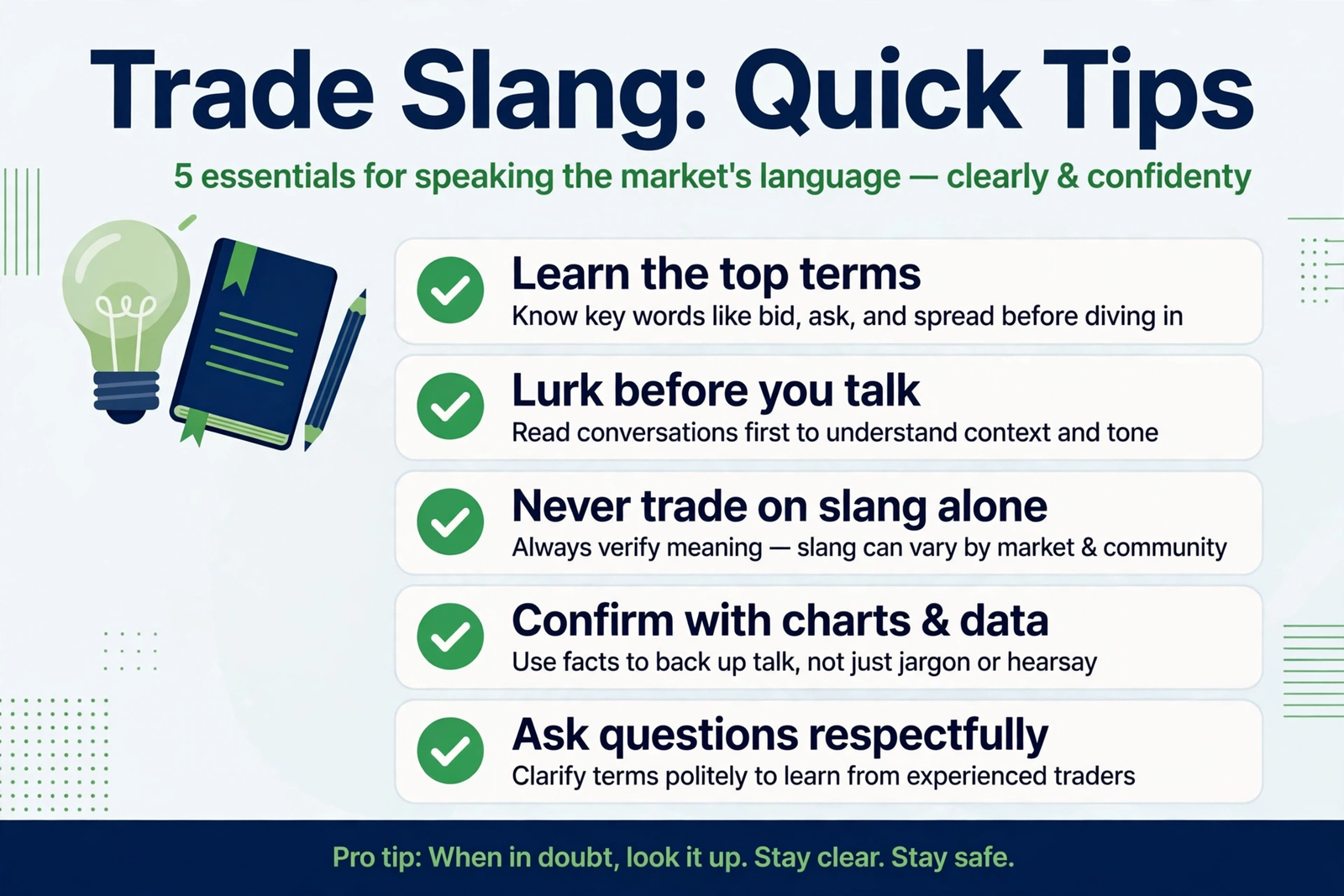
- Learn the top 10 terms first: HODL, diamond hands, paper hands, FOMO, FUD, rekt, bag holder, whale, to the moon, and ape in cover 90% of what you will see. Everything else is a variation.
- Lurk before you talk: Spend a week reading a trading community before posting. You will learn which terms are jokes, which are serious, and which will get you mocked.
- Never trade on slang alone: A term going viral is not a reason to buy. Check the actual chart, the news, and the fundamentals first.
- Keep a personal glossary: When you see a new term, write down what it meant in that context. Trading slang changes fast, and your notes will save you later.
- Use slang to learn, not to impress: The goal is understanding the conversation, not sounding like a veteran on day one. Asking “what does that mean?” is smarter than pretending you know.
- Watch for red flags: Heavy slang plus urgency (“ape in now, last chance, to the moon”) is the classic shape of a pump-and-dump. Slow down when you see it.
- Separate the joke from the advice: Most trading slang is humor. If you treat a meme as financial advice, the joke is on you — literally.
FAQ
What does trade slang mean?
Trade slang is the informal vocabulary traders use to talk about markets — terms like HODL, diamond hands, bag holder, and “to the moon.” It also covers the slang of any trade or craft, and the shorthand gamers use when swapping items. The financial meaning is the most common one today.
What does HODL mean in trade slang?
HODL means holding an asset long term instead of selling, even when the price drops. It started as a typo for “hold” in a 2013 Bitcoin forum post and became one of the most famous terms in trading. It is often backronymed as “Hold On for Dear Life.”
What are diamond hands and paper hands?
Diamond hands means holding an asset through big price drops without selling — it is praised as strong conviction. Paper hands means selling at the first sign of trouble, usually out of fear. Both are jokes as much as strategies, and neither is always the right move.
What does “to the moon” mean in trading?
“To the moon” means an asset’s price is rising very fast or is expected to. It comes from the idea of a price chart shooting upward like a rocket. It is enthusiastic slang, not a prediction — prices that “go to the moon” often come back down just as fast.
What does bag holder mean?
A bag holder is someone stuck holding an asset that has crashed in value, usually after buying near the top. The “bag” is the losing position they are left carrying. It is a self-deprecating joke when people say it about themselves, and an insult when said about others.
What does rekt mean in trade slang?
Rekt is a deliberate misspelling of “wrecked,” and it means suffering a big loss on a trade. “I got rekt” means “I lost a lot of money.” The term started in gaming, where it meant being badly defeated, and trading communities adopted it for blown-up positions.
Is trade slang the same as Wall Street jargon?
Not exactly. Wall Street jargon (bull market, bear market, IPO, dividend) is formal financial language used by professionals. Trade slang (HODL, diamond hands, ape in) is informal internet language used mostly by retail traders online. The two overlap — “bullish” and “bearish” appear in both — but slang is faster, funnier, and far less formal.

How can I learn trade slang quickly?
Start with the ten most common terms — HODL, diamond hands, paper hands, FOMO, FUD, rekt, bag holder, whale, to the moon, and ape in — then read trading forums and chats for a week to see them in context. Real usage teaches faster than any glossary. And if you want to understand the rest of the slang filling those same chats, a term like IMO is a good next read, since it appears in almost every trading discussion.
Conclusion
Trade slang is more than a list of funny words — it is the living language of millions of people who trade together online. Terms like HODL, diamond hands, and “to the moon” started as jokes and typos, but they now carry real meaning: they describe strategies, warn about emotions, and turn the stress of the market into something a community can share. Whether you trade stocks, crypto, or game items, understanding this vocabulary means understanding the people behind the charts.
The smart way to use trade slang is to treat it as a language, not as advice. Learn the terms, watch how experienced traders use them, and never let a meme make a decision for you. Hold when holding makes sense, sell when selling makes sense, and let the slang describe what you did — not decide what you will do. If you keep that line clear, the language becomes genuinely useful: it helps you read the room, spot the hype, and talk to other traders in the words they actually use. Now that you know the vocabulary, the next time a chat fills up with diamond hands and moon rockets, you will know exactly what everyone is saying — and whether to take any of it seriously.

1 thought on “Trade Slang: What It Means in Trading, Gaming & Texts (2026)”