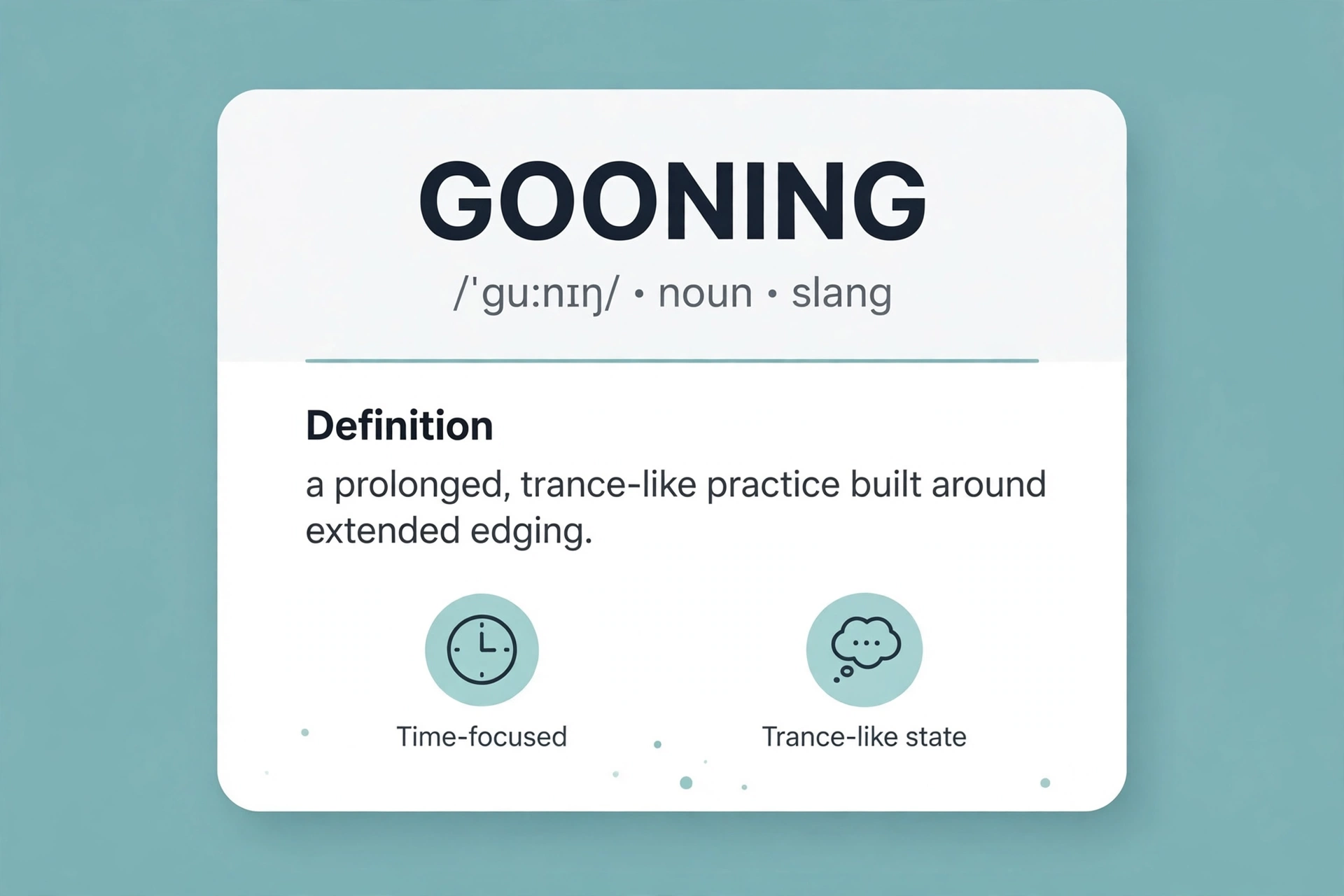
Quick Definition: Gooning slang refers to a prolonged, trance-like sexual practice built around extended edging — staying in a heightened state of arousal for a long time, often while consuming adult content, without rushing to climax. The goal is not the finish but the mental zone itself, sometimes called the “goon state.” In casual Gen Z and meme culture, the word is also used jokingly to describe being zoned out, obsessed, or lost in something for hours.
Gooning Slang Meaning & Definition
Gooning slang means the act of deliberately stretching out sexual arousal over a long session — sometimes for hours — by edging, which is bringing yourself close to climax and then backing off again and again. The person doing it is called a gooner, and the absorbed, almost hypnotic headspace they describe is known as the goon state. Unlike a quick session, gooning is about immersion: the time, the mood, the content, and the feeling of switching off the rest of the world.
The word sits at an interesting crossroads. In its original adult-community sense, it is a very specific practice with its own vocabulary, rituals, and online spaces. In wider internet culture, though, gooning slang has loosened into a joke word — a way to describe anyone who is hopelessly locked in on something, whether that is a video game, a TV series, or a feed they cannot stop scrolling. Context decides which meaning is in play, and that is exactly why so many people search for it: the same word can sound silly in one comment and very adult in the next.
Merriam-Webster lists gooning as vulgar slang for masturbation, especially for a prolonged period without orgasm, with its first known use dated to around 2005. Mainstream outlets such as Cosmopolitan have covered it as an evolving internet subculture term, and it now has its own detailed encyclopedia entry. It is not a clinical or medical term — no doctor will use it in a diagnosis — but it is a real, widely recognised piece of modern slang.
At its core, gooning slang describes three things at once: a practice (long edging sessions), a state of mind (the trance-like goon state), and a community identity (gooners, goon caves, goon culture). Understanding all three layers is the key to understanding the word.
Introduction
You have probably seen the word pop up somewhere unexpected: a meme caption, a TikTok comment, a Discord joke, or a friend laughing that they were “gooning all night” over a new game. If you had to guess from the tone alone, you might think it means acting goofy — after all, a “goon” has meant a silly or foolish person for decades. And sometimes, that is exactly what the speaker means.
But in most online spaces today, gooning slang carries a much more specific adult meaning, and using it without knowing that meaning can lead to an awkward moment fast. This guide explains the word properly: where it came from, what the goon state actually is, how people use the term in real conversations, how it differs from edging, and the mistakes to avoid. Everything is explained in plain, non-graphic language, so you can understand the term without wading through explicit detail.
Whether you are a parent decoding your teenager’s feed, a curious reader who keeps seeing the word in memes, or someone trying to understand Gen Z slang as a whole, this is the complete picture — the definition, the origin story, the community around it, and the lighter, joking uses that have pushed the word into the mainstream.
Origin
The story of gooning slang starts with the word goon. Long before the internet, “goon” meant a stupid, clumsy, or simple-minded person — a meaning that traces back to the dim-witted “goons” of the Popeye comics and, more generally, to old slang for a fool. It later picked up a second meaning, a hired thug or enforcer, which is why the word can still confuse newcomers today.
The sexual sense grew up in early internet forums. The earliest known definition on Urban Dictionary dates to August 18, 2005, when a user described it as the act of getting so absorbed in masturbation that the person “becomes a total goon” — someone who can think of nothing else. Around 2012, a more detailed definition appeared, describing the trance-like state reached after a prolonged edging session. The practice itself is often traced to communities on 4chan in the early 2000s, where extended sessions were discussed and joked about long before the word reached the mainstream.
For years, gooning slang stayed in niche corners: adult forums, Reddit communities, and Discord servers where people shared tips, memes, and setups for long sessions. The vocabulary grew with it. A gooner is someone who does it regularly. A goon cave is a room set up for sessions — dim lighting, a big screen, snacks, and privacy. Goon fuel is the content used during a session. Some gooners even describe themselves, half-jokingly, as “pornosexual,” meaning their attraction is tied to pornography itself rather than to a partner.
The big shift came in late 2022 and 2023, when the word broke out of its niche. TikTok, Twitter/X, and meme pages started using “gooning” and “gooner” as punchlines, and the term spread through Gen Z and Gen Alpha slang the way Ohio slang and sigma slang did — first as an in-joke, then as a word everyone recognised, even if they had never visited the communities where it started. By 2025, mainstream publications were writing explainers about it, and the German word “goonen” was even nominated for Youth Word of the Year in Germany.
Popularity
Why did gooning slang explode when it did? Four forces pushed it into the mainstream.
First, meme culture made it safe to say. The word sounds funny. “Goon” already meant a silly person, so “gooning” worked as a joke even for people who only half-understood it. Meme pages could post about goon caves and gooners without being explicit, and the humour carried the word further than any serious discussion could have.
Second, TikTok and short video turned it into a trend. Creators used the word to describe being obsessed with anything — a game, a show, a celebrity — and the algorithm pushed those jokes to millions of viewers. Each viral video added a new layer of meaning, until “gooning” could describe a mindset as easily as a practice.
Third, Gen Z slang moves fast. The same generation that made mewing, Gen Alpha slang, and “skibidi” household words treats slang as a shared game. A word that starts in one small community can be everywhere within weeks, and gooning slang followed exactly that path.
Fourth, curiosity does the rest. The word is deliberately ambiguous — playful on the surface, adult underneath — and that ambiguity makes people search for it. Every “what does gooning mean” search pushes the term higher in search results, which brings in more curious readers, which keeps the cycle going.
Today, gooning slang is one of the most searched adult slang terms online. It appears in dictionary entries, news explainers, health articles, and countless memes — sometimes all at once, in the same feed.
How It Is Used
People use gooning slang in three main ways, and telling them apart is the whole trick to understanding the word.
1. As a literal practice. In adult communities, “gooning” describes the session itself: “He spent the whole evening gooning.” A gooner might talk about their setup, their session length, or the goon state they reached. This is the original, specific meaning, and it is always adult in nature.
2. As a community label. “Gooner” works like a fan identity. Someone might call themselves a gooner the way another person calls themselves a gamer — it signals belonging to a particular online subculture with its own jokes, norms, and vocabulary. Related terms include “goonette,” used by some women and feminine-identifying people in the community.
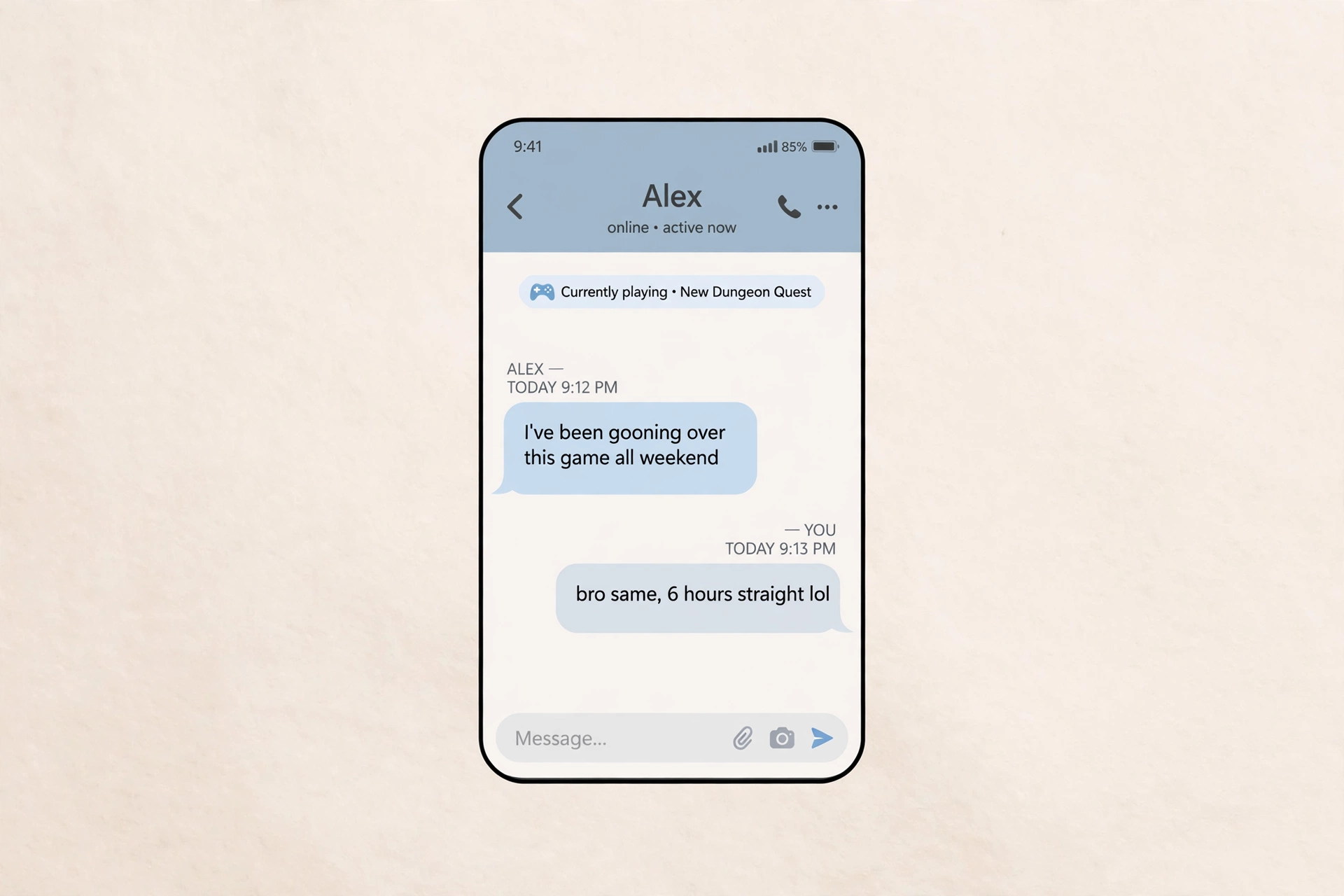
3. As a joke or exaggeration. This is the use most people encounter. In memes and casual chat, “gooning” means being hopelessly locked in on something: “I’ve been gooning over this game for six hours straight.” “Bro was gooning to the new episode all night.” Nobody in these examples is talking about the literal practice — they are borrowing the word’s energy (total absorption, losing track of time) to describe ordinary obsession. The joke works precisely because the audience knows the adult meaning in the background.
The word also shows up as a verb in the past tense (“was gooning”), as a noun for the state (“in a goon state”), and as an adjective-ish label (“goon mode”). Tone and audience decide everything: among close friends in a meme chat, it is a joke; in a serious conversation, it is a literal adult term; at work or with family, it is a word best avoided entirely.
Examples
Real examples make the different uses of gooning slang much clearer. Notice how the same word changes meaning with the setting.
Friendly Examples
- “I was gooning over the new album all weekend — I literally could not stop listening to it.” (Joking use: total obsession with music.)
- “He’s been in full goon mode on that game since Friday, hasn’t eaten a proper meal once.” (Playful teasing between friends.)
- “No joke, I went into a goon state watching that documentary series. Four hours just vanished.” (Exaggeration for comic effect.)
- “Welcome to the goon cave,” he said, pointing at his gaming setup with three monitors and a mountain of snacks. (Joke about an immersive setup.)
Professional Examples
There is almost no professional setting where gooning slang belongs. It is vulgar slang with an adult meaning, and using it at work, in a classroom, or in any formal writing would be inappropriate. If the topic ever comes up in a professional context — for example, a journalist, researcher, or health writer discussing internet culture — the correct approach is to name it once, define it plainly, and move on. For instance: “The term ‘gooning’ refers to an online subculture built around prolonged edging sessions.” That is the professional way to handle it: factual, brief, and free of jokes.
If you are writing about slang, moderation, or youth internet culture for work, keep the tone clinical and the detail minimal. Your readers need the definition, not the imagery.
Funny Examples
- “Me: I’ll just watch one episode. Also me at 4 a.m., fully gooning over this show.” (Meme format about losing track of time.)
- “Bro built a whole goon cave just to watch football highlights. Respect, honestly.” (Joke about an over-the-top fan setup.)
- “My screen time report said 9 hours today. I wasn’t gooning, I was just… researching.” (Self-deprecating joke about phone addiction.)
- “He’s not ignoring you, he’s gooning to the new trailer on loop.” (Teasing a friend who is obsessed with a release.)
The pattern in all the funny examples is the same: the adult meaning is never stated, but it hovers in the background and makes the joke land. That is why the word works as humour — and also why it can misfire badly if the audience does not share the joke.
Comparison with Similar Terms
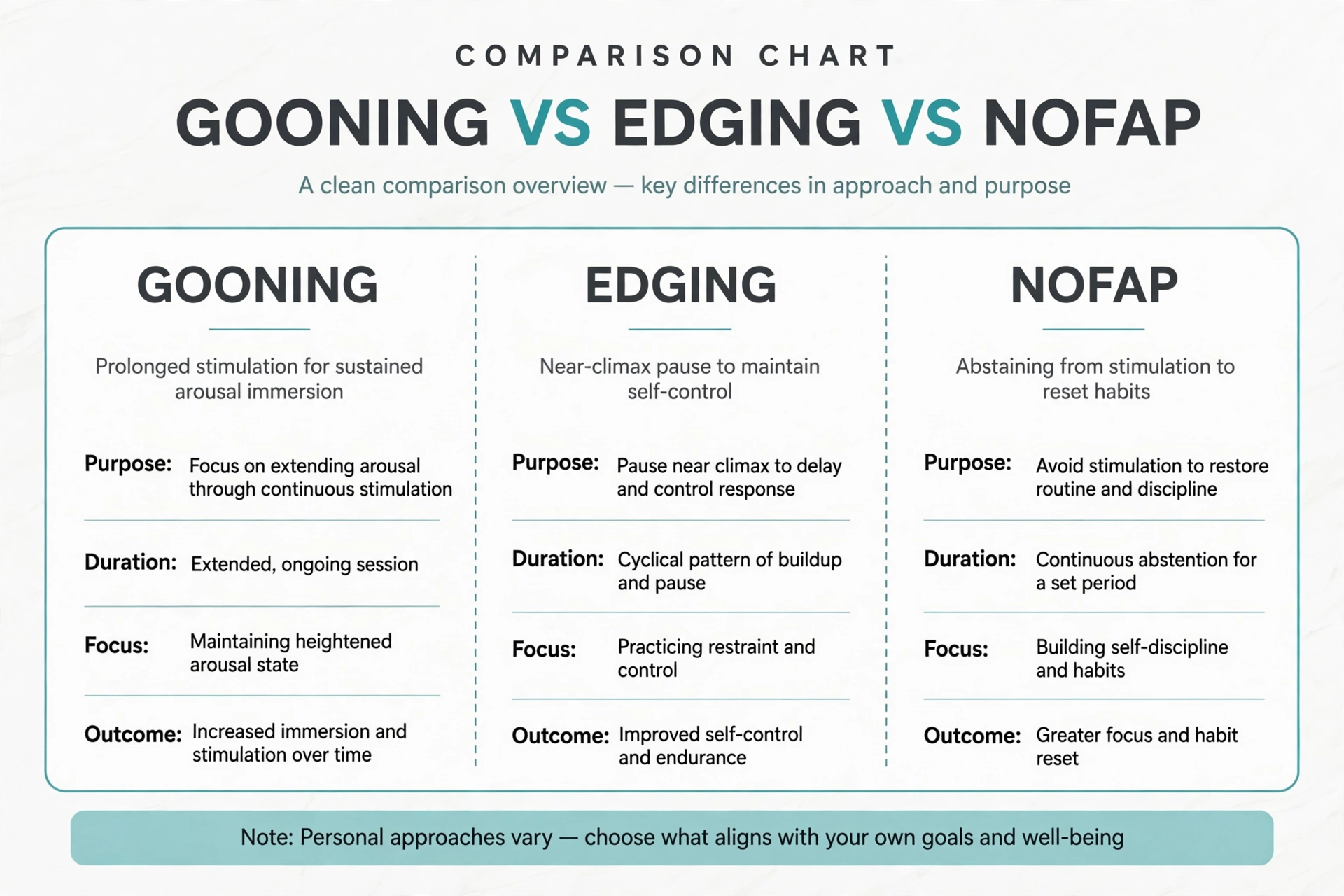
Gooning slang gets confused with several nearby terms. The differences matter, because each word describes a different thing.
| Term | What It Means | Key Difference from Gooning |
|---|---|---|
| Gooning | Long, immersive edging sessions aimed at a trance-like mental state (the goon state), often with pornography and a dedicated setup. | It is the full practice and the mindset — duration plus absorption. |
| Edging | The technique of approaching climax and backing off to delay it. | Edging is one technique inside gooning. A session can involve edging without being a gooning session, but gooning almost always involves edging. |
| NoFap | A movement and challenge built around abstaining from masturbation and pornography entirely. | The opposite direction: NoFap is about stopping, while gooning is about extending. |
| Cooming | Internet slang for orgasm or ejaculation, often used as a crude joke. | Cooming is about the finish. Gooning is about delaying the finish for as long as possible. |
| Goon state | The trance-like, absorbed headspace reported during a long session — narrowed focus, slowed sense of time. | This is the mental state gooning aims for, not the practice itself. |
| Gooner | A person who goons regularly or identifies with the community. | This is the identity label; gooning is the activity. |
| Bating | Short for masturbating; a casual, older piece of internet slang. | A general word for the act, with no implication of duration, trance, or community. |
The simplest way to remember it: edging is the technique, gooning is the session and the state, and the goon state is the destination. Everything else — goon caves, goon fuel, gooner identity — is culture built around that core idea.
Alternate Meanings
Gooning slang is not the only meaning attached to the root word, and the older meanings still cause confusion.
Acting goofy or silly. Because “goon” has meant a foolish person for nearly a century, “gooning around” can simply mean messing about, acting silly, or behaving like a clown. “Stop gooning around and help me move this box” has nothing to do with the adult meaning. This older sense is why the word can sound harmless — and why it catches people off guard when the adult meaning shows up instead.
A hired thug. In older crime slang, a goon was a hired muscle or enforcer. You will still see this in films and novels, though it is rare in everyday speech today.
Being zoned out or overstimulated. In Gen Z meme usage, gooning has broadened into a metaphor for any kind of overstimulation: doomscrolling for hours, binge-watching, or being unable to focus because the feed keeps pulling you back in. Health writers have noted this use too — young people describing themselves as “gooning” when they mean they feel mentally fried by constant digital stimulation, not anything literal.
The Australian twist. In Australia, “goon” is also slang for cheap boxed wine (“goon bag”), which has spawned its own jokes entirely unrelated to the internet meaning. If an Australian says they are “on the goon,” they are almost certainly talking about wine.
When you hear the word, ask two questions: who is speaking, and where? A meme page means the joke; an adult forum means the practice; an Australian at a barbecue means the wine.
Professional or Polite Alternatives
Because gooning slang is vulgar, there are many situations where you need a cleaner way to say the same thing — or to avoid the topic altogether.
- If you mean the practice: say “prolonged edging” or “extended arousal sessions.” Both are accurate, clinical, and safe to use in writing about health or internet culture.
- If you mean the mental state: say “a trance-like state of absorption” or “a flow state.” These describe the feeling without the slang.
- If you mean the joke sense: say “completely locked in,” “obsessed,” “zoned out,” or “lost in it for hours.” These carry the same energy in casual conversation with zero risk.
- If you are explaining it to someone: “It’s internet slang for a prolonged adult practice built around edging, and in memes it is also used jokingly to mean being totally absorbed in something.” That one sentence covers both meanings safely.
- If you are writing formally: define it once in neutral language, then use a neutral label such as “the practice” or “the subculture” for the rest of the piece.
The golden rule is simple: if you would not say it in front of your grandmother or your boss, do not say it in that room. The word’s shock value is part of its appeal online, and that same shock value is exactly what makes it a liability offline.
Common Mistakes
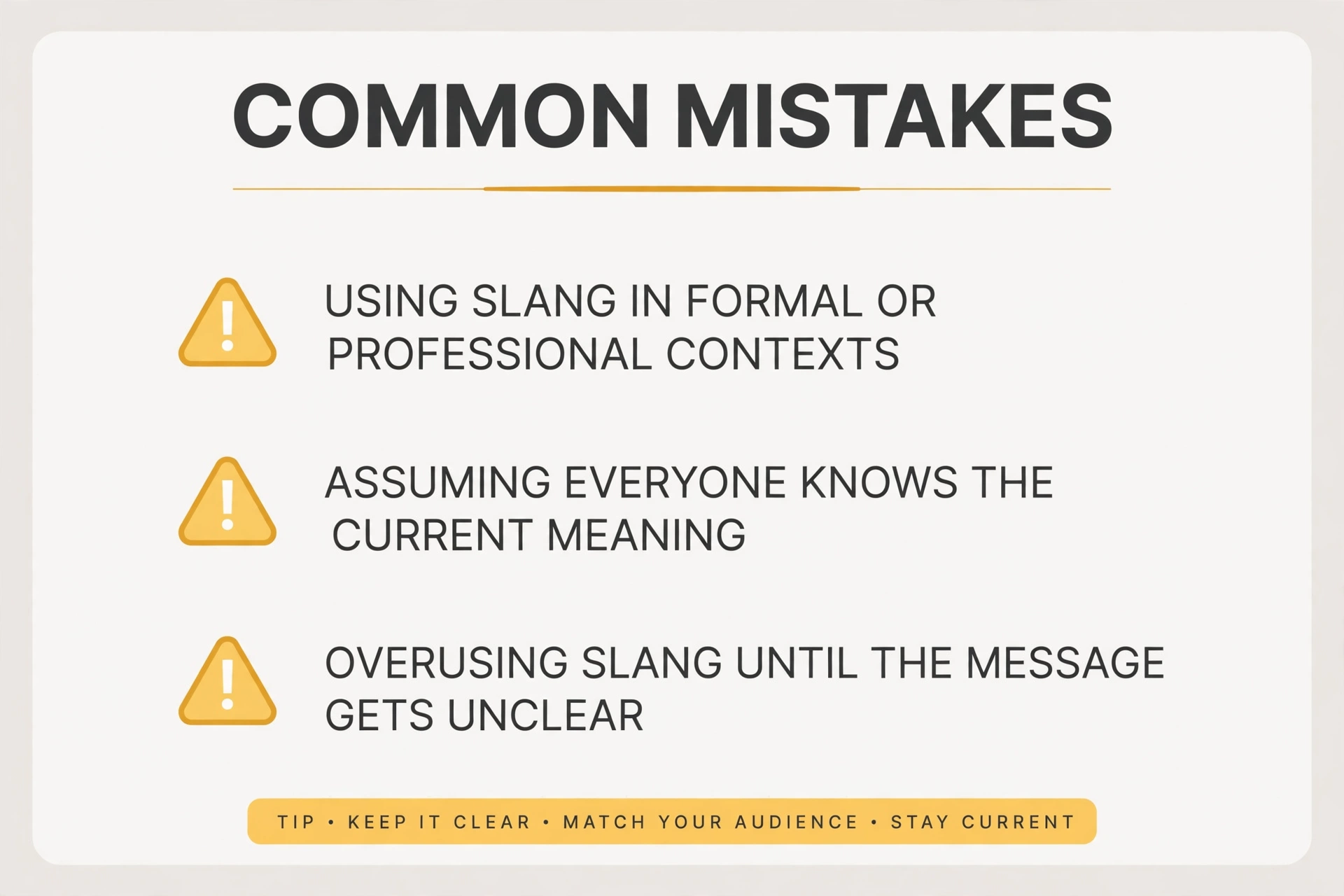
Most confusion around gooning slang comes from a handful of repeat mistakes. Avoid these and you will rarely misuse the word.
1. Using it at work or with family. This is the biggest mistake. The word sounds playful, so people assume it is harmless — then discover too late that their audience knows the adult meaning. Treat it as an internet-only word, and even there, check the room first.
2. Thinking it just means “being silly.” The older “goon” meaning is real, but it is no longer the dominant one online. If someone online says they were “gooning all night,” they almost certainly do not mean they were acting goofy.
3. Confusing gooning with edging. Edging is a technique that lasts minutes; gooning is a practice and a state that can last hours. They overlap, but they are not synonyms — a point the comparison table above makes clear.
4. Assuming everyone who says it is being literal. In meme culture, most uses are jokes. Taking a friend’s “I’ve been gooning over this game” literally will make the conversation very awkward, very fast.
5. Assuming it is harmless fun. The practice itself carries real risks that health sources flag: compulsive pornography use, addiction-like patterns, and sexual health effects such as difficulty with arousal or erectile dysfunction from excessive sessions. The community even jokes about this — but the health concerns are genuine, and several medical and psychological sources warn that constant overstimulation can affect attention, mood, and emotional regulation.
6. Repeating explicit detail. You do not need graphic descriptions to explain this word, and adding them does not make an explanation better — it makes it unshareable. The definition, the state, and the culture are enough.
7. Using it to describe a minor. Gooning slang is adult slang. Applying it to children or teenagers, even as a joke, is inappropriate. If a young person uses the word, the right response is a calm, factual explanation — not laughter, and not panic.
Quick Tips
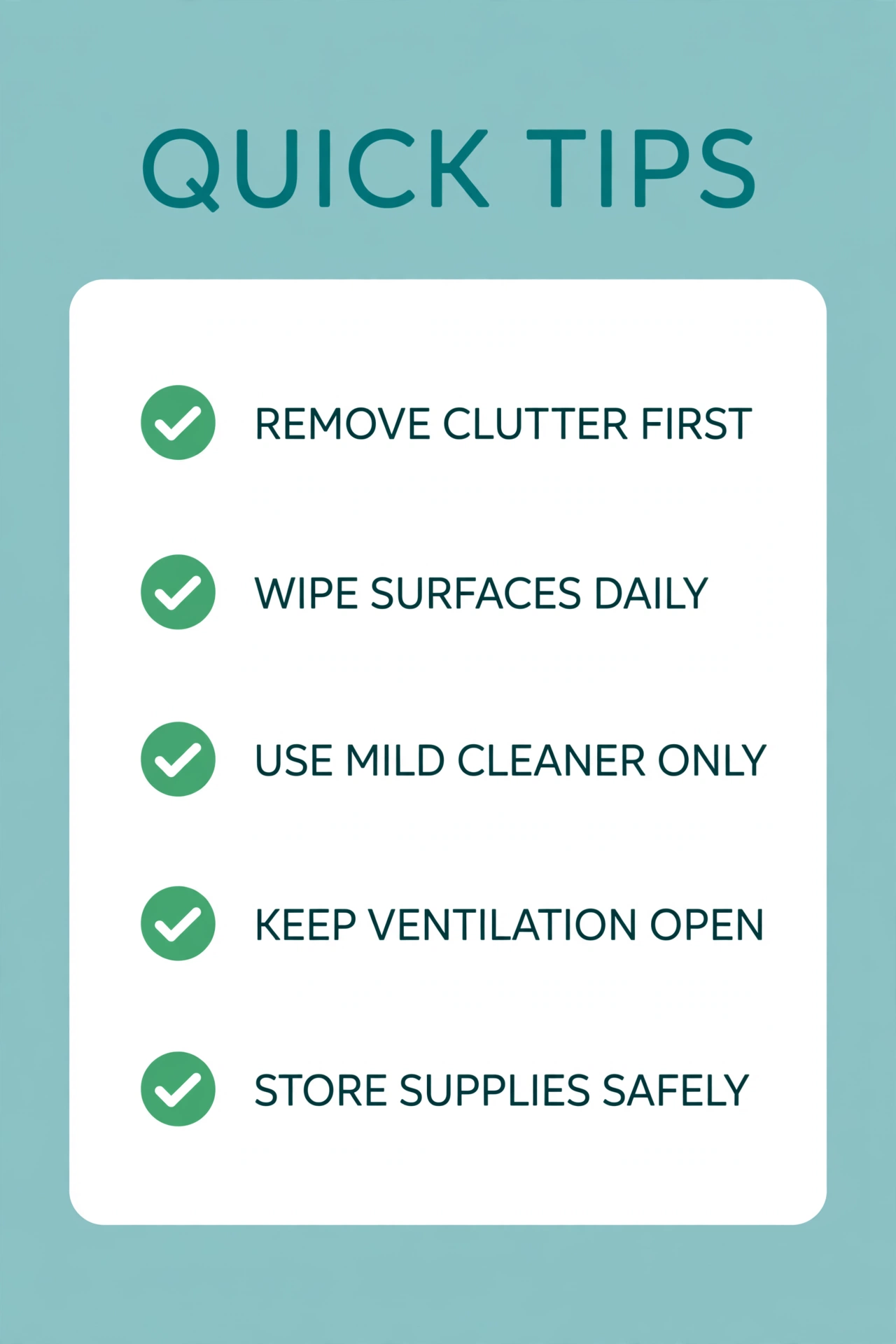
- Check the context first. Meme chat, adult forum, or Australian barbecue — the same word means three different things. Context is your best dictionary.
- When in doubt, do not say it. If you are unsure whether your audience knows the adult meaning, pick a cleaner alternative like “locked in” or “obsessed.”
- Remember the three layers. Practice, state, identity. If you can name which layer someone means, you understand the word.
- Do not confuse it with edging. Edging is the technique; gooning is the session and the trance.
- Keep explanations non-graphic. A plain definition is more useful — and more shareable — than explicit detail.
- Take the health warnings seriously. If long sessions are interfering with sleep, work, relationships, or mood, that is worth paying attention to, and support is available from health professionals.
- Use it for the joke, carefully. The meme use is the most common one today, but it only lands when everyone in the conversation is in on it.
- Learn the related words. Gooner, goon state, goon cave, goon fuel — knowing the family makes every individual term easier to decode.
FAQ
What does gooning slang mean?
Gooning slang refers to prolonged edging sessions aimed at reaching a trance-like mental state called the goon state, rather than climaxing quickly. In meme culture, it is also used jokingly to describe being totally absorbed in or obsessed with something for hours.
What is a gooner?
A gooner is a person who goons regularly or identifies with the online gooning community. The label works like a fan identity — it signals participation in the subculture, its jokes, and its vocabulary.
What is the goon state?
The goon state is the absorbed, trance-like headspace people report during a long session: narrowed attention, a slower sense of time, and a feeling of being switched off from everything outside the moment. It is the mental state gooning aims for.
What is the difference between gooning and edging?
Edging is a technique — approaching climax and backing off to delay it. Gooning is the broader practice and mindset: long, immersive sessions built around edging, with the goal of reaching the goon state. Edging is a part of gooning, but the two words are not interchangeable.
Where did gooning slang come from?
The term grew out of early internet forums in the 2000s, with the earliest Urban Dictionary definition appearing in 2005 and the practice often traced to 4chan communities. It comes from “goon,” old slang for a foolish or simple-minded person, and stayed in niche adult communities until memes and TikTok pushed it mainstream in 2022–2023.
Is gooning slang appropriate to use?
It depends entirely on the setting. Among close friends in an online meme chat, it is common. At work, school, or with family, it is inappropriate because of its vulgar adult meaning. When in doubt, use a cleaner alternative such as “locked in” or “obsessed.”
What is a goon cave?
A goon cave is community slang for a room set up for long sessions — dim lighting, a large screen, privacy, and snacks. In memes, the term is also used jokingly for any over-the-top gaming or viewing setup.
Is gooning bad for your health?
Health sources flag real risks from excessive sessions, including compulsive pornography use, addiction-like patterns, and sexual health effects such as erectile dysfunction or difficulty with arousal. Occasional discussion of the term is harmless, but if long sessions interfere with sleep, work, relationships, or mood, it is worth speaking to a health professional.
Conclusion
Gooning slang is a word with two faces: a specific adult practice built around long edging sessions and the trance-like goon state, and a loose Gen Z joke word for being completely absorbed in anything. It travelled from early internet forums and a 2005 dictionary definition to TikTok feeds and mainstream explainers, picking up a whole vocabulary — gooner, goon cave, goon fuel — along the way.
The key takeaway is context. The same sentence can be a joke, a literal description, or a serious health topic depending on who says it and where. Now that you know the definition, the origin, the difference from edging, and the common mistakes, you can read the word correctly wherever you meet it — and you know exactly when to leave it unsaid. If you found this guide useful, explore more slang explained in plain English, from delulu to sigma, and keep building your internet vocabulary the smart way.
