Quick definition: In slang, OD means “overdoing it” or “over the top.” It describes someone who is being excessive, dramatic, or extra — doing way more than the situation calls for. The term comes from “overdose,” but in everyday texting and social media, it almost never refers to drugs. When your friend says “you’re OD’ing,” they mean you are doing too much.
What Does OD Mean in Slang? Meaning & Definition
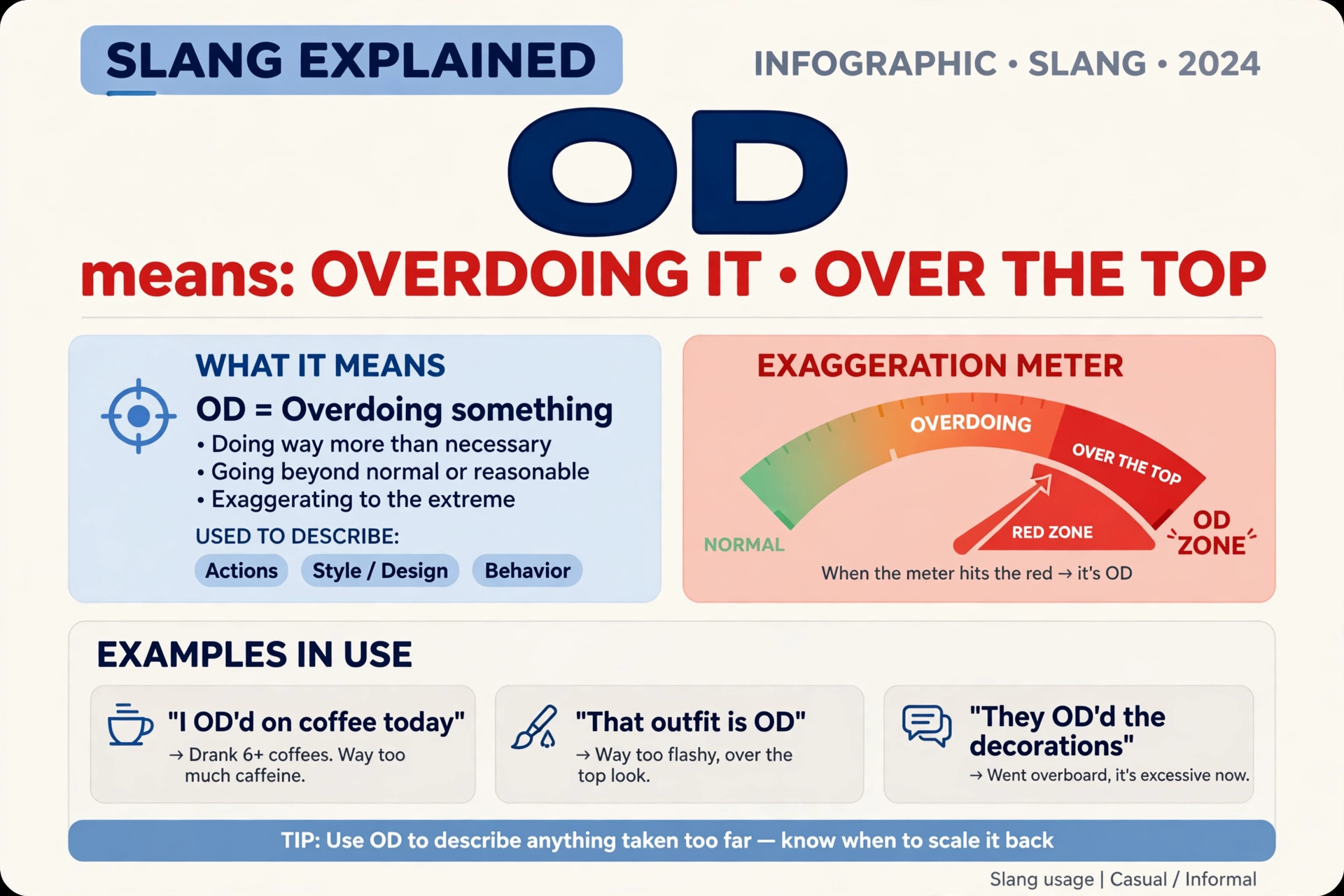
So, what does OD mean in slang? At its core, OD is short for “overdose,” but slang has stretched the word far beyond its medical roots. In texting, TikTok comments, group chats, and everyday conversation, OD means overdoing something, being extra, or going overboard. It works as both an adjective and a verb: you can say someone is “OD” (too much) or that they are “OD’ing” (overdoing it right now).
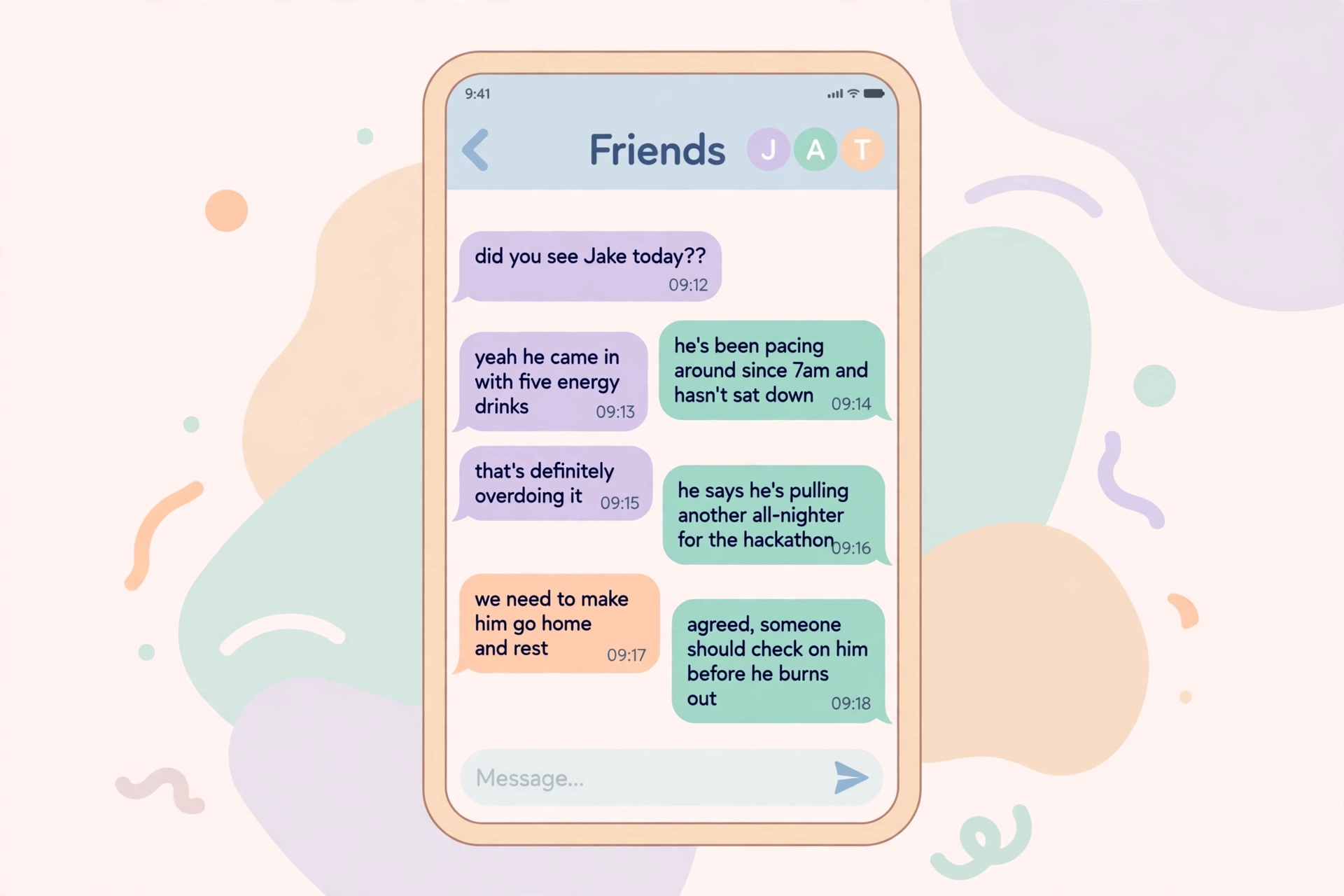
Here is the simplest way to remember it: if a reaction is bigger than the situation deserves, it is OD. A friend who cries over a slightly burnt toast? OD. A coworker who writes a five-paragraph email about a missing stapler? OD. A player who celebrates a routine goal like they won the World Cup? Definitely OD.
The word is flexible, too. It can be negative (“Bro, you’re OD’ing, chill”) or positive (“That concert was OD good” — meaning insanely, unbelievably good). Context and tone decide which one it is, which is exactly why this little two-letter abbreviation confuses so many people.
| Form | Meaning | Example |
|---|---|---|
| OD (adjective) | Excessive, over the top | “That party was OD lit.” |
| OD’ing / ODing (verb) | Overdoing it right now | “You’re OD’ing over a text.” |
| OD’d (past tense) | Went too far | “I OD’d on coffee this morning.” |
| OD (adverb) | Extremely, insanely | “She’s OD talented.” |
Introduction
Two letters. Endless confusion. If you have spent any time on TikTok, X (Twitter), Instagram, or even a family group chat, you have almost certainly seen someone type “OD” — and if you paused for even a second wondering what it meant, you are not alone. Slang moves fast, and OD is one of those terms that lives a double life: a serious medical word on one side and a playful exaggeration on the other.
That double life is what makes OD tricky. In a hospital, OD means overdose, and it is a medical emergency. In a group chat, OD means your friend is being dramatic about a video game loss. Same letters, completely different stakes. Knowing which meaning applies is a skill every modern texter needs, because using the wrong one at the wrong time can turn an awkward moment into a genuinely uncomfortable one.
In this guide, we break down everything about OD: where it came from, how it spread from New York street slang to global TikTok culture, how to use it naturally in texts, how it compares to similar slang like “extra” and “doing the most,” and the mistakes to avoid. By the end, you will read OD like a native speaker — and use it without second-guessing yourself.
And if you enjoy decoding internet abbreviations, you will probably like our guide to DP meaning in slang too — another two-letter term with more meanings than you would expect.
Origin
OD began life as a medical abbreviation. “Overdose” — taking more of a drug or medicine than the body can safely handle — has been documented in English since the early 20th century, and doctors shortened it to “OD” in clinical notes and emergency-room shorthand. For decades, that was the only meaning that mattered.
The slang meaning grew out of American street culture, particularly in New York City hip-hop communities in the 1990s and 2000s. Rappers and young people in the city started using “OD” metaphorically: if an overdose is taking something to a dangerous extreme, then a person who takes anything to an extreme — anger, excitement, fashion, confidence — is “OD’ing.” The word kept its sense of excess but dropped the medical danger.
Hip-hop lyrics carried the term across the country. By the 2010s, OD was showing up in rap verses, memes, and Vine clips as shorthand for “too much.” Then texting and social media did the rest. Short, punchy, and expressive, OD was perfect for character-limited platforms, comment sections, and fast group chats. TikTok sealed the deal in the 2020s: creators used “OD” in captions and voiceovers to describe anything over-the-top, from outfits to reactions to plot twists, and millions of viewers absorbed the meaning without ever looking it up.
That journey — from hospital charts to rap lyrics to TikTok captions — is a classic slang pipeline. A technical term gets borrowed, bent into a metaphor, and then polished by the internet into everyday language.
Popularity
OD is now firmly mainstream in US internet culture. It appears constantly on TikTok, Instagram Reels, X, Snapchat, and Reddit, and it has crossed from online spaces into spoken conversation among Gen Z and Millennials. You will hear it in classrooms, locker rooms, gaming lobbies, and offices where younger coworkers set the tone.
Several things keep OD popular. First, it is short — two letters that replace a whole phrase like “you are overreacting.” Second, it is versatile: it works as a joke, a warning, a compliment, and a criticism. Third, it carries attitude. Saying “that’s OD” hits harder than saying “that’s excessive,” because it sounds like something a real person would say, not something from a textbook.
Search interest in the term has stayed strong because new users keep encountering it for the first time — in song lyrics, in a friend’s text, in a viral video — and looking it up. Unlike flash-in-the-pan slang that vanishes in a month, OD has survived for years because its meaning is genuinely useful: every language needs a quick way to say “too much,” and OD fills that gap better than almost any other word.
How It Is Used
OD shows up in a few reliable patterns. Learning them will help you spot the meaning instantly, even in a fast-moving chat.
1. Calling out overreactions. This is the most common use. When someone’s response is wildly out of proportion, OD names it: “You’re OD’ing, it was just a joke.” It is a light way to say “calm down” without sounding preachy.
2. Describing excess. OD can describe anything taken too far — food, spending, working out, partying, studying. “I OD’d on tacos last night” means you ate far too many. Nobody thinks you need medical attention; they know you are exaggerating for comic effect.
3. As an intensifier. Placed before an adjective, OD means “extremely” or “insanely.” “That movie was OD good” means it was amazing. “He’s OD rich” means very rich. In this role it works like “mad,” “hella,” or “super” — pure emphasis.
4. As a warning. Friends use OD to flag behaviour before it becomes a problem: “Don’t OD on the drinks tonight.” Here it sits closer to its original sense — a friendly nudge toward moderation.
5. As a joke about effort. Gamers, athletes, and students use OD to tease someone who is trying too hard: “Bro is OD’ing in ranked, relax.” It is competitive trash talk, not an insult.
The tone is almost always casual and playful. OD belongs in chats with friends, comments, captions, and spoken slang — not in a job application or a formal email. And like other slang, it lands best when the people around you already use it. If you want to see how another short slang term behaves the same way, check out our breakdown of SOL meaning in slang.
Examples
Real examples make the meaning click. Here is how OD sounds in everyday conversations, sorted by tone.
Friendly Examples
- “You OD’d on the decorations, the house looks amazing!” — a compliment wrapped in exaggeration.
- “I’m OD’ing on this new song, it’s been on repeat all day.” — loving something too much, in a good way.
- “She went OD with the birthday surprise, there were balloons everywhere.” — praise for going above and beyond.
- “We OD’d on snacks for movie night and I regret nothing.” — playful self-mockery.
Professional Examples
OD is casual slang, so it rarely belongs in formal work settings — but it does appear in relaxed workplace chats and creative teams:
- “Let’s not OD on the slides, ten is enough for this pitch.” — a polite way to say “keep it simple.”
- “He OD’d on the report, it’s 40 pages for a 10-minute meeting.” — gentle criticism of overkill.
- “The client loved the design, but the animations were a bit OD.” — soft feedback in a creative review.
- “Don’t OD on the caffeine before the presentation.” — friendly advice between coworkers.
Rule of thumb: if you would not say “extra” to your boss, do not say “OD” either. Save it for teammates you joke with.
Funny Examples
- “My grandma OD’d on the food again — she cooked for 20 people and there are 6 of us.”
- “Bro OD’ing over a parking spot like it’s the last one on Earth.”
- “I said one compliment and now he’s OD’ing like I proposed.”
- “She OD’d on the filter, she looks like a cartoon character.”
- “He OD’d on cologne, I could smell him from the parking lot.”
Notice the pattern: every example follows the same formula — a normal thing, pushed way past normal. That formula is the whole meaning of OD in one sentence.
Comparison with Similar Terms
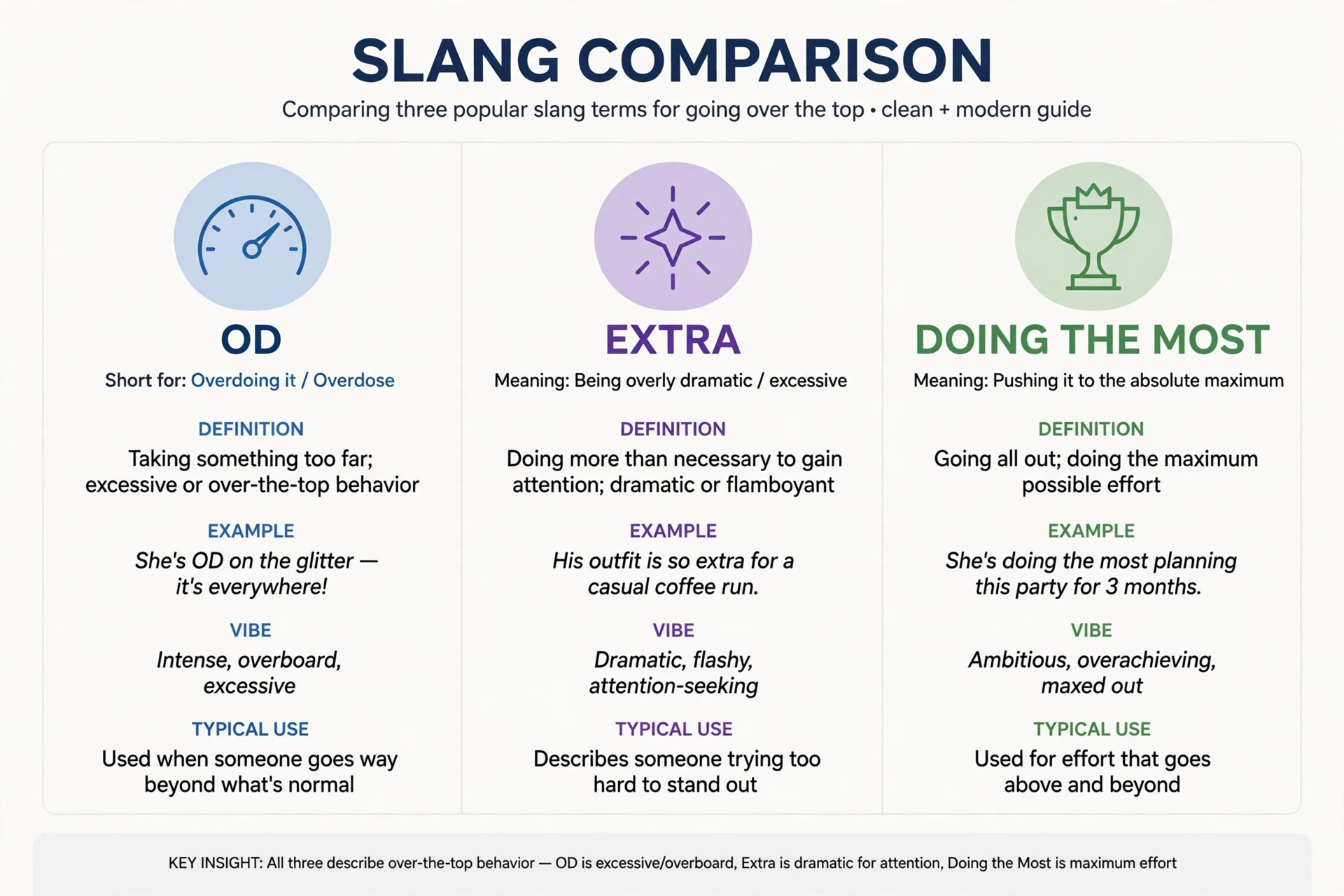
OD overlaps with several other slang words, but each one has its own flavour. Picking the right word matters if you want to sound natural.
| Term | Meaning | How It Differs from OD |
|---|---|---|
| Extra | Dramatic, over the top | Describes a person’s style or personality; OD describes the amount or intensity of an action. |
| Doing the most | Trying too hard | Focuses on effort and attention-seeking; OD is broader and can be positive too. |
| Overkill | Way more than necessary | More formal and usually negative; OD is casual and can praise excess. |
| Bougie / Boujee | Fancy, high-maintenance | About luxury and taste, not about quantity or intensity. |
| Mad / Hella | Very, extremely | Pure intensifiers; OD adds the idea of “too much,” not just “a lot.” |
| Trippin’ | Overreacting, acting crazy | Implies the person is being irrational; OD just says the reaction is too big. |
The closest cousin is “extra.” The difference is subtle: “She’s so extra” judges a person’s whole vibe, while “She’s OD’ing” judges one specific moment. You can be extra without OD’ing, and you can OD without being an extra person. Similar slang terms travel in packs — if you liked this comparison, our guide to unc slang meaning breaks down another term that confuses people the same way.
Alternate Meanings
Context is everything with OD, because these two letters wear many hats. Here are the main alternate meanings you might run into.
| Context | What OD Means | Example |
|---|---|---|
| Medicine / health | Overdose — taking a dangerous amount of a drug | “Call 911, I think he OD’d.” |
| Eye care / optometry | Oculus dexter — Latin for “right eye,” used on prescriptions | “OD -2.00” on a glasses prescription |
| Work / security | On duty | “Who’s OD tonight?” (who is on shift) |
| Business / HR | Organizational Development | “She works in OD at the head office.” |
| Sports | On deck (baseball) — the next batter up | “You’re OD after this inning.” |
| Slang / texting | Overdoing it / over the top | “You’re OD’ing, relax.” |
The medical meaning deserves respect. In a serious conversation about drugs, health, or an emergency, OD means overdose — full stop. The slang meaning never applies there, and joking about it in that context would be tone-deaf at best. If someone says a person “OD’d” and the conversation is about pills, hospitals, or an ambulance, treat it as the medical emergency it is and call for help. For the clinical definition of an overdose, see Merriam-Webster’s definition of overdose.
The eye-prescription meaning surprises most people. “OD” on a glasses or contact-lens prescription comes from the Latin oculus dexter, meaning “right eye” (OS, oculus sinister, is the left). If you ever see OD on paperwork from an eye doctor, it has nothing to do with slang at all.
Professional or Polite Alternatives
Sometimes OD is too casual, too vague, or too risky for the room you are in. Here are polished replacements for each slang use:
- Instead of “You’re OD’ing” (overreacting): “I think that reaction might be a bit strong for the situation.” / “Let’s take a step back here.”
- Instead of “That’s OD” (excessive): “That seems a bit excessive.” / “That might be more than we need.”
- Instead of “OD good” (amazing): “That was outstanding.” / “That was truly exceptional.”
- Instead of “I OD’d on coffee” (too much): “I had far too much coffee this morning.” / “I overdid it with the coffee.”
- Instead of “Don’t OD” (warning): “Let’s keep it in moderation.” / “Let’s not go overboard.”
The polite versions lose the punch and humour of OD, but they keep you safe in emails, meetings, classrooms, and conversations with people who do not speak internet slang. Good communication is about matching your words to your audience — and knowing when to swap OD for “excessive” is exactly that skill.
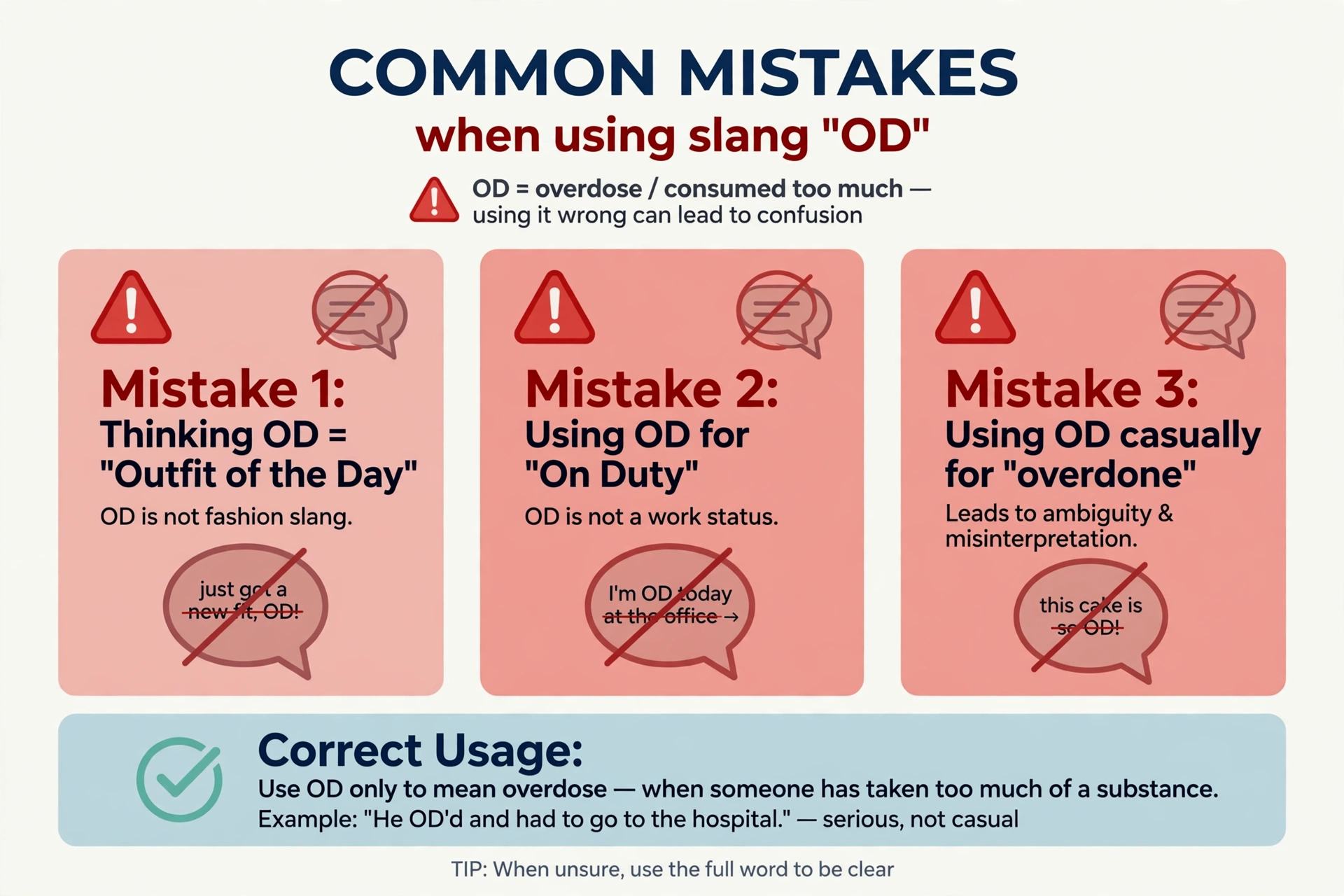
Common Mistakes
OD is easy to use and easy to misuse. These are the mistakes people make most often:
1. Thinking OD always means a drug overdose. In slang contexts it rarely does. If your friend texts “I OD’d on pizza,” they are joking about eating too much — not confessing to a medical crisis. Read the room before panicking.
2. Using OD in serious medical conversations. The reverse mistake is worse. Never use the slang meaning when someone is talking about a real overdose, addiction, or emergency. The word carries weight there, and casual use comes across as careless.
3. Using OD with people who don’t know the slang. Older relatives, formal colleagues, and non-native English speakers may only know the medical meaning. Dropping “you’re OD’ing” on them can cause genuine confusion — or alarm. Check your audience first.
4. Overusing it until it loses meaning. If everything is OD, nothing is. Save it for moments that are actually over the top, and it stays funny. Spam it in every sentence and it becomes noise.
5. Confusing OD with “OD’d” in the past tense. “He OD’d” in a news headline means a drug overdose. “He OD’d on tacos” in a group chat means he ate too many tacos. Same verb, wildly different stakes — the sentence around it decides.
6. Using OD as a compliment to strangers. “You’re OD fine” might sound like praise to you, but to someone who doesn’t know the slang it reads as strange or even alarming. Keep the compliment version for friends who speak the same slang.
Quick Tips
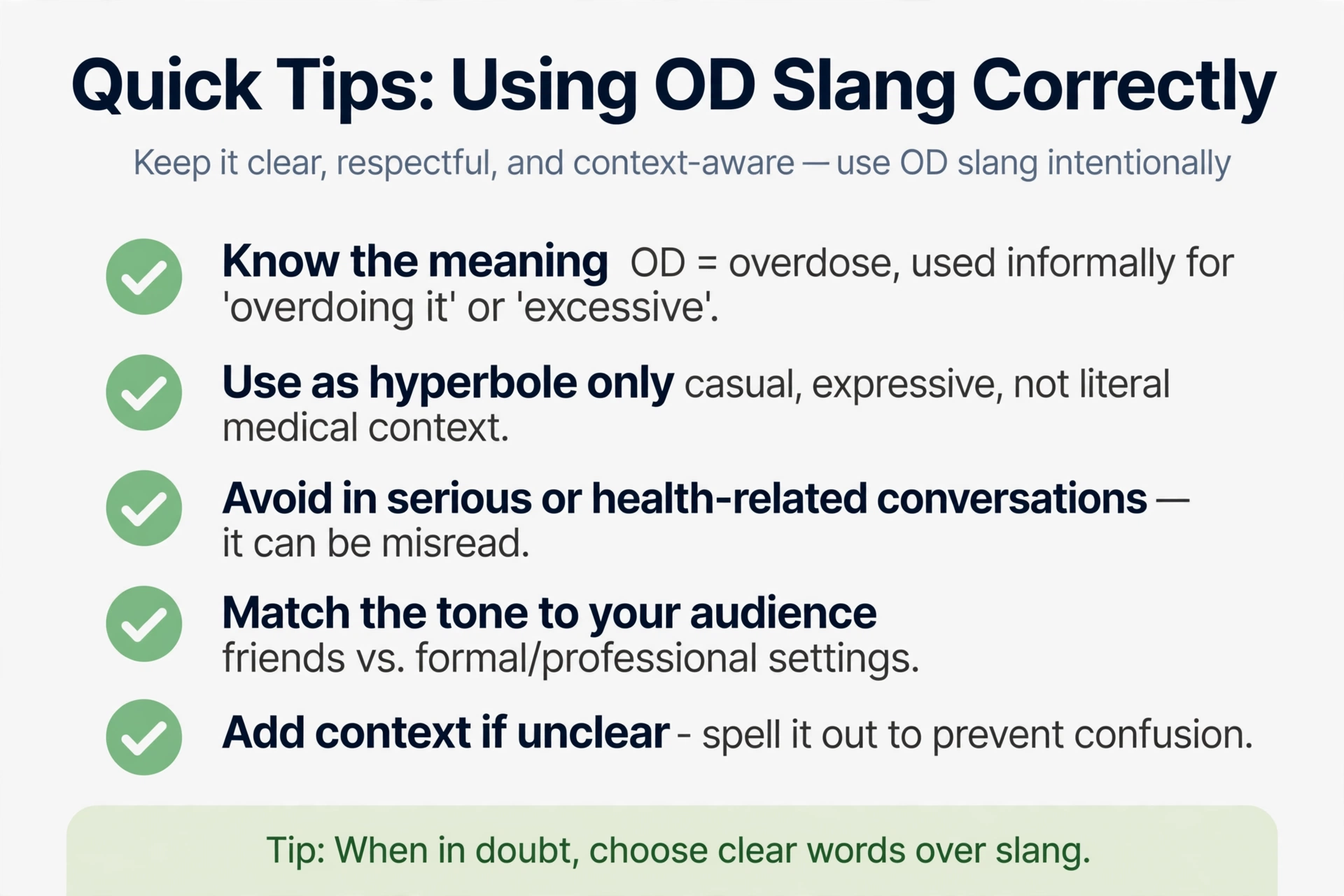
- Check the context first. Medical, emergency, or drug-related conversation? OD means overdose. Group chat, TikTok, or a joke? It means overdoing it.
- Use it to defuse, not to attack. “You’re OD’ing” works best as a light nudge between friends, not as an insult in an argument.
- Pair it with specifics. “You’re OD’ing over a parking spot” is funnier and clearer than just “You’re OD’ing.”
- Try the verb form. “OD’ing” and “OD’d” sound more natural in conversation than the bare adjective.
- Don’t force it. If OD doesn’t come naturally to you yet, use “extra” or “over the top” until it does. Forced slang is worse than no slang.
- Keep it casual. OD belongs in texts, chats, comments, and spoken slang — not in resumes, formal emails, or school essays.
- Remember the positive side. OD isn’t always criticism. “OD good,” “OD talented,” and “OD funny” are genuine compliments.
- When in doubt, ask. If someone texts you “OD” and you can’t tell which meaning they intend, a quick “you mean overdoing it?” clears it up in seconds.
FAQ
1. What does OD mean in texting?
In texting, OD means “overdoing it” or “over the top.” It describes someone whose reaction, behaviour, or effort is excessive compared to the situation — for example, “You’re OD’ing over one text” means “You’re overreacting to one message.”
2. What does OD mean in slang on TikTok?
On TikTok, OD usually means “extremely” or “insanely.” Creators use it as an intensifier — “that fit is OD clean” means the outfit is incredibly stylish — and to call out over-the-top reactions in videos and comments.
3. Does OD always mean overdose?
No. In medical and news contexts, OD does mean overdose, and that meaning is serious. But in casual slang, texting, and social media, OD almost always means “overdoing it.” Context tells you which one applies.
4. What does “OD’ing” mean?
“OD’ing” is the verb form of OD. It means someone is overdoing something right now — overreacting, trying too hard, or going too far. Example: “He’s OD’ing in the game chat” means he’s being way too intense about the game.
5. What does OD mean from a guy or a girl?
The meaning doesn’t change by gender. From anyone, OD in a casual chat means “overdoing it” or “too much.” The speaker’s tone and the situation matter far more than who is texting.
6. Is OD rude or offensive?
Usually not — it’s playful teasing between friends. But it can sting if used to mock someone’s genuine feelings, and it is inappropriate in serious conversations about drugs or overdose. Use it lightly, and never as a weapon.
7. What does OD mean on a glasses prescription?
On an eye prescription, OD stands for the Latin oculus dexter, meaning “right eye.” It tells the optician which lens correction applies to your right eye. This has nothing to do with slang or medicine.
8. How do you reply when someone says you’re OD’ing?
Keep it light: “Okay okay, I’ll chill 😅” or “Am I? Maybe a little.” If you disagree, laugh it off: “Nah, I’m just passionate.” The best reply matches the playful tone — don’t get defensive, and don’t escalate.
Conclusion
So, what does OD mean in slang? In one sentence: OD means overdoing it — being extra, excessive, or over the top. It started as medical shorthand for overdose, travelled through New York hip-hop culture, and landed in the group chats and TikTok feeds of millions of people. Today it is one of the most useful little words in internet slang, because it packs a whole judgement — “that was too much” — into two letters.
The key to using OD well is context. In a joke, a text, or a comment, it means someone went too far — and it is usually funny. In a hospital, a news report, or any conversation about drugs, it means overdose, and it is deadly serious. Learn to tell the difference, use it sparingly, and save it for moments that genuinely deserve it.
Next time a friend loses it over a delayed reply, a burnt pizza, or a video game loss, you will know exactly what to say: “Bro, you’re OD’ing. Relax.” And now you will know exactly why it works.
Want to keep decoding internet slang? Check out our guide to aura slang meaning — another term TikTok made famous that confuses almost everyone at first.
