Quick definition: 60s slang is the informal vocabulary of the 1960s — words and phrases like groovy, far out, and right on that young people, hippies, musicians, and surfers used to say something was cool, amazing, or worth agreeing with. Today, 60s slang survives as a nostalgic snapshot of a decade defined by rock music, the counterculture, and the fight for peace and civil rights.
60s Slang Meaning & Definition
When someone talks about 60s slang, they mean the casual, colorful language that exploded across the United States and Britain during the 1960s. It was the vocabulary of teenagers, college students, folk singers, rock bands, surfers, beatniks, and hippies — a whole generation that wanted its own way of talking, separate from the formal English of their parents.
At its core, 60s slang did three things. First, it judged things: groovy, boss, and outta sight all meant “excellent.” Second, it described people: a square was boring and conventional, a cat was cool, and a fox was attractive. Third, it built community — using the right words signaled that you belonged to the scene, whether that scene was a beach in California, a coffeehouse in Greenwich Village, or a dance floor in London.
Unlike internet slang today, which spreads through screens in hours, 60s slang traveled through vinyl records, radio, television shows like Rowan & Martin’s Laugh-In, and movies. A word could start in a jazz club, get picked up by a band, and end up in everyday conversation within months.
Some of the most famous examples of 60s slang include:
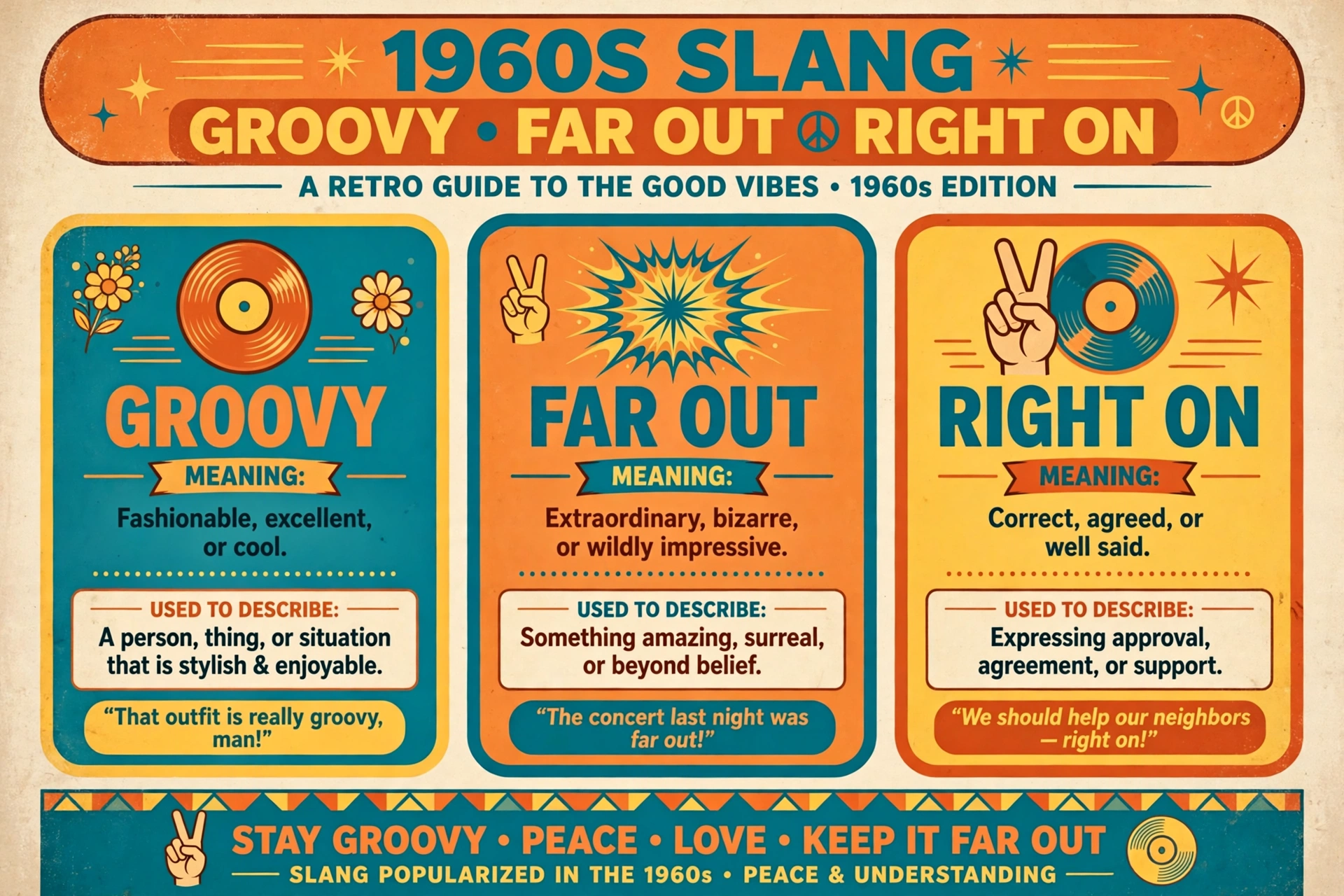
- Groovy — cool, excellent, or wonderful
- Far out — amazing, unbelievable, mind-blowing
- Right on — exactly right, I completely agree
- Square — someone conventional, boring, or out of touch
- Bummer — a disappointment or an unpleasant experience
- Bread — money
- Pad — your home or apartment
- Dig — to understand or enjoy something
- Fuzz — the police
- Flower power — the hippie philosophy of peace and love
Many of these words are still understood today, even by people who were born decades later. That staying power is exactly why the language of the sixties remains so fascinating — it was not just slang, it was the sound of a generation finding its voice.
Introduction
Picture a summer evening in 1967. The radio is playing The Beatles, someone’s transistor crackles with The Doors, and a group of teenagers is hanging out on the corner. One of them says the new record is “groovy,” another calls the light show “far out,” and a third answers “right on, man.” Nobody needs a dictionary. Everybody knows exactly what those words mean.
That is the magic of 60s slang. It was playful, musical, and rebellious all at once, and it captured the spirit of a decade that changed the world. The 1960s gave us the civil rights movement, the space race, the British Invasion, Woodstock, and the counterculture — and every one of those moments had its own vocabulary.
In this guide, you will learn what 60s slang means, where it came from, how it was used in real conversations, and which words are still worth knowing today. Whether you are writing a story set in the sixties, trying to understand your grandparents’ stories, or just love retro language, this is the complete guide to the grooviest words of the decade.
Origin
60s slang did not appear out of nowhere. It grew out of several streams of American and British culture that collided in the early 1960s.
Jazz and African American Vernacular English. Many of the decade’s most famous words started in jazz clubs and Black communities years earlier. “Groovy” came from the groove of a vinyl record — when the needle sat “in the groove,” the music sounded smooth and right. “Far out” was used by jazz musicians to describe music that pushed boundaries. “Dig,” meaning to understand, and “cat,” meaning a cool person, both traveled from jazz culture into mainstream teen speech.
The beatniks. In the late 1950s, beatnik poets and coffeehouse crowds in San Francisco and New York were already using words like “square” for conformists and “pad” for an apartment. The sixties inherited that vocabulary and made it mainstream.
Surfer culture. California surfers contributed laid-back words like “mellow,” “hang loose,” and “bogus” (meaning bad or fake). Their relaxed attitude matched the words themselves — short, easy, and unbothered.
British Mod culture. Across the Atlantic, London’s Mod scene gave the decade words like “mod” itself (short for modernist), “fab” (fabulous), and “gear” (great or excellent). The Beatles and other British bands carried those words to American teenagers through the British Invasion.
Television and comedy. Shows like Rowan & Martin’s Laugh-In turned slang into national catchphrases. “Sock it to me” and “you bet your sweet bippy” entered living rooms across America, and teenagers repeated them the next day at school.
By the middle of the decade, these streams had merged into a single shared vocabulary. A kid in Ohio and a kid in London might dress differently, but they both knew what “groovy” meant.
Popularity
60s slang peaked between 1965 and 1969, the years when youth culture dominated music, fashion, and film. Several forces pushed it into the mainstream.
First, rock music. Bands like The Beatles, The Rolling Stones, The Beach Boys, and Jefferson Airplane used slang in their lyrics, interviews, and album titles. When millions of teenagers sang along, the words stuck.
Second, movies and television. Films about surfers, bikers, and hippies made slang sound glamorous and fun. Laugh-In alone introduced dozens of phrases to a weekly audience of tens of millions.
Third, the counterculture. The hippie movement, the anti-war movement, and the civil rights movement all needed language that felt fresh and separate from the establishment. Slang became a badge of identity — using it said, “I am part of this moment.”
The words also crossed the Atlantic in both directions. American teenagers picked up British words like “fab” and “gear,” while British kids adopted American words like “cool cat” and “right on.”
By the 1970s, some of the words faded — “sock it to me” now sounds like a museum piece — but the most useful ones survived. “Bummer,” “mellow,” “cool,” “dig,” and “groovy” are still understood today, and “groovy” even enjoys an ironic second life in memes, movies like Austin Powers, and retro-themed parties. The slang of the sixties never really died; it just became part of the permanent vocabulary of English.
How It Is Used
60s slang was spoken language first and written language second. It showed up in conversation, song lyrics, and dialogue far more than in formal writing, and its meaning often depended on tone and context.
To praise something. The most common use was approval. “That’s groovy.” “That concert was far out.” “Her new dress is boss.” One word could replace a whole sentence of praise.
To agree. “Right on” was the sixties version of “exactly” or “100%.” It could stand alone as a complete reply: “We should all go to the festival.” “Right on, man.”
To describe people. Labels were quick and vivid. A “square” was someone stuck in the old ways. A “cat” was someone cool. A “fox” was someone attractive. A “hippie” was part of the counterculture, while a “fuzz” was the police.
To talk about everyday life. Slang covered money (“bread”), home (“pad”), clothes (“threads”), leaving (“split”), and trouble (“bummer”). Instead of saying “I don’t have any money,” a teenager in 1967 might say “I’m out of bread.”
To set a mood. Words like “mellow” and “hang loose” were not just descriptions — they were instructions. They told everyone to relax, slow down, and not take things too seriously.
Importantly, 60s slang was rarely used in formal settings. You would not use it in a job interview, a letter to your teacher, or a conversation with a strict parent. That was the point: the slang belonged to young people, and keeping it out of adult spaces was part of its charm.
Examples
The best way to understand 60s slang is to see it in action. Here are real-world style examples from friendly chats, professional situations, and funny moments.
Friendly Examples
- “That new Beatles record is groovy! I have played it ten times today.”
- “Are you coming to the beach party?” “Right on, man. I will bring my guitar.”
- “Wow, your new threads are outta sight. Where did you get them?”
- “Let’s split after the movie and hang at my pad.”
- “I dig your style — that jacket is boss.”
- “Don’t be a square, come dance with us!”
Professional Examples
Slang rarely appeared in formal workplaces in the sixties, but it did show up in creative industries — music, advertising, fashion, and radio. A DJ might introduce a song like this:
- “Here is a far-out new track from The Doors, and it is going to blow your mind.”
- “This week’s grooviest record comes straight from London.”
A record-store clerk might say, “That album is heavy, man — you have to hear the last track.” In those settings, slang was a sign of being plugged into youth culture, which was exactly what the audience wanted. A quick note: even in the sixties, you would not use words like “groovy” or “far out” in a formal business letter — they were casual by design.
Funny Examples
- “Mom, can I have some bread?” “We have a whole loaf in the kitchen, dear.” “No, Mom — bread means money!”
- “Here comes the fuzz!” “Why are you scared of a sweater?”
- “You bet your sweet bippy I am going to the concert.” (Thanks, Laugh-In.)
- “I told my grandma her hat was groovy and she said, ‘Thank you, dear, I got it on sale.'”
- “That party was a real bummer — the record player broke during the best song.”
These examples show why the slang worked: it was short, musical, and a little bit cheeky. A single word like “bummer” could carry a whole story of disappointment, and “right on” could carry a whole speech of agreement.
Comparison with Similar Terms
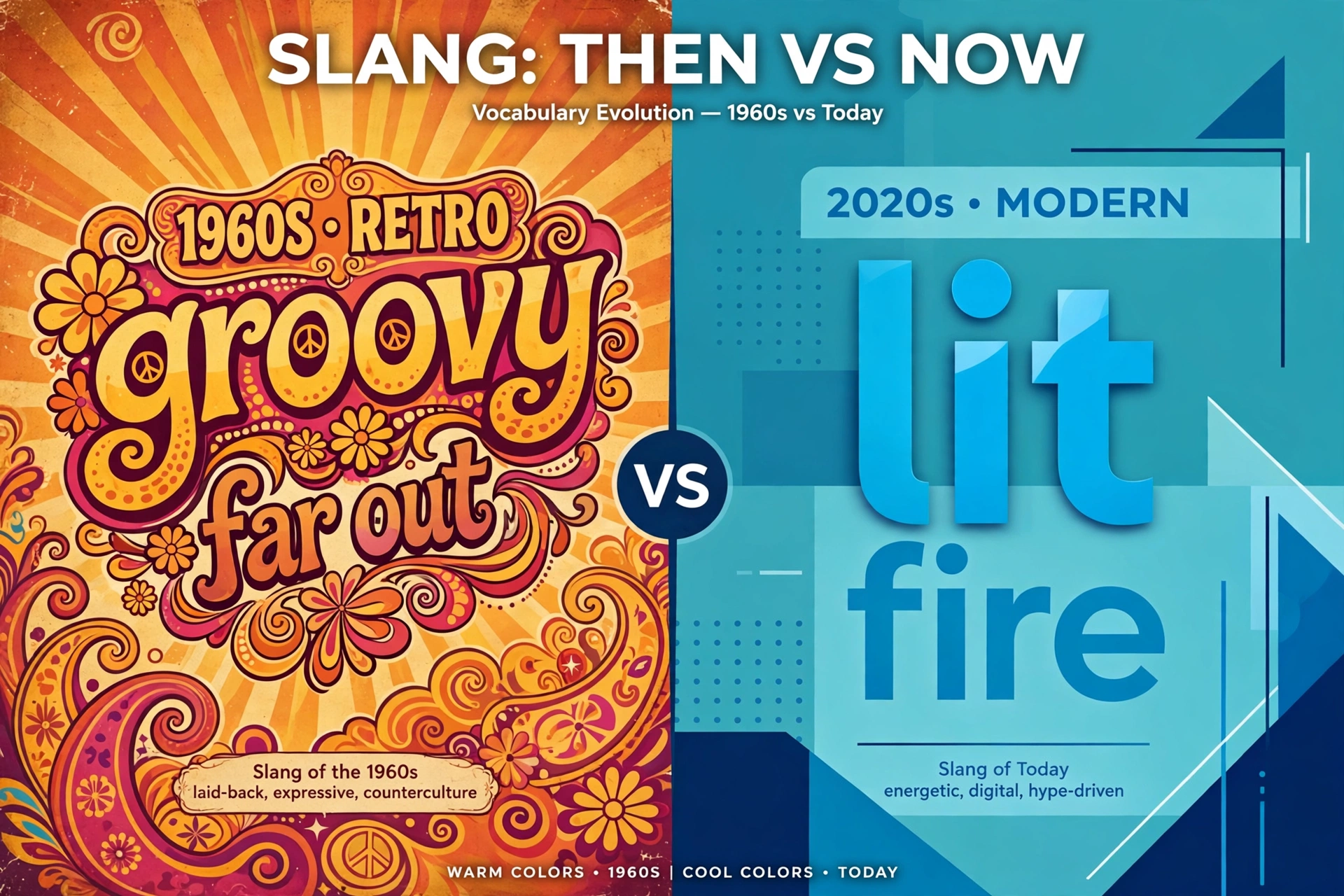
60s slang overlaps with slang from other decades, but each era has its own flavor. The table below compares the most famous 60s words with their equivalents from the 1920s, the 1970s, and today, so you can see how the language of “cool” keeps reinventing itself. If you enjoy decade slang, our guide to 1920s slang covers the jazz-age words that started it all, and the slang of the sixties is a direct descendant of that era’s playful vocabulary.
| Meaning | 60s Slang | 1920s Slang | 1970s Slang | Modern Equivalent |
|---|---|---|---|---|
| Cool / excellent | Groovy | The bee’s knees | Rad | Lit / fire |
| Amazing | Far out | Swell | Awesome | Insane / wild |
| I agree | Right on | You said it | You got it | Exactly / facts |
| Money | Bread | Dough | Bucks | Cash / bag |
| Home | Pad | Joint | Crib | Place / spot |
| Police | Fuzz | Coppers | Pigs | Five-O |
| Leave | Split | Scram | Jet | Dip / bounce |
| Understand | Dig | Get it | Dig (continued) | I feel you |
| Disappointment | Bummer | Too bad | Drag | That’s rough |
| Attractive person | Fox | Sheba | Fox (continued) | Fine / a snack |
Notice the pattern: every generation invents new words for the same handful of ideas — approval, money, home, authority, and attraction. The 60s versions are special because so many of them survived. “Dig,” “fox,” “bummer,” and “cool” all outlived their decade, while most 1920s words like “the bee’s knees” now sound like costumes. For a broader look at how modern slang phrases work, see our guide to fn meaning in text — today’s texting slang follows the same pattern of short, punchy words that the sixties perfected.
The other difference is tone. 1920s slang was witty and elegant; 70s slang was laid-back and funky; modern slang is fast and ironic. 60s slang was optimistic. Words like “flower power” and “peace” were not just slang — they were a worldview.
Alternate Meanings
Some 60s slang words have other meanings, so context matters.
- Groovy: In music, it still describes a song with a strong, smooth rhythm. A “groovy bassline” is a compliment in any decade.
- Heavy: In the sixties, “heavy” meant serious or intense (“That speech was heavy, man”). Today it can also mean emotionally difficult, which is close to the original sense.
- Mellow: Originally it meant relaxed, but in the sixties it could also mean intoxicated. Today, “mellow” almost always means calm and easygoing.
- Grass: In ordinary English it is a plant; in 60s slang it meant marijuana. The double meaning made it a useful code word.
- Bogart: As a verb, it meant to hog something (“Don’t bogart that joint”). The word came from Humphrey Bogart’s habit of holding a cigarette in the corner of his mouth.
- Pad: Beyond “home,” a pad could also mean a bachelor apartment or a hippie crash pad where friends gathered.
- Cat: Outside slang, a cat is an animal. In the sixties, calling someone a “cool cat” meant they were a stylish, confident person — usually a man.
- Cherry: In 60s slang, “cherry” meant something in perfect, mint condition — a cherry car was a flawless classic.
The key is context. “That’s heavy” at a concert means something very different from “that’s heavy” at a furniture store.
Professional or Polite Alternatives
If you love the flavor of 60s slang but need to sound professional, here are polite swaps that keep the meaning without the retro informality.
| 60s Slang | Polite / Professional Alternative |
|---|---|
| Groovy | Excellent / wonderful |
| Far out | Remarkable / impressive |
| Right on | Exactly / I completely agree |
| Bummer | That’s disappointing / unfortunate |
| Bread | Money / funds |
| Pad | Home / apartment |
| Split | Leave / head out |
| Dig | Understand / appreciate |
| Square | Conventional / traditional |
| Fuzz | Police / law enforcement |
| Hang loose | Take it easy / relax |
| Outta sight | Outstanding / fantastic |
For creative writing, parties, or retro-themed events, the original slang is perfect. For a job interview, an email to your boss, or a formal essay, use the alternatives — unless your boss is a cool cat, in which case a well-timed “groovy” might just make their day.
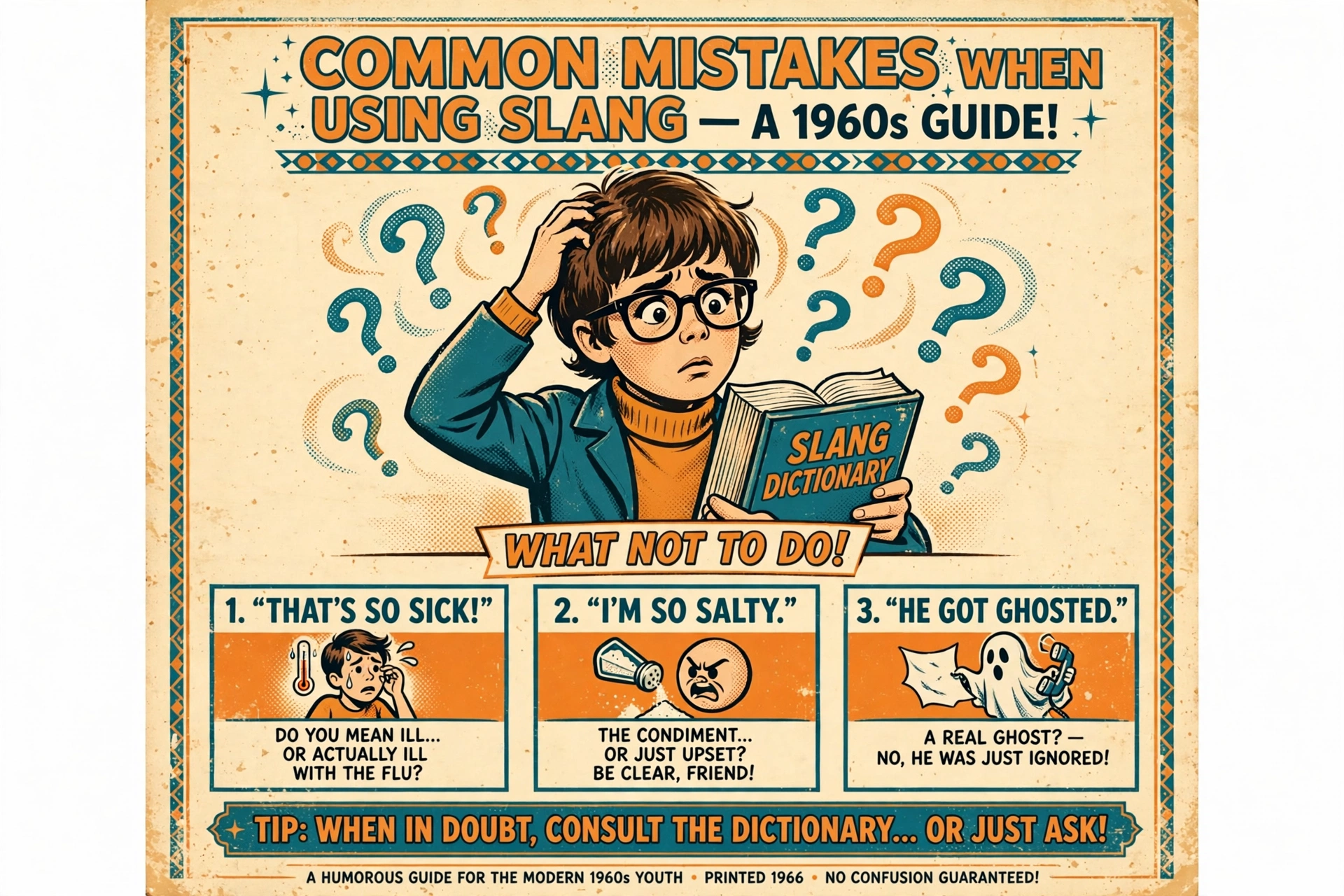
Common Mistakes
People make a few common mistakes when they use 60s slang today. Avoid these and you will sound like you actually know the decade.
- Using it in formal settings. 60s slang is casual by nature. Dropping “groovy” into a business presentation or a legal email will confuse people, not impress them.
- Mixing decades. “Groovy” is sixties, “rad” is eighties, and “lit” is modern. Mixing them in one sentence (“That party was groovy and lit”) sounds like a costume, not a conversation.
- Overusing it. One or two slang words add flavor; a whole paragraph of them is hard to read. The best 60s dialogue used slang like seasoning, not like the main course.
- Getting “far out” wrong. In the sixties, “far out” meant amazing — not distant. Saying “the store is far out” to mean it is a long drive would have confused a 1960s teenager.
- Calling everyone “man.” “Man” was a friendly address between peers (“Right on, man”), but using it with strangers, elders, or authority figures could come across as rude.
- Assuming every word is innocent. Some 60s words, like “grass” and “bogart,” were connected to drug culture. Know what a word meant before you use it in front of children or at work.
- Using “square” as an insult today. In the sixties it was a playful jab at conventional people. Today it mostly sounds like a history lesson — use it with a smile, not as a real insult.
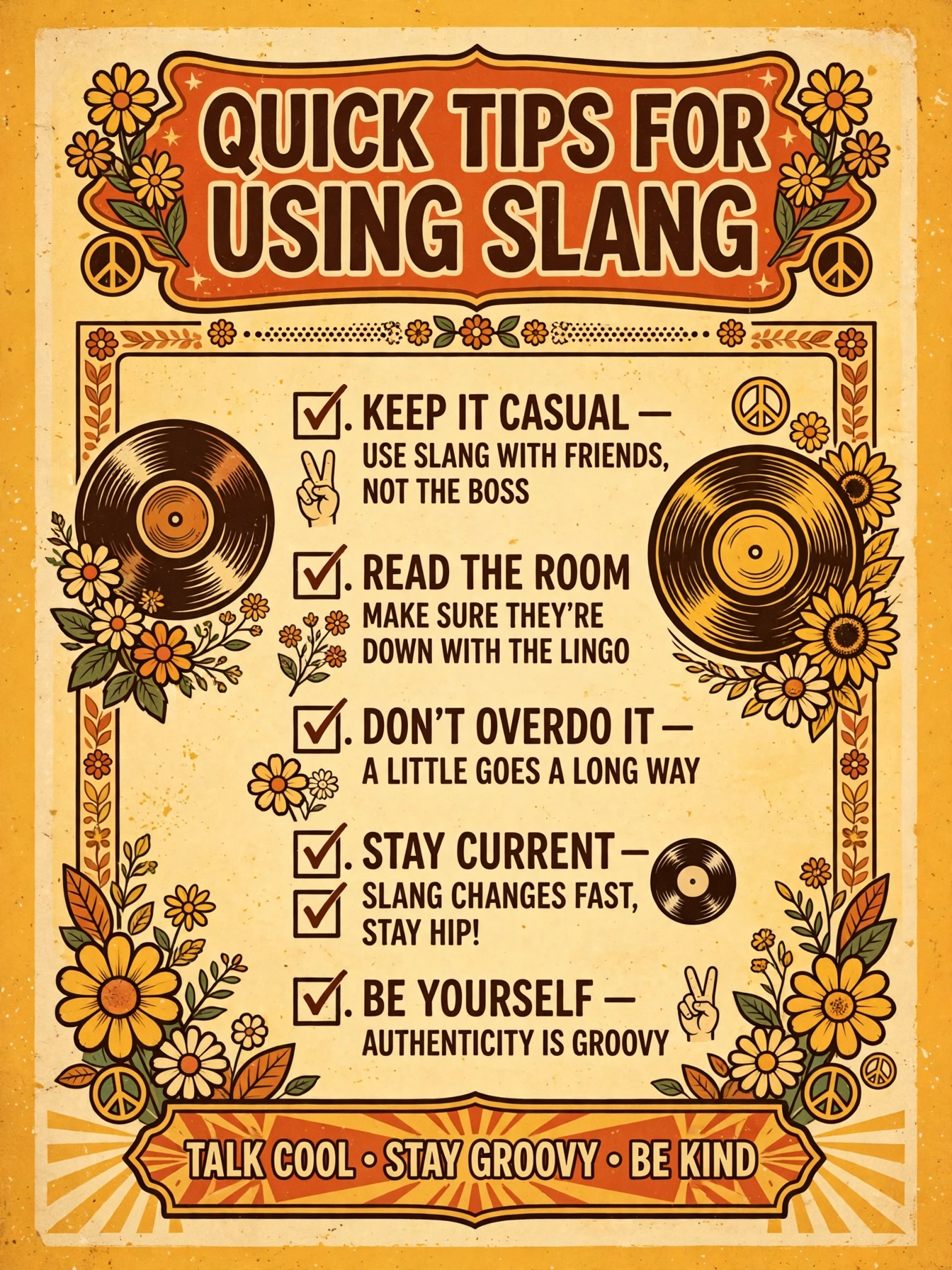
Quick Tips
- Start with the big three: groovy, far out, and right on cover most situations. Learn those first and you can hold a sixties-style conversation.
- Match the mood: use upbeat words (groovy, boss, outta sight) for praise and softer words (mellow, hang loose) when things are calm.
- Watch movies and listen to music: films and songs from the era are the best teachers. Austin Powers is a fun, exaggerated starting point; real 1960s films and Beatles interviews are even better.
- Use it for themed parties: 60s slang is perfect for retro parties, costume events, trivia nights, and themed playlists.
- Teach kids with context: when you explain a word, explain the history too — “bread” makes more sense when kids know money was as essential as food.
- Check the decade: before using a word in a story or script, confirm it actually existed in the sixties. “Rad” and “gnarly” belong to later decades.
- Keep it natural: the best slang sounds effortless. If a sentence feels forced, drop the slang and say it plainly.
FAQ
What does 60s slang mean?
60s slang is the informal vocabulary of the 1960s, including words like groovy, far out, right on, and bummer. Young people, musicians, surfers, and hippies used it to describe things as cool or amazing, to agree with each other, and to signal belonging to the youth culture of the decade.
What is the most famous 60s slang word?
Groovy is the most famous 60s slang word. It means cool, excellent, or wonderful, and it came from the groove of a vinyl record. It is so iconic that it is still the first word most people think of when they hear “1960s slang.”
What does “far out” mean in 60s slang?
In 60s slang, “far out” means amazing, unbelievable, or mind-blowing. It was used to describe anything impressive — a concert, an outfit, a new idea. It had nothing to do with physical distance.
What does “right on” mean?
“Right on” means “exactly right” or “I completely agree.” In the 1960s it was a common, enthusiastic way to agree with someone, similar to saying “100%” or “absolutely” today.
What does “groovy” mean?
“Groovy” means cool, excellent, or pleasing. It comes from the idea of a record needle sitting “in the groove” and playing smoothly. In the 1960s, anything good — a song, a person, a sandwich — could be groovy.
Is 60s slang still used today?
Yes, some of it is. Words like bummer, mellow, cool, dig, and groovy are still understood, and groovy is often used playfully or ironically in movies, memes, and retro-themed events. Most other 60s words, like “sock it to me,” have faded into history.
What did hippies say in the 60s?
Hippies popularized phrases like “flower power,” “peace and love,” “make love, not war,” “right on,” “far out,” and “hang loose.” Their language emphasized peace, freedom, community, and rejecting mainstream conventions.
What is the difference between 60s slang and 70s slang?
60s slang, like groovy and far out, was optimistic and tied to the counterculture, rock music, and the peace movement. 70s slang, like “rad” (which actually peaked later), “jive,” and “boogie,” leaned more toward disco, funk, and street culture. The two decades share words like “cool” and “dig,” but their signature words are different.
Conclusion
60s slang is more than a list of funny old words — it is the voice of a decade that believed the world could change. When a teenager in 1967 said something was “groovy” or “far out,” they were not just praising a song. They were saying they belonged to a generation that valued peace, music, freedom, and fun over the stiff formalities of the past.
The best words survived because they were useful: “groovy” is still the fastest way to call something cool with a smile, “bummer” still captures disappointment in a single word, and “right on” still feels like a high-five in sentence form. The rest of the vocabulary lives on in movies, songs, and trivia nights, waiting for the next retro party or history lesson.
So the next time you hear a Beatles track or watch a sixties film, listen for the slang. Try dropping a “groovy” or a “far out” into your next conversation — just for fun. And if someone asks you what it means, you will know exactly what to say. Right on.
Want to explore more retro language? Start with our guide to 1920s slang to see where the jazz-age words came from, or check out how today’s texting slang works in our guide to fn meaning in text. The language keeps changing, but the urge to say “that’s cool” in a fresh new way never goes away. For a deeper dive into the decade’s most iconic words, see also the Babbel guide to the best 1960s slang.
