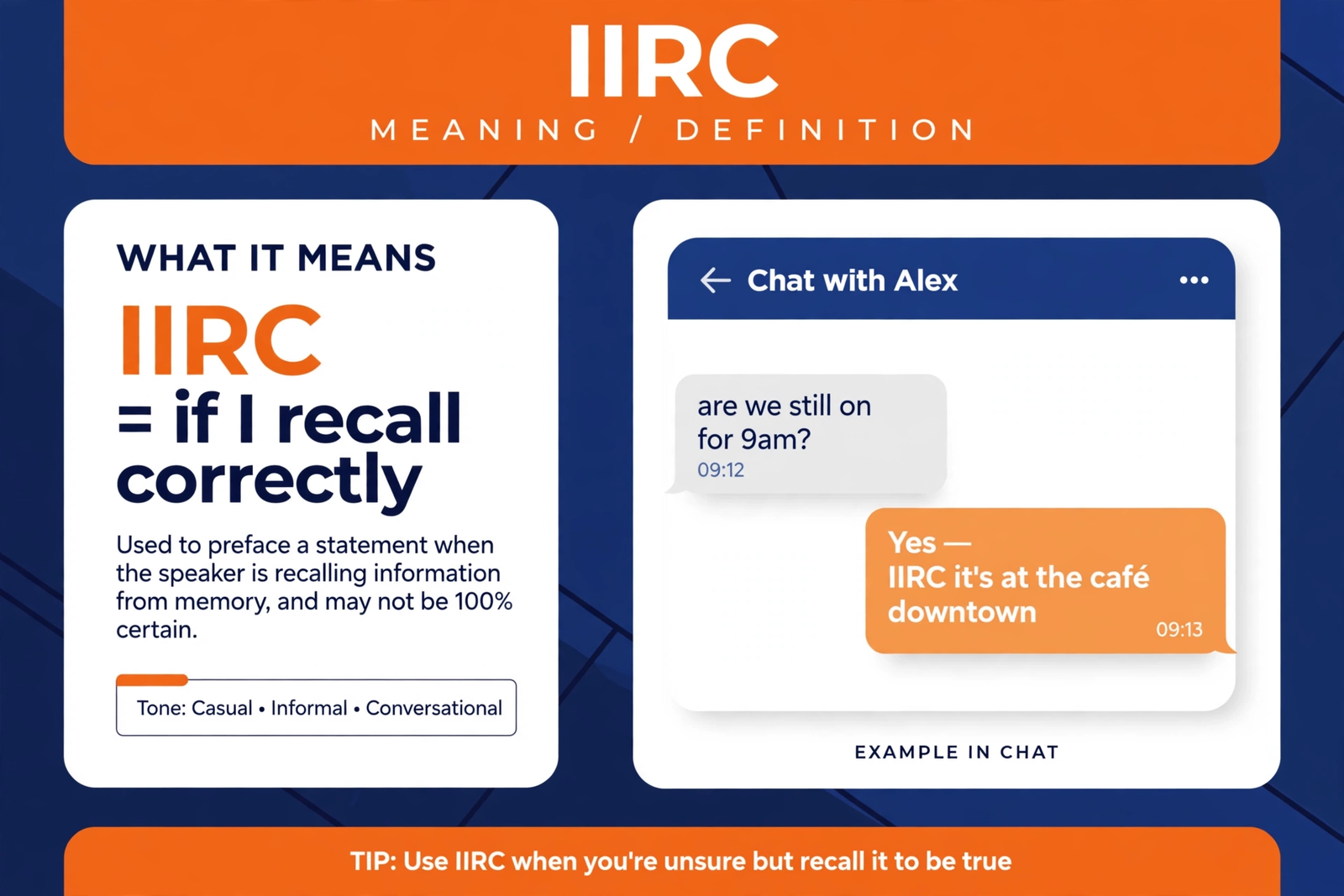
Quick definition: In iirc slang, IIRC stands for “if I recall correctly.” People type it at the start of a sentence when they are sharing something from memory but are not 100% sure it is exactly right. It is a quick, honest way to say “I think this is true, but double-check me.”
iirc slang Meaning & Definition
The iirc slang meaning is simple: IIRC is an abbreviation for “if I recall correctly.” It shows up in text messages, group chats, social media comments, gaming chats, and online forums whenever someone wants to share a fact, a memory, or a detail without sounding like they are stating it as absolute truth. The four letters do the work of a whole sentence, and that is exactly why internet slang exists.
Think of IIRC as a small honesty flag. When you write “IIRC, the meeting starts at 3,” you are telling the reader two things at once: here is the information, and I am fairly confident but not completely certain. That little bit of humility matters online, where wrong information spreads fast and people love correcting each other.
Unlike some slang that changes meaning depending on the platform, iirc slang is remarkably stable. On TikTok, Reddit, Discord, Twitter/X, and in a plain old text message, it means the same thing: if I recall correctly. It is one of the oldest abbreviations still in everyday use on the internet, and it has survived every wave of new slang since the 1990s.
Here is a quick summary of what you need to know:
- IIRC = if I recall correctly
- Used when: you are sharing something from memory and want to signal mild uncertainty
- Where: texts, chats, comments, forums, gaming, emails, social media
- Tone: casual, honest, low-key — never rude or sarcastic on its own
- Opposite: AFAIK (as far as I know) is close, but IIRC is specifically about memory
Introduction
You are scrolling through a Reddit thread when someone writes, “IIRC, that movie came out in 2019.” Nobody asks what IIRC means. Nobody laughs. The conversation just moves on, because almost everyone online already knows this one — or at least pretends to until they quietly look it up later.
That is the strange power of iirc slang. It is so common that people assume it is obvious, yet plenty of people have seen it for years without ever being sure what it stands for. If you have ever nodded along at “IIRC” in a group chat and then Googled it later, you are not alone. It is one of those abbreviations that feels like it should be self-explanatory but is not, because the letters do not spell out the phrase in an obvious way.
This guide fixes that. You will learn exactly what IIRC means, where it came from, when to use it, when not to use it, and how it compares to similar abbreviations like AFAIK, IMO, and TBH. By the end, you will use it naturally — and you will know the common mistakes that make people look careless when they use it wrong.
Origin
IIRC was born in the early days of the internet, long before smartphones and TikTok. It first appeared in Usenet newsgroups and IRC chat rooms in the 1990s, when typing was slow, keyboards were clunky, and every keystroke cost time. Early internet users invented dozens of abbreviations to save effort: LOL, BRB, IMO, FYI — and IIRC joined that first generation of internet shorthand.
The phrase itself, “if I recall correctly,” is much older than the internet. It has been used in formal English writing for centuries as a polite way to hedge a statement. What the internet did was compress it into four letters so it could be typed in a second. The abbreviation kept the polite, careful tone of the full phrase, which is part of why it stuck around.
As internet culture moved from forums to instant messaging to social media, IIRC traveled with it. It never had a viral moment or a celebrity endorsement. It simply stayed useful. While flashier slang terms rise and fall every year, IIRC has quietly remained in the daily vocabulary of millions of people for over three decades — a rare feat for any piece of internet language.
Today, you will find it everywhere from gaming Discord servers to professional Slack channels. It even shows up in work emails, which is unusual for internet slang. That staying power tells you something important: IIRC is not a trend. It is a tool.
Popularity
IIRC is not the kind of slang that trends on TikTok or gets its own hashtag challenge. Its popularity is quieter and steadier than that. It does not spike and crash; it just stays. Search interest in the term has remained consistent for years, and it appears in millions of posts across Reddit, Twitter/X, and Discord every month.
Part of the reason is generational reach. Unlike slang that belongs mostly to teenagers, IIRC is used by people of all ages. A 50-year-old forum user and a 19-year-old gamer both type it without thinking. That cross-generational use is rare, and it is one reason the abbreviation never feels dated.
It is also popular because it solves a real social problem. Online, people correct each other constantly, and stating something wrong with total confidence can be embarrassing. IIRC lets you contribute to a conversation while honestly admitting you might be slightly off. That small shield against correction makes people reach for it again and again.
On Reddit especially, iirc slang is part of the platform’s culture. Long discussion threads about movies, games, history, and science are full of “IIRC” comments, because those conversations are built on people sharing half-remembered facts and then refining them together. In that environment, admitting uncertainty is not a weakness — it is how good discussions work.
How It Is Used
IIRC almost always appears at the beginning of a sentence or clause, right before the fact or memory it qualifies. The most common pattern is simple: “IIRC, [thing you remember].” The comma after IIRC is standard, though many people skip it in fast typing.
Here are the main ways people use it:
- Stating a remembered fact: “IIRC, the store closes at 9 on Sundays.”
- Recalling a detail in a discussion: “IIRC, she was in the second season, not the first.”
- Softening a correction: “IIRC, that quote is from the book, not the movie.”
- Answering a question from memory: “IIRC, the password is on the fridge.”
- Adding context to a story: “IIRC, we met at Sarah’s party in 2021.”
Notice what all of these have in common: the speaker is offering information they believe is true, but they are leaving room for error. That is the whole job of IIRC. It is not a joke, not an insult, and not an exaggeration — it is a small, honest disclaimer built into four letters.
You can also use it mid-sentence, though this is less common: “The update, IIRC, drops next Tuesday.” This version sounds slightly more formal and works well in longer messages or emails where you want the hedge to feel natural rather than abrupt.
One important note: IIRC is almost always written in all capital letters. Writing “iirc” in lowercase is fine in casual chats, but the capitalized form is the standard one, and it reads more clearly in longer messages. Either way, everyone understands it.
Examples
Real examples make slang click faster than definitions do. Here is how IIRC sounds in different situations, from friendly chats to professional messages.
Friendly Examples
- “IIRC, you said you wanted the blue one, right?”
- “We went to that beach in July, IIRC. Best trip ever.”
- “IIRC, Jake’s birthday is this Friday — someone remind me to get a cake!”
- “The new season starts in March, IIRC. Can’t wait.”
- “IIRC, mom already bought the tickets, so we’re good.”
In friendly conversations, IIRC keeps things light. It says “I am pretty sure” without sounding like you are lecturing anyone, and it invites the other person to correct you gently if you are wrong. That is exactly the tone you want with friends.
Professional Examples
- “IIRC, the client asked for the report by Thursday, not Friday.”
- “The budget was approved in Q2, IIRC — I can double-check the email.”
- “IIRC, Sarah handled the last version of this document.”
- “The deadline moved to the 15th, IIRC. Let me confirm with the team.”
In professional settings, IIRC is surprisingly welcome. It shows that you are careful with facts and honest about uncertainty, which builds trust. Just remember to follow up and verify when the detail actually matters — IIRC is a starting point, not a substitute for checking.
Funny Examples
- “IIRC, I was supposed to be on a diet starting Monday. It is now Friday.”
- “IIRC, I promised myself I would only watch one episode. That was four hours ago.”
- “The wifi password is ‘password123,’ IIRC. Very secure, obviously.”
- “IIRC, I said I would never play that game again. I am currently playing that game.”
Humor works well with IIRC because the abbreviation already admits that memory is unreliable. Pairing it with a joke about forgetting something doubles the effect — everyone relates to it.
The table below sums up the different tones at a glance:
| Tone | Example | Best For |
|---|---|---|
| Friendly | “IIRC, you wanted the blue one, right?” | Friends, family, group chats |
| Professional | “IIRC, the client asked for Thursday.” | Work chats, emails, meetings |
| Funny | “IIRC, I was on a diet starting Monday.” | Jokes, memes, casual posts |
| Neutral | “IIRC, the store closes at 9.” | Forums, comments, Q&A threads |

Comparison with Similar Terms
IIRC has several close cousins in internet slang, and mixing them up is easy. The table below shows how it differs from the abbreviations people confuse it with most often.
| Abbreviation | Stands For | What It Really Means | IIRC Difference |
|---|---|---|---|
| IIRC | If I recall correctly | I remember this, but I could be slightly wrong | — |
| AFAIK | As far as I know | This is true based on what I know so far | AFAIK is about knowledge; IIRC is about memory |
| IMO / IMHO | In my opinion / In my humble opinion | This is what I think, not a fact | IMO shares an opinion; IIRC shares a remembered fact |
| TBH | To be honest | I am about to say something blunt | TBH adds honesty; IIRC adds uncertainty |
| IDK | I don’t know | I have no idea | IDK admits total ignorance; IIRC claims partial memory |
| IIRC vs. IF I REMEMBER RIGHT | Same phrase, spelled out | Identical meaning, just longer | Same meaning — IIRC is just the shortcut |
The most important distinction is between IIRC and AFAIK. They look interchangeable, but they are not. Use IIRC when you are pulling something from memory — a date, a name, a detail from the past. Use AFAIK when you are describing the current state of your knowledge — “AFAIK, the office is still closed” means nobody has told you otherwise. Memory versus knowledge: that is the dividing line.
Similarly, IMO and IIRC serve opposite purposes. IMO tells people you are giving an opinion and that no fact-checking is needed. IIRC tells people you are giving a fact and that gentle fact-checking is welcome. If you swap them, your message sends the wrong signal entirely.
If you want to go deeper on opinion slang, our guide to imo meaning in text explains how IMO works, and our tbh meaning in text guide covers the honesty abbreviation people often pair with IIRC. For the classic “I don’t know” shortcut, see idk meaning in text.

Alternate Meanings
IIRC has one dominant meaning — “if I recall correctly” — and in everyday texting that is the only one that matters. But like many abbreviations, it has a few rare alternate uses worth knowing so you are never confused.
- If I remember correctly: This is the same meaning with slightly different wording. Some people expand IIRC this way instead of “if I recall correctly.” The difference is zero in practice.
- If I read correctly: In rare cases, usually in technical forums, someone might use IIRC to mean “if I read correctly,” as in “IIRC the manual, the setting is under Preferences.” This is uncommon and most readers will still understand it as “if I recall correctly.”
- International Institute for… (organizations): A few organizations share the IIRC initials, but you will essentially never encounter these in a chat or text message. Context makes the meaning obvious.
The practical rule is simple: in any conversation, comment, or message, IIRC means “if I recall correctly.” If someone uses it differently, the surrounding sentence will make that clear within seconds.
Professional or Polite Alternatives
IIRC is casual, but it is not rude, so it works in many professional settings. Still, there are times when the full phrase — or a different one entirely — sounds better. Here are the best alternatives and when to use each:
- “If I recall correctly,” — the full phrase, best for formal emails and documents where abbreviations look sloppy.
- “As I remember it,” — warm and natural, good for storytelling and personal messages.
- “To the best of my recollection,” — formal and precise, ideal for legal or official contexts.
- “I believe…” — confident but honest, good when you are fairly sure and want to sound decisive.
- “My understanding is…” — professional and measured, perfect for work emails and meetings.
- “Correct me if I’m wrong, but…” — friendly and collaborative, great for group discussions.
The key is matching the alternative to the situation. In a text to a friend, “IIRC” is perfect. In a cover letter or a formal report, write the phrase out. In a work email, “my understanding is” often lands better than either one. Small choices like these are what make your writing sound polished instead of careless.
Common Mistakes
IIRC is easy to use, but people still get it wrong in a few predictable ways. Avoid these mistakes and you will already sound more careful than most people online.
1. Using IIRC when you are actually certain. If you know something for a fact, say it plainly. Writing “IIRC, water boils at 100°C” makes you sound unsure about something obvious. Save IIRC for genuine uncertainty.
2. Using IIRC when you have no idea at all. IIRC means you remember something — it is not a substitute for “I don’t know.” If you genuinely have no memory of the detail, say IDK instead. Pretending to half-remember something you never knew is how misinformation spreads.
3. Stacking hedges. “IIRC, I think maybe the meeting is at 3, possibly?” is three hedges in one sentence. One is enough. Pick IIRC or “I think” — not both, and definitely not both plus “maybe.”
4. Using it in formal writing without thinking. Abbreviations like IIRC look out of place in academic papers, legal documents, and formal reports. Write the full phrase or restructure the sentence instead.
5. Putting it after the fact it qualifies. “The meeting is at 3, IIRC” works, but starting with IIRC is clearer: “IIRC, the meeting is at 3.” When the hedge comes first, the reader knows immediately that what follows is approximate.
6. Using IIRC to dodge responsibility. In work settings, “IIRC, I sent the file” is not a replacement for actually checking whether you sent it. Use IIRC to share what you remember, then verify when the detail matters.

Quick Tips
Want to use IIRC like someone who has been online for years? Keep these tips in mind:
- Lead with it. Put IIRC at the start of the sentence so the reader knows right away that the information is from memory.
- Pair it with a source when it matters. “IIRC, the deadline is Friday — the email is in your inbox” is far more helpful than IIRC alone.
- Do not overuse it. If every sentence starts with IIRC, you sound unsure about everything. Use it only when you genuinely are not certain.
- Follow up when corrected. If someone corrects your IIRC statement, a quick “Thanks, good catch!” keeps the conversation friendly.
- Use it to soften corrections. “IIRC, that was 2019, not 2020” corrects someone without sounding like a know-it-all.
- Keep it capitalized. IIRC in all caps is the standard form and reads more clearly than lowercase iirc in longer messages.
- Know when to skip it. In formal writing, job applications, and legal documents, write the full phrase or drop the hedge entirely.
FAQ
What does IIRC mean in text?
IIRC means “if I recall correctly.” People use it in text messages and online chats when sharing something from memory while admitting they might not be 100% sure. For example: “IIRC, the party starts at 7.”
Is IIRC rude or sarcastic?
No. IIRC is neutral and polite. It is a humble way to share information, and it is often used to soften corrections so they do not sound aggressive. It only becomes sarcastic if the rest of the sentence is sarcastic.
What is the difference between IIRC and AFAIK?
IIRC is about memory: you are recalling a past fact or detail. AFAIK (as far as I know) is about your current knowledge: this is what you believe to be true based on what you know so far. The two overlap, but memory versus knowledge is the key distinction.
Can I use IIRC at work?
Yes, in most workplaces IIRC is perfectly acceptable in chats, Slack messages, and casual emails. It shows honesty about uncertainty. In formal documents, reports, or client-facing letters, write out “if I recall correctly” or use “my understanding is” instead.
Do people still use IIRC in 2026?
Yes. IIRC has been in use since the 1990s and remains common on Reddit, Discord, Twitter/X, forums, and in everyday texting. Unlike trend-driven slang, it has stayed popular because it solves a real communication problem.
What does IIRC mean on Reddit?
On Reddit, IIRC means the same thing as everywhere else: “if I recall correctly.” It is especially common in discussion threads about movies, games, history, and science, where users share half-remembered facts and refine them together in the comments.
Is IIRC the same as “if I remember correctly”?
Yes, essentially. “If I remember correctly” and “if I recall correctly” mean the same thing, and IIRC is used for both. Most dictionaries list “if I recall correctly” as the standard expansion — see the Dictionary.com entry for IIRC for the standard definition.
Should I write IIRC or iirc?
Both are understood, but IIRC in all capital letters is the standard form. Lowercase “iirc” is fine in very casual chats, but the capitalized version is clearer, especially in longer messages or professional chats.

Conclusion
IIRC is one of the internet’s oldest and most useful abbreviations. It stands for “if I recall correctly,” and it does a small but important job: it lets you share what you remember while being honest that memory is not perfect. That honesty is why it has survived since the 1990s while trendier slang has come and gone.
The rules for using it well are simple. Lead with it, use it only when you are genuinely unsure, do not stack it with other hedges, and verify the detail when it actually matters. Pair it with a source when you can, accept corrections gracefully, and switch to the full phrase in formal writing.
Once you start noticing IIRC, you will see it everywhere — in group chats, Reddit threads, Discord servers, and even work emails. Now you know exactly what it means, when to use it, and how it differs from lookalikes like AFAIK and IMO. The next time someone writes “IIRC, that happened in 2019,” you will not need to Google it. You will already know — and if you want to keep building your slang vocabulary, our guides to ngl meaning in text and btw meaning in text are a great place to continue.
