Quick definition: In slang, cracking means something is excellent, impressive, or first-rate. If a friend says “That party was cracking!”, they mean it was amazing. It is a cheerful British slang word that has travelled into texts, chats, and social media around the world.
Cracking Slang Meaning & Definition
The cracking slang meaning is simple: extremely good. The Cambridge Dictionary defines cracking as a UK informal adjective meaning “extremely good”, as in “He scored with a cracking shot into the back of the goal.” That dictionary definition captures the heart of the slang perfectly — when people call something cracking, they are giving it the highest praise in a casual, upbeat way.
Unlike many internet slang terms that are abbreviations or acronyms, cracking is a regular English word that picked up a slang meaning. You can use it to describe almost anything that impresses you: a person, a meal, a film, a game, a night out, or even an idea. “She’s a cracking friend.” “That was a cracking cup of tea.” “We had a cracking night out.” In every case, the message is the same — it was really, really good.
Cracking can also work as an intensifier, meaning “extremely” or “very”. A “cracking good film” is a really good film, and a marathon that begins “at a cracking pace” starts very fast. This flexible little word slides easily into everyday speech, which is one reason it has survived for centuries while trendier slang fades away.
It is worth noting that the cracking slang meaning is almost always positive. When someone says a party, a match, or a meal was cracking, they are not being neutral — they are excited about it. The tone is warm, friendly, and a little old-fashioned in the best way, like a compliment from someone who genuinely enjoyed themselves.
Introduction
Picture this: you are scrolling through your messages after a weekend away, and a friend from London texts, “Last night was absolutely cracking!” You pause. Cracking? Is something broken? Should you be worried? Not at all — your friend just paid the night the biggest compliment in British slang.
Slang moves fast, and new words appear on TikTok and in group chats every week. Yet some words stick around because they do a job no other word does quite as well. Cracking is one of them. It is short, punchy, and packed with enthusiasm, and it has been describing excellent things in British English for hundreds of years — long before smartphones, texting, or social media existed.
In this guide, you will learn exactly what cracking means in slang, where it came from, how people use it in texts and conversations today, and how it compares with similar words like “cracked”, “brilliant”, and “lit”. You will see real examples for friendly, professional, and funny situations, discover the common mistakes to avoid, and pick up quick tips so you can use it naturally — just like a native speaker. If you enjoy decoding internet language, you may also like our guide to TM meaning in text, another term that confuses people in chats every day.

Origin
The story of cracking starts in Britain, centuries before it ever appeared in a text message. The word comes from the Old English verb cracian, meaning to make a sharp noise or to break — the same root that gives us “crack” and “cracker”. By the late 1600s, slang dictionaries were already recording cracking in a figurative sense: to boast or to talk big. A “cracking” fellow was someone who talked impressively, and the word slowly shifted toward describing anything outstanding or first-rate.
Over the next two centuries, the meaning settled into the one we know today. In Victorian Britain, “a cracking horse” was a superb horse, and “a cracking good story” was a story well worth hearing. The word appeared in literature, newspapers, and everyday conversation, always carrying that sense of something being top quality. It never really left British English — it simply waited for the internet to give it a second life.
That second life arrived with global texting and social media. British slang now travels instantly: a phrase used in a Manchester group chat can appear in a TikTok comment in Texas within hours. Cracking rode that wave, helped by British television, YouTubers, and football commentary, where “a cracking goal” or “a cracking save” is still a standard line. Today you will find it in WhatsApp messages, Instagram captions, and gaming chats far beyond the UK.
There is also a family connection worth knowing. The phrasal verb “to crack on” means to get started or carry on with something — “It’s getting late, I’d better crack on.” It shares the same root but means something different, so do not mix the two up. Cracking describes quality; cracking on describes action.
Popularity
So how popular is cracking slang today? It sits in an interesting middle ground: hugely familiar in the UK, and increasingly recognised everywhere else. In Britain, it is everyday language used by all ages, from teenagers texting friends to grandparents praising a Sunday roast. It is not a fad word that belongs to one generation — it is a permanent part of the vocabulary.
Outside the UK, its popularity has grown with the global spread of British media. Shows, podcasts, and football coverage have carried it to the United States, Canada, Australia, and beyond. American readers often meet it first in a British TV show or a comment from a UK creator, then start using it themselves because it sounds more colourful than plain “great” or “awesome”.
Online, cracking appears most often in:
- Text messages and group chats — reacting to good news, photos, or plans.
- Social media captions and comments — praising a photo, a video, or an achievement.
- Sports discussions — describing a great goal, match, or performance.
- Food and travel posts — “a cracking meal” or “a cracking view”.
- Gaming chats — though here it is often confused with “cracked”, which means something different (see the comparison table below).
Search interest in the term stays steady rather than spiky, which tells you something important: cracking is not a viral trend that will vanish next month. It is a stable, long-lived slang word with deep roots, and learning it is a safe investment in your English vocabulary.
How It Is Used
Cracking is wonderfully easy to use because it behaves like an ordinary adjective. You place it before a noun — “a cracking idea”, “a cracking day” — or after a linking verb — “The concert was cracking.” Both patterns are natural and common.
Here is the basic grammar at a glance:
| Pattern | Example | Notes |
|---|---|---|
| Before a noun | “That’s a cracking car!” | The most common pattern. |
| After “was/is” | “The match was cracking.” | Works as a compliment on its own. |
| As an intensifier | “A cracking good time.” | Means “extremely good”. |
| With “absolutely” | “Absolutely cracking!” | Extra enthusiasm for chats and captions. |
| Describing people | “He’s a cracking lad.” | Warm praise for someone’s character. |
The word is informal, so it fits best in casual settings: friends, family, social media, and relaxed workplaces. You would not write “a cracking report” in a formal business email, but you might say it to a colleague after a great presentation. It also carries a distinctly British flavour. Americans will understand it, especially online, but they use it less often in everyday speech, so dropping it into a US conversation marks you as someone who enjoys British English.
Tone matters too. Cracking is upbeat and genuine — it is hard to say it sarcastically without the listener noticing. It works best when you actually mean the praise. If you use it for something ordinary, it sounds exaggerated; save it for things that genuinely impressed you.
One more thing to note: cracking is not an acronym or abbreviation, and it has no hidden second meaning in texting. If you are curious about terms that are abbreviations, our guide to FN meaning in text breaks one down in detail.
Examples
The fastest way to learn any slang word is to see it in real sentences. Here are examples grouped by tone, so you can match the right version to the right moment.
Friendly Examples
- “That party last night was absolutely cracking!”
- “You’re a cracking friend, thanks for always being there.”
- “We had a cracking time at the beach today.”
- “Mum made a cracking roast dinner on Sunday.”
- “That’s a cracking photo — you look amazing!”
- “Cracking news! I got the job!”
Professional Examples
Yes, cracking can appear in professional settings — just keep it relaxed and verbal rather than formal and written.
- “That was a cracking presentation — really well put together.”
- “She did a cracking job on the new website.”
- “We had a cracking first quarter, well done everyone.”
- “That’s a cracking idea. Let’s run with it.”
- “He gave a cracking interview and the client loved him.”
In a professional chat, cracking adds warmth without sounding sloppy. It tells a colleague you are genuinely impressed, not just being polite. If you want more casual workplace language, check out our guide to what drip means in slang, another term that has crossed from street language into everyday conversation.
Funny Examples
- “My attempt at baking was not cracking — the cake looked like a brick.”
- “That’s a cracking jumper, grandad. Very 1987.”
- “He thinks his dancing is cracking. It is not. It is a health hazard.”
- “Cracking weather we’re having — said no one in Manchester, ever.”
- “I told one joke at dinner and now everyone thinks I’m a cracking comedian.”
Notice how the funny examples often play with the word’s positive meaning by flipping it — praising something that clearly does not deserve praise. That gentle irony only works because everyone knows cracking means “excellent”.
Comparison with Similar Terms
Cracking has several close cousins, and choosing the right one depends on the vibe you want. The table below compares it with the words people confuse it with most often.
| Term | Meaning | Origin / Vibe | Example |
|---|---|---|---|
| Cracking | Excellent, first-rate | British, cheerful, timeless | “A cracking night out.” |
| Brilliant | Excellent, wonderful | British, very common | “That was brilliant!” |
| Cracked | Extremely skilled (gaming) | Gen-Z gaming slang | “He’s cracked at Fortnite.” |
| Lit | Exciting, amazing, fun | US, party and social scene | “The party was lit.” |
| Smashing | Excellent, wonderful | British, slightly old-fashioned | “A smashing time.” |
| Awesome | Amazing, impressive | US, general use | “That was awesome.” |
| Top-notch | Of the highest quality | Neutral, slightly formal | “Top-notch service.” |
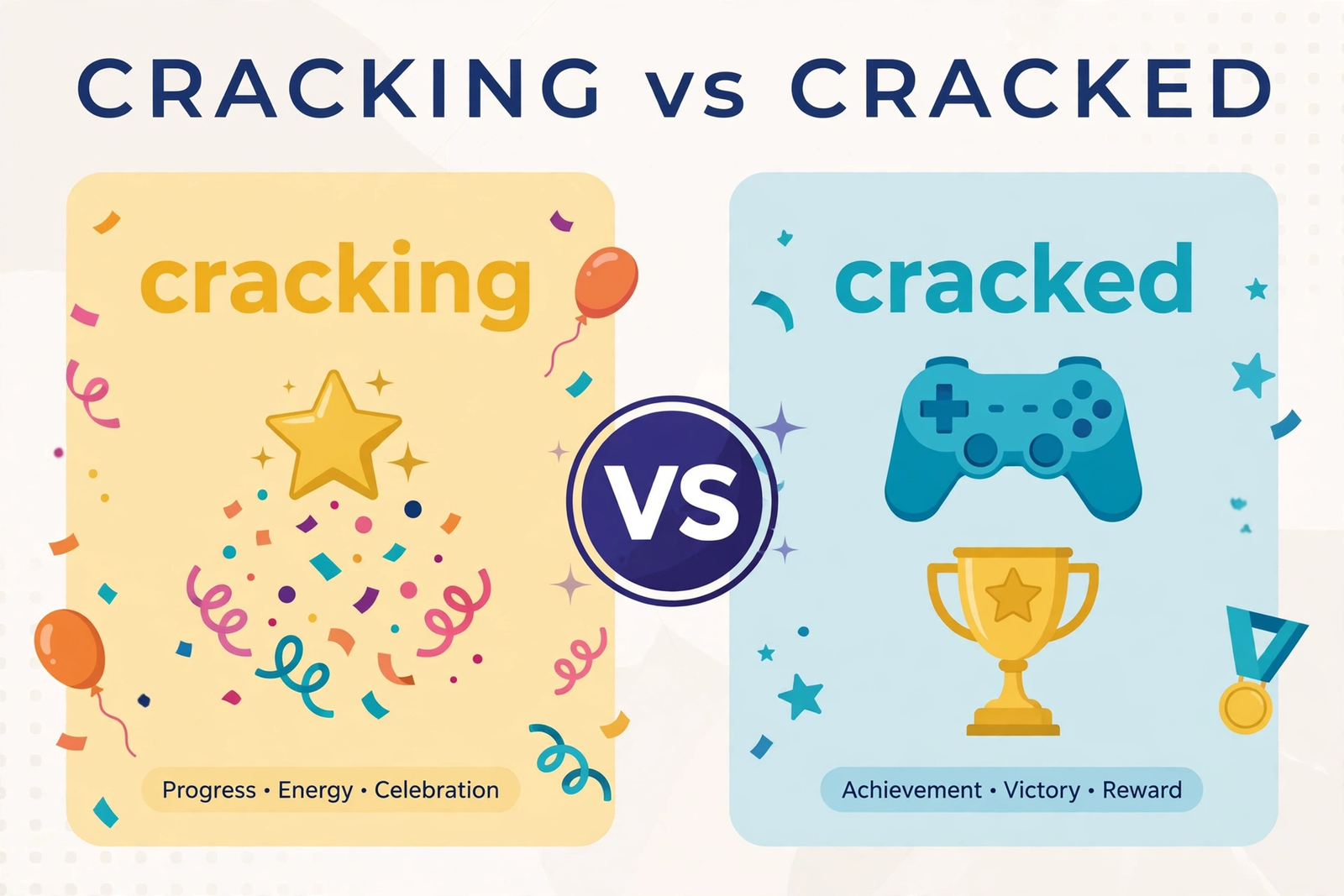
The most important distinction is cracking vs. cracked. They look almost identical, but they mean different things. Cracking describes a thing or experience that is excellent — a cracking match, a cracking meal. Cracked describes a person’s skill, especially in gaming: someone who is “cracked at Fortnite” plays at an elite level. Mixing them up is the single most common mistake learners make, so keep them separate.
Compared with “brilliant”, cracking feels slightly more old-fashioned and warm, while brilliant is the everyday default in modern Britain. Compared with “lit”, cracking is calmer and more versatile — lit belongs to parties and high-energy moments, while cracking works for a quiet cup of tea just as well as a wild night out. And compared with “awesome”, cracking carries a clear British identity, which is part of its charm for international speakers.
Alternate Meanings
Like many old English words, cracking has more than one meaning, and context decides which one applies. Here are the main ones:
- Excellent (slang, adjective): “A cracking film.” This is the meaning covered in this article, and the one you will meet most often in chats.
- Extremely (intensifier): “At a cracking pace.” Here it strengthens the word that follows.
- Breaking or splitting (literal): “The ice is cracking.” This is the original, physical meaning — something actually breaking apart.
- Boasting or talking (old slang): Historical dictionaries record “cracking” as boasting or talking big, though this sense is rare today.
- Chemistry (technical noun): In science, “cracking” is a process that breaks large hydrocarbon molecules into smaller ones. You will only meet this in a chemistry class.
- Code-breaking (computing): “Password cracking” means breaking into a system — a completely separate, technical use.
In everyday conversation, the slang meaning dominates. If someone texts “that was cracking”, they are praising something, not describing damage. But if a friend writes “my phone screen is cracking”, they mean the literal sense — the screen is breaking. The surrounding words always tell you which meaning is in play.
Professional or Polite Alternatives
Cracking is informal, so there are moments when a more neutral word fits better — a job application, a formal email, or a meeting with senior clients. Here are polished alternatives that keep the positive meaning without the slang:
| Instead of | Say | Best for |
|---|---|---|
| “A cracking presentation” | “An excellent presentation” | Work emails and reviews |
| “A cracking idea” | “A superb idea” | Meetings and proposals |
| “A cracking job” | “Outstanding work” | Performance feedback |
| “A cracking meal” | “A wonderful meal” | Formal dinners and thank-you notes |
| “A cracking day” | “A fantastic day” | General polite conversation |
| “Absolutely cracking!” | “Truly impressive!” | Professional praise |
The trick is matching the word to the room. With friends, cracking sounds warm and natural. With a client, “excellent” or “outstanding” lands better. Knowing both versions — and when to switch between them — is what makes your English sound fluent rather than just correct.
Common Mistakes
Even native speakers occasionally trip over this word, and learners make a few predictable errors. Avoid these five and you will sound natural every time.
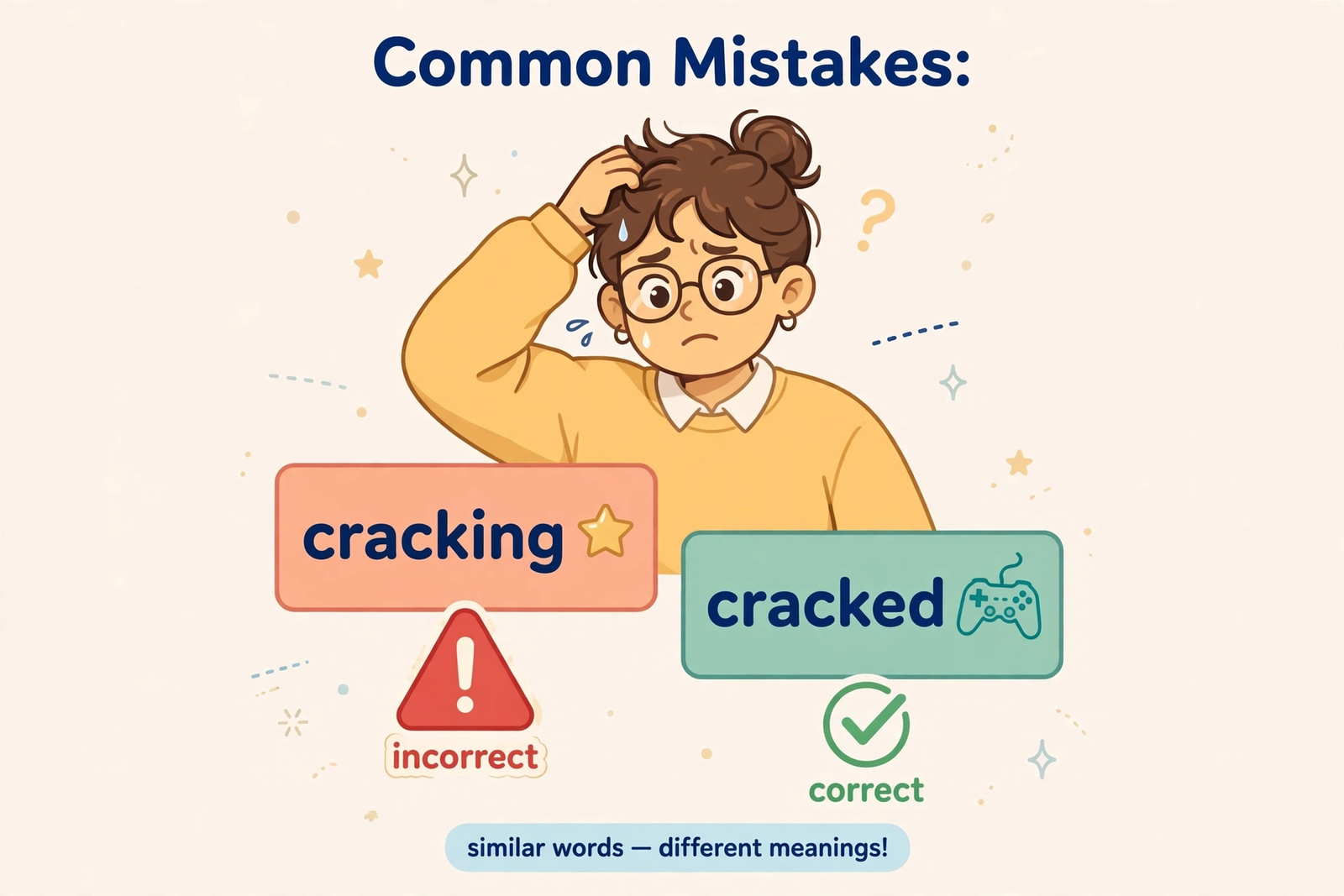
1. Confusing cracking with cracked. As explained above, cracking praises a thing or experience, while cracked (in modern gaming slang) praises a person’s skill. “He’s cracking at Fortnite” sounds wrong to a native ear — the right word there is “cracked”.
2. Using it for something broken. If your phone screen is damaged, do not text “my phone is cracking” unless you mean it literally. In slang contexts people expect the positive meaning, so the literal use can confuse them. Say “my phone screen is cracked” instead.
3. Overusing it. Cracking is a strong compliment. If every meal, film, and meeting is “cracking”, the word loses its power. Save it for things that genuinely impressed you and it will keep its punch.
4. Using it in formal writing. It is a casual, conversational word. It does not belong in a CV, a legal document, or a formal report. Use “excellent” or “outstanding” there instead.
5. Forgetting the British flavour. Cracking is understood worldwide, but it still reads as British. That is usually a plus — it adds character — but in a very American context it can sound like an affectation if overused. One cracking per conversation is plenty.
Quick Tips
- Pair it with “absolutely” for maximum enthusiasm: “Absolutely cracking!” works perfectly as a standalone reply in chats.
- Use it before nouns for the most natural sound: “a cracking idea”, “a cracking goal”, “a cracking weekend”.
- Save it for genuine praise. The word carries real warmth, so it lands best when you mean it.
- Try it in captions. “A cracking view from the top” is a natural, likeable Instagram caption.
- Listen for it in football commentary. “A cracking strike!” is one of the fastest ways to hear the word used naturally by native speakers.
- Do not force it. If “great” or “brilliant” comes more naturally to you in the moment, use that. Slang should sound effortless, never rehearsed.
- Remember the spelling. It is cracking with one “k” in the middle and “-ing” at the end — not “craking” and not “crackking”.
- Teach it with an example. If a friend asks what it means, say: “It means really, really good — like, that match was cracking means it was amazing.”
FAQ
What does cracking mean in slang?
In slang, cracking means excellent, impressive, or first-rate. It is a British informal adjective used to praise something — a cracking party is an amazing party, and a cracking lad is a great guy. The Cambridge Dictionary defines it as “extremely good”.
Is cracking slang British or American?
Cracking slang is British in origin and still most common in the UK, where people of all ages use it. Thanks to British TV, football, and social media, it is now widely understood in the US, Canada, and Australia too, though Americans use it less often in everyday speech.
What is the difference between cracking and cracked in slang?
Cracking describes something excellent — a cracking match or a cracking meal. Cracked, in modern gaming slang, describes a person who is extremely skilled, especially at a video game: “He’s cracked at Fortnite.” They look similar but mean different things, so do not swap them.
Can I use cracking in a text message?
Yes, absolutely. Cracking is perfect for texts and chats: “That was cracking!” or “Cracking news!” are natural, friendly replies. It also works well in social media captions and comments.
Is cracking a positive or negative word?
In slang, cracking is almost always positive — it means something was excellent. The only negative use is the literal one, when something is physically breaking, like “the ice is cracking”. Context makes the meaning clear.
What does “a cracking good time” mean?
It means a really great time. Here cracking works as an intensifier meaning “extremely” — so a cracking good time is a very enjoyable time, and a cracking good film is a really good film.
Is cracking slang formal or informal?
It is informal. Use it with friends, family, and in casual conversations or social media. In formal writing or business emails, choose “excellent”, “outstanding”, or “superb” instead.
Where did cracking slang come from?
It comes from British English, with roots in the Old English verb cracian (to make a sharp noise). By the late 1600s, slang dictionaries recorded cracking in a figurative sense, and by the Victorian era it meant “first-rate” — the meaning it still carries today.
Conclusion
The cracking slang meaning is one of the friendliest pieces of British English you can learn: something excellent, impressive, and well worth your enthusiasm. It has travelled from 17th-century slang dictionaries to Victorian novels, football commentary, and today’s group chats without losing its warmth — and that long history is exactly why it sounds natural rather than trendy.
Remember the essentials: use it for things that genuinely impressed you, keep it casual, and do not confuse it with “cracked”, the gaming term for elite skill. Try it this week — praise a friend’s cooking as “a cracking dinner”, call a great match “absolutely cracking”, or drop it into a caption and see how natural it feels. And if you want to keep building your slang vocabulary, our guides to CFS meaning in text and TM meaning in text are good next stops. For the dictionary definition behind this guide, see the Cambridge Dictionary entry for cracking.
Now you know what cracking means in slang — go and use it, and make your next compliment sound a little more British.
